

EN 50117-9-1:2026
(Main)Coaxial cables - Part 9-1: Sectional specification for coaxial cables for analogue and digital signal transmission - Indoor drop cables for systems operating at 5 MHz - 1 000 MHz
- Abstract
This part of the EN 50117 series which is a sectional specification applies to coaxial indoor drop cables for analogue and digital one and two way signal transmission, e.g. for cable networks for television signals, sound signals and interactive services in accordance with EN 60728 1:2014, EN 60728 1 1:2014, EN 60728 101:2017, EN 60728 10:2014, EN 50173 1:2018 and EN 50173 4:2018. This also includes the transmission of BCT signals provided by a CATV, MATV or SMATV cable network. The purpose of this document is to specify the applicable test methods and requirements for the electrical, mechanical and environmental characteristics and for fire performance of the cables.
- Status
- Published
- Publication Date
- 17-Sep-2026
- Withdrawal Date
- 22-Nov-2022
- Technical Committee
- CLC/TC 46X - Communication cables
- Drafting Committee
- CLC/SC 46XA - Coaxial cables
- Current Stage
- 6060 - Document made available - Publishing
- Start Date
- 18-Sep-2026
- Due Date
- 28-Feb-2022
- Completion Date
- 18-Sep-2026

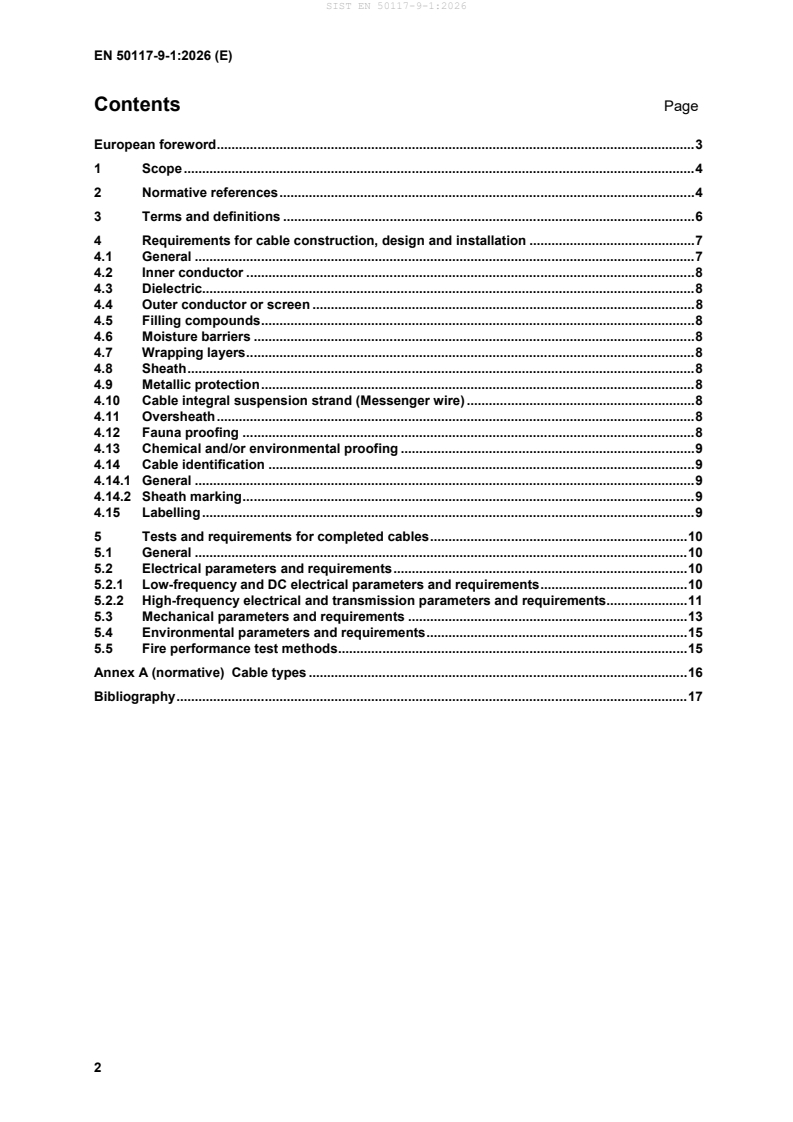
EN 50117-9-1:2026 is a CLC European Standard for coaxial indoor drop cables used for analogue and digital one- and two-way signal transmission between 5 MHz and 1 000 MHz. It specifies the cable construction, test methods and performance requirements for electrical, mechanical, environmental and fire behaviour, for use in cable networks for television signals, sound signals and interactive services, including BCT signals in CATV, MATV and SMATV networks.
What does EN 50117-9-1:2026 specify?
EN 50117-9-1:2026 is a sectional specification for indoor coaxial drop cables. It sets the scope, the applicable references, the cable construction rules in Clause 4, the tests and acceptance criteria for finished cables in Clause 5, and the normative cable types in Annex A.
The document is aimed at the cable itself, not the whole network. In practice, that means it helps a manufacturer, tester or buyer check whether a cable is suitable for indoor distribution, signal return paths and related services in the 5 MHz to 1 000 MHz range.
| Annex | What it covers |
|---|---|
| Annex A | Cable types, preferred nominal dimensions and ratings for indoor drop cables |
What are the key requirements of EN 50117-9-1:2026?
EN 50117-9-1:2026 combines construction rules with type tests for finished cables. The most important points are the operating limits, the specified materials, the screening performance classes and the post-test performance checks.
Construction and installation
Clause 4 sets an operating temperature range from -40 °C to +70 °C and states that the cables are for 5 MHz to 1 000 MHz. It also allows operation up to 72 V DC, but not direct connection to the mains supply or other low-impedance sources. For users, this means the cable choice must match both the signal system and the installation environment.
The inner conductor shall be solid, plain or metal coated, with no joint after the last drawing operation. The dielectric shall use polyolefin materials, with preferred nominal diameters listed in the document. The outer conductor or screen shall follow the defined construction options, and braid-based designs have stated angle and coverage limits. These points matter because they control attenuation, screening and mechanical stability.
The sheath shall be PVC or HFFR, and sheath colour is agreed between supplier and customer. Cable identification and sheath marking are defined, including durable metre markings that carry the cable designation, attenuation value at 800 MHz, screening class, Euroclass where applicable, and supplier name. This helps traceability on site and during receiving inspection.
Electrical, mechanical and environmental performance
Clause 5 requires low-frequency and DC checks such as conductor resistance, dielectric strength, insulation resistance and sheath spark testing. The high-frequency requirements cover attenuation, characteristic impedance, return loss, impedance regularity, transfer impedance and screening attenuation. For the user, these are the key numbers that show whether the cable will carry the intended signal with acceptable loss and screening.
The mechanical tests include crush resistance, adhesion of dielectric, bending under tension, flexure and marking abrasion. The environmental checks include cold bend, climatic sequence and damp heat, with some additional tests marked not applicable. These tests matter because indoor drop cables still have to survive handling, routing, installation and normal indoor ageing.
Fire performance is handled by reference to EN 50575 and Euroclass is defined by EN 13501-6. When the cable is intended for a construction work, this is the part that links the cable to reaction-to-fire classification.
Annex A cable types
Annex A gives preferred nominal dimensions and ratings for typical copper-inner-conductor cables. It links cable type designation to attenuation at 800 MHz and screening class, and also shows the maximum DC current and operating voltage. That makes Annex A the quick selection point when comparing cable sizes for a given installation.
What terms does EN 50117-9-1:2026 define?
- drop cable - a coaxial cable used to connect a subscriber tap or directional coupler to a system outlet, or to connect a splitter to an outlet.
- indoor drop cable - a drop cable intended for indoor application.
- CATV - cable television network used here as a source of television and related signals.
- MATV - master antenna television network used here as a source of distribution signals.
- SMATV - satellite master antenna television network used here as a source of distribution signals.
- HFFR - halogen free flame retardant sheath material used when a halogen-free option is needed.
- CPR - Construction Products Regulation, relevant where the cable is installed in construction works.
Who uses EN 50117-9-1:2026?
EN 50117-9-1:2026 is used by coaxial cable manufacturers, test laboratories, network designers, installers and buyers of indoor distribution cable. It is especially relevant for cable networks for television, sound and interactive services, and for systems based on CATV, MATV, SMATV and generic cabling applications. Quality teams use it to define product tests and acceptance criteria, while installers use it to confirm that the cable suits the route, environment and fire classification needed on site.
What changed in EN 50117-9-1:2026 from the previous edition?
EN 50117-9-1:2026 supersedes EN 50117-9-1:2019 and its amendments and corrigenda, if any. The foreword states these main technical changes:
- normative references were dated;
- Clause 4 on cable construction, design and installation was completely revised;
- Annex A was completely revised.
Which standards are used with EN 50117-9-1:2026?
EN 50117-9-1:2026 relies on EN 50117-1:2019 for the generic coaxial-cable framework. It uses EN 50289 test-method standards for resistance, dielectric strength, attenuation, impedance, mechanical tests and environmental tests, and EN 50290 standards for definitions, common design rules and sheath or insulation materials.
It also uses EN 60811-201, EN 60811-202 and EN 60811-203 for measuring dimensions, EN 60728-11:2023 for installation safety, EN 50575:2014 and EN 13501-6:2018+A1:2022 for fire classification, and IEC 61196 and IEC 62153 methods for impedance, return loss and screening performance. The scope also names EN 60728-1, EN 60728-1-1, EN 60728-10, EN 60728-101, EN 50173-1 and EN 50173-4 as the application contexts for these cables.
What does the EN 50117-9-1:2026 document contain?
Clause 4 is a construction section that covers the inner conductor, dielectric, screen, sheath, identification and labelling. Clause 5 contains the test tables for electrical, mechanical, environmental and fire performance, including the named test methods and the frequency bands or post-test checks used to judge compliance.
Annex A gives the cable-type table with preferred dimensions, attenuation classes, screening classes, current rating and operating voltage. The document also includes formulas for attenuation and adhesion-related calculations, plus detailed procedures for bending, crush, return loss, transfer impedance and screening attenuation, which are the parts normally used in design verification, type testing and product qualification.
Relations
- Effective Date
- 07-May-2019
Get Certified
Connect with accredited certification bodies for this standard

ANCE
Mexican certification and testing association.

Intertek Slovenia
Intertek testing, inspection, and certification services in Slovenia.

LNE (Laboratoire National de Métrologie et d'Essais)
French national laboratory for metrology and testing.
Sponsored listings
Frequently Asked Questions
EN 50117-9-1:2026 is a standard published by CLC. Its full title is "Coaxial cables - Part 9-1: Sectional specification for coaxial cables for analogue and digital signal transmission - Indoor drop cables for systems operating at 5 MHz - 1 000 MHz". This standard covers: This part of the EN 50117 series which is a sectional specification applies to coaxial indoor drop cables for analogue and digital one and two way signal transmission, e.g. for cable networks for television signals, sound signals and interactive services in accordance with EN 60728 1:2014, EN 60728 1 1:2014, EN 60728 101:2017, EN 60728 10:2014, EN 50173 1:2018 and EN 50173 4:2018. This also includes the transmission of BCT signals provided by a CATV, MATV or SMATV cable network. The purpose of this document is to specify the applicable test methods and requirements for the electrical, mechanical and environmental characteristics and for fire performance of the cables.
This part of the EN 50117 series which is a sectional specification applies to coaxial indoor drop cables for analogue and digital one and two way signal transmission, e.g. for cable networks for television signals, sound signals and interactive services in accordance with EN 60728 1:2014, EN 60728 1 1:2014, EN 60728 101:2017, EN 60728 10:2014, EN 50173 1:2018 and EN 50173 4:2018. This also includes the transmission of BCT signals provided by a CATV, MATV or SMATV cable network. The purpose of this document is to specify the applicable test methods and requirements for the electrical, mechanical and environmental characteristics and for fire performance of the cables.
EN 50117-9-1:2026 is classified under the following ICS (International Classification for Standards) categories: 33.120.10 - Coaxial cables. Waveguides. The ICS classification helps identify the subject area and facilitates finding related standards.
EN 50117-9-1:2026 has the following relationships with other standards: It is inter standard links to EN 50117-9-1:2019. Understanding these relationships helps ensure you are using the most current and applicable version of the standard.
EN 50117-9-1:2026 is associated with the following European legislation: EU Directives/Regulations: 2014/35/EU; Standardization Mandates: M/511. When a standard is cited in the Official Journal of the European Union, products manufactured in conformity with it benefit from a presumption of conformity with the essential requirements of the corresponding EU directive or regulation.
EN 50117-9-1:2026 is available in PDF format for immediate download after purchase. The document can be added to your cart and obtained through the secure checkout process. Digital delivery ensures instant access to the complete standard document.
Standards Content (Sample)
SLOVENSKI STANDARD
01-november-2026
Nadomešča:
SIST EN 50117-9-1:2019
Koaksialni kabli - 9-1. del: Področna specifikacija za koaksialne kable za analogni
in digitalni prenos signala - Notranji priključni kabli za sisteme, ki delujejo v
območju od 5 MHz do 1000 MHz
Coaxial cables - Part 9-1: Sectional specification for coaxial cables for analogue and
digital signal transmission - Indoor drop cables for systems operating at 5 MHz - 1 000
MHz
Koaxiale Kabel - Teil 9-1: Rahmenspezifikation für koaxiale Kabel für analoge und
digitale Signalübertragung - Innenkabel für Systeme im Bereich von 5 MHz - 1 000 MHz
Câbles coaxiaux - Partie 9-1: Spécification intermédiaire pour câbles coaxiaux pour la
transmission de signaux analogiques et numériques - Câbles de raccordement à usage
intérieur pour les systèmes fonctionnant entre 5 MHz et 1 000 MHz
Ta slovenski standard je istoveten z: EN 50117-9-1:2026
ICS:
33.120.10 Koaksialni kabli. Valovodi Coaxial cables. Waveguides
2003-01.Slovenski inštitut za standardizacijo. Razmnoževanje celote ali delov tega standarda ni dovoljeno.
EUROPEAN STANDARD EN 50117-9-1
NORME EUROPÉENNE
EUROPÄISCHE NORM September 2026
ICS 33.120.10 Supersedes EN 50117-9-1:2019
English Version
Coaxial cables - Part 9-1: Sectional specification for coaxial
cables for analogue and digital signal transmission - Indoor drop
cables for systems operating at 5 MHz - 1 000 MHz
Câbles coaxiaux - Partie 9-1: Spécification intermédiaire Koaxiale Kabel - Teil 9-1: Rahmenspezifikation für koaxiale
pour câbles coaxiaux pour la transmission de signaux Kabel für analoge und digitale Signalübertragung -
analogiques et numériques - Câbles de raccordement à Innenkabel für Systeme im Bereich von 5 MHz - 1 000 MHz
usage intérieur pour les systèmes fonctionnant entre 5 MHz
et 1 000 MHz
This European Standard was approved by CENELEC on 2026-05-25. CENELEC members are bound to comply with the CEN/CENELEC
Internal Regulations which stipulate the conditions for giving this European Standard the status of a national standard without any alteration.
Up-to-date lists and bibliographical references concerning such national standards may be obtained on application to the CEN-CENELEC
Management Centre or to any CENELEC member.
This European Standard exists in three official versions (English, French, German). A version in any other language made by translation
under the responsibility of a CENELEC member into its own language and notified to the CEN-CENELEC Management Centre has the
same status as the official versions.
CENELEC members are the national electrotechnical committees of Austria, Belgium, Bulgaria, Croatia, Cyprus, the Czech Republic,
Denmark, Estonia, Finland, France, Germany, Greece, Hungary, Iceland, Ireland, Italy, Latvia, Lithuania, Luxembourg, Malta, the
Netherlands, Norway, Poland, Portugal, Republic of North Macedonia, Romania, Serbia, Slovakia, Slovenia, Spain, Sweden, Switzerland,
Türkiye and the United Kingdom.
European Committee for Electrotechnical Standardization
Comité Européen de Normalisation Electrotechnique
Europäisches Komitee für Elektrotechnische Normung
CEN-CENELEC Management Centre: Rue de la Science 23, B-1040 Brussels
© 2026 CENELEC All rights of exploitation in any form and by any means reserved worldwide for CENELEC Members.
Ref. No. EN 50117-9-1:2026 E
Contents Page
European foreword . 3
1 Scope . 4
2 Normative references . 4
3 Terms and definitions . 6
4 Requirements for cable construction, design and installation . 7
4.1 General . 7
4.2 Inner conductor . 8
4.3 Dielectric. 8
4.4 Outer conductor or screen . 8
4.5 Filling compounds . 8
4.6 Moisture barriers . 8
4.7 Wrapping layers . 8
4.8 Sheath . 8
4.9 Metallic protection . 8
4.10 Cable integral suspension strand (Messenger wire) . 8
4.11 Oversheath . 8
4.12 Fauna proofing . 8
4.13 Chemical and/or environmental proofing . 9
4.14 Cable identification . 9
4.14.1 General . 9
4.14.2 Sheath marking . 9
4.15 Labelling . 9
5 Tests and requirements for completed cables . 10
5.1 General . 10
5.2 Electrical parameters and requirements . 10
5.2.1 Low-frequency and DC electrical parameters and requirements . 10
5.2.2 High-frequency electrical and transmission parameters and requirements . 11
5.3 Mechanical parameters and requirements . 13
5.4 Environmental parameters and requirements . 15
5.5 Fire performance test methods . 15
Annex A (normative) Cable types . 16
Bibliography . 17
European foreword
This document (EN 50117-9-1:2026) has been prepared by CLC/SC 46XA “Coaxial cables” of CLC/TC 46X
“Communication cables”.
The following dates are fixed:
• latest date by which this document has to be (dop) 2027-09-30
implemented at national level by publication of
an identical national standard or by
endorsement
• latest date by which the national standards (dow) 2029-09-30
conflicting with this document have to
be withdrawn
This document supersedes EN 50117-9-1:2019 and all of its amendments and corrigenda (if any).
— Normative references were dated;
— complete revision of Clause 4, Requirements for cable construction, design and installation;
— complete revision of Annex A.
Attention is drawn to the possibility that some of the elements of this document may be the subject of patent
rights. CENELEC shall not be held responsible for identifying any or all such patent rights.
All materials used for cables according to this document are expected to fulfil the requirements of the current
REACH Regulation and ROHS Directives.
Cables according to this document are expected to fulfil the requirements of the CPR where applicable.
Any feedback and questions on this document should be directed to the users’ national committee. A complete
listing of these bodies can be found on the CENELEC website.
1 Scope
This part of the EN 50117 series which is a sectional specification applies to coaxial indoor drop cables for
analogue and digital one and two way signal transmission, e.g. for cable networks for television signals, sound
signals and interactive services in accordance with EN 60728-1:2014, EN 60728-1-1:2014,
EN 60728-101:2017, EN 60728-10:2014, EN 50173-1:2018 and EN 50173-4:2018. This also includes the
transmission of BCT signals provided by a CATV, MATV or SMATV cable network.
The purpose of this document is to specify the applicable test methods and requirements for the electrical,
mechanical and environmental characteristics and for fire performance of the cables.
2 Normative references
The following documents are referred to in the text in such a way that some or all of their content constitutes
requirements of this document. For dated references, only the edition cited applies. For undated references,
the latest edition of the referenced document (including any amendments) applies.
EN 13501-6:2018+A1:2022, Fire classification of construction products and building elements - Part 6:
Classification using data from reaction to fire tests on power, control and communication cables
EN 50117-1:2019, Coaxial cables - Part 1: Generic specification
EN 50289-1-2:2001, Communication cables - Specifications for test methods - Part 1-2: Electrical test methods
- DC resistance
EN 50289-1-3:2001, Communication cables - Specifications for test methods - Part 1-3: Electrical test methods
- Dielectric strength
EN 50289-1-4:2001, Communication cables - Specifications for test methods - Part 1-4: Electrical test methods
- Insulation resistance
EN 50289-1-5:2001, Communication cables - Specifications for test methods - Part 1-5: Electrical test methods
- Capacitance
EN 50289-1-7:2001, Communication cables - Specifications for test methods - Part 1-7: Electrical test methods
- Velocity of propagation
EN 50289-1-8:2017, Communication cables - Specifications for test methods - Part 1-8: Electrical test methods
- Attenuation
EN 50289-1-11:2016, Communication cables - Specifications for test methods - Part 1-11: Electrical test
methods - Characteristic impedance, input impedance, return loss
EN 50289-3-2:2001, Communication cables - Specifications for test methods - Part 3-2: Mechanical test
methods - Tensile strength and elongation for conductor
EN 50289-3-5:2001, Communication cables - Specifications for test methods - Part 3-5: Mechanical test
methods - Crush resistance of the cable
EN 50289-3-6:2001, Communication cables - Specifications for test methods - Part 3-6: Mechanical test
methods - Impact resistance of the cable
EN 50289-3-7:2001, Communication cables - Specifications for test methods - Part 3-7: Mechanical test
methods - Abrasion resistance of the cable sheath
In EN 5289-1-3, EN 50290-2-1 is referenced as “At draft stage”. EN 50290-2-1:2005 shall be applied.
EN 50289-3-8:2013, Communication cables - Specifications for test methods - Part 3-8: Mechanical test
methods - Abrasion resistance of cable sheath markings
EN 50289-3-9:2001, Communication cables - Specifications for test methods - Part 3-9: Mechanical test
methods - Bending tests
EN 50289-3-16:2001, Communication cables - Specifications for test methods - Part 3-16: Mechanical test
methods - Cable tensile performance
EN 50289-3-17:2002, Communication cables - Specifications for test methods - Part 3-17: Mechanical test
methods - Adhesion of dielectric and sheath
EN 50289-4-2:2001, Communication cables - Specifications for test methods - Part 4-2: Environmental test
methods - Water penetration
EN 50289-4-4:2008, Communication cables - Specifications for test methods - Part 4-4: Environmental test
methods - Resistance to solvents and contaminating fluids
EN 50289-4-6:2001, Communication cables - Specifications for test methods - Part 4-6: Environmental test
methods - Temperature cycling
EN 50289-4-7:2008, Communication cables - Specifications for test methods - Part 4-7: Environmental test
methods - Damp heat, steady state
EN 50289-4-17:2015, Communication cables - Specifications for test methods - Part 4-17: Test methods for
UV resistance evaluation of the sheath of electrical and optical fibre cable
EN 50290-1-2:2004, Communication cables - Part 1-2: Definitions
EN 50290-2-1:2005, Communication cables - Part 2-1: Common design rules and construction
EN 50290-2-22:2001, Communication cables - Part 2-22: Common design rules and construction - PVC
sheathing compounds
EN 50290-2-27:2021, Communication cables - Part 2-27: Common design rules and construction - Halogen
free polyolefin based sheathing compounds for cables having improved flame and fire properties (HFFR)
EN 50290-2-37:2016, Communication cables - Part 2-37: Common design rules and construction -
Polyethylene insulation for coaxial cables
EN 50290-2-38:2016, Communication cables - Part 2-38: Common design rules and construction -
Polypropylene insulation for coaxial cables
EN 50290-4-1:2014, Communication cables - Part 4-1: General considerations for the use of cables -
Environmental conditions and safety aspects
EN 50290-4-2:2014, Communication cables - Part 4-2: General considerations for the use of cables - Guide
to use
EN 50575:2014, Power, control and communication cables - Cables for general applications in construction
works subject to reaction to fire requirements
EN 50575:2014, Power, control and communication cables - Cables for general applications in construction
works subject to reaction to fire requirements
As impacted by EN 50575:2014/A1:2016.
EN 60728-1:2014, Cable networks for television signals, sound signals and interactive services - Part 1:
System performance of forward paths
EN 60728-11:2023, Cable networks for television signals, sound signals and interactive services - Part 11:
Safety (IEC 60728-11:2023)
EN 60811-201:2012, Electric and optical fibre cables - Test methods for non-metallic materials - Part 201:
General tests - Measurement of insulation thickness (IEC 60811-201:2012)
EN 60811-202:2012, Electric and optical fibre cables - Test methods for non-metallic materials - Part 202:
General tests - Measurement of thickness of non-metallic sheath (IEC 60811-202:2012)
EN 60811-203:2012, Electric and optical fibre cables - Test methods for non-metallic materials - Part 203:
General tests - Measurement of overall dimensions
EN 61180:2016, High-voltage test techniques for low-voltage equipment - Definitions, test and procedure
requirements, test equipment
EN 62153-1-1:2004, Metallic communication cables test methods - Part 1-1: Electrical - Measurement of the
pulse/step return loss in the frequency domain using the Inverse Discrete Fourier Transformation (IDFT)
EN 62230:2007, Electric cables - Spark-test method (IEC 62230:2006)
IEC 60096-0-1:2012, CSV Radio frequency cables - Part 1- 0: Guide to the design of detail specifications -
Coaxial cables
IEC 61196-1-112:2025, Coaxial communication cables - Part 1-112: Electrical test methods - Test for return
loss (uniformity of impedance)
IEC 61196-1-115:2006, Coaxial communication cables - Part 1-115: Electrical test methods - Test for regularity
of impedance (pulse/step function return loss)
IEC 61196-1-325:2008, Coaxial communication cables - Part 1-325: Mechanical test methods - Aeolian
vibration
IEC 62153-4-3:2013, Metallic communication cable test methods - Part 4-3: Electromagnetic compatibility
(EMC) - Surface transfer impedance - Triaxial method
IEC 62153-4-4:2015, Metallic communication cable test methods - Part 4-4: Electromagnetic compatibility
(EMC) - Test method for measuring of the screening attenuation as up to and above 3 GHz, triaxial method
3 Terms and definitions
For the purposes of this document, the terms and definitions given in EN 50290-1-2:2004, EN 50117-1:2019,
EN 60728-1:2014 and the following apply.
ISO and IEC maintain terminology databases for use in standardization at the following addresses:
— ISO Online browsing platform: available at https://www.iso.org/obp
As impacted by EN 60811-201:2012/A1:2017 and EN 60811-201:2012/A2:2023.
As impacted by EN 60811-202:2012/A1:2017 and EN 60811-202:2012/A2:2023.
As impacted by EN 62230:2007/A1:2014.
As impacted by IEC 60096-0-1:2012/AMD1:2017.
As impacted by IEC 62153-4-3:2013/AMD1:2024.
— IEC Electropedia: available at https://www.electropedia.org/
3.1
drop cable
coaxial cable which is used to connect from:
a) subscriber tap or a directional coupler to a system outlet;
b) subscriber tap to a subscriber splitter;
c) subscriber splitter to a system outlet
3.2
indoor drop cable
drop cable for indoor application
4 Requirements for cable construction, design and installation
4.1 General
Cables according to this document are designed for an operating temperature range from −40 °C to +70 °C
and at frequencies between 5 MHz and 1 000 MHz.
When designing the cable, the maximum admissible current shall be in accordance with Table A.1.
Cables according to this document can be operated at maximum voltages of 72 V DC in accordance with the
relevant detail specification of the manufacturer. However, these cables are not intended for direct connection
to the mains electricity supply or other low impedance sources.
Cables according to this document shall be designed and constructed according to EN 50290-2-1:2005 and
according to EN 50290-4-1:2014. Compliance w
...