

EN 50288-12-2:2026
(Main)Multi-element metallic cables used in analogue and digital communication and control - Part 12-2: Sectional specification for screened cables characterised from 1 MHz up to 2000 MHz - Work Area cables
- Abstract
This document relates to EN 50288 1, Multi-element metallic cables used in analogue and digital communication and control. It covers screened cables, characterized up to 2GHz, used in work area wiring for information technology, generic-cabling systems. The electrical, mechanical, transmission and environmental performance characteristics of the cables, related to their reference test methods, are detailed. This sectional specification is expected to be read in conjunction with EN 50288 1, which contains the essential provisions for its application. The cables covered by this sectional specification are intended to operate with voltages and currents normally encountered in communication systems. These cables are not intended to be used in conjunction with low impedance sources, for example, the electric power supplies of public utility mains.
- Status
- Not Published
- Publication Date
- 22-Oct-2026
- Withdrawal Date
- 19-Jan-2023
- Technical Committee
- CLC/TC 46X - Communication cables
- Drafting Committee
- CLC/SC 46XC - Multicore, Multipair and Quad Data communication cables
- Current Stage
- 6055 - Ratification Completed (DOR) - Publishing
- Start Date
- 10-Aug-2026
- Due Date
- 26-Sep-2021
- Completion Date
- 10-Aug-2026

EN 50288-12-2:2026 is a CLC sectional specification for screened multi-element metallic cables used in analogue and digital communication and control. It covers work area cables for information technology and generic-cabling systems, and it sets their construction, test methods and performance characteristics for manufacturers, test labs, specifiers and buyers who need a common technical basis.
What does EN 50288-12-2:2026 specify?
EN 50288-12-2:2026 specifies screened cables characterised up to 2 GHz for work area wiring. The standard is meant to be read with EN 50288-1, which provides the essential provisions for applying this sectional specification.
It organizes the subject into cable construction, completed-cable test requirements, and a normative annex for communication service ratings.
| Part | What it covers |
|---|---|
| Clause 1 | Scope |
| Clause 2 | Normative references |
| Clause 3 | Definitions, symbols and abbreviations |
| Clause 4 | Cable construction |
| Clause 5 | Test methods and requirements for completed cables |
| Annex A | Data cable current, voltage and power ratings |
The cables are intended for the voltages and currents normally found in communication systems. They are not intended for low-impedance sources such as public utility mains.
What are the key requirements of EN 50288-12-2:2026?
EN 50288-12-2:2026 combines construction rules with a test program that checks electrical, mechanical, environmental and fire-related performance. In practice, that means a cable is not just defined by its materials and build, but also by how it behaves when measured, bent, crushed, pulled, cycled in temperature and used in installation.
Cable construction
Clause 4 limits the cable to a pair as the cabling element, with conductors that are solid copper or stranded copper, plain or metal coated. It also points to suitable insulation and sheath materials from the EN 50290-2 series.
This matters because the standard is aimed at a specific cable family, not general-purpose wiring. The reader has to select the right conductor, insulation, screening and sheath materials before any compliance testing starts.
Clause 4 also covers identification and screening. Colour coding follows IEC 60189-2 or IEC 60708 as appropriate, and the cable core screening is defined through EN 50288-1, with braid coverage rules depending on the screening build.
Electrical performance
Clause 5 sets low-frequency, d.c. and high-frequency measurements for completed cables. The covered parameters include resistance, insulation resistance, dielectric strength, capacitance balance, attenuation, crosstalk, return loss, impedance, skew and balance-related behaviour.
In practice, these checks show whether the cable can carry communication signals cleanly and stay compatible with system requirements. For a buyer or designer, the important point is that the document ties the cable to measured transmission performance, not just to a construction description.
Mechanical and installation performance
Clause 5 also requires mechanical tests for conductor elongation, insulation shrinkage, crush resistance, impact resistance, sheath-marking abrasion, simulated installation bending and tensile performance.
This is the part that matters when the cable is pulled through routes, bent during installation or exposed to handling damage. It helps verify that the cable can survive installation without losing its electrical characteristics.
Environmental and fire-related checks
Clause 5 includes environmental tests for cold bend and temperature cycling, with visual crack inspection and performance re-checks after cycling. Fire performance test methods are also listed and are linked to EN 50288-1:2013.
That means the standard looks at both ordinary use conditions and environmental stress. Users can use the same specification to judge suitability for installation, operation and exposure to temperature change.
Communication service ratings
Annex A gives the table for data cable current, voltage and power ratings. It is meant for communication service use and must not be applied to mains supplies.
What terms does EN 50288-12-2:2026 define?
EN 50288-12-2:2026 defines a small set of terms directly and uses several standard transmission abbreviations in its test tables.
- ex - exogenous, meaning originating externally.
- NEXT - near-end crosstalk, the unwanted signal coupled at the near end of a pair.
- PSNEXT - power sum near-end crosstalk, the combined near-end crosstalk from multiple disturbing pairs.
- ACR-F - attenuation to crosstalk ratio at the far end, a measure of signal margin against far-end interference.
- PSACR-F - power sum attenuation to crosstalk ratio at the far end, the power-sum version of far-end signal margin.
- Characteristic impedance - the cable impedance used to judge matching and reflection behaviour at the stated frequency.
- Coupling attenuation - a screening-related measure used to assess how strongly external fields couple into the cable.
Who uses EN 50288-12-2:2026?
EN 50288-12-2:2026 is used by cable manufacturers, test laboratories, network cabling specifiers, quality managers and purchasers working in information technology and generic-cabling systems. It is also useful for installers and system designers who need work area cables with defined screening and transmission behaviour.
The standard supports product design, type testing, incoming inspection and purchasing specifications. It gives all of those groups a shared reference for what a screened work area cable should be and how it should be verified.
Which standards are used with EN 50288-12-2:2026?
- EN 50288-1:2013 - the generic specification that provides the essential application provisions.
- EN 50289-3-2 - tensile strength and elongation for conductor.
- EN 50289-3-4 - tensile strength, elongation and shrinkage of insulation and sheath.
- EN 50289-3-5, EN 50289-3-6, EN 50289-3-8 and EN 50289-3-9:2001 - crush, impact, sheath-marking abrasion and bending or simulated installation tests.
- EN 50289-3-16 - cable tensile performance.
- EN 50290-2 series - material requirements for cable-related insulating and sheath materials.
- IEC 60189-2 and IEC 60708 - colour coding for identification, where appropriate.
- EN 50289-4-6 - temperature-cycling test method used in the environmental section.
What does the EN 50288-12-2:2026 document contain?
EN 50288-12-2:2026 contains a construction clause, a requirements-and-test clause, and a normative annex for data cable ratings. The test clause is split into electrical, mechanical, environmental and fire-related parts, so users can see which performance area each method addresses.
The document uses tables to link each property to its test method and acceptance basis. Those tables are the practical core of the specification for design verification, type testing and compliance assessment.
Annex A adds a communication-service rating table for current, voltage and power. That annex supports safe use of the cable in communications applications and separates those ratings from mains-related use.
Get Certified
Connect with accredited certification bodies for this standard

ANCE
Mexican certification and testing association.

Intertek Slovenia
Intertek testing, inspection, and certification services in Slovenia.

LNE (Laboratoire National de Métrologie et d'Essais)
French national laboratory for metrology and testing.
Sponsored listings
Frequently Asked Questions
EN 50288-12-2:2026 is a draft published by CLC. Its full title is "Multi-element metallic cables used in analogue and digital communication and control - Part 12-2: Sectional specification for screened cables characterised from 1 MHz up to 2000 MHz - Work Area cables". This standard covers: This document relates to EN 50288 1, Multi-element metallic cables used in analogue and digital communication and control. It covers screened cables, characterized up to 2GHz, used in work area wiring for information technology, generic-cabling systems. The electrical, mechanical, transmission and environmental performance characteristics of the cables, related to their reference test methods, are detailed. This sectional specification is expected to be read in conjunction with EN 50288 1, which contains the essential provisions for its application. The cables covered by this sectional specification are intended to operate with voltages and currents normally encountered in communication systems. These cables are not intended to be used in conjunction with low impedance sources, for example, the electric power supplies of public utility mains.
This document relates to EN 50288 1, Multi-element metallic cables used in analogue and digital communication and control. It covers screened cables, characterized up to 2GHz, used in work area wiring for information technology, generic-cabling systems. The electrical, mechanical, transmission and environmental performance characteristics of the cables, related to their reference test methods, are detailed. This sectional specification is expected to be read in conjunction with EN 50288 1, which contains the essential provisions for its application. The cables covered by this sectional specification are intended to operate with voltages and currents normally encountered in communication systems. These cables are not intended to be used in conjunction with low impedance sources, for example, the electric power supplies of public utility mains.
EN 50288-12-2:2026 is classified under the following ICS (International Classification for Standards) categories: 33.120.10 - Coaxial cables. Waveguides. The ICS classification helps identify the subject area and facilitates finding related standards.
EN 50288-12-2:2026 is associated with the following European legislation: EU Directives/Regulations: 2014/35/EU; Standardization Mandates: M/511. When a standard is cited in the Official Journal of the European Union, products manufactured in conformity with it benefit from a presumption of conformity with the essential requirements of the corresponding EU directive or regulation.
EN 50288-12-2:2026 is available in PDF format for immediate download after purchase. The document can be added to your cart and obtained through the secure checkout process. Digital delivery ensures instant access to the complete standard document.
Standards Content (Sample)
SLOVENSKI STANDARD
oSIST prEN 50288-12-2:2020
01-julij-2020
Večelementni kovinski kabli za analogne in digitalne komunikacije in krmiljenje -
12-2. del: Področna specifikacija za zaslonjene kable z lastnostmi od 1 MHz do
2000 MHz - Kabli na delovnih območjih
Multi-element metallic cables used in analogue and digital communication and control -
Part 12-2: Sectional specification for screened cables characterised from 1 MHz up to
2000 MHz - Work Area cables
Câbles métalliques à éléments multiples utilisés pour les transmissions et les
commandes analogiques et numériques - Partie 12-2: Spécification intermédiaire pour
les câbles écrantés caractérisés de 1 MHz à 2 000 MHz - Câbles de zone de travail
Ta slovenski standard je istoveten z: prEN 50288-12-2
ICS:
33.120.20 Žice in simetrični kabli Wires and symmetrical
cables
oSIST prEN 50288-12-2:2020 en
2003-01.Slovenski inštitut za standardizacijo. Razmnoževanje celote ali delov tega standarda ni dovoljeno.
oSIST prEN 50288-12-2:2020
oSIST prEN 50288-12-2:2020
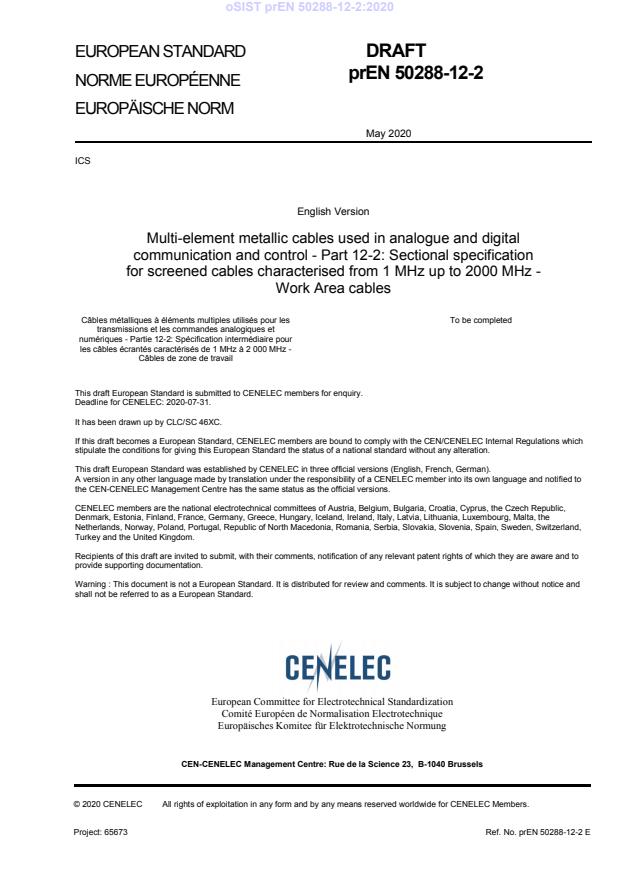
EUROPEAN STANDARD DRAFT
prEN 50288-12-2
NORME EUROPÉENNE
EUROPÄISCHE NORM
May 2020
ICS
English Version
Multi-element metallic cables used in analogue and digital
communication and control - Part 12-2: Sectional specification
for screened cables characterised from 1 MHz up to 2000 MHz -
Work Area cables
Câbles métalliques à éléments multiples utilisés pour les To be completed
transmissions et les commandes analogiques et
numériques - Partie 12-2: Spécification intermédiaire pour
les câbles écrantés caractérisés de 1 MHz à 2 000 MHz -
Câbles de zone de travail
This draft European Standard is submitted to CENELEC members for enquiry.
Deadline for CENELEC: 2020-07-31.
It has been drawn up by CLC/SC 46XC.
If this draft becomes a European Standard, CENELEC members are bound to comply with the CEN/CENELEC Internal Regulations which
stipulate the conditions for giving this European Standard the status of a national standard without any alteration.
This draft European Standard was established by CENELEC in three official versions (English, French, German).
A version in any other language made by translation under the responsibility of a CENELEC member into its own language and notified to
the CEN-CENELEC Management Centre has the same status as the official versions.
CENELEC members are the national electrotechnical committees of Austria, Belgium, Bulgaria, Croatia, Cyprus, the Czech Republic,
Denmark, Estonia, Finland, France, Germany, Greece, Hungary, Iceland, Ireland, Italy, Latvia, Lithuania, Luxembourg, Malta, the
Netherlands, Norway, Poland, Portugal, Republic of North Macedonia, Romania, Serbia, Slovakia, Slovenia, Spain, Sweden, Switzerland,
Turkey and the United Kingdom.
Recipients of this draft are invited to submit, with their comments, notification of any relevant patent rights of which they are aware and to
provide supporting documentation.
Warning : This document is not a European Standard. It is distributed for review and comments. It is subject to change without notice and
shall not be referred to as a European Standard.
European Committee for Electrotechnical Standardization
Comité Européen de Normalisation Electrotechnique
Europäisches Komitee für Elektrotechnische Normung
CEN-CENELEC Management Centre: Rue de la Science 23, B-1040 Brussels
© 2020 CENELEC All rights of exploitation in any form and by any means reserved worldwide for CENELEC Members.
Project: 65673 Ref. No. prEN 50288-12-2 E
oSIST prEN 50288-12-2:2020
prEN 50288-12-2:2020 (E)
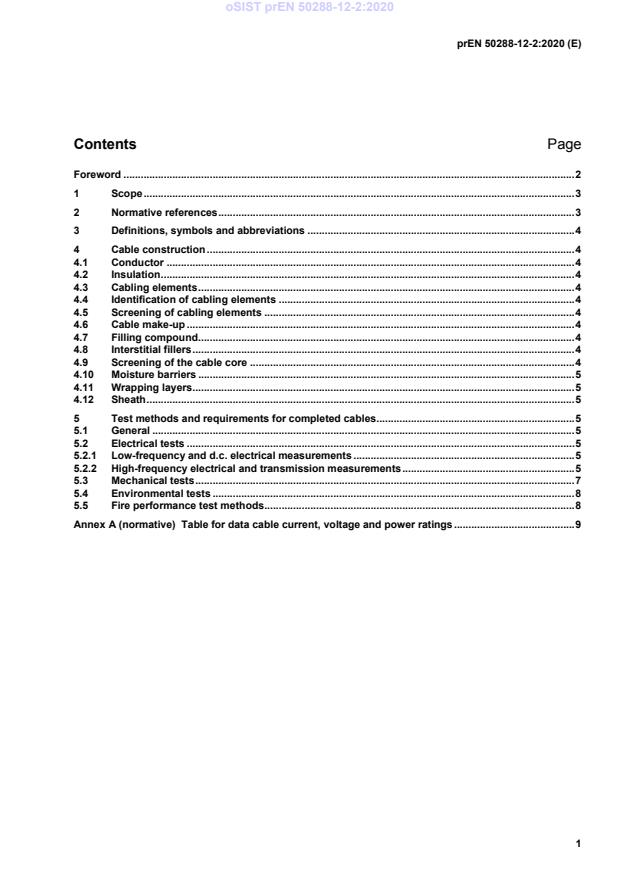
Contents Page
Foreword . 2
1 Scope . 3
2 Normative references . 3
3 Definitions, symbols and abbreviations . 4
4 Cable construction . 4
4.1 Conductor . 4
4.2 Insulation . 4
4.3 Cabling elements . 4
4.4 Identification of cabling elements . 4
4.5 Screening of cabling elements . 4
4.6 Cable make-up . 4
4.7 Filling compound . 4
4.8 Interstitial fillers . 4
4.9 Screening of the cable core . 4
4.10 Moisture barriers . 5
4.11 Wrapping layers . 5
4.12 Sheath . 5
5 Test methods and requirements for completed cables. 5
5.1 General . 5
5.2 Electrical tests . 5
5.2.1 Low-frequency and d.c. electrical measurements . 5
5.2.2 High-frequency electrical and transmission measurements . 5
5.3 Mechanical tests . 7
5.4 Environmental tests . 8
5.5 Fire performance test methods . 8
Annex A (normative) Table for data cable current, voltage and power ratings . 9
oSIST prEN 50288-12-2:2020
prEN 50288-12-2:2020 (E)
European foreword
This document (prEN 50288-12-2:2020) has been prepared by SC 46XC, “Multicore, multipair and quad data
communication cables”, of TC 46X, “Communication cables”.
This document is currently submitted to the Enquiry.
The following dates are proposed:
• latest date by which the existence of this (doa) dor + 6 months
document has to be announced at national
level
• latest date by which this document has to be (dop) dor + 12 months
implemented at national level by publication of
an identical national standard or by
endorsement
• latest date by which the national standards (dow) dor + 36 months
conflicting with this document have to be (to be confirmed or
withdrawn modified when voting)
This Part 12-2 is to be read in conjunction with EN 50288-1:2013.
oSIST prEN 50288-12-2:2020
prEN 50288-12-2:2020 (E)
1 Scope
This document relates to EN 50288-1, Multi-element metallic cables used in analogue and digital
communication and control.
It covers screened cables, characterized up to 2GHz, used in work area wiring for information technology,
generic-cabling systems.
The electrical, mechanical, transmission and environmental performance characteristics of the cables, related
to their reference test methods, are detailed.
This sectional specification is expected to be read in conjunction with EN 50288-1, which contains the
essential provisions for its application.
The cables covered by this sectional specification are intended to operate with voltages and currents normally
encountered in communication systems. These cables are not intended to be used in conjunction with low
impedance sources, for example, the electric power supplies of public utility mains.
2 Normative references
The following documents are referred to in the text in such a way that some or all of their content constitutes
requirements of this document. For dated references, only the edition cited applies. For undated references,
the latest edition of the referenced document (including any amendments) applies.
EN 50288-1:2013, Multi-element metallic cables used in analogue and digital communication and control -
Part 1: Generic specification
EN 50289-3-2, Communication cables - Specifications for test methods - Part 3-2: Mechanical test methods -
Tensile strength and elongation for conductor
EN 50289-3-4, Communication cables - Specifications for test methods - Part 3-4: Mechanical test methods -
Tensile strength, elongation and shrinkage of insulation and sheath
EN 50289-3-5, Communication cables - Specifications for test methods - Part 3-5: Mechanical test methods -
Crush resistance of the cable
EN 50289-3-6, Communication cables - Specifications for test methods - Part 3-6: Mechanical test methods -
Impact resistance of the cable
EN 50289-3-8, Communication cables - Specifications for test methods - Part 3-8: Mechanical test methods -
Abrasion resistance of cable sheath markings
EN 50289-3-9:2001, Communication cables - Specifications for test methods - Part 3-9: Mechanical te
...