

EN IEC 62271-102:2018
(Main)High-voltage switchgear and controlgear - Part 102: Alternating current disconnectors and earthing switches
General Information
- Abstract
IEC 62271-102:2018 applies to alternating current disconnectors and earthing switches, designed for indoor and outdoor installations for nominal voltages above 1 000 V and for service frequencies up to and including 60 Hz. This second edition cancels and replaces the first edition published in 2001, Amendment 1:2011 and Amendment 2:2013. This edition constitutes a technical revision. This edition includes the following significant technical changes with respect to the previous edition:
new numbering according to IEC 17/1025/RQ to harmonize with ISO/IEC Directives, Part 2, and IEEE Std. C37.100.1;
clause numbering has been aligned with IEC 62271-1:2017;
the Scope has been extended to cover all indoor and outdoor installations. Consideration of switching devices having disconnecting and/or earthing switch functionalities, apart from other functions, are also covered by this document;
ratings have been moved from Annexes B, C and E to Clause 5; the order of the subclauses now corresponds to the order of subclauses in Clause 7;
new rating values for bus-transfer current and bus-transfer voltage have been assigned;
new class of mechanical endurance for earthing switches has been added (M1);
subclause "Rated values of electrical endurance for earthing switches" is now called "Classification of earthing switches for short-circuit making capability";
new subclause with ratings for ice-coating has been added;
new subclause with classification of bus-charging switching capability has been added;
new withstand requirements for interlocking devices have been added;
the way to comply with the requirements of the isolating distance of disconnectors has been modified;
design and construction requirements for position-indicating devices have been modified, aligning the requirements for position indication and signalling;
the value of the operating force has been changed;
the test procedures and validation criteria have been revised and modified where necessary;
requirements for applied voltage during single-phase test on non-simultaneous closing earthing switches have been changed;
non-verifiable requirements have been deleted;
a new subclause has been added for testing mechanical interlocking devices;
the high- and low-temperature test is mandatory if the temperature limits for the service conditions of the apparatus (defined by the manufacturer) are above +40 °C or below −5 °C, and a more detailed testing procedure is given;
the testing procedure to verify the proper functioning of the position-indicating device allows a more practicable testing for every technology used;
a new Annex B has been added with title: "Current-switching capability required of disconnectors and earthing switches";
a new Annex C has been added with title: "Tolerances on test quantities for type tests";
a new Annex E has been added with title: "Extension of validity of type tests".
- Status
- Published
- Publication Date
- 16-Aug-2018
- Withdrawal Date
- 18-Jun-2021
- Technical Committee
- CLC/TC 17AC - High-voltage switchgear and controlgear
- Drafting Committee
- IEC/SC 17A - IEC_SC_17A
- Current Stage
- 6060 - Document made available - Publishing
- Start Date
- 17-Aug-2018
- Completion Date
- 17-Aug-2018
Overview
EN IEC 62271-102:2018 - "High-voltage switchgear and controlgear - Part 102: Alternating current disconnectors and earthing switches" is a technical standard (CLC adoption of IEC 62271-102:2018) for disconnectors and earthing switches used in high-voltage installations. It applies to indoor and outdoor equipment for nominal voltages above 1 000 V and service frequencies up to 60 Hz. This second edition supersedes earlier versions (2002, A1:2011, A2:2013) and contains a number of technical revisions to ratings, testing, design and classification.
Key Topics and Requirements
- Scope and harmonization: Clause and numbering aligned with IEC/ISO directives and IEC 62271-1:2017 for consistent terminology and structure.
- Ratings (Clause 5): Rated voltages, insulation levels, continuous and short-time withstand currents, peak currents, bus-transfer current/voltage and new values for specific switching duties (moved from annexes to Clause 5).
- Mechanical and electrical classification: New mechanical endurance class for earthing switches (M1) and revised classifications for short-circuit making and electrical endurance.
- Switching capabilities: Added classifications and ratings for bus-transfer, bus-charging and induced-current switching capabilities; new ratings for ice-coating conditions.
- Design and construction: Revised requirements for position-indicating devices, isolating distances, interlocking devices, locking, earthing arrangements, mechanical strength and maximum operating force.
- Type tests and test procedures (Clause 7): Updated dielectric, mechanical and functional tests, revised validation criteria, mandatory high/low temperature tests when service limits exceed +40 °C or below −5 °C, and new Annexes:
- Annex B: Current-switching capability required
- Annex C: Tolerances on type-test quantities
- Annex E: Extension of validity of type tests
- Interlocking and position indication: New withstand and testing requirements for interlocks and more practical verification methods for position-indicating technologies.
Applications and Who Uses This Standard
- Manufacturers of high-voltage disconnectors and earthing switches for indoor/outdoor substations
- Utility and transmission system engineers specifying switchgear performance and safety
- Type-test laboratories and certification bodies performing compliance testing
- Procurement specialists and design engineers writing technical specifications for substations and switchyards
- Maintenance teams using requirements for operation, interlocks and environmental testing
Related Standards
- IEC/EN 62271-1 (Common specs for AC switchgear)
- IEC/EN 62271-100, -101, -200, -201, -203
- IEC/TR 62271-305 (capacitive current switching)
- Other referenced standards for insulation coordination, testing and mounting (see Clause “Normative references”).
EN IEC 62271-102:2018 is essential for ensuring safe, tested and interoperable high-voltage disconnecting and earthing devices in modern power systems.
Relations
- Effective Date
- 26-Jan-2023
- Effective Date
- 23-Jan-2023
- Effective Date
- 21-Aug-2018
- Effective Date
- 02-Aug-2016
- Effective Date
- 20-Feb-2026
- Effective Date
- 10-Feb-2026
- Effective Date
- 10-Feb-2026
- Effective Date
- 10-Feb-2026
- Effective Date
- 10-Feb-2026
- Effective Date
- 10-Feb-2026
- Effective Date
- 09-Feb-2026
- Effective Date
- 09-Feb-2026
- Effective Date
- 09-Feb-2026
- Effective Date
- 09-Feb-2026
- Refers
EN IEC 60270:2025 - High-voltage test techniques - Charge-based measurement of partial discharges - Effective Date
- 03-Feb-2026
Get Certified
Connect with accredited certification bodies for this standard

IMQ S.p.A. (Certification)
Italian electrical product certification.

SLG Prüf- und Zertifizierungs GmbH
German testing and certification body.

UL Solutions
Global safety science company with testing, inspection and certification.
Sponsored listings
Frequently Asked Questions
EN IEC 62271-102:2018 is a standard published by CLC. Its full title is "High-voltage switchgear and controlgear - Part 102: Alternating current disconnectors and earthing switches". This standard covers: IEC 62271-102:2018 applies to alternating current disconnectors and earthing switches, designed for indoor and outdoor installations for nominal voltages above 1 000 V and for service frequencies up to and including 60 Hz. This second edition cancels and replaces the first edition published in 2001, Amendment 1:2011 and Amendment 2:2013. This edition constitutes a technical revision. This edition includes the following significant technical changes with respect to the previous edition: new numbering according to IEC 17/1025/RQ to harmonize with ISO/IEC Directives, Part 2, and IEEE Std. C37.100.1; clause numbering has been aligned with IEC 62271-1:2017; the Scope has been extended to cover all indoor and outdoor installations. Consideration of switching devices having disconnecting and/or earthing switch functionalities, apart from other functions, are also covered by this document; ratings have been moved from Annexes B, C and E to Clause 5; the order of the subclauses now corresponds to the order of subclauses in Clause 7; new rating values for bus-transfer current and bus-transfer voltage have been assigned; new class of mechanical endurance for earthing switches has been added (M1); subclause "Rated values of electrical endurance for earthing switches" is now called "Classification of earthing switches for short-circuit making capability"; new subclause with ratings for ice-coating has been added; new subclause with classification of bus-charging switching capability has been added; new withstand requirements for interlocking devices have been added; the way to comply with the requirements of the isolating distance of disconnectors has been modified; design and construction requirements for position-indicating devices have been modified, aligning the requirements for position indication and signalling; the value of the operating force has been changed; the test procedures and validation criteria have been revised and modified where necessary; requirements for applied voltage during single-phase test on non-simultaneous closing earthing switches have been changed; non-verifiable requirements have been deleted; a new subclause has been added for testing mechanical interlocking devices; the high- and low-temperature test is mandatory if the temperature limits for the service conditions of the apparatus (defined by the manufacturer) are above +40 °C or below −5 °C, and a more detailed testing procedure is given; the testing procedure to verify the proper functioning of the position-indicating device allows a more practicable testing for every technology used; a new Annex B has been added with title: "Current-switching capability required of disconnectors and earthing switches"; a new Annex C has been added with title: "Tolerances on test quantities for type tests"; a new Annex E has been added with title: "Extension of validity of type tests".
IEC 62271-102:2018 applies to alternating current disconnectors and earthing switches, designed for indoor and outdoor installations for nominal voltages above 1 000 V and for service frequencies up to and including 60 Hz. This second edition cancels and replaces the first edition published in 2001, Amendment 1:2011 and Amendment 2:2013. This edition constitutes a technical revision. This edition includes the following significant technical changes with respect to the previous edition: new numbering according to IEC 17/1025/RQ to harmonize with ISO/IEC Directives, Part 2, and IEEE Std. C37.100.1; clause numbering has been aligned with IEC 62271-1:2017; the Scope has been extended to cover all indoor and outdoor installations. Consideration of switching devices having disconnecting and/or earthing switch functionalities, apart from other functions, are also covered by this document; ratings have been moved from Annexes B, C and E to Clause 5; the order of the subclauses now corresponds to the order of subclauses in Clause 7; new rating values for bus-transfer current and bus-transfer voltage have been assigned; new class of mechanical endurance for earthing switches has been added (M1); subclause "Rated values of electrical endurance for earthing switches" is now called "Classification of earthing switches for short-circuit making capability"; new subclause with ratings for ice-coating has been added; new subclause with classification of bus-charging switching capability has been added; new withstand requirements for interlocking devices have been added; the way to comply with the requirements of the isolating distance of disconnectors has been modified; design and construction requirements for position-indicating devices have been modified, aligning the requirements for position indication and signalling; the value of the operating force has been changed; the test procedures and validation criteria have been revised and modified where necessary; requirements for applied voltage during single-phase test on non-simultaneous closing earthing switches have been changed; non-verifiable requirements have been deleted; a new subclause has been added for testing mechanical interlocking devices; the high- and low-temperature test is mandatory if the temperature limits for the service conditions of the apparatus (defined by the manufacturer) are above +40 °C or below −5 °C, and a more detailed testing procedure is given; the testing procedure to verify the proper functioning of the position-indicating device allows a more practicable testing for every technology used; a new Annex B has been added with title: "Current-switching capability required of disconnectors and earthing switches"; a new Annex C has been added with title: "Tolerances on test quantities for type tests"; a new Annex E has been added with title: "Extension of validity of type tests".
EN IEC 62271-102:2018 is classified under the following ICS (International Classification for Standards) categories: 29.130.10 - High voltage switchgear and controlgear; 29.130.99 - Other switchgear and controlgear. The ICS classification helps identify the subject area and facilitates finding related standards.
EN IEC 62271-102:2018 has the following relationships with other standards: It is inter standard links to EN 62271-102:2002/A2:2013, EN 62271-102:2002, EN 62271-102:2002/AC:2014, EN 62271-102:2002/A1:2011, IEC 60050-471:2007, IEC 60050-614:2016, IEC 62271-101:2012/AMD1:2017, IEC 60050-441:1984, IEC 60050-151:2001, IEC TR 62271-305:2009, EN 28050:1992, EN 22768-1:1993, EN 13587:2003, EN ISO 3680:2004, EN IEC 60270:2025. Understanding these relationships helps ensure you are using the most current and applicable version of the standard.
EN IEC 62271-102:2018 is available in PDF format for immediate download after purchase. The document can be added to your cart and obtained through the secure checkout process. Digital delivery ensures instant access to the complete standard document.
Standards Content (Sample)
SLOVENSKI STANDARD
01-oktober-2018
Nadomešča:
SIST EN 62271-102:2002
SIST EN 62271-102:2002/A1:2011
SIST EN 62271-102:2002/A2:2013
SIST EN 62271-102:2002/AC:2015
Visokonapetostne stikalne in krmilne naprave - 102. del: Ločilniki za izmenični tok
in ozemljitvena stikala (IEC 62271-102:2018)
High-voltage switchgear and controlgear - Part 102: Alternating current disconnectors
and earthing switches (IEC 62271-102:2018)
Hochspannungs-Schaltgeräte und -Schaltanlagen - Teil 102: Wechselstrom-
Trennschalter und -Erdungsschalter (IEC 62271-102:2018)
Appareillage à haute tension - Partie 102: Sectionneurs etsectionneurs de terre à
courant alternatif (IEC 62271-102:2018)
Ta slovenski standard je istoveten z: EN IEC 62271-102:2018
ICS:
29.130.10 Visokonapetostne stikalne in High voltage switchgear and
krmilne naprave controlgear
2003-01.Slovenski inštitut za standardizacijo. Razmnoževanje celote ali delov tega standarda ni dovoljeno.
EUROPEAN STANDARD EN IEC 62271-102
NORME EUROPÉENNE
EUROPÄISCHE NORM
August 2018
ICS 29.130.10; 29.130.99 Supersedes EN 62271-102:2002
English Version
High-voltage switchgear and controlgear -
Part 102: Alternating current disconnectors and earthing
switches
(IEC 62271-102:2018)
Appareillage à haute tension - Hochspannungs-Schaltgeräte und -Schaltanlagen -
Partie 102: Sectionneurs et sectionneurs de terre à courant Teil 102: Wechselstrom-Trennschalter und -
alternatif Erdungsschalter
(IEC 62271-102:2018) (IEC 62271-102:2018)
This European Standard was approved by CENELEC on 2018-06-19. CENELEC members are bound to comply with the CEN/CENELEC
Internal Regulations which stipulate the conditions for giving this European Standard the status of a national standard without any alteration.
Up-to-date lists and bibliographical references concerning such national standards may be obtained on application to the CEN-CENELEC
Management Centre or to any CENELEC member.
This European Standard exists in three official versions (English, French, German). A version in any other language made by translation
under the responsibility of a CENELEC member into its own language and notified to the CEN-CENELEC Management Centre has the
same status as the official versions.
CENELEC members are the national electrotechnical committees of Austria, Belgium, Bulgaria, Croatia, Cyprus, the Czech Republic,
Denmark, Estonia, Finland, Former Yugoslav Republic of Macedonia, France, Germany, Greece, Hungary, Iceland, Ireland, Italy, Latvia,
Lithuania, Luxembourg, Malta, the Netherlands, Norway, Poland, Portugal, Romania, Serbia, Slovakia, Slovenia, Spain, Sweden,
Switzerland, Turkey and the United Kingdom.
European Committee for Electrotechnical Standardization
Comité Européen de Normalisation Electrotechnique
Europäisches Komitee für Elektrotechnische Normung
CEN-CENELEC Management Centre: Rue de la Science 23, B-1040 Brussels
© 2018 CENELEC All rights of exploitation in any form and by any means reserved worldwide for CENELEC Members.
Ref. No. EN IEC 62271-102:2018 E
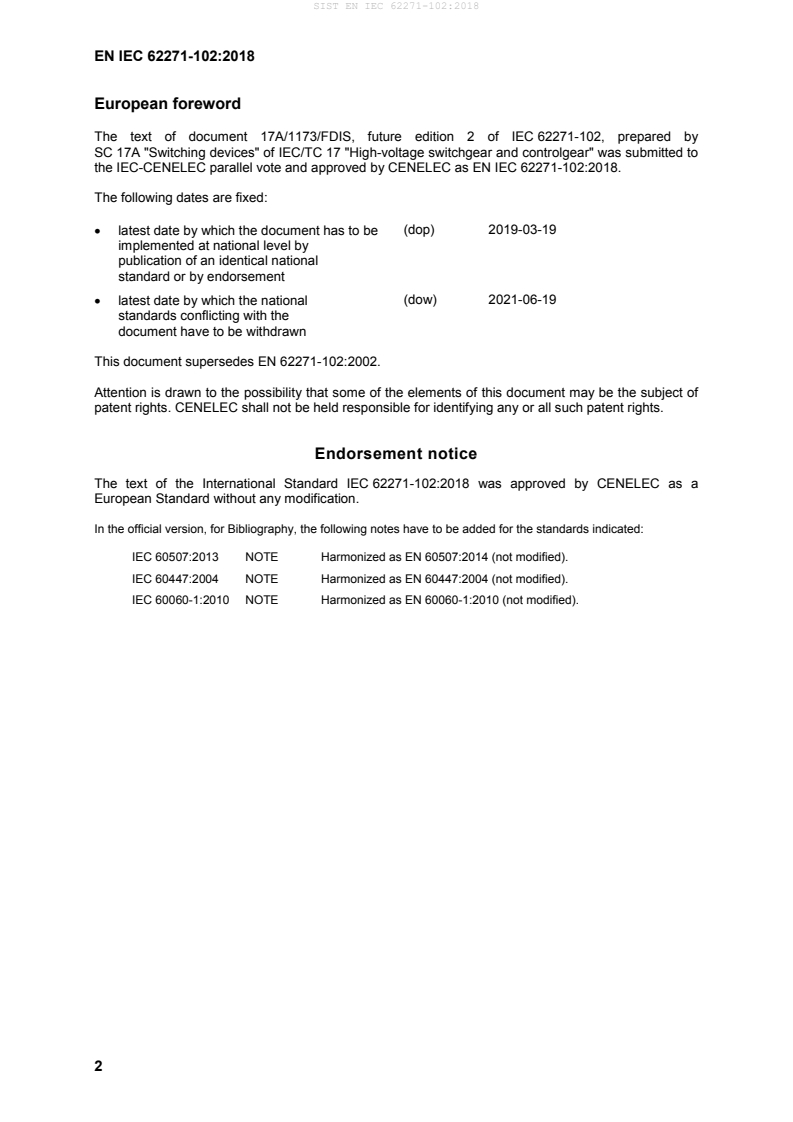
European foreword
The text of document 17A/1173/FDIS, future edition 2 of IEC 62271-102, prepared by
SC 17A "Switching devices" of IEC/TC 17 "High-voltage switchgear and controlgear" was submitted to
the IEC-CENELEC parallel vote and approved by CENELEC as EN IEC 62271-102:2018.
The following dates are fixed:
(dop) 2019-03-19
• latest date by which the document has to be
implemented at national level by
publication of an identical national
standard or by endorsement
• latest date by which the national (dow) 2021-06-19
standards conflicting with the
document have to be withdrawn
This document supersedes EN 62271-102:2002.
Attention is drawn to the possibility that some of the elements of this document may be the subject of
patent rights. CENELEC shall not be held responsible for identifying any or all such patent rights.
Endorsement notice
The text of the International Standard IEC 62271-102:2018 was approved by CENELEC as a
European Standard without any modification.
In the official version, for Bibliography, the following notes have to be added for the standards indicated:
IEC 60507:2013 NOTE Harmonized as EN 60507:2014 (not modified).
IEC 60447:2004 NOTE Harmonized as EN 60447:2004 (not modified).
IEC 60060-1:2010 NOTE Harmonized as EN 60060-1:2010 (not modified).
Annex ZA
(normative)
Normative references to international publications
with their corresponding European publications
The following documents are referred to in the text in such a way that some or all of their content
constitutes requirements of this document. For dated references, only the edition cited applies. For
undated references, the latest edition of the referenced document (including any amendments)
applies.
NOTE 1 Where an International Publication has been modified by common modifications, indicated by (mod), the relevant
EN/HD applies.
NOTE 2 Up-to-date information on the latest versions of the European Standards listed in this annex is available here:
www.cenelec.eu.
Publication Year Title EN/HD Year
IEC 60050-151 - International Electrotechnical Vocabulary - - -
Part 151: Electrical and magnetic devices
IEC 60050-441 - International Electrotechnical Vocabulary - -
(IEV) - Chapter 441: Switchgear,
controlgear and fuses
IEC 60050-471 - International Electrotechnical Vocabulary - - -
Part 471: Insulators
IEC 60050-614 - International electrotechnical vocabulary - - -
Part 614: Generation, transmission and
distribution of electricity - Operation
IEC 60071-2 - Insulation co-ordination - EN IEC 60071-2 -
Part 2: Application guidelines
IEC 60137 - Insulated bushings for alternating voltages EN 60137 -
above 1000 V
IEC 60270 - High-voltage test techniques - Partial EN 60270 -
discharge measurements
IEC 60529 1989 Degrees of protection provided by EN 60529 1991
enclosures (IP Code) corr. May 1993
+A1 1999 +A1 2000
+A2 2013 +A2 2013
IEC 60865-1 - Short-circuit currents - Calculation of EN 60865-1 -
effects - Part 1: Definitions and calculation
methods
IEC 62262 2002 Degrees of protection provided by EN 62262 2002
enclosures for electrical equipment against
external mechanical impacts (IK code)
IEC 62271-1 2017 High-voltage switchgear and controlgear - EN 62271-1 2017
Part 1: Common specifications for
alternating current switchgear and
controlgear
Publication Year Title EN/HD Year
IEC 62271-100 2008 High-voltage switchgear and controlgear - EN 62271-100 2009
+A1 2012 Part 100: Alternating current circuit- +A1 2012
+A2 2017 breakers +A2 2017
IEC 62271-101 2012 High-voltage switchgear and controlgear - EN 62271-101 2013
+A1 2017 Part 101: Synthetic testing - -
IEC 62271-200 2011 High-voltage switchgear and controlgear - EN 62271-200 2012
Part 200: AC metal-enclosed switchgear
and controlgear for rated voltages
above 1 kV and up to and including 52 kV
IEC 62271-201 2014 High-voltage switchgear and controlgear - EN 62271-201 2014
Part 201: AC solid-insulation enclosed
switchgear and controlgear for rated
voltages above 1 kV and up to and
including 52 kV
IEC 62271-203 2011 High-voltage switchgear and controlgear - EN 62271-203 2012
Part 203: Gas-insulated metal-enclosed
switchgear for rated voltages above 52 kV
IEC/TR 62271-305 - High-voltage switchgear and controlgear - - -
Part 305: Capacitive current switching
capability of air-insulated disconnectors for
rated voltages above 52 kV
ISO 2768-1 - General tolerances - EN 22768-1 -
Part 1: Tolerances for linear and angular
dimensions without individual tolerance
indications
IEC 62271-102 ®
Edition 2.0 2018-05
INTERNATIONAL
STANDARD
NORME
INTERNATIONALE
colour
inside
High-voltage switchgear and controlgear –
Part 102: Alternating current disconnectors and earthing switches
Appareillage à haute tension –
Partie 102: Sectionneurs et sectionneurs de terre à courant alternatif
INTERNATIONAL
ELECTROTECHNICAL
COMMISSION
COMMISSION
ELECTROTECHNIQUE
INTERNATIONALE
ICS 29.130.10; 29.130.99 ISBN 978-2-8322-5654-1
– 2 – IEC 62271-102:2018 © IEC 2018
CONTENTS
FOREWORD . 9
1 Scope . 12
2 Normative references . 12
3 Terms and definitions . 13
3.1 General terms and definitions . 13
3.2 Assemblies of switchgear and controlgear . 14
3.3 Parts of assemblies . 14
3.4 Switching devices . 14
3.5 Parts of switching devices . 15
3.6 Operation . 18
3.7 Characteristic quantities . 19
3.8 Index of definitions . 24
4 Normal and special service conditions . 26
5 Ratings . 26
5.1 General . 26
5.2 Rated voltage (U ) . 27
r
5.3 Rated insulation level (U , U , U ) . 27
d p s
5.4 Rated frequency (f ) . 27
r
5.5 Rated continuous current (I ) . 27
r
5.6 Rated short-time withstand current (I ) . 27
k
5.7 Rated peak withstand current (I ) . 27
p
5.8 Rated duration of short-circuit (t ) . 28
k
5.9 Rated supply voltage of auxiliary and control circuits (U ) . 28
a
5.10 Rated supply frequency of auxiliary circuits and control circuits . 28
5.11 Rated pressure of compressed gas supply for controlled pressure systems . 28
5.11.101 Rated pressure of compressed gas supply for insulation and/or
switching . 28
5.11.102 Rated pressure of compressed gas supply for operation . 28
5.101 Rated short-circuit making current (I ) . 28
ma
5.102 Classification of earthing switches for short-circuit making . 28
5.103 Rated contact zone . 29
5.104 Rated static mechanical terminal load . 29
5.105 Classification of disconnectors for mechanical endurance . 30
5.106 Classification of earthing switches for mechanical endurance . 31
5.107 Rated ice-coating . 31
5.108 Rated values of disconnectors for bus-transfer current switching . 31
5.108.1 Rated bus-transfer current . 31
5.108.2 Rated bus-transfer voltage. 32
5.109 Classification and rated values of earthing switches for induced current
switching . 32
5.110 Classification and rated values of disconnectors for bus-charging current
switching . 33
6 Design and construction . 34
6.1 Requirements for liquids in disconnectors and earthing switches . 34
6.2 Requirements for gases in disconnectors and earthing switches . 34
6.3 Earthing of disconnectors and earthing switches . 34
IEC 62271-102:2018 © IEC 2018 – 3 –
6.4 Auxiliary and control equipment and circuits . 35
6.5 Dependent power operation . 35
6.6 Stored energy operation . 35
6.7 Independent unlatched operation (independent manual or power operation) . 35
6.8 Manually operated actuators . 35
6.9 Operation of releases . 35
6.10 Pressure/level indication . 35
6.11 Nameplates. 35
6.12 Locking devices . 38
6.13 Position indication . 38
6.14 Degree of protection provided by enclosures . 38
6.15 Creepage distances for outdoor insulators . 38
6.16 Gas and vacuum tightness . 38
6.17 Tightness for liquid systems . 38
6.18 Fire hazard (flammability) . 38
6.19 Electromagnetic compatibility (EMC) . 38
6.20 X-ray emission . 38
6.21 Corrosion . 38
6.22 Filling levels for insulation, switching and/or operation . 39
6.101 Particular requirements for earthing switches . 39
6.102 Requirements in respect of the isolating distance of disconnectors . 39
6.103 Mechanical strength . 39
6.104 Operation of disconnectors and earthing switches – Position of the movable
contact system and its indicating and signalling devices . 40
6.104.1 Securing of position . 40
6.104.2 Additional requirements for power-operated mechanisms . 40
6.104.3 Indication and signalling of position . 40
6.105 Maximum force required for manual (dependent or independent) operation . 41
6.105.1 General . 41
6.105.2 Operation requiring more than one revolution . 42
6.105.3 Operation requiring up to one revolution . 42
6.106 Dimensional tolerances . 42
6.107 Earthing switches with short-circuit making current capability . 42
7 Type tests . 42
7.1 General . 42
7.1.1 Basics . 42
7.1.2 Information for identification of test objects . 44
7.1.3 Information to be included in type test reports . 44
7.2 Dielectric tests . 44
7.2.1 General . 44
7.2.2 Ambient air conditions during tests . 44
7.2.3 Wet test procedure . 44
7.2.4 Arrangement of the equipment . 44
7.2.5 Criteria to pass the test . 45
7.2.6 Application of the test voltage and test conditions . 45
7.2.7 Tests of disconnectors and earthing switches of U ≤ 245 kV . 45
r
7.2.8 Test of disconnectors and earthing switches of U > 245 kV . 45
r
7.2.9 Artificial pollution tests for outdoor insulators . 45
7.2.10 Partial discharge tests . 46
– 4 – IEC 62271-102:2018 © IEC 2018
7.2.11 Dielectric tests on auxiliary and control circuits . 46
7.2.12 Voltage test as condition check . 46
7.3 Radio interference voltage (RIV) test . 46
7.4 Resistance measurement . 46
7.5 Continuous current tests . 46
7.6 Short-time withstand current and peak withstand current tests . 46
7.6.1 General . 46
7.6.2 Arrangement of the disconnectors and earthing switches and of the test
circuit . 46
7.6.3 Test current and duration . 52
7.6.4 Conditions of disconnectors and earthing switches after test . 52
7.7 Verification of the protection . 53
7.8 Tightness tests . 53
7.9 Electromagnetic compatibility tests (EMC) . 53
7.10 Additional tests on auxiliary and control circuits . 53
7.11 X-ray radiation test for vacuum interrupters. 53
7.101 Test to prove the short-circuit making performance of earthing switches . 54
7.101.1 General test conditions . 54
7.101.2 Arrangement of the earthing switch for tests . 54
7.101.3 Test frequency . 54
7.101.4 Test voltage . 54
7.101.5 Test short-circuit making current . 55
7.101.6 Test circuits . 55
7.101.7 Test procedures . 55
7.101.8 Behaviour of earthing switches when making short-circuit currents . 56
7.101.9 Condition of earthing switch after short-circuit making tests . 56
7.101.10 Invalid tests . 57
7.101.11 Type test reports . 57
7.102 Operating and mechanical endurance tests . 58
7.102.1 General test conditions . 58
7.102.2 Contact zone test. 58
7.102.3 Mechanical endurance test . 61
7.102.4 Operation during the application of rated static mechanical terminal
loads . 63
7.102.5 Extended mechanical endurance tests . 64
7.102.6 Testing of mechanical interlocking devices. . 65
7.103 Operation under severe ice conditions . 65
7.103.1 General . 65
7.103.2 Test arrangement . 65
7.103.3 Test procedure . 66
7.104 Low- and high-temperature tests . 67
7.104.1 General . 67
7.104.2 Measurement of ambient air temperature . 68
7.104.3 Low-temperature test . 68
7.104.4 High-temperature test . 70
7.105 Tests to verify the proper functioning of the position-indicating device . 70
7.105.1 General . 70
7.105.2 Tests on the power kinematic chain and the position-indicating
kinematic chain . 71
7.106 Bus-transfer current switching tests on disconnectors . 71
IEC 62271-102:2018 © IEC 2018 – 5 –
7.106.1 General . 71
7.106.2 Making and breaking tests . 71
7.107 Induced current switching tests on earthing switches . 75
7.107.1 General . 75
7.107.2 Arrangement of the earthing switch for tests . 75
7.107.3 Earthing of test circuit and earthing switch . 76
7.107.4 Test frequency . 76
7.107.5 Test voltage . 76
7.107.6 Test currents . 76
7.107.7 Test circuits . 76
7.108 Bus-charging current switching tests on disconnectors. 81
7.108.1 General . 81
7.108.2 Test duties . 82
7.108.3 Arrangement of the disconnector for tests . 82
7.108.4 Test frequency . 82
7.108.5 Test voltages for making and breaking tests . 83
7.108.6 Test circuits for making and breaking tests . 84
7.108.7 Performance of making and breaking tests . 86
7.108.8 Behaviour of the disconnector during making and breaking tests . 86
7.108.9 Condition after test . 87
7.108.10 Type test reports . 87
7.108.11 Requirements for U measurements . 88
TVE
8 Routine tests . 88
8.1 General . 88
8.2 Dielectric test on the main circuit . 88
8.3 Tests on auxiliary and control circuits . 89
8.4 Measurement of the resistance of the main circuit . 89
8.5 Tightness test . 89
8.6 Design and visual checks . 89
8.101 Mechanical operating tests . 89
8.102 Verification of earthing function . 90
9 Guide to the selection of disconnectors and earthing switches (informative) . 90
9.1 General . 90
9.2 Selection of rated values . 91
9.2.101 General . 91
9.2.102 Selection of rated voltage and rated insulation level . 91
9.2.103 Selection of rated continuous current . 91
9.2.104 Selection of rated contact zone . 91
9.2.105 Selection of rated static mechanical terminal load . 92
9.2.106 Selection of a bus-transfer current switching capability for
disconnectors of U > 52 kV . 92
r
9.2.107 Selection of an induced-current switching capability for earthing
switches of U > 52 kV . 92
r
9.2.108 Selection of rated short-time withstand current and of rated duration of
short-circuit . 92
9.2.109 Selection of rated peak withstand current and of rated short-circuit
making current for earthing switches. 93
9.2.110 Selection of short-circuit making capability for earthing switches . 93
9.3 Cable-interface considerations . 93
– 6 – IEC 62271-102:2018 © IEC 2018
9.4 Continuous or temporary overload due to changed service conditions . 93
9.5 Environmental aspects . 93
9.5.101 Local environmental conditions . 93
10 Information to be given with enquiries, tenders and orders (informative) . 94
10.1 General . 94
10.2 Information with enquiries and orders . 94
10.3 Information with tenders . 95
11 Transport, storage, installation, operating instructions, and maintenance . 96
11.1 General . 96
11.2 Conditions during transport, storage and installation . 96
11.3 Installation . 96
11.4 Operation . 97
11.5 Maintenance . 97
12 Safety . 97
12.1 General . 97
12.2 Precautions by manufacturers . 97
12.3 Precautions by users . 97
13 Influence of the product on the environment . 97
Annex A (informative) Test voltage for the most disadvantageous dielectric position of
an earthing switch during operation (minimum temporary clearance) . 98
Annex B (informative) Current-switching capability required of disconnectors and
earthing switches . 99
B.1 Bus-transfer current switching capability of disconnectors . 99
B.2 Bus-charging current switching capability of disconnectors . 99
B.3 Induced current-switching capability of earthing switches . 100
Annex C (normative) Tolerances on test quantities for type tests . 101
Annex D (normative) Alternative test methods for short-circuit current making tests . 103
D.1 General . 103
D.2 Alternative methods . 103
D.2.1 Synthetic test method with both rated voltage and rated short-circuit
current . 103
D.2.2 Test methods with reduced voltage . 103
Annex E (informative) Extension of validity of type tests . 105
E.1 General . 105
E.2 Dielectric tests . 105
E.3 Short-time withstand current tests . 105
E.4 Short-circuit making performance of earthing switches . 105
E.5 Operating and mechanical endurance tests . 105
E.6 Bus-transfer current switching tests on disconnectors . 105
E.7 Induced current switching tests on earthing switches . 106
Bibliography . 107
Figure 1 – Position indicating/signalling device(s) . 40
Figure 2 – Three-phase test arrangement for disconnectors and earthing switches . 48
Figure 3 – Single-phase test arrangement for disconnectors with a horizontal isolating
distance and for earthing switches of U > 52 kV, to be used with flexible or with rigid
r
conductors . 49
IEC 62271-102:2018 © IEC 2018 – 7 –
Figure 4 – Single-phase test arrangement for divided support disconnectors (earthing
switches) of U > 52 kV with a vertical isolating distance, to be used with flexible
r
conductors . 50
Figure 5 – Single-phase test arrangement for divided support disconnectors (earthing
switches) of U > 52 kV with a vertical isolating distance, to be used with rigid
r
conductors . 51
Figure 6 – Fixed contact parallel to support . 59
Figure 7 – Fixed contact perpendicular to support . 60
Figure 8 – Example of the application of rated static mechanical terminal loads to a
(divided support) pantograph disconnector (or earthing switch) . 61
Figure 9 – Example of the application of rated static mechanical terminal loads to a
two-column disconnector . 62
Figure 10 – Test sequences for low and high temperature tests . 68
Figure 11 – Example of test circuit for bus-transfer current switching tests . 73
Figure 12 – Test circuit for electromagnetically induced current switching tests . 77
Figure 13 – Test circuits for electrostatically induced current-switching tests . 79
Figure 14 – Test circuit for test duty 1 . 83
Figure 15 – Typical voltage waveform (Including VFT and FT components) . 85
Figure 16 – Test circuit for test duty 2 . 85
Figure 17 – Test circuit for test duty 3 . 86
Figure B.1 – Examples of resistor-fitted disconnectors . 100
Table 1 – Classification of earthing switches for short-circuit making . 28
Table 2 – Preferred contact zones for "fixed" contacts supported by flexible
conductors . 29
Table 3 – Preferred contact zones for "fixed" contacts supported by rigid conductors . 29
Table 4 – Preferred static mechanical terminal loads . 30
Table 5 – Classification of disconnectors for mechanical endurance . 31
Table 6 – Classification of earthing switches for mechanical endurance . 31
Table 7 – Rated bus-transfer voltages of disconnectors . 32
Table 8 – Classification of earthing switches for induced-current switching . 32
Table 9 – Rated induced currents and voltages . 33
Table 10 – Classification of disconnectors for bus-charging switching . 34
Table 11 – Standard rated bus-charging currents . 34
Table 12 – Product information . 36
Table 13 – List of type tests . 43
Table 14 – Power frequency withstand voltages . 45
Table 15 – Requirements on the instant of making . 56
Table 16 – Invalid tests . 57
Table 17 – Standard values of recovery voltages for electromagnetically induced
current breaking tests . 78
Table 18 – Test circuit capacitances (C values) for electrostatically induced current
switching tests . 80
Table 19 – Test voltages for making and breaking tests . 83
Table 20 – Number of tests . 86
– 8 – IEC 62271-102:2018 © IEC 2018
Table 21 – Power frequency voltage tests . 89
Table B.1 – Average impedances . 99
Table C.1 – Tolerances on test quantities for type tests . 101
IEC 62271-102:2018 © IEC 2018 – 9 –
INTERNATIONAL ELECTROTECHNICAL COMMISSION
____________
HIGH-VOLTAGE SWITCHGEAR AND CONTROLGEAR –
Part 102: Alternating current disconnectors and earthing switches
FOREWORD
1) The International Electrotechnical Commission (IEC) is a worldwide organization for standardization comprising
all national electrotechnical committees (IEC National Committees). The object of IEC is to promote
international co-operation on all questions concerning standardization in the electrical and electronic fields. To
this end and in addition to other activities, IEC publishes International Standards, Technical Specifications,
Technical Reports, Publicly Available Specifications (PAS) and Guides (hereafter referred to as "IEC
Publication(s)"). Their preparation is entrusted to technical committees; any IEC National Committee interested
in the subject dealt with may participate in this preparatory work. International, governmental and non-
governmental organizations liaising with the IEC also participate in this preparation. IEC collaborates closely
with the International Organization for Standardization (ISO) in accordance with conditions determined by
agreement between the two organizations.
2) The formal decisions or agreements of IEC on technical matters express, as nearly as possible, an international
consensus of opinion on the relevant subjects since each technical committee has representation from all
interested IEC National Committees.
3) IEC Publications have the form of recommendations for international use and are accepted by IEC National
Committees in that sense. While all reasonable efforts are made to ensure that the technical content of IEC
Publications is accurate, IEC cannot be held responsible for the way in which they are used or for any
misinterpretation by any end user.
4) In order to promote international uniformity, IEC National Committees undertake to apply IEC Publications
transparently to the maxi
...