

IEC TR 62271-305:2009
(Main)High-voltage switchgear and controlgear - Part 305: Capacitive current switching capability of air-insulated disconnectors for rated voltages above 52 kV
General Information
- Abstract
IEC/TR 62271-305:2009(E) applies to high-voltage air-insulated disconnectors for rated voltages above 52 kV. The report describes the capacitive current switching duty and provides guidance on laboratory testing to demonstrate the switching capability. Air-insulated disconnectors equipped with auxiliary interrupting devices are included under this scope.
The contents of the corrigendum of June 2017 have been included in this copy.
- Status
- Published
- Publication Date
- 24-Nov-2009
- Technical Committee
- SC 17A - Switching devices
- Current Stage
- PPUB - Publication issued
- Start Date
- 25-Nov-2009
- Completion Date
- 28-Feb-2010
Buy Documents
IEC TR 62271-305:2009 - High-voltage switchgear and controlgear - Part 305: Capacitive current switching capability of air-insulated disconnectors for rated voltages above 52 kV Released:11/25/2009
Overview
IEC TR 62271-305:2009(E) is a technical report from the International Electrotechnical Commission (IEC) that addresses the capacitive current switching capability of air‑insulated disconnectors for rated voltages above 52 kV. It describes the capacitive switching duty, gives guidance for laboratory testing to demonstrate switching capability (including air‑insulated disconnectors with auxiliary interrupting devices), and includes the corrigendum of June 2017.
Key SEO phrases: IEC TR 62271-305, capacitive current switching, air‑insulated disconnectors, high‑voltage testing, rated voltages above 52 kV.
Key Topics
- Scope and intent: Defines testing guidance for air‑insulated disconnectors where capacitive charging currents exceed historically assumed values (0.5 A).
- Test arrangement: Disconnector mounted on its support, motor operation only (at minimum supply voltage), resistance checks and no‑load operations before testing.
- Test parameters:
- Rated phase‑to‑earth test voltage (±5% tolerance).
- Test current agreed between manufacturer and user (±10% tolerance).
- Capacitance ratio C_S/C_L tolerance ±20%.
- Tests may be at 50 Hz or 60 Hz (equivalent).
- Test circuit and alternatives: Principal test circuit defined (source inductance L, supply and load capacitances C_S and C_L); alternative arrangements described in Annex C for practical laboratory limitations.
- Test procedure:
- Twenty close‑open (CO) operations per test current with no trapped charge on the load capacitance.
- Recovery voltage maintained for 10 s after full opening.
- Measurements required: source voltage, load dc/transient overvoltages, current, arc duration, and video recording of arc propagation.
- Performance criteria:
- Disconnector must interrupt capacitive current before moving blades reach fully open.
- No earth faults or phase‑to‑phase faults in three‑phase tests.
- Guidance on when single‑phase tests suffice and when three‑phase tests are necessary (e.g., excessive arc reach).
Applications
Who uses IEC TR 62271-305:
- High‑voltage switchgear manufacturers validating disconnector designs.
- Laboratory test houses developing test programs for capacitive switching.
- Transmission utilities and designers specifying disconnector switching capability for lines and station equipment.
- Procurement and standards engineers writing requirements for air‑insulated disconnectors at voltages >52 kV.
Practical value: helps ensure reliable interruption of capacitive charging currents, informs specification of disconnector ratings, and reduces risk of unacceptable arcing, overvoltages or equipment damage.
Related Standards
- IEC 62271-1: High‑voltage switchgear and controlgear – Part 1: Common specifications.
- IEC 62271-102: High‑voltage switchgear and controlgear – Part 102: AC disconnectors and earthing switches (includes gas‑insulated disconnector testing provisions).
For detailed test circuits, capacitive charging current tables and analysis, refer to Annexes A–C and the full IEC TR 62271-305 text.
Relations
- Effective Date
- 10-Feb-2026
- Effective Date
- 05-Sep-2023
Buy Documents
IEC TR 62271-305:2009 - High-voltage switchgear and controlgear - Part 305: Capacitive current switching capability of air-insulated disconnectors for rated voltages above 52 kV Released:11/25/2009
Get Certified
Connect with accredited certification bodies for this standard

IMQ S.p.A. (Certification)
Italian electrical product certification.

SLG Prüf- und Zertifizierungs GmbH
German testing and certification body.

UL Solutions
Global safety science company with testing, inspection and certification.
Sponsored listings
Frequently Asked Questions
IEC TR 62271-305:2009 is a technical report published by the International Electrotechnical Commission (IEC). Its full title is "High-voltage switchgear and controlgear - Part 305: Capacitive current switching capability of air-insulated disconnectors for rated voltages above 52 kV". This standard covers: IEC/TR 62271-305:2009(E) applies to high-voltage air-insulated disconnectors for rated voltages above 52 kV. The report describes the capacitive current switching duty and provides guidance on laboratory testing to demonstrate the switching capability. Air-insulated disconnectors equipped with auxiliary interrupting devices are included under this scope. The contents of the corrigendum of June 2017 have been included in this copy.
IEC/TR 62271-305:2009(E) applies to high-voltage air-insulated disconnectors for rated voltages above 52 kV. The report describes the capacitive current switching duty and provides guidance on laboratory testing to demonstrate the switching capability. Air-insulated disconnectors equipped with auxiliary interrupting devices are included under this scope. The contents of the corrigendum of June 2017 have been included in this copy.
IEC TR 62271-305:2009 is classified under the following ICS (International Classification for Standards) categories: 29.130.10 - High voltage switchgear and controlgear. The ICS classification helps identify the subject area and facilitates finding related standards.
IEC TR 62271-305:2009 has the following relationships with other standards: It is inter standard links to EN IEC 62271-102:2018, IEC TR 62271-305:2009/COR1:2017. Understanding these relationships helps ensure you are using the most current and applicable version of the standard.
IEC TR 62271-305:2009 is available in PDF format for immediate download after purchase. The document can be added to your cart and obtained through the secure checkout process. Digital delivery ensures instant access to the complete standard document.
Standards Content (Sample)
IEC/TR 62271-305 ®
Edition 1.0 2009-11
TECHNICAL
REPORT
colour
inside
High-voltage switchgear and controlgear –
Part 305: Capacitive current switching capability of air-insulated disconnectors
for rated voltages above 52 kV
IEC/TR 62271-305:2009(E)
All rights reserved. Unless otherwise specified, no part of this publication may be reproduced or utilized in any form or by
any means, electronic or mechanical, including photocopying and microfilm, without permission in writing from either IEC or
IEC's member National Committee in the country of the requester.
If you have any questions about IEC copyright or have an enquiry about obtaining additional rights to this publication,
please contact the address below or your local IEC member National Committee for further information.
Droits de reproduction réservés. Sauf indication contraire, aucune partie de cette publication ne peut être reproduite
ni utilisée sous quelque forme que ce soit et par aucun procédé, électronique ou mécanique, y compris la photocopie
et les microfilms, sans l'accord écrit de la CEI ou du Comité national de la CEI du pays du demandeur.
Si vous avez des questions sur le copyright de la CEI ou si vous désirez obtenir des droits supplémentaires sur cette
publication, utilisez les coordonnées ci-après ou contactez le Comité national de la CEI de votre pays de résidence.
IEC Central Office
3, rue de Varembé
CH-1211 Geneva 20
Switzerland
Email: inmail@iec.ch
Web: www.iec.ch
About IEC publications
The technical content of IEC publications is kept under constant review by the IEC. Please make sure that you have the
latest edition, a corrigenda or an amendment might have been published.
ƒ Catalogue of IEC publications: www.iec.ch/searchpub
The IEC on-line Catalogue enables you to search by a variety of criteria (reference number, text, technical committee,…).
It also gives information on projects, withdrawn and replaced publications.
ƒ IEC Just Published: www.iec.ch/online_news/justpub
Stay up to date on all new IEC publications. Just Published details twice a month all new publications released. Available
on-line and also by email.
ƒ Electropedia: www.electropedia.org
The world's leading online dictionary of electronic and electrical terms containing more than 20 000 terms and definitions
in English and French, with equivalent terms in additional languages. Also known as the International Electrotechnical
Vocabulary online.
ƒ Customer Service Centre: www.iec.ch/webstore/custserv
If you wish to give us your feedback on this publication or need further assistance, please visit the Customer Service
Centre FAQ or contact us:
Email: csc@iec.ch
Tel.: +41 22 919 02 11
Fax: +41 22 919 03 00
IEC/TR 62271-305 ®
Edition 1.0 2009-11
TECHNICAL
REPORT
colour
inside
High-voltage switchgear and controlgear –
Part 305: Capacitive current switching capability of air-insulated disconnectors
for rated voltages above 52 kV
INTERNATIONAL
ELECTROTECHNICAL
COMMISSION
PRICE CODE
Q
ICS 29.130.10 ISBN 978-2-88910-659-2
– 2 – TR 62271-305 © IEC:2009(E)
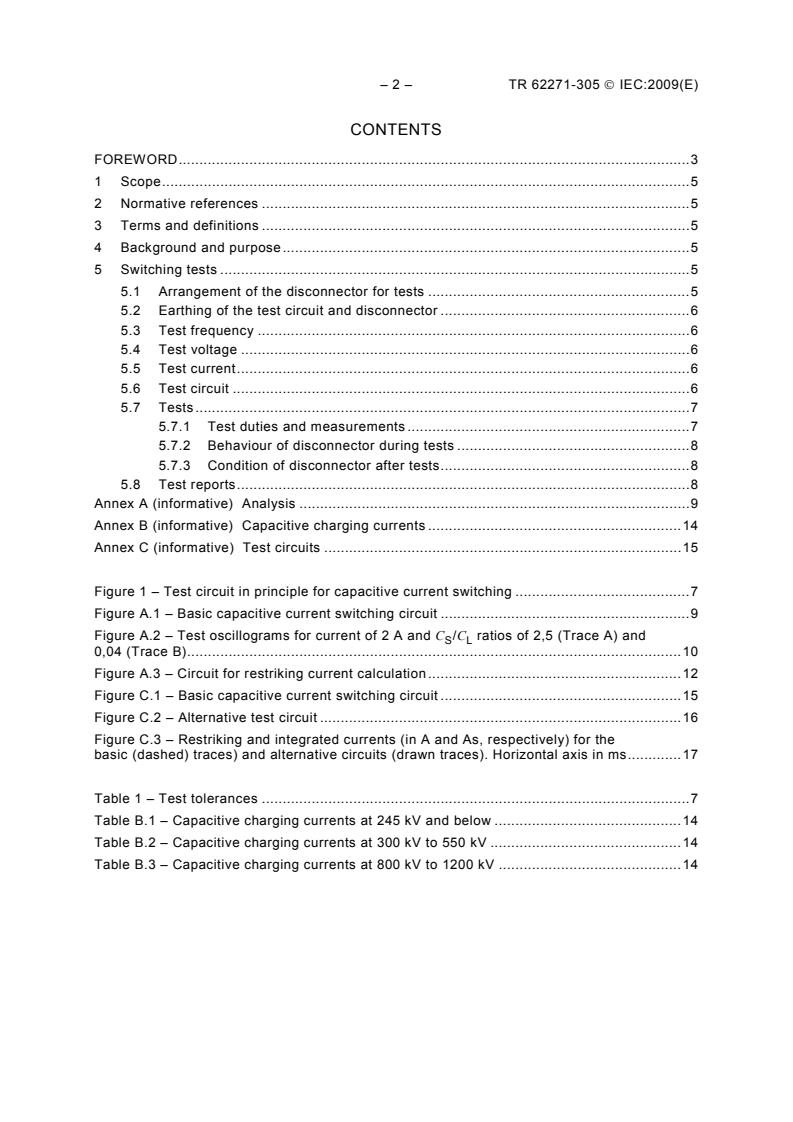
CONTENTS
FOREWORD.3
1 Scope.5
2 Normative references .5
3 Terms and definitions .5
4 Background and purpose.5
5 Switching tests .5
5.1 Arrangement of the disconnector for tests .5
5.2 Earthing of the test circuit and disconnector .6
5.3 Test frequency .6
5.4 Test voltage .6
5.5 Test current.6
5.6 Test circuit .6
5.7 Tests.7
5.7.1 Test duties and measurements .7
5.7.2 Behaviour of disconnector during tests .8
5.7.3 Condition of disconnector after tests.8
5.8 Test reports.8
Annex A (informative) Analysis .9
Annex B (informative) Capacitive charging currents .14
Annex C (informative) Test circuits .15
Figure 1 – Test circuit in principle for capacitive current switching .7
Figure A.1 – Basic capacitive current switching circuit .9
Figure A.2 – Test oscillograms for current of 2 A and C /C ratios of 2,5 (Trace A) and
S L
0,04 (Trace B).10
Figure A.3 – Circuit for restriking current calculation.12
Figure C.1 – Basic capacitive current switching circuit .15
Figure C.2 – Alternative test circuit .16
Figure C.3 – Restriking and integrated currents (in A and As, respectively) for the
basic (dashed) traces) and alternative circuits (drawn traces). Horizontal axis in ms.17
Table 1 – Test tolerances .7
Table B.1 – Capacitive charging currents at 245 kV and below .14
Table B.2 – Capacitive charging currents at 300 kV to 550 kV .14
Table B.3 – Capacitive charging currents at 800 kV to 1200 kV .14
TR 62271-305 © IEC:2009(E) – 3 –
INTERNATIONAL ELECTROTECHNICAL COMMISSION
____________
HIGH-VOLTAGE SWITCHGEAR AND CONTROLGEAR –
Part 305: Capacitive current switching capability of air-insulated
disconnectors for rated voltages above 52 kV
FOREWORD
1) The International Electrotechnical Commission (IEC) is a worldwide organization for standardization comprising
all national electrotechnical committees (IEC National Committees). The object of IEC is to promote
international co-operation on all questions concerning standardization in the electrical and electronic fields. To
this end and in addition to other activities, IEC publishes International Standards, Technical Specifications,
Technical Reports, Publicly Available Specifications (PAS) and Guides (hereafter referred to as “IEC
Publication(s)”). Their preparation is entrusted to technical committees; any IEC National Committee interested
in the subject dealt with may participate in this preparatory work. International, governmental and non-
governmental organizations liaising with the IEC also participate in this preparation. IEC collaborates closely
with the International Organization for Standardization (ISO) in accordance with conditions determined by
agreement between the two organizations.
2) The formal decisions or agreements of IEC on technical matters express, as nearly as possible, an international
consensus of opinion on the relevant subjects since each technical committee has representation from all
interested IEC National Committees.
3) IEC Publications have the form of recommendations for international use and are accepted by IEC National
Committees in that sense. While all reasonable efforts are made to ensure that the technical content of IEC
Publications is accurate, IEC cannot be held responsible for the way in which they are used or for any
misinterpretation by any end user.
4) In order to promote international uniformity, IEC National Committees undertake to apply IEC Publications
transparently to the maximum extent possible in their national and regional publications. Any divergence
between any IEC Publication and the corresponding national or regional publication shall be clearly indicated in
the latter.
5) IEC itself does not provide any attestation of conformity. Independent certification bodies provide conformity
assessment services and, in some areas, access to IEC marks of conformity. IEC is not responsible for any
services carried out by independent certification bodies.
6) All users should ensure that they have the latest edition of this publication.
7) No liability shall attach to IEC or its directors, employees, servants or agents including individual experts and
members of its technical committees and IEC National Committees for any personal injury, property damage or
other damage of any nature whatsoever, whether direct or indirect, or for costs (including legal fees) and
expenses arising out of the publication, use of, or reliance upon, this IEC Publication or any other IEC
Publications.
8) Attention is drawn to the Normative references cited in this publication. Use of the referenced publications is
indispensable for the correct application of this publication.
9) Attention is drawn to the possibility that some of the elements of this IEC Publication may be the subject of
patent rights. IEC shall not be held responsible for identifying any or all such patent rights.
The main task of IEC technical committees is to prepare International Standards. However, a
technical committee may propose the publication of a technical report when it has collected
data of a different kind from that which is normally published as an International Standard, for
example "state of the art".
IEC 62271-305, which is a technical report, has been prepared by subcommittee 17A: High-
voltage switchgear and controlgear, of IEC technical committee 17: Switchgear and
controlgear.
– 4 – TR 62271-305 © IEC:2009(E)
The text of this technical report is based on the following documents:
Enquiry draft Report on voting
17A/872/DTR 17A/885/RVC
Full information on the voting for the approval of this technical report can be found in the
report on voting indicated in the above table.
This publication has been drafted in accordance with the ISO/IEC Directives, Part 2.
A list of all parts of the IEC 62271 series, published under the general title High-voltage
switchgear and controlgear, can be found on the IEC website.
The committee has decided that the contents of this publication will remain unchanged until
the maintenance result date indicated on the IEC web site under "http://webstore.iec.ch" in
the data related to the specific publication. At this date, the publication will be
• reconfirmed,
• withdrawn,
• replaced by a revised edition, or
• amended.
A bilingual version of this publication may be issued at a later date.
The contents of the corrigendum of June 2017 have been included in this copy.
IMPORTANT – The “colour inside” logo on the cover page of this publication indicates
that it contains colours which are considered to be useful for the correct understanding
of its contents. Users should therefore print this publication using a colour printer.
TR 62271-305 © IEC:2009(E) – 5 –
HIGH-VOLTAGE SWITCHGEAR AND CONTROLGEAR –
Part 305: Capacitive current switching capability of air-insulated
disconnectors for rated voltages above 52 kV
1 Scope
This technical report applies to high-voltage air-insulated disconnectors for rated voltages
above 52 kV. The report describes the capacitive current switching duty and provides
guidance on laboratory testing to demonstrate the switching capability. Air-insulated
disconnectors equipped with auxiliary interrupting devices are included under this scope.
NOTE For manually operated disconnectors, the in-service safety of the operator should be considered and it
should be recognized that the results of the switching tests described herein (performed using motor-operated
disconnectors) are not necessarily representative of the performance of such disconnectors in actual service. Due
diligence should be exercised if the switching tests indicate that prolonged arc durations are probable.
2 Normative references
The following referenced documents are indispensable for the application of this document.
For dated references, only the edition cited applies. For undated references, the latest edition
of the referenced document (including any amendments) applies.
IEC 62271-1: High-voltage switchgear and controlgear – Part 1: Common specifications
IEC 62271-102:2001 High-voltage switchgear and controlgear – Part 102: Alternating current
disconnectors and earthing switches
3 Terms and definitions
For purposes of this part of IEC 62271 the terms and definitions in IEC 62271-1 and
IEC 62271-102 apply.
4 Background and purpose
Disconnectors do not have current interrupting ratings but, by virtue of having one or more
moving contacts during opening operations, they have a certain current switching capability.
For capacitive currents and air-insulated disconnectors, this capability has in the past been
taken as 0,5 A or less and no testing was defined. For gas-insulated disconnectors, the
required capacitive current switching capability and test requirements are specified in
Annex F of IEC 62271-102.
User requirements for capacitive current switching using air-insulated disconnectors
frequently exceed the above-stated 0,5 A. The purpose, therefore, of this report is to provide
an analysis of the switching duty (refer to Annex A) and to define testing procedures.
5 Switching tests
5.1 Arrangement of the disconnector for tests
The disconnector under test should be completely mounted on its own support or on an
equivalent support. For safety reasons and to obtain consistent results, only motor operation
should be used. Motor operation should be at the minimum supply voltage.
– 6 – TR 62271-305 © IEC:2009(E)
Before commencing switching tests, resistance measurement of the main circuit and no-load
operations should be made and details of the operating characteristics of the disconnector
such as contact separation (arc initiation), closing time and opening time, should be recorded.
Only singe-phase tests on one pole of a three-pole disconnector need be performed provided
that the pole is not in a more favourable condition than the complete three-pole disconnector
with respect to
• closing time;
• opening time;
• influence of adjacent phases.
NOTE Single-phase tests are adequate to demonstrate the switching performance of a disconnector provided that
the arcing time and arc reach are such that there is no possibility of involvement of an adjacent phase. If excessive
arc reach is encountered during single-phase testing, then three-phase testing should be performed. A reach of the
tip of the arc towards an adjacent phase equal to or greater than half the metal-to-metal spacing between phases is
to be considered as excessive.
5.2 Ea
...