

EN IEC 60335-2-101:2026
(Main)Household and similar electrical appliances - Safety - Part 2-101: Particular requirements for vaporizers
- Abstract
This European Standard deals with the safety of electric vaporizers for household and similar use, their rated voltage being not more than 250 V including direct current (DC) supplied appliances and battery-operated appliances
- Status
- Published
- Publication Date
- 03-Sep-2026
- Technical Committee
- CLC/TC 61 - Safety of household and similar electrical appliances
- Drafting Committee
- CLC/TC 61 - Safety of household and similar electrical appliances
- Current Stage
- 6060 - Document made available - Publishing
- Start Date
- 04-Sep-2026
- Due Date
- 27-Oct-2027
- Completion Date
- 04-Sep-2026

EN IEC 60335-2-101:2026 is a European Standard published by CENELEC for the safety of electric vaporizers for household and similar use. It covers appliances with rated voltage not more than 250 V, including direct current (DC) supplied appliances and battery-operated appliances. The document gives particular safety requirements that are used together with IEC 60335-1 and adapted for vaporizers.
What does EN IEC 60335-2-101:2026 specify?
EN IEC 60335-2-101:2026 specifies safety requirements for electric vaporizers for household and similar use. It is written for appliances such as air fresheners and insect repellers, and it also covers products intended for use by laypersons in shops, light industry and farms when they can present a public safety risk.
The standard is organized as a Part 2 document that modifies the general requirements in Part 1 clause by clause. Clause 1 gives the scope and exclusions, Clause 2 lists the normative references, Clause 3 gives definitions, and Clauses 4 to 32 cover the safety tests and construction topics. Annex B is normative and deals with battery-operated appliances and their batteries.
| Annex | What it covers |
|---|---|
| Annex B (normative) | Battery-operated appliances, separable batteries and detachable batteries for battery-operated appliances |
What are the key requirements of EN IEC 60335-2-101:2026?
Scope, exclusions and the basic safety approach
EN IEC 60335-2-101:2026 applies to vaporizers used in household and similar environments, with rated voltage not more than 250 V. Clause 1 also makes clear that it is aimed at common hazards around the home, while still covering certain non-household products used by laypersons.
The scope excludes appliances intended exclusively for industrial purposes, appliances used in special atmospheres such as corrosive or explosive dust, vapour or gas, and several related product families named in the clause. In practice, that means a manufacturer needs to check whether a product is really a vaporizer under this part, or whether another Part 2 standard is the better fit.
Marking and instructions
Clause 7 allows an appliance with rated power input not exceeding 10 W to be marked “10 W max”. For a buyer or compliance team, this means the rating can appear in a simplified form, but the stated limit still has to be respected in testing.
Clause 7.12 requires instructions to say that the appliance is only to be used with the recommended vaporizing medium, because other substances can create toxic or fire risk. For directly plugged appliances, the instructions also need a warning when accessible surfaces become hot during the Clause 11 test. This matters because the user manual is part of the safety control, not just a product description.
Access to live parts and mechanical hazards
Clause 8 adds test probe 19, used together with test probe 18, for parts with pins for insertion into the socket-outlet and for appliances situated not more than 850 mm above the floor after installation or in normal use. Clause 20 applies the same addition for stability and mechanical hazard checks.
In practice, this tightens the reachability test for plug-in products and for appliances that may be low enough for contact by children or bystanders. Designers need to plan barriers, spacing and shape so the appliance remains safe under the extra probe test conditions.
Heating and surface temperatures
Clause 11 introduces a dedicated probe in Figure 101 for measuring temperature rise on suitably flat external accessible surfaces, using a contact force of 4 N ± 1 N for 30 s. Table 101 gives the maximum temperature rise limits for those surfaces, with different values depending on the surface material and whether the appliance is installed more than 850 mm above the floor.
For directly plugged appliances, Clause 11 adds further limits for accessible surfaces and a separate limit for the surface adjacent to the socket-outlet. That matters because the hot parts of a plug-in vaporizer are close to the wall outlet and can present a burn hazard in normal use.
Abnormal operation and fire risk
Clause 19 requires operation without the vaporizing medium and adds test 19.101, where a pre-washed cotton sheet is draped over the appliance during normal operation at rated voltage. The cotton sheet must not smoulder or ignite.
This is the key fire-risk check for vaporizers, because loss of medium, user error, or accidental contact with fabric must not turn the appliance into an ignition source. For product development, it means the heater and enclosure must stay within safe limits even in foreseeable abnormal use.
Battery-operated appliances and connection arrangements
Clause 12 of Part 1 applies to charging of metal-ion batteries, and Annex B gives the additional provisions for battery-operated appliances, separable batteries and detachable batteries. Annex B also extends the use of test probe 19 to battery parts situated not more than 850 mm above the floor.
Clause 25.5 allows Type Z attachment. In practical terms, battery versions and cord-connected versions both need to be checked for safe construction, suitable charging arrangements and the correct attachment method.
What terms does EN IEC 60335-2-101:2026 define?
- Vaporizer - An appliance that incorporates a heater to vaporize a medium in order to affect the air in a room.
- Normal operation - The appliance is operated filled with vaporizing medium in accordance with the instructions, or unfilled if that gives a more severe condition.
- Direct current (DC) - A supply type included in the scope, so the standard applies not only to mains-fed appliances but also to DC supplied appliances.
- Battery-operated appliance - An appliance powered from batteries, covered in Annex B for extra safety provisions.
- Separable battery - A battery intended to be separable from the appliance, addressed in Annex B.
- Detachable battery - A battery intended to be detached from the battery-operated appliance, also addressed in Annex B.
Who uses EN IEC 60335-2-101:2026?
EN IEC 60335-2-101:2026 is used by manufacturers, design engineers, test laboratories, certification bodies, quality managers and buyers who need to verify the safety of vaporizers. It is especially relevant for products such as air fresheners and insect repellers, and for battery-operated or socket-plugged designs.
It is also useful for teams preparing instructions, ratings, and conformity test plans. Because the scope includes appliances sold for use by laypersons in shops, light industry and farms, the document matters beyond traditional domestic product lines.
What changed in EN IEC 60335-2-101:2026 from the previous edition?
EN IEC 60335-2-101:2026 supersedes EN 60335-2-101:2002 and its amendments. The IEC second edition also cancels and replaces the first edition published in 2002, Amendment 1:2008 and Amendment 2:2014.
The stated technical changes are:
- alignment with IEC 60335-1:2020
- conversion of some notes to normative text in Clause 1 and 7.1
- introduction of test probe 19 in 8.1.1, 8.1.3, 20.2, B.22.3 and B.22.4
- addition of external accessible surface temperatures in Clause 11
Which standards are used with EN IEC 60335-2-101:2026?
- IEC 60335-1 - The general Part 1 safety standard that this part 2 is used with and modifies for vaporizers.
- IEC 60584-1 - Gives the thermocouple EMF specifications and tolerances used for the probe in Figure 101.
- EN IEC 60335-2-101:2026/A11:2026 - The foreword says this document is read in conjunction with that amendment.
- IEC 60335-2-15, IEC 60335-2-59, IEC 60335-2-85 and IEC 60335-2-98 - Named in the bibliography as related parts for heating liquids, insect killers, fabric steamers and humidifiers.
What does the EN IEC 60335-2-101:2026 document contain?
EN IEC 60335-2-101:2026 contains the full Part 2 structure for vaporizers, with clauses from scope through radiation, toxicity and similar hazards. It also contains a normative Annex B for battery-operated appliances and battery parts.
The document includes Figure 101 for the temperature-measuring probe and Table 101 for maximum temperature rises of accessible surfaces. It also sets out the abnormal-operation cotton-sheet test, the rotation test for some plug-in appliances, and the added probe 19 checks for access and mechanical safety.
Relations
- Effective Date
- 01-Apr-2025
- Effective Date
- 01-Apr-2025
- Effective Date
- 01-Apr-2025
- Effective Date
- 05-May-2026
- Effective Date
- 08-Sep-2026
- Effective Date
- 08-Sep-2026
- Effective Date
- 07-Apr-2025
Get Certified
Connect with accredited certification bodies for this standard

CIS Institut d.o.o.
Personal Protective Equipment (PPE) certification body. Notified Body NB-2890 for EU Regulation 2016/425 PPE.

Kiwa BDA Testing
Building and construction product certification.
Kmetijski inštitut Slovenije
Agricultural Institute of Slovenia. Soil testing, plant health, agricultural product analysis.
Sponsored listings
Frequently Asked Questions
EN IEC 60335-2-101:2026 is a standard published by CLC. Its full title is "Household and similar electrical appliances - Safety - Part 2-101: Particular requirements for vaporizers". This standard covers: This European Standard deals with the safety of electric vaporizers for household and similar use, their rated voltage being not more than 250 V including direct current (DC) supplied appliances and battery-operated appliances
This European Standard deals with the safety of electric vaporizers for household and similar use, their rated voltage being not more than 250 V including direct current (DC) supplied appliances and battery-operated appliances
EN IEC 60335-2-101:2026 is classified under the following ICS (International Classification for Standards) categories: 13.120 - Domestic safety; 97.030 - Domestic electrical appliances in general. The ICS classification helps identify the subject area and facilitates finding related standards.
EN IEC 60335-2-101:2026 has the following relationships with other standards: It is inter standard links to EN 60335-2-101:2002, EN 60335-2-101:2002/A1:2008, EN 60335-2-101:2002/A2:2014, EN 60584-1:2013, EN 12976-1:2017, EN 12976-1:2021, EN IEC 60335-2-101:2026/A11:2026. Understanding these relationships helps ensure you are using the most current and applicable version of the standard.
EN IEC 60335-2-101:2026 is available in PDF format for immediate download after purchase. The document can be added to your cart and obtained through the secure checkout process. Digital delivery ensures instant access to the complete standard document.
Standards Content (Sample)
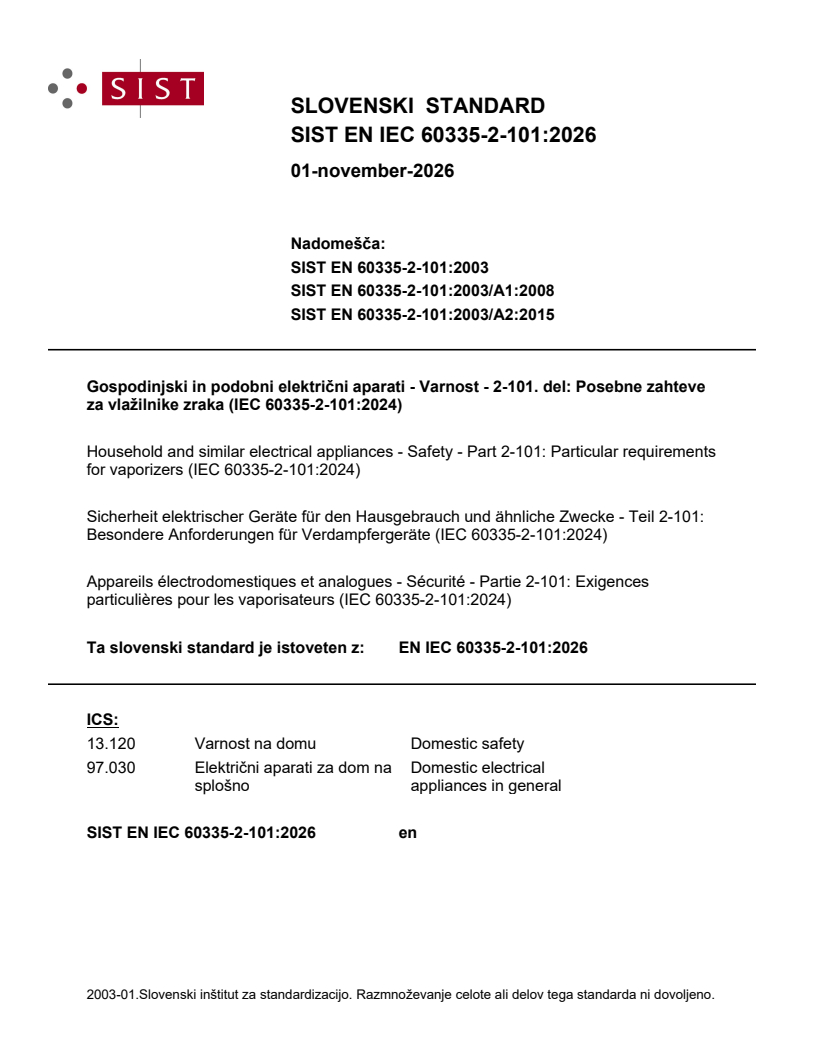
SLOVENSKI STANDARD
01-november-2026
Nadomešča:
SIST EN 60335-2-101:2003
SIST EN 60335-2-101:2003/A1:2008
SIST EN 60335-2-101:2003/A2:2015
Gospodinjski in podobni električni aparati - Varnost - 2-101. del: Posebne zahteve
za vlažilnike zraka (IEC 60335-2-101:2024)
Household and similar electrical appliances - Safety - Part 2-101: Particular requirements
for vaporizers (IEC 60335-2-101:2024)
Sicherheit elektrischer Geräte für den Hausgebrauch und ähnliche Zwecke - Teil 2-101:
Besondere Anforderungen für Verdampfergeräte (IEC 60335-2-101:2024)
Appareils électrodomestiques et analogues - Sécurité - Partie 2-101: Exigences
particulières pour les vaporisateurs (IEC 60335-2-101:2024)
Ta slovenski standard je istoveten z: EN IEC 60335-2-101:2026
ICS:
13.120 Varnost na domu Domestic safety
97.030 Električni aparati za dom na Domestic electrical
splošno appliances in general
2003-01.Slovenski inštitut za standardizacijo. Razmnoževanje celote ali delov tega standarda ni dovoljeno.
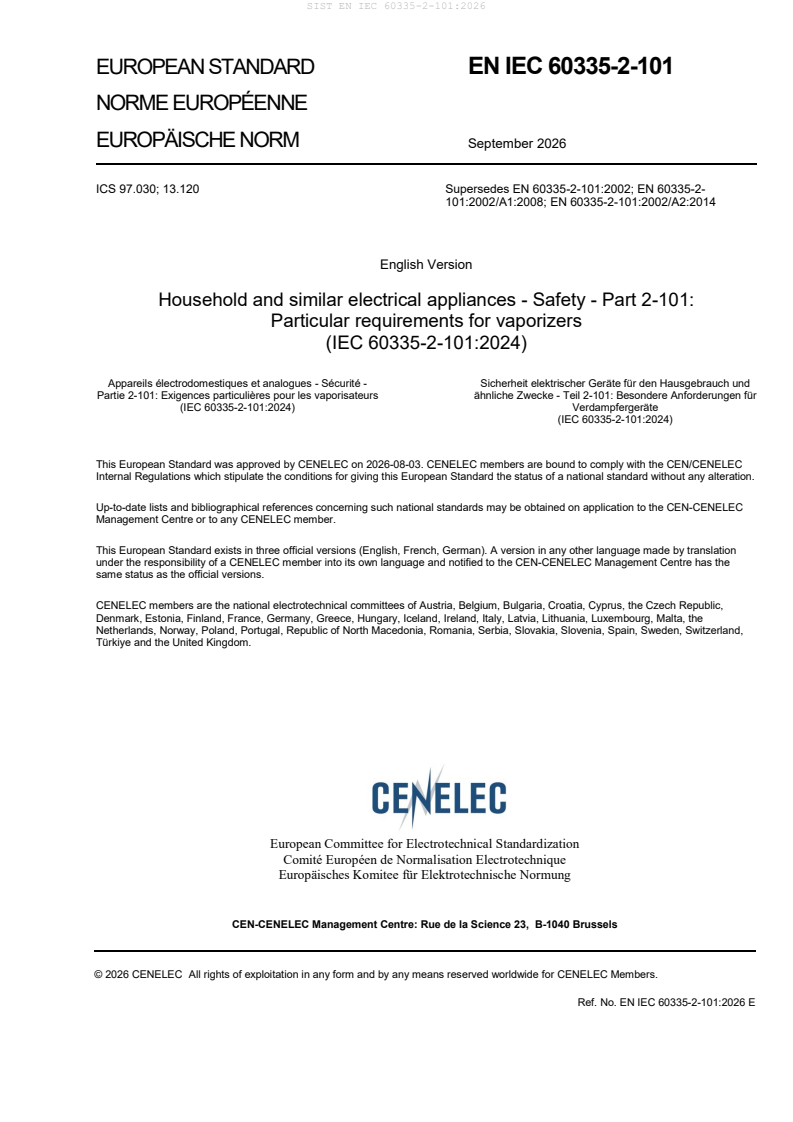
EUROPEAN STANDARD EN IEC 60335-2-101
NORME EUROPÉENNE
EUROPÄISCHE NORM September 2026
ICS 97.030; 13.120 Supersedes EN 60335-2-101:2002; EN 60335-2-
101:2002/A1:2008; EN 60335-2-101:2002/A2:2014
English Version
Household and similar electrical appliances - Safety - Part 2-101:
Particular requirements for vaporizers
(IEC 60335-2-101:2024)
Appareils électrodomestiques et analogues - Sécurité - Sicherheit elektrischer Geräte für den Hausgebrauch und
Partie 2-101: Exigences particulières pour les vaporisateurs ähnliche Zwecke - Teil 2-101: Besondere Anforderungen für
(IEC 60335-2-101:2024) Verdampfergeräte
(IEC 60335-2-101:2024)
This European Standard was approved by CENELEC on 2026-08-03. CENELEC members are bound to comply with the CEN/CENELEC
Internal Regulations which stipulate the conditions for giving this European Standard the status of a national standard without any alteration.
Up-to-date lists and bibliographical references concerning such national standards may be obtained on application to the CEN-CENELEC
Management Centre or to any CENELEC member.
This European Standard exists in three official versions (English, French, German). A version in any other language made by translation
under the responsibility of a CENELEC member into its own language and notified to the CEN-CENELEC Management Centre has the
same status as the official versions.
CENELEC members are the national electrotechnical committees of Austria, Belgium, Bulgaria, Croatia, Cyprus, the Czech Republic,
Denmark, Estonia, Finland, France, Germany, Greece, Hungary, Iceland, Ireland, Italy, Latvia, Lithuania, Luxembourg, Malta, the
Netherlands, Norway, Poland, Portugal, Republic of North Macedonia, Romania, Serbia, Slovakia, Slovenia, Spain, Sweden, Switzerland,
Türkiye and the United Kingdom.
European Committee for Electrotechnical Standardization
Comité Européen de Normalisation Electrotechnique
Europäisches Komitee für Elektrotechnische Normung
CEN-CENELEC Management Centre: Rue de la Science 23, B-1040 Brussels
© 2026 CENELEC All rights of exploitation in any form and by any means reserved worldwide for CENELEC Members.
Ref. No. EN IEC 60335-2-101:2026 E
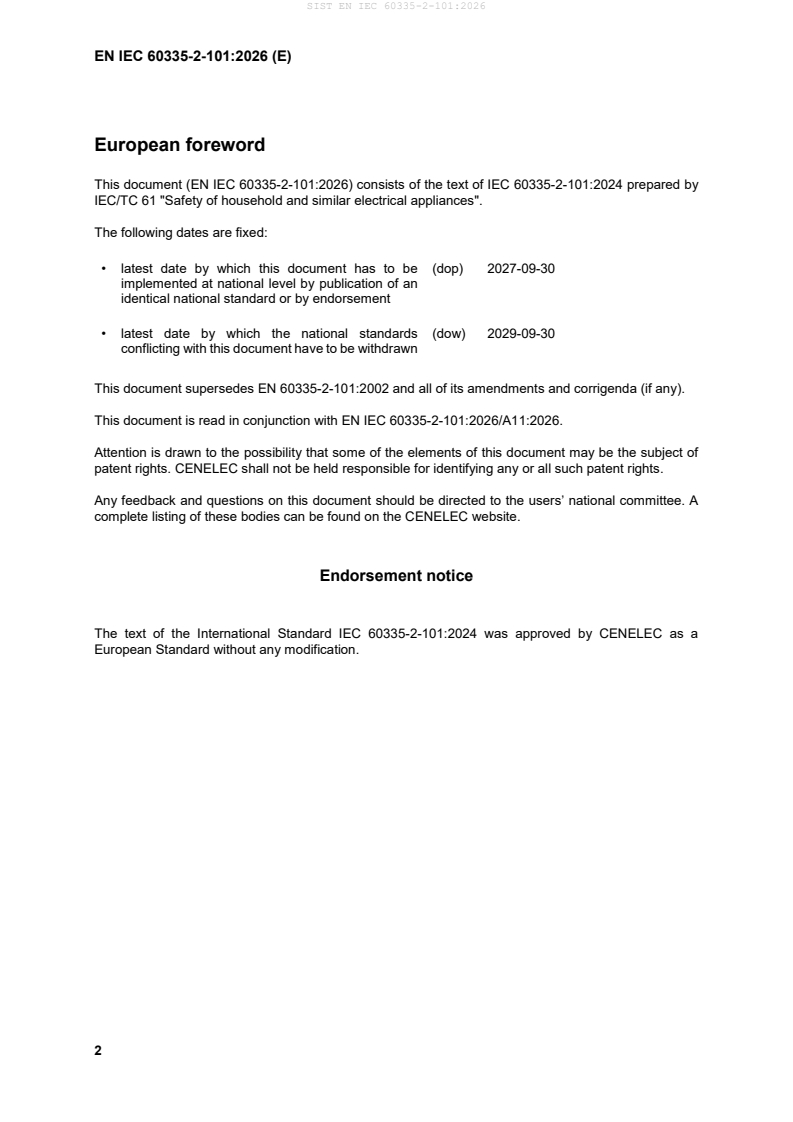
European foreword
This document (EN IEC 60335-2-101:2026) consists of the text of IEC 60335-2-101:2024 prepared by
IEC/TC 61 "Safety of household and similar electrical appliances".
The following dates are fixed:
• latest date by which this document has to be (dop) 2027-09-30
implemented at national level by publication of an
identical national standard or by endorsement
• latest date by which the national standards (dow) 2029-09-30
conflicting with this document have to be withdrawn
This document supersedes EN 60335-2-101:2002 and all of its amendments and corrigenda (if any).
This document is read in conjunction with EN IEC 60335-2-101:2026/A11:2026.
Attention is drawn to the possibility that some of the elements of this document may be the subject of
patent rights. CENELEC shall not be held responsible for identifying any or all such patent rights.
Any feedback and questions on this document should be directed to the users’ national committee. A
complete listing of these bodies can be found on the CENELEC website.
Endorsement notice
The text of the International Standard IEC 60335-2-101:2024 was approved by CENELEC as a
European Standard without any modification.
IEC 60335-2-101 ®
Edition 2.0 2024-10
INTERNATIONAL
STANDARD
NORME
INTERNATIONALE
Household and similar electrical appliances – Safety –
Part 2-101: Particular requirements for vaporizers
Appareils électrodomestiques et analogues – Sécurité –
Partie 2-101: Exigences particulières pour les vaporisateurs
INTERNATIONAL
ELECTROTECHNICAL
COMMISSION
COMMISSION
ELECTROTECHNIQUE
INTERNATIONALE
ICS 97.030, 13.120 ISBN 978-2-8322-9745-2
– 2 – IEC 60335-2-101:2024 © IEC 2024
CONTENTS
FOREWORD . 4
INTRODUCTION . 7
1 Scope . 8
2 Normative references . 9
3 Terms and definitions . 9
4 General requirement . 9
5 General conditions for the tests . 9
6 Classification . 9
7 Marking and instructions . 9
8 Protection against access to live parts . 10
9 Starting of motor-operated appliances . 10
10 Power input and current . 10
11 Heating . 10
12 Charging of metal-ion batteries . 12
13 Leakage current and electric strength at operating temperature . 12
14 Transient overvoltages . 12
15 Moisture resistance . 12
16 Leakage current and electric strength . 12
17 Overload protection of transformers and associated circuits . 13
18 Endurance . 13
19 Abnormal operation . 13
20 Stability and mechanical hazards . 14
21 Mechanical strength . 14
22 Construction . 14
23 Internal wiring . 14
24 Components . 14
25 Supply connection and external flexible cords . 15
26 Terminals for external conductors . 15
27 Provision for earthing . 15
28 Screws and connections . 15
29 Clearances, creepage distances and solid insulation . 15
30 Resistance to heat and fire . 15
31 Resistance to rusting . 15
32 Radiation, toxicity and similar hazards . 15
Annexes . 17
Annex B (normative) Battery-operated appliances, separable batteries and detachable
batteries for battery-operated appliances . 18
Bibliography . 19
IEC 60335-2-101:2024 © IEC 2024 – 3 –
Figure 101 – Probe for measuring surface temperatures . 16
Table 101 – Maximum temperature rises for specified external accessible surfaces
under normal operating conditions . 12
– 4 – IEC 60335-2-101:2024 © IEC 2024
INTERNATIONAL ELECTROTECHNICAL COMMISSION
____________
HOUSEHOLD AND SIMILAR ELECTRICAL APPLIANCES –
SAFETY –
Part 2-101: Particular requirements for vaporizers
FOREWORD
1) The International Electrotechnical Commission (IEC) is a worldwide organization for standardization comprising
all national electrotechnical committees (IEC National Committees). The object of IEC is to promote international
co-operation on all questions concerning standardization in the electrical and electronic fields. To this end and
in addition to other activities, IEC publishes International Standards, Technical Specifications, Technical Reports,
Publicly Available Specifications (PAS) and Guides (hereafter referred to as "IEC Publication(s)"). Their
preparation is entrusted to technical committees; any IEC National Committee interested in the subject dealt with
may participate in this preparatory work. International, governmental and non-governmental organizations liaising
with the IEC also participate in this preparation. IEC collaborates closely with the International Organization for
Standardization (ISO) in accordance with conditions determined by agreement between the two organizations.
2) The formal decisions or agreements of IEC on technical matters express, as nearly as possible, an international
consensus of opinion on the relevant subjects since each technical committee has representation from all
interested IEC National Committees.
3) IEC Publications have the form of recommendations for international use and are accepted by IEC National
Committees in that sense. While all reasonable efforts are made to ensure that the technical content of IEC
Publications is accurate, IEC cannot be held responsible for the way in which they are used or for any
misinterpretation by any end user.
4) In order to promote international uniformity, IEC National Committees undertake to apply IEC Publications
transparently to the maximum extent possible in their national and regional publications. Any divergence between
any IEC Publication and the corresponding national or regional publication shall be clearly indicated in the latter.
5) IEC itself does not provide any attestation of conformity. Independent certification bodies provide conformity
assessment services and, in some areas, access to IEC marks of conformity. IEC is not responsible for any
services carried out by independent certification bodies.
6) All users should ensure that they have the latest edition of this publication.
7) No liability shall attach to IEC or its directors, employees, servants or agents including individual experts and
members of its technical committees and IEC National Committees for any personal injury, property damage or
other damage of any nature whatsoever, whether direct or indirect, or for costs (including legal fees) and
expenses arising out of the publication, use of, or reliance upon, this IEC Publication or any other IEC
Publications.
8) Attention is drawn to the Normative references cited in this publication. Use of the referenced publications is
indispensable for the correct application of this publication.
9) IEC draws attention to the possibility that the implementation of this document may involve the use of (a)
patent(s). IEC takes no position concerning the evidence, validity or applicability of any claimed patent rights in
respect thereof. As of the date of publication of this document, IEC had not received notice of (a) patent(s), which
may be required to implement this document. However, implementers are cautioned that this may not represent
the latest information, which may be obtained from the patent database available at https://patents.iec.ch. IEC
shall not be held responsible for identifying any or all such patent rights.
IEC 60335-2-101 has been prepared by IEC technical committee 61: Safety of household and
similar electrical appliances. It is an International Standard.
This second edition cancels and replaces the first edition published in 2002, Amendment 1:2008
and Amendment 2:2014. This edition constitutes a technical revision.
This edition includes the following significant technical changes with respect to the previous
edition:
a) alignment with IEC 60335-1:2020;
b) conversion of some notes to normative text (Clause 1, 7.1);
c) application of test probe 19 has been introduced (8.1.1, 8.1.3, 20.2, B.22.3, B.22.4);
d) addition of external accessible surface temperatures (Clause 11).
IEC 60335-2-101:2024 © IEC 2024 – 5 –
The text of this International Standard is based on the following documents:
Draft Report on voting
61/7278/FDIS 61/7302/RVD
Full information on the voting for its approval can be found in the report on voting indicated in
the above table.
The language used for the development of this International Standard is English.
This document was drafted in accordance with ISO/IEC Directives, Part 2, and developed in
accordance with ISO/IEC Directives, Part 1 and ISO/IEC Directives, IEC Supplement, available
at www.iec.ch/members_experts/refdocs. The main document types developed by IEC are
described in greater detail at www.iec.ch/publications.
A list of all parts of the IEC 60335 series, under the general title: Household and similar
electrical appliances – Safety, can be found on the IEC website.
This part 2 is to be used in conjunction with the latest edition of IEC 60335-1 and its
amendments unless that edition precludes it; in that case, the latest edition that does not
preclude it is used. It was established on the basis of the sixth edition (2020) of that standard.
NOTE 1 When "Part 1" is mentioned in this standard, it refers to IEC 60335-1.
This part 2 supplements or modifies the corresponding clauses in IEC 60335-1, so as to convert
that publication into the IEC standard: Particular requirements for vaporizers.
When a particular subclause of Part 1 is not mentioned in this part 2, that subclause applies as
far as is reasonable. When this standard states "addition", "modification", or "replacement", the
relevant text in Part 1 is to be adapted accordingly.
NOTE 2 The following numbering system is used:
– subclauses, tables and figures that are numbered starting from 101 are additional to those in Part 1;
– unless notes are in a new subclause or involve notes in Part 1, they are numbered starting from 101, including
those in a replaced clause or subclause;
– additional annexes are lettered AA, BB, etc.
NOTE 3 The following print types are used:
– requirements: in roman type;
– test specifications: in italic type;
– notes: in small roman type.
Words in bold in the text are defined in Clause 3. When a definition concerns an adjective, the adjective and the
associated noun are also in bold.
– 6 – IEC 60335-2-101:2024 © IEC 2024
The committee has decided that the contents of this document will remain unchanged until the
stability date indicated on the IEC website under webstore.iec.ch in the data related to the
specific document. At this date, the document will be
• reconfirmed,
• withdrawn, or
• revised.
NOTE 4 The attention of National Committees is drawn to the fact that equipment manufacturers and testing
organizations can need a transitional period following publication of a new, amended or revised IEC publication in
which to make products in accordance with the new requirements and to equip themselves for conducting new or
revised tests.
It is the recommendation of the committee that the content of this publication be adopted for implementation nationally
not earlier than 12 months or later than 36 months from the date of publication.
--
...