

prEN IEC 62973-2:2025/prAA:2026
(Amendment)Railway applications - Rolling stock - Batteries for auxiliary power supply systems - Part 2: Nickel Cadmium (NiCd) batteries
- Abstract
The part 2 of IEC 62973 will get a European annex. The European annex will contain additions regarding European operating conditions (such as temperature) and requirements (such as such as discharging/charging characteristic, application of guidelines TR 50718) as well as general additions (which are contained in EN 50547 and are missing in the IEC-version).
- Status
- Not Published
- Publication Date
- 13-Mar-2028
- Technical Committee
- CLC/TC 9X - Electrical and electronic applications for railways
- Drafting Committee
- WG 45 - RS - Auxiliary Batteries
- Current Stage
- 4020 - Enquiry circulated - Enquiry
- Start Date
- 07-Aug-2026
- Due Date
- 26-Jan-2026
- Completion Date
- 07-Aug-2026
prEN IEC 62973-2:2025/prAA:2026 is a CENELEC draft amendment for railway rolling stock auxiliary power supply batteries, focused on Nickel Cadmium (NiCd) batteries. It adds European requirements for operating conditions, charging behaviour, capacity sizing, fire protection, and battery information for train manufacturers, battery manufacturers, system integrators, and end users.
What does prEN IEC 62973-2:2025/prAA:2026 specify?
prEN IEC 62973-2:2025/prAA:2026 specifies European modifications to the rolling stock battery standard for NiCd batteries. The amendment is organized as a European foreword followed by changes to Clause 2, 3.1, 3.2, 4.2.5, 4.4.1, 4.4.2, 4.4.4, 4.4.5, 4.6, 4.9.2 and the Bibliography.
In practice, the document adds European operating-condition material such as temperature-related expectations, charging and discharging characteristics, application of CLC/TR 50718, and general additions that the scope says are drawn from EN 50547 and are missing from the IEC version.
What are the key requirements of prEN IEC 62973-2:2025/prAA:2026?
prEN IEC 62973-2:2025/prAA:2026 mainly tightens the battery selection, charging, sizing and safety information used for NiCd batteries on rolling stock.
- Clause 2 - normative references updates the base NiCd cell standards to IEC/FDIS 60623:2026 and IEC/FDIS 62259:2026. This means the amendment is aligned with the newer industrial-cell documents.
- Clause 3.1 and 3.2 add the term reference test current and the abbreviation I_t. This gives one common current basis for comparing charge and discharge data against rated capacity.
- Clause 4.2.5 adds a note that NiCd pocket plate batteries can be used under special agreement between the end user, system integrator and manufacturer. In practice, that use is not the default and needs explicit agreement.
- Clause 4.4.2 replaces the charging guidance with typical charging characteristics by technology and performance type, including float and boost voltages, temperature correction, switching setpoints, stop charging temperature, and current thresholds. It also limits battery charging voltage to the equipment maximum voltage and points to the preferred 110 V low-voltage supply network used in EN IEC 62973-1.
- Clause 4.4.4 sets a self-discharge expectation: a fully charged NiCd battery shall have no more than 20 % reversible loss after 28 days at 20 °C. That matters for storage, standby readiness and maintenance planning.
- Clause 4.4.5 assigns the sizing data split between train manufacturer and battery manufacturer. The train manufacturer defines SOC, ambient emergency temperature, load profile and minimum battery voltage; the battery manufacturer defines ageing factor and expected life. The clause also requires low-temperature operation down to -18 °C or an agreed value without permanent damage.
- Clause 4.6 and 4.9.2 add two practical limits: fire protection is to observe and comply with CLC/TR 50718, and available energy in service can only be estimated to a limited extent because NiCd discharge voltage is non-linear.
What terms does prEN IEC 62973-2:2025/prAA:2026 define?
- reference test current (I_t) - the charge or discharge current whose numerical value equals the rated capacity in ampere-hours; it gives a common test current basis.
- NiCd - Nickel Cadmium batteries, the battery technology covered by this amendment.
- SOC - state of charge, used in battery sizing and emergency-load assumptions.
- DoD - depth of discharge, used in the energy-throughput example in the sizing data.
- float charging - the maintained charging mode used to keep the battery ready in service.
- boost charging - the higher charging mode used before the battery returns to float charging.
Who uses prEN IEC 62973-2:2025/prAA:2026?
prEN IEC 62973-2:2025/prAA:2026 is used by the people who specify, design, approve and maintain auxiliary battery systems for rolling stock.
- Train manufacturers use it to define emergency load profiles, minimum voltage and sizing assumptions.
- Battery manufacturers use it to state charging characteristics, ageing factor, expected life and documentation.
- System integrators and end users use it when agreeing special applications such as pocket plate batteries.
- Railway electrical and safety teams use it when checking charging, fire protection and low-temperature performance.
What changed in prEN IEC 62973-2:2025/prAA:2026 from the previous edition?
prEN IEC 62973-2:2025/prAA:2026 modifies prEN IEC 62973-2:2025 by:
- replacing the cited IEC 60623 and IEC 62259 references with the 2026 FDIS editions,
- adding the term reference test current and the abbreviation I_t,
- adding a note on pocket plate/electrode technology under special agreement,
- revising system-voltage and charging requirements, including Table 2 and Figure 4,
- tightening the self-discharge statement,
- rewriting the battery-capacity sizing text and adding the low-temperature emergency-load condition,
- adding a fire-protection statement linked to CLC/TR 50718,
- adding a battery-information-system note on the limits of available-energy calculation,
- updating the Bibliography with EN 50125-1, EN 50155, CLC/TR 50718, IEC 61434 and prEN IEC 62973-3:2025.
Which standards are used with prEN IEC 62973-2:2025/prAA:2026?
| Standard | What it contributes |
|---|---|
| IEC/FDIS 60623:2026 | Base standard for vented NiCd prismatic rechargeable cells and batteries for industrial use. |
| IEC/FDIS 62259:2026 | Base standard for NiCd prismatic rechargeable cells with partial gas recombination. |
| EN 50125-1 | Environmental conditions for rolling stock and on-board equipment. |
| EN 50155 | Rolling stock electronic equipment; used for voltage-related limits. |
| CLC/TR 50718 | Guidelines for using EN 45545-2 for Ni-Cd batteries on board rolling stock. |
| IEC 61434 | Source for the current designation used for I_t. |
| EN IEC 62973-1 | Cited for the preferred 110 V low-voltage supply network. |
| prEN IEC 62973-3:2025 | Companion part for lead acid batteries, cited for load-profile and sizing references. |
| EN 50547 | Named in the scope as the source of general additions carried into the European version. |
What does the prEN IEC 62973-2:2025/prAA:2026 document contain?
prEN IEC 62973-2:2025/prAA:2026 contains replacement text for the charging section, including Table 2 of typical NiCd charging characteristics and Figure 4 showing the charging behaviour. It also contains the revised battery-sizing text and Table 3, which sets out the information needed to define a discharging characteristic.
The amendment also adds a note on pocket plate batteries, updated fire-protection wording, and a battery-information-system note that explains why in-service energy estimates are only approximate. The Bibliography links the document to the environmental, voltage, fire-safety and battery-design references used in practice.
Relations
- Effective Date
- 25-Feb-2025
Get Certified
Connect with accredited certification bodies for this standard

IMQ S.p.A. (Certification)
Italian electrical product certification.

IRIS Certification (UNIFE)
International Railway Industry Standard certification.

SLG Prüf- und Zertifizierungs GmbH
German testing and certification body.
Sponsored listings
Frequently Asked Questions
prEN IEC 62973-2:2025/prAA:2026 is a draft published by CLC. Its full title is "Railway applications - Rolling stock - Batteries for auxiliary power supply systems - Part 2: Nickel Cadmium (NiCd) batteries". This standard covers: The part 2 of IEC 62973 will get a European annex. The European annex will contain additions regarding European operating conditions (such as temperature) and requirements (such as such as discharging/charging characteristic, application of guidelines TR 50718) as well as general additions (which are contained in EN 50547 and are missing in the IEC-version).
The part 2 of IEC 62973 will get a European annex. The European annex will contain additions regarding European operating conditions (such as temperature) and requirements (such as such as discharging/charging characteristic, application of guidelines TR 50718) as well as general additions (which are contained in EN 50547 and are missing in the IEC-version).
prEN IEC 62973-2:2025/prAA:2026 is classified under the following ICS (International Classification for Standards) categories: 29.220.99 - Other cells and batteries; 45.060.01 - Railway rolling stock in general. The ICS classification helps identify the subject area and facilitates finding related standards.
prEN IEC 62973-2:2025/prAA:2026 has the following relationships with other standards: It is inter standard links to prEN IEC 62973-2:2025. Understanding these relationships helps ensure you are using the most current and applicable version of the standard.
prEN IEC 62973-2:2025/prAA:2026 is available in PDF format for immediate download after purchase. The document can be added to your cart and obtained through the secure checkout process. Digital delivery ensures instant access to the complete standard document.
Standards Content (Sample)
SLOVENSKI STANDARD
01-september-2026
Železniške naprave - Vozna sredstva - Baterije za pomožne napajalne sisteme - 2.
del: Nikelj-kadmij (NiCd) baterije - Dopolnilo AA
Railway applications - Rolling stock - Batteries for auxiliary power supply systems - Part
2: Nickel Cadmium (NiCd) batteries
Bahnanwendungen - Fahrzeuge - Batterien für Bordnetzversorgungssysteme - Teil 2:
Nickel-Cadmium-Batterien (NiCd-Batterien)
Applications ferroviaires - Matériel roulant - Batteries pour systèmes d'alimentation
auxiliaire - Partie 2: Batteries au Nickel Cadmium (NiCd)
Ta slovenski standard je istoveten z: prEN IEC 62973-2:2025/prAA:2026
ICS:
29.220.99 Drugi členi in baterije Other cells and batteries
45.060.01 Železniška vozila na splošno Railway rolling stock in
general
oSIST prEN IEC 62973- en
2:2025/oprAA:2026
2003-01.Slovenski inštitut za standardizacijo. Razmnoževanje celote ali delov tega standarda ni dovoljeno.
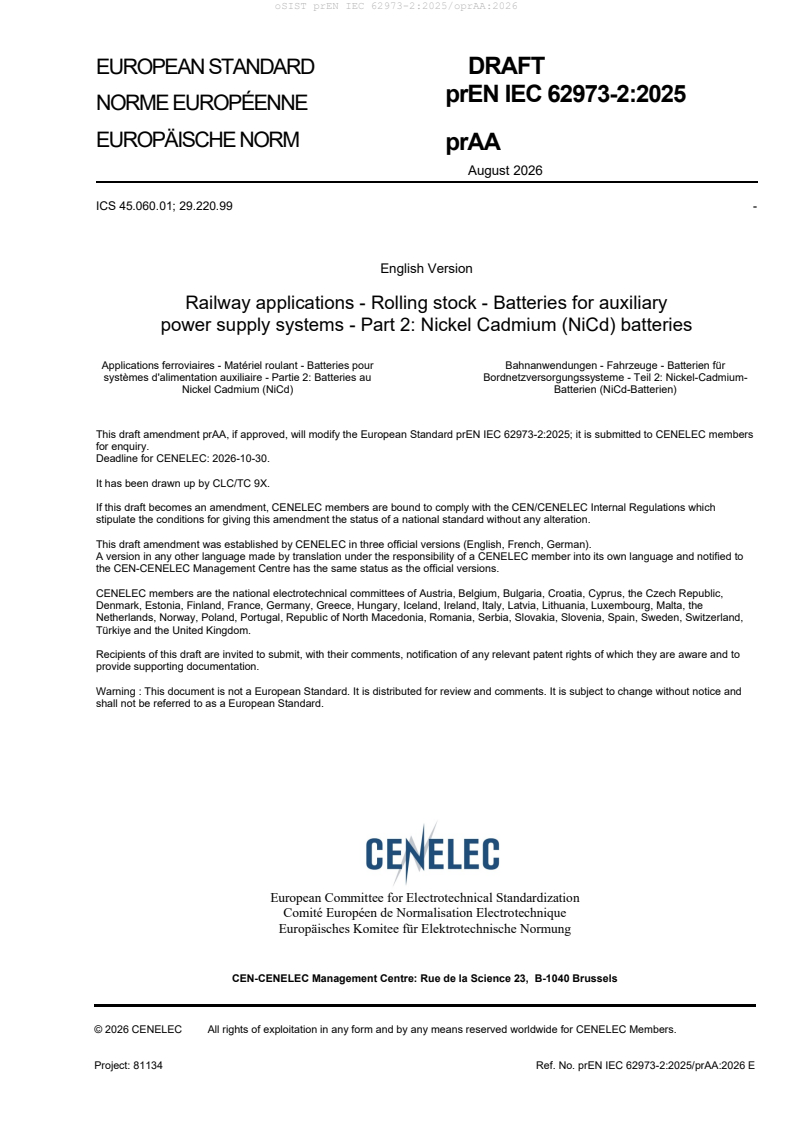
EUROPEAN STANDARD DRAFT
prEN IEC 62973-2:2025
NORME EUROPÉENNE
EUROPÄISCHE NORM
prAA
August 2026
ICS 45.060.01; 29.220.99 -
English Version
Railway applications - Rolling stock - Batteries for auxiliary
power supply systems - Part 2: Nickel Cadmium (NiCd) batteries
Applications ferroviaires - Matériel roulant - Batteries pour Bahnanwendungen - Fahrzeuge - Batterien für
systèmes d'alimentation auxiliaire - Partie 2: Batteries au Bordnetzversorgungssysteme - Teil 2: Nickel-Cadmium-
Nickel Cadmium (NiCd) Batterien (NiCd-Batterien)
This draft amendment prAA, if approved, will modify the European Standard prEN IEC 62973-2:2025; it is submitted to CENELEC members
for enquiry.
Deadline for CENELEC: 2026-10-30.
It has been drawn up by CLC/TC 9X.
If this draft becomes an amendment, CENELEC members are bound to comply with the CEN/CENELEC Internal Regulations which
stipulate the conditions for giving this amendment the status of a national standard without any alteration.
This draft amendment was established by CENELEC in three official versions (English, French, German).
A version in any other language made by translation under the responsibility of a CENELEC member into its own language and notified to
the CEN-CENELEC Management Centre has the same status as the official versions.
CENELEC members are the national electrotechnical committees of Austria, Belgium, Bulgaria, Croatia, Cyprus, the Czech Republic,
Denmark, Estonia, Finland, France, Germany, Greece, Hungary, Iceland, Ireland, Italy, Latvia, Lithuania, Luxembourg, Malta, the
Netherlands, Norway, Poland, Portugal, Republic of North Macedonia, Romania, Serbia, Slovakia, Slovenia, Spain, Sweden, Switzerland,
Türkiye and the United Kingdom.
Recipients of this draft are invited to submit, with their comments, notification of any relevant patent rights of which they are aware and to
provide supporting documentation.
Warning : This document is not a European Standard. It is distributed for review and comments. It is subject to change without notice and
shall not be referred to as a European Standard.
European Committee for Electrotechnical Standardization
Comité Européen de Normalisation Electrotechnique
Europäisches Komitee für Elektrotechnische Normung
CEN-CENELEC Management Centre: Rue de la Science 23, B-1040 Brussels
© 2026 CENELEC All rights of exploitation in any form and by any means reserved worldwide for CENELEC Members.
Project: 81134 Ref. No. prEN IEC 62973-2:2025/prAA:2026 E
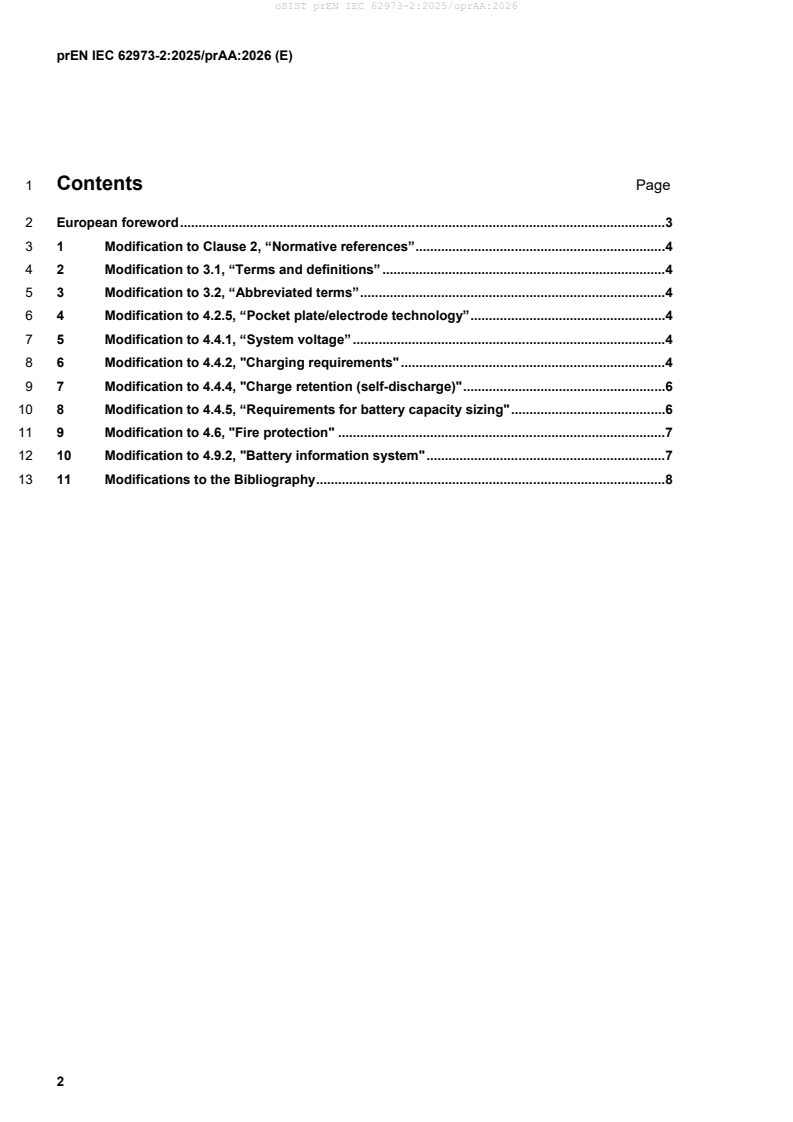
1 Contents Page
2 European foreword . 3
3 1 Modification to Clause 2, “Normative references” . 4
4 2 Modification to 3.1, “Terms and definitions” . 4
5 3 Modification to 3.2, “Abbreviated terms” . 4
6 4 Modification to 4.2.5, “Pocket plate/electrode technology” . 4
7 5 Modification to 4.4.1, “System voltage” . 4
8 6 Modification to 4.4.2, "Charging requirements" . 4
9 7 Modification to 4.4.4, "Charge retention (self-discharge)" . 6
10 8 Modification to 4.4.5, “Requirements for battery capacity sizing" . 6
11 9 Modification to 4.6, "Fire protection" . 7
12 10 Modification to 4.9.2, "Battery information system" . 7
13 11 Modifications to the Bibliography . 8
14 European foreword
15 This document (prEN IEC 62973-2:2025/prAA:2026) has been prepared by CLC/SC 9XB “Electrical, electronic
16 and electromechanical material on board rolling stock, including associated software”.
17 This document is currently submitted to the Enquiry.
18 The following dates are proposed:
• latest date by which the existence of this (doa) dav + 6 months
document has to be announced at national level
• latest date by which this document has to be (dop) dav + 12 months
implemented at national level by publication of
an identical national standard or by
endorsement
• latest date by which the national standards (dow) dav + 36 months
conflicting with this document have to be (to be confirmed or
withdrawn modified when voting)
19 1 Modification to Clause 2, “Normative references”
20 Replace the reference to IEC 60623:2017 in Clause 2 and throughout the text with the following:
21 IEC/FDIS 60623:2026, Secondary cells and batteries containing alkaline or other non-acid electrolytes -
22 Vented nickel-cadmium prismatic rechargeable cells and batteries for use in industrial applications
23 Replace the reference to IEC 62259:2003 in Clause 2 and throughout the text with the following:
24 IEC/FDIS 62259:2026, Secondary cells and batteries containing alkaline or other non-acid electrolytes - Nickel-
25 cadmium prismatic rechargeable cells with partial gas recombination and batteries for use in industrial
26 applications
27 2 Modification to 3.1, “Terms and definitions”
28 Add the following new term entry:
29 “
30 3.1.15
31 reference test current
32 charge or discharge current of a cell or battery, expressed in amperes, having the same numerical value as the
33 rated capacity of that cell or battery, expressed in ampere-hours
34 EXAMPLE For a battery rated at 5 Ah during an n-hour discharge, the reference test current I equals 5 A.
t
35 Note 1 to entry: As opposed to the rated current the reference test current is independent of the rate capability of the
36 battery.
37 [SOURCE: IEC 61434:1996]”
38 3 Modification to 3.2, “Abbreviated terms”
39 Add the following abbreviation:
“It reference test current (see 3.1.15)”
40 4 Modification to 4.2.5, “Pocket plate/electrode technology”
41 Add
...