

prEN IEC 62822-2:2026
(Main)Electric welding equipment - Assessment of restrictions related to human exposure to electromagnetic fields (0 Hz to 300 GHz) - Part 2: Arc welding equipment
- Status
- Not Published
- Publication Date
- 22-Aug-2027
- Technical Committee
- CLC/TC 26 - Electric welding
- Current Stage
- 4060 - Enquiry results established and sent to TC, SR, BTTF - Enquiry
- Start Date
- 05-Jun-2026
- Completion Date
- 05-Jun-2026

Overview
prEN IEC 62822-2:2026 defines standardized assessment methods for evaluating human exposure to electromagnetic fields (EMF) generated by electric arc welding equipment. Issued by the CLC under the IEC framework, this standard applies to equipment used for arc welding and similar processes in professional occupational settings. It provides guidelines to assess compliance with exposure restrictions to magnetic fields within 0 Hz to 300 GHz, with a practical focus on non-thermal effects up to 10 MHz. The document clarifies terminology, establishes test scenarios, and outlines measurement and calculation techniques for determining EMF exposure relevant to worker safety and regulatory requirements.
Key Topics
- Human Exposure to Electromagnetic Fields: Addresses health-related exposure restrictions for magnetic fields produced by arc welding equipment, focusing on non-thermal biological effects such as stimulation of nerves and muscles.
- Assessment Methods: Details both direct measurement and numerical calculation methods to evaluate field levels and intracorporeal exposure, including the use of exposure indices (EI) for comparison against permissible values.
- Standardized Test Scenarios: Describes configurations for assessment, specifying measurement conditions for the head, trunk, and limbs, as well as different welding current modes.
- Reference and Basic Restrictions: Explains concepts such as action levels and basic restrictions, aligning with international guidelines and employing exposure indices for compliance demonstration.
- Pulsed and Non-Sinusoidal Currents: Incorporates methods for weighted peak determination during complex waveforms, ensuring accurate assessment for modern welding technologies.
- Measurement Equipment and Procedures: Specifies calibration, sample rates, and setup requirements for measurement devices, enhancing the reliability and repeatability of assessment results.
Applications
prEN IEC 62822-2:2026 serves a range of practical needs in the welding and occupational safety industries:
- Manufacturers: Use the standard to design and test arc welding equipment for EMF compliance prior to market release, meeting customer and regulatory expectations.
- Occupational Safety Professionals: Apply assessment procedures to monitor worker exposure to EMF in welding environments and support workplace risk assessments for health and safety management.
- Industrial Facilities: Implement the standard to verify that welding operations meet EMF safety limits, particularly in environments where multiple types of welding equipment are in use.
- Testing Laboratories: Employ the prescribed measurement methodologies and reporting formats to offer trusted conformity assessment services for arc welding products.
Key benefits include harmonization with international safety practices, clear guidelines for EMF risk evaluation, and support for workplace compliance with European directives and other regulatory frameworks.
Related Standards
- IEC 62822-1: Electric welding equipment – Assessment of restrictions related to human exposure to electromagnetic fields – Part 1: Product family standard; foundational reference for exposure to electric fields and thermal effects.
- IEC 60974-1: Arc welding equipment – Welding power sources; fundamental product safety and performance requirements for welding devices.
- IEC 61786-1/2: Measurement of DC and AC magnetic/electric fields; specifies requirements for measuring field instruments and standard measurement approaches.
- IEC 62311:2019: Assessment of electronic and electrical equipment related to human exposure restrictions for EMF (0 Hz to 300 GHz); offers general assessment methodology applicable across electrical equipment.
- International Directives and Guidelines: Aligns with the European EMF Directive 2013/35/EU and guidelines set by the International Commission on Non-Ionizing Radiation Protection (ICNIRP).
Adoption of prEN IEC 62822-2 ensures best practices for EMF safety are implemented uniformly, enhancing occupational health protection in the electric welding industry.
Keywords: IEC 62822-2, arc welding equipment, electromagnetic field exposure, EMF assessment, human safety, occupational exposure, welding safety standard, EMF measurement methods, arc welding EMF limits, CLC standard, industrial health compliance, welding equipment testing, exposure index, non-thermal effects, European EMF Directive.
Relations
- Effective Date
- 12-Dec-2023
Get Certified
Connect with accredited certification bodies for this standard

DVS-ZERT GmbH
German welding certification society.
CARES (UK Certification Authority for Reinforcing Steels)
UK certification for reinforcing steels and construction.
EWF/IIW (European/International Welding Federation)
International welding personnel certification.
Sponsored listings
Frequently Asked Questions
prEN IEC 62822-2:2026 is a draft published by CLC. Its full title is "Electric welding equipment - Assessment of restrictions related to human exposure to electromagnetic fields (0 Hz to 300 GHz) - Part 2: Arc welding equipment". This standard covers: Electric welding equipment - Assessment of restrictions related to human exposure to electromagnetic fields (0 Hz to 300 GHz) - Part 2: Arc welding equipment
Electric welding equipment - Assessment of restrictions related to human exposure to electromagnetic fields (0 Hz to 300 GHz) - Part 2: Arc welding equipment
prEN IEC 62822-2:2026 is classified under the following ICS (International Classification for Standards) categories: 25.160.30 - Welding equipment. The ICS classification helps identify the subject area and facilitates finding related standards.
prEN IEC 62822-2:2026 has the following relationships with other standards: It is inter standard links to EN 62822-2:2016. Understanding these relationships helps ensure you are using the most current and applicable version of the standard.
prEN IEC 62822-2:2026 is associated with the following European legislation: EU Directives/Regulations: 2014/35/EU; Standardization Mandates: M/511. When a standard is cited in the Official Journal of the European Union, products manufactured in conformity with it benefit from a presumption of conformity with the essential requirements of the corresponding EU directive or regulation.
prEN IEC 62822-2:2026 is available in PDF format for immediate download after purchase. The document can be added to your cart and obtained through the secure checkout process. Digital delivery ensures instant access to the complete standard document.
Standards Content (Sample)
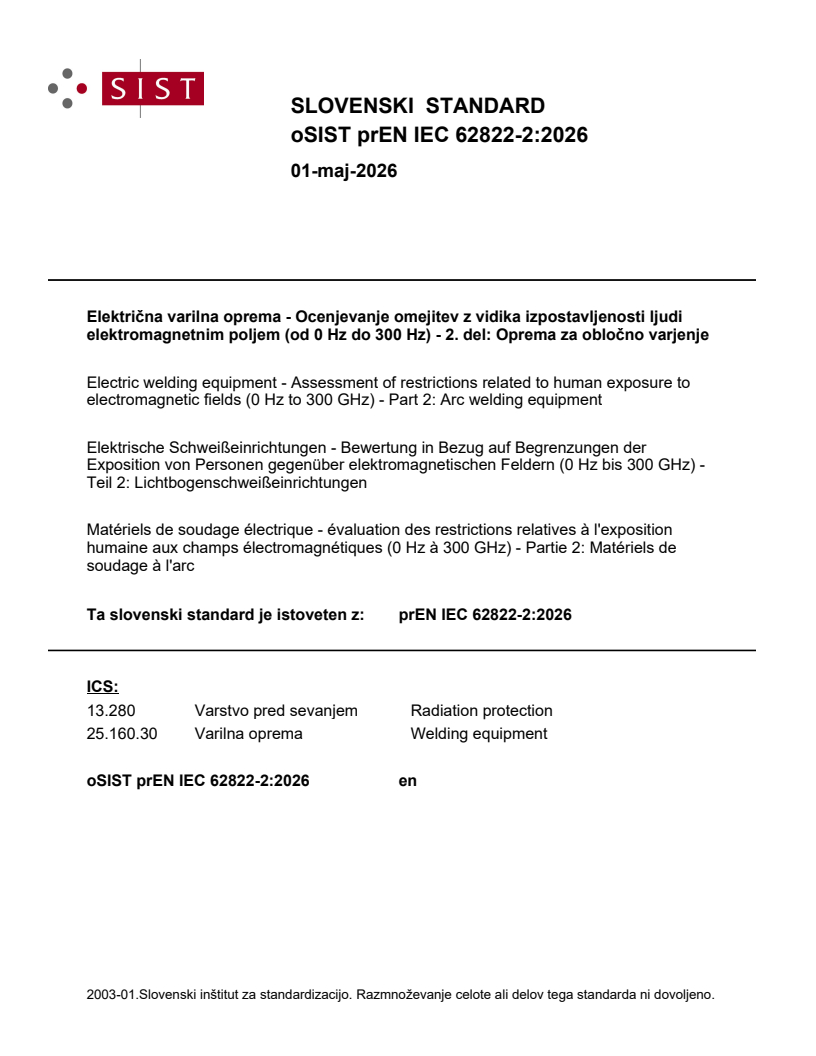
SLOVENSKI STANDARD
01-maj-2026
Električna varilna oprema - Ocenjevanje omejitev z vidika izpostavljenosti ljudi
elektromagnetnim poljem (od 0 Hz do 300 Hz) - 2. del: Oprema za obločno varjenje
Electric welding equipment - Assessment of restrictions related to human exposure to
electromagnetic fields (0 Hz to 300 GHz) - Part 2: Arc welding equipment
Elektrische Schweißeinrichtungen - Bewertung in Bezug auf Begrenzungen der
Exposition von Personen gegenüber elektromagnetischen Feldern (0 Hz bis 300 GHz) -
Teil 2: Lichtbogenschweißeinrichtungen
Matériels de soudage électrique - évaluation des restrictions relatives à l'exposition
humaine aux champs électromagnétiques (0 Hz à 300 GHz) - Partie 2: Matériels de
soudage à l'arc
Ta slovenski standard je istoveten z: prEN IEC 62822-2:2026
ICS:
13.280 Varstvo pred sevanjem Radiation protection
25.160.30 Varilna oprema Welding equipment
2003-01.Slovenski inštitut za standardizacijo. Razmnoževanje celote ali delov tega standarda ni dovoljeno.
26/783/CDV
COMMITTEE DRAFT FOR VOTE (CDV)
PROJECT NUMBER:
IEC 62822-2 ED2
DATE OF CIRCULATION: CLOSING DATE FOR VOTING:
2026-03-13 2026-06-05
SUPERSEDES DOCUMENTS:
26/775/CD, 26/782/CC
TC 26 : ELECTRIC WELDING
IEC
SECRETARIAT: SECRETARY:
Austria Mr Josef Feichtinger
OF INTEREST TO THE FOLLOWING COMMITTEES: HORIZONTAL FUNCTION(S):
ASPECTS CONCERNED:
Saf ety
SUBMITTED FOR CENELEC PARALLEL VOTING NOT SUBMITTED FOR CENELEC PARALLEL VOTING
Attention IEC-CENELEC parallel voting
The attention of IEC National Committees, members of
CENELEC, is d rawn to the f act that this Co mmittee Draft
for Vote (CDV) is submitted for parallel voting.
The CENELEC memb ers are invited to vo te thro ug h the
CENELEC online voting system.
This document is still under study and subject to change. It should not be used for reference purposes.
Recip ients o f this d ocument are invited to submit, with their co mments, no tification o f any relevant p atent rights of
which they are aware and to provide supporting documentation.
Recipients of this document are invited to submit, with their comments, notification of any relevant “In Some
Countries” clauses to be included should this proposal proceed. Recipients are reminded that the CDV stage is
the final stage for submitting ISC clauses. (SEE AC/22/2007 OR NEW GUIDANCE DOC).
TITLE:
Electric welding equipment - Assessment of restrictions related to human exposure to
electromagnetic fields (0 Hz to 300 GHz) - Part 2: Arc welding equipment
PROPOSED STABILITY DATE: 2029
NOTE FROM TC/SC OFFICERS:
Project is in OSD
electronic file, to make a copy and to print out the content for the sole purpose of preparing National Committee positions.
You may not copy or "mirror" the f ile or printed version of the document, or any part of it, f or any other purpose without
permission in writing from IEC.
IEC CDV 62822-2 © IEC 2026
Link to Committee Draft for Vote (CDV) online document:
Click here
How to access
This link leads you to the Online Standards Development (OSD) platform for National Mirror
Committee’s (NMC) comments. The project draft may be found further down this document.
Resource materials
We recommend NCs to review the available materials to better understand the member commenting
on the OSD platform. This includes the:
• OSD NC roles overview
• How to add and submit comments to the IEC
Contact
Should you require any assistance, please contact the IEC IT Helpdesk.
IEC CDV 62822-2 © IEC 2026
CONTENTS
CONTENTS .2
FOREWORD.5
INTRODUCTION .7
1 Scope .8
2 Normative references .8
3 Terms, definitions, symbols and abbreviated terms .8
3.1 Terms and definitions .8
3.2 Quantities and units . 10
3.3 Constants. 10
3.4 Abbreviated terms. 10
4 Requirements . 10
5 Assessment methods . 10
5.1 General considerations . 10
5.1.1 Time averaging . 10
5.1.2 Spatial averaging of external field values . 10
5.1.3 Spatial averaging of intracorporeal values . 10
5.1.4 Equipment with pulsed or non-sinusoidal welding current . 11
5.1.5 Considerations for spectral analysis . 14
5.2 Measurement of external field levels. 16
5.2.1 General . 16
5.2.2 Measurement equipment . 16
5.3 Calculation of external field levels . 17
5.3.1 General . 17
5.3.2 Source model and calculation equation . 17
5.4 Uncertainty of assessment. 17
5.5 Calculations of intracorporeal field levels. 17
5.5.1 EMF assessment using Induction Factors "IF" and Normalized Exposure
Indices "ExpInd " . 17
norm
5.5.2 General public safety distances . 20
5.6 Body model for analytical calculations. 22
5.6.1 Anatomical body models for numerical calculations . 22
6 Assessment conditions . 22
6.1 Assessment configurations . 22
6.1.1 General . 22
6.1.2 Exposure of the head . 23
6.1.3 Exposure of the trunk . 25
6.1.4 Exposure of limbs . 26
6.2 Welding current conditions . 28
6.2.1 General . 28
6.2.2 Single operating mode. 29
6.2.3 Multiple operating modes . 30
6.2.4 Worst case power source capability . 30
6.2.5 Current ripple . 30
7 EMF data sheet and assessment report . 30
Annex A (informative) EMF assessment examples . 32
A.1 Example for EMF data sheet structure for numerically simulated values . 32
IEC CDV 62822-2 © IEC 2026
A.1.1 Blank EMF data sheet . 32
A.1.2 Selection / calculation scheme . 33
A.1.3 Completed EMF data sheet . 35
A.2 Example for EMF data sheet structure for measured fields . 37
A.2.1 Blank EMF data sheet . 37
A.2.2 Completed EMF data sheet . 38
Annex B (informative) Normalized Exposure Index "ExpInd " calculation . 39
norm
B.1 General . 39
B.2 Calculation scheme and formulas. 39
B.3 Selected worst case welding current wave forms. 40
Annex C (informative) General public safety distance calculation . 41
C.1 ExpInd values for uniform magnetic fields . 41
norm_H
C.2 General public distances for welding parameters selection. 41
Annex D (informative) Additional information to investigated numerical simulation
methods . 42
Annex E (informative) Assessment example for maximum power-source capability . 43
E.1 Equipment description . 43
E.2 Welding current measurement and spectral analysis . 43
Annex F (informative) Summation with approximated and piecewise linear limit values . 45
Bibliography . 46
Figure 1 – Piecewise linear and approximated limit amplitudes [4]. 13
Figure 2 – Piecewise linear and approximated summation function phase angles . 13
Figure 3 – Spectral synthesis for the validation of the analysis . 14
Figure 4 – Equivalent waveform for non-repetitive signals. 15
Figure 5 – Graphical representation of EMF assessment method . 18
Figure 6 – Field measurement at head position. 23
Figure 7 – Field calculation at head position . 24
Figure 8 – Numerical calculation of intracorporeal metrics for the head . 24
Figure 9 – Field measurement at trunk position . 25
Figure 10 – Field calculation at trunk position. 25
Figure 11 – Numerical calculation of intracorporeal metrics for the trunk . 26
Figure 12 – Field measurement at limb positions, hand and thigh . 27
Figure 13 – Field calculation at limb positions, hand and thigh. 27
Figure 14 – Numerical calculation of intracorporeal metrics for hand and thigh . 28
Figure A.1 – Template for necessary information without values . 32
Figure A.2 – Template for additional information (for workers) without values . 33
Figure A.3 – Template for necessary information with values . 35
Figure A.4 – Template for additional information (for workers) with values . 36
Figure A.5 – Template for necessary information without values . 37
Figure A.6 – Template for necessary information with values . 38
Figure B.1 – Graphical representation of selected worst case welding current wave
forms . 40
Figure E.1 – Example 1 – Current ripple. 43
Figure E.2 – Example 2 – Maximum power-source capability. 44
IEC CDV 62822-2 © IEC 2026
Figure F.1 – EI comparison with approximated and piecewise linear values . 45
Table 1 – Phase angles of weighting function or summation function . 11
Table 2 – Recommended sample rates for welding current measurement . 16
Table 3 – IFs for MIG/MAG welding postures and cable positions. 18
Table 4 – IFs for TIG welding postures and cable positions . 19
Table 5 – ExpInd values for ELV . 19
norm Health_PNS
Table 6 – ExpInd values for ELV . 20
norm Sensory_CNS
Table 7 – ExpInd values for BR . 20
norm ICNIRP1998_CNS
Table 8 – IFs for uniform magnetic fields (IF ) in tabular form . 21
uniform
Table B.1 – Current change of welding current waveforms from minimum to maximum
current . 40
Table C.1 – ExpInd values for ELV (PNS) . 41
norm_H Health
Table C.2 – ExpInd values for BR (CNS) . 41
norm_H ICNIRP1998
Table C.3 – Calculated minimum distances for general public based on basic
restrictions (BR) of ICNIRP 1998 (CNS) . 41
IEC CDV 62822-2 © IEC 2026
INTERNATIONAL ELECTROTECHNICAL COMMISSION
____________
Electric welding equipment - Assessment of restrictions related to human
exposure to electromagnetic fields (0 Hz to 300 GHz) -
Part 2: Arc welding equipment
FOREWORD
a) The Internatio nal Electro technical Co mmission (IEC) is a wo rld wid e o rg anization f or stand ardization co mprising
all natio nal electrotechnical committees (IEC Natio nal Co mmittees). The o b ject of IEC is to p romote international
co-o p eration o n all q uestions c o ncerning stand ardization in the electrical and electro nic f ields. To this end and
in addition to other activities, IEC publishes International Standards, Technical Specifications, Technical
Rep o rts, Publicly Availab le Sp ecifications (PAS) and Guides (hereafter referred to as “IEC Pub lication(s)”). Their
preparation is entrusted to technical committees; any IEC National Committee interested in the subject dealt
with may participate in this preparatory work. International, governmental and non-governmental organizations
liaising with the IEC also participate in this preparation. IEC collaborates closely with the International
Org anizatio n f or Standardizatio n (ISO) in acco rdance with co nditions d etermined b y ag reement b etween the two
organizations.
b) The f o rmal d ecisions o r ag reements o f IEC o n technical matters exp ress, as nearly as p o ssib le, an international
consensus of opinion on the relevant subjects since each technical committee has representation from all
interested IEC National Committees.
c) IEC Publications have the f orm of recommendations f or international use and are accepted by IEC National
Committees in that sense. While all reasonable ef forts are made to ensure that the technical content of IEC
Publications is accurate, IEC cannot be held responsible for the way in which they are used or for any
misinterpretation by any end user.
d) In order to promote international uniformity, IEC National Committees undertake to apply IEC Publications
transp arently to the maximum extent possible in their national and reg ional p ublications. Any divergence between
any IEC Pub lication and the corresponding national o r reg io nal p ublication shall be clearly indicated in the latter.
e) IEC itself does not provide any attestation of conformity. Independent certification bodies provide conf ormity
assessment services and, in some areas, access to IEC marks of conformity. IEC is not responsible f or any
services carried out by independent certification bodies.
f) All users should ensure that they have the latest edition of this publication.
g) No liability shall attach to IEC or its directors, employees, servants or agents including individual experts and
memb ers o f its technical co mmittees and IEC Natio nal Co mmittees f or any p erso nal injury, p ro perty d amage or
other damage of any nature whatsoever, whether direct or indirect, or for costs (including legal fees) and
expenses arising out of the publication, use of, or reliance upon, this IEC Publication or any other IEC
Publications.
h) Attention is drawn to the Normative ref erences cited in this publication. Use of the ref erenced publications is
indispensable for the correct application of this publication.
i) Attentio n is d rawn to the p ossibility that some of the elements o f this IEC Pub lication may b e the subject of p atent
rights. IEC shall not be held responsible for identifying any or all such patent rights.
International Standard IEC 62822–2 has been prepared by IEC technical committee 26: Electric
welding.
The text of this standard is based on the following documents:
FDIS Report on voting
26/XX/FDIS 26/XX/RVD
Full information on the voting for the approval of this standard can be found in the report on
voting indicated in the above table.
This publication has been drafted in accordance with the ISO/IEC Directives, Part 2.
A list of all parts in the IEC 62822 series, published under the general title Electric welding
equipment – Assessment of restrictions related to human exposure to electromagnetic fields (0
Hz to 300 GHz), can be found on the IEC website.
IEC CDV 62822-2 © IEC 2026
The committee has decided that the contents of this publication will remain unchanged until the
stability date indicated on the IEC website under "http://webstore.iec.ch" in the data related to
the specific publication. At this date, the publication will be
• reconfirmed,
• withdrawn,
• replaced by a revised edition, or
• amended.
NOTE The 'colour inside' logo on the cover page of this publication indicates that it contains colours which
are considered to be useful for the correct understanding of its contents. Users should therefore print this
document using a colour printer.
IEC CDV 62822-2 © IEC 2026
INTRODUCTION
Concerning arc welding, IEC 62822-2:2016 [1] suggests a simplified assessment of induced
electric field strength E and induced current density J based on the assumption that parts of
i
the human body can be represented by homogeneous circular disk models of electric
conductivity 0,2 S/m (different body parts are represented by different disk diameters). Findings
that the disk model (used in the previous version of this standard IEC 62822-2:2016 [1]) leads
to a systematic underestimation [2] of EMF assessment. Therefore investigations using
numerical body model simulation [3] were conducted.
IEC CDV 62822-2 © IEC 2026
1 Scope
This part of IEC 62822 applies to equipment for arc welding and allied processes designed for
occupational use by professionals.
NOTE 1 Typical allied processes are electric arc cutting and arc spraying.
This document specifies methods for the assessment of human exposure to magnetic fields
produced by arc welding. This document covers non-thermal biological effects in the frequency
range from 0 Hz to 10 MHz and defines standardized test scenarios.
NOTE 2 The general term “field” is used throughout this document for “magnetic field”.
NOTE 3 Fo r the assessment of expo sure to electric fields and thermal effects, the methods specified in IEC 62822–
1 apply.
This document does not define methods for workplace assessment regarding the risks arising
from electromagnetic fields (EMF). However, the EMF data that results from the application of
this document can be used to assist in workplace assessment.
It does not specify any product safety requirements other than those specifically related to
human exposure to electromagnetic fields.
This document is not applicable to assess the effects on medical devices.
2 Normative references
T he following documents are referred to in the text in such a way that some or all of their content
constitutes requirements of this document. For dated references, only the edition cited applies.
For undated references, the latest edition of the referenced document (including any
amendments) applies.
IEC 60050–851:2008, International Electrotechnical Vocabulary – Part 851: Electric welding
IEC 60974–1, Arc welding equipment – Part 1: Welding power sources
IEC 61786–1, Measurement of DC magnetic, AC magnetic and AC electric fields from 1 Hz to
100 kHz with regard to exposure of human beings – Part 1: Requirements for measuring
instruments
IEC 61786–2, Measurement of DC magnetic, AC magnetic and AC electric fields from 1 Hz to
100 kHz with regard to exposure of human beings – Part 2: Basic standard for measurements
IEC 62311:2019, Assessment of electronic and electrical equipment related to human exposure
restrictions for electromagnetic fields (0 Hz to 300 GHz)
IEC 62822–1, Electric welding equipment – Assessment of restrictions related to human
exposure to electromagnetic fields (0 Hz to 300 GHz) – Part 1: Product family standard
3 Terms, definitions, symbols and abbreviated terms
3.1 Terms and definitions
For the purposes of this document, the terms and definitions given in IEC 60050–851,
IEC 60974–1 and the following, apply.
IEC CDV 62822-2 © IEC 2026
ISO and IEC maintain terminology databases for use in standardization at the following
addresses:
– IEC electropedia: available at https://www.electropedia.org/
– ISO online browsing platform: available at https://www.iso.org/obp
3.1.1
basic restrictions
exposure limit value
restrictions on exposure to electric, magnetic and electromagnetic fields that are based directly
on established health effects and biological considerations
3.1.2
exposure index
EI
result of the evaluation of exposure to (both sinusoidal and non-sinusoidal) EMF, expressed as
a fraction or percentage of the permissible values
Note 1 to entry: Fractions higher than 1 (100 %) represent exceeding the permissible values.
3.1.3
general public
individuals of all ages and of varying health conditions
Note 1 to entry: Varying ages and health conditions can increase the individuals susceptibilities to EMF.
3.1.4
occupational use
workers at their workplaces performing their regular or assigned job activities
Note 1 to entry: A worker is any person employed by an employer, including trainees and apprentices.
3.1.5
health effects
adverse effects, such as thermal heating or stimulation of nerve and muscle tissue as a result
of human exposure to EMF
3.1.6
intracorporeal
situated or occurring within the body
3.1.7
non-thermal effects
the stimulation of muscles, nerves or sensory organs as a result of human exposure to EMF
3.1.8
reference levels
action levels
directly measurable quantities, derived from basic restrictions, provided for practical exposure
assessment purposes
No te 1 to entry: Resp ect o f the ref erence levels will ensure resp ect of the relevant b asic restriction. If the ref erence
levels are exceeded, it does not necessarily follow that the basic restriction will be exceeded.
3.1.9
sensory effects
transient disturbed sensory perceptions and minor changes in brain functions as a result of
human exposure to EMF
IEC CDV 62822-2 © IEC 2026
3.2 Quantities and units
The internationally accepted SI units are used throughout this document.
Physical quantity Symbol Units
−2
Current density J
A m
−1
Electric co nd uctivity σ S m
Electric current I A
−1
Electric f ield strength E
V m
Frequency f Hz
Mag netic f lux d ensity B T
−1
Permeability μ
H m
3.3 Constants
Physical constant Symbol Magnitude Units
−7 −1
Permeab ility o f f ree space μ H m
4·π ·10
3.4 Abbreviated terms
ICNIRP International Commission on Non-Ionizing Radiation Protection
EMF electromagnetic fields
IEEE Institute of Electrical and Electronics Engineers
PNS peripheral nervous system
CNS central nervous system
4 Requirements
Equipment shall be assessed as defined in Clause 7, using the methods given in Clause 5 and
the conditions defined in Clause 6. The results shall be reported as specified in Clause 7.
5 Assessment methods
5.1 General considerations
5.1.1 Time averaging
Time averaging of exposure is not permitted for non-thermal effects unless the applied national
or international requirements explicitly specify time averaging procedures.
5.1.2 Spatial averaging of external field values
Reference levels are typically based on spatial averaging over the relevant part of the body. If
spatial averaging of exposure is not excluded and no specific procedures are defined in
applicable national and international requirements, the procedures detailed in the relevant
subclauses of 6.1 shall be applied.
5.1.3 Spatial averaging of intracorporeal values
If spatial averaging of exposure is not excluded and no specific procedures are specified in
applicable national and international requirements, the procedures detailed in the relevant
subclauses of 5.3 and 6.1 shall be applied.
IEC CDV 62822-2 © IEC 2026
5.1.4 Equipment with pulsed or non-sinusoidal welding current
5.1.4.1 General
Several methods for the assessment of pulsed and non-sinusoidal fields are available. For the
purpose of this standard, only the weighted peak methods as given in 5.1.4.2 and 5.1.4.3 are
applicable. For additional information, see IEC 61786–2. The result of these calculation
methods is the exposure index (EI).
NOTE Ap p lications of the weig hted peak method in time d omain o r frequency d omain are mathematically eq uivalent
and give exactly the same results, if applied correctly. For some cases, e.g. when large numbers of spectral
co mp onents have to b e co nsid ered f or the co mp lete analysis o f a sig nal, the ap p lication o f the time d o main method
can be less complex.
Phase angles used for the weighted peak methods are given in Table 1.
Table 1 – Phase angles of weighting function or summation function
2 0
a 1/ƒ ƒ
1/ƒ ƒ (constant)
proportionality p
A
b 180° 90° 0° -90°
phase angle φ
I
a
p is the p ro p ortionality f actor d efining the variatio n o f the b asic restriction/reference level as sp ecified in the
A
applicable national and international requirements.
b
φ is the phase angle of the weighting function or summation function.
I
5.1.4.2 Weighted peak method in the frequency domain
For frequency domain evaluation, a phase corrected summation of the weighted spectral
components of the signal is applicable. The evaluation shall be based on the peak value of the
weighted signal as given in Formula (1). This method can be used for both external field levels
and intracorporeal metrics.
The sum of the weighted spectral components shall not exceed 1 at any time t within the
evaluation interval, which shall be one period of the pulsed or non-sinusoidal signal. The time
increments used for evaluation shall be less than or equal to 1/10 of the period of the highest
relevant spectral component, as defined in 5.1.5.4.
𝐴𝐴
i
( )
�� cos 2 ·𝜋𝜋 ·𝑓𝑓 ·𝑡𝑡 +𝜃𝜃 +𝜑𝜑 �≤ 1 (1)
i i i
𝐿𝐿
i
𝑖𝑖
A is the amplitude of the spectral component at frequency ƒ
i i
L is the applicable limit at frequency ƒ
i i
is the frequency of the spectral component i
ƒ
i
θ is the phase angle of the spectral component at frequency ƒ
i i
φ is the phase angle of the summation function at frequency ƒ , see Table 1
i i
5.1.4.3 Weighted peak method in the time domain
For time domain evaluation, an evaluation system which incorporates a weighting function is
applicable. T he evaluation shall be based on the peak value of the weig hted signal. T his method
can be used for both external field levels and intracorporeal metrics.
For comparison with the given exposure levels, the weighting function shall have a frequency
response which matches the applicable national and international requirements, so that the
weighting and summation of spectral components occurs in the time domain.
IEC CDV 62822-2 © IEC 2026
Further information on this method is given in IEC 62311:2019.
The amplitudes and phase angles of the limit values can be approximated with electronic or
digital filters (this is described in more detail below). The amplitudes shall not deviate more
than 3 dB and the phase angles not more than 90° from the piecewise linear frequency
response. The piecewise linear values for phase angles are given in Table 1.
For an approximation of the piecewise linear frequency response it is recommended to use a
rational function of form like Formula (2), which is a polynomial devided by a polynomial. A
function represented in this way can be used as transfer function in linear time-invariant
systems. With that the assessment in the time domain can be done via the construction of a
transfer function and by usag e of sig nal processing packages or libraries (provided for the most
widely used programming languages).
𝑚𝑚 𝑚𝑚−1
𝑃𝑃 ( ) 𝑎𝑎 ·𝑥𝑥 +𝑎𝑎 ·𝑥𝑥 +. . +𝑎𝑎 ·𝑥𝑥 +𝑎𝑎
𝑥𝑥
𝑚𝑚 𝑚𝑚 𝑚𝑚−1 1 0
𝑓𝑓(𝑥𝑥) = = (2)
𝑛𝑛 𝑛𝑛−1
( )
𝑄𝑄 𝑥𝑥 𝑏𝑏 ·𝑥𝑥 +𝑏𝑏 ·𝑥𝑥 +. . +𝑏𝑏 ·𝑥𝑥 +𝑏𝑏
𝑛𝑛 𝑛𝑛 𝑛𝑛−1 1 0
T he weig hting function should be represented by combining filter functions (low pass, high pass,
boost, etc.). A detailed description of this calculation method can be found in the paper from H.
Keller [4]. An example for this method can be seen in Formula (3) by generating the limit
functions for the high action levels (𝑊𝑊 ) found in 2013/35/EU [5]. In this case the weighting
𝐻𝐻𝐻𝐻𝐻𝐻
function is constructed by combining a high pass filter function with a constant factor.
𝑓𝑓
𝑗𝑗 ·
3𝑘𝑘𝑘𝑘𝑘𝑘
(3)
𝑊𝑊 (𝑓𝑓) = ·
𝐻𝐻𝐻𝐻𝐻𝐻
𝑓𝑓
2 · 100𝜇𝜇𝜇𝜇
√
1 +𝑗𝑗 ·
3𝑘𝑘𝑘𝑘𝑘𝑘
An example for a piecewise linear limit and the derived approximation is shown in Fig ure 1. T he
example shows the combined reference levels for sensory and health effects in the head as
specified in the European EMF Workers Directive 2013/35/EU [5] .
___________
Numbers in square brackets refer to the Bibliography.
IEC CDV 62822-2 © IEC 2026
Figure 1 – Piecewise linear and approximated limit amplitudes [4]
The phase angles φ of the summation function shall be calculated from the complex function
i
for the approximated amplitudes. An example for piecewise linear phase angles and the phase
angles of the derived approximation is shown in Figure 2, an example for the effect of this
approximation is given in Annex F. The example in Figure 2 shows the phase angle of the
combined reference levels for sensory and health effects in the head as specified in the
European EMF Workers Directive 2013/35/EU [5].
Figure 2 – Piecewise linear and approximated summation function phase angles
IEC CDV 62822-2 © IEC 2026
5.1.5 Considerations for spectral analysis
5.1.5.1 Validation
The results of spectral analyses, i.e. the amplitudes and phase angles of the spectral
components of the assessed welding current or magnetic field, shall be validated. An example
for validation by spectral synthesis is given in Figure 3.
NOTE The purpose of the validation is to check if major mistakes were made when perf orming spectral analysis
(e.g . 90° erro rs in the p hase ang les) rather than checking f or small d eviations d ue to samp ling rates o r d ig itizing .
Figure 3 – Spectral synthesis for the validation of the analysis
5.1.5.2 Analysis of repetitive signals
Spectral analysis of repetitive signals (e.g. pulsed welding, a.c. welding or the welding current
ripple) shall be based on one full cycle of the signal, where the amplitude at the beginning and
the end of the assessment time-frame shall be equal. The number of spectral components to
be calculated, i.e. the hig hest frequency covered by the spectral components, shall comply with
the requirements given in 5.1.5.4.
5.1.5.3 Analysis of non-repetitive signals
In order to simplify the spectral analysis of non-repetitive signals (e.g. the maximum rate of
change of current with respect to time (di/dt) capability of the welding power source), the
constant part after the change can be replaced by a slope with a weighted value that is
considerably lower than that of the chang e to be assessed, and does not influence the resulting
value of the exposure index EI. The repetition time shall be sufficiently long to allow the EI
curve to decay to zero before the end of the artificial cycle. By this, the non-repetitive signal is
replaced by a repetitive signal that can be assessed as given in 5.1.5.2. See Figure 4.
IEC CDV 62822-2 © IEC 2026
Figure 4 – Equivalent waveform for non-repetitive signals
5.1.5.4 Frequency range limitations
Assessment, dependent on the type of welding current waveform, shall be made in the relevant
frequency range from 0 Hz (d.c., as applicable) to an upper frequency defined as the highest
applicable value of
– 1 kHz for single phase transformer-rectifier types;
– 3 kHz for three phase transformer-rectifier types;
– 10 kHz for thyristor controlled types;
– 10 times the ripple frequency for inverter types;
– 10 times the a.c. welding current frequency;
– the frequency ƒ defined by the minimum rise or fall time τ of the maximum welding
max p min
current (10 % to 90 %, from 0 A to I or I ).
2 max pos 2 max neg
𝑓𝑓 = 10 · (4)
𝑚𝑚𝑚𝑚𝑚𝑚
4 ·𝜏𝜏
𝑝𝑝𝑚𝑚𝑖𝑖𝑛𝑛
The maximum upper frequency within the scope of this standard is 10 MHz.
The manufacturer, based on his knowledge of the process or special techniques used in the
apparatus, shall select a higher upper frequency if applicable. An example for such a case is
an a.c. square-wave power source.
If the output-current ripple-amplitude meets the exclusion criteria given in IEC 62822–1, the
upper frequency range boundary based on ripple frequency can be neglected.
5.1.5.5 Current measurement method
In order to calculate the ExpInd correctly, an adeq uate measurement of the welding current
norm
is essential.
Regardless of the measuring system used, the following parameters must be adhered to when
measuring current.
The information was taken from IEC 62822-3:2023 [6].
IEC CDV 62822-2 © IEC 2026
If welding current was done by measurement, the slew rate (di/dt) has to be determined from
10 % to 90 % of the welding waveform.
Table 2 – Recommended sample rates for welding current measurement
Slew rate Rise-/Fall time Sample rate
𝑑𝑑𝑖𝑖 𝑘𝑘𝐻𝐻 𝑘𝑘𝑘𝑘
≥ 1 𝑚𝑚𝑚𝑚
≤ 1 ≥ 100
𝑑𝑑𝑑𝑑 𝑚𝑚𝑚𝑚 𝑚𝑚
𝑘𝑘𝐻𝐻 𝑑𝑑𝑖𝑖 𝑘𝑘𝐻𝐻
𝑀𝑀𝑘𝑘 𝑀𝑀𝑘𝑘
≥ 0,01 𝑚𝑚𝑚𝑚
1 < ≤ 20 � �
≥ 1 𝑚𝑚𝑎𝑎𝑥𝑥. 10
𝑚𝑚𝑚𝑚 𝑑𝑑𝑑𝑑 𝑚𝑚𝑚𝑚
𝑚𝑚 𝑚𝑚
Furthermore, the measurement parameters such as digital filtering, bandwidth limitation and
non-linearities of the current measurement method must be taken into account and carefully
considered.
5.2 Measurement of external field levels
5.2.1 General
This method is based on field measurements and can be used to show compliance without the
need for complex calculation or modelling procedures related to basic restrictions. Reference
levels typically include additional margins and are derived from the basic restrictions by using
assumptions with regard to the properties of the field and the coupling conditions. Therefore
this method represents a conservative approach and generally overestimates exposure.
The results shall be compared to the limits that are applicable to the relevant parts of the body
as specified in IEC 62822–1.
Field measurements shall be made with straight welding cables carrying the relevant test
current I . Return cables shall be routed in a way that eliminates or minimizes the influence of
t
the return current on the measured field.
In the case of a metallic floor, the welding cables shall be placed on a non-metallic support with
a minimum height of 0,8 m. Any other metallic objects, which could distort the magnetic field,
should be at a horizontal distance of at least 2 m from the measurement points.
Measurements of background levels are recommended to establish the presence of external
fields.
If necessary the influence of external field sources should be minimized. For medium and high
frequency ranges this can be achieved by measurements in shielded enclosures, which shall
be of sufficient size to avoid field distortion. Generally, increasing the distance to external
sources of magnetic fields will dramatically decrease the background field strength.
5.2.2 Measurement equipment
The field probes(s) used for measurement shall comply with the requirements of IEC 61786–1,
2 2
the probe(s) shall be of an area of 3 cm ± 0,6 cm .
For most arc welding applications, measuring devices with the common frequency range of 1 Hz
to 400 kHz are sufficient.
NOTE The f requency resulting f rom the welding process is well below 100 kHz anyway (the ripple current is not
relevant in these applications). This means that the IEC 61786–1 requirements can be met.
IEC CDV 62822-2 © IEC 2026
5.3 Calculation of external field levels
5.3.1 General
This method is based on analytical field calculations using welding current parameters and
other data (e.g. source models and assessment configuration) and can be used to show
compliance without the need for extensive field measurement campaigns or complex calculation
or modelling procedures related to basic restrictions. Reference levels typically include
additional margins and are derived from the basic restrictions by using assumptions with regard
to the properties of the field and the coupling conditions. Therefore this method represents a
conservative approach and generally overestimates exposure.
The results shall be compared to the limits that are applicable to the relevant parts of the body
as specified in IEC 62822–1.
5.3.2 Source model and calculation equation
The model of an infinite single straight wire shall be used. Reference levels are typically
applicable to field levels B that are averaged over the relevant part of the body, therefore
AV
Formula (5), which includes averaging of the maximum and minimum values over the
assessment range covered, shall be applied.
𝜇𝜇 ·𝐼𝐼 1 1
0 t
𝐵𝐵 = ·� + � (5)
AV
4 ·𝜋𝜋 𝑑𝑑 𝑑𝑑
1 2
is the smallest distance between the body part and the virtual welding cable
d
d is the largest distance between the body part and the virtual welding cable
I is the value of a spectral component or the total value of the welding current
t
NOTE Formula (5) can be used f or any type of current values. The type of current values for the above equation
needs to match the type of limit used f or assessment (f or example, r.m.s. current values will result in r.m.s. field
values).
Simplified versions of Formula (5), considering the standardized distances to and dimensions
of relevant body parts, are given in the relevant subclauses of 6.1.
If spatial averaging is not allowed, Formula (5) shall be used with d equal to d .
2 1
5.4 Uncertainty of assessment
The expanded uncertainty of the assessment shall be calculated as defined in IEC 61786–2.
If the expanded uncertainty is higher than the value specified in IEC 62822–1, and the
assessment is not proven to provide conservative results (i.e. overestimates the exposure), the
method to calculate penalties given in IEC 62822–1 shall be applied.
5.5 Calculations of intracorporeal field levels
5.5.1 EMF assessment using Induction Factors "IF" and Normalized Exposure
Indices "ExpInd "
norm
5.5.1.1 General
The exposure assessment is separated into two individual parts. The first part includes
induction factors (IFs) 5.5.1.2 found by numerical computations of different realistic arc welding
scenarios for MIG/MAG and TIG with different anatomical body models.
IEC CDV 62822-2 © IEC 2026
The second part of the exposure assessment considers current wave forms used for MIG/MAG
and TIG arc welding and their influence on the exposure, resulting in a normalized exposure
index ExpInd 5.5.1.3. Multiplication of both values results in an exposure index EI , which
norm int
has to be below unity, in order to meet given limit values. This allows for flexible usage and
combination of both, IFs, representing different arc welding scenarios, and ExpInd ,
norm
representing different current wave forms.
The EMF assessment method can be seen in Figure 5.
Figure 5 – Graphical representation of EMF assessment method
5.5.1.2 Induction Factor "IF"
Table 3 and Table 4 provide the induction factors (IF) for different welding scenarios. Values
were determined by means of numerical computations with 5 different anatomical body models
in Seibersdorf research report [3]. IFs are the highest p99,9 whole body values of the 5 body
models simulated and is given in paranthesis in the tables. The numerical computations used
harmonic sine wave at a frequency of 1 kHz and an amplitude of 1 A .
peak
Table 3 – IFs for MIG/MAG welding postures and cable positions
Scenario + cable position Standard On thigh On shoulder and along back
Picture of cable routing [7] [7] [7]
IF (E ) 1,219 (Louis) 1,995 (Fats) 2,746 (Duke)
i,avgV_PNS
IF (E ) 0,076 (Duke) 0,078 (Fats) 0,340 (Fats)
i,avgV_CNS
IEC CDV 62822-2 © IEC 2026
Scenario + cable position Standard On thigh On shoulder and along back
IF (J ) 0,0070 (Ella) 0,0066 (Fats) 0,0299 (Fats)
avg_CNS
𝑚𝑚𝑉𝑉
𝑝𝑝𝑝𝑝𝑝𝑝𝑝𝑝
IF (E ) unit:� /1𝐴𝐴 /1𝑘𝑘𝑘𝑘𝑘𝑘�
𝑝𝑝𝑝𝑝𝑚𝑚𝑘𝑘
i,avgV
𝑚𝑚
𝑚𝑚𝐻𝐻
𝑝𝑝𝑝𝑝𝑝𝑝𝑝𝑝
IF (J ) unit:� /1𝐴𝐴 /1𝑘𝑘𝑘𝑘𝑘𝑘�
2 𝑝𝑝𝑝𝑝𝑚𝑚𝑘𝑘
avg
𝑚𝑚
Table 4 – IFs for TIG welding postures and cable positions
Scenario + cable Wrapped around
Standard Under armpit On neck
position forearm
Picture of cable
[7] [7] [7] [7]
routing
IF (E )
...