


EN 60872-2:1999
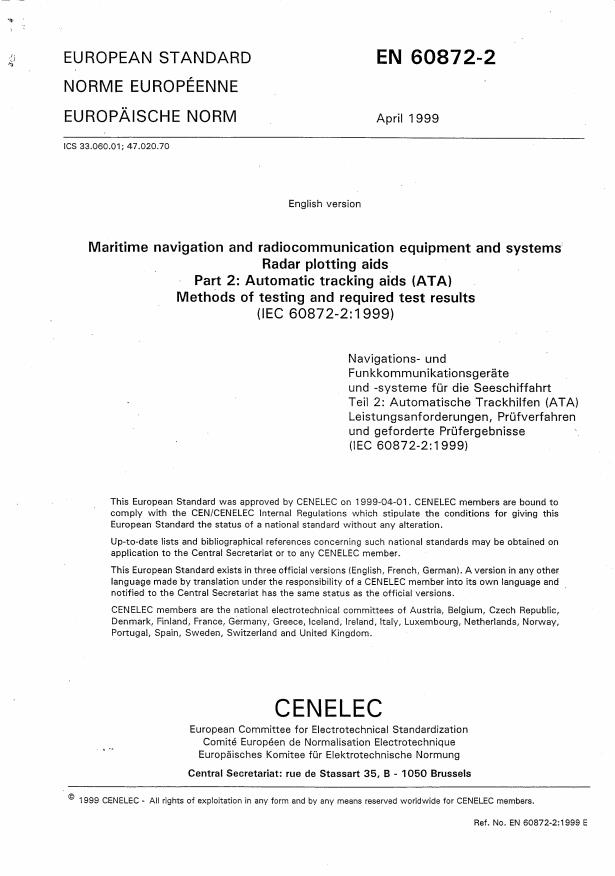
(Main)Maritime navigation and radiocommunication equipment and systems - Radar plotting aids - Part 2: Automatic tracking aids (ATA) - Methods of testing and required test results
General Information
- Abstract
Specifies the minimum performance requirements, technical characteristics, methods of testing and test results for equipment that complies with performance standards not inferior to those adopted by the IMO. This standard takes account of IMO resolution A.694 and is associated with EN 60945.
- Status
- Withdrawn
- Publication Date
- 31-Mar-1999
- Withdrawal Date
- 31-Dec-2001
- Technical Committee
- CLC/SR 80 - Maritime navigation and radiocommunication equipment and systems
- Drafting Committee
- IEC/TC 80 - IEC_TC_80
- Parallel Committee
- IEC/TC 80 - IEC_TC_80
- Current Stage
- 9960 - Withdrawal effective - Withdrawal
- Start Date
- 01-Feb-2011
- Completion Date
- 01-Feb-2011

Relations
- Effective Date
- 29-Jan-2023
- Effective Date
- 09-Feb-2026
- Effective Date
- 03-Feb-2026
- Effective Date
- 03-Feb-2026
- Effective Date
- 03-Feb-2026
- Effective Date
- 03-Feb-2026
- Effective Date
- 03-Feb-2026
- Effective Date
- 03-Feb-2026
- Effective Date
- 03-Feb-2026
- Effective Date
- 03-Feb-2026
Get Certified
Connect with accredited certification bodies for this standard

DNV
DNV is an independent assurance and risk management provider.

Lloyd's Register
Lloyd's Register is a global professional services organisation specialising in engineering and technology.

FSC International
Forest Stewardship Council certification.
Sponsored listings
Frequently Asked Questions
EN 60872-2:1999 is a standard published by CLC. Its full title is "Maritime navigation and radiocommunication equipment and systems - Radar plotting aids - Part 2: Automatic tracking aids (ATA) - Methods of testing and required test results". This standard covers: Specifies the minimum performance requirements, technical characteristics, methods of testing and test results for equipment that complies with performance standards not inferior to those adopted by the IMO. This standard takes account of IMO resolution A.694 and is associated with EN 60945.
Specifies the minimum performance requirements, technical characteristics, methods of testing and test results for equipment that complies with performance standards not inferior to those adopted by the IMO. This standard takes account of IMO resolution A.694 and is associated with EN 60945.
EN 60872-2:1999 is classified under the following ICS (International Classification for Standards) categories: 33.060.01 - Radiocommunications in general; 47.020.70 - Navigation and control equipment. The ICS classification helps identify the subject area and facilitates finding related standards.
EN 60872-2:1999 has the following relationships with other standards: It is inter standard links to EN 62388:2008, EN ISO 9000-1:1994, EN 61162-2:1998, EN 60945:1997, EN 60872-1:1998, EN 62252:2004, EN 60872-3:2001, EN 60936-2:1999, EN 60936-3:2002, EN 60936-1:2000. Understanding these relationships helps ensure you are using the most current and applicable version of the standard.
EN 60872-2:1999 is available in PDF format for immediate download after purchase. The document can be added to your cart and obtained through the secure checkout process. Digital delivery ensures instant access to the complete standard document.
Standards Content (Sample)
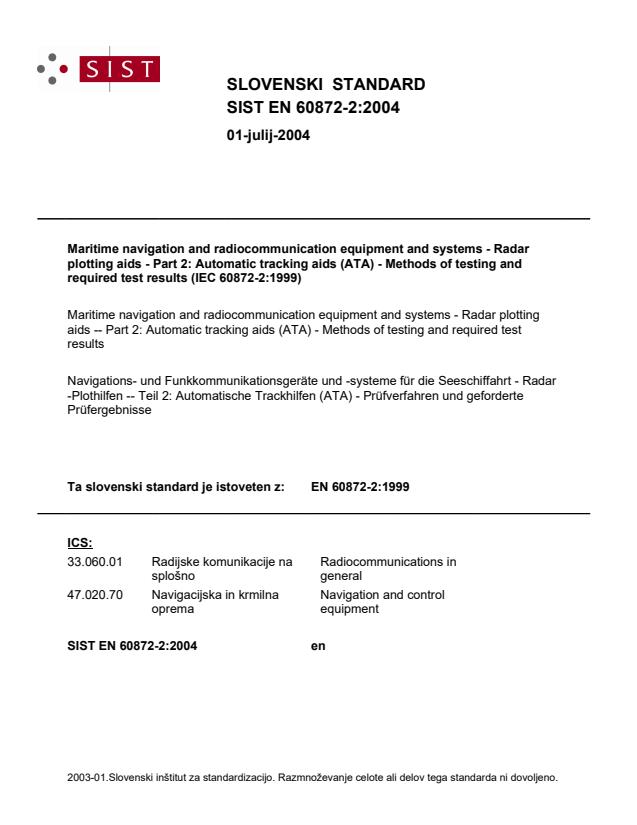
SLOVENSKI STANDARD
01-julij-2004
Maritime navigation and radiocommunication equipment and systems - Radar
plotting aids - Part 2: Automatic tracking aids (ATA) - Methods of testing and
required test results (IEC 60872-2:1999)
Maritime navigation and radiocommunication equipment and systems - Radar plotting
aids -- Part 2: Automatic tracking aids (ATA) - Methods of testing and required test
results
Navigations- und Funkkommunikationsgeräte und -systeme für die Seeschiffahrt -
...