

EN 60749-23:2004/A1:2011
(Amendment)Semiconductor devices - Mechanical and climatic test methods - Part 23: High temperature operating life
General Information
- Abstract
This test is used to determine the effects of bias conditions and temperature on solid state devices over time. It simulates the device operating condition in an accelerated way, and is primarily used for device qualification and reliability monitoring. A form of high temperature bias life using a short duration, popularly known as “burn-in”, may be used to screen for infant mortality related failures. The detailed use and application of burn-in is outside the scope of this standard.
- Status
- Published
- Publication Date
- 03-Mar-2011
- Withdrawal Date
- 02-Mar-2014
- Technical Committee
- CLC/TC 47X - Semiconductor devices and trusted chips
- Drafting Committee
- IEC/TC 47 - IEC_TC_47
- Parallel Committee
- IEC/TC 47 - IEC_TC_47
- Current Stage
- 6060 - Document made available - Publishing
- Start Date
- 04-Mar-2011
- Completion Date
- 04-Mar-2011



Overview
EN 60749-23:2004/A1:2011 (IEC 60749-23:2004/A1:2011) is a CENELEC amendment that updates the European adoption of the international test method for high temperature operating life (HTOL) of semiconductor devices. It forms part of the EN/IEC 60749 series on mechanical and climatic test methods for semiconductor devices and clarifies measurement and stress-resumption rules for reliability testing at elevated temperatures.
Key topics and requirements
- Scope: Amendment A1 modifies EN 60749-23:2004 to refine measurement and high temperature testing restrictions (no change to the general HTOL purpose).
- 96-hour measurement window: If devices under HTOL are removed from bias and the 96-hour window for measurements is exceeded, the amendment requires resuming high-temperature stress before completing electrical measurements.
- Stress resumption and continuity: After an interim electrical measurement, stress must be continued from the point of interruption rather than restarting the full test.
- Additional stress hours: The amendment introduces a table that defines additional stress hours required prior to performing electrical tests when the 96-hour window has been exceeded:
0 but ≤168 hours overrun: 24 hours additional stress
168 but ≤336 hours overrun: 48 hours additional stress
336 but ≤504 hours overrun: 72 hours additional stress
- Verification data exception: The 96-hour restriction and stress-resumption rules need not be applied if adequate verification data for the technology is provided.
- Editorial update: Summary cross-reference updated (Clause 6 → Clause 7).
Applications and who uses it
This amendment is directly relevant to:
- Reliability engineers performing HTOL / high temperature operating life testing
- Semiconductor manufacturers and device designers validating long-term thermal stability
- Qualification and compliance laboratories that perform electrical measurements during stress tests
- Quality and product assurance teams establishing test plans and acceptance criteria
Typical practical uses:
- Defining procedures for resuming HTOL after interruptions
- Determining additional stress duration when measurement timelines are missed
- Ensuring consistent HTOL record-keeping and comparability across test campaigns
Related standards and context
- This document is an amendment to EN 60749-23:2004 and corresponds to IEC 60749-23:2004/A1:2011.
- It sits within the broader IEC/EN 60749 family covering mechanical and climatic test methods for semiconductor devices.
- Managed by CENELEC/IEC TC 47 (Semiconductor devices); national adoption and withdrawal dates are specified in the amendment.
Keywords: EN 60749-23, IEC 60749-23, high temperature operating life, HTOL, semiconductor devices, mechanical and climatic test methods, bias, stress resumption, reliability testing, CENELEC.
Relations
- Effective Date
- 15-Oct-2024
- Effective Date
- 03-Feb-2026
- Effective Date
- 29-Jan-2023
Frequently Asked Questions
EN 60749-23:2004/A1:2011 is a amendment published by CLC. Its full title is "Semiconductor devices - Mechanical and climatic test methods - Part 23: High temperature operating life". This standard covers: This test is used to determine the effects of bias conditions and temperature on solid state devices over time. It simulates the device operating condition in an accelerated way, and is primarily used for device qualification and reliability monitoring. A form of high temperature bias life using a short duration, popularly known as “burn-in”, may be used to screen for infant mortality related failures. The detailed use and application of burn-in is outside the scope of this standard.
This test is used to determine the effects of bias conditions and temperature on solid state devices over time. It simulates the device operating condition in an accelerated way, and is primarily used for device qualification and reliability monitoring. A form of high temperature bias life using a short duration, popularly known as “burn-in”, may be used to screen for infant mortality related failures. The detailed use and application of burn-in is outside the scope of this standard.
EN 60749-23:2004/A1:2011 is classified under the following ICS (International Classification for Standards) categories: 31.080.01 - Semiconductor devices in general. The ICS classification helps identify the subject area and facilitates finding related standards.
EN 60749-23:2004/A1:2011 has the following relationships with other standards: It is inter standard links to EN IEC 60749-23:2026, EN 62047-4:2010, EN 60749-23:2004. Understanding these relationships helps ensure you are using the most current and applicable version of the standard.
EN 60749-23:2004/A1:2011 is available in PDF format for immediate download after purchase. The document can be added to your cart and obtained through the secure checkout process. Digital delivery ensures instant access to the complete standard document.
Standards Content (Sample)
SLOVENSKI STANDARD
01-maj-2011
Polprevodniški elementi - Metode za mehansko in klimatsko preskušanje - 23. del:
Obratovalna življenjska doba pri visoki temperaturi - Dopolnilo A1 (IEC 60749-
23:2004/A1:2011)
Semiconductor devices - Mechanical and climatic test methods - Part 23: High
temperature operating life (IEC 60749-23:2004/A1:2011)
Halbleiterbauelemente - Mechanische und klimatische Prüfverfahren - Teil 23:
Lebensdauer bei hoher Temperatur (IEC 60749-23:2004/A1:2011)
Dispositifs à semiconducteurs - Méthodes d'essais mécaniques et climatiques - Partie
23: Durée de vie en fonctionnemement à haute température (CEI 60749-
23:2004/A1:2011)
Ta slovenski standard je istoveten z: EN 60749-23:2004/A1:2011
ICS:
31.080.01 Polprevodniški elementi Semiconductor devices in
(naprave) na splošno general
2003-01.Slovenski inštitut za standardizacijo. Razmnoževanje celote ali delov tega standarda ni dovoljeno.
EUROPEAN STANDARD
EN 60749-23/A1
NORME EUROPÉENNE
March 2011
EUROPÄISCHE NORM
ICS 31.080.01
English version
Semiconductor devices -
Mechanical and climatic test methods -
Part 23: High temperature operating life
(IEC 60749-23:2004/A1:2011)
Dispositifs à semiconducteurs - Halbleiterbauelemente -
Méthodes d'essais mécaniques et Mechanische und klimatische
climatiques - Prüfverfahren -
Partie 23: Durée de vie en Teil 23: Lebensdauer bei hoher
fonctionnemement à haute température Temperatur
(CEI 60749-23:2004/A1:2011) (IEC 60749-23:2004/A1:2011)
This amendment A1 modifies the European Standard EN 60749-23:2004; it was approved by CENELEC on
2011-03-03. CENELEC members are bound to comply with the CEN/CENELEC Internal Regulations which
stipulate the conditions for giving this amendment the status of a national standard without any alteration.
Up-to-date lists and bibliographical references concerning such national standards may be obtained on
application to the Central Secretariat or to any CENELEC member.
This amendment exists in three official versions (English, French, German). A version in any other language
made by translation under the responsibility of a CENELEC member into its own language and notified to the
Central Secretariat has the same status as the official versions.
CENELEC members are the national electrotechnical committees of Austria, Belgium, Bulgaria, Croatia, Cyprus,
the Czech Republic, Denmark, Estonia, Finland, France, Germany, Greece, Hungary, Iceland, Ireland, Italy,
Latvia, Lithuania, Luxembourg, Malta, the Netherlands, Norway, Poland, Portugal, Romania, Slovakia, Slovenia,
Spain, Sweden, Switzerland and the United Kingdom.
CENELEC
European Committee for Electrotechnical Standardization
Comité Européen de Normalisation Electrotechnique
Europäisches Komitee für Elektrotechnische Normung
Management Centre: Avenue Marnix 17, B - 1000 Brussels
© 2011 CENELEC - All rights of exploitation in any form and by any means reserved worldwide for CENELEC members.
Ref. No. EN 60749-23:2004/A1:2011 E
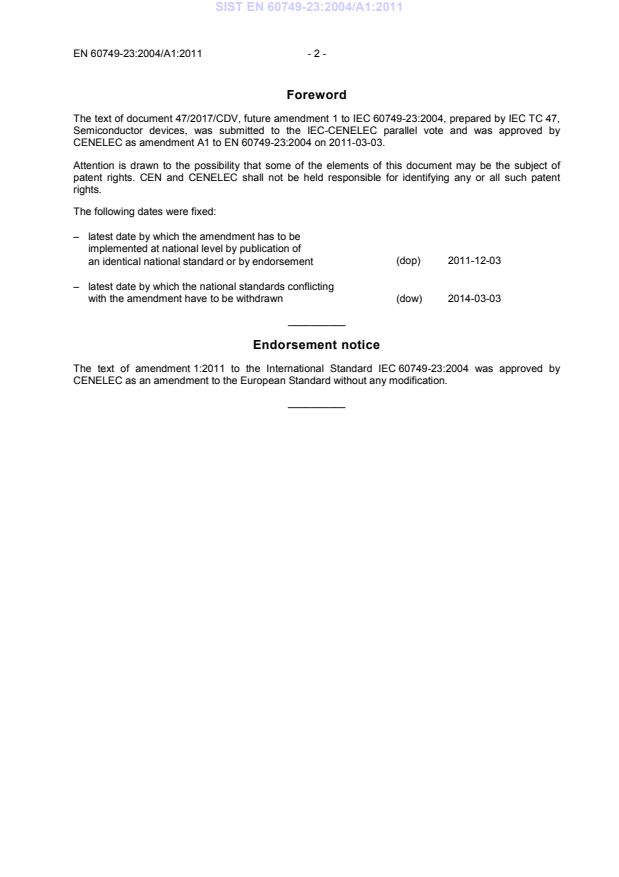
Foreword
The text of document 47/2017/CDV, future amendment 1 to IEC 60749-23:2004, prepared by IEC TC 47,
Semiconductor devices, was submitted to the IEC-CENELEC parallel vote and was approved by
CENELEC as amendment A1 to
...