


EN IEC 60749-24:2026
(Main)Semiconductor devices - Mechanical and climatic test methods - Part 24: Accelerated moisture resistance - Unbiased HAST
Semiconductor devices - Mechanical and climatic test methods - Part 24: Accelerated moisture resistance - Unbiased HAST
IEC 60749-24:2025 specifies unbiased highly accelerated stress testing (HAST). HAST is performed for the purpose of evaluating the reliability of non-hermetically packaged solid-state devices in humid environments. It is a highly accelerated test which employs temperature and humidity under non-condensing conditions to accelerate the penetration of moisture through the external protective material (encapsulant or seal) or along the interface between the external protective material and the metallic conductors which pass through it. Bias is not applied in this test to ensure that the failure mechanisms potentially overshadowed by bias can be uncovered (e.g. galvanic corrosion). This test is used to identify failure mechanisms internal to the package and is destructive. This edition includes the following significant technical changes with respect to the previous edition: a) rearrangement of clauses to reposition requirements; b) addition of two notes to the post-test electrical procedures.
Halbleiterbauelemente - Mechanische und klimatische Prüfverfahren - Teil 24: Beschleunigte Feuchtigkeitsbeständigkeit - Unvoreingenommene Hast
Dispositifs à semiconducteurs - Méthodes d'essais mécaniques et climatiques - Partie 24: Résistance à l'humidité accélérée - HAST sans polarisation
L'IEC 60749-24:2025 spécifie un essai fortement accéléré de contrainte d’humidité (HAST, Highly Accelerated Stress Testing) sans polarisation. L’essai HAST est réalisé dans le but d’évaluer la fiabilité des dispositifs à l’état solide sous boîtiers non hermétiques dans des environnements humides. Il s’agit d’un essai fortement accéléré qui utilise une température et une humidité dans des conditions sans condensation, pour accélérer la pénétration d’humidité à travers le matériau de protection extérieur (agent d’enrobage ou de scellement) ou par l’interface entre le matériau de protection extérieur et les conducteurs métalliques qui le traversent. La polarisation n’est pas appliquée dans cet essai pour s’assurer que les mécanismes de défaillance potentiellement éclipsés par la polarisation puissent être découverts (la corrosion galvanique, par exemple). Cet essai destructif est utilisé pour identifier les mécanismes de défaillance internes au boîtier. Cette édition inclut les modifications techniques majeures suivantes par rapport à l'édition précédente: a) réorganisation des articles pour repositionner les exigences; b) ajout de deux notes aux procédures électriques après l’essai.
Polprevodniški elementi - Metode za mehansko in klimatsko preskušanje - 24. del: Povečana odpornost proti vlagi (IEC 60749-24:2025)
General Information
- Status
- Published
- Publication Date
- 15-Jan-2026
- Technical Committee
- CLC/TC 47X - Semiconductor devices and trusted chips
- Current Stage
- 6060 - Document made available - Publishing
- Start Date
- 16-Jan-2026
- Due Date
- 31-Mar-2025
- Completion Date
- 16-Jan-2026
Relations
- Effective Date
- 23-Jul-2024
- Effective Date
- 03-Feb-2026
- Effective Date
- 03-Feb-2026
- Effective Date
- 03-Feb-2026
Overview
EN IEC 60749-24:2026 is a critical international standard published by the CLC organization that defines the methods for mechanical and climatic testing of semiconductor devices, specifically focusing on accelerated moisture resistance via Unbiased Highly Accelerated Stress Testing (HAST). This test is designed to evaluate the reliability of non-hermetically packaged solid-state devices when exposed to high humidity and temperature conditions, replicating harsh operating environments.
Unbiased HAST accelerates the penetration of moisture through the device’s external protective layers, such as encapsulants and seals, by applying elevated temperature and humidity under non-condensing conditions. Importantly, no electrical bias is applied during this test, enabling the identification of failure mechanisms that might be masked under biased conditions, such as galvanic corrosion inside the package. This standard serves as a destructive test method, offering manufacturers and testers a robust framework to understand moisture-induced failure modes effectively.
Key Topics
- Test Objective: Assess moisture ingress and related failure mechanisms in semiconductor packages, focusing on unbiased conditions to uncover subtle corrosion or interface-related failures.
- Test Environment: Controlled temperature and relative humidity with non-condensing atmosphere to avoid irrelevant external failures like corrosion on leads or pin-to-pin leakage.
- Test Conditions: Utilizes specific temperature and humidity profiles, typically involving elevated temperatures of 110°C to 130°C combined with 85% relative humidity under positive pressure.
- Test Apparatus: Requires specialized chambers capable of maintaining precise temperature, humidity, and pressure profiles, with recorded monitoring to ensure reproducibility and adherence to tolerances.
- Procedure Highlights:
- Test samples mounted to minimize temperature gradients.
- Ramp-up time limited to under 3 hours, ensuring no condensation occurs.
- Ramp-down conducted carefully to avoid rapid depressurization artifacts.
- Use of distilled or deionized water to prevent ionic contamination.
- Failure Criteria: Defines how to identify moisture-related failure mechanisms internally within the semiconductor package after exposure.
- Technical Changes: This second edition includes clause rearrangement and additional notes on post-test electrical procedures enhancing clarity and procedural consistency.
Applications
EN IEC 60749-24:2026 provides essential guidelines for:
- Semiconductor Manufacturers: To enhance design robustness by testing devices under accelerated moisture stress, ensuring better quality and reliability of plastic-encapsulated and other non-hermetic packages.
- Reliability Engineers: For evaluating product durability in humid and thermally challenging environments resembling real-world applications.
- Quality Assurance Teams: To implement standardized, internationally accepted test methods that support qualification and failure analysis protocols.
- Component Test Labs: To adopt consistent and reproducible test setups aligned with this global standard, supporting industry-wide benchmarking.
- Automotive, Consumer Electronics, and Industrial Electronics Sectors: Where devices are exposed to variable environmental stresses, this standard helps safeguard against premature failures caused by moisture ingress.
By applying EN IEC 60749-24:2026, stakeholders achieve predictive insights into moisture resistance, reducing risks and enhancing device longevity.
Related Standards
This standard complements and references several key IEC documents essential to semiconductor testing:
- IEC 60749-33: Accelerated moisture resistance - Unbiased autoclave test methods, offering alternative moisture resistance evaluation techniques.
- IEC 60749-5: Steady-state temperature humidity bias life test, serving as a reference method where bias is applied, supporting comprehensive moisture resistance testing strategies.
- IEC 60749 Series: The overarching series covering various mechanical and climatic test procedures for semiconductor devices, ensuring holistic stress testing coverage.
Utilizing EN IEC 60749-24 alongside these related standards ensures a well-rounded reliability assessment framework capable of addressing modern semiconductor device challenges in diverse environments.
Keywords: EN IEC 60749-24, semiconductor devices, unbiased HAST, accelerated moisture resistance, mechanical and climatic test methods, semiconductor reliability testing, non-hermetic packages, moisture ingress, temperature humidity stress test, failure mechanism identification, IEC semiconductor standards.

Frequently Asked Questions
EN IEC 60749-24:2026 is a standard published by CLC. Its full title is "Semiconductor devices - Mechanical and climatic test methods - Part 24: Accelerated moisture resistance - Unbiased HAST". This standard covers: IEC 60749-24:2025 specifies unbiased highly accelerated stress testing (HAST). HAST is performed for the purpose of evaluating the reliability of non-hermetically packaged solid-state devices in humid environments. It is a highly accelerated test which employs temperature and humidity under non-condensing conditions to accelerate the penetration of moisture through the external protective material (encapsulant or seal) or along the interface between the external protective material and the metallic conductors which pass through it. Bias is not applied in this test to ensure that the failure mechanisms potentially overshadowed by bias can be uncovered (e.g. galvanic corrosion). This test is used to identify failure mechanisms internal to the package and is destructive. This edition includes the following significant technical changes with respect to the previous edition: a) rearrangement of clauses to reposition requirements; b) addition of two notes to the post-test electrical procedures.
IEC 60749-24:2025 specifies unbiased highly accelerated stress testing (HAST). HAST is performed for the purpose of evaluating the reliability of non-hermetically packaged solid-state devices in humid environments. It is a highly accelerated test which employs temperature and humidity under non-condensing conditions to accelerate the penetration of moisture through the external protective material (encapsulant or seal) or along the interface between the external protective material and the metallic conductors which pass through it. Bias is not applied in this test to ensure that the failure mechanisms potentially overshadowed by bias can be uncovered (e.g. galvanic corrosion). This test is used to identify failure mechanisms internal to the package and is destructive. This edition includes the following significant technical changes with respect to the previous edition: a) rearrangement of clauses to reposition requirements; b) addition of two notes to the post-test electrical procedures.
EN IEC 60749-24:2026 is classified under the following ICS (International Classification for Standards) categories: 31.080.01 - Semiconductor devices in general. The ICS classification helps identify the subject area and facilitates finding related standards.
EN IEC 60749-24:2026 has the following relationships with other standards: It is inter standard links to EN 60749-24:2004, EN IEC 60749-5:2024, EN 60749-33:2004, EN IEC 60749-30:2020. Understanding these relationships helps ensure you are using the most current and applicable version of the standard.
EN IEC 60749-24:2026 is available in PDF format for immediate download after purchase. The document can be added to your cart and obtained through the secure checkout process. Digital delivery ensures instant access to the complete standard document.
Standards Content (Sample)
SLOVENSKI STANDARD
01-marec-2026
Nadomešča:
SIST EN 60749-24:2004
Polprevodniški elementi - Metode za mehansko in klimatsko preskušanje - 24. del:
Povečana odpornost proti vlagi (IEC 60749-24:2025)
Semiconductor devices - Mechanical and climatic test methods - Part 24: Accelerated
moisture resistance - Unbiased HAST (IEC 60749-24:2025)
Halbleiterbauelemente - Mechanische und klimatische Prüfverfahren - Teil 24:
Beschleunigte Feuchtigkeitsbeständigkeit - Unvoreingenommene Hast (IEC 60749-
24:2025)
Dispositifs à semiconducteurs - Méthodes d'essais mécaniques et climatiques - Partie
24: Résistance à l'humidité accélérée - HAST sans polarisation (IEC 60749-24:2025)
Ta slovenski standard je istoveten z: EN IEC 60749-24:2026
ICS:
19.020 Preskuševalni pogoji in Test conditions and
postopki na splošno procedures in general
31.080.01 Polprevodniški elementi Semiconductor devices in
(naprave) na splošno general
2003-01.Slovenski inštitut za standardizacijo. Razmnoževanje celote ali delov tega standarda ni dovoljeno.
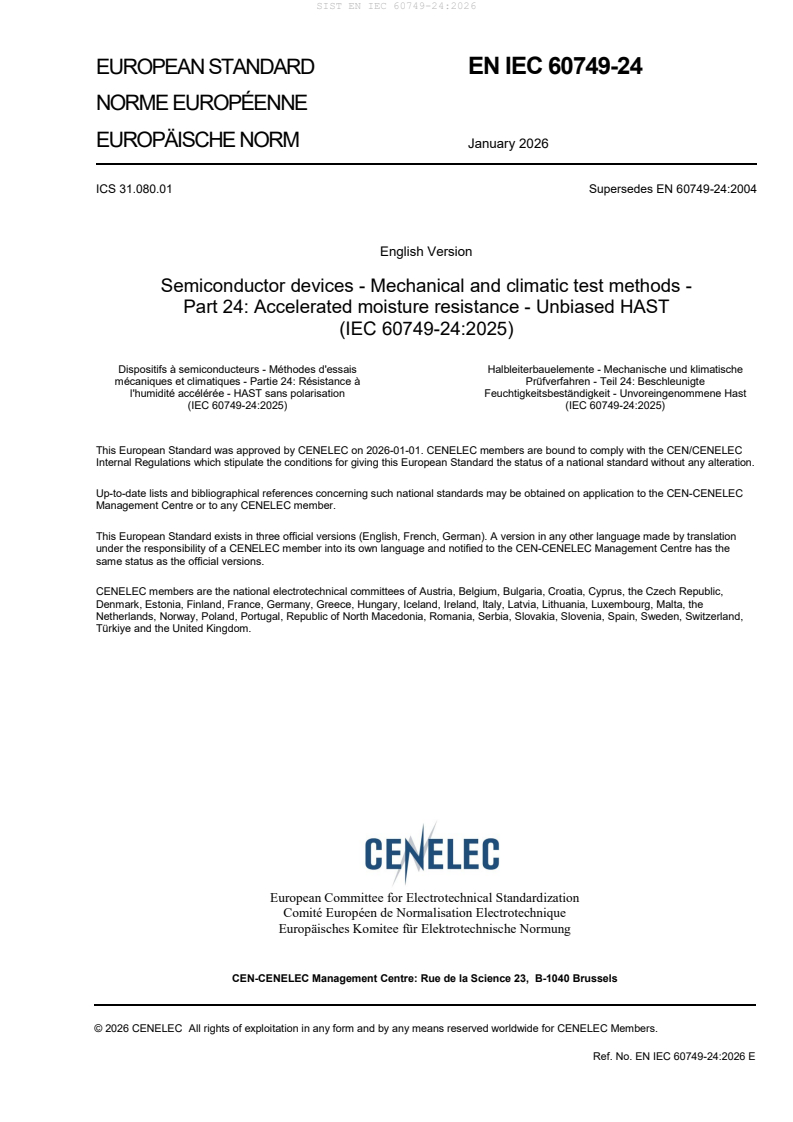
EUROPEAN STANDARD EN IEC 60749-24
NORME EUROPÉENNE
EUROPÄISCHE NORM January 2026
ICS 31.080.01 Supersedes EN 60749-24:2004
English Version
Semiconductor devices - Mechanical and climatic test methods -
Part 24: Accelerated moisture resistance - Unbiased HAST
(IEC 60749-24:2025)
Dispositifs à semiconducteurs - Méthodes d'essais Halbleiterbauelemente - Mechanische und klimatische
mécaniques et climatiques - Partie 24: Résistance à Prüfverfahren - Teil 24: Beschleunigte
l'humidité accélérée - HAST sans polarisation Feuchtigkeitsbeständigkeit - Unvoreingenommene Hast
(IEC 60749-24:2025) (IEC 60749-24:2025)
This European Standard was approved by CENELEC on 2026-01-01. CENELEC members are bound to comply with the CEN/CENELEC
Internal Regulations which stipulate the conditions for giving this European Standard the status of a national standard without any alteration.
Up-to-date lists and bibliographical references concerning such national standards may be obtained on application to the CEN-CENELEC
Management Centre or to any CENELEC member.
This European Standard exists in three official versions (English, French, German). A version in any other language made by translation
under the responsibility of a CENELEC member into its own language and notified to the CEN-CENELEC Management Centre has the
same status as the official versions.
CENELEC members are the national electrotechnical committees of Austria, Belgium, Bulgaria, Croatia, Cyprus, the Czech Republic,
Denmark, Estonia, Finland, France, Germany, Greece, Hungary, Iceland, Ireland, Italy, Latvia, Lithuania, Luxembourg, Malta, the
Netherlands, Norway, Poland, Portugal, Republic of North Macedonia, Romania, Serbia, Slovakia, Slovenia, Spain, Sweden, Switzerland,
Türkiye and the United Kingdom.
European Committee for Electrotechnical Standardization
Comité Européen de Normalisation Electrotechnique
Europäisches Komitee für Elektrotechnische Normung
CEN-CENELEC Management Centre: Rue de la Science 23, B-1040 Brussels
© 2026 CENELEC All rights of exploitation in any form and by any means reserved worldwide for CENELEC Members.
Ref. No. EN IEC 60749-24:2026 E
European foreword
The text of document 47/2957/FDIS, future edition 2 of IEC 60749-24, prepared by TC 47
"Semiconductor devices" was submitted to the IEC-CENELEC parallel vote and approved by
CENELEC as EN IEC 60749-24:2026.
The following dates are fixed:
• latest date by which the document has to be implemented at national (dop) 2027-01-31
level by publication of an identical national standard or by endorsement
• latest date by which the national standards conflicting with the (dow) 2029-01-31
document have to be withdrawn
This document supersedes EN 60749-24:2004 and all of its amendments and corrigenda (if any).
Attention is drawn to the possibility that some of the elements of this document may be the subject of
patent rights. CENELEC shall not be held responsible for identifying any or all such patent rights.
Any feedback and questions on this document should be directed to the users’ national committee. A
complete listing of these bodies can be found on the CENELEC website.
Endorsement notice
The text of the International Standard IEC 60749-24:2025 was approved by CENELEC as a European
Standard without any modification.
Annex ZA
(normative)
Normative references to international publications
with their corresponding European publications
The following documents are referred to in the text in such a way that some or all of their content
constitutes requirements of this document. For dated references, only the edition cited applies. For
undated references, the latest edition of the referenced document (including any amendments)
applies.
NOTE 1 Where an International Publication has been modified by common modifications, indicated by (mod),
the relevant EN/HD applies.
NOTE 2 Up-to-date information on the latest versions of the European Standards listed in this annex is available
here: www.cencenelec.eu.
Publication Year Title EN/HD Year
IEC 60749-5 - Semiconductor devices - Mechanical and EN IEC 60749-5 -
climatic test methods - Part 5: Steady-state
temperature humidity bias life test
IEC 60749-33 - Semiconductor devices - Mechanical and EN 60749-33 -
climatic test methods - Part 33:
Accelerated moisture resistance -
Unbiased autoclave
IEC 60749-24 ®
Edition 2.0 2025-11
INTERNATIONAL
STANDARD
Semiconductor devices - Mechanical and climatic test methods -
Part 24: Accelerated moisture resistance - Unbiased HAST
ICS 31.080.01 ISBN 978-2-8327-0862-0
IEC 60749-24:2025-11(en)
IEC 60749-24:2025 © IEC 2025
CONTENTS
FOREWORD . 2
1 Scope . 4
2 Normative references . 4
3 Terms and definitions . 4
4 Test requirements. 4
5 Test apparatus . 5
5.1 Test chamber . 5
5.2 Records . 5
5.3 Devices under stress . 5
5.4 Ionic contamination . 5
5.5 Distilled or deionized water . 5
6 Test conditions . 5
7 Procedure . 6
7.1 Mounting . 6
7.2 Ramp-up . 6
7.3 Ramp-down . 7
7.4 Test clock . 7
7.5 Electrical tests . 7
7.6 Handling . 7
8 Failure criteria . 7
9 Safety . 7
10 Summary . 8
Bibliography . 9
Table 1 – Test conditions for accelerated moisture resistance testing . 6
IEC 60749-24:2025 © IEC 2025
INTERNATIONAL ELECTROTECHNICAL COMMISSION
____________
Semiconductor devices - Mechanical and climatic test methods -
Part 24: Accelerated moisture resistance - Unbiased HAST
FOREWORD
1) The International Electrotechnical Commission (IEC) is a worldwide organization for standardization comprising
all national electrotechnical committees (IEC National Committees). The object of IEC is to promote international
co-operation on all questions concerning standardization in the electrical and electronic fields. To this end and
in addition to other activities, IEC publishes International Standards, Technical Specifications, Technical Reports,
Publicly Available Specifications (PAS) and Guides (hereafter referred to as “IEC Publication(s)”). Their
preparation is entrusted to technical committees; any IEC National Committee interested in the subject dealt with
may participate in this preparatory work. International, governmental and non-governmental organizations liaising
with the IEC also participate in this preparation. IEC collaborates closely with the International Organization for
Standardization (ISO) in accordance with conditions determined by agreement between the two organizations.
2) The formal decisions or agreements of IEC on technical matters express, as nearly as possible, an international
consensus of opinion on the relevant subjects since each technical committee has representation from all
interested IEC National Committees.
3) IEC Publications have the form of recommendations for international use and are accepted by IEC National
Committees in that sense. While all reasonable efforts are made to ensure that the technical content of IEC
Publications is accurate, IEC cannot be held responsible for the way in which they are used or for any
misinterpretation by any end user.
4) In order to promote international uniformity, IEC National Committees undertake to apply IEC Publications
transparently to the maximum extent possible in their national and regional publications. Any divergence between
any IEC Publication and the corresponding national or regional publication shall be clearly indicated in the latter.
5) IEC itself does not provide any attestation of conformity. Independent certification bodies provide conformity
assessment services and, in some areas, access to IEC marks of conformity. IEC is not responsible for any
services carried out by independent certification bodies.
6) All users should ensure that they have the latest edition of this publication.
7) No liability shall attach to IEC or its directors, employees, servants or agents including individual experts and
members of its technical committees and IEC National Committees for any personal injury, property damage or
other damage of any nature whatsoever, whether direct or indirect, or for costs (including legal fees) and
expenses arising out of the publication, use of, or reliance upon, this IEC Publication or any other IEC
Publications.
8) Attention is drawn to the Normative references cited in this publication. Use of the referenced publications is
indispensable for the correct application of this publication.
9) IEC draws attention to the possibility that the implementation of this document may involve the use of (a)
patent(s). IEC takes no position concerning the evidence, validity or applicability of any claimed patent rights in
respect thereof. As of the date of publication of this document, IEC had not received notice of patens, which may
be required to implement this document. However, implementers are cautioned that this may not represent the
latest information, which may be obtained from the patent database available at https://patents.iec.ch. IEC shall
not be held responsible for identify
...
Questions, Comments and Discussion
Ask us and Technical Secretary will try to provide an answer. You can facilitate discussion about the standard in here.
Loading comments...