


prEN IEC 60704-2-17:2026
(Main)Household and similar electrical appliances - Test code for the determination of airborne acoustical noise - Part 2-17: Particular requirements for floor cleaning robots
General Information
- Abstract
- Status
- Not Published
- Publication Date
- 25-Oct-2027
- Technical Committee
- CLC/TC 59X - Consumer information related to household electrical appliances
- Current Stage
- 4060 - Enquiry results established and sent to TC, SR, BTTF - Enquiry
- Start Date
- 26-Jun-2026
- Completion Date
- 26-Jun-2026

Overview
prEN IEC 60704-2-17:2026 establishes a standardized test code for measuring airborne acoustical noise emitted by household and similar electrical appliances, with a particular focus on floor cleaning robots. Developed by CLC and IEC Subcommittee SC 59F, this standard specifies the methodology for assessing sound levels produced by electrical floor cleaning robots, covering both normal operation on hard floors and carpets, including their accessories and docking stations.
The standard supports manufacturers, laboratories, and regulatory bodies in consistently determining and reporting the noise emission of these widely used appliances. By ensuring comparable measurements, prEN IEC 60704-2-17:2026 helps facilitate product development, regulatory compliance, and consumer choice in the fast-growing market for robotic vacuum and floor cleaners.
Key Topics
- Scope and Applicability: Covers electrical floor cleaning robots intended for household or similar environments, including wet and dry cleaning functionalities. Excludes devices for industrial or outdoor use.
- Measurement Methods: Defines direct and comparison methods aligned with ISO 3743-2 and ISO 3744 for robust and repeatable noise measurements in both special reverberation and free-field test rooms.
- Acoustical Test Environments: Specifies requirements for test rooms, including background noise limitations and flooring specifications to ensure accurate assessment of noise emissions.
- Test Setup and Conditions:
- Preparation and conditioning of appliances before measurement
- Standardized loading conditions using Wilton test carpets and hard floors
- Use of fenced test areas to limit robot movement during testing
- Docking station treatment and testing
- Instrumentation: Requirements for sound measurement devices, microphone array setups, and recommendations for their calibration and maintenance.
- Operating Modes: Measurement protocols include all relevant robot and docking station modes, especially those producing the highest noise emissions.
- Reporting and Documentation: Details which appliance and test parameters must be recorded and reported, enhancing data transparency and repeatability.
Applications
prEN IEC 60704-2-17:2026 is vital for a wide range of applications, including:
- Manufacturers: Assists in designing quieter floor cleaning robots, validating product claims, and supporting product differentiation based on noise emission levels.
- Testing Laboratories: Provides a unified, internationally recognized protocol for noise testing, enhancing comparability of results across regions and facilities.
- Product Certification and Compliance: Enables consistent fulfillment of regulatory or ecolabel requirements regarding household appliance noise emissions.
- Market Surveillance and Consumer Protection: Facilitates fair testing and communication of sound power levels to consumers, allowing informed purchasing decisions.
- Research and Development: Supports benchmarking and innovation in robot vacuum and cleaning technology, including integration of noise-reduction features.
Related Standards
- IEC 60704-1:2021 – General requirements and measurement procedures for airborne acoustical noise from household and similar electrical appliances.
- IEC 60704-2-1:2021 – Particular requirements for vacuum cleaners.
- IEC/ASTM 62885-7:2020 – Performance testing methods for dry-cleaning robots used in households.
- IEC/ASTM 62885-11:202x – Performance testing for wet-cleaning robots and related functionalities.
- ISO 3743-2, ISO 3744 – Specifications for acoustical test environments and sound measurement methodologies relevant for household appliances.
- IEC TS 62885-1:2020 – General requirements related to test materials and equipment for surface cleaning appliances.
By following prEN IEC 60704-2-17:2026, stakeholders gain a reliable foundation for the measurement and assessment of acoustic noise from robotic floor cleaners, aligning products with international best practices and marketplace expectations for appliances’ noise performance.
Relations
- Effective Date
- 18-Jul-2023
Get Certified
Connect with accredited certification bodies for this standard

BSMI (Bureau of Standards, Metrology and Inspection)
Taiwan's standards and inspection authority.
Sponsored listings
Frequently Asked Questions
prEN IEC 60704-2-17:2026 is a draft published by CLC. Its full title is "Household and similar electrical appliances - Test code for the determination of airborne acoustical noise - Part 2-17: Particular requirements for floor cleaning robots". This standard covers: Household and similar electrical appliances - Test code for the determination of airborne acoustical noise - Part 2-17: Particular requirements for floor cleaning robots
Household and similar electrical appliances - Test code for the determination of airborne acoustical noise - Part 2-17: Particular requirements for floor cleaning robots
prEN IEC 60704-2-17:2026 is classified under the following ICS (International Classification for Standards) categories: 17.140.20 - Noise emitted by machines and equipment. The ICS classification helps identify the subject area and facilitates finding related standards.
prEN IEC 60704-2-17:2026 has the following relationships with other standards: It is inter standard links to EN IEC 60704-2-17:2020. Understanding these relationships helps ensure you are using the most current and applicable version of the standard.
prEN IEC 60704-2-17:2026 is available in PDF format for immediate download after purchase. The document can be added to your cart and obtained through the secure checkout process. Digital delivery ensures instant access to the complete standard document.
Standards Content (Sample)
SLOVENSKI STANDARD
01-maj-2026
Gospodinjski in podobni električni aparati - Postopek preskušanja za ugotavljanje
zvočnega hrupa v zraku - 2-17. del: Posebne zahteve za robotske sesalnike
Household and similar electrical appliances - Test code for the determination of airborne
acoustical noise - Part 2-17: Particular requirements for floor cleaning robots
Elektrische Geräte für den Hausgebrauch und ähnliche Zwecke - Prüfvorschrift für die
Bestimmung der Luftschallemission - Teil 2-17: Besondere Anforderungen an Trocken-
Reinigungsroboter
Appareils électrodomestiques et analogues - Code d'essai pour la détermination du bruit
aérien - Partie 2-17: Exigences particulières pour les robots de nettoyage de sols
Ta slovenski standard je istoveten z: prEN IEC 60704-2-17:2026
ICS:
17.140.20 Emisija hrupa naprav in Noise emitted by machines
opreme and equipment
97.080 Aparati za čiščenje Cleaning appliances
2003-01.Slovenski inštitut za standardizacijo. Razmnoževanje celote ali delov tega standarda ni dovoljeno.
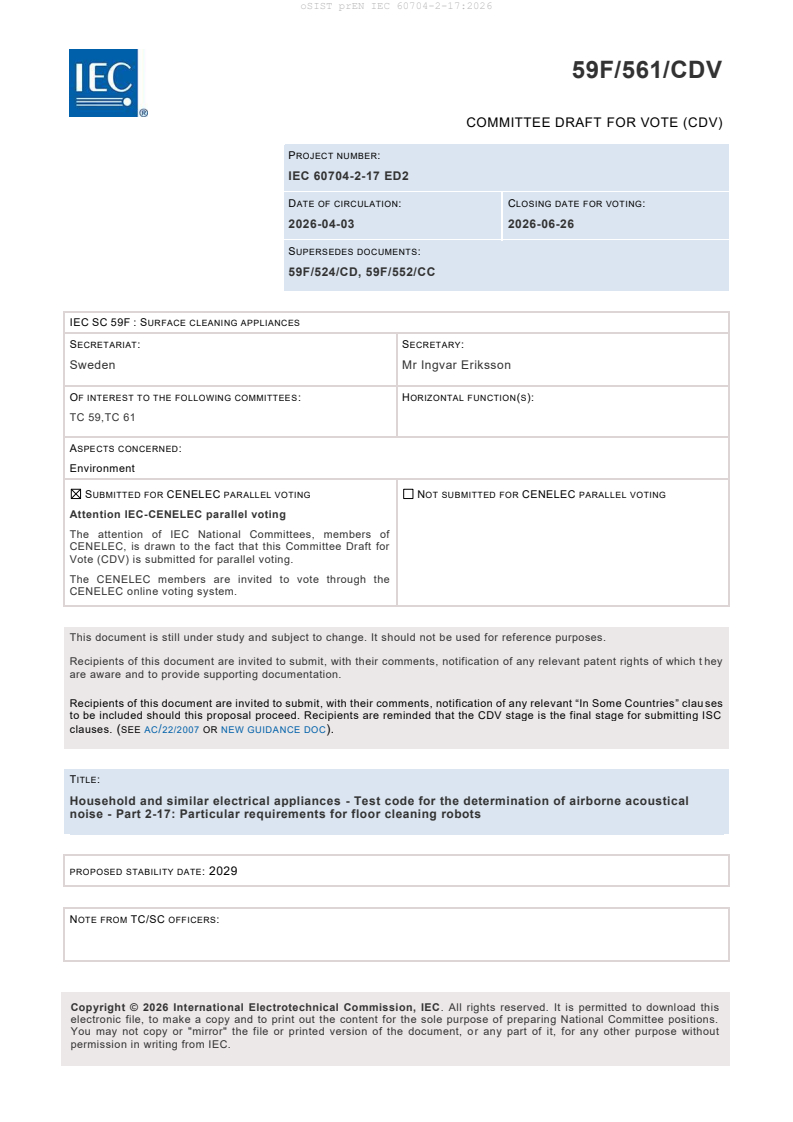
59F/561/CDV
COMMITTEE DRAFT FOR VOTE (CDV)
PROJECT NUMBER:
IEC 60704-2-17 ED2
DATE OF CIRCULATION: CLOSING DATE FOR VOTING:
2026-04-03 2026-06-26
SUPERSEDES DOCUMENTS:
59F/524/CD, 59F/552/CC
IEC SC 59F : SURFACE CLEANING APPLIANCES
SECRETARIAT: SECRETARY:
Sweden Mr Ingvar Eriksson
OF INTEREST TO THE FOLLOWING COMMITTEES: HORIZONTAL FUNCTION(S):
TC 59,TC 61
ASPECTS CONCERNED:
Environment
SUBMITTED FOR CENELEC PARALLEL VOTING NOT SUBMITTED FOR CENELEC PARALLEL VOTING
Attention IEC-CENELEC parallel voting
The attention of IEC National Committees, members of
CENELEC, is drawn to the fact that this Committee Draft for
Vote (CDV) is submitted for parallel voting.
The CENELEC members are invited to vote through the
CENELEC online voting system.
This document is still under study and subject to change. It should not be used for reference purposes.
Recipients of this document are invited to submit, with their comments, notification of any relevant patent rights of which t hey
are aware and to provide supporting documentation.
Recipients of this document are invited to submit, with their comments, notification of any relevant “In Some Countries” clau ses
to be included should this proposal proceed. Recipients are reminded that the CDV stage is the final stage for submitting ISC
clauses. (SEE AC/22/2007 OR NEW GUIDANCE DOC).
TITLE:
Household and similar electrical appliances - Test code for the determination of airborne acoustical
noise - Part 2-17: Particular requirements for floor cleaning robots
PROPOSED STABILITY DATE: 2029
NOTE FROM TC/SC OFFICERS:
electronic file, to make a copy and to print out the content for the sole purpose of preparing National Committee positions.
You may not copy or "mirror" the file or printed version of the document, or any part of it, for any other purpose without
permission in writing from IEC.
IEC CDV 60704-2-17 © IEC 2026
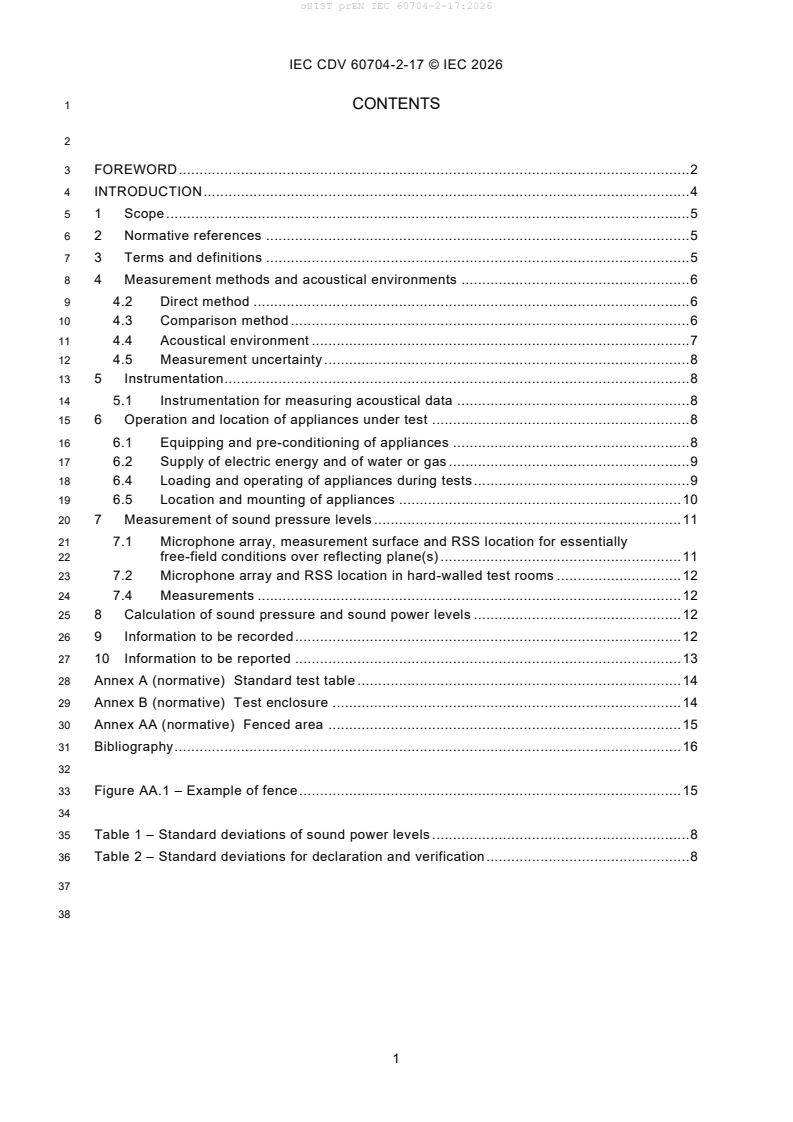
1 CONTENTS
3 FOREWORD . 2
4 INTRODUCTION . 4
5 1 Scope . 5
6 2 Normative references . 5
7 3 Terms and definitions . 5
8 4 Measurement methods and acoustical environments . 6
9 4.2 Direct method . 6
10 4.3 Comparison method . 6
11 4.4 Acoustical environment . 7
12 4.5 Measurement uncertainty . 8
13 5 Instrumentation . 8
14 5.1 Instrumentation for measuring acoustical data . 8
15 6 Operation and location of appliances under test . 8
16 6.1 Equipping and pre-conditioning of appliances . 8
17 6.2 Supply of electric energy and of water or gas . 9
18 6.4 Loading and operating of appliances during tests . 9
19 6.5 Location and mounting of appliances . 10
20 7 Measurement of sound pressure levels . 11
21 7.1 Microphone array, measurement surface and RSS location for essentially
22 free-field conditions over reflecting plane(s) . 11
23 7.2 Microphone array and RSS location in hard-walled test rooms . 12
24 7.4 Measurements . 12
25 8 Calculation of sound pressure and sound power levels . 12
26 9 Information to be recorded . 12
27 10 Information to be reported . 13
28 Annex A (normative) Standard test table . 14
29 Annex B (normative) Test enclosure . 14
30 Annex AA (normative) Fenced area . 15
31 Bibliography . 16
33 Figure AA.1 – Example of fence . 15
35 Table 1 – Standard deviations of sound power levels . 8
36 Table 2 – Standard deviations for declaration and verification . 8
IEC CDV 60704-2-17 © IEC 2026
39 INTERNATIONAL ELECTROTECHNICAL COMMISSION
40 ____________
42 HOUSEHOLD AND SIMILAR ELECTRICAL APPLIANCES –
43 TEST CODE FOR THE DETERMINATION
44 OF AIRBORNE ACOUSTICAL NOISE –
46 Part 2-17: Particular requirements for floor cleaning robots
48 FOREWORD
49 1) The International Electrotechnical Commission (IEC) is a worldwide organization for standardization comprising
50 all national electrotechnical committees (IEC National Committees). The object of IEC is to promote international
51 co-operation on all questions concerning standardization in the electrical and electronic fields. To this end and
52 in addition to other activities, IEC publishes International Standards, Technical Specifications, Technical Reports,
53 Publicly Available Specifications (PAS) and Guides (hereafter referred to as "IEC Publication(s)"). Their
54 preparation is entrusted to technical committees; any IEC National Committee interested in the subject dealt with
55 may participate in this preparatory work. International, governmental and non-governmental organizations liaising
56 with the IEC also participate in this preparation. IEC collaborates closely with the International Organization for
57 Standardization (ISO) in accordance with conditions determined by agreement between the two organizations.
58 2) The formal decisions or agreements of IEC on technical matters express, as nearly as possible, an international
59 consensus of opinion on the relevant subjects since each technical committee has representation from all
60 interested IEC National Committees.
61 3) IEC Publications have the form of recommendations for international use and are accepted by IEC National
62 Committees in that sense. While all reasonable efforts are made to ensure that the technical content of IEC
63 Publications is accurate, IEC cannot be held responsible for the way in which they are used or for any
64 misinterpretation by any end user.
65 4) In order to promote international uniformity, IEC National Committees undertake to apply IEC Publications
66 transparently to the maximum extent possible in their national and regional publications. Any divergence between
67 any IEC Publication and the corresponding national or regional publication shall be clearly indicated in the latter.
68 5) IEC itself does not provide any attestation of conformity. Independent certification bodies provide conformity
69 assessment services and, in some areas, access to IEC marks of conformity. IEC is not responsible for any
70 services carried out by independent certification bodies.
71 6) All users should ensure that they have the latest edition of this publication.
72 7) No liability shall attach to IEC or its directors, employees, servants or agents including individual experts and
73 members of its technical committees and IEC National Committees for any personal injury, property damage or
74 other damage of any nature whatsoever, whether direct or indirect, or for costs (including legal fees) and
75 expenses arising out of the publication, use of, or reliance upon, this IEC Publication or any other IEC
76 Publications.
77 8) Attention is drawn to the Normative references cited in this publication. Use of the referenced publications is
78 indispensable for the correct application of this publication.
79 9) IEC draws attention to the possibility that the implementation of this document may involve the use of (a)
80 patent(s). IEC takes no position concerning the evidence, validity or applicability of any claimed patent rights in
81 respect thereof. As of the date of publication of this document, IEC had not received notice of (a) patent(s), which
82 may be required to implement this document. However, implementers are cautioned that this may not represent
83 the latest information, which may be obtained from the patent database available at https://patents.iec.ch shall
84 not be held responsible for identifying any or all such patent rights.
85 IEC 60704-2-17 has been prepared by subcommittee 59F: Surface cleaning appliances, of IEC
86 technical committee 59: Performance of household and similar electrical appliances. It is an
87 International Standard.
88 This second edition cancels and replaces the first edition published in 2020. This edition
89 constitutes a technical revision.
90 This edition includes the following significant technical changes with respect to the previous
91 edition:
92 a) alignment with IEC 60704-1:2021;
93 b) addressing consumer relevant testing aspects, adding noise measurement on floor cleaning
94 robots and multifunctional base station;
IEC CDV 60704-2-17 © IEC 2026
95 c) robustness of standards and closing potential loop holes;
96 d) enlarged scope to floor cleaning robots by inclusion of noise measurement on wet cleaning
97 functionality
98 The text of this International Standard is based on the following documents:
FDIS Report on voting
59F/xxx/FDIS 59F/xxx/RVD
100 Full information on the voting for its approval can be found in the report on voting indicated in
101 the above table.
102 The language used for the development of this International Standard is English.
103 This document was drafted in accordance with ISO/IEC Directives, Part 2, and developed in
104 accordance with ISO/IEC Directives, Part 1 and ISO/IEC Directives, IEC Supplement available
105 at www.iec.ch/members_experts/refdocs. The main document types developed by IEC are
106 described in greater detail at www.iec.ch/publications.
107 This document is intended to be used in conjunction with IEC 60704-1:2021, Household and
108 similar electrical appliances – Test code for the determination of airborne acoustical noise –
109 Part 1: General requirements.
110 The relevant text of IEC 60704-1:2021 as amended by this document establishes the test code
111 for floor cleaning robots.
112 This document supplements or modifies the corresponding clauses in IEC 60704-1:2021. When
113 a particular subclause of IEC 60704-1:2021 is not mentioned in this document, that subclause
114 is applicable as far as reasonable. Where this standard states "addition", "modification" or
115 "replacement", the relevant requirements, test specifications or explanatory matter in Part 1
116 should be adapted accordingly.
117 Subclauses, tables, and figures that are additional to those in IEC 60704-1:2021 are numbered
118 starting from 101. Additional annexes are lettered AA, BB, etc.
119 Unless notes are in a new subclause or involve notes in IEC 60704-1:2021, they are numbered
120 starting from 101, including those in a replaced clause or subclause.
121 In this standard, the following print types are used:
122 • terms defined in Clause 3: bold type.
123 A list of all the parts in the IEC 60704 series, published under the general title Household and
124 similar electrical appliances – Test code for the determination of airborne acoustical noise, can
125 be found on the IEC website.
126 The committee has decided that the contents of this document will remain unchanged until the
127 stability date indicated on the IEC website under webstore.iec.ch in the data related to the
128 specific document. At this date, the document will be
129 • reconfirmed,
130 • withdrawn,
131 • replaced by a revised edition, or
132 • amended.
IEC CDV 60704-2-17 © IEC 2026
134 INTRODUCTION
135 The measuring conditions specified in this document provide for sufficient accuracy in
136 determining the noise emitted and comparing the results of measurements taken by different
137 laboratories, whilst simulating as far as possible the practical use of floor cleaning robots.
138 It is recommended to consider the determination of noise levels as part of a comprehensive
139 testing procedure covering many aspects of the properties and performance of floor cleaning
140 robots.
141 NOTE As stated in the introduction to IEC 60704-1:2021, this test code is concerned with airborne noise only.
IEC CDV 60704-2-17 © IEC 2026
143 HOUSEHOLD AND SIMILAR ELECTRICAL APPLIANCES –
144 TEST CODE FOR THE DETERMINATION
145 OF AIRBORNE ACOUSTICAL NOISE –
147 Part 2-17: Particular requirements for floor cleaning robots
151 1 Scope
152 Addition:
153 This document specifies the determination of airborne acoustical noise to electrical floor
154 cleaning robots including their accessories, docking stations and their component parts for
155 household use or under conditions similar to those in households.
156 This document describes the determination of the noise emission of floor cleaning robots under
157 normal operating conditions on carpet and hard floors.
158 This document does not apply to cleaning robots for industrial or professional purposes,
159 manually operated vacuum cleaners and cleaning robots for outdoor use.
160 2 Normative references
161 Addition:
162 IEC TS 62885-1:2020 , Surface cleaning appliances – Part 1: General requirements on test
163 material and test equipment
164 3 Terms and definitions
165 Addition:
166 3.101
167 standard Wilton test carpet
168 Wilton carpet on which the cleaning robot is moving during for the measurement
169 Note 1 to entry: The specification of the standard Wilton test carpet can be found in IEC TS 62885-1.
170 3.102
171 standard hard floor
172 hard floor on which the cleaning robot is moving during the measurement
173 3.103
174 fenced area
175 area of the floor of the test room, limited by a fence, in which the cleaning robot can move
176 around during the test
___________
Under preparation. Stage at the date of publication: IEC TS/ DTS 62885-1:2025
IEC CDV 60704-2-17 © IEC 2026
177 3.104
178 cleaning robot
179 automatic battery-powered cleaner
180 automatic floor cleaner that operates autonomously without human intervention within a defined
181 perimeter
182 Note 1 to entry: The cleaning robot consists of a mobile part and may have a docking station and/or other
183 accessories to assist its operation.
184 [SOURCE: IEC/ASTM 62885-7:2020 , 3.1]
185 3.105
186 docking station
187 base unit
188 unit that can provide manual or automatic battery charging facilities, dust removal from the
189 robot, water management system, data processing facility or other cleaning robot support
190 functions
191 Note 1 to entry: For some robots, the docking station could come in the form of an external power supply.
192 [SOURCE: IEC/ASTM 62885-7:2020 , 3.5]
193 3.106
194 wet cleaning robot
195 cleaning robot with a function that is capable of removing wet or dry stains and soils (e.g.,
196 beverage and/or food stains, floor grime, etc.) from a surface to be cleaned by use of water
197 alone, or a detergent solution mix
198 Note 1 to entry: The cleaning robot consists of a mobile part and may have a docking station and/or other
199 accessories to assist its operation.
200 Note 2 to entry: A wet cleaning robot can be a standalone cleaning robot dedicated for wet cleaning or a multi-
201 purpose cleaning robot used in wet cleaning mode.
202 [SOURCE: IEC/ASTM 62885-11:20xx , 3.1]
204 4 Measurement methods and acoustical environments
205 4.2 Direct method
206 Addition:
207 If audible discrete tones are present in the noise emitted by the source, the estimated standard
208 deviation of the measured sound pressure levels in the special reverberation room can increase.
209 In such cases, additional m
...