


EN 15459-1:2017
(Main)Energy performance of buildings - Economic evaluation procedure for energy systems in buildings - Part 1: Calculation procedures, Module M1-14
Energy performance of buildings - Economic evaluation procedure for energy systems in buildings - Part 1: Calculation procedures, Module M1-14
This European Standard provides a calculation method for the economic issues of heating systems and other systems that are involved in the energy demand and consumption of the building. It applies to all types of new and existing buildings.
The fundamental principles and terminology are explained in the standard.
The main items of the standard will be:
- the definitions and the structure of the types of costs which should be taken into account for the calculation of the economic efficiency of saving options in buildings;
- data needed for definition of costs related to systems under consideration;
- the calculation method(s);
- expression of the result of the economic study.
This European Standard is part of the method for calculation of economic performance of energy saving options in buildings (e.g. insulation, better performing generators and distribution systems, efficient lighting, renewable sources, combined heat and power...).
The scope of this specific part is to standardize:
- the required inputs;
- the required outputs;
- the calculation formulas;
- the type of energy systems concerned with the energy performance of the building.
NOTE 1 This is the revision of EN 15459:2007. The revision has been made consistent with the EU regulation on cost-optimal. This revision includes the definition of payback for investment, and inclusion of the costs due to the deconstruction of the building. The method presenting annualized costs has been suppressed.
NOTE 2 This standard does not consider financial advantages for higher productivity, higher attractiveness for tenants due to higher indoor comfort, when relevant for comparison of different options.
Table 1 shows the relative position of this standard within the set of EPB standards in the context of the modular structure as set out in EN ISO 52000-1.
NOTE 3 In CEN ISO/TR 52000-2 the same table can be found, with, for each module, the numbers of the relevant EPB standards and accompanying technical reports that are published or in preparation.
NOTE 4 The modules represent EPB standards, although one EPB standard may cover more than one module and one module may be covered by more than one EPB standard, for instance a simplified and a detailed method respectively. See also Clause 2 and Tables A.1 and B.1.
(...)
Energetische Bewertung von Gebäuden - Wirtschaftlichkeitsberechnungen für Energieanlagen in Gebäuden - Teil 1: Berechnungsverfahren, Modul M1-14
Diese Europäische Norm beschreibt ein Berechnungsverfahren für die wirtschaftlichen Aspekte von Heizungsanlagen und anderen Anlagen/Systemen, die mit dem Energiebedarf und Energieverbrauch eines Gebäudes im Zusammenhang stehen. Sie gilt für alle Arten von neuen und bestehenden Gebäuden.
Die Grundsätze und die Terminologie werden in der Norm erläutert.
Die Hauptbestandteile der Norm sind:
— Definitionen und Struktur der Kostenarten, die für die Berechnung der Wirtschaftlichkeit der Einsparmöglichkeiten in Gebäuden in Betracht gezogen werden sollten;
— Daten, die für die Definition der Kosten erforderlich sind, die mit den betrachteten Anlagen in Verbindung stehen;
— Berechnungsverfahren;
— Darstellung der Ergebnisse der Wirtschaftlichkeitsuntersuchung.
Diese Europäische Norm ist Teil des Verfahrens zur Berechnung der Wirtschaftlichkeit von Energieeinsparmöglichkeiten in Gebäuden (z. B. Wärmedämmung, bessere Leistung von Erzeugungs- und Verteilungssystemen, effiziente Beleuchtung, erneuerbare Quellen, Kraft-Wärme-Kopplung,...).
Der Anwendungsbereich dieses speziellen Teils dient zur Normung des Folgenden:
— der erforderlichen Eingangswerte;
— der erforderlichen Ausgangswerte;
— der Gleichungen zur Berechnung;
— der Art der Energiesysteme, die Einfluss auf die Energieeffizienz des Gebäudes haben.
ANMERKUNG 1 Bei diesem Dokument handelt es sich um die Überarbeitung der EN 15459:2007. Die Überarbeitung ist in Übereinstimmung mit der EU-Verordnung zur Kostenoptimierung erfolgt. Diese Überarbeitung umfasst die Definition der Amortisationsdauer in Bezug auf die Investitionen sowie die Aufnahme der durch den Rückbau des Gebäudes verursachten Kosten. Das Verfahren zur Darstellung der auf die Jahresbasis bezogenen Kosten wurde gestrichen.
ANMERKUNG 2 Diese Norm berücksichtigt keine finanziellen Vorteile für höhere Produktivität oder eine höhere Attraktivität für Mieter aufgrund eines größeren Komforts im Innenbereich, wenn dies für den Vergleich verschiedener Optionen relevant ist.
Tabelle 1 zeigt die relative Position dieser Norm innerhalb des EPB-Normenpakets im Kontext der modularen Struktur wie in EN ISO 52000-1 dargelegt.
ANMERKUNG 3 In CEN ISO/TR 52000-2 findet sich die gleiche Tabelle mit den Nummern (für jedes Modul) der jeweiligen EPB-Normen und den dazugehörigen technischen Berichten, die bereits veröffentlicht wurden oder sich in der Erstellung befinden.
ANMERKUNG 4 Die Module repräsentieren EPB-Normen, auch wenn eine EPB-Norm mehr als ein Modul abdecken kann und ein Modul von mehr als einer EPB-Norm abgedeckt werden kann, zum Beispiel jeweils ein vereinfachtes und ein detailliertes Verfahren. Siehe auch Abschnitt 2 und Tabellen A.1 und B.1.
Performance énergétique des bâtiments - Procédure d’évaluation économique des systèmes énergétiques des bâtiments - Partie 1 : Méthode de calcul, Module M1-14
La présente Norme européenne fournit une méthode de calcul pour les problématiques économiques des systèmes de chauffage et des autres systèmes impliqués dans les besoins énergétiques et la consommation d’énergie des bâtiments. Elle s’applique à tous les types de bâtiments neufs ou existants.
Les principes fondamentaux et la terminologie sont expliqués dans la norme.
Les principaux éléments de la norme sont :
- les définitions et la structure des types de coûts qu’il convient de prendre en compte pour le calcul de l’efficacité économique des options d’économie d’énergie dans les bâtiments ;
- les données requises pour la définition des coûts associés aux systèmes pris en compte ;
- la ou les méthodes de calcul ;
- l’expression du résultat de l’étude économique.
La présente Norme européenne fait partie de la méthode de calcul de la performance économique des options d’économie d’énergie dans les bâtiments (par exemple, isolation, générateurs et systèmes de distribution plus performants, éclairage efficace, sources renouvelables, production combinée de chaleur et d’électricité...).
L’objet de cette partie spécifique est de normaliser :
- les données d’entrée requises ;
- les données de sortie requises ;
- les formules de calcul ;
- le type de système d’énergie concerné par la performance énergétique du bâtiment.
NOTE 1 La présente norme constitue la révision de l’EN 15459:2007. Cette révision a été rédigée en accord avec la réglementation de l’UE sur les niveaux optimaux en fonction des coûts. La présente révision inclut la définition du recouvrement de l’investissement et la prise en compte des coûts liés à la déconstruction du bâtiment. La méthode présentant les coûts annualisés a été supprimée.
NOTE 2 En ce qui concerne la comparaison des différentes options, la présente norme ne tient pas compte des avantages financiers d’une amélioration de la productivité ni de la plus grande attractivité pour les locataires d’un meilleur confort intérieur.
Le Tableau 1 indique la position relative de la présente norme dans l’ensemble des normes PEB dans le cadre de la structure modulaire définie par l’EN ISO 52000-1.
NOTE 3 Le CEN ISO/TR 52000-2 fournit le même tableau avec, pour chaque module, le numéro des normes PEB pertinentes et les rapports techniques associés qui sont publiés ou en cours d’élaboration.
NOTE 4 Les modules représentent les normes PEB, bien qu’une seule norme PEB puisse couvrir plusieurs modules et qu’un seul module puisse être couvert par plusieurs normes PEB, par exemple une méthode simplifiée et une méthode détaillée respectivement. Voir également l’Article 2 et les Tableaux A.1 et B.1.
(...)
Energijske lastnosti stavb - Postopek ekonomskega vrednotenja energijskih sistemov v stavbah - 1. del: Postopki za izračun - Modul M1-14
Ta standard nudi računsko metodo za gospodarska vprašanja sistemov ogrevanja in drugih sistemov, ki so vključeni v zahteve po energiji in porabo energije stavbe. Velja za vse vrste novih in obstoječih stavb.
Osnovna načela in terminologija so razloženi v standardu.
Glavni elementi standarda so:
– definicije in sestava vrste stroškov, ki jih je treba upoštevati za izračun gospodarske učinkovitosti možnosti varčevanja v stavbah;
– podatki, ki so potrebni za določitev stroškov, povezanih z zadevnimi sistemi;
– računske metode;
– izražanje rezultatov gospodarske študije.
Ta standard je del metode za izračun gospodarske učinkovitosti možnosti varčevanja z energijo v stavbah (npr. izolacija, učinkovitejši generatorji in sistemi za distribucijo, učinkovita osvetlitev, obnovljivi viri, kombinirana toplota in napajanje).
Namen tega standarda je standardizirati:
– zahtevane vhode;
– zahtevane izhode
– formule za izračun;
– vrsto energijskih sistemov, ki vplivajo na energetsko učinkovitost stavbe.
OPOMBA To je revizija standarda EN 15459:2009. Revizija je usklajena z uredbo EU o stroškovno optimalnih ravneh. Ta revizija vključuje definicije za povračilo naložbe in vključitev stroškov zaradi odstranitve stavbe. Metoda, ki predstavlja stroške na letni ravni, ni upoštevana.
General Information
Relations
Overview - EN 15459-1:2017 (Module M1-14)
EN 15459-1:2017, published by CEN, defines a standardized economic evaluation procedure for energy systems in buildings (Module M1-14). The standard applies to all new and existing buildings and provides calculation procedures for assessing the economic performance of heating and other systems that affect building energy demand and consumption. This part standardizes required inputs, outputs and calculation formulas and is aligned with the EU cost-optimal framework. It supersedes EN 15459:2007 and introduces payback definitions and end-of-life / deconstruction costs (the annualized-cost method was removed).
Key topics and technical requirements
- Scope & terminology: Fundamental principles, definitions and the modular position within the EPB (Energy Performance of Buildings) standards.
- Cost structure: Clear breakdown of initial costs, annual costs, and final costs to be included in economic evaluations.
- Economic parameters: Use of discount rate / present value factors, and other financial inputs required for present-value calculations.
- Calculation method: Step-by-step procedure covering financial/project data, component and system costs (investment, replacement), energy costs, global cost calculation, and payback period computation.
- Inputs and outputs: Normative templates in Annex A (required inputs) and informative default choices in Annex B.
- Quality control & reporting: Requirements for calculation reporting and for comparing different retrofit or design options.
- Limitations: Non-financial benefits such as increased productivity or tenant attractiveness from improved comfort are explicitly excluded.
Practical applications and users
EN 15459-1:2017 is intended for professionals and stakeholders involved in building energy and economic assessments:
- Energy consultants and assessors performing cost-optimal or life-cycle economic studies
- Building services engineers evaluating heating, distribution and renewable integration options
- Architects and designers comparing envelope vs. system trade-offs
- Policy makers and regulators implementing national/regional annexes to meet EU directives
- Facility managers and developers planning investments, replacements or decommissioning
Use cases include economic feasibility of insulation, efficient generators, lighting upgrades, renewable systems, CHP integration, and retrofit decision-making.
Related standards
- EN 15603 - methods for building energy demand (referenced for energy calculations)
- EN ISO 52000-1 - modular EPB structure context
- CEN/TR 15459-2 - explanation and justification accompanying EN 15459-1
- EN 15459:2007 - superseded by this revision
Keywords: EN 15459-1:2017, energy performance of buildings, economic evaluation, payback, cost-optimal, heating systems, EPB standards, CEN.
Frequently Asked Questions
EN 15459-1:2017 is a standard published by the European Committee for Standardization (CEN). Its full title is "Energy performance of buildings - Economic evaluation procedure for energy systems in buildings - Part 1: Calculation procedures, Module M1-14". This standard covers: This European Standard provides a calculation method for the economic issues of heating systems and other systems that are involved in the energy demand and consumption of the building. It applies to all types of new and existing buildings. The fundamental principles and terminology are explained in the standard. The main items of the standard will be: - the definitions and the structure of the types of costs which should be taken into account for the calculation of the economic efficiency of saving options in buildings; - data needed for definition of costs related to systems under consideration; - the calculation method(s); - expression of the result of the economic study. This European Standard is part of the method for calculation of economic performance of energy saving options in buildings (e.g. insulation, better performing generators and distribution systems, efficient lighting, renewable sources, combined heat and power...). The scope of this specific part is to standardize: - the required inputs; - the required outputs; - the calculation formulas; - the type of energy systems concerned with the energy performance of the building. NOTE 1 This is the revision of EN 15459:2007. The revision has been made consistent with the EU regulation on cost-optimal. This revision includes the definition of payback for investment, and inclusion of the costs due to the deconstruction of the building. The method presenting annualized costs has been suppressed. NOTE 2 This standard does not consider financial advantages for higher productivity, higher attractiveness for tenants due to higher indoor comfort, when relevant for comparison of different options. Table 1 shows the relative position of this standard within the set of EPB standards in the context of the modular structure as set out in EN ISO 52000-1. NOTE 3 In CEN ISO/TR 52000-2 the same table can be found, with, for each module, the numbers of the relevant EPB standards and accompanying technical reports that are published or in preparation. NOTE 4 The modules represent EPB standards, although one EPB standard may cover more than one module and one module may be covered by more than one EPB standard, for instance a simplified and a detailed method respectively. See also Clause 2 and Tables A.1 and B.1. (...)
This European Standard provides a calculation method for the economic issues of heating systems and other systems that are involved in the energy demand and consumption of the building. It applies to all types of new and existing buildings. The fundamental principles and terminology are explained in the standard. The main items of the standard will be: - the definitions and the structure of the types of costs which should be taken into account for the calculation of the economic efficiency of saving options in buildings; - data needed for definition of costs related to systems under consideration; - the calculation method(s); - expression of the result of the economic study. This European Standard is part of the method for calculation of economic performance of energy saving options in buildings (e.g. insulation, better performing generators and distribution systems, efficient lighting, renewable sources, combined heat and power...). The scope of this specific part is to standardize: - the required inputs; - the required outputs; - the calculation formulas; - the type of energy systems concerned with the energy performance of the building. NOTE 1 This is the revision of EN 15459:2007. The revision has been made consistent with the EU regulation on cost-optimal. This revision includes the definition of payback for investment, and inclusion of the costs due to the deconstruction of the building. The method presenting annualized costs has been suppressed. NOTE 2 This standard does not consider financial advantages for higher productivity, higher attractiveness for tenants due to higher indoor comfort, when relevant for comparison of different options. Table 1 shows the relative position of this standard within the set of EPB standards in the context of the modular structure as set out in EN ISO 52000-1. NOTE 3 In CEN ISO/TR 52000-2 the same table can be found, with, for each module, the numbers of the relevant EPB standards and accompanying technical reports that are published or in preparation. NOTE 4 The modules represent EPB standards, although one EPB standard may cover more than one module and one module may be covered by more than one EPB standard, for instance a simplified and a detailed method respectively. See also Clause 2 and Tables A.1 and B.1. (...)
EN 15459-1:2017 is classified under the following ICS (International Classification for Standards) categories: 91.140.10 - Central heating systems. The ICS classification helps identify the subject area and facilitates finding related standards.
EN 15459-1:2017 has the following relationships with other standards: It is inter standard links to EN 15459:2007. Understanding these relationships helps ensure you are using the most current and applicable version of the standard.
EN 15459-1:2017 is associated with the following European legislation: EU Directives/Regulations: 2010/31/EU; Standardization Mandates: M/480. When a standard is cited in the Official Journal of the European Union, products manufactured in conformity with it benefit from a presumption of conformity with the essential requirements of the corresponding EU directive or regulation.
You can purchase EN 15459-1:2017 directly from iTeh Standards. The document is available in PDF format and is delivered instantly after payment. Add the standard to your cart and complete the secure checkout process. iTeh Standards is an authorized distributor of CEN standards.
Standards Content (Sample)
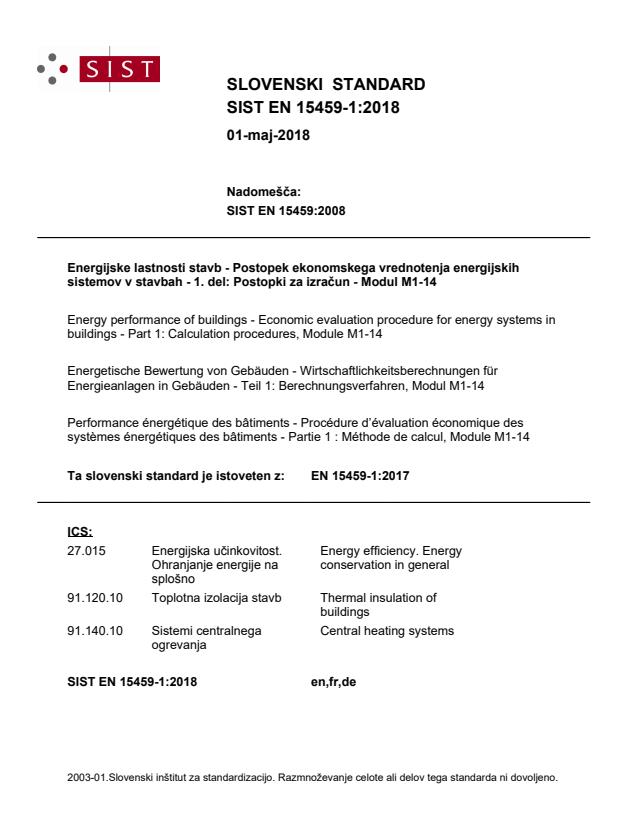
2003-01.Slovenski inštitut za standardizacijo. Razmnoževanje celote ali delov tega standarda ni dovoljeno.UJLMVNLKEnergetische Bewertung von Gebäuden - Wirtschaftlichkeitsberechnungen für Energieanlagen in Gebäuden - Teil 1: Berechnungsverfahren, Modul M1-14Performance énergétique des bâtiments - Procédure d’évaluation économique des systèmes énergétiques des bâtiments - Partie 1 : Méthode de calcul, Module M1-14Energy performance of buildings - Economic evaluation procedure for energy systems in buildings - Part 1: Calculation procedures, Module M1-1491.140.10Sistemi centralnega ogrevanjaCentral heating systems91.120.10Toplotna izolacija stavbThermal insulation of buildings27.015VSORãQREnergy efficiency. Energy conservation in generalICS:Ta slovenski standard je istoveten z:EN 15459-1:2017SIST EN 15459-1:2018en,fr,de01-maj-2018SIST EN 15459-1:2018SLOVENSKI
STANDARDSIST EN 15459:20081DGRPHãþD
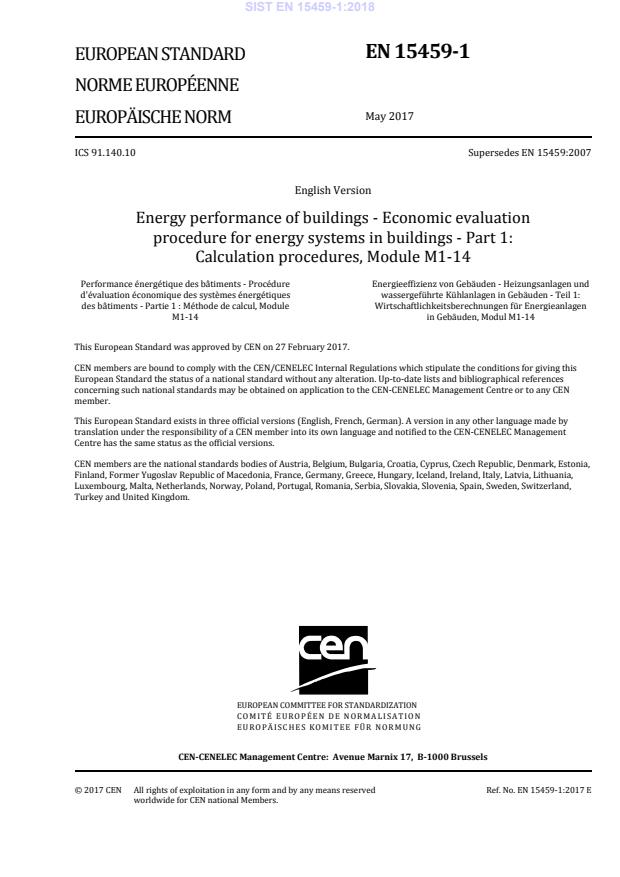
EUROPEAN STANDARD NORME EUROPÉENNE EUROPÄISCHE NORM
EN 15459-1
May
t r s y ICS
{ sä s v rä s r Supersedes EN
s w v w {ã t r r yEnglish Version
Energy performance of buildings æ Economic evaluation procedure for energy systems in buildings æ Part
sã Calculation proceduresá Module M sæ s v Performance énergétique des bâtiments æ Procédure d 5évaluation économique des systèmes énergétiques des bâtiments æ Partie
s ã Méthode de calculá Module M sæ s v
Energieeffizienz von Gebäuden æ Heizungsanlagen und wassergeführte Kühlanlagen in Gebäuden æ Teil
sã Wirtschaftlichkeitsberechnungen für Energieanlagen in Gebäudená Modul M sæ s v This European Standard was approved by CEN on
t y February
t r s yä
egulations which stipulate the conditions for giving this European Standard the status of a national standard without any alterationä Upætoædate lists and bibliographical references concerning such national standards may be obtained on application to the CENæCENELEC Management Centre or to any CEN memberä
translation under the responsibility of a CEN member into its own language and notified to the CENæCENELEC Management Centre has the same status as the official versionsä
CEN members are the national standards bodies of Austriaá Belgiumá Bulgariaá Croatiaá Cyprusá Czech Republicá Denmarká Estoniaá Finlandá Former Yugoslav Republic of Macedoniaá Franceá Germanyá Greeceá Hungaryá Icelandá Irelandá Italyá Latviaá Lithuaniaá Luxembourgá Maltaá Netherlandsá Norwayá Polandá Portugalá Romaniaá Serbiaá Slovakiaá Sloveniaá Spainá Swedená Switzerlandá Turkey and United Kingdomä
EUROPEAN COMMITTEE FOR STANDARDIZATION COMITÉ EUROPÉEN DE NORMALISATION EUROPÄISCHES KOMITEE FÜR NORMUNG
CEN-CENELEC Management Centre:
Avenue Marnix 17,
B-1000 Brussels
t r s y CEN All rights of exploitation in any form and by any means reserved worldwide for CEN national Membersä Refä Noä EN
s w v w {æ sã t r s y ESIST EN 15459-1:2018
Template for input data and choices . 36 A.1 Financial data . 36 A.2 Calculation period . 36 A.3 Valuation of the costs for products and services . 36 A.4 Valuation of costs for energy . 37 Annex B (informative)
Default input data . 38 B.1 Financial data . 38 B.2 Calculation period . 38 SIST EN 15459-1:2018
Selection for methods . 41 C.1 General . 41 C.2 Selection between methods A and B . 41 Annex D (informative)
Data for components . 42 Annex E (informative)
Description of systems . 45 Bibliography . 52
Building (as such) Technical Building Systems
Descriptions
Descriptions
Descriptions Heating Cooling Ventilation Humidification Dehumidification Domestic Hot water Lighting Building automation and control Electricity production sub1
M1 sub1 M2 sub1
M3 M4 M5 M6 M7 M8 M9 M10 M11 1 General
1 General 1 General 15316–1
15316–1
2 Common terms and definitions; symbols, units and subscripts
2 Building Energy Needs 2 Needs
12831–3
3 Applications
3 (Free) Indoor Conditions without Systems 3 Maximum Load and Power 12831–1
12831–3
4 Ways to Express Energy
Performance
4 Ways to Express Energy Performance 4 Ways to Express Energy Performance 15316–1
15316–1
5 Building
Functions and Building Boundaries
5 Heat Transfer by Transmission 5 Emission and control 15316–2 15316–2
6 Building Occupancy and Operating Conditions
6 Heat Transfer by Infiltration and Ventilation 6 Distribution and control 15316–3 15316–3
15316–3
Building (as such) Technical Building Systems
Descriptions
Descriptions
Descriptions Heating Cooling Ventilation Humidification Dehumidification Domestic Hot water Lighting Building automation and control Electricity production sub1
M1 sub1 M2 sub1
M3 M4 M5 M6 M7 M8 M9 M10 M11 7 Aggregation of Energy Services and Energy Carriers
7 Internal
Heat Gains 7 Storage and control 15316–5
15316–5 15316–4–3
8 Building Partitioning
8 Solar
Heat Gains 8 Generation
8–1 Combustion boilers 15316–4–1
15316–4–1
8–2 Heat pumps 15316–4–2 15316–4–2
15316–4–2
8–3 Thermal solar Photovoltaics 15316–4–3
15316–4–3
15316–4–3
8–4 On-site cogeneration 15316–4–4
15316–4–4
15316–4–4
8–5 District heating and cooling 15316–4–5 15316–4–5
15316–4–5
8–6 Direct electrical heater 15316–4–9
15316–4–9
8–7 Wind turbines
15316–4–10
8–8 Radiant heating, stoves 15316–4–8
Building (as such) Technical Building Systems
Descriptions
Descriptions
Descriptions Heating Cooling Ventilation Humidification Dehumidification Domestic Hot water Lighting Building automation and control Electricity production sub1
M1 sub1 M2 sub1
M3 M4 M5 M6 M7 M8 M9 M10 M11 9 Calculated Energy Performance
9 Building Dynamics (thermal mass) 9 Load dispatching and operating conditions 15316–1
10 Measured
Energy
Performance
10 Measured Energy Performance 10 Measured Energy Performance 15378–3
15378–3
11 Inspection
11 Inspection 11 Inspection 15378–1
15378–1
12 Ways to Express Indoor Comfort
12 – 12 BMS
13 External Environment Conditions
14 Economic Calculation 15459–1
NOTE The shaded modules are not applicable.
Key 1 tTC calculation period (50 years for example) 2 COinv investment cost 3 COrun running costs 4 COrepl replacement costs Figure 1 — Global cost presentation SIST EN 15459-1:2018
This includes annual costs for inspection, cleaning, adjustments, repair under preventive maintenance, consumable items. 3.5 operational cost COOp cost linked to the operation of the building, including annual costs for insurance, utility charges and other standing charges and taxes 3.6 energy cost COen cost and fixed and peak charges for energy including national taxes Note 1 to entry: Conventionally, contracts for energy delivered are included in energy costs. It is considered good practice to include the external costs and metering costs in economic calculations and to specify them. 3.7 periodic costs of year i COper(i) substitute investment that is necessary for age reasons; that corresponds to cost replacement of all components (or system) according to their lifespan that occur on year i Note 1 to entry: Periodic costs include all replacement costs for any components or system that occur the same year. SIST EN 15459-1:2018
RATen _1 is the rate of development of prices for energy 1 (rate could be different depending on the energy considered) RATop is the rate of development of prices for human operation RATpr
is the rate of development of prices for products 3.13 discount rate RATdisc definite value for comparison of the value of money at different times expressed in real terms Note 1 to entry: Corresponds to the interest rate which is charged or paid for the use of money for the calculation period considered. SIST EN 15459-1:2018
Key 1 Time (a)
2 tTC calculation period (30 years for example) 3 COinv investment cost 4 COriun running costs 5 COper periodic costs (period is identical for all components or systems to be replaced) 6 VALfin residual value Figure 2 — Presentation of the final value 3.21 present value factor PVAL_f multiplying factor used for adjustment of the cost at year i to starting year of the calculation 3.22 global unitary cost GC_x cost obtained by the division of the global cost per the calculation period and the surface of the building Note 1 to entry: The definition of the surface of the building used to weight the global cost should be consistent with the one used for energy calculation or display of the performance of the building. 4 Symbols and abbreviations 4.1 Symbols For the purposes of this document, the symbols given in EN ISO 52000-1 and the specific symbols listed in Table 2 apply. SIST EN 15459-1:2018
4.2 Subscripts For the purposes of this document, the subscripts given in EN ISO 52000-1 and the specific subscripts listed in Table 3 apply. SIST EN 15459-1:2018
nEPus non EPB services INIT Initial BAC Building automation and control Inv Investment Tr Transport Ma Maintenance V Ventilation
C Cooling Op Operational XY combination of H, C, W Per Periodic DHU Dehumidification Pr Products H Heating Re Real TOT Total Rep Repair E Photovoltaic, wind Rpl Replacement W DHW Run Running HU Humidification Disp Disposal EN Energy
W Water En Energy WS Waste LC Life cycle
5 Description of the method 5.1 General This standard presents the calculation method that is used for aggregation of the past, present and future costs over a period of calculation. When this period includes the demolition of the building the disposal costs for deconstruction/demolition are also included. This calculation method is also named ‘global cost’. The time step of the output is yearly based, but can be adapted to a monthly period. 5.2 Output of the method The output of the calculation method is the value of the global cost. SIST EN 15459-1:2018
Maintenance RATma % As a percentage of the investment cost for the related product or system Products RATpr %
Hours RAThu % Different values could be used depending on purpose and skills Service RATser %
Energy RATen_1 % Different values could be used depending on the type of energy and energy provider
Costs could be annual (energy, maintenance, taxes, insurance) or periodic (replacement) depending on the lifespan of the products or the scheduled replacement for products or systems. 5.3.4 Final costs 5.3.4.1 Calculation of the residual (final) value The final value VALfin(j) of a component is determined by straight-line depreciation of the initial investment until the end of the calculation period and referred to the beginning of the calculation period (Formula (3)). If the calculation period TC exceeds the lifespan Tn(j) of the considered component (j), the last replacement cost is considered for the straight-line depreciation: SIST EN 15459-1:2018
Key 1 tTC calculation period 2 A0 initial cost 3 LS life time of the component 4 A1 net present value after 1 replacement 5 A2 net present value after 2 replacements 6 Vf net present value at the end of the calculation period 7 A’1 cost for the first replacement 8 A’2 cost for the second replacement Figure 3 — Development of value during calculation period Figure 3 illustrates such principles for products with 2 replacements during the calculation period TC. Total cost during the calculation period considered is the sum of: — initial investment A0 (value of the initial investment rises with time due to inflation rate); — cost for the first replacement ()=+10pr1'*LSAARAT SIST EN 15459-1:2018
The global cost for solution x is expressed as dependant of the time period of calculation TC. 6.2 Calculation time steps The calculation method described in Clause 7 is suitable for the following calculation time steps: — yearly; — monthly. If an input data are available with a shorter time step than the output or the calculation time step, the value or the cost is adapted in proportion with the periodic time of the specific input and the time step used for the calculation. Conventionally the values of the input data occurring during the time step of calculation are reported to the beginning of the time step of calculation without any adjustment. SIST EN 15459-1:2018
6.3.3 Specific input data for products and services For each cost item considered (product, category of products, service or system) Tables 7 and 8 describe the type of information needed. The costs occurring during the operation time of the building can be expressed either with their respective quantity or values (Table 7) or expressed as a percentage of the investment costs (Table 8). SIST EN 15459-1:2018
Added products b t € - € € € €
Service 2 Hours a t € - € € € € a Added products b t € - € € € €
a Different hourly rates for human operation can be defined depending on the qualification level. b Added products could be products that are used for the construction of installation of the product (hoses, glue, or other consumables). Table 8 — Specific product or service information data based on the investment costs Description Type Time when cost occurs Cost per unit Quantity Initial costs Maintenance Repair Cleaning Demolition Life span or periodicity Product 1 Product1 tpro € - € % % % LS_1 Service Hours t € - € % % % a Added products
€ - % % % %
For energy and water the costs for energy use during the construction stage and operation stage of the building are separated (see Table 9). Table 9 — Specific information for energy and water Description Symbol Unit Origin Module Cost per unit Quantity Initial costs Operation Energy 1 Edel,cr,1 kWh M1–1 €
€ € Energy 2 Edel,cr,2 kWh M1–10 €
€ € Water Mw m3
€
€ €
Organization of the various types of building only related costs is presented in Table 10. SIST EN 15459-1:2018
6.4 Step by step calculation 6.4.1 General Types of data and default values are presented respectively in Annex A and Annex B. 6.4.2 STEP 1 - Financial data In this step, the financial data needed for the calculations are identified. Duration of the calculation: — duration of mortgage subscribed; — or economic life cycle: — or duration given by the contractors. Inflation rate: — estimated from available economical (institute) data; — for information only as all rates are real rates reduced form the inflation rate). Discount rate: usually stated at the national level. Rate of development of human operation costs: — depends on the cost development due to staff in operation (usually the rate of development of human operation costs is higher than the inflation rate). SIST EN 15459-1:2018
...
記事タイトル: EN 15459-1:2017 - 建築物のエネルギー性能 - 建築物におけるエネルギーシステムの経済的評価手順 - パート1: 計算手順、モジュールM1-14 記事内容: この欧州規格は、建築物のエネルギー需要と消費に関与する暖房システムおよびその他のシステムの経済的な課題の計算方法を提供しています。これは新築および既存のあらゆるタイプの建築物に適用されます。 基本原則と用語は、この規格で説明されています。 規格の主要な項目は以下の通りです。 - 建築物内でのエネルギー節約オプションの経済効率の計算に考慮すべき費用の定義と構造 - 対象となるシステムに関連する費用の定義に必要なデータ - 計算方法 - 経済研究の結果の表現 この欧州規格は、建築物のエネルギー節約オプションの経済的性能の計算方法の一部です(例:断熱、性能が良い発電機および配電システム、効率的な照明、再生可能エネルギー、コージェネレーション...)。 この特定のパートの範囲は、次のことを標準化することです。 - 必要な入力データ - 必要な出力データ - 計算式 - 建築物のエネルギー性能に関連するエネルギーシステムのタイプ 注1: これはEN 15459:2007の改訂版です。改訂版はEUのコスト最適ルールに合致するように改訂されており、投資の回収期間の定義と建物の解体に関連する費用が含まれています。年間費用を示す方法は削除されました。 注2: この規格は、生産性向上や室内快適性の向上によるテナントへの魅力的さといった財務上の利点は考慮していません。 表1は、この規格がEPB(エネルギー性能のある建物)規格セットの中での相対的な位置を示しています。 注3: CEN ISO/TR 52000-2には、各モジュールに関連するEPB規格や準備中の技術報告書の番号が記載された同じ表があります。 注4: モジュールはEPB規格を表していますが、1つのEPB規格が複数のモジュールをカバーする場合や、1つのモジュールが複数のEPB規格でカバーされる場合があります。セクション2と表A.1およびB.1も参照してください。 (...)
The article discusses EN 15459-1:2017, a European standard that provides a method for calculating the economic evaluation of energy systems in buildings. The standard applies to both new and existing buildings and covers heating systems and other systems involved in the building's energy demand and consumption. It explains the fundamental principles and terminology related to economic efficiency and defines the costs that should be considered in the calculation. The standard also specifies the required inputs, outputs, calculation formulas, and types of energy systems covered. The revision of the standard aligns it with EU regulations and includes definitions of payback for investment and costs related to building deconstruction. However, it does not consider financial advantages related to higher productivity and indoor comfort. Table 1 in the article shows the position of this standard within the set of EPB (Energy Performance of Buildings) standards.
기사 제목: EN 15459-1:2017 - 건축물의 에너지 성능 - 건축물의 에너지 시스템의 경제적 평가 절차 - 파트 1: 계산 절차, 모듈 M1-14 내용: 이 유럽 표준은 건축물의 에너지 수요와 소비에 관여하는 난방 시스템 및 기타 시스템의 경제적 문제에 대한 계산 방법을 제공한다. 이는 모든 유형의 신규 및 기존 건물에 적용된다. 핵심 원리와 용어는 이 표준에서 설명된다. 표준의 주요 항목은 다음과 같다: - 건물 내 에너지 절약 옵션의 경제적 효율성 계산을 위해 고려해야 할 비용 유형의 정의 및 구조; - 고려 대상 시스템과 관련된 비용 정의를 위해 필요한 데이터; - 계산 방법; - 경제 연구 결과의 표현. 이 유럽 표준은 건축물의 에너지 절약 옵션의 경제적 성능 계산 방법의 일부이다 (예: 단열, 성능이 더 좋은 발전기 및 분배 시스템, 효율적인 조명, 재생 에너지, 연속 열 및 전력 ...). 이 특정 부분의 범위는 다음을 표준화하는 것이다: - 필요한 입력 데이터; - 필요한 출력 데이터; - 계산식; - 건축물의 에너지 성능과 관련된 에너지 시스템 유형. 참고 1: 이것은 EN 15459:2007의 개정판이다. 개정판은 비용 최적화에 대한 EU 규제와 일치하도록 개정되었다. 이 개정판은 투자 수익의 정의 및 건물 해체에 따른 비용을 포함한다. 연간 비용을 제시하는 방법은 제외되었다. 참고 2: 이 표준은 다른 옵션과의 비교를 위해 생산성 향상 및 더 높은 실내 편안함과 관련된 재정적 이점을 고려하지 않는다면, 해당 사항이 있는 경우에도 고려하지 않는다. 표 1은 이 표준이 EN ISO 52000-1에서 설정한 모듈 구조의 EPB 표준 세트 내에서의 상대적 위치를 보여준다. 참고 3: CEN ISO/TR 52000-2에서는 동일한 표를 모듈별로 포함하고 있으며, 각 모듈에 대해 출판되거나 준비 중인 관련 EPB 표준 및 기술 보고서의 번호가 있다. 참고 4: 이러한 모듈은 EPB 표준을 나타내지만, 한 EPB 표준이 하나 이상의 모듈을 커버할 수 있으며, 한 모듈은 각각 간소화된 방법 및 상세한 방법으로 커버될 수 있다. 또한 부록 2 및 표 A.1 및 B.1을 참조하십시오. (...)
Questions, Comments and Discussion
Ask us and Technical Secretary will try to provide an answer. You can facilitate discussion about the standard in here.
Loading comments...