


prEN 12131
(Main)Feather and down - Test methods - Determination of the quantitative composition of feather and down (manual method)
Feather and down - Test methods - Determination of the quantitative composition of feather and down (manual method)
This document specifies a method for the determination of the composition of feather and/or down fit for or constituting filled manufactured articles in order to label and/or mark it or to verify the denominations reported on the label.
Federn und Daunen - Prüfverfahren - Bestimmung der quantitativen Zusammensetzung von Federn und Daunen (manuelles Verfahren)
Dieses Dokument legt ein Verfahren für die Bestimmung der Zusammensetzung von Federn und/oder Daunen fest, die für gefüllte Fertigartikel geeignet ist oder daraus besteht, um diese zu kennzeichnen und/oder zu etikettieren oder um die auf dem Etikett angegebenen Bezeichnungen nachzuweisen.
Plumes et duvets - Méthodes d'essais - Détermination de la composition quantitative de plumes et duvets (méthode manuelle)
Le présent document spécifie une méthode permettant de déterminer la composition des plumes et/ou des duvets destinés aux produits manufacturés garnis, ou constitutifs de ces derniers, en vue de leur étiquetage et/ou de leur marquage ou pour vérifier les dénominations indiquées sur l’étiquette.
Perje in puh - Preskusne metode - Določanje količinske sestave perja in puha (ročna metoda)
General Information
- Status
- Not Published
- Publication Date
- 24-Jun-2026
- Technical Committee
- CEN/TC 443 - Feather and down
- Drafting Committee
- CEN/TC 443 - Feather and down
- Current Stage
- 4599 - Dispatch of FV draft to CMC - Finalization for Vote
- Start Date
- 11-Dec-2025
- Due Date
- 14-Sep-2026
- Completion Date
- 11-Dec-2025
Relations
- Effective Date
- 24-Jan-2024
Overview
The prEN 12131:2025 standard, developed by the European Committee for Standardization (CEN), provides a precise manual test method for determining the quantitative composition of feather and down used in filled manufactured articles. This standard method is crucial for accurate labeling, marking, and verification of feather and down content claims on product labels. It supersedes the previous EN 12131:2018 and introduces technical updates improving measurement precision and clarity.
Key Topics
Scope
prEN 12131:2025 applies to feather and/or down filling materials intended for filled manufactured articles. It is designed to establish the exact proportions of feathers and down present to support correct product information and quality claims.Sampling and Conditioning
Samples are collected following EN 1883 and conditioned per ISO 139 to maintain consistent testing environments.Manual Separation Procedure
The standard outlines a two-step manual separation process:- First separation identifies major feather types (waterfowl, landfowl feathers, down, residual material, and foreign matter).
- Second separation further refines down and fiber components from mixed residues collected during the first step.
Equipment Requirements
The method requires a specialized separation box with controlled lighting, weighing containers, tweezers, an analytical balance with at least 0.1 mg readability, and non-electrostatic brushes.Calculations and Reporting
Detailed formulas are included to calculate the relative percentages of each component (whole feathers, broken feathers, down types, feather fibers, milled feathers, residuals, and foreign matter), ensuring precise and reproducible results.Quality Control
Acceptable mass deviations are specified (loss not exceeding 2%, gain less than 0.5%) to validate test specimen integrity and reproducibility.
Applications
This standard is essential for multiple practical applications in the textile and bedding industries, including:
Quality Assurance and Control
Ensures that feather and down fillings in products such as pillows, duvets, jackets, and upholstery meet labeled compositions, enhancing customer trust.Label Compliance Verification
Manufacturers and testing laboratories use prEN 12131 to verify that the feather and down content declared on product labels complies with industry and regulatory requirements.Product Development
During product formulation, understanding precise material composition helps in optimizing comfort, insulation, and durability properties.Import and Export Compliance
Facilitates standardized documentation and testing aligned across European markets, supporting trade regulations.
Related Standards
prEN 12131:2025 references and works in conjunction with several key standards to offer a comprehensive testing framework:
EN 1883: Feather and down - Sampling in view of tests
Defines sampling methods essential for obtaining representative test specimens.EN 1885: Feather and down - Terms and definitions
Provides the necessary terminology and definitions to maintain clarity in testing and reporting.EN ISO 139: Textiles - Standard atmospheres for conditioning and testing
Sets the standard environmental conditions for sample conditioning and testing consistency.
Summary
Standard prEN 12131:2025 sets a definitive guide for the manual determination of feather and down proportions in filling materials. It supports enhanced accuracy, repeatability, and quality assurance in the testing process, helping manufacturers, testing labs, and regulators uphold transparency and consumer confidence in feather and down products. Adopting this standard ensures adherence to European harmonized testing practices and facilitates international trade and product verification.

Frequently Asked Questions
prEN 12131 is a draft published by the European Committee for Standardization (CEN). Its full title is "Feather and down - Test methods - Determination of the quantitative composition of feather and down (manual method)". This standard covers: This document specifies a method for the determination of the composition of feather and/or down fit for or constituting filled manufactured articles in order to label and/or mark it or to verify the denominations reported on the label.
This document specifies a method for the determination of the composition of feather and/or down fit for or constituting filled manufactured articles in order to label and/or mark it or to verify the denominations reported on the label.
prEN 12131 is classified under the following ICS (International Classification for Standards) categories: 59.040 - Textile auxiliary materials. The ICS classification helps identify the subject area and facilitates finding related standards.
prEN 12131 has the following relationships with other standards: It is inter standard links to EN 12131:2018. Understanding these relationships helps ensure you are using the most current and applicable version of the standard.
prEN 12131 is available in PDF format for immediate download after purchase. The document can be added to your cart and obtained through the secure checkout process. Digital delivery ensures instant access to the complete standard document.
Standards Content (Sample)
SLOVENSKI STANDARD
01-december-2025
Perje in puh - Preskusne metode - Določanje količinske sestave perja in puha
(ročna metoda)
Feather and down - Test methods - Determination of the quantitative composition of
feather and down (manual method)
Federn und Daunen - Prüfverfahren - Bestimmung der quantitativen Zusammensetzung
von Federn und Daunen (manuelles Verfahren)
Plumes et duvets - Méthodes d'essais - Détermination de la composition quantitative de
plumes et duvets (méthode manuelle)
Ta slovenski standard je istoveten z: prEN 12131
ICS:
59.040 Pomožni materiali za tekstilije Textile auxiliary materials
2003-01.Slovenski inštitut za standardizacijo. Razmnoževanje celote ali delov tega standarda ni dovoljeno.
DRAFT
EUROPEAN STANDARD
NORME EUROPÉENNE
EUROPÄISCHE NORM
September 2025
ICS 59.040 Will supersede EN 12131:2018
English Version
Feather and down - Test methods - Determination of the
quantitative composition of feather and down (manual
method)
Plumes et duvets - Méthodes d'essais - Détermination Federn und Daunen - Prüfverfahren - Bestimmung der
de la composition quantitative de plumes et duvets quantitativen Zusammensetzung von Federn und
(méthode manuelle) Daunen (manuelles Verfahren)
This draft European Standard is submitted to CEN members for enquiry. It has been drawn up by the Technical Committee
CEN/TC 443.
If this draft becomes a European Standard, CEN members are bound to comply with the CEN/CENELEC Internal Regulations
which stipulate the conditions for giving this European Standard the status of a national standard without any alteration.
This draft European Standard was established by CEN in three official versions (English, French, German). A version in any other
language made by translation under the responsibility of a CEN member into its own language and notified to the CEN-CENELEC
Management Centre has the same status as the official versions.
CEN members are the national standards bodies of Austria, Belgium, Bulgaria, Croatia, Cyprus, Czech Republic, Denmark, Estonia,
Finland, France, Germany, Greece, Hungary, Iceland, Ireland, Italy, Latvia, Lithuania, Luxembourg, Malta, Netherlands, Norway,
Poland, Portugal, Republic of North Macedonia, Romania, Serbia, Slovakia, Slovenia, Spain, Sweden, Switzerland, Türkiye and
United Kingdom.
Recipients of this draft are invited to submit, with their comments, notification of any relevant patent rights of which they are
aware and to provide supporting documentation.
Warning : This document is not a European Standard. It is distributed for review and comments. It is subject to change without
notice and shall not be referred to as a European Standard.
EUROPEAN COMMITTEE FOR STANDARDIZATION
COMITÉ EUROPÉEN DE NORMALISATION
EUROPÄISCHES KOMITEE FÜR NORMUNG
CEN-CENELEC Management Centre: Rue de la Science 23, B-1040 Brussels
© 2025 CEN All rights of exploitation in any form and by any means reserved Ref. No. prEN 12131:2025 E
worldwide for CEN national Members.
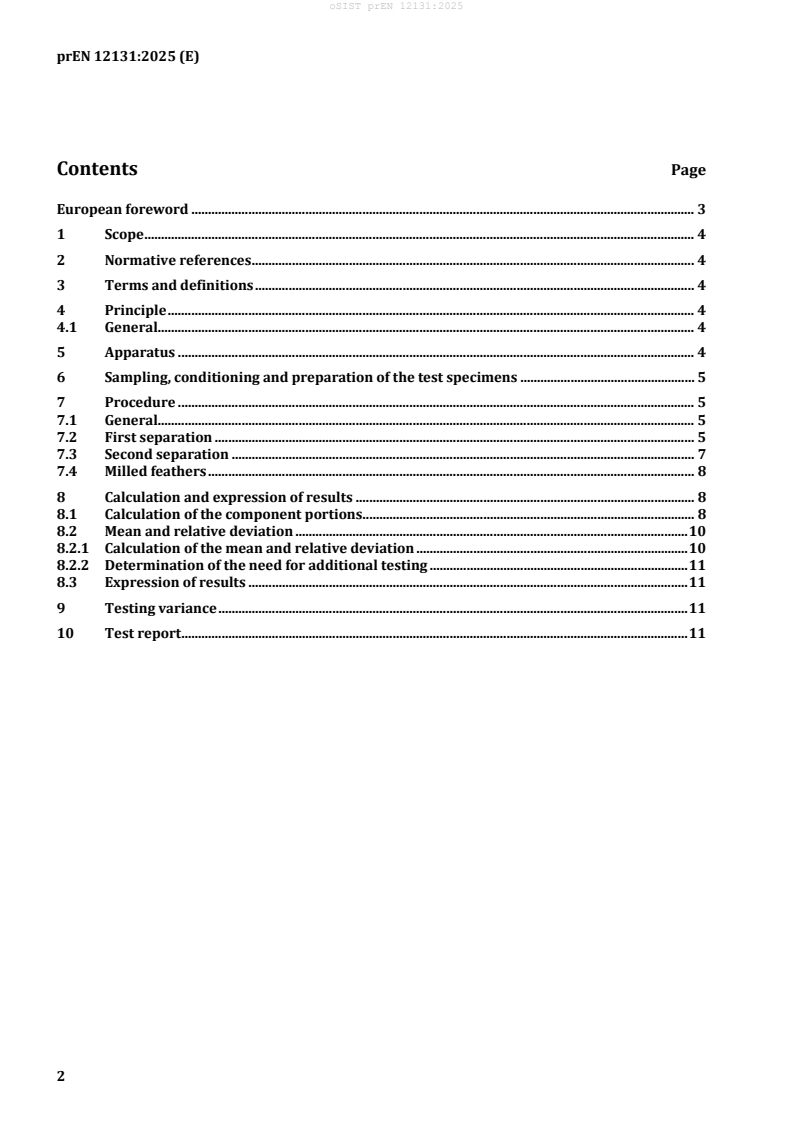
Contents Page
European foreword . 3
1 Scope . 4
2 Normative references . 4
3 Terms and definitions . 4
4 Principle . 4
4.1 General. 4
5 Apparatus . 4
6 Sampling, conditioning and preparation of the test specimens . 5
7 Procedure . 5
7.1 General. 5
7.2 First separation . 5
7.3 Second separation . 7
7.4 Milled feathers . 8
8 Calculation and expression of results . 8
8.1 Calculation of the component portions . 8
8.2 Mean and relative deviation . 10
8.2.1 Calculation of the mean and relative deviation . 10
8.2.2 Determination of the need for additional testing . 11
8.3 Expression of results . 11
9 Testing variance . 11
10 Test report . 11
European foreword
This document (prEN 12131:2025) has been prepared by Technical Committee CEN/TC 443 “Feather
and down”, the secretariat of which is held by UNI.
This document is currently submitted to the CEN Enquiry.
This document will supersede EN 12131:2018.
— definition 3.1 has been updated;
— a new note to 5.1 has been added;
— in 8.3 the decimal points have been upgraded from at least one to two decimal points.
1 Scope
This document specifies a method for the determination of the composition of feather and/or down fit
for or constituting filled manufactured articles in order to label and/or mark it or to verify the
denominations reported on the label.
2 Normative references
The following documents are referred to in the text in such a way that some or all of their content
constitutes requirements of this document. For dated references, only the edition cited applies. For
undated references, the latest edition of the referenced document (including any amendments) applies.
EN 1883, Feather and down — Sampling in view of tests
EN 1885, Feather and down — Terms and definitions
EN ISO 139, Textiles — Standard atmospheres for conditioning and testing (ISO 139)
3 Terms and definitions
For the purposes of this document, the terms and definitions given in EN 1885 and the following apply.
ISO and IEC maintain terminology databases for use in standardization at the following addresses:
— ISO Online browsing platform: available at https://www.iso.org/obp/
— IEC Electropedia: available at https://www.electropedia.org/
3.1
substantial element
any element having a mass ≥ 7 % of the total mass in any of the specimen
Note 1 to entry: The average mass is calculated with two tests.
4 Principle
4.1 General
A known quantity of the filling material, sampled according to EN 1883, is separated by hand into its
elements. The elements are collected into separate containers, which are suitably marked.
The content of each container is weighed in order to determine the mass of the element concerned and
therefore to calculate the relative percentages.
5 Apparatus
5.1 Box for the manual separation (separation box), usually consisting of the following parts:
— black and smooth base about 450 mm in length and about 300 mm in width, having a suitable fixture
or area to insert the containers into;
— front part about 150 mm high open or provided with two openings wide enough to permit the
operators’ hands to enter the box;
— back part about 300 mm high;
— two side parts fit for front and back parts;
— cover, to avoid air draughts during the execution of the test, made of glass or other transparent
material to permit the separation of the elements;
— lamp to allow the illumination of the box.
NOTE It has been experienced that lamps with heat emission especially if placed too close to the specimen
might decrease its moisture content.
5.2 Weighing containers with cover, made of aluminium or other light antistatic material fit to
contain and weigh the different elements of the filling, with a capacity up to 300 ml.
5.3 Tweezers, fit to pick the single elements.
5.4 Analytical balance, with a readability (d) of 0,1 mg or better.
Keep attention on a non-ionized electro statical environment around the balance.
5.5 Mixing container with base dimensions of 300 mm × 300 mm and 150 mm high.
5.6 Flat, soft, non-electrostatic brush, from 2 cm to 3 cm wide.
6 Sampling, conditioning and preparation of the test specimens
6.1 Carry the sampling out according to EN 1883.
6.2 Condition the samples according to EN ISO 139.
6.3 Draw a sample of no less than 30 g from the conditioned laboratory global sample. Put the sample
into the mixing container (5.5) and mix carefully by hand to make it as homogeneous as possible. From
different places of this sample, draw at least three test specimens, each of them having a mass of about
5 g, weighed with an accuracy of 1 mg, of about 5 g for fillings with an expected down content less than
60 % and of about 3 g for fillings with an expected down content of 60 % or more.
Each specimen is placed in a separate container.
For setting the final result it is necessary to have validated analysis of at least two test specimens w
...
Questions, Comments and Discussion
Ask us and Technical Secretary will try to provide an answer. You can facilitate discussion about the standard in here.
Loading comments...