

EN 14566:2008
(Main)Mechanical fasteners for gypsum plasterboard systems - Definitions, requirements and test methods
- Abstract
This European Standard specifies the characteristics and performance of mechanical fasteners, including nails, screws and staples, intended to be used for the fixing of gypsum plasterboard, gypsum boards with fibrous reinforcement, products from secondary processing and suitable ancillary products as shown in Figure 2, to timber and metal, as appropriate, in building construction works. The fasteners secure the board to the framing enabling its surface to be finished by jointing or plastering to receive decoration. They can also be used for the construction of the framing and for the connection between substructure and load bearing components and for fixing boards together. Mechanical fasteners contribute to the stability of the assembly.
This European Standard covers the following product performance characteristics: reaction to fire and flexural strength to be measured according to the corresponding European test methods.
It provides for the evaluation of conformity of the product to this European Standard.
This European Standard also covers the additional technical characteristics that are of importance for the use and acceptance of the products by the construction industry and the reference tests for these characteristics.
This European Standard does not cover nails, screws and staples intended for use with materials other than plasterboard and the plasterboard based products referred to above and their associated system components.
- Status
- Withdrawn
- Publication Date
- 29-Jan-2008
- Withdrawal Date
- 04-Aug-2009
- Technical Committee
- CEN/TC 241 - Gypsum and gypsum based products
- Drafting Committee
- CEN/TC 241/WG 3 - Board products
- Current Stage
- 9960 - Withdrawal effective - Withdrawal
- Start Date
- 05-Aug-2009
- Completion Date
- 05-Aug-2009
89/106/EEC - Construction productsOJ Ref: C, C 321 OJ Date: 16-Dec-2008

Relations
- Effective Date
- 13-Jun-2009
- Effective Date
- 28-Jan-2026
- Effective Date
- 22-Dec-2008
Get Certified
Connect with accredited certification bodies for this standard

DIBt (Deutsches Institut für Bautechnik)
German Institute for Building Technology.
DIN CERTCO
DIN Group product certification.

Aboma Certification B.V.
Specialized in construction, metal, and transport sectors.
Sponsored listings
Frequently Asked Questions
EN 14566:2008 is a standard published by the European Committee for Standardization (CEN). Its full title is "Mechanical fasteners for gypsum plasterboard systems - Definitions, requirements and test methods". This standard covers: This European Standard specifies the characteristics and performance of mechanical fasteners, including nails, screws and staples, intended to be used for the fixing of gypsum plasterboard, gypsum boards with fibrous reinforcement, products from secondary processing and suitable ancillary products as shown in Figure 2, to timber and metal, as appropriate, in building construction works. The fasteners secure the board to the framing enabling its surface to be finished by jointing or plastering to receive decoration. They can also be used for the construction of the framing and for the connection between substructure and load bearing components and for fixing boards together. Mechanical fasteners contribute to the stability of the assembly. This European Standard covers the following product performance characteristics: reaction to fire and flexural strength to be measured according to the corresponding European test methods. It provides for the evaluation of conformity of the product to this European Standard. This European Standard also covers the additional technical characteristics that are of importance for the use and acceptance of the products by the construction industry and the reference tests for these characteristics. This European Standard does not cover nails, screws and staples intended for use with materials other than plasterboard and the plasterboard based products referred to above and their associated system components.
This European Standard specifies the characteristics and performance of mechanical fasteners, including nails, screws and staples, intended to be used for the fixing of gypsum plasterboard, gypsum boards with fibrous reinforcement, products from secondary processing and suitable ancillary products as shown in Figure 2, to timber and metal, as appropriate, in building construction works. The fasteners secure the board to the framing enabling its surface to be finished by jointing or plastering to receive decoration. They can also be used for the construction of the framing and for the connection between substructure and load bearing components and for fixing boards together. Mechanical fasteners contribute to the stability of the assembly. This European Standard covers the following product performance characteristics: reaction to fire and flexural strength to be measured according to the corresponding European test methods. It provides for the evaluation of conformity of the product to this European Standard. This European Standard also covers the additional technical characteristics that are of importance for the use and acceptance of the products by the construction industry and the reference tests for these characteristics. This European Standard does not cover nails, screws and staples intended for use with materials other than plasterboard and the plasterboard based products referred to above and their associated system components.
EN 14566:2008 is classified under the following ICS (International Classification for Standards) categories: 21.060.99 - Other fasteners; 91.100.10 - Cement. Gypsum. Lime. Mortar. The ICS classification helps identify the subject area and facilitates finding related standards.
EN 14566:2008 has the following relationships with other standards: It is inter standard links to EN 14566:2008+A1:2009, EN 13523-4:2001, EN 14566:2008/prA1. Understanding these relationships helps ensure you are using the most current and applicable version of the standard.
EN 14566:2008 is associated with the following European legislation: EU Directives/Regulations: 305/2011, 89/106/EEC; Standardization Mandates: M/106. When a standard is cited in the Official Journal of the European Union, products manufactured in conformity with it benefit from a presumption of conformity with the essential requirements of the corresponding EU directive or regulation.
EN 14566:2008 is available in PDF format for immediate download after purchase. The document can be added to your cart and obtained through the secure checkout process. Digital delivery ensures instant access to the complete standard document.
Standards Content (Sample)
2003-01.Slovenski inštitut za standardizacijo. Razmnoževanje celote ali delov tega standarda ni dovoljeno.Mechanical fasteners for gypsum plasterboard systems - Definitions, requirements and test methodsFixations mécaniques pour systèmes en plaques de plâtre - Définitions, spécifications et méthodes d'essaiMechanische Befestigungsmittel für Gipsplattensysteme - Begriffe, Anforderungen und PrüfverfahrenTa slovenski standard je istoveten z:EN 14566:2008SIST EN 14566:2008en,de91.100.1021.060.99ICS:SLOVENSKI
STANDARDSIST EN 14566:200801-april-2008
EUROPEAN STANDARDNORME EUROPÉENNEEUROPÄISCHE NORMEN 14566January 2008ICS 21.060.99; 91.100.10 English VersionMechanical fasteners for gypsum plasterboard systems -Definitions, requirements and test methodsFixations mécaniques pour systèmes en plaques de plâtre -Définitions, spécifications et méthodes d'essaiMechanische Befestigungsmittel für Gipsplattensysteme -Begriffe, Anforderungen und PrüfverfahrenThis European Standard was approved by CEN on 25 November 2007.CEN members are bound to comply with the CEN/CENELEC Internal Regulations which stipulate the conditions for giving this EuropeanStandard the status of a national standard without any alteration. Up-to-date lists and bibliographical references concerning such nationalstandards may be obtained on application to the CEN Management Centre or to any CEN member.This European Standard exists in three official versions (English, French, German). A version in any other language made by translationunder the responsibility of a CEN member into its own language and notified to the CEN Management Centre has the same status as theofficial versions.CEN members are the national standards bodies of Austria, Belgium, Bulgaria, Cyprus, Czech Republic, Denmark, Estonia, Finland,France, Germany, Greece, Hungary, Iceland, Ireland, Italy, Latvia, Lithuania, Luxembourg, Malta, Netherlands, Norway, Poland, Portugal,Romania, Slovakia, Slovenia, Spain, Sweden, Switzerland and United Kingdom.EUROPEAN COMMITTEE FOR STANDARDIZATIONCOMITÉ EUROPÉEN DE NORMALISATIONEUROPÄISCHES KOMITEE FÜR NORMUNGManagement Centre: rue de Stassart, 36
B-1050 Brussels© 2008 CENAll rights of exploitation in any form and by any means reservedworldwide for CEN national Members.Ref. No. EN 14566:2008: E
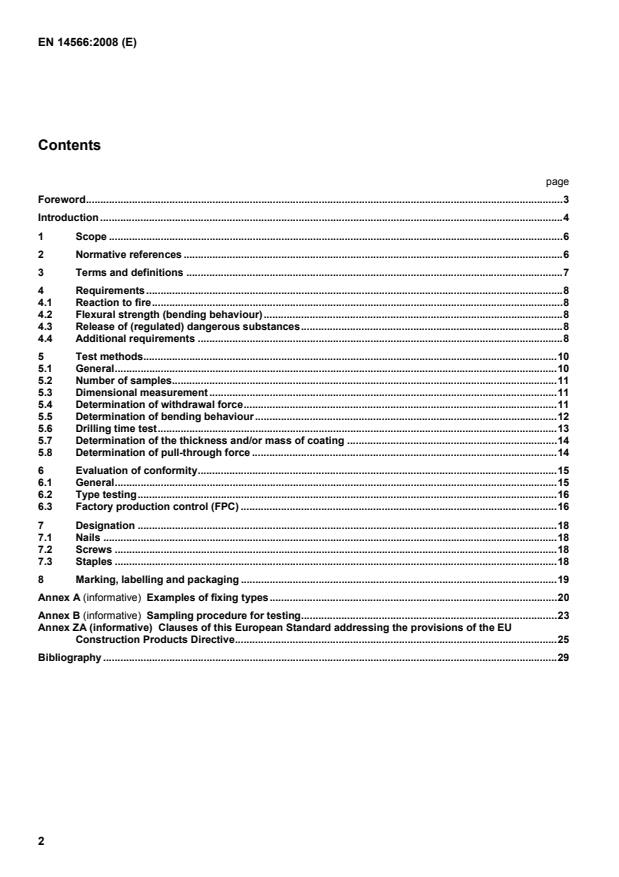
Examples of fixing types.20 Annex B (informative)
Sampling procedure for testing.23 Annex ZA (informative)
Clauses of this European Standard addressing the provisions of the EU Construction Products Directive.25 Bibliography.29
Figure 1 — Family of gypsum products
Figure 2 — Family of ancillary products
(ISO 12777-3:2002)
Fasteners protected with zinc coating shall have a minimum coating thickness of 5 µm (35 g/m²) for screws and nails and 3 µm (21 g/m²) for staples when tested in accordance with 5.7. 4.4.2 Requirements for plasterboard nails 4.4.2.1 Materials Plasterboard nails shall be produced from wire drawn from rods produced in accordance with EN 10016-1 to -4. 4.4.2.2 Head - Dimensions and tolerances The diameter and tolerance of the head shall be stated by the producer in its technical literature. When measured in accordance with 5.3.3.3, no more than five nails shall fail.
EN 10327 up to a thickness of 2 mm when screws are tested in accordance with 5.6. No more than 5 screws shall exceed a penetration time of 4 s. 4.4.3.4 Length The nominal length and tolerances shall be stated by the producer in its technical literature. When measured in accordance with 5.3.3.2, no more than five screws shall be outside the stated tolerances. 4.4.3.5 Hardness The surface of the screws shall be case hardened to a minimum depth of 0,05 mm with a case hardness of
55 HRC to Rockwell cone according to EN ISO 6508-1. Not more than five screws shall fail.
5.3.3.2 Length 4.4.2.4 4.4.3.4 4.4.4.3 5.3.3.3 Head diameter or Crown width 4.4.2.2
4.4.4.4 5.4 Withdrawal force 4.4.2.5 4.4.3.2 4.4.4.2 5.5 Bending behaviour 4.2 4.2 4.2 5.6 Drilling performance test
4.4.3.3
5.7 Determination of coating thickness/mass 4.4.1 4.4.1 4.4.1 EN ISO 6508-1 Hardness
4.4.3.5
Key 1 coupling ring 2 clamping device adapted to the type of fastener (the figure gives example for screws) 3 support (plate) 4 metal section or wood Figure 3 — Device for determining the extraction force of fasteners 5.4.3 Procedure Prepare the timber section which should be free from knots, local grain distortion, fissures and warping. Drive the appropriate fastener perpendicular into the timber to a depth of 20 mm. In the case of metal a depth of 10 mm is required. Anchor the support plate. Apply the clamping device to the head or crown of the fastener. Attach the coupling ring to the loading machine. Apply a progressive force at the rate of 450 N per min to determine the total withdrawal force. 5.4.4 Expression of results Record the test results and compare with the requirements of 4.4.2.5, 4.4.3.2 and 4.4.4.2. 5.5 Determination of bending behaviour 5.5.1 Principle The fastener is clamped in such a way as to resist bending at two points A and B (see Figure 3 of
EN ISO 12777-3:2002). A force is then applied to the unclamped portion of the fastener at a set point C, using a pivot bending actuator to which torque is applied.
to 350 w, no load speed (2 350 ± 350) revolutions per min; c) fixed support mounting for the power screwdriver; d) application force: Power screwdriver plus dead weight = 15 kg; e) stop watch with pre-setting to start at the commencement of drilling and stop when screw penetrates to a depth of 10 mm. This fixed depth allows all lengths of screws to be tested; f) cold rolled galvanised steel sheet (0,6 ± 0,04) mm manufactured to EN 10327 of a size large enough for 50 type N screws to be inserted without interference with one another.(See Table A.2). g) cold rolled galvanised steel sheet (2 ± 0,09) mm manufactured to EN 10327 of a size large enough for 50 type D screws to be inserted without interference with one another. (See Table A.2). 5.6.3 Procedure Select 50 screws from the batch of screws to be tested. Secure the sample metal below the mounted screwdriver. Locate the bit in the power screwdriver and engage a sample screw with the tip of the screw in contact with the metal prior to power being applied. Set the stop watch to zero. Start the drill. The watch will stop automatically after the screw has penetrated 10 mm. Note the penetration time for type N screws and repeat for the remainder or note the number of type D screws which fail to penetrate. 5.6.4 Expression of results Record for type N screws, the average drilling time and the number of screws exceeding the 1 s penetration time (see 4.4.3.3.). Record for type D screws, the average drilling time and the number of screws exceeding the 4 s penetration time (see 4.4.3.3.).
...