

FprEN 18336
(Main)Leather - Raw bovine hides and skins - grading
- Abstract
This document specifies requirements to grade hides and skins according to the defects listed in EN 16055. It applies to raw bovine hides and skins, both fresh and salted, intended for use throughout the leather manufacturing supply chain.
- Status
- Not Published
- Publication Date
- 09-Feb-2027
- Technical Committee
- CEN/TC 289 - Leather
- Current Stage
- 5060 - Closure of Vote - Formal Approval
- Start Date
- 19-Nov-2026
- Due Date
- 18-Jan-2028
- Completion Date
- 18-Jan-2028

FprEN 18336 is a CEN draft European Standard for grading raw bovine hides and skins. It specifies how to classify fresh and salted hides and skins by the defects listed in EN 16055, so buyers, processors and tanneries can use the same grading basis across the leather manufacturing supply chain.
What does FprEN 18336 specify?
FprEN 18336 specifies requirements for grading raw bovine hides and skins according to visible defects described in EN 16055. The standard applies to both fresh and salted material and is organized into four main clauses: scope, normative references, terms and definitions, and grading requirements.
Clause 4 sets out the grading system as four selections. The practical purpose is to make sorting decisions more consistent before hides and skins move further through the leather chain.
What are the key requirements of FprEN 18336?
FprEN 18336 grades hides and skins by visible quality, using four selections: first selection, second selection, third selection, and rejects. In practice, the closer a hide or skin is to first selection, the fewer and smaller the defects allowed.
First selection
Clause 4.2 requires hides and skins to be largely free of visually recognizable defects. No defects are allowed in the central area on either the flesh side or the grain side, the flay must follow EN 16055, and there must be no preservation defects. Non-disease defects other than holes are not allowed unless each is smaller than 8 cm, and only up to two defects are allowed in the external area.
For disease-related defects, such as warts, herpes or skin leaks, the affected area must be smaller than 0,1 m². This gives a near-prime grade for material that can be used with minimal sorting loss.
Second selection
Clause 4.3 allows only isolated defects. Hides and skins may have no more than two additional defects in the central area compared with first selection, and the defects listed for third selection are excluded.
A slight amount of dung and a slight mis-shape do not affect this grade, provided the dung is less than 1 kg. In practice, this grade covers material that is still usable but needs more tolerance for minor defects.
Third selection
Clause 4.4 allows more visible defects, especially toward the edge area. The standard permits larger holes or cuts, visible hair slip, visible mis-shape, large disease or parasite damage, and a larger amount of dung.
The clause gives specific limits for several defects: up to 8 grubs, holes or cuts larger than 15 cm, hair slip up to 20% of total surface, disease or parasite damage between 0,1 m² and two thirds of total surface, dung above 1 kg, and mis-shape up to 20% of total surface. This grade is for hides and skins that remain usable but have clear quality loss.
Rejects
Clause 4.5 classifies hides and skins as rejects when defects are widespread or beyond the third-selection limits. That includes defects spread over the whole surface, mis-shape above 20% of total surface, disease or parasite damage over 66% of the total surface, or more than 8 open grubs or similar defects.
For buyers and quality staff, this clause marks material that falls outside the grading bands intended for normal trade.
What terms does FprEN 18336 define?
FprEN 18336 uses the following terms in Clause 3, alongside the definitions in EN 16055 and EN 15987:
- Grub - the larval stage of certain insects, especially beetles.
- Warble fly/warble - a parasitic fly whose larvae create lumps and holes under the skin.
- Scabies - a rash caused by mite infestation.
- Alopecia - partial or complete loss of hair from the hide or skin.
These terms matter because the grading rules refer directly to damage caused by parasites, disease and hair loss.
Who uses FprEN 18336?
FprEN 18336 is intended for the leather supply chain, especially agriculture, slaughterhouses, hides and skins processors, and tanneries. It helps these parties sort incoming raw bovine hides and skins, agree on quality grades, and reduce disputes over acceptance and price classification.
Which standards are used with FprEN 18336?
FprEN 18336 relies on two normative references:
- EN 15987 - provides key leather trade terminology used in the document.
- EN 16055 - defines the description, presentation and preservation of raw bovine hides and skins, and supplies the defect basis used for grading.
These references give FprEN 18336 its terminology and the defect framework it applies.
What does the FprEN 18336 document contain?
FprEN 18336 contains the grading clauses and supporting figures needed to apply the selections in practice. Clause 4 is supported by figures that illustrate holes in the central area, grain break, disease presence, mis-shape, hair slip, dung, and mis-shaping beyond the reject limit.
The document also includes a short introduction explaining that it was developed to avoid disagreements between parties, based on discussion with representatives of agriculture, slaughterhouses, hides and skins processors, and tanneries. This makes the grading approach practical for shared commercial use.
Get Certified
Connect with accredited certification bodies for this standard

Control Union Certifications
Global certification for agriculture and sustainability.

Hohenstein Institut
Textile testing and certification.

Bureau Veritas Bangladesh
Bureau Veritas certification services in Bangladesh.
Sponsored listings
Frequently Asked Questions
FprEN 18336 is a draft published by the European Committee for Standardization (CEN). Its full title is "Leather - Raw bovine hides and skins - grading". This standard covers: This document specifies requirements to grade hides and skins according to the defects listed in EN 16055. It applies to raw bovine hides and skins, both fresh and salted, intended for use throughout the leather manufacturing supply chain.
This document specifies requirements to grade hides and skins according to the defects listed in EN 16055. It applies to raw bovine hides and skins, both fresh and salted, intended for use throughout the leather manufacturing supply chain.
FprEN 18336 is classified under the following ICS (International Classification for Standards) categories: 59.140.20 - Raw skins, hides and pelts. The ICS classification helps identify the subject area and facilitates finding related standards.
FprEN 18336 is available in PDF format for immediate download after purchase. The document can be added to your cart and obtained through the secure checkout process. Digital delivery ensures instant access to the complete standard document.
Standards Content (Sample)
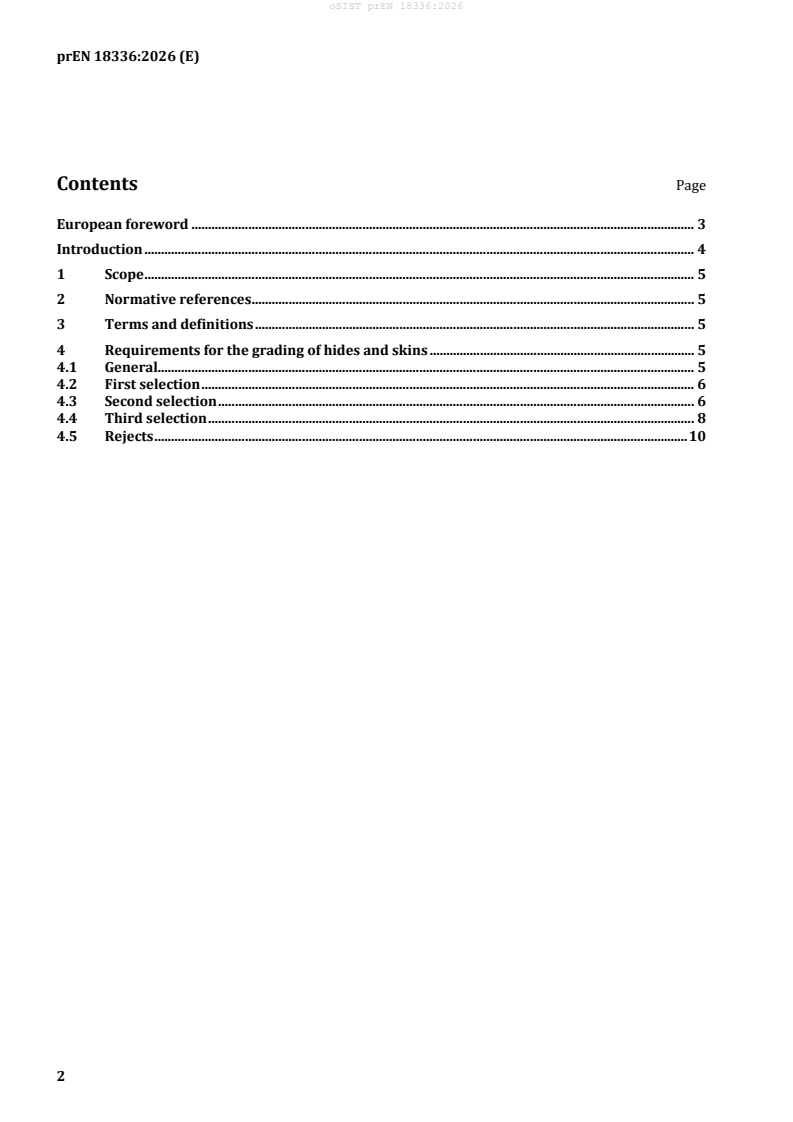
Contents
- Introduction
- 1 Scope
- 2 Normative references
- 3 Terms and definitions
- 3.1 grub
- 3.2 warble fly/warble
- 3.3 scabies
- 3.4 alopecia
- 4 Requirements for the grading of hides and skins
- 4.1 General
- 4.2 First selection
- 4.3 Second selection
- 4.4 Third selection
- 4.5 Rejects
Introduction
This document is intended to avoid disagreements between parties. It is the result of discussions with representatives of agriculture, slaughterhouses, hides and skins processors and tanneries.
oSIST prEN 18336:2026 prEN 18336:2026 (E)
1 Scope
This document specifies requirements to grade hides and skins according to the defects listed in EN 16055. It applies to raw bovine hides and skins, both fresh and salted, intended for use throughout the leather manufacturing supply chain.
2 Normative references
The following documents are referred to in the text in such a way that some or all of their content constitutes requirements of this document. For dated references, only the edition cited applies. For undated references, the latest edition of the referenced document (including any amendments) applies. EN 15987, Leather — Terminology — Key definitions for the leather trade EN 16055, Leather — Raw bovine hides and skins — Description, presentation and preservation
3 Terms and definitions
For the purposes of this document, the terms and definitions given in EN 16055 and EN 15987 and the following apply.
ISO and IEC maintain terminology databases for use in standardization at the following addresses:
- ISO Online browsing platform: available at https://www.iso.org/obp/
- IEC Electropedia: available at https://www.electropedia.org/
3.1 grub
larval stage of certain insects, particularly beetles
3.2 warble fly/warble
lumps caused by a type of parasitic fly whose larvae (often called warbles) develop under the skin of mammals, including cattle and deer, creating a hole in the host’s skin/hide as they grow, before emerging as adult flies
3.3 scabies
rash caused by intense itching, due to parasitic infestation caused by tiny mites that burrow into the skin and lay eggs
3.4 alopecia
partial or complete loss of hair from hide/skin
...