

EN 1434-2:2007
(Main)Heat meters - Part 2: Constructional requirements
- Abstract
This European Standard specifies the constructural requirements and applies to heat meters, that is to instruments intended for measur¬ing the heat which, in a heat-exchange circuit, is absorbed or given up by a liquid called the heat-conveying liquid. The heat meter indicates the quantity of heat in legal units.
Electrical safety requirements are not covered by this European Standard.
Pressure safety requirements are not covered by this European Standard.
Surface mounted temperature sensors are not covered by this European Standard.
- Status
- Withdrawn
- Publication Date
- 27-Feb-2007
- Withdrawal Date
- 06-Oct-2026
- Technical Committee
- CEN/TC 176 - Heat meters
- Current Stage
- 9960 - Withdrawal effective - Withdrawal
- Start Date
- 04-Nov-2015
- Completion Date
- 07-Oct-2026
- Directive
- 2004/22/EC - Measuring instrumentsOJ Ref: C, C 162 OJ Date: 14-Jul-2007


Relations
- Effective Date
- 22-Dec-2008
- Effective Date
- 22-Dec-2008
- Effective Date
- 11-Jul-2011
- Effective Date
- 25-Aug-2026
- Effective Date
- 25-Aug-2026
- Effective Date
- 25-Aug-2026
- Effective Date
- 25-Aug-2026
- Effective Date
- 09-Feb-2026
- Effective Date
- 09-Feb-2026
- Effective Date
- 28-Jan-2026
- Effective Date
- 28-Jan-2026
- Effective Date
- 28-Jan-2026
- Effective Date
- 28-Jan-2026
- Effective Date
- 28-Jan-2026
- Effective Date
- 28-Jan-2026
Get Certified
Connect with accredited certification bodies for this standard

BSMI (Bureau of Standards, Metrology and Inspection)
Taiwan's standards and inspection authority.
Sponsored listings
Frequently Asked Questions
EN 1434-2:2007 is a standard published by the European Committee for Standardization (CEN). Its full title is "Heat meters - Part 2: Constructional requirements". This standard covers: This European Standard specifies the constructural requirements and applies to heat meters, that is to instruments intended for measur¬ing the heat which, in a heat-exchange circuit, is absorbed or given up by a liquid called the heat-conveying liquid. The heat meter indicates the quantity of heat in legal units. Electrical safety requirements are not covered by this European Standard. Pressure safety requirements are not covered by this European Standard. Surface mounted temperature sensors are not covered by this European Standard.
This European Standard specifies the constructural requirements and applies to heat meters, that is to instruments intended for measur¬ing the heat which, in a heat-exchange circuit, is absorbed or given up by a liquid called the heat-conveying liquid. The heat meter indicates the quantity of heat in legal units. Electrical safety requirements are not covered by this European Standard. Pressure safety requirements are not covered by this European Standard. Surface mounted temperature sensors are not covered by this European Standard.
EN 1434-2:2007 is classified under the following ICS (International Classification for Standards) categories: 17.200.10 - Heat. Calorimetry. The ICS classification helps identify the subject area and facilitates finding related standards.
EN 1434-2:2007 has the following relationships with other standards: It is inter standard links to EN 1434-2:1997/A1:2002, EN 1434-2:1997, EN 1434-2:2015, ISO 7005-2:1988, ISO 7005-3:1988, ISO 4903:1989, ISO 7005-1:1992, EN 60751:1995, EN 60947-5-6:2000, EN 14015:2004, EN 13198:2003, EN 1434-1:2007, EN 1434-3:2025, EN ISO 228-1:2003, CEN/TR 15760:2010. Understanding these relationships helps ensure you are using the most current and applicable version of the standard.
EN 1434-2:2007 is associated with the following European legislation: EU Directives/Regulations: 2004/22/EC; Standardization Mandates: M/374. When a standard is cited in the Official Journal of the European Union, products manufactured in conformity with it benefit from a presumption of conformity with the essential requirements of the corresponding EU directive or regulation.
EN 1434-2:2007 is available in PDF format for immediate download after purchase. The document can be added to your cart and obtained through the secure checkout process. Digital delivery ensures instant access to the complete standard document.
Standards Content (Sample)
2003-01.Slovenski inštitut za standardizacijo. Razmnoževanje celote ali delov tega standarda ni dovoljeno.Heat meters - Part 2: Constructional requirementsToplotni števci - 2. del: Konstrukcijske zahteveCompteurs d'énergie thermique - Partie 2: Prescriptions de fabricationWärmezähler - Teil 2: Anforderungen an die KonstruktionTa slovenski standard je istoveten z:EN 1434-2:2007SIST EN 1434-2:2007en17.200.10Toplota. KalorimetrijaHeat. CalorimetryICS:SIST EN 1434-2:1997/A1:2002SIST EN 1434-2:19971DGRPHãþDSLOVENSKI
STANDARDSIST EN 1434-2:200701-maj-2007
EUROPEAN STANDARDNORME EUROPÉENNEEUROPÄISCHE NORMEN 1434-2February 2007ICS 17.200.10Supersedes EN 1434-2:1997
English VersionHeat meters - Part 2: Constructional requirementsCompteurs d'énergie thermique - Partie 2: Prescriptions defabricationWärmezähler - Teil 2: Anforderungen an die KonstruktionThis European Standard was approved by CEN on 7 January 2007.CEN members are bound to comply with the CEN/CENELEC Internal Regulations which stipulate the conditions for giving this EuropeanStandard the status of a national standard without any alteration. Up-to-date lists and bibliographical references concerning such nationalstandards may be obtained on application to the CEN Management Centre or to any CEN member.This European Standard exists in three official versions (English, French, German). A version in any other language made by translationunder the responsibility of a CEN member into its own language and notified to the CEN Management Centre has the same status as theofficial versions.CEN members are the national standards bodies of Austria, Belgium, Bulgaria, Cyprus, Czech Republic, Denmark, Estonia, Finland,France, Germany, Greece, Hungary, Iceland, Ireland, Italy, Latvia, Lithuania, Luxembourg, Malta, Netherlands, Norway, Poland, Portugal,Romania, Slovakia, Slovenia, Spain, Sweden, Switzerland and United Kingdom.EUROPEAN COMMITTEE FOR STANDARDIZATIONCOMITÉ EUROPÉEN DE NORMALISATIONEUROPÄISCHES KOMITEE FÜR NORMUNGManagement Centre: rue de Stassart, 36
B-1050 Brussels© 2007 CENAll rights of exploitation in any form and by any means reservedworldwide for CEN national Members.Ref. No. EN 1434-2:2007: E
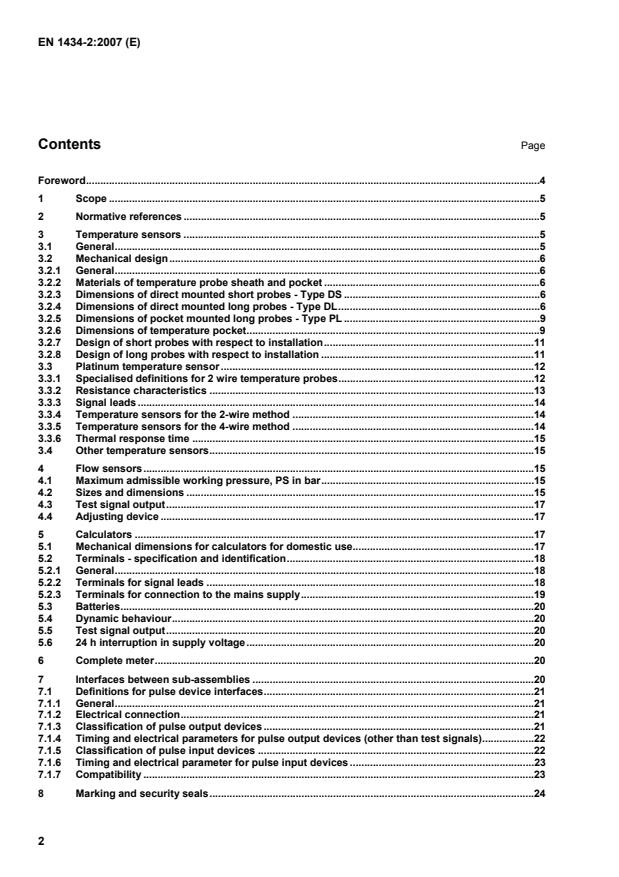
Examples of temperature sensors.27 Annex B (normative)
Input and output test signals.36 Annex C (informative)
Low voltage Power Supply for heat meters and their sub-assemblies.39 C.1 Remote supply.39 C.1.1 Voltage (DC or AC).39 C.1.2 Current available.39 C.1.3 Cabling requirements.39 C.2 Local external DC supply.39 C.2.1 Voltage.39 C.2.2 Other data.40 C.3 Power supply specifications.40 Annex ZA (informative)
Relationship between this European Standard and the Essential Requirements of
EU Directive 2004/22/EC, MID.41 Bibliography.42
Dimension
mm
0,5
up to
over
up to
over
up to
over
up to
over
up to
Tolerance
mm
± 0,2
± 0,3
± 1
± 1,5
± 2,5
3.2 Mechanical design 3.2.1 General For pipe sizes up to and including DN 250, 3 different temperature sensor types are standardised: direct mounted short probes - Type DS; direct mounted long probes - Type DL; pocket mounted long probes - Type PL. Types PL and DL can be either head probes or have permanently connected signal leads. Type DS shall have permanently connected signal leads only. 3.2.2 Materials of temperature probe sheath and pocket The temperature pocket and the protective sheath of direct mounted probes shall be of a material, that is adequately strong and resistant to corrosion and has the requisite thermal conductivity. A suitable material has been shown to be EN 10088-3 - X6 Cr Ni Mo Ti 17 12 2 3.2.3 Dimensions of direct mounted short probes - Type DS The dimensions shall be as given in Figure 1. Further non-normative information is given in Annex A, Figure A.1. The qualifying immersion depth shall be 20 mm – or less if so specified by the supplier. 3.2.4 Dimensions of direct mounted long probes - Type DL The dimensions shall be as given in Figure 2. Further information is given in Annex A, Figures A.2 and A.3. The qualifying immersion depth shall be 50 % of the length B – or less if so specified by the supplier.
Key 1 temperature sensing element 2 protective sheath 3 sealing ring Figure 1 — Temperature probes type DS
Key G 1/2 B thread in accordance with EN ISO 228-1 A: < 30 mm or ≤ 50 mm for PT1000 Alternative lengths B C head probe only 85 105 120 140 210 230
1 temperature sensing element 2 protective sheath 3 sealing face 4 outline of head probe 5 outline of permanently connected signal lead probe 6 inlet for signal cable – ø ≤ 9 mm Figure 2 — Temperature probes type DL (head or cable)
Key 1)
Corresponding to c11 in ISO 286-2, rounded to 2 decimals A: < 30 mm or ≤ 50 mm for PT1000 Alternative lengths B (head probe only) 105 140 230
1 temperature sensing element 2 outline of head probe 3 outline of permanently connected signal lead probe 4 inlet for signal cable – ø ≤ 9 mm Figure 3 — temperature probes – Type PL (head or cable)
Key 1)
Corresponding to H11 in ISO 286-2 rounded to 2 decimals G 1/2 B thread in accordance with EN ISO 228-1 Alternative lengths C D 85 ≤ 100 120 ≤ 135 210 ≤ 225
1 sealing face 2 probe clamping screw with provision for security sealing Figure 4 — Temperature pocket
3.2.7 Design of short probes with respect to installation The sensor shall be mounted perpendicular to the flow and with the sensing element inserted to at least the centre of the pipe. For internal pressures up to 16 bar, the sensor shall be designed to fit in a pipe fitting (see Annex A,
Figure A.7). 3.2.8 Design of long probes with respect to installation The sensor shall be mounted with the sensing element inserted to at least the centre of the pipe.
in a pipe DN 50 mounted with the tip pointing into the flow in a bend (see Annex A,
Figure A.8 B), using welded-in boss (see Annex A, Figure A.6 b)). b)
in a pipe –DN 50 mounted at an angle 45º to the direction of the flow with the tip pointing into the flow (see Annex A, Figure A.8 C), using a welded in boss (see Annex A,
Figure A.6 b)). c)
in a pipe DN 65 to DN 250, mounted perpendicular to the flow (see Annex A, Figure A.8 D), using a welded-in boss (see Annex A, Figure A.6 a)). 3.3 Platinum temperature sensor 3.3.1 Specialised definitions for 2 wire temperature probes
Key R1
temperature sensing element resistance 1
temperature sensing element R2
internal wire resistance 2
protective sheath R3
signal lead resistance 3
mounting thread
signal leads
Figure 5 — Temperature probe with permanently connected signal leads
Figure 6 — Head sensor temperature probe Key R1
temperature sensing element resistance 1
temperature sensing element R2
internal wire and terminals resistance 2
protective sheath
mounting thread
outline of head
3.3.2 Resistance characteristics The calibration of temperature sensors shall be traceable to national temperature standards. The intermediate values of the heat meter temperature sensor shall be interpolated using the EN 60751 equation as follows: R1 = R0 (1 + At + Bt2) where R1 is the resistance value at temperature t in Ω (excluding cable resistance - see Figures 5 and 6); R0 is the resistance value at temperature 0 ºC in Ω (base value) (excluding cable resistance); A is 3,908 3 × 10⁻³ ºC-1;
Lead cross section
mm2
Max. length for Pt 100
m
0,22
0,50
0,75
1,50
2,5
5,0
7,5
15,0
For sensors of higher resistances the limiting value can be extended proportionally. NOTE The values given in Table 2 have been obtained in the following manner: It is assumed, that the difference in temperature of the leads does not exceed one third of the temperature difference between flow and return pipes. The maximum permissible length of lead for each lead cross section was then calculated, having decided that the error created may not be allowed to exceed 0,2 times the maximum permissible error of the temperature probe pair and using the knowledge of the different resistances created by the temperature differences between the flow and return leads. The influence of the length of a signal lead can be neglected, if the total resistance of a lead for a Pt 100 temperature sensor does not exceed two times 0,2 Ω. 3.3.5 Temperature sensors for the 4-wire method If the cable length requirements in 3.3.4 cannot be fulfilled, the 4-wire method shall be used. The connections shall be clearly identifiable so that they cannot be confused.
Table 3 — Dimensions
Preferred
Also acceptable
Also
acceptable qp m3/h Overall length
mm Threaded end con-nections Flanged connec-tions
DN Overall length
mm Threaded end con-nections Flanged connec-tions
DN Overall length
mm Threaded end con-nections
0,6 1,0 1,5 2,5 3,5 6,0 10 15 25 40 60 100 150 250 400
110 130 165 190 260 260 300 300 300 350 350 350 500 500 600
G 3/4 B G 3/4 B G 3/4 B G
B G 1 1/4 B G 1 1/2 B
G 2 B
15 15 15 20 25 32 40 50 65 80 100 125 150 200 250
190 190 190
300 360
G 1 B G 1 B G 1 B
G 1 1/4 B
20 20 20
80 100
110 110 130
G 3/4 B G 3/4 B G 1 B
To achieve the necessary overall length adaptor pieces can be fitted. The adjacent lengths larger or smaller than the preferred lengths may be adopted for qp š≥ 10 m3/h Tolerances on the overall length shall be: up to 300 mm 02−mm; from 350 to 600 mm 03− mm. Threaded connection Dimensions for the threaded end connections are specified in Table 4. Threads shall comply with
EN ISO 228-1. Figure 7 outlines the dimensions a and b. Flanged connection Flanged end connections shall comply with ISO 7005-1, 7005-2 and 7005-3 (as appropriate) for a nominal pressure corresponding to that of the flow sensor.
Table 4 — Threaded end connections Range of size and minimum thread lengths in mm
Thread
a
b
G 3/4 B
G 1 B
G 1 1/4 B
G 1 1/2 B
G 2 B
12 14 16 18 20
Figure 7 — Outline of the dimensions a and b in Table 4 4.3 Test signal output For test purposes, it is
...