


EN 14080:2013
(Main)Timber structures - Glued laminated timber and glued solid timber - Requirements
Timber structures - Glued laminated timber and glued solid timber - Requirements
This European Standard sets the performance requirements of the following glued laminated products:
- Glued laminated timber (glulam);
- Glued solid timber;
- Glulam with large finger joints;
- Block glued glulam
for use in buildings and bridges.
It also lays down minimum production requirements, provisions for evaluation and attestation of conformity and marking of glued laminated products.
This European Standard is applicable for glued laminated timber made of coniferous species listed in this standard or poplar consisting of two or more laminations having a thickness from 6 mm up to 45 mm (inclusive).
It may be possible to produce glulam made from specific hardwood species based on some provisions of this European Standard. In this case, Annex ZA does not apply.
This European Standard is applicable for glued solid timber made of coniferous species listed in this standard or poplar consisting of two to five laminations having a thickness greater than 45 mm and less than or equal to 85 mm.
This European Standard is applicable for large finger joints in glued laminated timber with a finger length of at least 45 mm.
This European Standard is applicable for block glued glulam having solid rectangular cross sections.
This European Standard also gives the requirements for glued laminated products treated against biological attack. Glued laminated products treated with fire retardants are not covered.
Holzbauwerke - Brettschichtholz und Balkenschichtholz - Anforderungen
Diese Europäische Norm legt die Leistungsanforderungen an die folgenden geklebten Schichtholzprodukte zur Verwendung im Hoch- und Brückenbau fest:
- Brettschichtholz;
- Balkenschichtholz;
- Brettschichtholz mit Universal-Keilzinkenverbindungen;
- Verbundbauteile aus Brettschichtholz.
Sie legt außerdem Mindestanforderungen an die Herstellung fest und enthält Bestimmungen zur Konformitäts-bewertung und -bescheinigung sowie zur Kennzeichnung von geklebten Schichtholzprodukten.
Diese Europäische Norm gilt für Brettschichtholz aus den in dieser Norm aufgelisteten Nadelholzarten oder aus Pappel mit mindestens zwei Lamellen mit einer Dicke von 6 mm bis einschließlich 45 mm.
Brettschichtholz könnte auf der Grundlage einiger Bestimmungen dieser Europäischen Norm aus bestimmten Laubholzarten hergestellt werden. In diesem Fall gilt Anhang ZA nicht.
Diese Europäische Norm gilt für Balkenschichtholz aus den in dieser Norm aufgelisteten Nadelholzarten oder aus Pappel mit zwei bis fünf Lamellen mit einer Dicke von mehr als 45 mm, jedoch höchstens 85 mm.
Die vorliegende Europäische Norm gilt für Universal-Keilzinkenverbindungen in Brettschichtholz mit einer Zinkenlänge von mindestens 45 mm.
Diese Europäische Norm gilt für Verbundbauteile aus Brettschichtholz mit massivem rechteckigem Querschnitt.
Diese Europäische Norm legt darüber hinaus die Anforderungen an geklebte Schichtholzprodukte fest, die gegen biologischen Befall behandelt werden. Mit Feuerschutzmitteln behandelte geklebte Schichtholz¬produkte sind nicht Gegenstand dieser Norm.
Structures en bois - Bois lamellé collé et bois massif reconstitué - Exigences
La présente Norme européenne spécifie les exigences de performance des produits en bois lamellés-collés suivants:
- bois lamellé-collé (BLC) ;
- bois massif reconstitué ;
- bois lamellé-collé avec aboutages à entures multiples de grandes dimensions ;
- bois lamellé-collé en bloc ;
destinés à être utilisés dans les bâtiments et les ponts.
Elle spécifie également les exigences minimales de fabrication, ainsi que les dispositions relatives à l'évaluation et à l’attestation de la conformité et au marquage des produits lamellés-collés.
La présente Norme européenne est applicable au bois lamellé-collé fabriqué à partir des essences de bois de résineux énumérées dans la présente norme ou de peuplier, constitué de deux lamelles ou plus, ayant une épaisseur comprise entre 6 mm et 45 mm (inclus).
Il peut être possible de fabriquer du bois lamellé-collé réalisé à partir des essences de bois feuillus en se basant sur les exigences de la présente Norme européenne. Dans ce cas, l’annexe ZA ne s’applique pas.
La présente Norme européenne est applicable au bois massif reconstitué fabriqué à partir des essences de bois de résineux énumérées dans la présente norme ou de peuplier, constitué de deux à cinq lamelles, ayant une épaisseur supérieure à 45 mm et inférieure ou égale à 85 mm.
La présente Norme européenne est applicable aux aboutages à entures multiples de grandes dimensions réalisés dans un bois lamellé-collé, avec une longueur d'enture d'au moins 45 mm.
La présente Norme européenne est applicable au bois lamellé-collé en bloc de sections rectangulaires massives.
La présente Norme européenne spécifie également les exigences relatives aux produits lamellés-collés traités contre les attaques biologiques. Les produits lamellés-collés traités par des produits ignifuges ne sont pas couverts.
Lesene konstrukcije - Lepljeni lamelirani les in lepljeni masivni les
Ta evropski standard določa zahteve glede funkcionalnosti za naslednje lepljene lamelirane izdelke: – lepljeni lamelirani les (glulam); – lepljeni masivni les; – glulam z zobatimi spoji velikega formata; – blokovno lepljeni glulam za uporabo v stavbah in mostovih. Določa tudi minimalne zahteve glede proizvodnje ter določila za vrednotenje in potrjevanje skladnosti in označevanje lepljenih lameliranih izdelkov. Ta evropski standard se uporablja za lepljeni lamelirani les, izdelan iz iglavcev, ki so navedeni v tem standardu, ali topolovine, ki je sestavljena iz dveh ali več laminatov z debelino od 6 mm do 45 mm (vključno). Na osnovi nekaterih določil tega evropskega standarda obstaja možnost izdelave glulama iz določenega lesa listavcev. V tem primeru dodatek ZA ne velja. Ta evropski standard se uporablja za lepljeni masivni les, izdelan iz iglavcev, ki so navedeni v tem standardu, ali topolovine, ki je sestavljena iz dveh ali več laminatov z debelino, ki je večja od 45 mm in manjša od ali enaka 85 mm. Ta evropski standard se uporablja za zobate spoje velikega formata v lepljenem lameliranem lesu, pri čemer je dolžina zoba vsaj 45 mm. Ta evropski standard se uporablja za blokovno lepljeni glulam s polnimi pravokotnimi prerezi. Ta evropski standard določa tudi zahteve za lepljene lamelirane izdelke, ki imajo zaščito pred biološkimi dejavniki. Lepljeni lamelirani izdelki, ki so obdelani z zaščitnimi sredstvi proti ognju, niso zajeti.
General Information
- Status
- Published
- Publication Date
- 25-Jun-2013
- Withdrawal Date
- 30-Dec-2013
- Technical Committee
- CEN/TC 124 - Timber structures
- Drafting Committee
- CEN/TC 124/WG 3 - Glued laminated timber
- Current Stage
- 9093 - Decision to confirm - Review Enquiry
- Start Date
- 11-Sep-2024
- Completion Date
- 14-Apr-2025
- Directive
- 89/106/EEC - Construction products
Relations
- Effective Date
- 08-Jun-2022
- Effective Date
- 08-Jun-2022
- Effective Date
- 03-Jul-2013
- Effective Date
- 03-Jul-2013
- Effective Date
- 03-Jul-2013
- Replaces
EN 386:2001 - Glued laminated timber - Performance requirements and minimum production requirements - Effective Date
- 03-Jul-2013
- Effective Date
- 23-Oct-2010
- Effective Date
- 23-Oct-2010
Overview
EN 14080:2013 - Timber structures: Glued laminated timber and glued solid timber is a European standard that defines performance, production and conformity requirements for glued laminated products used in buildings and bridges. The standard applies primarily to glued laminated timber (glulam), glued solid timber, glulam with large finger joints, and block glued glulam, made from the coniferous species listed in the standard or poplar. It was approved by CEN in May/June 2013 and supersedes earlier EN editions.
Key topics and technical requirements
- Product scope and material limits
- Glulam: laminations 6 mm to 45 mm thickness (conifers or poplar).
- Glued solid timber: 2–5 laminations, thickness >45 mm and ≤85 mm.
- Large finger joints: finger length ≥45 mm.
- Block glued glulam: solid rectangular cross sections.
- Mechanical resistance and structural verification
- Verification routes include classification of lamination properties, cross-sectional lay-ups, full-scale tests and resawn glulam provisions.
- Bonding strength and durability
- Requirements for adhesives, finger joints, glue lines and bonding methods.
- Annexes contain delamination and shear test procedures and additional adhesive tests.
- Durability against biological attack
- Requirements for untreated and preservative-treated glued laminated products.
- Note: products treated with fire retardants are not covered.
- Production and quality control
- Minimum production requirements, Factory Production Control (FPC), initial type testing, initial factory inspection and continuous surveillance.
- Marking, labelling and attestation of conformity requirements are specified.
- Regulated emissions and safety
- Formaldehyde release classification and clauses on other dangerous substances are included.
- Normative annexes
- Detailed test methods (delamination, shear, finger joint testing, climatic/long-term tests) and reporting criteria are provided in annexes A–E.
Practical applications and users
- Manufacturers of glulam and glued solid timber use the standard to design production processes, select adhesives and establish factory production control and marking.
- Structural engineers and bridge designers rely on the mechanical verification and lamination classifications for safe design and specification of load-bearing timber elements.
- Test laboratories and certification bodies perform initial type testing, FPC audits, and surveillance to attest conformity.
- Architects, contractors and building authorities reference the standard when specifying certified glulam products for buildings and bridges.
Related standards
- EN 14080:2013 consolidates and supersedes earlier EN standards (e.g., EN 1194:1999, EN 14080:2005, EN 385/386/387/390/391/392 series). It is a CEN European Standard and should be used alongside national implementation rules where applicable.
Keywords: EN 14080:2013, glued laminated timber, glulam, glued solid timber, finger joints, block glued glulam, factory production control, durability, adhesive testing, timber structures.
Frequently Asked Questions
EN 14080:2013 is a standard published by the European Committee for Standardization (CEN). Its full title is "Timber structures - Glued laminated timber and glued solid timber - Requirements". This standard covers: This European Standard sets the performance requirements of the following glued laminated products: - Glued laminated timber (glulam); - Glued solid timber; - Glulam with large finger joints; - Block glued glulam for use in buildings and bridges. It also lays down minimum production requirements, provisions for evaluation and attestation of conformity and marking of glued laminated products. This European Standard is applicable for glued laminated timber made of coniferous species listed in this standard or poplar consisting of two or more laminations having a thickness from 6 mm up to 45 mm (inclusive). It may be possible to produce glulam made from specific hardwood species based on some provisions of this European Standard. In this case, Annex ZA does not apply. This European Standard is applicable for glued solid timber made of coniferous species listed in this standard or poplar consisting of two to five laminations having a thickness greater than 45 mm and less than or equal to 85 mm. This European Standard is applicable for large finger joints in glued laminated timber with a finger length of at least 45 mm. This European Standard is applicable for block glued glulam having solid rectangular cross sections. This European Standard also gives the requirements for glued laminated products treated against biological attack. Glued laminated products treated with fire retardants are not covered.
This European Standard sets the performance requirements of the following glued laminated products: - Glued laminated timber (glulam); - Glued solid timber; - Glulam with large finger joints; - Block glued glulam for use in buildings and bridges. It also lays down minimum production requirements, provisions for evaluation and attestation of conformity and marking of glued laminated products. This European Standard is applicable for glued laminated timber made of coniferous species listed in this standard or poplar consisting of two or more laminations having a thickness from 6 mm up to 45 mm (inclusive). It may be possible to produce glulam made from specific hardwood species based on some provisions of this European Standard. In this case, Annex ZA does not apply. This European Standard is applicable for glued solid timber made of coniferous species listed in this standard or poplar consisting of two to five laminations having a thickness greater than 45 mm and less than or equal to 85 mm. This European Standard is applicable for large finger joints in glued laminated timber with a finger length of at least 45 mm. This European Standard is applicable for block glued glulam having solid rectangular cross sections. This European Standard also gives the requirements for glued laminated products treated against biological attack. Glued laminated products treated with fire retardants are not covered.
EN 14080:2013 is classified under the following ICS (International Classification for Standards) categories: 79.060.99 - Other wood-based panels. The ICS classification helps identify the subject area and facilitates finding related standards.
EN 14080:2013 has the following relationships with other standards: It is inter standard links to EN 390:1994, EN 385:2001, EN 392:1995, EN 387:2001, EN 14080:2005, EN 386:2001, EN 1194:1999, EN 391:2001. Understanding these relationships helps ensure you are using the most current and applicable version of the standard.
EN 14080:2013 is associated with the following European legislation: EU Directives/Regulations: 305/2011, 89/106/EEC; Standardization Mandates: M/112. When a standard is cited in the Official Journal of the European Union, products manufactured in conformity with it benefit from a presumption of conformity with the essential requirements of the corresponding EU directive or regulation.
You can purchase EN 14080:2013 directly from iTeh Standards. The document is available in PDF format and is delivered instantly after payment. Add the standard to your cart and complete the secure checkout process. iTeh Standards is an authorized distributor of CEN standards.
Standards Content (Sample)
2003-01.Slovenski inštitut za standardizacijo. Razmnoževanje celote ali delov tega standarda ni dovoljeno.Lesene konstrukcije - Lepljeni lamelirani les in lepljeni masivni lesHolzbauwerke - Brettschichtholz und Balkenschichtholz - AnforderungenStructures en bois - Bois lamellé collé et bois massif reconstitué - ExigencesTimber structures - Glued laminated timber and glued solid timber91.080.20Lesene konstrukcijeTimber structures79.060.99Other wood-based panelsICS:Ta slovenski standard je istoveten z:EN 14080:2013SIST EN 14080:2013en,fr,de01-november-2013SIST EN 14080:2013SLOVENSKI
STANDARDSIST EN 390:1996SIST EN 387:2002SIST EN 392:1996SIST EN 391:2002SIST EN 14080:2005SIST EN 1194:2000SIST EN 386:2002SIST EN 385:20021DGRPHãþD
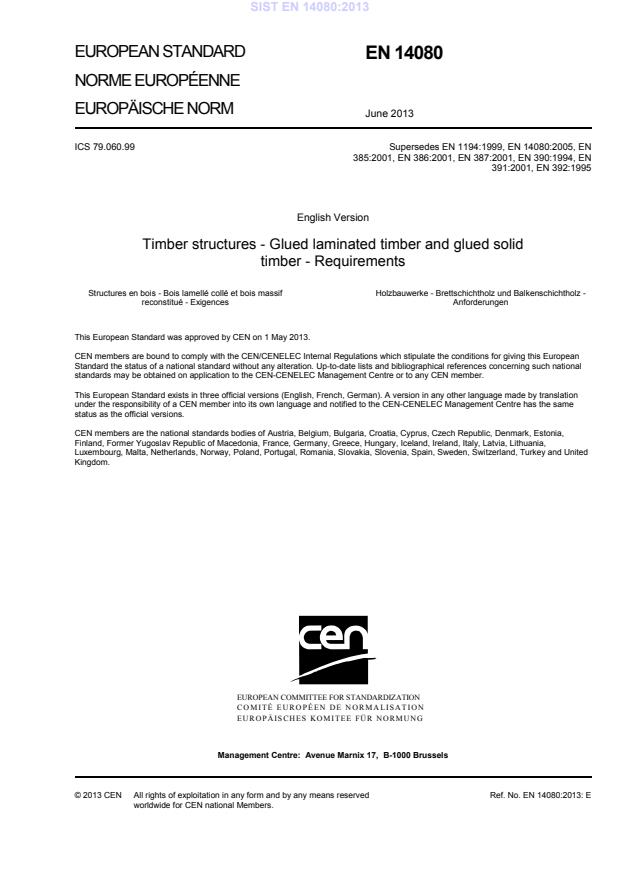
EUROPEAN STANDARD NORME EUROPÉENNE EUROPÄISCHE NORM
EN 14080
June 2013 ICS 79.060.99 Supersedes EN 1194:1999, EN 14080:2005, EN 385:2001, EN 386:2001, EN 387:2001, EN 390:1994, EN 391:2001, EN 392:1995English Version
Timber structures - Glued laminated timber and glued solid timber - Requirements
Structures en bois - Bois lamellé collé et bois massif reconstitué - Exigences
Holzbauwerke - Brettschichtholz und Balkenschichtholz - Anforderungen This European Standard was approved by CEN on 1 May 2013.
CEN members are bound to comply with the CEN/CENELEC Internal Regulations which stipulate the conditions for giving this European Standard the status of a national standard without any alteration. Up-to-date lists and bibliographical references concerning such national standards may be obtained on application to the CEN-CENELEC Management Centre or to any CEN member.
This European Standard exists in three official versions (English, French, German). A version in any other language made by translation under the responsibility of a CEN member into its own language and notified to the CEN-CENELEC Management Centre has the same status as the official versions.
CEN members are the national standards bodies of Austria, Belgium, Bulgaria, Croatia, Cyprus, Czech Republic, Denmark, Estonia, Finland, Former Yugoslav Republic of Macedonia, France, Germany, Greece, Hungary, Iceland, Ireland, Italy, Latvia, Lithuania, Luxembourg, Malta, Netherlands, Norway, Poland, Portugal, Romania, Slovakia, Slovenia, Spain, Sweden, Switzerland, Turkey and United Kingdom.
EUROPEAN COMMITTEE FOR STANDARDIZATION
COMITÉ EUROPÉEN DE NORMALISATION EUROPÄISCHES KOMITEE FÜR NORMUNG
Management Centre:
Avenue Marnix 17,
B-1000 Brussels © 2013 CEN All rights of exploitation in any form and by any means reserved worldwide for CEN national Members. Ref. No. EN 14080:2013: ESIST EN 14080:2013
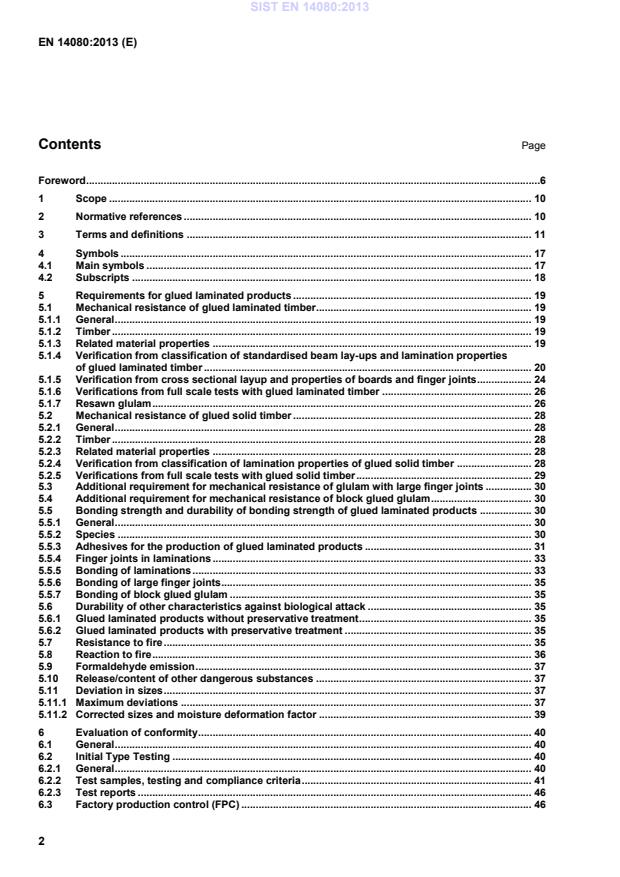
Release of Formaldehyde . 56 A.1 General . 56 A.2 Classification . 56 A.2.1 Glued laminated timber or glued solid timber . 56 A.2.2 Classification for glulam with large finger joints and block glued glulam . 57 Annex B (normative)
Additional test methods and requirements for adhesives . 58 B.1 General . 58 B.2 Long-term sustained load test at cyclic climate conditions with specimens loaded perpendicular to the glue line for moisture curing one-component polyurethane and emulsion polymer isocyanate adhesives. 58 B.2.1 General description . 58 B.2.2 Production of the specimens . 58 B.2.3 Test procedure and climate conditions . 59 B.2.4 Requirements . 60 B.2.5 Report . 60 B.3 Delamination test for finger joints in laminations . 60 B.3.1 Production of the specimens . 60 B.3.2 Testing . 61 B.3.3 Results . 61 B.3.4 Report . 61 Annex C (normative)
Delamination test of glue lines . 63 C.1 Principle. 63 C.2 Apparatus . 63 C.2.1 Pressure vessel . 63 C.2.2 Drying duct . 63 C.2.3 Balance . 63 C.2.4 Metal wedge and hammer . 63 C.3 Sampling and preparation of test pieces . 63 C.4 Procedures . 64 C.4.1 General . 64 C.4.2 Measurement and evaluation of delamination . 64 C.4.3 Test cycle for method A . 65 C.4.4 Test cycle for method B . 65 C.4.5 Test cycle for method C . 66 C.5 Results . 66 C.5.1 General . 66 C.5.2 Total delamination . 66 C.5.3 Maximum delamination . 66 C.6 Report . 67 Annex D (normative)
Shear test of glue lines . 68 D.1 Principle. 68 D.2 Apparatus . 68 D.2.1 Testing machine . 68 D.2.2 Shearing tool . 68 D.3 Test pieces for glulam and glued solid timber . 69 D.3.1 Preparation of test pieces. 69 D.3.2 Sampling of test pieces (test bars) . 70 D.3.3 Marking of test pieces (test bars) . 71 SIST EN 14080:2013
Tests with laminations with or without finger joints (including compliance criteria) . 74 E.1 Sampling of finger joints in laminations . 74 E.1.1 General . 74 E.1.2 For Initial type testing . 74 E.1.3 For Factory production control . 74 E.2 Testing of finger joints in laminations . 74 E.2.1 General . 74 E.2.2 Additionally for initial type testing . 74 E.2.3 Additionally for factory production control . 74 E.3 Compliance criteria of finger joints in laminations . 75 E.3.1 For Initial type testing . 75 E.3.2 For factory production control . 75 E.4 Report of tests with finger joints in laminations . 75 E.5 Tests with laminations without finger joints . 76 Annex F (normative)
Bending tests with glued laminated timber, glued solid timber and glulam with large finger joints (including compliance criteria) . 77 F.1 Sampling . 77 F.2 Testing . 77 F.3 Evaluation . 77 F.4 Compliance criteria. 77 F.5 Report . 78 Annex G (normative)
Measurement of moisture content . 79 G.1 General . 79 G.2 Measurement of moisture content of boards during production . 79 G.3 Mean moisture content of glued laminated timber and glulam components for the production of glulam with large finger joints and block glued glulam . 79 G.4 Moisture content of glued solid timber . 79 Annex H (normative)
Equipment . 80 H.1 General . 80 H.2 Additionally for the production of glued laminated timber and glued solid timber . 80 H.3 Additionally for the production of glulam with large finger joints . 80 H.4 Additionally for the production of block glued glulam . 80 Annex I (normative)
Minimum production requirements . 81 I.1 Personnel . 81 I.2 Production and storage facilities . 81 I.2.1 General . 81 I.2.2 Facilities for drying and storage of timber . 81 I.2.3 Facilities for processing and storage of adhesives . 81 I.2.4 Facilities for production and curing . 81 I.3 Equipment . 81 I.4 Finger joints in laminations . 82 I.4.1 Wane and edge damages . 82 I.4.2 Finger joint geometry . 82 I.4.3 Knots and local grain deviation . 82 I.4.4 Moisture content at bonding . 83 I.4.5 Bonding surface and application of the adhesive . 83 I.4.6 Time between cutting and bonding . 84 I.4.7 Pressure . 84 I.4.8 Curing . 84 I.5 Bonding of laminations . 85 I.5.1 Permissible finished lamination sizes and radius of curvature . 85 I.5.2 Laminations made of two boards side by side . 85 I.5.3 Grooves in laminations . 85 SIST EN 14080:2013
Clauses of this European Standard addressing the provisions of the EU Construction Products Directive . 90 ZA.1 Scope and relevant characteristics . 90 ZA.2 Procedures for the attestation of conformity of glued laminated products . 92 ZA.2.1 System of attestation of conformity . 92 ZA.2.2 EC certificate of conformity . 93 ZA.3 CE marking and labelling. 94 ZA.3.1 General . 94 ZA.3.2 CE marking on the product . 94 ZA.3.3
CE marking in the accompanying documents . 97 Bibliography . 103
Key 1 boards
6 glued laminated timber (glulam) 2 is a component for
7 glulam with large finger joints 3 structural finger jointed timber
8 block glued glulam 4 glued laminated products
9 cross laminated timber (X-Lam) 5 glued solid timber
10 cross laminated timber (X-Lam) with large finger joints Figure 1 — Relation of European Standards for structural timber products prepared by CEN/TC 124 SIST EN 14080:2013
Key 1 glulam component 1 2 glulam component 2 n glulam component n a glue line between glulam components Figure 2 — Examples for block glued glulam 3.4 combined glued laminated timber glued laminated timber with a cross section comprising inner and outer laminations of different strength classes or manufacturer specific strength class 3.5 combined glulam with asymmetrical layup combined glued laminated timber having an asymmetrical cross sectional layup 3.6 corrected size size of a glued laminated product corrected by calculation from its actual size to its size at the reference moisture content 3.7 curved glued laminated member member made of glulam or glulam with large finger joints or block glued glulam having a precamber greater than 1 % of its span SIST EN 14080:2013
Key lj finger length p pitch α finger angle lt tip gap bt tip width Figure 3 — Typical profile of a finger joint
3.12 finger length distance between the finger base and the tip of the finger, measured along the centre line of the finger Note 1 to entry: See Figure 3. 3.13 finished thickness thickness after planing 3.14 gap filling adhesive adhesive that has been tested with a glue line thickness of 2 mm SIST EN 14080:2013
glulam structural timber member composed by at least two essentially parallel laminations which may comprise of one or two boards side by side having finished thicknesses from 6 mm up to 45 mm (inclusive) Note 1 to entry: See Figure 4. Note 2 to entry: Due to planing of the glued laminated timber member an outermost lamination may have reduced thicknesses compared to the inner laminations.
Figure 4
...
La norme EN 14080:2013, intitulée "Structures en bois - Bois lamellé-collé et bois massif collé - Exigences", est une référence essentielle pour les produits en bois collé, notamment le bois lamellé-collé (glulam) et le bois massif collé. Cette norme définit des exigences de performance claires pour une gamme variée de produits, incluant le bois lamellé-collé, le bois massif collé, le glulam avec de grands joints à doigts, ainsi que le glulam collé en blocs, pour leur utilisation tant dans les bâtiments que dans les ponts. L'un des points forts de cette norme est son approche détaillée des exigences minimales de production et des procédures d'évaluation et d'attestation de la conformité, garantissant ainsi que les produits en bois collé respectent des critères de qualité rigoureux. Cela renforce la fiabilité des structures construites en utilisant ces matériaux et contribue à la sécurité des utilisateurs finaux. La norme s'applique spécifiquement au bois lamellé-collé fabriqué à partir d'espèces de conifères répertoriées dans la norme, ou de peupliers, avec des laminations ayant une épaisseur variant de 6 mm à 45 mm. De plus, elle ouvre la possibilité de produire du glulam à partir de certaines espèces de feuillus, bien que dans ce cas, l'Annexe ZA ne s'applique pas, ce qui montre la flexibilité de la norme tout en maintenant des standards stricts. En ce qui concerne le bois massif collé, la norme stipule avec précision que celui-ci doit être constitué de deux à cinq laminations et avoir une épaisseur supérieure à 45 mm et inférieure ou égale à 85 mm. Ceci assure que seuls les produits de dimensions appropriées et adaptées aux exigences de performance entrent sur le marché, augmentant ainsi la sécurité et la durabilité des constructions. La norme couvre également les exigences relatives aux grands joints à doigts dans le bois lamellé-collé, avec une longueur minimale de doigt de 45 mm, ce qui est crucial pour les applications structurales où la performance et la résistance des joints sont primordiales. De plus, les produits en bois lamellé-collé traités contre l'attaque biologique sont également intégrés dans le champ d'application, ce qui démontre l'importance de la durabilité et de la longévité des matériaux de construction. Cependant, il convient de noter que les produits en bois lamellé-collé traités avec des retardateurs de flamme ne sont pas couverts par cette norme, ce qui souligne la nécessité d'autres normes spécialisées pour cette catégorie spécifique de traitement. En résumé, la norme EN 14080:2013 est un document fondamental qui établit des critères de performance et de production pour les produits en bois lamellé-collé et en bois massif collé, garantissant leur qualité et leur adéquation pour des usages dans les constructions. Sa rigueur et sa portée en font un cadre réglementaire pertinent pour les professionnels du secteur du bois.
표준 EN 14080:2013은 접착 라미네이티드 목재 및 접착 고체 목재에 대한 요구 사항을 명시하며, 건축물과 교량에 사용되는 접착 라미네이티드 제품의 성능 요구 사항을 설정합니다. 이 표준은 접착 라미네이티드 목재(glulam), 접착 고체 목재, 대형 핀 접합(glulam with large finger joints), 블록 접착 라미네이티드 목재(block glued glulam)와 같은 다양한 제품의 최소 생산 요구 사항을 포함하고 있습니다. EN 14080:2013의 주요 강점은 coniferous species 및 특정 hardwood species를 포함하여, 다양한 원목의 적용성을 확보하고 있다는 점입니다. 특히, 6 mm에서 45 mm 두께의 라미네이션을 사용하는 접착 라미네이티드 목재와 45 mm 초과 85 mm 이하의 접착 고체 목재에 대한 명확한 기준을 제시함으로써 산업 내에서의 표준화에 기여합니다. 또한, 최소한 45 mm의 핀 길이를 가진 대형 핀 접합과 고체 사각 단면을 가지는 블록 접착 라미네이티드 목재의 규정 또한 포함되어 있어, 생산 공정의 일관성을 높이고 있습니다. 이 표준은 생물학적 공격에 대해 처리가 된 접착 라미네이티드 제품에 대한 요구 사항도 제시하고 있으며, 화재 억제제를 사용한 제품은 포함되지 않는 점을 명확히 하고 있습니다. 이러한 세부 사항은 다양한 애플리케이션에서의 안전성과 신뢰성을 유지하는 데 중요한 역할을 합니다. 결론적으로, EN 14080:2013은 접착 라미네이티드 목재 및 접착 고체 목재의 표준화에 있어 필수적인 가이드라인을 제공하며, 건축물과 교량의 구조적 안정성과 안전성을 확보하는 데 있어 매우 적합합니다. 이 표준은 업계의 요구 사항을 충족시키고, 지속 가능한 건축 자원의 사용을 촉진할 수 있는 기초를 마련하고 있습니다.
Die Norm EN 14080:2013 befasst sich mit den Anforderungen an Brettschichtholz und verleimtes Massivholz, das in Bauwerken und Brücken eingesetzt wird. Diese europäische Norm legt nicht nur die Leistungsanforderungen für verschiedene verleimte Produkte fest, sondern definiert auch Mindestanforderungen an die Produktion, Verfahren zur Bewertung und Konformitätsbescheinigung sowie die Kennzeichnung dieser Produkte. Ein herausragendes Merkmal der EN 14080:2013 ist der umfassende Anwendungsbereich, der sich auf Brettschichtholz (glulam), verleimtes Massivholz sowie Brettschichtholz mit großen Fingerverbindungen und blockverleimtes Brettschichtholz erstreckt. Dies ermöglicht eine vielseitige Nutzung in verschiedenen Bauanwendungen und bietet Architekten sowie Bauunternehmern klare Richtlinien zur Auswahl und Verwendung dieser Materialien. Die Norm hebt zudem die Flexibilität bei der Bearbeitung von Holzarten hervor. Während die Nutzung von Nadelhölzern und Pappeln für die Herstellung von verleimtem Holz festgelegt ist, eröffnet die Norm die Möglichkeit, spezifische Hartholzarten unter bestimmten Vorgaben zu verwenden. Dies fördert die Innovation im Holzbau und ermöglicht die Anpassung an unterschiedliche Bauanforderungen. Ein weiterer Vorteil der EN 14080:2013 ist die vorgeschriebene Behandlung von verleimten Produkten gegen biologische Angriffe, was die Langlebigkeit und Sicherheit der verwendeten Materialien erhöht. Zudem werden zusätzliche Anforderungen an Produkte, die gegen Feuer behandelt werden, erwähnt, jedoch nicht abgedeckt. Diese detaillierte Differenzierung zeigt das Bewusstsein für verschiedene Risikofaktoren im Bauwesen und betont die Notwendigkeit für geeignete Sicherheitsmaßnahmen. Insgesamt ist die EN 14080:2013 eine entscheidende Norm, die den Holzbau in Europa maßgeblich unterstützt. Ihre klaren Vorgaben und umfassenden Anforderungen tragen dazu bei, die Qualität und Sicherheit von Brettschichtholz und verleimtem Massivholz zu gewährleisten und somit die Relevanz dieser Materialien in der modernen Architektur zu steigern.
The EN 14080:2013 standard, titled "Timber structures - Glued laminated timber and glued solid timber - Requirements," provides a comprehensive framework for the quality and performance of glulam and glued solid timber products used in structural applications such as buildings and bridges. One of the strengths of this standard is its detailed scope, which encompasses various glued laminated products, including glued laminated timber, glued solid timber, glulam with large finger joints, and block glued glulam. This extensive coverage ensures that a wide range of timber structures can be constructed using materials that meet uniform performance criteria, thus enhancing the reliability and safety of timber in construction. The standard lays down minimum production requirements, which helps ensure consistency in manufacturing processes. By establishing clear provisions for evaluation and attestation of conformity, EN 14080:2013 guarantees that the products will perform according to the defined criteria, thus fostering trust among manufacturers, builders, and end-users alike. Another notable aspect of this standard is its flexibility regarding materials. While it primarily focuses on glued laminated timber made of coniferous species or poplar, it also allows for the possibility of using specific hardwood species under certain conditions. This adaptability is essential as it opens avenues for innovation in timber construction, catering to diverse project needs. Furthermore, the specification of glued laminated products treated against biological threats underlines the standard's relevance in promoting durable timber solutions. Although treatment with fire retardants is excluded from this standard, its focus on biological attack protection ensures that the timber structures maintain integrity over time, particularly in challenging environmental conditions. Overall, EN 14080:2013 stands out as a vital standard within the timber construction sector. Its comprehensive approach to the quality requirements for glued laminated and solid timber products strengthens the foundation for sustainable and safe timber structures, affirming its relevance and importance in modern construction practices.
SIST EN 14080:2013は、木材構造物に関する欧州標準であり、特に接着 laminated timber(グルーラム)および接着 solid timberに関する包括的な要件を提供しています。この標準は、建物や橋に使用される接着 laminated製品の性能要件を明確に定義しており、その適用範囲は非常に広範囲にわたります。特に、接着 laminated timber(グルーラム)や接着 solid timberに対する製造要件が詳細に記載されている点が、この標準の大きな強みです。 また、グルーラムには大きな指接合(large finger joint)やブロック接着グルーラム(block glued glulam)が含まれ、それぞれの製品に対する具体的な性能基準が設けられています。このことで、設計者や施工者は、様々な用途において信頼性の高い構造物を構築するための基盤を得ることができます。 さらに、SIST EN 14080:2013は、接着された木材製品がどのように評価および適合性を証明されるべきかについてのガイダンスを提供しており、マーキングの要件についても具体的に述べています。これは、製品の信頼性を高め、最終的な消費者に安全性を保証するために不可欠です。 この標準は、特に針葉樹やポプラから製造された接着 laminated timberに適用され、2層以上のラミネーションから構成され、厚さが6mmから45mmのグルーラムに関して詳細な基準を持っています。さらに、特定の広葉樹から製造されたグルーラムの可能性についても言及されており、制度的な柔軟性を持たせています。 接着 solid timberについても、2層から5層のラミネーションから構成され、厚さが45mmを超え85mm以下の場合に適用されることが明記されています。これにより、より重厚な構造物の要求にも応えることが可能です。 最後に、SIST EN 14080:2013は生物攻撃に対する処理が施された接着 laminated製品に関する要件も明示しており、特定の環境条件においても耐久性を保つための指針を提供しています。これにより、持続可能な建材選択が可能となり、環境に優しい建築を促進します。このような包括的な要件は、業界における信頼性と安全性を高め、標準化の重要性を再確認させるものです。
Questions, Comments and Discussion
Ask us and Technical Secretary will try to provide an answer. You can facilitate discussion about the standard in here.
Loading comments...