


EN 14884:2022
(Main)Stationary source emissions - Determination of total mercury - Automated measuring systems
Stationary source emissions - Determination of total mercury - Automated measuring systems
This document specifies requirements for the calibration and validation (QAL2), the ongoing quality assurance during operation (QAL3) and the annual surveillance test (AST) of AMS used for monitoring total mercury emissions from stationary sources to demonstrate compliance with an emission limit value (ELV). This document is derived from EN 14181 and is only applicable in conjunction with EN 14181.
This document is applicable by direct correlation with the standard reference method (SRM) described in EN 13211.
Emissionen aus stationären Quellen - Bestimmung der Gesamtquecksilber-Konzentration - Automatische Messeinrichtungen
Dieses Dokument legt Anforderungen fest für die Kalibrierung und Validierung (QAL2), die laufende Qualitätssicherung beim Betrieb (QAL3) und die jährliche Funktionsprüfung (AST) von AMS, die zur Überwachung der Gesamtquecksilberemissionen aus stationären Quellen zum Nachweis des Einhaltens von Emissionsgrenzwerten (ELV) verwendet werden. Dieses Dokument ist aus EN 14181 abgeleitet und ist nur in Verbindung mit EN 14181 anwendbar.
Dieses Dokument ist in Verbindung mit dem in EN 13211 beschriebenen Standardreferenzverfahren (SRM) anwendbar.
Émissions de sources fixes - Détermination de la concentration en mercure total - Systèmes de mesurage automatisés
Le présent document définit les exigences relatives à l’étalonnage et à la validation (QAL2), à l’assurance qualité en routine dans les conditions de fonctionnement (QAL3) et au test annuel de surveillance (AST, Annual Surveillance Test) des AMS utilisés pour la surveillance des émissions de mercure total provenant de sources fixes en vue de démontrer la conformité à une valeur limite d’émission (VLE). Le présent document est basé sur l’EN 14181 et est uniquement applicable en association avec l’EN 14181.
Le présent document est applicable en association avec la méthode de référence normalisée (SRM) décrite dans l’EN 13211.
Emisije nepremičnih virov - Določevanje celotnega živega srebra - Avtomatski merilni sistemi
Ta evropski standard določa zahteve za kalibracijo in validacijo (QAL2), stalno zagotavljanje kakovosti med delovanjem (QAL3) in letni nadzorni preskus (AST) avtomatskih merilnih sistemov (AMS), ki se uporabljajo za spremljanje emisij celotnega živega srebra iz nepremičnih virov za dokazovanje skladnosti z mejno vrednostjo emisij (ELV). Dokument izhaja iz standarda EN 14181 in se uporablja samo v povezavi z njim.
Ta dokument se uporablja v neposredni korelaciji s standardno referenčno metodo (SRM), opisano v standardu EN 13211.
General Information
Relations
Overview
EN 14884:2022 is a CEN standard for monitoring total mercury emissions from stationary sources using automated measuring systems (AMS). It specifies requirements for calibration and validation (QAL2), ongoing quality assurance during operation (QAL3) and the annual surveillance test (AST) to demonstrate compliance with an emission limit value (ELV). EN 14884 is derived from EN 14181 and is applicable only in conjunction with it; calibration is carried out by direct correlation with the standard reference method (SRM) in EN 13211.
Key topics and requirements
- Scope: Quality assurance procedures for AMS measuring total gaseous mercury (elemental and oxidized) in flue gas to meet regulatory uncertainty requirements.
- QAL2 (Calibration & Validation): Parallel measurements with the SRM (EN 13211) to establish the AMS calibration function and test variability. Maximum permissible uncertainty is typically 40% of the daily ELV, unless a lower long‑term ELV applies.
- QAL3 (Ongoing QA): Routine checks and ongoing performance monitoring during operation to ensure measurement reliability.
- AST (Annual Surveillance Test): Yearly performance assessment to confirm maintained compliance and calibration validity.
- Measurement principles & sampling:
- AMS measure total mercury after conversion of oxidized species to elemental Hg using a converter.
- Sampling systems are heated and often dilute the sample (e.g., with N2 or air) to reduce adsorption and matrix interferences.
- Results may be reported on a wet basis and require water vapour correction to dry reference conditions (CEN/TS 17286 provides guidance when water is not directly measured).
- Data handling & evaluation: Procedures for preparing paired data, deriving calibration functions, calculating variability and reporting QAL2 results.
Practical applications and users
Who uses EN 14884:2022:
- Environmental compliance teams at power plants, waste incinerators and industrial facilities
- Emissions monitoring service providers and operators of continuous mercury AMS
- Instrument manufacturers and system integrators designing mercury monitoring solutions
- Accreditation bodies, regulators and competent authorities assessing compliance
- Laboratories performing SRM analyses per EN 13211 for AMS validation
Typical applications:
- Demonstrating conformity with mercury ELVs under national or EU regulation
- Implementing structured calibration, validation and QA programs for continuous mercury monitoring
- Integrating AMS outputs into Data Acquisition and Handling Systems (DAHS) for reporting
Related standards
- EN 14181:2014 - Quality assurance of automated measuring systems (mandatory companion)
- EN 13211 - Manual SRM for total mercury (used for QAL2 correlation)
- EN 17255-1 - DAHS requirements for data handling and reporting
- CEN/TS 17286 - Guidance for long‑term sampling and water vapour correction
Keywords: EN 14884:2022, total mercury, automated measuring systems, AMS, QAL2, QAL3, AST, EN 14181, EN 13211, emission limit value, mercury monitoring.

Frequently Asked Questions
EN 14884:2022 is a standard published by the European Committee for Standardization (CEN). Its full title is "Stationary source emissions - Determination of total mercury - Automated measuring systems". This standard covers: This document specifies requirements for the calibration and validation (QAL2), the ongoing quality assurance during operation (QAL3) and the annual surveillance test (AST) of AMS used for monitoring total mercury emissions from stationary sources to demonstrate compliance with an emission limit value (ELV). This document is derived from EN 14181 and is only applicable in conjunction with EN 14181. This document is applicable by direct correlation with the standard reference method (SRM) described in EN 13211.
This document specifies requirements for the calibration and validation (QAL2), the ongoing quality assurance during operation (QAL3) and the annual surveillance test (AST) of AMS used for monitoring total mercury emissions from stationary sources to demonstrate compliance with an emission limit value (ELV). This document is derived from EN 14181 and is only applicable in conjunction with EN 14181. This document is applicable by direct correlation with the standard reference method (SRM) described in EN 13211.
EN 14884:2022 is classified under the following ICS (International Classification for Standards) categories: 13.040.40 - Stationary source emissions. The ICS classification helps identify the subject area and facilitates finding related standards.
EN 14884:2022 has the following relationships with other standards: It is inter standard links to EN 14884:2005. Understanding these relationships helps ensure you are using the most current and applicable version of the standard.
EN 14884:2022 is associated with the following European legislation: EU Directives/Regulations: 2000/76/EC, 94/67/EC; Standardization Mandates: M/036. When a standard is cited in the Official Journal of the European Union, products manufactured in conformity with it benefit from a presumption of conformity with the essential requirements of the corresponding EU directive or regulation.
You can purchase EN 14884:2022 directly from iTeh Standards. The document is available in PDF format and is delivered instantly after payment. Add the standard to your cart and complete the secure checkout process. iTeh Standards is an authorized distributor of CEN standards.
Standards Content (Sample)
SLOVENSKI STANDARD
01-marec-2023
Nadomešča:
SIST EN 14884:2006
Emisije nepremičnih virov - Določevanje celotnega živega srebra - Avtomatski
merilni sistemi
Stationary source emissions - Determination of total mercury - Automated measuring
systems
Emissionen aus stationären Quellen - Bestimmung der Gesamtquecksilber-
Konzentration - Automatische Messeinrichtungen
Émissions de sources fixes - Détermination de la concentration en mercure total -
Systèmes de mesurage automatisés
Ta slovenski standard je istoveten z: EN 14884:2022
ICS:
13.040.40 Emisije nepremičnih virov Stationary source emissions
2003-01.Slovenski inštitut za standardizacijo. Razmnoževanje celote ali delov tega standarda ni dovoljeno.
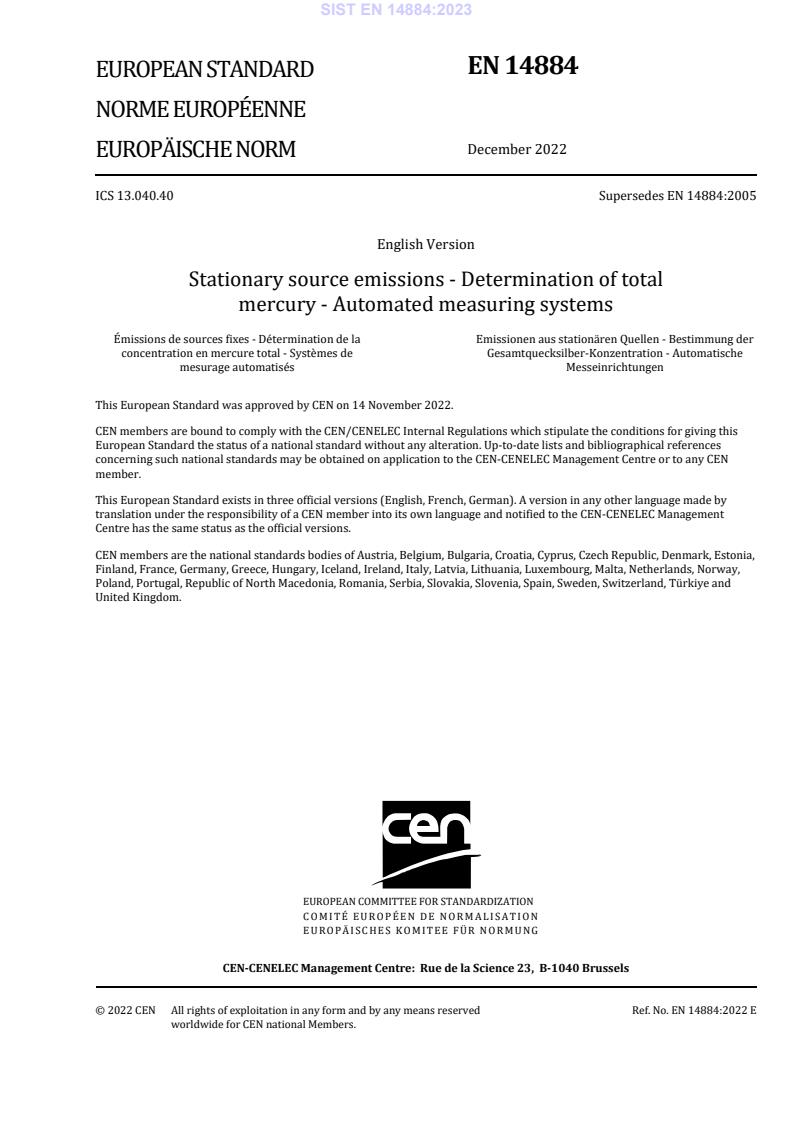
EN 14884
EUROPEAN STANDARD
NORME EUROPÉENNE
December 2022
EUROPÄISCHE NORM
ICS 13.040.40 Supersedes EN 14884:2005
English Version
Stationary source emissions - Determination of total
mercury - Automated measuring systems
Émissions de sources fixes - Détermination de la Emissionen aus stationären Quellen - Bestimmung der
concentration en mercure total - Systèmes de Gesamtquecksilber-Konzentration - Automatische
mesurage automatisés Messeinrichtungen
This European Standard was approved by CEN on 14 November 2022.
CEN members are bound to comply with the CEN/CENELEC Internal Regulations which stipulate the conditions for giving this
European Standard the status of a national standard without any alteration. Up-to-date lists and bibliographical references
concerning such national standards may be obtained on application to the CEN-CENELEC Management Centre or to any CEN
member.
This European Standard exists in three official versions (English, French, German). A version in any other language made by
translation under the responsibility of a CEN member into its own language and notified to the CEN-CENELEC Management
Centre has the same status as the official versions.
CEN members are the national standards bodies of Austria, Belgium, Bulgaria, Croatia, Cyprus, Czech Republic, Denmark, Estonia,
Finland, France, Germany, Greece, Hungary, Iceland, Ireland, Italy, Latvia, Lithuania, Luxembourg, Malta, Netherlands, Norway,
Poland, Portugal, Republic of North Macedonia, Romania, Serbia, Slovakia, Slovenia, Spain, Sweden, Switzerland, Türkiye and
United Kingdom.
EUROPEAN COMMITTEE FOR STANDARDIZATION
COMITÉ EUROPÉEN DE NORMALISATION
EUROPÄISCHES KOMITEE FÜR NORMUNG
CEN-CENELEC Management Centre: Rue de la Science 23, B-1040 Brussels
© 2022 CEN All rights of exploitation in any form and by any means reserved Ref. No. EN 14884:2022 E
worldwide for CEN national Members.
Contents Page
European foreword . 4
Introduction . 5
1 Scope . 6
2 Normative references . 6
3 Terms and definitions . 6
4 Symbols and abbreviations . 6
4.1 Symbols . 6
4.2 Abbreviations . 7
5 Principle . 8
6 Calibration and validation of the AMS (QAL2) . 8
6.1 General . 8
6.2 Functional test . 9
6.2.1 General . 9
6.2.2 Zero and span check (EN 14181:2014, A.7) . 9
6.2.3 Linearity test (EN 14181:2014, A.8 and Annex B) . 10
6.2.4 Response time (EN 14181:2014, A.11) . 10
6.2.5 Converter efficiency . 10
6.3 Parallel measurements with the SRM . 10
6.4 Data evaluation . 11
6.4.1 Preparation of data. 11
6.4.2 Selection of data points from automated SRM . 11
6.4.3 Establishing the calibration function . 11
6.5 Calibration function of the AMS and its validity . 11
6.6 Calculation of variability . 11
6.7 Test of variability . 12
6.8 QAL2 report . 12
7 Ongoing quality assurance during operation (QAL3) . 12
8 Annual Surveillance Test (AST) . 12
9 Documentation . 12
Annex A (informative) Example of calculation of the calibration function and of the
variability test . 13
A.1 General . 13
A.2 Data evaluation . 13
A.2.1 General . 13
A.2.2 Calculation of measured values of the SRM at standard conditions . 15
A.2.3 Calibration function . 16
A.2.4 Calibrated values of AMS . 18
A.2.5 Conversion of data to standard conditions . 19
A.2.6 Valid calibration range . 20
A.2.7 Test of variability . 21
Annex B (informative) Significant technical changes . 24
Bibliography . 25
European foreword
This document (EN 14884:2022) has been prepared by Technical Committee CEN/TC 264 “Air quality”,
the secretariat of which is held by DIN.
This European Standard shall be given the status of a national standard, either by publication of an
identical text or by endorsement, at the latest by June 2023, and conflicting national standards shall be
withdrawn at the latest by June 2023.
Attention is drawn to the possibility that some of the elements of this document may be the subject of
patent rights. CEN shall not be held responsible for identifying any or all such patent rights.
This document supersedes EN 14884:2005.
Annex B provides details of significant technical changes between this document and the previous
edition.
This document has been prepared under a Standardization Request given to CEN by the European
Commission and the European Free Trade Association.
Any feedback and questions on this document should be directed to the users’ national standards body.
A complete listing of these bodies can be found on the CEN website.
According to the CEN-CENELEC Internal Regulations, the national standards organisations of the
following countries are bound to implement this European Standard: Austria, Belgium, Bulgaria, Croatia,
Cyprus, Czech Republic, Denmark, Estonia, Finland, France, Germany, Greece, Hungary, Iceland, Ireland,
Italy, Latvia, Lithuania, Luxembourg, Malta, Netherlands, Norway, Poland, Portugal, Republic of North
Macedonia, Romania, Serbia, Slovakia, Slovenia, Spain, Sweden, Switzerland, Türkiye and the United
Kingdom.
Introduction
This document describes the quality assurance procedures related to automated measuring systems
(AMS) for the determination of total mercury in waste gas, in order to meet the uncertainty requirements
on measured values given by regulations, e.g. EU Directives [1], national or other legislation.
This document is derived from EN 14181, which specifies general procedures for establishing quality
assurance levels (QAL) for AMS installed on industrial plants for the determination of the flue gas
components and other flue gas parameters. It amends EN 14181 and provides guidance specific to total
mercury measurements. It is only applicable in conjunction with EN 14181.
The calibration and validation of mercury AMS that measure the total vapour phase mercury content is
based on parallel measurements with the manual method described in EN 13211. The species of mercury
0 2+
(elemental Hg and oxidized Hg ) and the physical occurrence (gaseous, dust-bound or within droplets)
can vary significantly depending on the type of process to be monitored and this is taken into account
when implementing the SRM.
1 Scope
This document specifies requirements for the calibration and validation (QAL2), the ongoing quality
assurance during operation (QAL3) and the annual surveillance test (AST) of AMS used for monitoring
total mercury emissions from stationary sources to demonstrate compliance with an emission limit value
(ELV). This document is derived from EN 14181 and is only applicable in conjunction with EN 14181.
This document is applicable by direct correlation with the standard reference method (SRM) described
in EN 13211.
2 Normative references
The following documents are referred to in the text in such a way that some or all of their content
constitutes requirements of this document. For dated references, only the edition cited applies. For
undated references, the latest edition of the referenced document (including any amendments) applies.
EN 13211, Air quality — Stationary source emissions — Manual method of determination of the
concentration of total mercury
EN 14181:2014, Stationary source emissions — Quality assurance of automated measuring systems
EN 17255-1, Stationary source emissions — Data acquisition and handling systems — Part 1: Specification
of requirements for the handling and reporting of data
3 Terms and definitions
For the purposes of this document, the terms and definitions given in EN 13211 and EN 14181 apply.
ISO and IEC maintain terminology databases for use in standardization at the following addresses:
• ISO Online browsing platform: available at https://www.iso.org/obp
• IEC Electropedia: available at https://www.electropedia.org/
4 Symbols and abbreviations
4.1 Symbols
a intercept of the calibration function
ˆ
best estimate of a
a
b slope of the calibration function
ˆ
best estimate of
b
b
D difference between SRM value, y and calibrated AMS value ŷ
i i i
average of D
D
i
E emission limit value
h water vapour content (by volume)
i counter
N number of paired samples in parallel measurements
k test value for variability
v
o oxygen content in dry gas (by volume)
o oxygen reference value
s
p gauge pressure
P percentage
standard deviation of the differences D in parallel measurements
s
i
D
t Celsius temperature
t response time
total measurement cycle time of AMS with pre-concentration
t
cycle
t sample period of AMS with pre-concentration
sample
U maximum permissible expanded uncertainty
max
th
i AMS measured signal at AMS measuring conditions
x
i
x average of AMS measured signals
th
i SRM measured value
y
i
y average of SRM measured values
th
i SRM measured value at standard conditions
y
i,s
SRM measured value at standard conditions
y
s
lowest SRM measured value at standard conditions
y
s,min
highest SRM measured value at standard conditions
y
s,max
ˆ
y best estimate for the “true value”, calculated from the AMS measured signal x by means
i i
of the calibration function
ˆ
y best estimate for the “true value”, calculated from the AMS measured signal x by means
i,s i
of the calibration function at standard conditions
difference between the maximum and minimum SRM measured value at standard
∆ y
max
conditions
Z
i
check value Grubbs-Test
Z
crit
critical limit – Grubbs-Test
σ standard deviation associated with the uncertainty derived from requirements of
legislation
4.2 Abbreviations
AMS automated measuring system
AST annual surveillance test
DAHS data acquisition and handling system
ELV emission limit value
QAL quality assurance level
QAL1 first quality assurance level
QAL2 second quality assurance level
QAL3 third quality assurance level
SRM standard reference method
5 Principle
The AMS measures total gaseous mercury, both elemental and oxidized, requiring a converter to reduce
oxidized Hg into elemental Hg prior to measurement of total Hg. Mercury compounds are reactive and
can be adsorbed onto particulate deposits within the sampling system. Therefore, the sample is often
diluted with nitrogen or air in order to aid sample transport and reduce cross-interferences from other
gas components within the flue gas matrix. The Hg AMS are capable of measuring the total concentration
in μg/m and reporting the undiluted vapour phase Hg, regardless of speciation. The
sampling system is heated in order to minimize mercury chloride adsorption.
NOTE AMS often report Hg concentration on a wet basis, i.e. the water vapour from the process sample is
retained within the sample. The water content is then required in order to correct the Hg concentration to dry
reference conditions. If the water content is not measured by any of the installed AMS, the use of a calculated water
content is acceptable as described in CEN/TS 17286 [2].
The general principles of quality assurance of AMS are laid down in EN 14181. These are applied within
this standard with the amendments specific to mercury AMS being specified in the subsequent Clauses.
In this context, an AMS is any system that continuously samples the mercury content of flue gas. This may
be a system that continuously analyses for mercury, typically producing a one-minute average
concentration that is based on discrete or time-integrated data sampling. Alternatively, this may be a
system that pre-concentrates the mercury in the flue gas, prior to analysis, within a gold accumulator for
example, with a measurement cycle of typically 2 to 10 min duration. Dual accumulators are then typically
used to provide continuous sampling and analysis.
Long-term sampling systems involve continuous, repetitive flue gas sampling using paired sorbent traps,
located within the flue gas duct, for mercury capture, with subsequent trap analysis of the time-integrated
samples. Long term sampling is typically from one day to two weeks sampling duration. The type testing,
functional tests and general quality assurance requirements, applicable to long-term sampling systems,
are specified in CEN/TS 17286 [2]. However, these systems also require QAL2 calibration according to
EN 14181 and this standard, except for the functional tests (EN 14181:2014, 6.2 and 8.2). Alternative
functional tests and quality assurance procedures are specified in CEN/TS 17286 [2].
6 Calibration and validation of the AMS (QAL2)
6.1 General
The AMS shall be calibrated and validated in accordance with EN 14181 with the modifications specified
in 6.2 to 6.8 of this standard. Unless otherwise specified by regulation, the maximum permissible
uncertainty is specified as 40 % of the daily ELV. EN 14181 specifies that the daily ELV, is used for quality
assurance purposes.
However, for mercury a lower long term ELV, e.g. an annual ELV, may be specified. If this long term ELV
is less than 50 % of the daily ELV, then the long-term ELV shall be used instead of the daily ELV, for all
quality assurance assessments. However, a multiple of the longer term ELV may be used for quality
assurance purposes if this is agreed with the competent authority, for example, if this is required due to
more variable mercury emissions during QAL2 testing.
NOTE Annex A shows an example of the application of QAL2 for an AMS.
6.2 Functional test
6.2.1 General
Functional tests are performed to ensure that the AMS is working according to the specifications and to
check the active measurement components of the AMS to ensure that they are not unduly influenced by
contamination. The functional tests shall be carried out in accordance with EN 14181:2014, Annex A,
with the modifications specified below. Both elemental and oxidized reference materials may be used for
the functional tests, noting that only oxidized reference material (e.g. HgCl ) is used for the converter
efficiency test. The manufacturers’ operating instructions for the reference material generators shall be
followed, ensuring that a sufficient flow of reference material is used to avoid simultaneous entrainment
of flue gas into the probe. The uncertainty of the reference materials shall be assessed and reported by
the test laboratory. The functional test shall be performed by an experienced testing laboratory, which
has been recognized by the competent authority. The independent reference material generators shall be
traceable to national standards.
NOTE Protocols for the certification of both elemental and oxidized mercury generators are under
development within the ‘European Metrology Programme for Innovation and Research (EMPIR) project 19NRM03
SI-Hg’. This project is also assessing the stability of mercury containing solutions that are used within the
generators. Until further guidance can be provided, these aspects continue to be addressed by the quality assurance
procedures of the accredited test laboratory. Analytical traceability is normally established using certified reference
materials such as NIST 3133 and NIST 3177.
All functional tests shall be performed by passing gaseous reference material through the entire AMS,
including the filter, dilution system (if applicable), sample line, and the oxidized mercury conversion
system. In the case of older AMS, when it is not possible to introduce reference material upstream of the
sample filter, then elements of the sampling system may need to be bypassed in which case the test
laboratory shall report a non-conformance with this document.
In the case of oxidized mercury, a reference material containing water vapour is typically specified in
order to minimize mercury losses and hold-up within the sampling system. Care should be taken to
volume correct the reference mercury concentration to take account of the injected water vapour
concentration which should ideally be held constant. If mercury chloride solutions are used within an
oxidized mercury generator supplied by the test laboratory then the stability of those solutions should
be checked by the test laboratory.
6.2.2 Zero and span check (EN 14181:2014, A.7)
Elemental mercury shall be used for the independent span check provided that the reference material
generator used by the test laboratory is calibrated with metrological traceability to the SI units.
NOTE Calibration according to EN ISO 17025 [3] demonstrates traceability to SI units.
Zero and span checks shall be performed by passing gaseous reference material through the entire AMS.
The selected span concentration shall be no higher
...
EN 14884:2022は、固定発生源からの全水銀排出量を監視するための自動測定システム(AMS)のキャリブレーションとバリデーション(QAL2)、運用中の継続的な品質保証(QAL3)、および年次監視テスト(AST)に関する要件を定めています。この文書は、EN 14181から派生しており、標準参照法(SRM)であるEN 13211と直接関連して適用されます。 この標準の強みは、全水銀排出量に関する明確なガイドラインを提供することにあります。特に、排出限度値(ELV)との遵守を証明するために必要な測定精度を保証するための適切な手順が確立されています。また、QAL2およびQAL3のプロセスは、測定システムの信頼性を確保し、運用中の安定性を維持するためのフレームワークを提供します。年次監視テスト(AST)を通じて、システムの性能を定期的に確認することができるため、長期的な適正維持が可能です。 さらに、この標準は、全水銀の継続的な監視に必要不可欠な、質の高いデータの取得を支援する役割を果たします。これは、環境保護の観点からも極めて重要であり、排出量に関する透明性を向上させ、関連する法律や規制の遵守を助けるのに寄与します。 EN 14884:2022は、特に産業界において環境に対する影響を低減し、持続可能な開発を支援するための基盤を提供します。このように、標準の適用は、環境基準の向上、企業の社会的責任の実現、そして公衆の健康と安全の確保において、極めて重要な役割を果たします。
SIST EN 14884:2023 표준 문서는 고정된 배출원에서의 총 수은 방출을 측정하기 위한 자동 측정 시스템(AMS)의 교정 및 검증 요구사항을 체계적으로 규정하고 있습니다. 이 표준은 QAL2(교정 및 검증), QAL3(운영 중 품질 보증), 그리고 연간 감시 테스트(AST)를 통한 품질 보증의 필수 요소를 명확히 제시하여 신뢰성 높은 수은 배출량 모니터링을 보장합니다. 이 표준의 강점은 신뢰성 있는 측정 방식으로 규정되어 있어, 사용자가 총 수은 방출 한도 값(ELV)을 준수하고 있음을 입증할 수 있는 명확한 기준을 제공한다는 점입니다. EN 14181로부터 파생된 이 문서는 특정한 규정 준수를 요구하는 만큼, 관련 규정과 함께 활용할 경우 더욱 효과적인 성과를 기대할 수 있습니다. 또한, EN 13211에서 설명하는 표준 참조 방법(SRM)과의 직접적인 상관관계로 인해, 이 문서는 기존의 방출 측정 방법과의 일관성을 유지하며, 수은 배출 감시에 대한 공신력을 강화하는 역할을 합니다. 결과적으로, SIST EN 14884:2023 표준은 고정 배출원의 수은 검출 및 관리에 있어 필수적인 문서로 자리 잡고 있으며, 환경 보호 및 공공 안전 측면에서 매우 중요한 역할을 수행합니다.
La norme SIST EN 14884:2023, intitulée "Émissions des sources fixes - Détermination du mercure total - Systèmes de mesure automatisés", constitue un document essentiel pour la gestion des émissions de mercure dans les installations industrielles. Son champ d'application repose sur des exigences claires concernant la calibration et la validation des systèmes de mesure automatisés (AMS) afin de garantir la conformité avec les valeurs limites d'émission (ELV) de mercure. Un des points forts de cette norme est sa double approche de qualité : la première concerne la validation et la calibration initiale (QAL2), et la seconde se concentre sur l'assurance qualité continue pendant l'exploitation (QAL3). Cela garantit non seulement que les systèmes fonctionnent correctement dès le départ, mais aussi qu'ils maintiennent des performances optimales tout au long de leur utilisation. En outre, l'exigence d'un test de surveillance annuel (AST) renforce encore la fiabilité des mesures effectuées, ce qui est crucial pour la protection de l'environnement et la santé publique. Pertinente dans le contexte actuel des préoccupations environnementales, la norme SIST EN 14884:2023 est particulièrement significative pour les industries soumises à des réglementations strictes sur les émissions de polluants. La corrélation directe avec la méthode de référence standard (SRM) décrite dans EN 13211 renforce la validité des résultats obtenus par les AMS, ce qui constitue un atout indéniable pour les établissements cherchant à prouver leur conformité vis-à-vis des normes environnementales. Enfin, en tant que document dérivé de la norme EN 14181 et applicable uniquement en conjonction avec celle-ci, la norme SIST EN 14884:2023 assure une cohérence harmonieuse dans les procédures de mesure et de contrôle des émissions de mercure, facilitant ainsi l'adoption par les établissements concernés.
The EN 14884:2022 standard presents a comprehensive framework for the evaluation of total mercury emissions from stationary sources through automated measuring systems (AMS). Its primary scope revolves around establishing clear protocols for calibration and validation (QAL2), continuous quality assurance during operation (QAL3), and annual surveillance testing (AST). This thorough approach ensures that emissions are monitored effectively, providing users with the necessary guidelines to demonstrate compliance with emission limit values (ELVs). One of the key strengths of this standard is its alignment with the existing framework provided by EN 14181. It underscores the importance of integrating the AMS with established reference methods, particularly emphasizing the direct correlation with the standard reference method detailed in EN 13211. This interconnection reinforces the reliability and accuracy of the measurements, making it a crucial resource for those managing emissions of total mercury. The relevance of EN 14884:2022 cannot be overstated in today's regulatory environment, where stringent control over mercury emissions is increasingly critical. By facilitating standardization in monitoring practices, it supports entities in achieving compliance while promoting environmental protection. The emphasis on ongoing quality assurance and thorough testing contributes significantly to the credibility and trustworthiness of the emission data, ultimately aiding in informed decision-making by regulatory bodies and industry stakeholders alike. Overall, EN 14884:2022 stands as an essential document for organizations involved in emissions monitoring, ensuring that methodologies are not only effective but also adhere to the highest standards of quality assurance and compliance.
Die Norm EN 14884:2022 behandelt die Emissionen von stationären Quellen und ermöglicht eine präzise Bestimmung von Gesamthg (Gesamtquecksilber) mittels automatisierter Messsysteme (AMS). Der Umfang dieser Norm umfasst wesentliche Anforderungen an die Kalibrierung und Validierung (QAL2) sowie an die kontinuierliche Qualitätssicherung während des Betriebs (QAL3) und die jährliche Überwachung (AST) der verwendeten AMS. Diese Anforderungen gewährleisten nicht nur die Zuverlässigkeit, sondern auch die Genauigkeit der Messungen, die für die Überwachung der Einhaltung von Emissionsgrenzwerten (ELV) entscheidend sind. Ein wesentlicher Vorteil der EN 14884:2022 ist ihre klare Ableitung von der Norm EN 14181, welche die Rahmenbedingungen für die Qualitätssicherung und -bewertung von Messsystemen festlegt. Die integrierte Beziehung zu der Standardreferenzmethode (SRM), die in der EN 13211 beschrieben ist, verstärkt die Relevanz dieser Norm und stellt sicher, dass die Errichtung und der Betrieb von AMS auf internationalen Standards basieren. Die Norm fördert mit ihren definierten Anforderungen die Harmonisierung der Verfahren zur Messung von Quecksilberemissionen und unterstützt so die Industrie und die Regulierungsbehörden dabei, umweltfreundliche Praktiken zu implementieren. Darüber hinaus trägt sie dazu bei, die wesentlichen Anforderungen an die Überwachung im Einklang mit den rechtlichen Vorgaben effizient zu erfüllen. Insgesamt positioniert sich die EN 14884:2022 als unverzichtbares Dokument für die Qualitätssicherung und -kontrolle in der Messung von stationären Emissionen, insbesondere in Bezug auf Gesamthg, und unterstreicht die Notwendigkeit und Wichtigkeit von robusten, automatisierten Messsystemen in der heutigen industriellen Praxis.
Questions, Comments and Discussion
Ask us and Technical Secretary will try to provide an answer. You can facilitate discussion about the standard in here.
Loading comments...