

EN 13674-1:2003
(Main)Railway applications - Track - Rail - Part 1: Vignole railway rails 46 kg/m and above
- Abstract
This European Standard specifies Vignole railway rails of 46 kg/m and greater linear mass, for general and high speed railway track usage.
Seven pearlitic steel grades are specified covering a hardness range of 200 to 390 HBW and include non heat treated carbon manganese steels; non heat treated alloy steels; and heat treated carbon manganese and low alloy steels.
There are 21 rail profiles specified in this Standard.
Two classes of rail straightness are specified, differing in requirements for straightness, surface flatness and crown profile. Two classes of profile tolerances are specified.
- Status
- Withdrawn
- Publication Date
- 23-Sep-2003
- Withdrawal Date
- 31-Oct-2007
- Technical Committee
- CEN/TC 256 - Railway applications
- Drafting Committee
- CEN/TC 256/SC 1/WG 4 - Rails
- Current Stage
- 9960 - Withdrawal effective - Withdrawal
- Start Date
- 01-Nov-2007
- Completion Date
- 01-Nov-2007
96/48/EC - Interoperability of the trans-European high-speed rail systemOJ Ref: C, C 68 OJ Date: 21-Mar-2006

Relations
- Effective Date
- 18-Jan-2023
- Effective Date
- 09-Feb-2026
- Effective Date
- 09-Feb-2026
- Effective Date
- 09-Feb-2026
- Effective Date
- 09-Feb-2026
- Effective Date
- 28-Jan-2026
- Effective Date
- 28-Jan-2026
- Effective Date
- 28-Jan-2026
Get Certified
Connect with accredited certification bodies for this standard

IRIS Certification (UNIFE)
International Railway Industry Standard certification.

TÜV SÜD Rail GmbH
TÜV SÜD railway certification services.

Bureau Veritas Railway Certification
Railway and transportation certification.
Sponsored listings
Frequently Asked Questions
EN 13674-1:2003 is a standard published by the European Committee for Standardization (CEN). Its full title is "Railway applications - Track - Rail - Part 1: Vignole railway rails 46 kg/m and above". This standard covers: This European Standard specifies Vignole railway rails of 46 kg/m and greater linear mass, for general and high speed railway track usage. Seven pearlitic steel grades are specified covering a hardness range of 200 to 390 HBW and include non heat treated carbon manganese steels; non heat treated alloy steels; and heat treated carbon manganese and low alloy steels. There are 21 rail profiles specified in this Standard. Two classes of rail straightness are specified, differing in requirements for straightness, surface flatness and crown profile. Two classes of profile tolerances are specified.
This European Standard specifies Vignole railway rails of 46 kg/m and greater linear mass, for general and high speed railway track usage. Seven pearlitic steel grades are specified covering a hardness range of 200 to 390 HBW and include non heat treated carbon manganese steels; non heat treated alloy steels; and heat treated carbon manganese and low alloy steels. There are 21 rail profiles specified in this Standard. Two classes of rail straightness are specified, differing in requirements for straightness, surface flatness and crown profile. Two classes of profile tolerances are specified.
EN 13674-1:2003 is classified under the following ICS (International Classification for Standards) categories: 45.080 - Rails and railway components. The ICS classification helps identify the subject area and facilitates finding related standards.
EN 13674-1:2003 has the following relationships with other standards: It is inter standard links to EN 13674-1:2003+A1:2007, EN 60728-1-2:2009, EN 60728-1-1:2010, EN 60728-1:2008, EN 60728-5:2008, ENV 13481-6:2002, EN 13674-4:2006+A1:2009, EN 13674-2:2006+A1:2010. Understanding these relationships helps ensure you are using the most current and applicable version of the standard.
EN 13674-1:2003 is associated with the following European legislation: EU Directives/Regulations: 93/38/EEC, 96/48/EC; Standardization Mandates: M/024, M/275. When a standard is cited in the Official Journal of the European Union, products manufactured in conformity with it benefit from a presumption of conformity with the essential requirements of the corresponding EU directive or regulation.
EN 13674-1:2003 is available in PDF format for immediate download after purchase. The document can be added to your cart and obtained through the secure checkout process. Digital delivery ensures instant access to the complete standard document.
Standards Content (Sample)
2003-01.Slovenski inštitut za standardizacijo. Razmnoževanje celote ali delov tega standarda ni dovoljeno.Bahnanwendungen - Oberbau - Schienen - Teil 1: Vignolschienen ab 46 kg/mApplications ferroviaires - Voie - Rails - Partie 1: Rails vignole de masse supérieure ou égale a 46 kg/mRailway applications - Track - Rail - Part 1: Vignole railway rails 46 kg/m and above45.080Rails and railway componentsICS:Ta slovenski standard je istoveten z:EN 13674-1:2003SIST EN 13674-1:2004en01-junij-2004SIST EN 13674-1:2004SLOVENSKI
STANDARD
EUROPEAN STANDARDNORME EUROPÉENNEEUROPÄISCHE NORMEN 13674-1September 2003ICS 45.080English versionRailway applications - Track - Rail - Part 1: Vignole railway rails46 kg/m and aboveApplications ferroviaires - Voie - Rails - Partie 1: Railsvignole de masse supérieure ou égale à 46 kg/mBahnanwendungen - Oberbau - Schienen - Teil 1:Vignolschienen ab 46 kg/mThis European Standard was approved by CEN on 28 February 2003.CEN members are bound to comply with the CEN/CENELEC Internal Regulations which stipulate the conditions for giving this EuropeanStandard the status of a national standard without any alteration. Up-to-date lists and bibliographical references concerning such nationalstandards may be obtained on application to the Management Centre or to any CEN member.This European Standard exists in three official versions (English, French, German). A version in any other language made by translationunder the responsibility of a CEN member into its own language and notified to the Management Centre has the same status as the officialversions.CEN members are the national standards bodies of Austria, Belgium, Czech Republic, Denmark, Finland, France, Germany, Greece,Hungary, Iceland, Ireland, Italy, Luxembourg, Malta, Netherlands, Norway, Portugal, Slovakia, Spain, Sweden, Switzerland and UnitedKingdom.EUROPEAN COMMITTEE FOR STANDARDIZATIONCOMITÉ EUROPÉEN DE NORMALISATIONEUROPÄISCHES KOMITEE FÜR NORMUNGManagement Centre: rue de Stassart, 36
B-1050 Brussels© 2003 CENAll rights of exploitation in any form and by any means reservedworldwide for CEN national Members.Ref. No. EN 13674-1:2003 ESIST EN 13674-1:2004
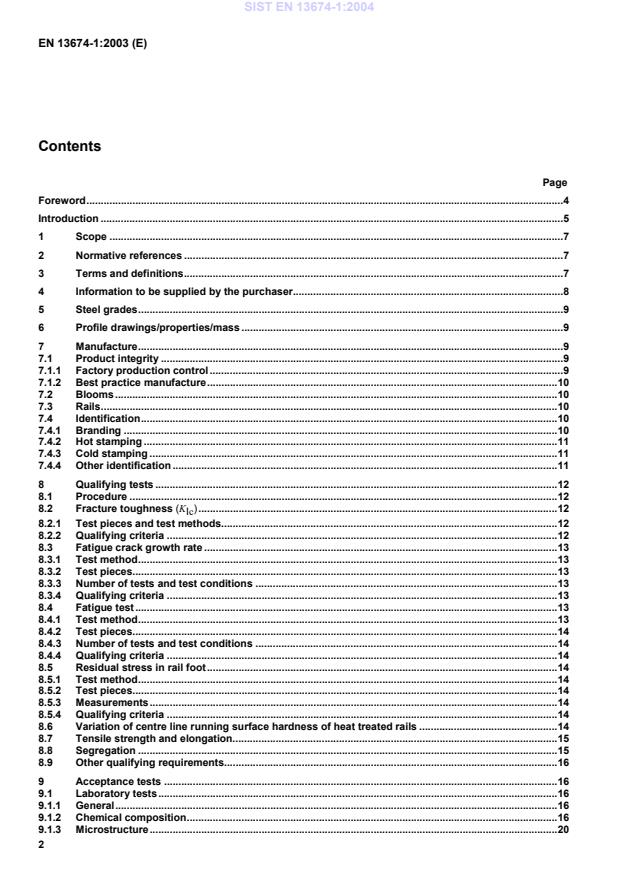
Rail profiles.44Annex B (normative)
Standard test method for the determination of the plane strain fracturetoughness (KIc) of rails.68Annex C (normative)
Method for the determination of rail foot surface longitudinal residual stresses.74Annex D (normative)
Limiting sulfur prints.77Annex E (normative)
Profile and drilling gauges.91Annex F (informative)
Comparison of steel designations referred to in this standard compared tothose in EN 10027-1 and EN 10027-2.104Annex ZA (informative)
Clauses of this European Standard addressing essential requirements or otherprovisions of EU Directives.105Bibliography.106SIST EN 13674-1:2004
The equipment specified is thatwhich gives the best probability of achieving the required product for use in track.
In the future new technology canadd to, but preferably will reduce or delete such items.Examples of areas where the technological state of the art renders the standard less than complete include: oxide/oxygen relationships; hydrogen test techniques; roller straightening effects on residual stresses; roller straightening effects on contact scrub; measurement and effect of residual stresses throughout the rail.SIST EN 13674-1:2004
106 cycles.NOTELife is defined as the complete separation of the specimen.8.5 Residual stress in rail foot8.5.1 Test methodThe residual stresses in the rail foot shall be determined in accordance with annex C.8.5.2 Test piecesEach of the 6 test pieces from the rail section shall be 1 m in length and shall be taken from rails as described in8.1.3 and 8.1.5.NOTEOnly a small part of the test piece will be destroyed for the purpose of measuring residual stress; the remaindercan be used for other qualifying approval tests.8.5.3 MeasurementsLongitudinal residual stress determinations shall be made on the rail foot of each of the 6 test pieces described in8.5.2. The location of the measurements is shown in Figure C.1.If data are available for straightness class A rails then class B rails of the same profile need not be tested.8.5.4 Qualifying criteriaThe maximum longitudinal residual stress in the foot shall be 250 MPa for all steel grades.8.6 Variation of centre line running surface hardness of heat treated railsThis clause only applies to heat treated rails.For the longest length of rail produced by the manufacturer, a one metre length of rail shall be taken from each endand at 20 m intervals from one end of the rail. These shall be hardness tested (HBW) in accordance withEN ISO 6506-1 along their length at 25 mm intervals on the centreline of the running surface after 0,5 mm hasbeen ground away. The hardness results shall be no more than
15 HBW from the mean result obtained.SIST EN 13674-1:2004
...