

EN 14543:2005+A1:2007
(Main + Amendment)Specification for dedicated liquefied petroleum gas appliances - Parasol patio heaters - Flueless radiant heaters for outdoor or amply ventilated area use
- Abstract
This European standard specifies the design, safety and marking requirements and test methods for flueless patio heaters for outdoor or amply ventilated area use only.
Although they are not covered by this standard, the requirements of this standard are applicable to appliances that may be used inside habitations which, in addition, shall have a heat input not exceeding 4,2 kW and comply with EN 449.
These appliances are for use exclusively with gases of the third family as defined in Clause 4.
This European standard applies to appliances that have a nominal heat input not exceeding 17 kW (based on the gross calorific value);
- fixed or,
- movable, including those which comprise a housing for a transportable and rechargeable liquefied petroleum gas cylinder.
This European standard does not apply to appliances equipped with a fan for either combustion or circulation of the convection air.
This European standard does not cover LPG containers for liquefied petroleum gas, neither their associated regulator nor tubing and flexible hoses which shall comply with national requirements in force.
This European standard does not lay down any specific requirements for the thermal efficiency of this type of appliances, but the requirements relating to combustion, which is a safety matter, ensure that the gas fuel will burn efficiently. However a method to measure the performance is described in informative Annex C.
This standard does not apply to appliances covered by EN 416-1, EN 419-1, EN 449, EN 461 and EN 521.
This European standard only covers type testing.
Items relating to quality assurance systems, production testing and particularly certificates of conformity of auxiliary equipment are not covered by this European standard.
- Status
- Withdrawn
- Publication Date
- 12-Jun-2007
- Withdrawal Date
- 06-Oct-2026
- Technical Committee
- CEN/TC 181 - Dedicated liquified petroleum gas appliances
- Drafting Committee
- CEN/TC 181/WG 1 - Flueless space heaters
- Current Stage
- 9960 - Withdrawal effective - Withdrawal
- Start Date
- 12-Jul-2017
- Completion Date
- 07-Oct-2026
- Directive
- 2009/142/EC - Appliances burning gaseous fuelsOJ Ref: C, C 349 OJ Date: 22-Dec-2010
90/396/EEC - Appliances burning gaseous fuelsOJ Ref: C, C 328 OJ Date: 23-Dec-2008



Relations
- Effective Date
- 19-Jan-2023
- Effective Date
- 18-Jan-2023
- Effective Date
- 19-Jul-2017
- Effective Date
- 25-Aug-2026
- Effective Date
- 09-Feb-2026
- Effective Date
- 09-Feb-2026
- Effective Date
- 28-Jan-2026
- Effective Date
- 28-Jan-2026
- Effective Date
- 28-Jan-2026
- Effective Date
- 28-Jan-2026
- Effective Date
- 28-Jan-2026
- Effective Date
- 28-Jan-2026
- Effective Date
- 28-Jan-2026
- Effective Date
- 28-Jan-2026
- Effective Date
- 28-Jan-2026
Frequently Asked Questions
EN 14543:2005+A1:2007 is a standard published by the European Committee for Standardization (CEN). Its full title is "Specification for dedicated liquefied petroleum gas appliances - Parasol patio heaters - Flueless radiant heaters for outdoor or amply ventilated area use". This standard covers: This European standard specifies the design, safety and marking requirements and test methods for flueless patio heaters for outdoor or amply ventilated area use only. Although they are not covered by this standard, the requirements of this standard are applicable to appliances that may be used inside habitations which, in addition, shall have a heat input not exceeding 4,2 kW and comply with EN 449. These appliances are for use exclusively with gases of the third family as defined in Clause 4. This European standard applies to appliances that have a nominal heat input not exceeding 17 kW (based on the gross calorific value); - fixed or, - movable, including those which comprise a housing for a transportable and rechargeable liquefied petroleum gas cylinder. This European standard does not apply to appliances equipped with a fan for either combustion or circulation of the convection air. This European standard does not cover LPG containers for liquefied petroleum gas, neither their associated regulator nor tubing and flexible hoses which shall comply with national requirements in force. This European standard does not lay down any specific requirements for the thermal efficiency of this type of appliances, but the requirements relating to combustion, which is a safety matter, ensure that the gas fuel will burn efficiently. However a method to measure the performance is described in informative Annex C. This standard does not apply to appliances covered by EN 416-1, EN 419-1, EN 449, EN 461 and EN 521. This European standard only covers type testing. Items relating to quality assurance systems, production testing and particularly certificates of conformity of auxiliary equipment are not covered by this European standard.
This European standard specifies the design, safety and marking requirements and test methods for flueless patio heaters for outdoor or amply ventilated area use only. Although they are not covered by this standard, the requirements of this standard are applicable to appliances that may be used inside habitations which, in addition, shall have a heat input not exceeding 4,2 kW and comply with EN 449. These appliances are for use exclusively with gases of the third family as defined in Clause 4. This European standard applies to appliances that have a nominal heat input not exceeding 17 kW (based on the gross calorific value); - fixed or, - movable, including those which comprise a housing for a transportable and rechargeable liquefied petroleum gas cylinder. This European standard does not apply to appliances equipped with a fan for either combustion or circulation of the convection air. This European standard does not cover LPG containers for liquefied petroleum gas, neither their associated regulator nor tubing and flexible hoses which shall comply with national requirements in force. This European standard does not lay down any specific requirements for the thermal efficiency of this type of appliances, but the requirements relating to combustion, which is a safety matter, ensure that the gas fuel will burn efficiently. However a method to measure the performance is described in informative Annex C. This standard does not apply to appliances covered by EN 416-1, EN 419-1, EN 449, EN 461 and EN 521. This European standard only covers type testing. Items relating to quality assurance systems, production testing and particularly certificates of conformity of auxiliary equipment are not covered by this European standard.
EN 14543:2005+A1:2007 is classified under the following ICS (International Classification for Standards) categories: 97.100.20 - Gas heaters. The ICS classification helps identify the subject area and facilitates finding related standards.
EN 14543:2005+A1:2007 has the following relationships with other standards: It is inter standard links to EN 14543:2005/prA1, EN 14543:2005, EN 14543:2017, ISO 7-1:1994, EN 60335-1:2002, EN IEC 60335-2-102:2024, EN 751-1:1996, EN 449:2002, EN 751-2:1996, EN 125:2022+A1:2024, EN 751-3:2022+A1:2023, EN ISO 228-1:2003, EN 437:2003, EN 257:2022+A1:2023, EN 298:2022. Understanding these relationships helps ensure you are using the most current and applicable version of the standard.
EN 14543:2005+A1:2007 is associated with the following European legislation: EU Directives/Regulations: 2009/142/EC, 90/396/EEC; Standardization Mandates: M/BC/CEN/89/6. When a standard is cited in the Official Journal of the European Union, products manufactured in conformity with it benefit from a presumption of conformity with the essential requirements of the corresponding EU directive or regulation.
EN 14543:2005+A1:2007 is available in PDF format for immediate download after purchase. The document can be added to your cart and obtained through the secure checkout process. Digital delivery ensures instant access to the complete standard document.
Standards Content (Sample)
2003-01.Slovenski inštitut za standardizacijo. Razmnoževanje celote ali delov tega standarda ni dovoljeno.Specification for dedicated liquefied petroleum gas appliances - Parasol patio heaters - Flueless radiant heaters for outdoor or amply ventilated area useSpécifications pour les appareils fonctionnant exclusivement aux gaz de pétrole liquéfiés - Parasols pour chauffage de terrasse - Appareils de chauffage radiants non raccordés utilisés a l'extérieur ou dans des espaces largement ventilésFestlegungen für Flüssiggasgeräte - Terrassen-Schirmheizgeräte - Abzugslose Terrassenheizstrahler zur Verwendung im Freien oder in gut belüfteten RäumenTa slovenski standard je istoveten z:EN 14543:2005+A1:2007SIST EN 14543:2005+A1:2008en,fr,de97.100.20Plinski grelnikiGas heatersICS:SLOVENSKI
STANDARDSIST EN 14543:2005+A1:200801-januar-2008
EUROPEAN STANDARDNORME EUROPÉENNEEUROPÄISCHE NORMEN 14543:2005+A1June 2007ICS 97.100.20 English VersionSpecification for dedicated liquefied petroleum gas appliances -Parasol patio heaters - Flueless radiant heaters for outdoor oramply ventilated area useSpécifications pour les appareils fonctionnantexclusivement aux gaz de pétrole liquéfiés - Parasols pourchauffage de terrasse - Appareils de chauffage radiantsnon raccordés utilisés à l'extérieur ou dans des espaceslargement ventilésFestlegungen für Flüssiggasgeräte - Terrassen-Schirmheizgeräte - Abzugslose Terrassenheizstrahler zurVerwendung im Freien oder in gut belüfteten RäumenThis European Standard was approved by CEN on 27 April 2007.CEN members are bound to comply with the CEN/CENELEC Internal Regulations which stipulate the conditions for giving this EuropeanStandard the status of a national standard without any alteration. Up-to-date lists and bibliographical references concerning such nationalstandards may be obtained on application to the CEN Management Centre or to any CEN member.This European Standard exists in three official versions (English, French, German). A version in any other language made by translationunder the responsibility of a CEN member into its own language and notified to the CEN Management Centre has the same status as theofficial versions.CEN members are the national standards bodies of Austria, Belgium, Bulgaria, Cyprus, Czech Republic, Denmark, Estonia, Finland,France, Germany, Greece, Hungary, Iceland, Ireland, Italy, Latvia, Lithuania, Luxembourg, Malta, Netherlands, Norway, Poland, Portugal,Romania, Slovakia, Slovenia, Spain, Sweden, Switzerland and United Kingdom.EUROPEAN COMMITTEE FOR STANDARDIZATIONCOMITÉ EUROPÉEN DE NORMALISATIONEUROPÄISCHES KOMITEE FÜR NORMUNGManagement Centre: rue de Stassart, 36
B-1050 Brussels© 2007 CENAll rights of exploitation in any form and by any means reservedworldwide for CEN national Members.Ref. No. EN 14543:2005+A1:2007: E
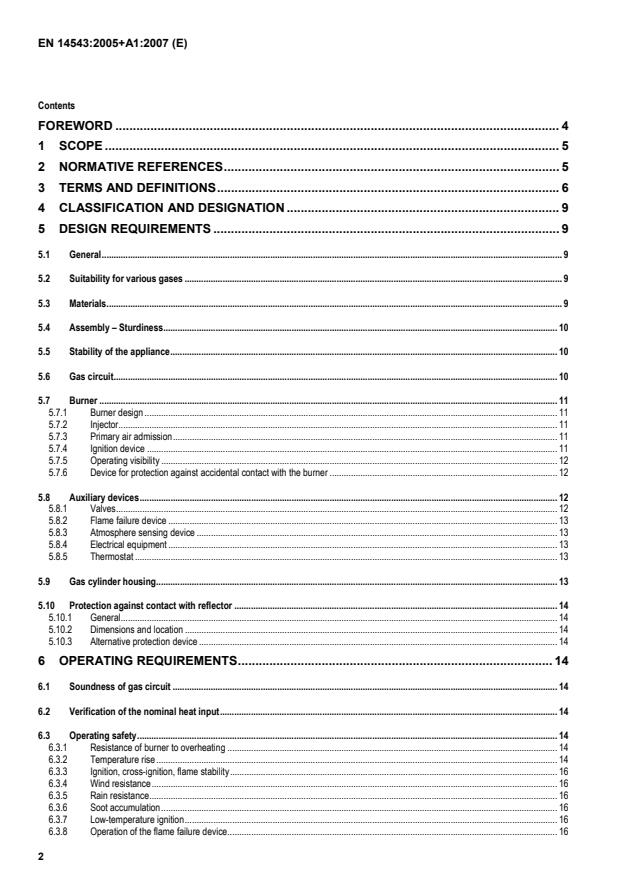
3 6.3.9 Atmosphere sensing device ().16 6.3.10 Electrical safety.17 6.4 Combustion.17 6.5 Performances.17 7 TEST METHODS.17 7.1 Test conditions.17 7.2 Verification of compliance with design requirements.17 7.2.1 Stability of the appliance.17 7.2.2 Protecting against accidental contact with the burner.17 7.3 Verification of compliance with operating requirements.18 7.3.1 Absence of leakage in the gas circuit.18 7.3.2 Heat input.19 7.3.3 Safety of operation.20 7.3.4 Combustion.26 7.3.5 Performances.26 8 MARKING, PACKAGING AND INSTRUCTIONS.27 8.1 General.27 8.2 Marking of the appliance.27 8.3 Marking of the packaging.28 8.4 Installation and operating instructions.28 ANNEX A (NORMATIVE)
SPECIAL NATIONAL CONDITIONS.31 ANNEX B (INFORMATIVE)
LPG CYLINDER FLOW RATE.35 ANNEX C (INFORMATIVE)
PERFORMANCE.36 ANNEX ZA (INFORMATIVE)
CLAUSES OF THIS EUROPEAN STANDARD ADDRESSING ESSENTIAL REQUIREMENTS OR OTHER PROVISIONS OF EU DIRECTIVES.38 BIBLIOGRAPHY.40
1 Scope This European standard specifies the design, safety and marking requirements and test methods for flueless patio heaters for outdoor or amply ventilated area use only. Although they are not covered by this standard, the requirements of this standard are applicable to appliances that may be used inside habitations which, in addition, shall have a heat input not exceeding 4,2 kW and comply with EN 449. These appliances are for use exclusively with gases of the third family as defined in Clause 4. This European standard applies to appliances that have a nominal heat input not exceeding 17 kW (based on the gross calorific value); fixed or, movable, including those which comprise a housing for a transportable and rechargeable liquefied petroleum gas cylinder. This European standard does not apply to appliances equipped with a fan for either combustion or circulation of the convection air. This European standard does not cover LPG containers for liquefied petroleum gas, neither their associated regulator nor tubing and flexible hoses which shall comply with national requirements in force. This European standard does not lay down any specific requirements for the thermal efficiency of this type of appliances, but the requirements relating to combustion, which is a safety matter, ensure that the gas fuel will burn efficiently. However a method to measure the performance is described in informative Annex C. This standard does not apply to appliances covered by EN 416-1, EN 419-1, EN 449, EN 461 and EN 521. This European standard only covers type testing. Items relating to quality assurance systems, production testing and particularly certificates of conformity of auxiliary equipment are not covered by this European standard. 2 Normative references The following referenced documents are indispensable for the application of this document. For dated references, only the edition cited applies. For undated references, the latest edition of the referenced document (including any amendments) applies. EN 125 Flame supervision devices for gas burning appliances – Thermo-electric flame supervision devices EN 126 Multifunctional controls for gas burning appliances EN 161 Automatic shut-off valves for gas burners and gas appliances EN 257 Mechanical thermostats for gas burning appliances
EN 298 Automatic gas burner control systems for gas burners and gas burning appliances with or without fans EN 437:2003 Test gases - Test pressures - Appliance categories EN 449 Specification for dedicated liquefied petroleum gas appliances - Domestic flueless space heaters (including diffusive catalytic combustion heaters)
7 [EN 449:2002] 3.7 injector component part that admits the gas into an aerated burner. There are two types of injectors: calibrated injector: where the section of the outlet orifice is fixed ; adjustable injector: where the section of the outlet orifice is variable [EN 449:2002] 3.8 burner component that allows the gas to burn 3.9 ignition delay time time between the moment when the gas is lit at the pilot (or main burner, if there is no pilot) and that when the flame supervision device acts 3.10 extinction delay time time between the moment when the pilot and burner are extinguished by shutting off the gas supply and the moment when, after restoring the supply, the flow of gas to the appliance ceases through the action of the flame supervision device 3.11 calorific value quantity of heat produced by the complete combustion, at a constant pressure equal to 1 013,25 mbar, of a unit volume or mass of gas, the constituents of the combustible mixture being taken at reference conditions and the products of combustion being brought back to the same conditions A distinction is made between: . the gross calorific value Hs: the water produced by combustion is assumed to be condensed; . the net calorific value Hi: the water produced by combustion is assumed to be in the vapour state NOTE The calorific value is expressed: . either in megajoules per cubic metre (MJ/m3) of dry gas under the reference conditions; . or in megajoules per kilogram (MJ/kg) of dry gas. [EN 437:2003] 3.12 relative density d ratio of the masses of equal volumes of dry gas and dry air under the same conditions of temperature and pressure: 15 °C or 0 °C and 1 013, 25 mbar [EN 437:2003] 3.13 Wobbe index gross Wobbe index Ws; net Wobbe index Wi ratio of the calorific value of a gas per unit volume and the square root of its relative density under the same reference conditions. The Wobbe index is said to be gross or net according to whether the calorific value used is the gross or net calorific value
9 4 Classification and designation The appliances covered by this European Standard belong to 3rd family gas categories defined in 6.1.2.3 of EN 437:2003. For national situations see Annex A. 5 Design requirements 5.1 General Unless otherwise specified, the design requirements shall be verified by examining the appliance and its operating instructions. Depending on their operating height, and according to table 1 the patio heaters: - shall not exceed the nominal heat input stated; - shall be fitted with one or two grids to protect against accidental contact respectively with working surface and/or reflector. For adjustable appliances the minimum operating position shall be considered. Table 1 – Nominal heat input and protection grids relating to the height of the appliance Minimum operating height : h m Maximal nominal heat input kW (Hs) a Grid required to prevent from contact with the working surface a (see 5.7.6) Grid required to prevent from contact with the reflector b (see 5.10) h ≤ 1,3 6 YES YES 1,3
< h ≤ 1,6 10 YES YES 1,6
< h ≤ 2,0 15 YES NO h > 2,0 17 NO NO a
The height h to be considered is the height of the lower rim of the working surface from the ground. b The height h to be considered is the height of the lower rim of the reflector from the ground. NOTE: For appliances to be fixed on a table the height h is the sum of the heights of the table and the appliance.
5.2 Suitability for various gases The appliance shall be delivered for operation with only one category of gas and for only one operating pressure or pressure combination. Operation with another category of gas or pressure or pressure combination shall not be allowed. No provision shall be made for adjusting any part of an appliance which has been pre-set by the manufacturer. 5.3 Materials The quality and thickness of the materials used for the construction of an appliance shall be such that the performances are not impaired during use. In particular, all components of the appliance shall be capable of withstanding any mechanical, chemical and thermal effects to which they may be subjected during use. Under normal operating, cleaning and adjustment conditions, the materials shall not suffer any permanent distortion which could impair proper operation. Metal parts shall be effectively protected against corrosion.
11 Soundness of shut-off devices or threaded elements of the gas circuit shall be ensured by mechanical means (for example, metal seals, O-rings, etc.), i.e. excluding the use of sealing materials in the thread. However, for those parts which do not require dismantling during normal maintenance, for example valves, injectors, the use of suitable sealing materials in the thread conforming with EN 751 serial standards shall be acceptable. Sealing materials according to EN 549 shall not be subject to ageing, nor to any deformation (reduction or increase in volume) likely to impair safety under normal operating conditions. None of the sealing joints in the gas circuit shall be made by soft soldering or any other process in which the lowest temperature of the melting range is below 450 °C. Parts which can be dismantled shall remain leakproof after dismantling and reassembly, and after possible replacement of the seal if specified in the operating instructions. Sealing washers, according to EN 549, and hoses, made of non metallic materials, shall be suitable for their intended use, specially concerning their resistance to LPG and the temperatures encountered during the use of the appliance. Any tube or flexible hose complying with a recognised standard, used under its approved service conditions and according to the national regulations in force may be used. Depending on the various national situations (see Annex A) the end of the supply pipework shall be fitted either with: - a nozzle allowing the connection of a tubing; the nozzle may be fixed or removable; - a fixed or removable cylindrical, smooth and clean part, at least 30 mm long allowing connection by means of a gastight compression fitting; - a thread in accordance with EN ISO 228-1:2003 or ISO 7-1:1994. During normal conditions of use connections shall not come loose unintentionally. Tubing or flexible hose of the length recommended by the manufacturer and connected in accordance with the instructions, shall not come into contact with a part of the appliance whose temperature is higher than that guaranteed by the tubing or flexible hose manufacturer. Disconnection of the internal piping is acceptable for the purpose of assembling or installing the appliance, provided the installation instructions mention the precautions to be taken when performing this operation in particular to ensure that the gas circuit remains leak-proof. 5.7 Burner 5.7.1 Burner design The burner position shall be fixed in relation to the body of the appliance; it shall not be possible to reassemble it in a position other than that intended by the manufacturer. The component materials of the burner shall be such that the burner is not liable to melting, deformation or damage which could impair its normal operation, even after the induced internal combustion test defined in 7.3.3.1. 5.7.2 Injector The injector shall be non adjustable and, if it can be disassembled, shall be marked. 5.7.3 Primary air admission No adjustment of the primary air by the user shall be possible. The primary air admission ports shall be arranged in such a manner that they cannot be accidentally obstructed. 5.7.4 Ignition device The burner or, if fitted, the pilot burner, shall be readily accessible at all times so that it can be safely ignited with a match, even if the appliance is equipped with an automatic ignition device.
13 In the case where a single knob operates a safety device controlling both the burner and the pilot burner, no marking shall be required if improper operation is impossible. In all other cases, the OFF position shall be indicated by a full disc or circle having a minimum diameter of 3 mm. If the controls are actuated by rotation, the OFF position shall be obtained by clockwise rotation when observing the control frontally. 5.8.2 Flame failure device Each appliance shall be fitted with a flame monitoring device complying with EN 125 which controls the supply or interruption thereof to the burner and pilot burner, where fitted. The device shall be designed to ensure that in the event of malfunction of any component essential to its operation, the gas supply to the burner is automatically shut off. The appliance shall not be fitted with any device for permanently overriding, without sustained manual operation, the operation of the flame monitoring device. During ignition, however, temporary supply of gas without the presence of a flame is permitted under the conditions specified in 7.3.3.9. The relative positions of the pilot burner, where fitted, the flame monitoring device and the burner shall be fixed. 5.8.3 Atmosphere sensing device If an atmosphere sensing device, or equivalent, intended to prevent the release of combustion products in a dangerous quantity is fitted on the appliance, it shall comply with 6.3.9. 5.8.4 Electrical equipment The electrical equipment of the appliance shall be so designed and constructed as to obviate hazards of an electrical origin. The appliance shall comply with the requirements of EN 60335-2-102 which cover such hazards.' 5.8.5 Thermostat If fitted with the appliance, any thermostat shall comply with EN 257. 5.9 Gas cylinder housing !When the appliance includes a gas cylinder housing, this shall be designed so as not to allow the use of cylinders in which the nominal gas capacity exceeds 20 kg." The dimensions of the opening and of the inside of the housing shall be sufficient to allow the easy introduction, use and removal of the cylinder fitted with its pressure-reducing regulator.
The gas line from the cylinder to the appliance shall be such as to not impair the correct functioning and the safety of the appliance. The housing shall be designed in such a way that: efficient ventilation is achieved through openings in its lower and upper section; the total surface area of the openings in the upper section being equal to or greater than 1/100 of the base surface area of the housing, and that of the openings in the lower section being equal to or greater than 1/50 of the base surface area of the housing; the gas cylinder receptacle has sufficient mechanical strength to not be distorted by the mass of a full cylinder; a design in which the cylinder rests directly on the ground is not permitted; it does not have a sill extending above the level on which the cylinder rests; the cylinder may be maintained; the cylinder valve is directly accessible and remains easy to operate when the cylinder is in position;
6.3.1 Resistance of burner to overheating When tested according to 7.3.3.1, the various parts of the burner shall not suffer any damage which could impair operation. 6.3.2 Temperature rise 6.3.2.1 Temperature of the various parts of the appliance. When tested according to 7.3.3.2, the temperature of parts likely to be handled shall not exceed ambient temperature by more than: 35 K in the case of metals or equivalent materials; 45 K in the case of ceramics or equivalent materials; 60 K in the case of plastics or equivalent materials.
15 In the same conditions, if the end of the gas inlet can be fitted with a nozzle conforming to the national situations given in Annex A, this nozzle shall be positioned so that its temperature does not exceed the ambient temperature by more than 30 K. When an alternative device to the protective grid of the reflector is fitted (see 5.10.3) and when tested according to 7.3.3.2 not any part of this device shall exceed ambient temperature by more than 80 K. 6.3.2.2 Temperature of the support, walls or adjacent partitions The temperature of the support on which the appliance stands and, in the case of fixed appliances, the temperature of neighbouring walls and, where applicable, ceilings or shelves located above the appliance shall not exceed ambient temperature by more than 50 K when tested according to 7.3.3.2 and in compliance with the minimum distances specified by the manufacturer in the instructions. 6.3.2.3 Temperature of valves and components The temperature of valve bodies and components shall not exceed the value specified by the manufacturer for an ambient temperature of 20 °C, when tested according to 7.3.3.2. 6.3.2.4 Temperature of surfaces in contact with the tubing or the flexible hose The temperatures of the nozzle and other surfaces in contact with the tubing or the flexible hoses shall not exceed the maximum temperature guaranteed by the tubing or flexible hose manufacturer. 6.3.2.5 Overheating of the LPG cylinder When tested according to 7.3.3.3, no overheating of the cylinder shall occur which could result in an increased vapour pressure in excess of the value given in Table 2: after 1 h of operation with all burners lit at maximum flowrate; during the 30 min following complete extinction of the appliance.
°C Butane Propane 15 20 25 0,40 0,45 0,50 1,10 1,17 1,28 NOTE
This increase corresponds to a temperature rise of 5 K above the relevant ambient temperature.
6.3.3 Ignition, cross-ignition, flame stability The burner shall ignite readily when tested according to 7.3.3.4. Cross-ignition shall occur correctly and without undue noise. The operation of the burner shall be stable and without undue noise. A slight tendency to lifting of the flame shall be accepted on ignition, but the flames shall remain stable after one minute of normal operation. 6.3.4 Wind resistance When tested according to 7.3.3.5, the appliance shall not extinguish when subjected to an airflow of 3 m/s. 6.3.5 Rain resistance When tested according to 7.3 3.6 the appliance shall continue to operate safely or shall shut off. The design of the appliance shall be such that, after the rain test, no permanent water accumulation shall be possible, neither in the operational and safety parts likely to be corroded nor in the cylinder housing. The appliance shall be able to restart, eventually assisted by a flame, five minutes after the water supply has been stopped. 6.3.6 Soot accumulation No soot accumulation shall occur which is likely to impair the safe operation of the appliance when tested according to 7.3.3.7. 6.3.7 Low-temperature ignition It shall be possible to light the appliance at 5 °C in test conditions of 7.3.3.8. The design of the burner and a
...