

prEN 12875-5
(Main)Mechanical dishwashing resistance of utensils - Part 5: Rapid test for ceramic catering articles
- Abstract
This European Standard specifies a rapid method for testing the dishwashing resistance of catering articles made of ceramics. It does not define the number of dishwashing cycles that any given product should withstand. The method tests the dishwashing durability of the glaze surface of the ceramic articles.
- Status
- Not Published
- Publication Date
- 07-Aug-2028
- Technical Committee
- CEN/TC 194 - Utensils in contact with food
- Drafting Committee
- CEN/TC 194/WG 9 - Technological suitability testing methods
- Current Stage
- 4010 - Start of draft translation - Enquiry
- Start Date
- 19-Oct-2026
- Completion Date
- 24-Sep-2026

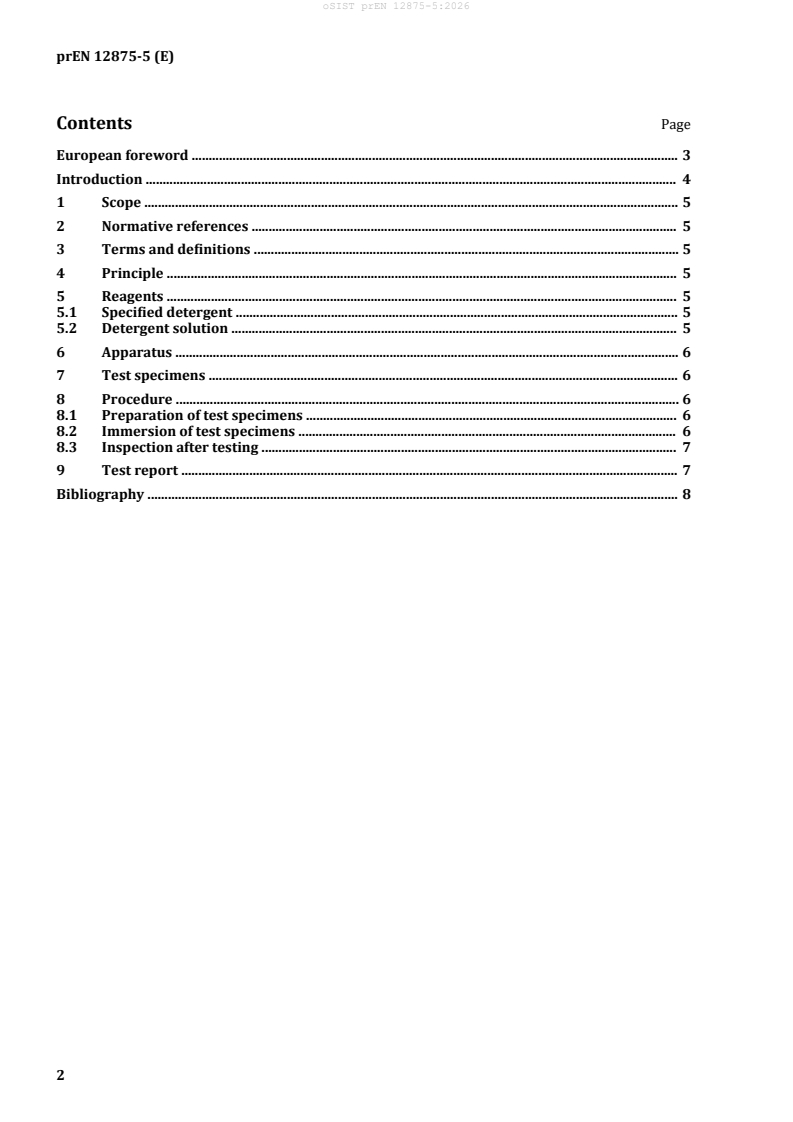
prEN 12875-5 is a CEN draft European Standard for testing the mechanical dishwashing resistance of ceramic catering articles. It specifies a rapid immersion method for checking how the glaze surface of ceramic ware changes after exposure to a hot alkaline detergent, and it is written for laboratories, manufacturers, and others who need to compare ceramic catering articles in a controlled way.
What does prEN 12875-5 specify?
prEN 12875-5 specifies a rapid test method for catering articles made of ceramics. The method is used to judge dishwashing durability of the glaze surface, not to assign a required number of dishwasher cycles for service life.
The document is organized into clauses 1 to 9:
- Scope
- Normative references
- Terms and definitions
- Principle
- Reagents
- Apparatus
- Test specimens
- Procedure
- Test report
It also includes a bibliography. The main technical content is in the principle, reagents, apparatus, procedure, and report clauses.
What are the key requirements of prEN 12875-5?
Principle and test purpose
prEN 12875-5 uses unused specimens that are immersed in a static detergent solution at 75 ± 1 °C for a total of 16 hours. After immersion, the specimens are visually compared with similar untested pieces to identify changes in gloss or colour.
In practice, this means the standard is focused on visible surface attack on the glaze, not on mechanical damage or a full service-life simulation. It is a comparative screening test.
Reagents and solution control
prEN 12875-5 requires a specified liquid detergent with a defined composition, and the test solution is a 2.0 % (w/w) aqueous detergent solution prepared with water of grade 3 as specified in EN ISO 3696:1995. The solution volume must be sufficient so that the total ware surface area to solution volume ratio does not exceed 130 cm²/l.
That matters because the detergent strength, water purity, and loading density affect the severity and repeatability of the test. The note also mentions a 0.3 % (w/w) solution for special applications, but that option is not in accordance with the standard.
Apparatus and temperature control
prEN 12875-5 calls for a stainless steel tank with lid, a rack to keep test items separated and off the tank bottom, a hot water bath that holds the solution at 75 ± 1 °C, a circulating pump, and a temperature monitoring device that records deviations during immersion.
In practice, the setup is meant to keep all specimens under the same chemical and thermal conditions. The standard also warns against contact with materials such as aluminium and zinc, because they can inhibit the alkaline attack being tested.
Test specimens and preparation
prEN 12875-5 requires that each item can be fully immersed, and that at least four identical pieces of ware are available for test. Before testing, surface contamination is removed, and the specimens are visually checked under normal corrected vision from a distance of 30 ± 10 cm.
This preparation step matters because the comparison must be made on specimens of comparable initial quality. One specimen is retained as an untested reference standard for the final comparison.
Immersion, inspection, and reporting
prEN 12875-5 gives a step-by-step immersion procedure: determine surface area, fill the tank, set temperature, add detergent, immerse the specimens in racks, and remove them after 16 h ± 10 min. After rinsing and drying, the specimens are inspected again and any change in gloss or colour is reported using the procedure in prEN 12875-2.
The test report must identify the standard, the specimens, the article description, sampling place and date, receipt and test dates, specimen count, article category according to prEN 12875-2, detergent concentration, average evaluation figures, and any unusual inspection findings.
What changed in prEN 12875-5 from the previous edition?
prEN 12875-5 will supersede EN 12875-5:2006. The foreword states one significant technical change: the references to inspection and evaluation according to prEN 12875-2 have been adjusted.
Which standards are used with prEN 12875-5?
- EN ISO 3696:1995 - provides the water quality specification used to prepare the detergent solution.
- prEN 12875-2 - provides the inspection and evaluation procedure used after testing.
- prEN 12875-2:2026 - the cited edition for inspection and evaluation, including the article category used in the test report.
- EN 12875-1 - the reference multi-cyclic dishwashing test for domestic articles, mentioned in the introduction as the benchmark method behind the series.
What does the prEN 12875-5 document contain?
prEN 12875-5 contains a defined test principle, a detergent specification, apparatus requirements, specimen selection rules, and a detailed immersion procedure. It also describes how to inspect the glazed surface after exposure and how to record the results in the test report.
The document includes practical guidance on temperature control, surface-area-to-volume loading, handling of specimens, and visual examination conditions. It is therefore useful for laboratory testing, product comparison, development work, and reporting of dishwashing resistance for ceramic catering ware.
Relations
- Effective Date
- 08-Apr-2024
Get Certified
Connect with accredited certification bodies for this standard

BSI Group
BSI (British Standards Institution) is the business standards company that helps organizations make excellence a habit.

Bureau Veritas
Bureau Veritas is a world leader in laboratory testing, inspection and certification services.

DNV
DNV is an independent assurance and risk management provider.
Sponsored listings
Frequently Asked Questions
prEN 12875-5 is a draft published by the European Committee for Standardization (CEN). Its full title is "Mechanical dishwashing resistance of utensils - Part 5: Rapid test for ceramic catering articles". This standard covers: This European Standard specifies a rapid method for testing the dishwashing resistance of catering articles made of ceramics. It does not define the number of dishwashing cycles that any given product should withstand. The method tests the dishwashing durability of the glaze surface of the ceramic articles.
This European Standard specifies a rapid method for testing the dishwashing resistance of catering articles made of ceramics. It does not define the number of dishwashing cycles that any given product should withstand. The method tests the dishwashing durability of the glaze surface of the ceramic articles.
prEN 12875-5 is classified under the following ICS (International Classification for Standards) categories: 67.250 - Materials and articles in contact with foodstuffs; 97.040.40 - Dishwashers; 97.040.60 - Cookware, cutlery and flatware. The ICS classification helps identify the subject area and facilitates finding related standards.
prEN 12875-5 has the following relationships with other standards: It is inter standard links to EN 12875-5:2006. Understanding these relationships helps ensure you are using the most current and applicable version of the standard.
prEN 12875-5 is available in PDF format for immediate download after purchase. The document can be added to your cart and obtained through the secure checkout process. Digital delivery ensures instant access to the complete standard document.
Standards Content (Sample)
SLOVENSKI STANDARD
01-december-2026
Mehanska odpornost posod proti pomivanju v pomivalnem stroju - 5. del: Hitri
preskus za keramične izdelke za gostinstvo
Mechanical dishwashing resistance of utensils - Part 5: Rapid test for ceramic catering
articles
Spülmaschinenbeständigkeit von Gegenständen - Teil 5: Schnellverfahren für
keramische Gegenstände für den gewerblichen Gebrauch
Résistance mécanique au lave-vaisselle des ustensiles - Partie 5 : Essai accéléré pour
les articles en céramique pour collectivités
Ta slovenski standard je istoveten z: prEN 12875-5
ICS:
97.040.40 Pomivalni stroji Dishwashers
97.040.60 Kuhinjska posoda, jedilni Cookware, cutlery and
servisi in jedilni pribor flatware
2003-01.Slovenski inštitut za standardizacijo. Razmnoževanje celote ali delov tega standarda ni dovoljeno.
DRAFT
EUROPEAN STANDARD
NORME EUROPÉENNE
EUROPÄISCHE NORM
December 2026
ICS 67.250; 97.040.40; 97.040.60 Will supersede EN 12875-5:2006
English Version
Mechanical dishwashing resistance of utensils - Part 5:
Rapid test for ceramic catering articles
Résistance mécanique au lave-vaisselle des ustensiles - Spülmaschinenbeständigkeit von Gegenständen - Teil
Partie 5 : Essai accéléré pour les articles en céramique 5: Schnellverfahren für keramische Gegenstände für
pour collectivités den gewerblichen Gebrauch
This draft European Standard is submitted to CEN members for enquiry. It has been drawn up by the Technical Committee
CEN/TC 194.
If this draft becomes a European Standard, CEN members are bound to comply with the CEN/CENELEC Internal Regulations
which stipulate the conditions for giving this European Standard the status of a national standard without any alteration.
This draft European Standard was established by CEN in three official versions (English, French, German). A version in any other
language made by translation under the responsibility of a CEN member into its own language and notified to the CEN-CENELEC
Management Centre has the same status as the official versions.
CEN members are the national standards bodies of Austria, Belgium, Bulgaria, Croatia, Cyprus, Czech Republic, Denmark, Estonia,
Finland, France, Germany, Greece, Hungary, Iceland, Ireland, Italy, Latvia, Lithuania, Luxembourg, Malta, Netherlands, Norway,
Poland, Portugal, Republic of North Macedonia, Romania, Serbia, Slovakia, Slovenia, Spain, Sweden, Switzerland, Türkiye and
United Kingdom.
Recipients of this draft are invited to submit, with their comments, notification of any relevant patent rights of which they are
aware and to provide supporting documentation.
Warning : This document is not a European Standard. It is distributed for review and comments. It is subject to change without
notice and shall not be referred to as a European Standard.
EUROPEAN COMMITTEE FOR STANDARDIZATION
COMITÉ EUROPÉEN DE NORMALISATION
EUROPÄISCHES KOMITEE FÜR NORMUNG
CEN-CENELEC Management Centre: Rue de la Science 23, B-1040 Brussels
© 2026 CEN All rights of exploitation in any form and by any means reserved Ref. No. prEN 12875-5:2026 E
worldwide for CEN national Members.
Contents Page
European foreword . 3
Introduction . 4
1 Scope . 5
2 Normative references . 5
3 Terms and definitions . 5
4 Principle . 5
5 Reagents . 5
5.1 Specified detergent . 5
5.2 Detergent solution . 5
6 Apparatus . 6
7 Test specimens . 6
8 Procedure . 6
8.1 Preparation of test specimens . 6
8.2 Immersion of test specimens . 6
8.3 Inspection after testing . 7
9 Test report . 7
Bibliography . 8
European foreword
This document (prEN 12875-5:2026) has been prepared by Technical Committee CEN/TC 194 “Utensils
in contact with food”, the secretariat of which is held by AFNOR.
This document is currently submitted to the CEN Enquiry.
This document will supersede EN 12875-5:2006 [1].
This document includes the following significant technical changes with respect to EN 12875-5:2006
[1]:
— the references to the inspection and evaluation according to prEN 12875-2 [2] have been adjusted.
Further parts of the EN 12875 series, under the general title Mechanical dishwashing resistance of
utensils, that have already been published or are in preparation, are as follows:
— Part 1: Reference test method for domestic articles
— Part 2: Inspection and evaluation
— Part 4: Rapid test for domestic ceramic articles
Introduction
This document specifies an accelerated test for the determination of the dishwashing resistance of
domestic articles made of ceramics.
The accelerated test is a useful method for predicting the dishwashing resistance of the glaze surface
of ceramic products intended for catering use. The catering industry requires significant quantities of
products that are decorated on the glaze surface (for example, customized or bespoke ware), and such
ware may have an overall durability which is lower than that of the glaze surface itself. A convenient
method to test on-glaze decorated ware is referred to in the Note to 5.2; however, testing by this modified
procedure will not be in accordance with EN 12875-5.
Note that the reference test method (EN 12875-1
...