

EN 1765:2004
(Main)Rubber hose assemblies for oil suction and discharge services - Specification for the assemblies
- Abstract
This document specifies the characteristics of four types of oil suction and discharge hose assemblies used for the conveyance of petroleum, including crude oils and other liquid petroleum products containing a maximum aromatics content of 50 % (v/v). It is not suitable for liquefied petroleum gas and natural gas.
Hose assemblies to this document can be used in the temperature range -20 °C to 82 °C.
The hoses specified are in the size range of nominal bore 50 to 500 and may be smooth bore, rough bore or armoured rough bore.
NOTE Hoses for use with petroleum products having an aromatic content greater than 50 % (v/v) are outside the scope of this document but the requirements may be used as a basis for such hoses on request to the manufacturer.
- Status
- Withdrawn
- Publication Date
- 09-Nov-2004
- Withdrawal Date
- 06-Oct-2026
- Technical Committee
- CEN/TC 218 - Rubber and plastics hoses and hose assemblies
- Current Stage
- 9960 - Withdrawal effective - Withdrawal
- Start Date
- 17-Aug-2016
- Completion Date
- 07-Oct-2026

Relations
- Effective Date
- 22-Dec-2008
- Effective Date
- 22-Oct-2014
- Effective Date
- 25-Aug-2026
- Effective Date
- 25-Aug-2026
- Effective Date
- 25-Aug-2026
- Effective Date
- 09-Feb-2026
- Effective Date
- 28-Jan-2026
- Effective Date
- 28-Jan-2026
- Effective Date
- 28-Jan-2026
- Effective Date
- 28-Jan-2026
- Effective Date
- 28-Jan-2026
- Effective Date
- 28-Jan-2026
- Effective Date
- 28-Jan-2026
- Effective Date
- 28-Jan-2026
- Effective Date
- 28-Jan-2026
Get Certified
Connect with accredited certification bodies for this standard

Element Materials Technology
Materials testing and product certification.

ABS Group Brazil
ABS Group certification services in Brazil.

ABS Quality Evaluations Inc.
American Bureau of Shipping quality certification.
Sponsored listings
Frequently Asked Questions
EN 1765:2004 is a standard published by the European Committee for Standardization (CEN). Its full title is "Rubber hose assemblies for oil suction and discharge services - Specification for the assemblies". This standard covers: This document specifies the characteristics of four types of oil suction and discharge hose assemblies used for the conveyance of petroleum, including crude oils and other liquid petroleum products containing a maximum aromatics content of 50 % (v/v). It is not suitable for liquefied petroleum gas and natural gas. Hose assemblies to this document can be used in the temperature range -20 °C to 82 °C. The hoses specified are in the size range of nominal bore 50 to 500 and may be smooth bore, rough bore or armoured rough bore. NOTE Hoses for use with petroleum products having an aromatic content greater than 50 % (v/v) are outside the scope of this document but the requirements may be used as a basis for such hoses on request to the manufacturer.
This document specifies the characteristics of four types of oil suction and discharge hose assemblies used for the conveyance of petroleum, including crude oils and other liquid petroleum products containing a maximum aromatics content of 50 % (v/v). It is not suitable for liquefied petroleum gas and natural gas. Hose assemblies to this document can be used in the temperature range -20 °C to 82 °C. The hoses specified are in the size range of nominal bore 50 to 500 and may be smooth bore, rough bore or armoured rough bore. NOTE Hoses for use with petroleum products having an aromatic content greater than 50 % (v/v) are outside the scope of this document but the requirements may be used as a basis for such hoses on request to the manufacturer.
EN 1765:2004 is classified under the following ICS (International Classification for Standards) categories: 23.040.70 - Hoses and hose assemblies; 75.200 - Petroleum products and natural gas handling equipment. The ICS classification helps identify the subject area and facilitates finding related standards.
EN 1765:2004 has the following relationships with other standards: It is inter standard links to EN 1765:1997, EN 1765:2016, ISO 7005-1:1992, ISO 1431-1:2004, ISO 4649:2002, ISO 1817:1999, EN ISO 8033:2017, EN ISO 8031:2020, EN ISO 8330:2000, EN ISO 1460:2020, EN ISO 2063-2:2017, EN ISO 12153:2012, EN ISO 1402:2021, EN ISO 1461:2022, EN ISO 7233:2021. Understanding these relationships helps ensure you are using the most current and applicable version of the standard.
EN 1765:2004 is available in PDF format for immediate download after purchase. The document can be added to your cart and obtained through the secure checkout process. Digital delivery ensures instant access to the complete standard document.
Standards Content (Sample)
2003-01.Slovenski inštitut za standardizacijo. Razmnoževanje celote ali delov tega standarda ni dovoljeno.Gummischlauchleitungen für das Ansaugen und Fördern von Öl - Anforderungen an die SchlauchleitungenFlexibles en caoutchouc pour chargement et déchargement des produits pétroliers - Spécifications pour les flexiblesRubber hose assemblies for oil suction and discharge services - Specification for the assemblies83.140.40Gumene ceviHoses75.200Petroleum products and natural gas handling equipmentICS:Ta slovenski standard je istoveten z:EN 1765:2004SIST EN 1765:2005en01-marec-2005SIST EN 1765:2005SLOVENSKI
STANDARDSIST EN 1765:20001DGRPHãþD
EUROPEAN STANDARDNORME EUROPÉENNEEUROPÄISCHE NORMEN 1765November 2004ICS 23.040.70; 75.200English versionRubber hose assemblies for oil suction and discharge services -Specification for the assembliesFlexibles en caoutchouc pour chargement et déchargementdes produits pétroliers - Spécifications pour les flexiblesGummischlauchleitungen für das Ansaugen und Fördernvon Öl - Anforderungen an die SchlauchleitungenThis European Standard was approved by CEN on 6 May 2004.CEN members are bound to comply with the CEN/CENELEC Internal Regulations which stipulate the conditions for giving this EuropeanStandard the status of a national standard without any alteration. Up-to-date lists and bibliographical references concerning such nationalstandards may be obtained on application to the Central Secretariat or to any CEN member.This European Standard exists in three official versions (English, French, German). A version in any other language made by translationunder the responsibility of a CEN member into its own language and notified to the Central Secretariat has the same status as the officialversions.CEN members are the national standards bodies of Austria, Belgium, Cyprus, Czech Republic, Denmark, Estonia, Finland, France,Germany, Greece, Hungary, Iceland, Ireland, Italy, Latvia, Lithuania, Luxembourg, Malta, Netherlands, Norway, Poland, Portugal, Slovakia,Slovenia, Spain, Sweden, Switzerland and United Kingdom.EUROPEAN COMMITTEE FOR STANDARDIZATIONCOMITÉ EUROPÉEN DE NORMALISATIONEUROPÄISCHES KOMITEE FÜR NORMUNGManagement Centre: rue de Stassart, 36
B-1050 Brussels© 2004 CENAll rights of exploitation in any form and by any means reservedworldwide for CEN national Members.Ref. No. EN 1765:2004: ESIST EN 1765:2005
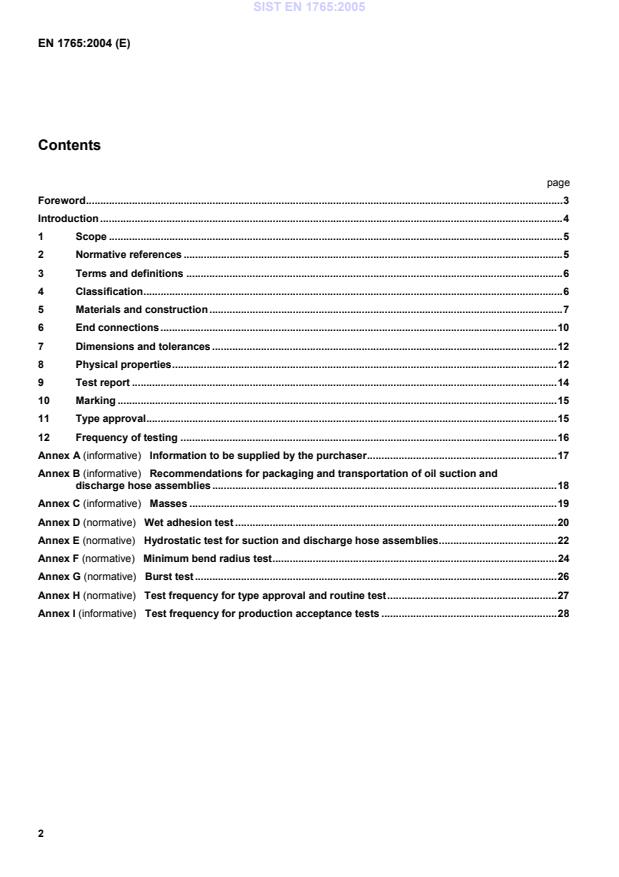
Information to be supplied by the purchaser.17 Annex B (informative)
Recommendations for packaging and transportation of oil suction and discharge hose assemblies.18 Annex C (informative)
Masses.19 Annex D (normative)
Wet adhesion test.20 Annex E (normative)
Hydrostatic test for suction and discharge hose assemblies.22 Annex F (normative)
Minimum bend radius test.24 Annex G (normative)
Burst test.26 Annex H (normative)
Test frequency for type approval and routine test.27 Annex I (informative)
Test frequency for production acceptance tests.28
1 Scope This document specifies the characteristics of four types of oil suction and discharge hose assemblies used for the conveyance of petroleum, including crude oils and other liquid petroleum products containing a maximum aromatics content of 50 % (v/v). It is not suitable for liquefied petroleum gas and natural gas. Hose assemblies to this document can be used in the temperature range -20 °C to 82 °C. The hoses specified are in the size range of nominal bore 50 to 500 and may be smooth bore, rough bore or armoured rough bore. NOTE Hoses for use with petroleum products having an aromatic content greater than 50 % (v/v) are outside the scope of this document but the requirements may be used as a basis for such hoses on request to the manufacturer. 2 Normative references The following referenced documents are indispensable for the application of this document. For dated references, only the edition cited applies. For undated references, the latest edition of the referenced document (including any amendments) applies.
EN 288-3:1992, Specification and approval of welding procedures for metallic materials – Part 3: Welding procedure tests for arc welding of steels EN 22063, Metallic and other inorganic coatings – Thermal spraying – Zinc, aluminium and their alloys (ISO 2063:1991, modified) EN 28033, Rubber and plastics hose - Determination of adhesion between components (ISO 8033:1991) EN ISO 1402, Rubber and plastics hoses and hose assemblies – Hydrostatic testing (ISO 1402:1994) EN ISO 1460, Metallic coatings – Hot dip galvanized coatings on ferrous materials – Gravimetric determination of the mass per unit area (ISO 1460:1992). EN ISO 7233, Rubber and plastics hoses and hose assemblies – Determination of suction resistance (ISO 7233:1991). EN ISO 8330:2000, Rubber and plastics hoses and hose assemblies – Vocabulary (ISO 8330:1998). EN ISO 8031, Rubber and plastic hoses and hose assemblies – Determination of electrical resistance (ISO 8031:1993). ISO 1431-1, Rubber, vulcanized or thermoplastic – Resistance to ozone cracking – Part 1: Static strain test. ISO 1461, Metallic coatings – Hot dip galvanized coatings on fabricated iron and steel articles – Specifications and test methods (ISO 1461:1999). ISO 1817, Rubber, vulcanized – Determination of the effect of liquids. ISO 4649, Rubber, vulcanized or thermoplastic – Determination of abrasion resistance using a rotating cylindrical drum device. ISO 7005-1, Metallic flanges – Part 1: Steel flanges. ASME B.1.20.1, Pipe threads, general purposes (inch). SIST EN 1765:2005
3.1 Electrically bonded hose assembly hose assembly that uses a metallic wire connection to create a low-resistance electrical connection between the end connections 3.2 Electrically discontinuous hose assembly hose assembly that incorporates an electrical insulation between the end of the helical wire or/and wire cord reinforcement and on or both couplings 4 Classification 4.1 General WARNING — Careful consideration needs to be given before the use of electrically discontinuous hoses for transferring liquids known to generate static charges. In no circumstances should more than one length of electrically discontinuous hose be used in an individual transfer pipeline and effective electrical continuity to earth from both ends of the electrically discontinuous hose should be maintained. 4.2 End – use Hose assemblies for this application are classified according to end-use as follows: - Type R, rough bore hose assemblies for dock operation and intended for situations where a relatively stiff, heavy and robust assembly can be used. The lining of the rubberized fabric is supported and reinforced by an internal (hot-dipped) zinc coated steel wire helix. Type R assemblies are electrically continuous; - Type A, armoured rough bore hose assemblies for dock operation. In addition to an internal zinc coated steel wire helix there shall be external helical armour of a similar material. Type A hoses are electrically continuous and may be lighter and more flexible than type R; - Type S, smooth bore hose assemblies for dock operation where flexibility and lightness are important. Type S hose assemblies may be electrically continuous or electrically discontinuous (see Warning); - Type L, hose assemblies for dock service where greater flexibility, lower weight and ease of handling are of primary consideration. Type L hose assemblies may be electrically continuous or electrically discontinuous. They are only suitable for discharge applications (see Warning). 4.3 Pressure ratings and designations Each type of hose assembly shall be designated according to the type letters R, A, S, or L followed by the maximum working pressure given in Table 1. For the purposes of this document the maximum working pressure includes an allowance for surge pressures above the normal operating pressure. SIST EN 1765:2005
Description 7 10,5 R7 Rough bore 7 10,5 A7 Armoured rough bore 7 10,5 S7 Smooth bore 7 10,5 L7 Light weight 10 15 R10 Rough bore 10 15 A10 Armoured bore 10 15 S10 Smooth bore 10 15 L10 Lightweight 15 22,5 R15 Rough bore 15 22,5 A15 Armoured bore 15 22,5 S15 Smooth bore 15 22,5 L15 Lightweight a 1 bar = 0,1 MPa 5 Materials and construction 5.1 Materials 5.1.1 Lining The rubber lining shall be resistant to the materials the assembly is to convey. The hose lining shall be suitable for continuous operation with the liquids to be conveyed. NOTE The purchaser should state the products that the assembly is to carry (see Annex A). 5.1.2 Reinforcing plies The reinforcing plies shall consist of textile or wire cord impregnated with rubber. Reinforcing wire cord shall be brass, copper or zinc coated carbon steel wire. 5.1.3 Wire helices Wire helices shall be cold drawn carbon steel having sulphur and phosphorus contents each not greater than 0,040%, and coated with copper or phosphate and comply with the requirements given in BS 3592-1. If joined, helical reinforcement wire shall be welded and shall conform to the following requirements: a) welding shall be carried out using electric butt welding; b) no weld shall be within 1,5 m of a nipple end or of another weld in the same wire neither along the hose length nor, in the case of two or more wire plies, nearer than 600 mm in adjacent wires. 5.1.4 Internal and armouring wire helices Internal and armouring, round and flat steel wire shall be cold drawn coated steel having sulphur and phosphorus contents each not greater than 0,040 % and comply with the requirements given in BS 3592-Part 1. SIST EN 1765:2005
ISO 7005-1. They shall have a continuous spiral grove generated by a 1,6 mm radius round nose tool at a feed rate of 0,8 mm ± 0,01 mm per revolution. The use of built-in swivel flanges is permitted when high flexibility and easy handling has been specified (see Annex A). Flange protection coatings may be specified by the purchaser (see Annex A) but shall not be applied to the flange sealing surface nor the internal surfaces of the flange or nipple. Coatings may be applied either by galvanizing or aluminium or zinc spraying in accordance with the requirements given in EN 22063 to a nominal thickness of 100 µm, with no localized area being less than 75 µm. Hot-dip coatings when applied shall conform to the requirements given in EN ISO 1460 and
EN ISO 1461. 6.2 Method of attachment of end connections to the hose For Types R, S and L, end fittings shall be either built-in during manufacture of the hose or shall be swaged. For Type A, end fittings shall be built-in during manufacture, or swaged, or wired in, or strapped. The exterior of the hose over built-in nipples shall taper smoothly into the body of the hose and no outside bands or clips shall be fitted. The design of the hose body shall be such that threaded bolts appropriate to the flange can be inserted into the flange. NOTE For types S and L see clauses 6.3 and 6.4. SIST EN 1765:2005
...