

CEN/TR 18260:2025
(Main)Sustainable Cities and Communities - A framework for standardization of services to the citizen
- Abstract
This document lays down a framework for a standardization project to establish and document best practice in the design and execution of smart and sustainable services made available by local government to citizens, both for residents and for visitors to a community. This document sets out the basic principles that are needed to be observed across the full range of services to be provided; it does not cover specific services.
The project covers services, whether these are directly delivered by authorities or whether their delivery is outsourced to arms-length public bodies or private enterprises.
The project does not cover specific technologies used in the delivery of electronic services.
The work takes due account of, and complement, the work of ISO/TC 176 concerning local authorities’ quality management systems, and of ISO/TC 312 concerning service excellence.
- Status
- Published
- Publication Date
- 16-Dec-2025
- Technical Committee
- CEN/TC 465 - Sustainable and Smart Cities and Communities
- Drafting Committee
- CEN/TC 465 - Sustainable and Smart Cities and Communities
- Current Stage
- 6060 - Definitive text made available (DAV) - Publishing
- Start Date
- 17-Dec-2025
- Due Date
- 20-Jan-2025
- Completion Date
- 17-Dec-2025

Overview
CEN/TR 18260:2025 - Sustainable Cities and Communities provides a framework for standardizing smart and sustainable citizen services delivered by local governments. The technical report sets out high-level principles and a project roadmap to document best practice in the design and execution of services for residents, visitors and organisations. It applies whether services are delivered directly by authorities or outsourced to arms‑length public bodies or private enterprises, and it explicitly does not prescribe specific technologies.
Key aims:
- Promote citizen-centric service design and delivery
- Ensure accessibility, equity and data privacy
- Align local services with sustainability objectives (including UN SDG 11)
Key topics and requirements
The document identifies core topics and general requirements that a future service framework standard will address. Main points include:
- Citizen needs and context of use: define users, tasks and environments to guide service design.
- Citizen-centric design principles: prioritize accessibility, inclusion and human-centered interactions (including non-digital back-up channels to avoid a digital divide).
- Service management and monitoring: processes for feedback, performance monitoring and traceability of service delivery.
- Sustainability integration: consider environmental, social and economic impacts in service planning and procurement.
- Interoperability and infrastructure: define infrastructure needs to support smart digital public services without mandating specific technologies.
- Digital considerations: guidance on responsible use of emerging technologies (AI, blockchain/DLT, data economy topics and immersive environments are referenced in Annex A) while leaving technology choice open.
Note: The report complements quality management and service excellence work by ISO/TC 176 and ISO/TC 312 rather than duplicating technical requirements.
Applications
CEN/TR 18260:2025 is designed to help cities and communities:
- Develop a harmonized framework for service-level expectations across multiple service domains (administration, transport, energy, water, healthcare, housing, environment, education, recreation).
- Draft procurement specifications and service contracts that embed accessibility and sustainability criteria.
- Design digital public services that maintain human‑interface alternatives and citizen feedback loops.
- Establish monitoring and performance indicators that respect privacy and traceability.
Who should use this standard
- Local authorities and municipal service planners
- Public service organisations and shared-service centres
- Procurement officers and policy makers
- Service designers, UX teams and accessibility specialists
- Private vendors and system integrators supplying citizen services
- Standards bodies and working groups involved in smart city governance
Related standards
- ISO 37101:2022 (sustainable development of communities)
- ISO/TC 176 (quality management systems)
- ISO/TC 312 (service excellence)
- ETSI TC Human Factors (smart city human-centric considerations)
CEN/TR 18260:2025 therefore serves as a practical, non‑prescriptive road map for creating equitable, sustainable and citizen-focused public services in the smart city context.
Get Certified
Connect with accredited certification bodies for this standard

BSI Group
BSI (British Standards Institution) is the business standards company that helps organizations make excellence a habit.

Bureau Veritas
Bureau Veritas is a world leader in laboratory testing, inspection and certification services.

DNV
DNV is an independent assurance and risk management provider.
Sponsored listings
Frequently Asked Questions
CEN/TR 18260:2025 is a technical report published by the European Committee for Standardization (CEN). Its full title is "Sustainable Cities and Communities - A framework for standardization of services to the citizen". This standard covers: This document lays down a framework for a standardization project to establish and document best practice in the design and execution of smart and sustainable services made available by local government to citizens, both for residents and for visitors to a community. This document sets out the basic principles that are needed to be observed across the full range of services to be provided; it does not cover specific services. The project covers services, whether these are directly delivered by authorities or whether their delivery is outsourced to arms-length public bodies or private enterprises. The project does not cover specific technologies used in the delivery of electronic services. The work takes due account of, and complement, the work of ISO/TC 176 concerning local authorities’ quality management systems, and of ISO/TC 312 concerning service excellence.
This document lays down a framework for a standardization project to establish and document best practice in the design and execution of smart and sustainable services made available by local government to citizens, both for residents and for visitors to a community. This document sets out the basic principles that are needed to be observed across the full range of services to be provided; it does not cover specific services. The project covers services, whether these are directly delivered by authorities or whether their delivery is outsourced to arms-length public bodies or private enterprises. The project does not cover specific technologies used in the delivery of electronic services. The work takes due account of, and complement, the work of ISO/TC 176 concerning local authorities’ quality management systems, and of ISO/TC 312 concerning service excellence.
CEN/TR 18260:2025 is classified under the following ICS (International Classification for Standards) categories: 13.020.20 - Environmental economics. Sustainability. The ICS classification helps identify the subject area and facilitates finding related standards.
CEN/TR 18260:2025 is available in PDF format for immediate download after purchase. The document can be added to your cart and obtained through the secure checkout process. Digital delivery ensures instant access to the complete standard document.
Standards Content (Sample)
SLOVENSKI STANDARD
01-februar-2026
Trajnostna mesta in skupnosti - Okvir za standardizacijo storitev za prebivalce
Sustainable Cities and Communities - A framework for standardization of services to the
citizen
Nachhaltige Städte und Gemeinden - Rahmen für die Standardisierung von
Dienstleistungen für den Bürger
Développement durable des collectivités - Cadre pour la normalisation des services aux
citoyens
Ta slovenski standard je istoveten z: CEN/TR 18260:2025
ICS:
03.080.01 Storitve na splošno Services in general
13.020.20 Okoljska ekonomija. Environmental economics.
Trajnostnost Sustainability
2003-01.Slovenski inštitut za standardizacijo. Razmnoževanje celote ali delov tega standarda ni dovoljeno.
CEN/TR 18260
TECHNICAL REPORT
RAPPORT TECHNIQUE
December 2025
TECHNISCHER REPORT
ICS 13.020.20
English Version
Sustainable Cities and Communities - A framework for
standardization of services to the citizen
Développement durable des collectivités - Cadre pour Nachhaltige Städte und Gemeinden - Rahmen für die
la normalisation des services aux citoyens Standardisierung von Dienstleistungen für den Bürger
This Technical Report was approved by CEN on 7 December 2025. It has been drawn up by the Technical Committee CEN/TC
465.
CEN members are the national standards bodies of Austria, Belgium, Bulgaria, Croatia, Cyprus, Czech Republic, Denmark, Estonia,
Finland, France, Germany, Greece, Hungary, Iceland, Ireland, Italy, Latvia, Lithuania, Luxembourg, Malta, Netherlands, Norway,
Poland, Portugal, Republic of North Macedonia, Romania, Serbia, Slovakia, Slovenia, Spain, Sweden, Switzerland, Türkiye and
United Kingdom.
EUROPEAN COMMITTEE FOR STANDARDIZATION
COMITÉ EUROPÉEN DE NORMALISATION
EUROPÄISCHES KOMITEE FÜR NORMUNG
CEN-CENELEC Management Centre: Rue de la Science 23, B-1040 Brussels
© 2025 CEN All rights of exploitation in any form and by any means reserved Ref. No. CEN/TR 18260:2025 E
worldwide for CEN national Members.
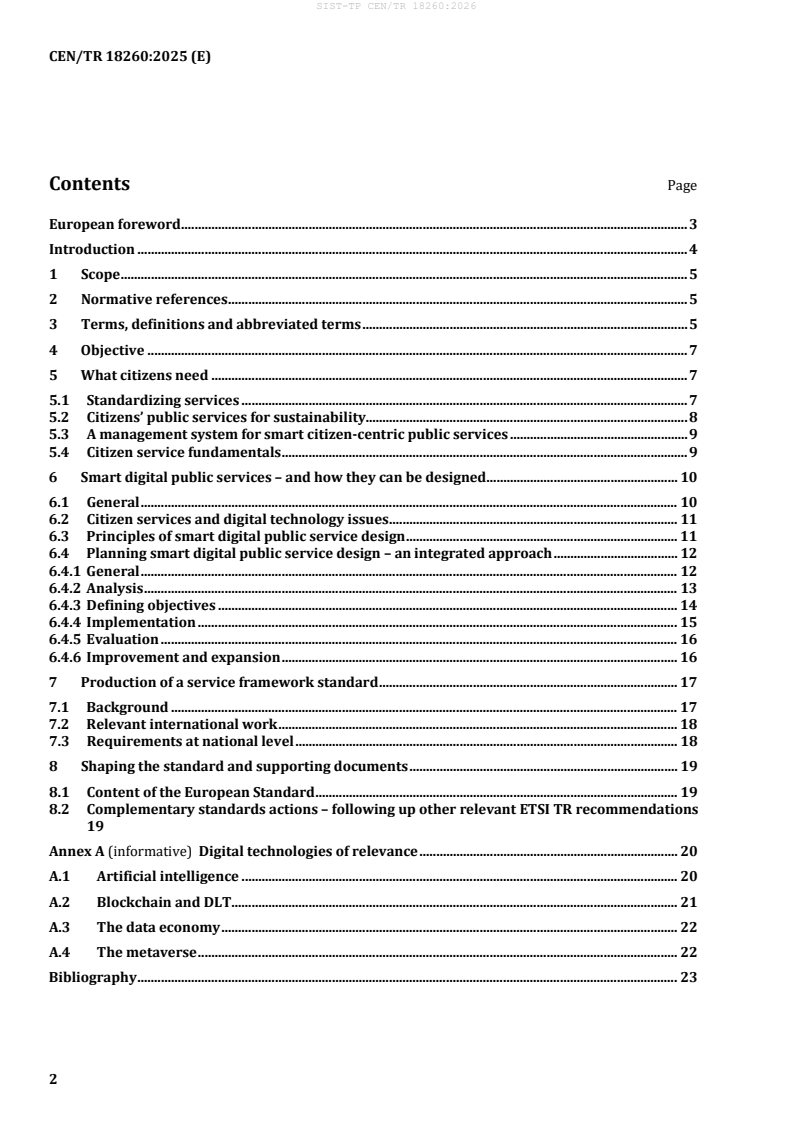
Contents Page
European foreword . 3
Introduction . 4
1 Scope . 5
2 Normative references . 5
3 Terms, definitions and abbreviated terms . 5
4 Objective . 7
5 What citizens need . 7
5.1 Standardizing services . 7
5.2 Citizens’ public services for sustainability. 8
5.3 A management system for smart citizen-centric public services . 9
5.4 Citizen service fundamentals . 9
6 Smart digital public services – and how they can be designed . 10
6.1 General . 10
6.2 Citizen services and digital technology issues . 11
6.3 Principles of smart digital public service design . 11
6.4 Planning smart digital public service design – an integrated approach . 12
6.4.1 General . 12
6.4.2 Analysis . 13
6.4.3 Defining objectives . 14
6.4.4 Implementation . 15
6.4.5 Evaluation . 16
6.4.6 Improvement and expansion . 16
7 Production of a service framework standard . 17
7.1 Background . 17
7.2 Relevant international work . 18
7.3 Requirements at national level . 18
8 Shaping the standard and supporting documents . 19
8.1 Content of the European Standard . 19
8.2 Complementary standards actions – following up other relevant ETSI TR recommendations
Annex A (informative) Digital technologies of relevance . 20
A.1 Artificial intelligence . 20
A.2 Blockchain and DLT . 21
A.3 The data economy . 22
A.4 The metaverse . 22
Bibliography . 23
European foreword
This document (CEN/TR 18260:2025) has been prepared by Technical Committee CEN/TC 465
“Sustainable Cities and Communities”, the secretariat of which is held by AFNOR.
Attention is drawn to the possibility that some of the elements of this document may be the subject of
patent rights. CEN shall not be held responsible for identifying any or all such patent rights.
Any feedback and questions on this document should be directed to the users’ national standards body.
A complete listing of these bodies can be found on the CEN website.
Introduction
The digital age offers considerable opportunity not only for citizens to have an improved living
environment in which they can benefit from effective services, but also for them to influence matters
affecting their daily lives. At the same time, equal treatment for all citizens needs to be ensured and
account needs to be taken of their security and data privacy concerns.
The digitalization of local services for citizens thus far has been focused on the benefits of technological
advance, particularly in terms of cost and overall convenience for those providing the service. However,
until now, the basic service-level requirements for citizens have not been codified. In some cases, levels
of service could well have worsened for more vulnerable individuals. For the well-being of citizens, it is
essential that these requirements are taken properly into account by service-providers. Without such a
discipline, societal development, particularly in terms of the needs of vulnerable citizens, can suffer.
In October 2020, ETSI TC Human Factors published a Technical Report [1] concerning standards issues
relating to smart cities and communities in so far as they affect individual citizens. This was the first time
these aspects had been addressed. Among the proposals in this document is a cluster relating to the
provision of services to the citizen.
This CEN Technical Report takes these proposals a step further, by defining a future citizen services
standardization project. This project in the first instance is intended to set out the fundamental
parameters for a standardized approach to the provision of citizen services. It will provide an overall
framework for citizen services that will implement all the relevant proposals, as well as consider any
additional aspects that need to be addressed. The project will require a number of different deliverables
produced over different timeframes, in order to maximize the benefit of the new standards approach for
local authorities and their citizens, and to ensure a good uptake.
Thus, citizens will benefit from improved services that better meet their needs, and local authorities, as
the ultimate service providers, will gain in efficiency from having smoothly efficient service framework.
1 Scope
This document lays down a framework for a standardization project to establish and document best
practice in the design and execution of smart and sustainable services made available by local
government to citizens, both for residents and for visitors to a community. This document sets out the
basic principles that are needed to be observed across the full range of services to be provided; it does
not cover specific services.
The project covers services, whether these are directly delivered by authorities or whether their delivery
is outsourced to arms-length public bodies or private enterprises.
The project does not cover specific technologies used in the delivery of electronic services.
The work takes due account of, and complement, the work of ISO/TC 176 concerning local authorities’
quality management systems, and of ISO/TC 312 concerning service excellence.
2 Normative references
There are no normative references in this document.
3 Terms, definitions and abbreviated terms
For the purposes of this document, the following terms and definitions apply:
ISO and IEC maintain terminology databases for use in standardization at the following addresses:
• ISO Online browsing platform: available at https://www.iso.org/obp
• IEC Electropedia: available at https://www.electropedia.org/
3.1
citizen/consumer/customer
person or organization that could or does receive a product or a service intended for or required by them
Note 1 to entry: Within the framework of this document, a recipient of public service can encompass a citizen (a
person with an inherent or legally granted residency status), a non-citizen (such as a visitor from another nation),
an organization, or a broader societal entity representing a collective of citizens.
Note 2 to entry: The customer/citizen is the recipient of a product or service provided by a public service
organization, or a private entity acting on its- behalf; and as such the term “customer” maybe used in combination
with the term citizen within the context of this document.
Note 3 to entry: “Consumer” is defined by the European Accessibility Act as any natural person who purchases the
relevant product or is a recipient of the relevant service for purposes which are outside his
3.2
citizen-centric
design and delivery of city services driven by the needs of citizens, rather than the functional structures
of a city’s silos
Note 1 to entry: The term citizen in this context includes residents, visitors and businesses within the city.
3.3
customer/citizen satisfaction
measurement of citizens’ perception of the degree to which the customer’s/citizen’s requirements have
been fulfilled / or have been made available or taken into consideration
3.4
accessibility
extent to which products, systems, services, environments and facilities can be used by citizens from a
population with the widest range of user needs, characteristics and capabilities to achieve identified goals
in identified contexts of use
Note 1 to entry: Context of use includes direct use or use supported by assistive technologies.
Note 2 to entry: Accessibility includes facilities offered to all citizens, including persons with disabilities (accessible
locations, accessible terminals or user-friendly interfaces, etc.).
3.5
public service
service delivered by an organization established or designated by the Government for citizens and other
clientele
3.6
context of use
users, tasks, equipment (hardware, software and materials), and the physical and social environments in
which a system, product or service is accessed and used
3.7
infrastructure
system of facilities, equipment and services needed for the operation of a public service organization or
for accessing the smart and sustainable services made available by local government to citizens
3.8
public service organization
any institution, service-oriented entity, or system that operates under the policy guidance and authority
of an elected government (whether at the national, federal, regional, or local level)
Note 1 to entry: This encompasses organizations involved in policy formulation and law enforcement — areas not
limited to services but with activities that significantly impact the broader public interest.
3.9
requirement
need or expectation that is stated, generally implied or obligatory
3.10
smart digital public services
services that increase city sustainability, smartness and resilience, by using appropriate technologies,
data integration and exchange between them
3.11
traceability
ability to trace the history, application or location of that which is under consideration
4 Objective
This document seeks to set out the basic elements of the citizen services standardization project,
providing guidance for cities to create a strategy which articulates how to change the focus from one of
technology implementation to a focus of prioritizing a citizen participation approach.
The service design elements include in particular:
• provision of clear and easy-to-use digital technologies, with background supporting information
easily available;
• assurance that human interface possibilities are always there (in whatever form) as back-up and
avoid digital divide issues;
• assurance that accessibility issues for citizen service design are included;
• provision of guidance on the processes which are needed for citizen service design;
• assurance of citizen feedback and enabling city monitoring of service performance.
5 What citizens need
5.1 Standardizing services
The lack of homogeneity of approach to services is compounded by very different sizes and shapes of the
organizations that deliver them, whether these are provided by local authorities, by not-for-profit
autonomous entities, or by commercial companies either on behalf of local authorities or on a wholly
privatized basis. Citizens’ common requirements however need to be addressed by all these, hence we
propose the adoption of a European Standard which specifies what these requirements are and the
principles that all service providers need to meet to address them, leading to a considerable improvement
in their delivery, with better outcomes for all, and, of course, for the environment.
Citizens are obliged to make use of a very wide range of services in connection with their daily lives, their
needs often cover an enormous range of different services delivered in different ways, and indeed by
different kinds of organizations, both private and public. This makes it very difficult to embrace a
homogenous digital approach, indeed this can be more difficult to harmonize than for services delivered
through paper. Cities also need to ensure equal treatment of all citizens no matter which disabilities they
have. Nevertheless, nearly all services delivered are now provided at least to some extent in electronic
form, but when provided this way, they need to take into consideration environmental, social and
economic aspects – the three dimensions of sustainability.
A non-exhaustive list of services includes:
• administrative services;
• education;
• energy supply;
• environmental services;
• healthcare services and other social/welfare services;
• recreational and sporting activities;
• social housing;
• transport;
• water.
5.2 Citizens’ public services for sustainability
Citizen services can contribute to achieving the six sustainability goals and take into account the
sustainability factors as in EN ISO 37101:2022 [2].
The Agenda 2030 and the UN SDGs involve all the aspect of citizens’ everyday lives and can therefore
provide a checklist for the citizen services, UN SDG 11, in particular, is relevant for citizen services.
People’s actions influence the environment for better or for worse.
The potential threat to the environment manifested in climate crisis and in water and air pollution,
environmental risks emerge daily and force governments, industries and in fact every citizen of the world
to adapt to and mitigate environmental respects by adopting novel ways of thinking and of behaving.
Sustainability can be generally described as the state of the global system (including environmental,
social and economic aspects) where the requirements of the present are satisfied without compromising
the possibility of future generations to meet their own needs (Brundtland Report, 1987).
Sustainability is mainly associated with broad and comprehensive daily decision-making processes by
public governments and by citizens.
Governments and public services lead the way in creating a more sustainable future and social value for
citizens, communities and businesses.
On the supply side, a sustainable governance, in the design and management phase of the public services
provided by them or by service providers, can analyse and assess the environmental, social and economic
impacts (and of the related infrastructures), climate impacts, biodiversity resources management, and
risks in plans, programmes and projects, services they implement in the city and in the communities.
Cities with ambitious climate and environmental goals and undergoing smart sustainable transformation
processes can identify and procure the best and most sustainable technical solutions for their
communities and demonstrate the local economic, environmental and social benefits of public
investments.
Strategic purchases of green products and services by public authorities can minimize damage to the
environment and contribute to meeting environmental challenges, from climate change to soil
degradation, waste disposal, etc.
Green public procurement (GPP) is defined by the European Commission as “a process whereby public
authorities seek to procure goods, services and works with a reduced environmental impact throughout
their life cycle when compared to goods, services and works with the same primary function that would
otherwise be procured”.
On the demand side the availability of information provided about the environmental impacts in life cycle,
as the carbon footprint, but also of social and economic impacts, climate impacts, biodiversity resources
management of a service and of the related infrastructures (e.g. concerning public transport), allows
citizens to make an informed and responsible choice of a more sustainable service compared to another
less sustainable one, i.e. a more conscious consumption of environmental resources and the respect of
equity, social inclusion and effectiveness principles.
[COM (2008) 400 final “Public procurement for a better environment”]
Environmental ecosystem services improve citizens’ quality of life in cities and communities and public
health (the World Health Organization’s “One Health Concept”).
Urban green space design, water management, waste management, design for all methodology, and
impact assessment, are strategies for public services which can ensure urban sustainability and
resilience.
5.3 A management system for smart citizen-centric public services
In a smart sustainable city is performed a more efficient management of its community services through
digital technology. Such is the case of intelligent traffic management with the aims of reducing air, light,
and noise pollution; improving the safety and health of citizens through Big Data; or developing a smart
economy through sensors that help optimize available resources.
The present TR is coherent with the citizen-centric city service management framework contained in the
smart city operation model as in ISO 37106:2021[3], and takes into account key elements such as:
• the use of smart data as an asset;
• co-creation of value by exchange of knowledge between citizens and city to create new services;
• to improve and optimize services by opening up city data via open platforms.
5.4 Citizen service fundamentals
Citizens have expectations towards the delivery of public services which can be described in as
“fundamentals”. These fundamentals undergo continuous change with regard to meeting users’ needs,
given the fast-paced development of the ICT sector. Public service standards need to be adapted regularly,
and public authorities and service providers need to build capabilities and agility, to keep pace with
digital transformation. Therefore, the list might not be comprehensive.
Some of these fundamentals can in effect be legal requirements – for example where there is legislation
such as the GDPR affecting service provision. But in any case, the future European Standard needs to
require that at least the following issues are taken into account by service providers:
• accessibility - the provisions of the European Accessibility Act (EAA) entered into force in mid-2025,
and will apply to many products and services, including those provided for the public;
• accountability - the obligation to be held responsible for designated duties, which includes the
diligent and proper management of allocated resources;
• agility - the capability to promptly and efficiently adapt to evolving circumstances, emerging
challenges, and the evolving needs of citizens;
• co-creation, co-design, co-production - co-creation is when citizens are directly involved in the
general planning of a service, the input by citizens affects the service individually provided to them.
SEVENTY-FOURTH WORLD HEALTH ASSEMBLY WHA74.7Agenda item 17.3 31 May 2021 Strengthening WHO
preparedness for and response to health emergencies - SEVENTY-FIFTH WORLD HEALTH ASSEMBLY A75/19
Provisional agenda item 16.2 6 May 2022 Strengthening WHO preparedness for and response to health emergencies
Strengthening collaboration on One Health Report by the Director-General
Veiko Lember, Taco Brandsen & Piret Tõnurist (2019) The potential impacts of digital technologies on co-
production and co-creation, Public Management Review, 21:11,
1665-1686,DOI: 10.1080/14719037.2019.1619807
Co-design seeks to involve all interested actors in the conception, definition, and creation of a project.
Co-production represents a mode of engagement in which citizens are actively and collaboratively
involved in the planning, design and delivery of public services;
• continuity - stable conditions, free of interruption, disconnection or suspension of fundamental
public services;
• data privacy - the handling of sensitive data and information is crucial for public service provision.
The need to be handled with confidentiality and integrity needs to be met with a secure and reliable
service;
• equity - upholding and ensuring equal opportunities, before the public service and in the access and
use of provided public service for all citizens alike;
• governance - the structure and highest-level procedures required to establish and run the service;
• integrity - consistently adhering to the core values and principles of an organization, demonstrated
through the actions and words of both the leadership and all members of the organization;
• interoperability - ensuring the seamless exchange of data between different ICT systems
(https://joinup.ec.europa.eu/collection/joinup/glossary/term/interoperability);
• neutrality - vis-à-vis consumers, and with regard to service administration and procedures;
• security - the handling of sensitive data and information is crucial for public service provision;
• transparency - the extent to which policies, strategies, decisions, and actions are made accessible to
the customers of the service.
6 Smart digital public services – and how they can be designed
6.1 General
Energy, transport, water management, waste management, the health system, education, safety and
security, emergency systems, are examples of community sustainability issues (EN ISO 37101 [2]) in
which digital services, managed in a smart way (by using appropriate digital technologies, data
integration and exchange between services) can improve efficiency but also citizens’ and city users’
quality of life.
Service delivery in cities has traditionally been based around vertically integrated delivery silos that are
built around specific functions, not user needs. Smart cities need to develop new ways of working across
these silos to deliver more citizen-centric services. New operating models are needed to drive cross-
service innovation and collaboration.
Services therefore need to be properly designed; in practice few are. Service design is an approach to
design that defines how the relationship between a user and an organization unfolds, generating a quality
experience for both parties involved and helping to achieve the desired result. In the digital age, with
what are in some cases revolutionary changes in the inter-relationship between the service provider and
the customer, there is even more need to do this. This includes especially the use of personal data when
implementing/training algorithms, using facial recognition, etc. It also requires due account to be taken
of the needs of the employees delivering the services – the service needs to be designed in relation to the
capabilities and availabilities of the staff needed to deliver it.
6.2 Citizen services and digital technology issues
Access to digital technologies is one of the most exciting things for people, but it can also be one of the
scariest. For many citizens this process is still new and unknown, leading to many misunderstandings
and miscommunications. In recent years, the EU has intensified its efforts to set global rules for the digital
sector. This is driven by economic and strategic rationales, and it has manifested itself in numerous new
EU policy initiatives that affect digital society, privacy, and data flows, as referenced in the bibliography
to this document.
Promoting a Europe “fit for the digital age” is a top strategic priority for the European Commission,
considering issues as: cyber-security, data privacy, artificial intelligence, DLT, data economy, metaverse,
etc.
As noted in Clause 5 above, cyber-security and personal data protection are of course fundamental to the
provision of proper citizen services. But to implement correctly designed citizen services, a number of
specific technologies will pose additional challenges. The major considerations are set out in Annex A to
this document.
A properly designed smart city programme can therefore involve a shift away from silo-based delivery of
service towards an integrated, multi-channel, service delivery approach – one that enables a whole-of-
city view of the customer and an ability to deliver services to citizens and businesses where and when
they need it most, including through one-stop services and through private - and voluntary-sector
intermediaries.
While many cities have made progress in this direction, at least in terms of physically bringing together
service delivery channels (via one-stop web services or single phone number initiatives), this is often not
a fully citizen-centric environment. Many city departments and agencies have overlapping but selective
information about their citizen and business customers, and for the most part nobody takes a lead
responsibility for owning and managing that information across the city, let alone using it to design better
services.
The digital transformation does not mean doing the same processes with digital technologies in a more
efficient way or simply be about digitising new records or automating processes using digital
technologies, but also it can help to analyse processes, to reinvent services and create new ones. It
concerns automating processes and interactions and delivering services virtually to improve their quality
and quantity, while reducing costs and delivering value for all. The responsible use of emerging
technologies, such as IoT, artificial intelligence, blockchain and big data analytics, has the potential to help
considerably in this.
Whilst following the generic principles just outlined, service design to ensure this objective can be met
needs to take full and proper account of the revolution that the digital transformation has created, and
which is now well on the way to becoming universal. Smart digital public services need to be designed on
a basis that reflects citizen needs, and this can be/is universal, taking proper account of every member of
society. Smartness in public services needs to focus on the dimensions of efficiency, effectiveness,
transparency, and collaboration.
6.3 Principles of smart digital public service design
The future European Standard can seek to ensure that service design takes due account of some basic
principles. A number of these are not solely related to smart digital services but can be applied to all
services. There is some international standards work setting out these design principles, notably in
Annex A of ISO/TS 24082:2021 [4], and in ISO 11367:2025 [5].
Additionally, there are a number of additional principles need to be observed in digital service design:
• according to the EU “digital by default” principle, services can/need to be organized in digital form,
and starting from this it is necessary to design additional points of contact with the citizen, to
consider every delivery method, digital and physical, that the service offers;
• as services are the meeting point between technologies and people, their design can simplify and
subtract whenever possible, reduce complexity, and focus on the actual needs of citizens as service
users;
• services need to be available and accessible online for all, in particular, for people in disadvantaged
situations, including older people and people with disabilities, as well as people in rural and remote
areas;
• services need to be accessible to all persons, without discrimination and are aligned with EU
fundamental rights. In addition to online accessibility, a physical back-up presence is still needed for
those unable to work through the online facilities;
• digital public services need to be seamless, integrated and accessible via multiple channels as well as
customisable, they can allow the user to easily identify the services they need through the channel
they find most convenient;
• smart government applications can enhance the delivery and efficiency of government services and
information, primarily due to their easy access and availability for consumers. In addition, smart
government services can provide more channels through which citizens can participate and interact
with government;
• the interaction between citizens and public services can take place through a series of channels
(called touchpoints), providing on the one hand the citizen with the tools to carry out specific
activities and achieve his/her objectives, and on the other hand for the public administration a way
to make their services available using properly trained staff;
• smart government applications and smart government services can provide better access to
information through location-based services (based on the premise of anytime, anywhere and
anyhow), which leads to increased opportunity for innovation in the provision of services in the
public sector.
6.4 Planning smart digital public service design – an integrated approach
6.4.1 General
Planning smart digital public service design involves several key steps to ensure that services are
efficient, user-friendly, and responsive to the needs of citizens.
Governments need to move away from a fragmented approach to service delivery that relies on multiple,
separate public sector websites. This siloed method is incompatible with the goal of offering simpler,
more convenient services.
Instead of maintaining isolated policies and operations, the focus can shift to enhancing the experience
for both citizens and public servants involved in policy design, service delivery, and ongoing
management.
Governments can integrate smart public services that are data-driven, ensuring high data quality,
interoperability, semantic clarity, standardization, security, and user privacy.
By leveraging city data and integrating information from various smart services, a new range of “smart
services” can be developed.
A well-rounded multidisciplinary team can be tasked with designing, building, and operating these
services, as well as effectively procuring digital solutions from the market.
Ongoing user research and usability testing are crucial for delivering and maintaining digital services.
The insights gained from this research will guide both immediate and long-term improvements to the
service.
Design of smart digital public services has particular features which are described below, together with
other general aspects in common with non-digital services.
Figure 1 below outlines the key stages of planning smart digital public service design:
Figure 1 — Planning smart digital public service – integrated approach
6.4.2 Analysis
6.4.2.1 Starting from the needs of citizens
Services can be approached based on user need, and not on the basis of the needs of the organizations
that deliver them, according to the Human-Centred Design (ISO 9241-210) [6] principle.
This means investigating, through research into user activities (such as web analytics or conducting
interviews and focus groups) how people use the system, and then to make sure that all the features are
designed around user needs and mental models, allowing them to get what they need easily and quickly,
without unnecessary steps, and with understandable instructions.
The public sector has the potential to know citizens’ aspirations, understand their socio-economic
condition and current needs, provide them with the space to voice and signal their requests and
preferences, and deliver a platform to meet their requests. The service needs also to cater for the needs
of those with accessibility needs, including through providing human assistance as back-up whenever
this is needed.
6.4.2.2 Involving citizens / Co-design
The principles in good governance are namely: consensus, accountable, transparent, responsive,
equitable and inclusive, effective and efficient.
In the European Council stated, “12 Principles of Good Governance – the responsible conduct of public
affairs and management of public resources” (2008), citizens are at the centre of public activity and they
are involved in clearly defined ways in public life at local level. Good governance with information and
communication technologies support can create a smart sustainable city, they are in the same goal to
provide excellent service and to enhance the citizens’ quality of life.
United Nations Economic and Social Commission for Asia and the Pacific “What is Good Governance?” - 2009
Citizens’ engagement is a new form of democracy in which citizens are part of the decision-making
process with regard to the development of their society. Citizen participation is therefore crucial for
governments that aim to be inclusive, accountable, transparent and responsive.
Involving citizens in the design of a public service helps government teams to avoid their personal biases
or delivering against the use cases they can imagine. In particular, this helps teams to consider the
accessibility needs of their users and the additional face to face or offline support that might be required
to support those who aren’t confident using the internet.
The digital transformation of government and civic participation offers new ways for citizens to share
their views, collaborate with their peers and express their dissatisfaction.
The digital technologies offer the opportunity to improve the quality and frequency of citizen
participation in governance issues while reducing costs and increasing the production and dissemination
of real-time data.
Digital citizen participation in government decision-making contributes to good governance when such
communication promotes transparent, accountable, inclusive, consensus-oriented and rules-based
government decision-making and when government service delivery is responsive and effective.
Whilst services can be designed with digital in mind, a focus on the needs of users will ensure that they
are never delivered to the exclusion of those who continue to need support through other channels.
Transparency and collaboration to be the principles for a participatory approach for planning, right from
the initial stages.
Trust is an important condition for every participatory process regarding planning, policy and of course,
experimentation. Trust building requires starting a relation with citizens based on clarity, transparency
and openness to take on board contradicting (often) opinions and beliefs, unclear aspirations as well as
frustrations over the wrongs of various preceding processes.
The experiment of co-create public services means to create an environment of trust that the time spent
experimenting and the commonly produced outcomes are trustworthy and time-worthy at the same time.
6.4.3 Defining objectives
Defining clear objectives is crucial for planning smart digital public service design. These objectives guide
the development process and ensure that the services meet user needs effectively.
To ensure accountability, projects can be documented in a clear and open way, to make the objectives
understood, encourage collaboration at all levels and build a common knowledge base within the Public
Administration and between the Public Administration and citizens.
Digital technologies in public services can allow the objectives to be achieved of transparency, trust, and
accountability.
By clearly defining these objectives, governments can ensure that their smart digital public services are
aligned with user needs and strategic goals, ultimately leading to better outcomes for citizens and
improved public service delivery.
The following are part of the minimum list of objectives for planning smart digital public service design:
1. Improvement of user experience – to enhance the overall user experience by simplifying access to
services and reducing the time needed to complete tasks.
2. Service Integration – to create a seamless integration of services across different departments to
eliminate silos and provide a unique user experience.
3. Decision Making based on data – to make full use of data analytics to improve service design and
enhance the decision-making processes.
4. Accessibility of services – to ensure that all digital services are accessible to diverse populations,
including those with disabilities.
5. Development of cost-effective services – to streamline processes to enhance operational efficiency
and reduce costs associated with digital public service delivery.
6. Ensuring security and privacy – to ensure user data security and privacy in the design and
implementation of digital services.
7. Continuous improvement of services – to establish a framework for ongoing assessment and
enhancement of digital services based on user feedback.
8. Continuous stakeholder engagement – to enable active involvement from all stakeholders, including
citizens, public servants, and other partners, in the service design process.
9. On-going training and support – to provide effective training and support to users and public
servants to maximize the applicability of new services.
6.4.4 Implementation
Implementing the planning phase for smart digital public service design involves a structured approach
so that the defined objectives are effectively met.
1. Define resources. A multidisciplinary team can be established. Members can come from various fields
such as IT, user experience, data analytics, policy, and communications. The roles and responsibilities
to be clearly defined in order to ensure accountability.
2. Conduct an assessment of real needs by identifying and engaging with key stakeholders. Gather input
from citizens, public servants, and other relevant stakeholders to understand their needs and
expectations. A review of current public services can be carried out to identify gaps, redundancies,
and opportunities for improvement.
3. Define Technical Requirements by identifying appropriate technologies that support
interoperability, scalability, and security. Additionally, data management protocols can be developed
for data collection, storage, analysis, and sharing, ensurin
...