

EN 1630:2011+A1:2015
(Main + Amendment)Pedestrian doorsets, windows, curtain walling, grilles and shutters - Burglar resistance - Test method for the determination of resistance to manual burglary attempts
- Abstract
This European Standard specifies a test method for the determination of resistance to manual burglary attempts in order to assess the burglar resistant characteristics of pedestrian doorsets, windows, curtain walling, grilles and shutters. It is applicable to the following means of opening: Turning, tilting, folding, turn-tilting, top or bottom hung, sliding (horizontally and vertically) and rolling as well as fixed constructions.
This European Standard does not directly cover the resistance of locks and cylinders to attack with picking tools. It also does not cover the attack of electric, electronic and electromagnetic operated burglar resistant construction products using attack methods that might defeat these characteristics.
It is acknowledged that there are two aspects to the burglar resistance performance of construction products, their normal resistance to forced operation and their ability to remain fixed to the building. Due to the limitation of reproducing the fixing methods and building construction in a laboratory environment this aspect is not fully covered by the standard. This is particularly true with products built into a building. The performance of the fixed part of the product is evaluated using a standard sub frame. It is the manufacturer´s responsibility to ensure that guidance on the fixing of the product is contained in the mounting instructions and that this guidance is suitable for the burglar resistance class claimed for the product. As with the other referenced standards this specification uses a standard sub frame and the product is mounted according to the manufacturers' instructions. An example for the contents of the manufacturer´s installation instructions is given in Annex A of EN 1627:2011. This test method does not evaluate the performance of the fixing to the building.
- Status
- Withdrawn
- Publication Date
- 22-Dec-2015
- Withdrawal Date
- 06-Oct-2026
- Technical Committee
- CEN/TC 33 - Doors, windows, shutters and building hardware
- Drafting Committee
- CEN/TC 33/WG 7 - Burglary resistance
- Current Stage
- 9960 - Withdrawal effective - Withdrawal
- Start Date
- 02-Jun-2021
- Completion Date
- 07-Oct-2026
Buy Documents



Relations
- Effective Date
- 18-Jan-2023
- Effective Date
- 18-Jan-2023
- Effective Date
- 13-Jan-2016
- Effective Date
- 28-Jan-2026
- Effective Date
- 28-Jan-2026
- Effective Date
- 28-Jan-2026
- Effective Date
- 28-Jan-2026
- Effective Date
- 28-Jan-2026
- Refers
EN 1906:2010 - Building hardware - Lever handles and knob furniture - Requirements and test methods - Effective Date
- 28-Jan-2026
- Effective Date
- 28-Jan-2026
- Effective Date
- 28-Jan-2026
Buy Documents
Get Certified
Connect with accredited certification bodies for this standard

DIBt (Deutsches Institut für Bautechnik)
German Institute for Building Technology.
DIN CERTCO
DIN Group product certification.

Kiwa BDA Testing
Building and construction product certification.
Sponsored listings
Frequently Asked Questions
EN 1630:2011+A1:2015 is a standard published by the European Committee for Standardization (CEN). Its full title is "Pedestrian doorsets, windows, curtain walling, grilles and shutters - Burglar resistance - Test method for the determination of resistance to manual burglary attempts". This standard covers: This European Standard specifies a test method for the determination of resistance to manual burglary attempts in order to assess the burglar resistant characteristics of pedestrian doorsets, windows, curtain walling, grilles and shutters. It is applicable to the following means of opening: Turning, tilting, folding, turn-tilting, top or bottom hung, sliding (horizontally and vertically) and rolling as well as fixed constructions. This European Standard does not directly cover the resistance of locks and cylinders to attack with picking tools. It also does not cover the attack of electric, electronic and electromagnetic operated burglar resistant construction products using attack methods that might defeat these characteristics. It is acknowledged that there are two aspects to the burglar resistance performance of construction products, their normal resistance to forced operation and their ability to remain fixed to the building. Due to the limitation of reproducing the fixing methods and building construction in a laboratory environment this aspect is not fully covered by the standard. This is particularly true with products built into a building. The performance of the fixed part of the product is evaluated using a standard sub frame. It is the manufacturer´s responsibility to ensure that guidance on the fixing of the product is contained in the mounting instructions and that this guidance is suitable for the burglar resistance class claimed for the product. As with the other referenced standards this specification uses a standard sub frame and the product is mounted according to the manufacturers' instructions. An example for the contents of the manufacturer´s installation instructions is given in Annex A of EN 1627:2011. This test method does not evaluate the performance of the fixing to the building.
This European Standard specifies a test method for the determination of resistance to manual burglary attempts in order to assess the burglar resistant characteristics of pedestrian doorsets, windows, curtain walling, grilles and shutters. It is applicable to the following means of opening: Turning, tilting, folding, turn-tilting, top or bottom hung, sliding (horizontally and vertically) and rolling as well as fixed constructions. This European Standard does not directly cover the resistance of locks and cylinders to attack with picking tools. It also does not cover the attack of electric, electronic and electromagnetic operated burglar resistant construction products using attack methods that might defeat these characteristics. It is acknowledged that there are two aspects to the burglar resistance performance of construction products, their normal resistance to forced operation and their ability to remain fixed to the building. Due to the limitation of reproducing the fixing methods and building construction in a laboratory environment this aspect is not fully covered by the standard. This is particularly true with products built into a building. The performance of the fixed part of the product is evaluated using a standard sub frame. It is the manufacturer´s responsibility to ensure that guidance on the fixing of the product is contained in the mounting instructions and that this guidance is suitable for the burglar resistance class claimed for the product. As with the other referenced standards this specification uses a standard sub frame and the product is mounted according to the manufacturers' instructions. An example for the contents of the manufacturer´s installation instructions is given in Annex A of EN 1627:2011. This test method does not evaluate the performance of the fixing to the building.
EN 1630:2011+A1:2015 is classified under the following ICS (International Classification for Standards) categories: 13.310 - Protection against crime; 91.060.50 - Doors and windows. The ICS classification helps identify the subject area and facilitates finding related standards.
EN 1630:2011+A1:2015 has the following relationships with other standards: It is inter standard links to EN 1630:2011/FprA1, EN 1630:2011, EN 1630:2021, EN 356:1999, EN 1303:2005, EN 12209:2003, EN 1627:2011, EN ISO/IEC 17025:2005, EN 1906:2010, EN 1628:2011+A1:2015, EN 1629:2011+A1:2015. Understanding these relationships helps ensure you are using the most current and applicable version of the standard.
EN 1630:2011+A1:2015 is available in PDF format for immediate download after purchase. The document can be added to your cart and obtained through the secure checkout process. Digital delivery ensures instant access to the complete standard document.
Standards Content (Sample)
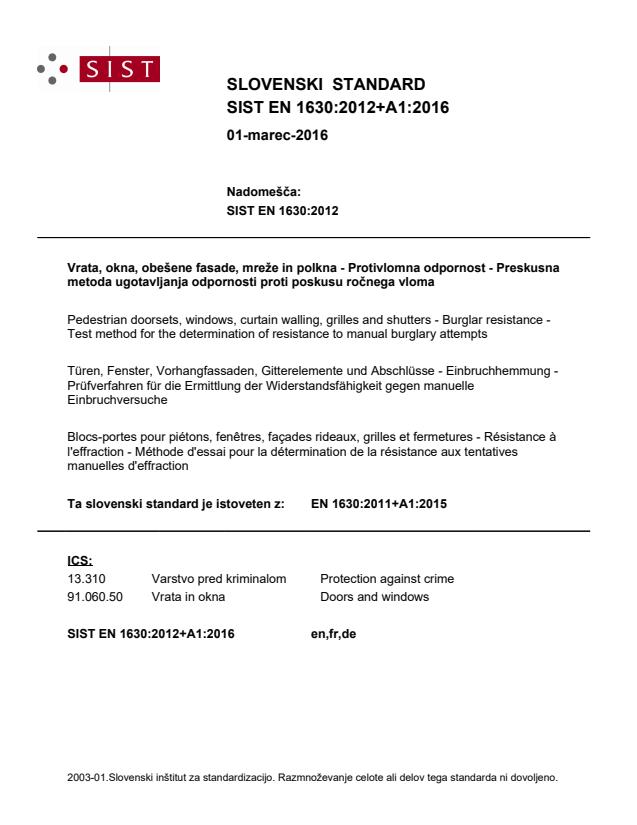
2003-01.Slovenski inštitut za standardizacijo. Razmnoževanje celote ali delov tega standarda ni dovoljeno.Türen, Fenster, Vorhangfassaden, Gitterelemente und Abschlüsse - Einbruchhemmung - Prüfverfahren für die Ermittlung der Widerstandsfähigkeit gegen manuelle EinbruchversucheBlocs-portes pour piétons, fenêtres, façades rideaux, grilles et fermetures - Résistance à l'effraction - Méthode d'essai pour la détermination de la résistance aux tentatives manuelles d'effractionPedestrian doorsets, windows, curtain walling, grilles and shutters - Burglar resistance - Test method for the determination of resistance to manual burglary attempts91.060.50Vrata in oknaDoors and windows13.310Varstvo pred kriminalomProtection against crimeICS:Ta slovenski standard je istoveten z:EN 1630:2011+A1:2015SIST EN 1630:2012+A1:2016en,fr,de01-marec-2016SIST EN 1630:2012+A1:2016SLOVENSKI
STANDARDSIST EN 1630:20121DGRPHãþD
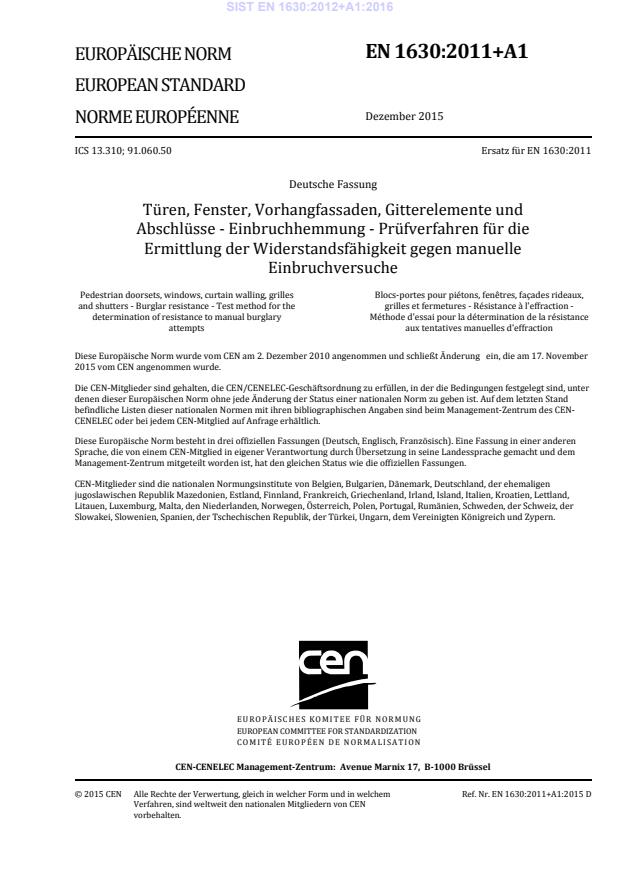
EUROPEAN STANDARD NORME EUROPÉENNE EUROPÄISCHE NORM
EN 1630:2011+A1
December
t r s w ICS
s uä u s râ
{ sä r x rä w r Supersedes EN
s x u rã t r s sEnglish Version
Pedestrian doorsetsá windowsá curtain wallingá grilles and shutters æ Burglar resistance æ Test method for the determination of resistance to manual burglary attemptsBlocsæportes pour piétonsá fenêtresá façades rideauxá grilles et fermetures æ Résistance à l 5effraction æ Méthode d 5essai pour la détermination de la résistance aux tentatives manuelles d 5effraction
Türená Fensterá Vorhangfassadená Gitterelemente und Abschlüsse æ Einbruchhemmung æ Prüfverfahren für die Ermittlung der Widerstandsfähigkeit gegen manuelle Einbruchversuche This European Standard was approved by CEN on
t December
t r s r and includes Amendment
approved by CEN on
s y November
t r s wä
egulations which stipulate the conditions for giving this European Standard the status of a national standard without any alterationä Upætoædate lists and bibliographical references concerning such national standards may be obtained on application to the CENæCENELEC Management Centre or to any CEN memberä
translation under the responsibility of a CEN member into its own language and notified to the CENæCENELEC Management Centre has the same status as the official versionsä
CEN members are the national standards bodies of Austriaá Belgiumá Bulgariaá Croatiaá Cyprusá Czech Republicá Denmarká Estoniaá Finlandá Former Yugoslav Republic of Macedoniaá Franceá Germanyá Greeceá Hungaryá Icelandá Irelandá Italyá Latviaá Lithuaniaá Luxembourgá Maltaá Netherlandsá Norwayá Polandá Portugalá Romaniaá Slovakiaá Sloveniaá Spainá Swedená Switzerlandá Turkey and United Kingdomä
EUROPEAN COMMITTEE FOR STANDARDIZATION COMITÉ EUROPÉEN DE NORMALISATION EUROPÄISCHES KOMITEE FÜR NORMUNG
CEN-CENELEC Management Centre:
Avenue Marnix 17,
B-1000 Brussels
t r s w CEN All rights of exploitation in any form and by any means reserved worldwide for CEN national Membersä Refä Noä EN
s x u rã t r s s ªA sã t r s w ESIST EN 1630:2012+A1:2016
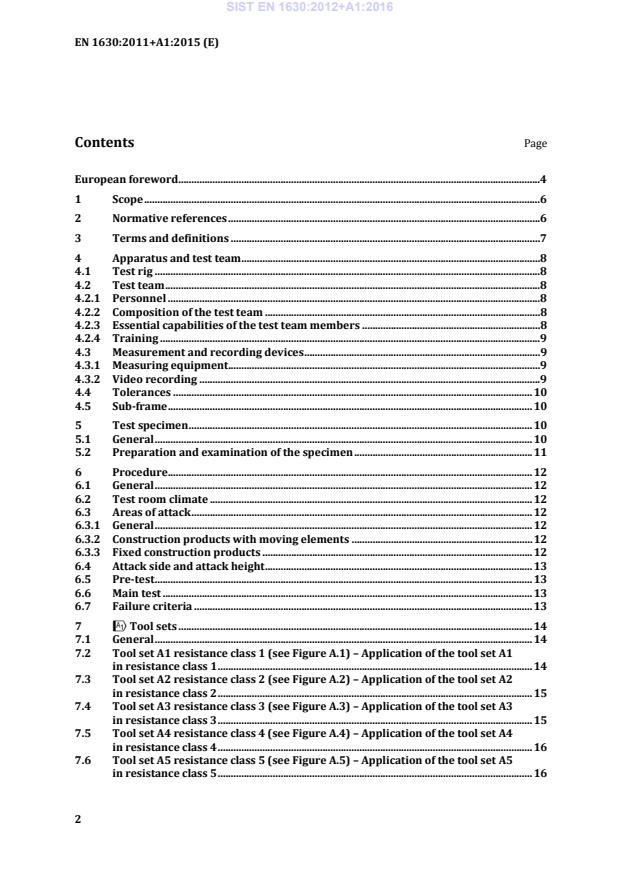
European foreword .4 1 Scope .6 2 Normative references .6 3 Terms and definitions .7 4 Apparatus and test team .8 4.1 Test rig .8 4.2 Test team .8 4.2.1 Personnel .8 4.2.2 Composition of the test team .8 4.2.3 Essential capabilities of the test team members .8 4.2.4 Training .9 4.3 Measurement and recording devices .9 4.3.1 Measuring equipment.9 4.3.2 Video recording .9 4.4 Tolerances . 10 4.5 Sub-frame . 10 5 Test specimen . 10 5.1 General . 10 5.2 Preparation and examination of the specimen . 11 6 Procedure . 12 6.1 General . 12 6.2 Test room climate . 12 6.3 Areas of attack . 12 6.3.1 General . 12 6.3.2 Construction products with moving elements . 12 6.3.3 Fixed construction products . 12 6.4 Attack side and attack height . 13 6.5 Pre-test . 13 6.6 Main test . 13 6.7 Failure criteria . 13 7 !Tool sets . 14 7.1 General . 14 7.2 Tool set A1 resistance class 1 (see Figure A.1) – Application of the tool set A1 in resistance class 1 . 14 7.3 Tool set A2 resistance class 2 (see Figure A.2) – Application of the tool set A2 in resistance class 2 . 15 7.4 Tool set A3 resistance class 3 (see Figure A.3) – Application of the tool set A3 in resistance class 3 . 15 7.5 Tool set A4 resistance class 4 (see Figure A.4) – Application of the tool set A4 in resistance class 4 . 16 7.6 Tool set A5 resistance class 5 (see Figure A.5) – Application of the tool set A5 in resistance class 5 . 16 SIST EN 1630:2012+A1:2016
Tool sets . 19 A.1 Tool set A1 . 19 A.2 Tool set A2 . 20 A.3 Tool set A3 . 21 A.4 Tool set A4 . 22 A.5 Tool set A5 . 23 A.6 Tool set A6 . 24 Annex B (normative)
Test sequence for manual test of resistance classes 2 to 6 . 25 B.1 Test sequence for manual test of resistance classes 2 to 6 . 25 Annex C (normative)
Example of test equipment Dimensions in mm . 26 Annex D (informative)
Examples of mounting arrangements . 27 D.1 Examples of mounting arrangements for doorsets . 27 D.2 Examples of mounting arrangements for windows . 29 D.3 Examples of mounting arrangements for wing and folding shutters . 30 D.4 Examples of mounting arrangements for guide rails and roller shutters into the test rig . 33 D.5 Examples of mounting arrangements for grilles into the test rig . 36 Bibliography . 37
It is acknowledged that there are two aspects to the burglar resistance performance of construction products, their normal resistance to forced operation and their ability to remain fixed to the building. Due to the limitation of reproducing the fixing methods and building construction in a laboratory environment this aspect is not fully covered by the standard. This is particularly true with products built into a building. The performance of the fixed part of the product is evaluated using a standard sub frame. It is the manufacturer´s responsibility to ensure that guidance on the fixing of the product is contained in the mounting instructions and that this guidance is suitable for the burglar resistance class claimed for the product. As with the other referenced standards this specification uses a standard sub frame and the product is mounted according to the manufacturers' instructions. An example for the contents of the manufacturer´s installation instructions is given in Annex A of EN 1627:2011. This test method does not evaluate the performance of the fixing to the building. This European Standard does not apply to doors, gates and barriers, intended for installation in areas in the reach of persons, and for which the main intended uses are giving safe access for goods and vehicles accompanied or driven by persons in industrial, commercial or residential premises, as covered by EN 13241-1. 2 Normative references The following referenced documents are indispensable for the application of this document. For dated references, only the edition cited applies. For undated references, the latest edition of the referenced document (including any amendments) applies. EN 356:1999, Glass in building - Security glazing - Testing and classification of resistance against manual attack EN 1303:2005, Building hardware - Cylinders for locks - Requirements and test methods EN 1627:2011, Pedestrian doorsets, windows, curtain walling, grilles and shutters - Burglar resistance - Requirements and classification !EN 1628:2011+A1:2015", Pedestrian doorsets, windows, curtain walling, grilles and shutters - Burglar resistance - Test method for the determination of resistance under static loading !EN 1629:2011+A1:2015", Pedestrian doorsets, windows, curtain walling, grilles and shutters - Burglar resistance - Test method for the determination of resistance under dynamic loading EN 1906:2010, Building hardware - Lever handles and knob furniture - Requirements and test methods SIST EN 1630:2012+A1:2016
At least two members of the test team shall be capable of performing the manual test. At least one member of the test team shall be competent to record the data and observations in such a way that a test report can be established. For each test in an area of attack only one test team member shall be permitted. 4.2.3 Essential capabilities of the test team members In order to perform the manual test, test team members shall be able to demonstrate that they are:
— mentally alert and well-motivated to maintain a sustained burglary attack; — physically able to perform the test, and are able to withstand the physical strain likely to be imposed for the duration of the test;
— free from mobility impairments and have normal vision, corrected where necessary; SIST EN 1630:2012+A1:2016
In addition, the test team shall be able to demonstrate detailed knowledge and understanding of: — the design and manufacture of burglar resistant construction products including the locks, hardware and materials used; — current modus operandi during burglary attacks; — operation and control of test equipment; — operation, control and maintenance of the attack tool sets; — operation, control and maintenance of the measuring equipment; — the handling of the tools used when performing the test for burglar resistance. 4.2.4 Training The test team shall have the opportunity for continuous development of skills and expertise appropriate to the performance of the tests, including: — checking and assessing of video recording of the tests by the test team;
NOTE Video records may also form the basis for demonstrating the competence of test team members. — the exchange of knowledge and experience between testing bodies and police agencies;
— further training e.g. measuring techniques, material information, new construction products, new opening and closing techniques. 4.3 Measurement and recording devices 4.3.1 Measuring equipment The following equipment shall be provided: a)
chronometer for measuring the resistance time; b)
chronometer for measuring the total test time; c)
equipment for determining temperature and relative humidity. 4.3.2 Video recording The pre-test and the main test conducted on each test specimen shall be fully recorded with a video recorder. !The videotape and any copies of it shall not be published nor shown publicly without permission from the applicant." NOTE 1 The video may be used as a reference when subsequent changes are made to the product.
NOTE 2 A time reference or code should be shown in the video. SIST EN 1630:2012+A1:2016
...
2003-01.Slovenski inštitut za standardizacijo. Razmnoževanje celote ali delov tega standarda ni dovoljeno.Türen, Fenster, Vorhangfassaden, Gitterelemente und Abschlüsse - Einbruchhemmung - Prüfverfahren für die Ermittlung der Widerstandsfähigkeit gegen manuelle EinbruchversucheBlocs-portes pour piétons, fenêtres, façades rideaux, grilles et fermetures - Résistance à l'effraction - Méthode d'essai pour la détermination de la résistance aux tentatives manuelles d'effractionPedestrian doorsets, windows, curtain walling, grilles and shutters - Burglar resistance - Test method for the determination of resistance to manual burglary attempts91.060.50Vrata in oknaDoors and windows13.310Varstvo pred kriminalomProtection against crimeICS:Ta slovenski standard je istoveten z:EN 1630:2011+A1:2015SIST EN 1630:2012+A1:2016en,fr,de01-marec-2016SIST EN 1630:2012+A1:2016SLOVENSKI
STANDARDSIST EN 1630:20121DGRPHãþD
EUROPÄISCHE NORM EUROPEAN STANDARD NORME EUROPÉENNE
EN 1630:2011+A1
Dezember
t r s w ICS
s uä u s râ
{ sä r x rä w r Ersatz für EN
s x u rã t r s sDeutsche Fassung
Türená Fensterá Vorhangfassadená Gitterelemente und Abschlüsse æ Einbruchhemmung æ Prüfverfahren für die Ermittlung der Widerstandsfähigkeit gegen manuelle Einbruchversuche Pedestrian doorsetsá windowsá curtain wallingá grilles and shutters æ Burglar resistance æ Test method for the determination of resistance to manual burglary attempts
Blocsæportes pour piétonsá fenêtresá façades rideauxá grilles et fermetures æ Résistance à l 5effraction æ Méthode d 5essai pour la détermination de la résistance aux tentatives manuelles d 5effraction Diese Europäische Norm wurde vom CEN am
tä Dezember
t r s r angenommen und schließt Änderung
einá die am
s yä November
t r s w vom CEN angenommen wurdeä
ung zu erfüllená in der die Bedingungen festgelegt sindá unter denen dieser Europäischen Norm ohne jede Änderung der Status einer nationalen Norm zu geben istä Auf dem letzten Stand befindliche Listen dieser nationalen Normen mit ihren bibliographischen Angaben sind beim ManagementæZentrum des CENæCENELEC oder bei jedem CENæMitglied auf Anfrage erhältlichä
Spracheá die von einem CENæMitglied in eigener Verantwortung durch Übersetzung in seine Landessprache gemacht und dem ManagementæZentrum mitgeteilt worden istá hat den gleichen Status wie die offiziellen Fassungenä
CENæMitglieder sind die nationalen Normungsinstitute von Belgiená Bulgariená Dänemarká Deutschlandá der ehemaligen jugoslawischen Republik Mazedoniená Estlandá Finnlandá Frankreichá Griechenlandá Irlandá Islandá Italiená Kroatiená Lettlandá Litauená Luxemburgá Maltaá den Niederlandená Norwegená Österreichá Polená Portugalá Rumäniená Schwedená der Schweizá der Slowakeiá Sloweniená Spaniená der Tschechischen Republiká der Türkeiá Ungarná dem Vereinigten Königreich und Zypernä
EUROPÄISCHES KOMITEE FÜR NORMUNG EUROPEAN COMMITTEE FOR STANDARDIZATION
COMITÉ EUROPÉEN DE NORMALISATION
CEN-CENELEC Management-Zentrum:
Avenue Marnix 17,
B-1000 Brüssel
t r s w CEN Alle Rechte der Verwertungá gleich in welcher Form und in welchem Verfahrená sind weltweit den nationalen Mitgliedern von CEN vorbehaltenä Refä Nrä EN
s x u rã t r s s ªA sã t r s w DSIST EN 1630:2012+A1:2016
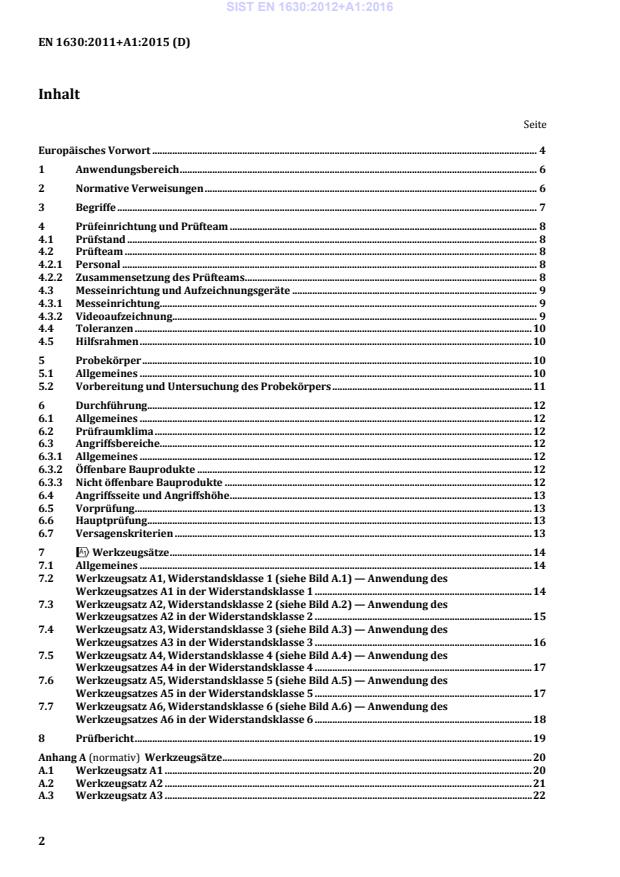
Werkzeugsätze . 20 A.1 Werkzeugsatz A1 . 20 A.2 Werkzeugsatz A2 . 21 A.3 Werkzeugsatz A3 . 22 SIST EN 1630:2012+A1:2016
Prüfablauf für die manuelle Prüfung in den Widerstandsklassen 2 bis 6 . 26 B.1 Prüfablauf für die manuelle Prüfung in den Widerstandsklassen 2 bis 6 . 26 Anhang C (normativ)
Beispiel für die Prüfeinrichtung . 27 Anhang D (informativ)
Montagebeispiele . 28 D.1 Montagebeispiele für Türelemente . 28 D.2 Montagebeispiele für Fenster . 30 D.3 Montagebeispiele für Dreh- und Faltläden . 31 D.4 Beispiele für den Einbau von Führungsschienen und Rollläden in den Prüfstand . 33 D.5 Beispiele für den Einbau von Gitterelementen in den Prüfstand . 36 Literaturhinweise . 37
Vorhangfassaden, Gitterelementen und Abschlüssen. Die anderen Normen der Reihe sind: EN 1627:2011, Türen, Fenster, Vorhangfassaden, Gitterelemente und Abschlüsse — Einbruchhemmung — Anforderungen und Klassifizierung !EN 1628:2011+A1:2015", Türen, Fenster, Vorhangfassaden, Gitterelemente und Abschlüsse — Einbruchhemmung — Prüfverfahren für die Ermittlung der Widerstandsfähigkeit unter statischer Belastung !EN 1629:2011+A1:2015", Türen, Fenster, Vorhangfassaden, Gitterelemente und Abschlüsse — Einbruchhemmung — Prüfverfahren für die Ermittlung der Widerstandsfähigkeit unter dynamischer Belastung Diese Norm ist eine Überarbeitung und ersetzt !EN 1630:2011". Die zwei anderen Normen in dieser Reihe sind Überarbeitungen und ersetzen jeweils !EN 1628:2011" und !EN 1629:2011". Die vorliegende Überarbeitung schließt Gitterelemente und Vorhangfassaden in den Anwendungsbereich ein. Die in der vorliegenden Norm beschriebene manuelle Prüfung umfasst die Schwachstellen der Prüfkörper, die in den in !EN 1628:2011+A1:2015" und !EN 1629:2011+A1:2015" beschriebenen Prüfungen unter statischer und dynamischer Belastung nicht ausreichend bewertet wurden. Bestimmte grundlegende Sicherheitsanforderungen an Schlösser, Beschläge und Zylinder sind durch die in EN 1627:2011, Tabelle 3 angeführten Anforderungen abgedeckt. Diese Sicherheitseigenschaften werden in dieser Prüfnorm nicht erneut bewertet; die Angriffsverfahren und Prüfzeiten wurden begrenzt, um das widerzuspiegeln. Die Verwendung von den in verschiedenen Werkzeugsätzen aufgeführten Werkzeugen ist in dieser Norm beschrieben. Dadurch wird die Vergleichbarkeit der Prüfung verbessert. SIST EN 1630:2012+A1:2016
EN 356:1999, Glas im Bauwesen — Sicherheitsverglasung: Prüfung und Klassifizierung der Widerstands-fähigkeit gegen manuellen Angriff EN 1303:2005, Baubeschläge — Schließzylinder für Schlösser — Anforderungen und Prüfverfahren EN 1627:2011, Türen, Fenster, Vorhangfassaden, Gitterelemente und Abschlüsse — Einbruchhemmung — Anforderungen und Klassifizierung !EN 1628:2011+A1:2015", Türen, Fenster, Vorhangfassaden, Gitterelemente und Abschlüsse — Einbruchhemmung — Prüfverfahren zur Ermittlung der Widerstandsfähigkeit unter statischer Belastung !EN 1629:2011+A1:2015", Türen, Fenster, Vorhangfassaden, Gitterelemente und Abschlüsse — Einbruchhemmung — Prüfverfahren zur Ermittlung der Widerstandsfähigkeit unter dynamischer Belastung EN 1906:2010, Schlösser und Baubeschläge — Türdrücker und Türknäufe — Anforderungen und Prüfver-fahren SIST EN 1630:2012+A1:2016
Mindestens zwei Mitglieder des Prüfteams müssen in der Lage sein, die manuelle Prüfung durchzuführen. Mindestens ein Mitglied des Prüfteams muss die erforderlichen Kenntnisse haben, um die Daten und Beobachtungen so aufzuzeichnen, dass ein Prüfbericht erstellt werden kann. Für jede Prüfung in einem Angriffsbereich ist nur ein Prüfer zulässig. 4.2.3 Wesentliche Fähigkeiten der Mitglieder des Prüfteams Die Mitglieder des Prüfteams müssen nachweisen können, dass sie: konzentrationsfähig sind und ausreichend motiviert sind, um einen Einbruchversuch ohne Unterbrechung durchzuführen; körperlich in der Lage sind, die Prüfung durchzuführen und die körperliche Belastung auszuhalten, die während der Prüfung zu erwarten ist; keine Bewegungseinschränkungen haben und über eine normale Sehkraft verfügen, gegebenenfalls mit Sehhilfe; in der Lage sind, derzeit übliche Vorgehensweisen bei Einbruchsversuchen anzuwenden, und zwar mit einem angemessenen, jedoch nicht übermäßigen Krafteinsatz, der einem für die Widerstandsklasse zu erwartenden Angriff entspricht; SIST EN 1630:2012+A1:2016
Videoaufnahmen können auch die Grundlage für den Nachweis der Fähigkeiten der Mitglieder des Prüfteams sein. Austausch von Kenntnissen und Erfahrungen zwischen Prüfstellen und Polizei; Weiterbildung, z. B. in Messtechniken, Informationen zum Material, neuen Bauprodukten, neuen Öffnungs- und Schließtechniken. 4.3 Messeinrichtung und Aufzeichnungsgeräte 4.3.1 Messeinrichtung Die folgende Einrichtung muss vorhanden sein: a) Stoppuhr zum Messen der Widerstandszeit; b) Stoppuhr zum Messen der Gesamtprüfzeit; c) Messgerät zum Bestimmen von Temperatur und relativer Luftfeuchte. 4.3.2 Videoaufzeichnung Die an jedem Probekörper durchgeführten Vor- und Hauptprüfungen sind vollständig mit einem Videorecorder aufzuzeichnen. !Die Aufzeichnung und mögliche Kopien dürfen ohne Genehmigung des Anwenders weder veröffentlicht noch öffentlich vorgeführt werden." ANMERKUNG 1 Die Aufzeichnung kann bei nachfolgenden Veränderungen am Produkt als Referenz verwendet werden. ANMERKUNG 2 Auf der Aufzeichnung sollte ein Zeitverweis oder Code vorhanden sein. ANMERKUNG 3 Wenn ein Prüflaboratorium mit der Prüfdurchführung beauftragt und ein Video aufgezeichnet wird, sollte das Prüflaboratorium Einschränkungen zur Verwendung des Videos in die Vertragsbedingungen mit dem Auftraggeber aufnehmen. SIST EN 1630:2012+A1:2016
...