

EN 1628:2011+A1:2015
(Main + Amendment)Pedestrian doorsets, windows, curtain walling, grilles and shutters - Burglar resistance - Test method for the determination of resistance under static loading
- Abstract
This European Standard specifies a test method for the determination of resistance to static loading in order to assess the burglar resistant properties of pedestrian door sets, windows, curtain walling, grilles and shutters. It is applicable to the following means of opening: Turning, tilting, folding, turn-tilting, top or bottom hung, sliding (horizontally and vertically) and rolling as well as fixed constructions.
This European Standard does not apply to doors, gates and barriers, intended for installation in areas in the reach of persons, and for which the main intended uses are giving safe access for goods and vehicles accompanied or driven by persons in industrial, commercial or residential premises, as covered by EN 13241-1.
- Status
- Withdrawn
- Publication Date
- 22-Dec-2015
- Withdrawal Date
- 06-Oct-2026
- Technical Committee
- CEN/TC 33 - Doors, windows, shutters and building hardware
- Drafting Committee
- CEN/TC 33/WG 7 - Burglary resistance
- Current Stage
- 9960 - Withdrawal effective - Withdrawal
- Start Date
- 02-Jun-2021
- Completion Date
- 07-Oct-2026
Buy Documents


Relations
- Effective Date
- 19-Jan-2023
- Effective Date
- 19-Jan-2023
- Effective Date
- 13-Jan-2016
- Effective Date
- 28-Jan-2026
- Effective Date
- 28-Jan-2026
- Effective Date
- 28-Jan-2026
- Refers
EN 1906:2010 - Building hardware - Lever handles and knob furniture - Requirements and test methods - Effective Date
- 28-Jan-2026
- Effective Date
- 28-Jan-2026
- Effective Date
- 28-Jan-2026
- Effective Date
- 28-Jan-2026
- Effective Date
- 28-Jan-2026
Buy Documents
Get Certified
Connect with accredited certification bodies for this standard

DIBt (Deutsches Institut für Bautechnik)
German Institute for Building Technology.
DIN CERTCO
DIN Group product certification.

Kiwa BDA Testing
Building and construction product certification.
Sponsored listings
Frequently Asked Questions
EN 1628:2011+A1:2015 is a standard published by the European Committee for Standardization (CEN). Its full title is "Pedestrian doorsets, windows, curtain walling, grilles and shutters - Burglar resistance - Test method for the determination of resistance under static loading". This standard covers: This European Standard specifies a test method for the determination of resistance to static loading in order to assess the burglar resistant properties of pedestrian door sets, windows, curtain walling, grilles and shutters. It is applicable to the following means of opening: Turning, tilting, folding, turn-tilting, top or bottom hung, sliding (horizontally and vertically) and rolling as well as fixed constructions. This European Standard does not apply to doors, gates and barriers, intended for installation in areas in the reach of persons, and for which the main intended uses are giving safe access for goods and vehicles accompanied or driven by persons in industrial, commercial or residential premises, as covered by EN 13241-1.
This European Standard specifies a test method for the determination of resistance to static loading in order to assess the burglar resistant properties of pedestrian door sets, windows, curtain walling, grilles and shutters. It is applicable to the following means of opening: Turning, tilting, folding, turn-tilting, top or bottom hung, sliding (horizontally and vertically) and rolling as well as fixed constructions. This European Standard does not apply to doors, gates and barriers, intended for installation in areas in the reach of persons, and for which the main intended uses are giving safe access for goods and vehicles accompanied or driven by persons in industrial, commercial or residential premises, as covered by EN 13241-1.
EN 1628:2011+A1:2015 is classified under the following ICS (International Classification for Standards) categories: 13.310 - Protection against crime; 91.060.50 - Doors and windows. The ICS classification helps identify the subject area and facilitates finding related standards.
EN 1628:2011+A1:2015 has the following relationships with other standards: It is inter standard links to EN 1628:2011, EN 1628:2011/FprA1, EN 1628:2021, EN 12195-2:2000, EN 1627:2011, EN 12209:2003, EN 1906:2010, EN 1630:2011+A1:2015, EN 1303:2005, EN 356:1999, EN 1629:2011+A1:2015. Understanding these relationships helps ensure you are using the most current and applicable version of the standard.
EN 1628:2011+A1:2015 is available in PDF format for immediate download after purchase. The document can be added to your cart and obtained through the secure checkout process. Digital delivery ensures instant access to the complete standard document.
Standards Content (Sample)
2003-01.Slovenski inštitut za standardizacijo. Razmnoževanje celote ali delov tega standarda ni dovoljeno.Türen, Fenster, Vorhangfassaden, Gitterelemente und Abschlüsse - Einbruchhemmung - Prüfverfahren für die Ermittlung der Widerstandsfähigkeit unter statischer BelastungBlocs-portes pour piétons, fenêtres, façades rideaux, grilles et fermetures - Résistance à l'effraction - Méthode d'essai pour la détermination de la résistance à la charge statiquePedestrian doorsets, windows, curtain walling, grilles and shutters - Burglar resistance - Test method for the determination of resistance under static loading91.060.50Vrata in oknaDoors and windows13.310Varstvo pred kriminalomProtection against crimeICS:Ta slovenski standard je istoveten z:EN 1628:2011+A1:2015SIST EN 1628:2012+A1:2016en,fr,de01-marec-2016SIST EN 1628:2012+A1:2016SLOVENSKI
STANDARDSIST EN 1628:20121DGRPHãþD
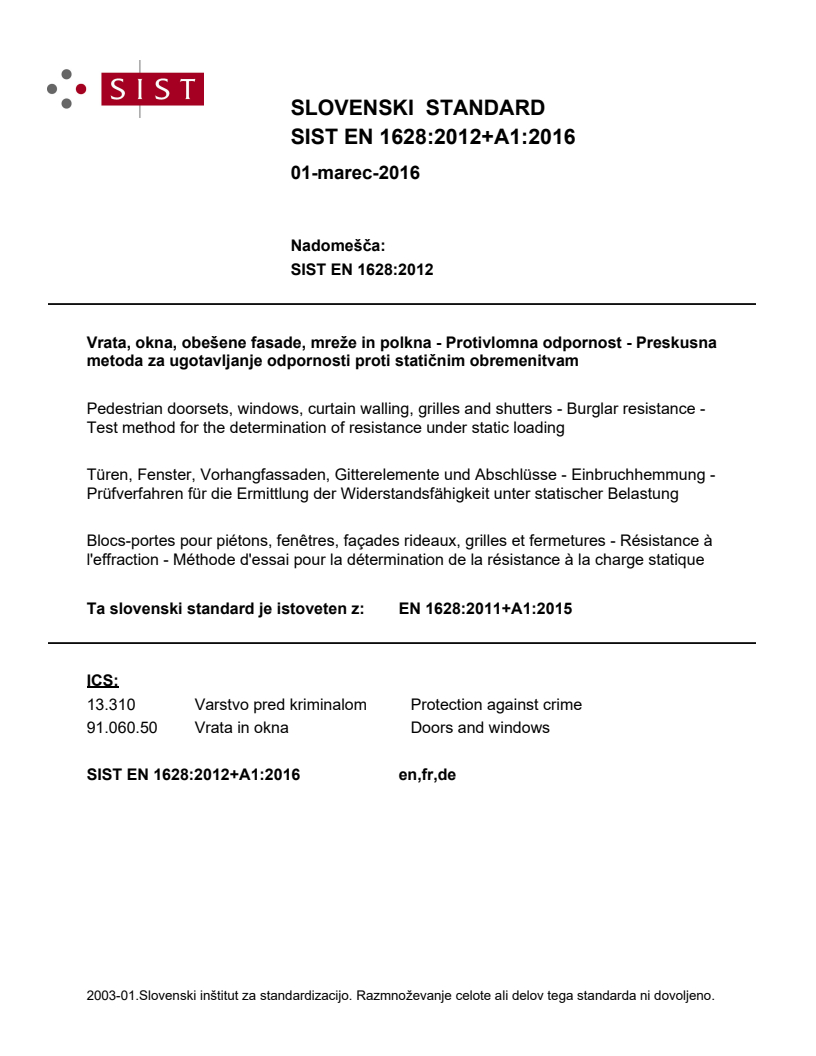
EUROPEAN STANDARD NORME EUROPÉENNE EUROPÄISCHE NORM
EN 1628:2011+A1
December
t r s w ICS
s uä u s râ
{ sä r x rä w r Supersedes EN
s x t zã t r s sEnglish Version
Pedestrian doorsetsá windowsá curtain wallingá grilles and shutters æ Burglar resistance æ Test method for the determination of resistance under static loading Blocsæportes pour piétonsá fenêtresá façades rideauxá grilles et fermetures æ Résistance à l 5effraction æ Méthode d 5essai pour la détermination de la résistance à la charge statique
Türená Fensterá Vorhangfassadená Gitterelemente und Abschlüsse æ Einbruchhemmung æ Prüfverfahren für die Ermittlung der Widerstandsfähigkeit unter statischer Belastung This European Standard was approved by CEN on
t December
t r s r and includes Amendment
approved by CEN on
s y November
t r s wä
egulations which stipulate the conditions for giving this European Standard the status of a national standard without any alterationä Upætoædate lists and bibliographical references concerning such national standards may be obtained on application to the CENæCENELEC Management Centre or to any CEN memberä
translation under the responsibility of a CEN member into its own language and notified to the CENæCENELEC Management Centre has the same status as the official versionsä
CEN members are the national standards bodies of Austriaá Belgiumá Bulgariaá Croatiaá Cyprusá Czech Republicá Denmarká Estoniaá Finlandá Former Yugoslav Republic of Macedoniaá Franceá Germanyá Greeceá Hungaryá Icelandá Irelandá Italyá Latviaá Lithuaniaá Luxembourgá Maltaá Netherlandsá Norwayá Polandá Portugalá Romaniaá Slovakiaá Sloveniaá Spainá Swedená Switzerlandá Turkey and United Kingdomä
EUROPEAN COMMITTEE FOR STANDARDIZATION COMITÉ EUROPÉEN DE NORMALISATION EUROPÄISCHES KOMITEE FÜR NORMUNG
CEN-CENELEC Management Centre:
Avenue Marnix 17,
B-1000 Brussels
t r s w CEN All rights of exploitation in any form and by any means reserved worldwide for CEN national Membersä Refä Noä EN
s x t zã t r s s ªA sã t r s w ESIST EN 1628:2012+A1:2016
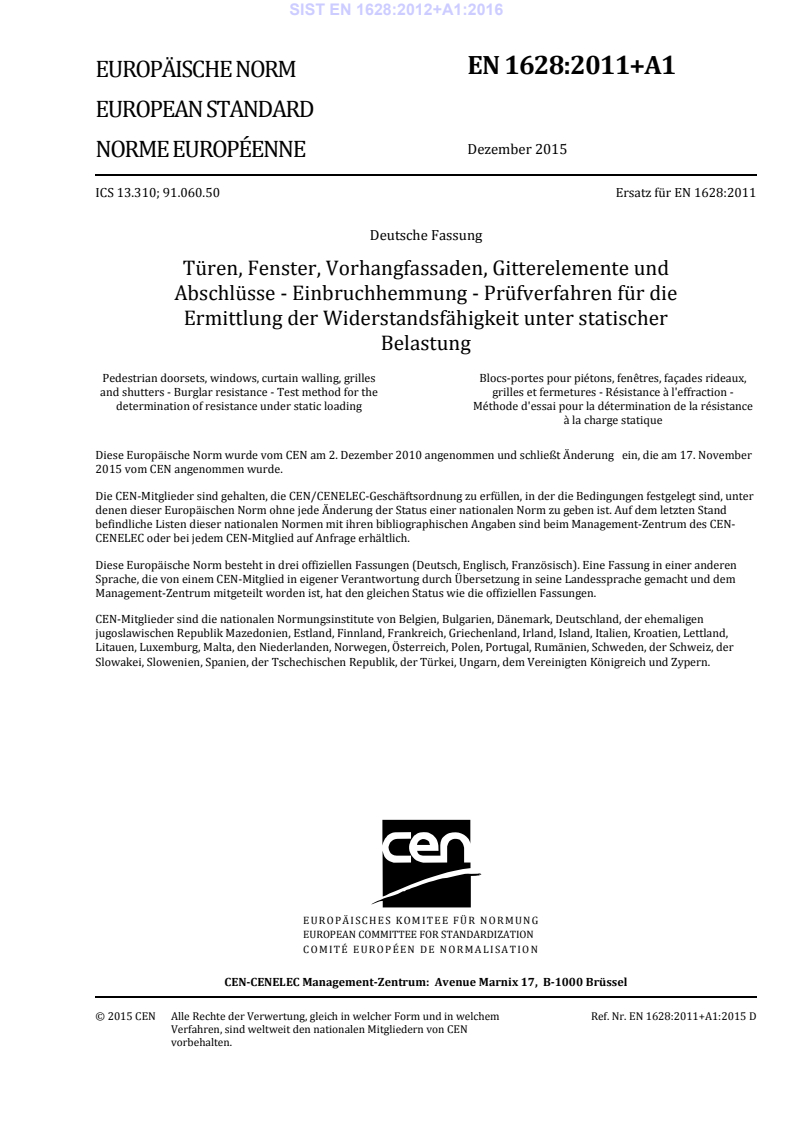
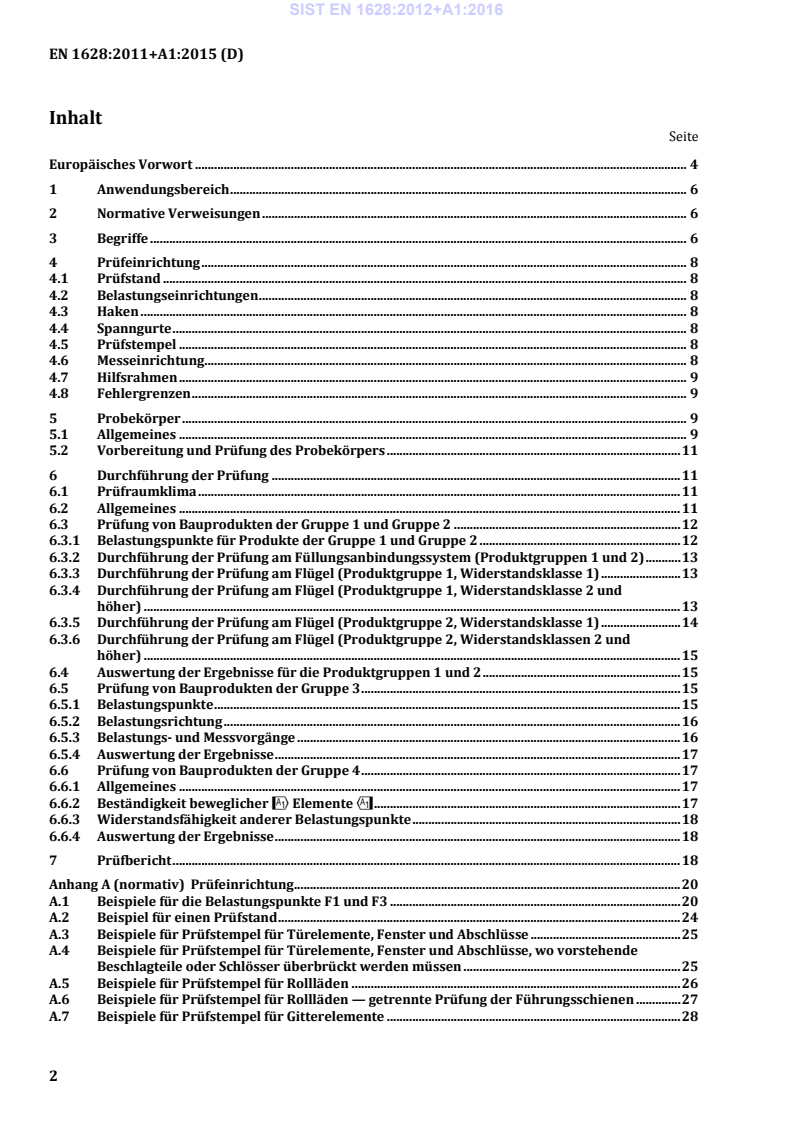
European foreword . 5 1 Scope . 7 2 Normative references . 7 3 Terms and definitions . 7 4 Apparatus . 9 4.1 Test rig . 9 4.2 Load applicators . 9 4.3 Hooks . 9 4.4 Straps. 9 4.5 Pressure pads . 9 4.6 Measuring equipment . 9 4.7 Sub-frame . 9 4.8 Tolerances . 10 5 Test specimen . 10 5.1 General . 10 5.2 Preparation and examination of the test specimen . 12 6 Procedure . 12 6.1 Test room climate . 12 6.2 General . 12 6.3 Testing of group 1 and group 2 construction products . 12 6.3.1 Loading points for group 1 and group 2 products . 12 6.3.2 Test procedure for the infill medium retention system (product groups 1 and 2) . 13 6.3.3 Test procedure for the leaf (product group 1, burglar resistance class 1) . 14 6.3.4 Test procedure for the leaf (product group 1, burglar resistance classes 2 and higher) . 14 6.3.5 Test procedure for the leaf (product group 2, burglar resistance class 1) . 14 6.3.6 Test procedure for the leaf (product group 2, burglar resistance classes 2 and higher) . 15 6.4 Expression of results for product groups 1 and 2 . 15 6.5 Testing of group 3 construction products . 16 6.5.1 Loading points . 16 6.5.2 Loading direction . 16 6.5.3 Loading and measurement procedure . 16 6.5.4 Expression of results . 17 6.6 Testing of group 4 construction products . 17 6.6.1 General . 17 6.6.2 Resistance of moving !elements" . 18 6.6.3 Resistance of other loading points . 18 6.6.4 Expression of results . 18 7 Test report . 18 Annex A (normative)
Test Equipment . 20 A.1 Examples for loading points F1 and F3 . 20 SIST EN 1628:2012+A1:2016
Test sequence for static loading test in resistance classes 1 to 6 . 74 Annex C (normative)
Dislocation of window hardware against the locking direction . 76 C.1 General . 76 C.2 Test criteria . 76 C.3 Test method . 76 Bibliography . 79
The test rig is consisting of a rigid steel frame with movable steel supports into which test specimens of various dimensions can be mounted, as shown in Figure A.5. The stiffness of the rig shall be such that a 15 kN force applied to any of the defined points and normal to the plane of the frame shall not cause a deflection of more than 5 mm. The test rig shall not impede the execution of the test. 4.2 Load applicators
The load applicators consisting of a hydraulic ram or similar loading device shall be capable of applying the required test forces progressively and without shock. 4.3 Hooks
Hooks are shown in Figure A.12. 4.4 Straps
Straps shall conform to EN 12195-2 or equivalent and have a minimum tensile strength of 5kN. These straps may be used to apply some of the loads. 4.5 Pressure pads
Pressure pads are shown in Figures A.6 to A.11. 4.6 Measuring equipment
The measurement equipment is consisting of the following: a) equipment to display and/or record the forces being applied; b) a chronometer with seconds display for measuring the loading times; c) equipment for determining temperature and relative humidity; d) calliper and/or depth gauge; e) angle measuring instrument; f) four gap gauges as shown in Figures A.13 and A.14: gap gauge A shall be 10 mm in diameter, gap gauge B shall be 25 mm in diameter, gap gauge C shall be 50 mm in diameter, gap gauge D shall have an elliptical form with a major diameter of 250 mm and a minor diameter of 150 mm. NOTE
The various gap gauges detailed in A.10 are used to evaluate the resistance to an applied load. They represent an acceptable level of deformation of the various products above which vulnerabilities may be exposed. They are not intended to represent any particular attack method but are used as a simple method to establishing failure. 4.7 Sub-frame The sub-frame shall simulate the support given to the product when installed into a building and shall be taken into consideration in the manufacturer´s installation instructions. It shall typically consist of the following: SIST EN 1628:2012+A1:2016
± 5 % Dimensions < 20 mm ± 0,5 mm
·
t r to
w r r mm ± 1,0 mm
·
w r r to
t 000 mm ± 2.0 mm
·
t 000 mm ± 3,0 mm Angle
± 2° Time
± 1 % Temperature
± 2 °C Relative humidity
± 5 % 5 Test specimen 5.1 General Each test specimen shall be a functioning product complete with its frames, hardware, guide rails, curtain, tube, roller box and accessories, as appropriate. When testing roller shutters at least two test specimens consisting of separate sections of the guide rails shall be supplied for test. These sections shall be 1 m in length (see Figure A.56). The test specimen shall be fixed square and plumb and without twist or bend into a sub-frame. The installation shall be in accordance with the manufacturer's instructions as detailed in Clause 10 of EN 1627:2011, including the method of fixing, packing supports, sealing requirements, etc. (see Figures A.15 to A.63). !The sub-frame shall be supported by the test rig so that there will be no movement of the sub-frame during the test." The sub-frame shall simulate the support given to the product when installed into a building. !Products that are intended to be installed in orientations other than vertical (e.g. roof lights) may be installed in the vertical orientation for the purpose of this test." NOTE 1
The product may be installed directly into a building !structure" as intended in practice. For the purposes of this standard, the test specimen shall be glazed according to the relevant glazing resistance class of EN 356:1999, corresponding to the resistance class of the construction product according to EN 1627:2011, as shown in Table 1. Security glazing, when used in an insulating glass unit, is normally positioned on the non-attack side. For the purpose of this test, the glass pane offering the highest security level shall be positioned on the attack side of the sample. !Products shall be glazed in accordance with the manufacturer’s specification." SIST EN 1628:2012+A1:2016
Accessible opening through the glazing
itself Fixing of the glazing on the complete element Glazing fitted on the test sample Test criteria
(EN 1630) RC1 N No test, no requirements Test according to EN 1628, EN 1629, EN 1630 P4A No test RC2 N No test, no requirements Test according to EN 1628, EN 1629, EN 1630 P4A Accessible opening according to EN 1630:2011+A1:2015, 3.11
RC2 No test, classification according to EN 356 class P4A Test according to EN 1628, EN 1629, EN 1630 P4A Accessible opening according to EN 1630:2011+A1:2015, 3.11 RC3 No test, classification according to EN 356 class P5A Test according to EN 1628, EN 1629, EN 1630 P5A Accessible opening according to EN 1630:2011+A1:2015, 3.11 RC4 No test, classification according to EN 356 class P6B Test according to EN 1628, EN 1629, EN 1630 P6B Accessible opening according to EN 1630:2011+A1:2015, 3.11 RC5 Classification according to EN 356 class P7B and manual test according to EN 1630 Test according to EN 1628, EN 1629, EN 1630 P7B Accessible opening according to EN 1630:2011+A1:2015, 3.11 RC6 Classification according to EN 356 class P8B and manual test according to EN 1630 Test according to EN 1628, EN 1629, EN 1630 P8B Accessible opening according to EN 1630:2011+A1:2015, 3.11 " !NOTE 2
If a higher grade of glass is used on the test specimens, it may not be possible to assess the use of lower grade glass within those products without conducting further tests. This is because higher grades of glass may increase the rigidity of the product." NOTE !3" The test specimen used in this test may also be used for the dynamic test in accordance with !EN 1629" and the pre-test in accordance with !EN 1630", provided that any damage caused by these tests will not affect the result of the pre-test. SIST EN 1628:2012+A1:2016
Each test specimen shall be examined and the direction to disengage each locking point shall be noted. During testing the test specimen shall be closed and locked at the declared closing condition in accordance with the manufacturer's instructions. All locking hardware that can be disengaged from the attack side without the use of a key or tool shall be disengaged during all tests. Products in resistance class 1 shall additionally be prepared prior to the static loading test by removing all parts on the attack side that can be unscrewed, dismounted or disassembled using the tools described in !EN 1630:2011+A1:2015", Annex A, tool set A1. Parts must not be damaged during this procedure. The total time for this preparation procedure shall not exceed 3 minutes.
The parts removed during this preparation shall be recorded. 6 Procedure 6.1 Test room climate The test room temperature shall be maintained between 15 °C and 30 °C. The relative humidity in the test room shall be between 30 % and 70 %. 6.2 General The specified test loads detailed in EN 1627:2011 shall be applied in the order specified in 7.1 of EN 1627:2011 at the various loading points using the load applicator. The ability of the products to resist static loading shall be assessed by means of a gap gauge, as shown in Figures A.13 and A.14. The complete test procedure shall be carried out as shown in Annex B. Details of the hardware shall be recorded and their performance in terms of EN 1303:2005, EN 12209:2003 and EN 1906:2010 shall be identified, where relevant. !Should the glass break during any tests, the test programme shall proceed with the broken glass in situ. Adhesive film may be applied to the glass to protect the tester. F2 loads will be applied progressively and without shock over a period of 10 s to 20 s and will be maintained for a period of 8 s to 12 s." 6.3 Testing of group 1 and group 2 construction products 6.3.1 Loading points for group 1 and group 2 products 6.3.1.1 Loading point F1: infilling corner The specified load shall be applied, in turn, to each corner of the infilling medium at a point as shown in Figure A.1, unless the infilling medium is circular, in which case four points shall be selected at approximately equidistant intervals around the edge. The load shall be applied in a direction to SIST EN 1628:2012+A1:2016
For the purpose of this test, the leaf of the test specimen shall be restrained to resist any deflection between leaf and frame due to the loads applied to the infilling medium. The restraint shall have a nominal contact area of 100 X 50 mm and offer restraint in the opposite directions to the applied load. The load F1 shall be applied progressively and without shock over a period of 10 s to 20 s and within 5° of perpendicular to plane to each corner of the infill medium. The load shall be maintained for a period of 8 s to 12 s. If the retention system exhibits any sign of disengagement at a corner, the loading test shall be continued along each section of the retention system in an attempt to defeat the system. Subsequent loads shall be applied at intervals of a minimum of 50 mm. SIST EN 1628:2012+A1:2016
In all cases, the F3 load shall be applied progressively and without shock over a period of 10 s to 20 s and within 5° of the desired direction. These loads shall be maintained for a period of 8 s to 12 s. After that the load shall be removed without shock. SIST EN 1628:2012+A1:2016
6.5.1 Loading points 6.5.1.1 General Loads shall be applied to the weakest points of the test specimen at the loading points F1, F1.1, F2 and F3 for the static testing of roller shutters, as described in 6.5.1.2–6.5.1.5 and as shown in Figures A.56 to A.59. 6.5.1.2 Loading point F1: connection between guide rail and roller curtain Loading point F1 for roller shutters shall correspond to loading point F1 for infilling corners of door
sets and windows, as shown in Figure A.59. 6.5.1.3 Loading point F1.1: Guide rails as separate components Loading point F1.a is a point located on the guide rail of group 3 products.
The load is applied to the guide rail as a separate component, as shown in Figure A.56. 6.5.1.4 Loading point F2: extraction of bottom lath and roller curtain Loading point F2 for the roller curtain and the bottom lath in the middle between the guide rails, as shown in Figures A.58, shall correspond with the loading point F2 for, doors sets and windows. 6.5.1.5 Loading point F3: Lift up of roller curtain Loading points F3 shall correspond with those at the locking points of doors sets and windows, as shown in Figure A.57. Any additional locks shall also be loaded by this method. 6.5.2 Loading direction The loading direction for the loading points F1, F1.1 and F2, as shown in Figures A.58 and A.59 shall be dependent on the attack side (levering out of the curtain ends). Test specimens with two defined attack sides shall undergo two tests. The loading on the loading points F3, as shown in Figure A.57, shall be applied in the direction of opening (e.g. sliding up of a roller shutter with an overhead roller tube). 6.5.3 Loading and measurement procedure 6.5.3.1 Guide rail deflection test The guide rail deflection test shall be carried out on each guide rail submitted for test. The rail exhibiting the highest angular measurement shall be selected for the tests described in 6.5.3.2 and 6.5.3.3. The test shall be carried out on guide rails as separate components. The installation of the guide rails shall be in accordance with the manufacturer’s published mounting instructions, e.g. the cavity fills and the distance A between the fixing points of the guide rails. The leg of the guide rail on the attack side shall be loaded, as shown in Figure A.56. The load F1.1 shall be applied progressively and without shock over a period of 10 s to 20 s. It shall be maintained for 8 s to 12 s. The angular displacement shall be measured with the load F1.a applied as shown in Figure A.56. SIST EN 1628:2012+A1:2016
...
2003-01.Slovenski inštitut za standardizacijo. Razmnoževanje celote ali delov tega standarda ni dovoljeno.Türen, Fenster, Vorhangfassaden, Gitterelemente und Abschlüsse - Einbruchhemmung - Prüfverfahren für die Ermittlung der Widerstandsfähigkeit unter statischer BelastungBlocs-portes pour piétons, fenêtres, façades rideaux, grilles et fermetures - Résistance à l'effraction - Méthode d'essai pour la détermination de la résistance à la charge statiquePedestrian doorsets, windows, curtain walling, grilles and shutters - Burglar resistance - Test method for the determination of resistance under static loading91.060.50Vrata in oknaDoors and windows13.310Varstvo pred kriminalomProtection against crimeICS:Ta slovenski standard je istoveten z:EN 1628:2011+A1:2015SIST EN 1628:2012+A1:2016en,fr,de01-marec-2016SIST EN 1628:2012+A1:2016SLOVENSKI
STANDARDSIST EN 1628:20121DGRPHãþD
EUROPÄISCHE NORM EUROPEAN STANDARD NORME EUROPÉENNE
EN 1628:2011+A1
Dezember
t r s w ICS
s uä u s râ
{ sä r x rä w r Ersatz für EN
s x t zã t r s sDeutsche Fassung
Türená Fensterá Vorhangfassadená Gitterelemente und Abschlüsse æ Einbruchhemmung æ Prüfverfahren für die Ermittlung der Widerstandsfähigkeit unter statischer Belastung Pedestrian doorsetsá windowsá curtain wallingá grilles and shutters æ Burglar resistance æ Test method for the determination of resistance under static loading
Blocsæportes pour piétonsá fenêtresá façades rideauxá grilles et fermetures æ Résistance à l 5effraction æ Méthode d 5essai pour la détermination de la résistance à la charge statique Diese Europäische Norm wurde vom CEN am
tä Dezember
t r s r angenommen und schließt Änderung
einá die am
s yä November
t r s w vom CEN angenommen wurdeä
ung zu erfüllená in der die Bedingungen festgelegt sindá unter denen dieser Europäischen Norm ohne jede Änderung der Status einer nationalen Norm zu geben istä Auf dem letzten Stand befindliche Listen dieser nationalen Normen mit ihren bibliographischen Angaben sind beim ManagementæZentrum des CENæCENELEC oder bei jedem CENæMitglied auf Anfrage erhältlichä
Spracheá die von einem CENæMitglied in eigener Verantwortung durch Übersetzung in seine Landessprache gemacht und dem ManagementæZentrum mitgeteilt worden istá hat den gleichen Status wie die offiziellen Fassungenä
CENæMitglieder sind die nationalen Normungsinstitute von Belgiená Bulgariená Dänemarká Deutschlandá der ehemaligen jugoslawischen Republik Mazedoniená Estlandá Finnlandá Frankreichá Griechenlandá Irlandá Islandá Italiená Kroatiená Lettlandá Litauená Luxemburgá Maltaá den Niederlandená Norwegená Österreichá Polená Portugalá Rumäniená Schwedená der Schweizá der Slowakeiá Sloweniená Spaniená der Tschechischen Republiká der Türkeiá Ungarná dem Vereinigten Königreich und Zypernä
EUROPÄISCHES KOMITEE FÜR NORMUNG EUROPEAN COMMITTEE FOR STANDARDIZATION
COMITÉ EUROPÉEN DE NORMALISATION
CEN-CENELEC Management-Zentrum:
Avenue Marnix 17,
B-1000 Brüssel
t r s w CEN Alle Rechte der Verwertungá gleich in welcher Form und in welchem Verfahrená sind weltweit den nationalen Mitgliedern von CEN vorbehaltenä Refä Nrä EN
s x t zã t r s s ªA sã t r s w DSIST EN 1628:2012+A1:2016
Seite Europäisches Vorwort . 4 1 Anwendungsbereich . 6 2 Normative Verweisungen . 6 3 Begriffe . 6 4 Prüfeinrichtung . 8 4.1 Prüfstand . 8 4.2 Belastungseinrichtungen . 8 4.3 Haken . 8 4.4 Spanngurte . 8 4.5 Prüfstempel . 8 4.6 Messeinrichtung . 8 4.7 Hilfsrahmen . 9 4.8 Fehlergrenzen . 9 5 Probekörper . 9 5.1 Allgemeines . 9 5.2 Vorbereitung und Prüfung des Probekörpers . 11 6 Durchführung der Prüfung . 11 6.1 Prüfraumklima . 11 6.2 Allgemeines . 11 6.3 Prüfung von Bauprodukten der Gruppe 1 und Gruppe 2 . 12 6.3.1 Belastungspunkte für Produkte der Gruppe 1 und Gruppe 2 . 12 6.3.2 Durchführung der Prüfung am Füllungsanbindungssystem (Produktgruppen 1 und 2) . 13 6.3.3 Durchführung der Prüfung am Flügel (Produktgruppe 1, Widerstandsklasse 1) . 13 6.3.4 Durchführung der Prüfung am Flügel (Produktgruppe 1, Widerstandsklasse 2 und höher) . 13 6.3.5 Durchführung der Prüfung am Flügel (Produktgruppe 2, Widerstandsklasse 1) . 14 6.3.6 Durchführung der Prüfung am Flügel (Produktgruppe 2, Widerstandsklassen 2 und höher) . 15 6.4 Auswertung der Ergebnisse für die Produktgruppen 1 und 2 . 15 6.5 Prüfung von Bauprodukten der Gruppe 3 . 15 6.5.1 Belastungspunkte . 15 6.5.2 Belastungsrichtung . 16 6.5.3 Belastungs- und Messvorgänge . 16 6.5.4 Auswertung der Ergebnisse . 17 6.6 Prüfung von Bauprodukten der Gruppe 4 . 17 6.6.1 Allgemeines . 17 6.6.2 Beständigkeit beweglicher !Elemente" . 17 6.6.3 Widerstandsfähigkeit anderer Belastungspunkte . 18 6.6.4 Auswertung der Ergebnisse . 18 7 Prüfbericht . 18 Anhang A (normativ)
Prüfeinrichtung . 20 A.1 Beispiele für die Belastungspunkte F1 und F3 . 20 A.2 Beispiel für einen Prüfstand . 24 A.3 Beispiele für Prüfstempel für Türelemente, Fenster und Abschlüsse . 25 A.4 Beispiele für Prüfstempel für Türelemente, Fenster und Abschlüsse, wo vorstehende Beschlagteile oder Schlösser überbrückt werden müssen . 25 A.5 Beispiele für Prüfstempel für Rollläden . 26 A.6 Beispiele für Prüfstempel für Rollläden — getrennte Prüfung der Führungsschienen . 27 A.7 Beispiele für Prüfstempel für Gitterelemente . 28 SIST EN 1628:2012+A1:2016
Prüffolge für die statische Belastungsprüfung in den Widerstandsklassen 1 bis 6 . 78 Anhang C (normativ)
Verschiebung von Fensterbeschlägen entgegen der Verriegelungsrichtung . 79 C.1 Allgemeines . 79 C.2 Prüfkriterien . 79 C.3 Prüfverfahren . 79 Literaturhinweise. 82
Europäisches Vorwort Dieses Dokument (EN 1628:2011+A1:2015) wurde vom Technischen Komitee CEN/TC 33 „Türen, Tore, Fenster, Abschlüsse, Baubeschläge und Vorhangfassaden“ erarbeitet, dessen Sekretariat vom AFNOR gehalten wird. Diese Europäische Norm muss den Status einer nationalen Norm erhalten, entweder durch Veröffentlichung eines identischen Textes oder durch Anerkennung bis Monat Juni 2016, und etwaige entgegenstehende nationale Normen müssen bis Juni 2016 zurückgezogen werden. Es wird auf die Möglichkeit hingewiesen, dass einige Elemente dieses Dokuments Patentrechte berühren können. CEN [und/oder CENELEC] sind nicht dafür verantwortlich, einige oder alle diesbezüglichen Patentrechte zu identifizieren. Dieses Dokument enthält die Änderung 1, die vom CEN am 2015-11-17 angenommen wurde.
Dieses Dokument ersetzt !EN 1628:2011". Anfang und Ende der durch die Änderung eingefügten oder geänderten Texte sind jeweils durch Änderungsmarken !" angegeben. Die vorliegende Europäische Norm ist ein Teil einer Normenreihe zu einbruchhemmenden Türen, Fenstern, Vorhangfassaden, Gitterelementen und Abschlüssen. Die anderen Normen der Reihe sind: EN 1627:2011, Türen, Fenster, Vorhangfassaden, Gitterelemente und Abschlüsse — Einbruchhemmung
— Anforderungen und Klassifizierung !EN 1629:2011+A1:2015", Türen, Fenster, Vorhangfassaden, Gitterelemente und Abschlüsse — Einbruchhemmung
— Prüfverfahren für die Ermittlung der Widerstandsfähigkeit unter dynamischer Belastung !EN 1630:2011+A1:2015", Türen, Fenster, Vorhangfassaden, Gitterelemente und Abschlüsse — Einbruchhemmung — Prüfverfahren für die Ermittlung der Widerstandsfähigkeit gegen manuelle Einbruchversuche Diese Norm ist eine Überarbeitung und ersetzt !EN 1628:2011". Die zwei anderen Normen in dieser Reihe sind Überarbeitungen und ersetzen jeweils EN 1629:2011 und !EN 1630:2011". Die vorliegende Überarbeitung schließt Gitterelemente und Vorhangfassaden in den Anwendungsbereich ein. Es gibt zwei Aspekte der einbruchhemmenden Leistungsfähigkeit eines Bauproduktes, dessen Widerstand gegen gewaltsame Öffnung und die Fähigkeit, im Gebäude fest verankert zu bleiben. Auf Grund der Ein-schränkungen, die Befestigungsverfahren und die Bauweise des Gebäudes in einer Laborumgebung nach-bilden zu können, ist dieser Aspekt in der vorliegenden Norm nicht vollständig abgedeckt. Dieses gilt vor allem für Produkte, die in ein Gebäude eingebaut sind. Die Leistungsfähigkeit des befestigten Teils des Produktes wird mit Hilfe eines Norm-Hilfsrahmens bewertet. Es liegt in der Verantwortung des Herstellers, dafür zu sorgen, dass eine Anleitung zur Befestigung des Produktes in den Montageanweisungen enthalten ist und dass diese Anleitung für die durch das Produkt beanspruchte Klasse der Einbruchhemmung geeignet ist. Wie in den weiteren in Bezug genommenen Normen wird das Bauprodukt für die Prüfung in einen SIST EN 1628:2012+A1:2016
EN 356:1999, Glas im Bauwesen — Sicherheitssonderverglasung — Prüfung und Klassifizierung des Widerstandes gegen manuellen Angriff EN 1303:2005, Baubeschläge — Schließzylinder für Schlösser — Anforderungen und Prüfverfahren EN 1627:2011, Türen, Fenster, Vorhangfassaden, Gitterelemente und Abschlüsse — Einbruchhemmung — Anforderungen und Klassifizierung !EN 1630:2011+A1:2015", Türen, Fenster, Vorhangfassaden, Gitterelemente und Abschlüsse — Einbruchhemmung — Prüfverfahren zur Ermittlung der Widerstandsfähigkeit gegen manuelle Einbruchversuche EN 1906:2010, Schlösser und Baubeschläge — Türdrücker und Türknäufe — Anforderungen und Prüfver-fahren EN 12195-2, Ladungssicherungseinrichtungen auf Straßenfahrzeugen — Sicherheit — Teil 2: Zurrgurte aus Chemiefasern EN 12209:2003, Schlösser und Baubeschläge — Schlösser; Mechanisch betätigte Schlösser und Schließ-bleche — Anforderungen und Prüfverfahren 3 Begriffe Für die Anwendung dieses Dokuments gelten die Begriffe nach EN 1627:2011 und die folgenden Begriffe. !" 3.1 Probekörper komplettes, vollständig funktionsfähiges Bauprodukt in Übereinstimmung mit der Beschreibung im Anwen-dungsbereich der vorliegenden Norm SIST EN 1628:2012+A1:2016
verschiedener Produkte, bei deren Überschreitung die Schutzwirkung beeinträchtigt werden könnte.
Sie sollen kein bestimmtes Angriffsverfahren darstellen, werden aber als einfaches Verfahren zur Ermittlung von Versagenskriterien eingesetzt. SIST EN 1628:2012+A1:2016
bei Produkten der Gruppe 1 bis Gruppe 4; b) zusätzlich bei Produkten der Gruppe 3 und Gruppe 4 aus einem Stahlrohr 40 mm × 40 mm × 3 mm und einer Grundplatte aus 8 mm Stahl, in mehreren Teilen, die für Belastungszwecke, falls notwendig, ab-nehmbar sein müssen. Siehe Bilder A.15 bis A.32. 4.8 Fehlergrenzen Sofern in dieser Europäischen Norm nicht anders festgelegt, müssen die folgenden Fehlergrenzen für die Prüfeinrichtung gelten: Belastung
± 5 % Maße < 20 mm ± 0,5 mm
R 20 mm bis 500 mm ± 1,0 mm
R 500 mm bis 2 000 mm ± 2,0 mm
R 2 000 mm ± 3,0 mm Winkel
± 2° Zeit
± 1 % Temperatur
± 2 °C Relative Luftfeuchte
± 5 % 5 Probekörper 5.1 Allgemeines Jeder Probekörper muss ein funktionsfähiges, vollständiges Bauprodukt mit entsprechenden Rahmen, Beschlägen, Führungsschienen, Panzer, Welle, Rollladenkasten und Zubehörteilen sein. Bei der Prüfung von Rollläden sind für die Prüfung mindestens zwei Probekörper zur Verfügung zu stellen, die aus einzelnen Abschnitten der Führungsschienen bestehen. Diese Abschnitte müssen 1 m lang sein (siehe Bild A.56). Der Probekörper ist im Lot und ohne Verwindung oder Krümmung in einem Hilfsrahmen zu befestigen. Der Einbau muss in Übereinstimmung mit den Montageanweisungen des Herstellers wie in EN 1627:2011, Abschnitt 10, beschrieben erfolgen, einschließlich Befestigungsverfahren, Hinterfütterung, Anforderungen an die Dichtung usw. (siehe Bilder A.15 bis A.63). !Der Hilfsrahmen muss vom Prüfstand gehalten werden, damit sich der Hilfsrahmen während der Prüfung nicht bewegt."Der Hilfsrahmen simuliert die bauliche Umgebung der späteren Montage im Gebäude. !Produkte, die nicht für den Einbau in vertikaler Ausrichtung vorgesehen sind (z. B. Dachoberlichter), sind zum Zweck dieser Prüfung vertikal einzubauen." SIST EN 1628:2012+A1:2016
Zugängliche Öffnung durch die Verglasung Befestigung der Verglasung am gesamten Bauteil Vergla-sung am Probe-körper Prüfkriterien (EN 1630) RC1 N Keine Prüfung, keine Anforderungen Prüfung nach EN 1628, EN 1629, EN 1630 P4A Keine Prüfung RC2 N Keine Prüfung, keine Anforderungen Prüfung nach EN 1628, EN 1629, EN 1630 P4A Zugängliche Öffnung nach EN 1630:2011+A1:2015, 3.11 RC2 Keine Prüfung, Klassifizierung nach EN 356, Klasse P4A Prüfung nach EN 1628, EN 1629, EN 1630 P4A Zugängliche Öffnung nach EN 1630:2011+A1:2015, 3.11 RC3 Keine Prüfung, Klassifizierung nach EN 356, Klasse P5A Prüfung nach EN 1628, EN 1629, EN 1630 P5A Zugängliche Öffnung nach EN 1630:2011+A1:2015, 3.11 RC4 Keine Prüfung, Klassifizierung nach EN 356, Klasse P6B Prüfung nach EN 1628, EN 1629, EN 1630 P6B Zugängliche Öffnung nach EN 1630:2011+A1:2015, 3.11 RC5 Klassifizierung nach EN 356, Klasse P7B, und Tastprüfung nach EN 1630 Prüfung nach EN 1628, EN 1629, EN 1630 P7B Zugängliche Öffnung nach EN 1630:2011+A1:2015, 3.11 RC6 Klassifizierung nach EN 356, Klasse P8B, und Tastprüfung nach EN 1630 Prüfung nach EN 1628, EN 1629, EN 1630 P8B Zugängliche Öffnung nach EN 1630:2011+A1:2015, 3.11 " !ANMERKUNG 2 Wird an den Probekörpern höherwertiges Glas verwendet, ist es unter Umständen nicht möglich, eine Beurteilung der Produkte bei Verwendung von Glas geringerer Qualität vorzunehmen, ohne weitere Prüfungen durchzuführen. Das liegt daran, dass höherwertiges Glas die Steifigkeit des Produkts erhöhen kann." ANMERKUNG !3" Der in dieser Prüfung verwendete Probekörper darf auch für die dynamische Prüfung nach !EN 1629" und die Vorprüfung nach !EN 1630" verwendet werden, sofern ein möglicher Schaden durch diese Prüfungen das Prüfergebnis der Vorprüfung nicht beeinträchtigt. SIST EN 1628:2012+A1:2016
Wenn eine Trennkraft gefordert wird, ist eine Belastung auch auf andere !Teile" des Produktes aufzubringen. Die Belastung F3.a ist so lange aufzubringen und zu halten, bis Belastungspunkt F3 belastet und wieder entlastet wurde. SIST EN 1628:2012+A1:2016
ist senkrecht zur Ebene des Schiebeelementes an den exemplarischen Punkten nach Bild A.39 (Rechtecke in den Flügelecken) aufzubringen. In allen Fällen ist die F3-Belastung zunehmend und stoßfrei für die Dauer von 10 s bis 20 s und innerhalb einer Grenzabweichung von 5° in der gewünschten Richtung aufzubringen. Diese Belastungen sind für 8 s bis 12 s aufrecht zu erhalten. Danach sind alle Belastungen stoßfrei zurückzunehmen. Alle Belastungspunkte müssen geprüft werden, es sei denn, das Bauprodukt hält den Belastungen nicht stand. Als Regel gilt, dass Kippschiebefenster und Faltschiebefenster als Produktgruppe 1 geprüft werden sollten, falls die Ausführung der Beschläge und die Öffnungsbewegung wie bei Kippdreh- oder Drehfenstern ist (um den Verriegelungsmechanismus zu lösen). 6.3.5.2 Hebeschiebe-Tür/-Fenster Die Belastungen sind auf die Punkte nach den Bildern A.11 und A.40 aufzubringen. Die erste Prüfung muss die Eigenschaft des Schließmechanismus beurteilen, einer auf die Belastungspunkte in Öffnungsrichtung der Hebeschiebetür aufgebrachten Belastung zu widerstehen (die Belastungsachse liegt in der Ebene des Flügels). Zuerst ist die am Belastungspunkt F3.a (z. B. in Bild A.40 – untere Ecke des Hebeflügels) aufgebrachte Belastung entgegen der Verriegelungsrichtung und/oder in Heberichtung aufzubringen. Sie ist zunehmend und stoßfrei über eine Zeitspanne von höchstens 30 s aufzubringen. Während diese Belastung F3.a aufrechterhalten wird, ist eine zweite Belastung F3 in Öffnungsrichtung des Hebe- und Schiebeelementes aufzubringen. Die zweite Belastung ist zunehmend und stoßfrei über eine Zeitspanne von höchstens 30 s aufzubringen. Diese Belastung ist für eine Dauer von 8 s bis 12 s aufrechtzuerhalten. Danach werden die Belastung F3 und anschließend die Belastung F3.a stoßfrei zurückgenommen. Die zweite Prüfung muss die Festigkeit des Hebe- und Schiebeelementes in seinem Rahmen beurteilen. Die Belastung F3 an den Belastungspunkten
ist senkrecht zur Ebene des Hebe- und Schiebeelementes an den exemplarischen Punkten nach Bild A.40 (Rechtecke in den Flügelecken) aufzubringen. SIST EN 1628:2012+A1:2016
...