

EN 14035-38:2006
(Main)Fireworks - Part 38: Shot tubes - Specification and test methods
- Abstract
This European Standard specifies requirements for the construction, performance, primary packaging and labelling of shot tubes and the corresponding test methods. It is applicable to fireworks which are classified as shot tubes in categories 2 and 3 in EN 14035-2.
It is not applicable to shot tubes containing pyrotechnic composition which includes any of the following substances:
— arsenic or arsenic compounds;
— mixtures containing a mass fraction of chlorates greater than 80 %;
— mixtures of chlorates with metals;
— mixtures of chlorates with red phosphorus;
— mixtures of chlorates with potassium hexacyanoferrate(II);
— mixtures of chlorates with sulfur;
— mixtures of chlorates with sulfides;
— lead or lead compounds;
— mercury compounds;
— white phosphorus;
— picrates or picric acid;
— potassium chlorate with a mass fraction of bromates greater than 0,15 %;
— sulfur with an acidity, expressed as mass fraction of sulfuric acid, greater than 0,002 %;
— zirconium with a particle size of less than 40 mm.
NOTE In EN 14035-2, shot tubes are classified as follows:
— brief description: tube containing propellant charge and a pyrotechnic unit, with or without a transmitting fuse;
— principal effects: ejection of the pyrotechnic unit, producing a visual and/or aural effect in the air.
Schemes for type testing of shot tubes and batch testing of shot tubes are specified in Annex A and Annex B respectively.
- Status
- Withdrawn
- Publication Date
- 21-Feb-2006
- Withdrawal Date
- 28-Sep-2010
- Technical Committee
- CEN/TC 212 - Fireworks
- Drafting Committee
- CEN/TC 212 - Fireworks
- Current Stage
- 9960 - Withdrawal effective - Withdrawal
- Start Date
- 29-Sep-2010
- Completion Date
- 29-Sep-2010

Relations
- Effective Date
- 08-Jun-2022
- Effective Date
- 08-Jun-2022
- Replaced By
EN 15947-4:2010 - Pyrotechnic articles - Fireworks, Categories 1, 2 and 3 - Part 4: Test methods - Effective Date
- 08-Jun-2022
Get Certified
Connect with accredited certification bodies for this standard

ECOCERT
Organic and sustainability certification.

Eurofins Food Testing Global
Global leader in food, environment, and pharmaceutical product testing.

Intertek Bangladesh
Intertek certification and testing services in Bangladesh.
Sponsored listings
Frequently Asked Questions
EN 14035-38:2006 is a standard published by the European Committee for Standardization (CEN). Its full title is "Fireworks - Part 38: Shot tubes - Specification and test methods". This standard covers: This European Standard specifies requirements for the construction, performance, primary packaging and labelling of shot tubes and the corresponding test methods. It is applicable to fireworks which are classified as shot tubes in categories 2 and 3 in EN 14035-2. It is not applicable to shot tubes containing pyrotechnic composition which includes any of the following substances: — arsenic or arsenic compounds; — mixtures containing a mass fraction of chlorates greater than 80 %; — mixtures of chlorates with metals; — mixtures of chlorates with red phosphorus; — mixtures of chlorates with potassium hexacyanoferrate(II); — mixtures of chlorates with sulfur; — mixtures of chlorates with sulfides; — lead or lead compounds; — mercury compounds; — white phosphorus; — picrates or picric acid; — potassium chlorate with a mass fraction of bromates greater than 0,15 %; — sulfur with an acidity, expressed as mass fraction of sulfuric acid, greater than 0,002 %; — zirconium with a particle size of less than 40 mm. NOTE In EN 14035-2, shot tubes are classified as follows: — brief description: tube containing propellant charge and a pyrotechnic unit, with or without a transmitting fuse; — principal effects: ejection of the pyrotechnic unit, producing a visual and/or aural effect in the air. Schemes for type testing of shot tubes and batch testing of shot tubes are specified in Annex A and Annex B respectively.
This European Standard specifies requirements for the construction, performance, primary packaging and labelling of shot tubes and the corresponding test methods. It is applicable to fireworks which are classified as shot tubes in categories 2 and 3 in EN 14035-2. It is not applicable to shot tubes containing pyrotechnic composition which includes any of the following substances: — arsenic or arsenic compounds; — mixtures containing a mass fraction of chlorates greater than 80 %; — mixtures of chlorates with metals; — mixtures of chlorates with red phosphorus; — mixtures of chlorates with potassium hexacyanoferrate(II); — mixtures of chlorates with sulfur; — mixtures of chlorates with sulfides; — lead or lead compounds; — mercury compounds; — white phosphorus; — picrates or picric acid; — potassium chlorate with a mass fraction of bromates greater than 0,15 %; — sulfur with an acidity, expressed as mass fraction of sulfuric acid, greater than 0,002 %; — zirconium with a particle size of less than 40 mm. NOTE In EN 14035-2, shot tubes are classified as follows: — brief description: tube containing propellant charge and a pyrotechnic unit, with or without a transmitting fuse; — principal effects: ejection of the pyrotechnic unit, producing a visual and/or aural effect in the air. Schemes for type testing of shot tubes and batch testing of shot tubes are specified in Annex A and Annex B respectively.
EN 14035-38:2006 is classified under the following ICS (International Classification for Standards) categories: 71.100.30 - Explosives. Pyrotechnics and fireworks. The ICS classification helps identify the subject area and facilitates finding related standards.
EN 14035-38:2006 has the following relationships with other standards: It is inter standard links to EN 15947-3:2010, EN 15947-5:2010, EN 15947-4:2010. Understanding these relationships helps ensure you are using the most current and applicable version of the standard.
EN 14035-38:2006 is available in PDF format for immediate download after purchase. The document can be added to your cart and obtained through the secure checkout process. Digital delivery ensures instant access to the complete standard document.
Standards Content (Sample)
2003-01.Slovenski inštitut za standardizacijo. Razmnoževanje celote ali delov tega standarda ni dovoljeno.Fireworks - Part 38: Shot tubes - Specification and test methodsOgnjemet - 38. del: Tulci, enostrelni - Specifikacija in preskusne metodeArtifices de divertissement - Partie 38: Chandelles monocoup - Spécifications et méthodes d'essaiFeuerwerkskörper - Teil 38: Feuerwerksrohre - Anforderungen und PrüfverfahrenTa slovenski standard je istoveten z:EN 14035-38:2006SIST EN 14035-38:2006en,fr,de71.100.30ICS:SLOVENSKI
STANDARDSIST EN 14035-38:200601-maj-2006
EUROPEAN STANDARDNORME EUROPÉENNEEUROPÄISCHE NORMEN 14035-38February 2006ICS 71.100.30 English VersionFireworks - Part 38: Shot tubes - Specification and test methodsArtifices de divertissement - Partie 38: Chandellesmonocoup - Spécifications et méthodes d'essaiFeuerwerkskörper - Teil 38: Feuerwerksrohre -Anforderungen und PrüfverfahrenThis European Standard was approved by CEN on 30 December 2005.CEN members are bound to comply with the CEN/CENELEC Internal Regulations which stipulate the conditions for giving this EuropeanStandard the status of a national standard without any alteration. Up-to-date lists and bibliographical references concerning such nationalstandards may be obtained on application to the Central Secretariat or to any CEN member.This European Standard exists in three official versions (English, French, German). A version in any other language made by translationunder the responsibility of a CEN member into its own language and notified to the Central Secretariat has the same status as the officialversions.CEN members are the national standards bodies of Austria, Belgium, Cyprus, Czech Republic, Denmark, Estonia, Finland, France,Germany, Greece, Hungary, Iceland, Ireland, Italy, Latvia, Lithuania, Luxembourg, Malta, Netherlands, Norway, Poland, Portugal, Romania,Slovakia, Slovenia, Spain, Sweden, Switzerland and United Kingdom.EUROPEAN COMMITTEE FOR STANDARDIZATIONCOMITÉ EUROPÉEN DE NORMALISATIONEUROPÄISCHES KOMITEE FÜR NORMUNGManagement Centre: rue de Stassart, 36
B-1050 Brussels© 2006 CENAll rights of exploitation in any form and by any means reservedworldwide for CEN national Members.Ref. No. EN 14035-38:2006: E
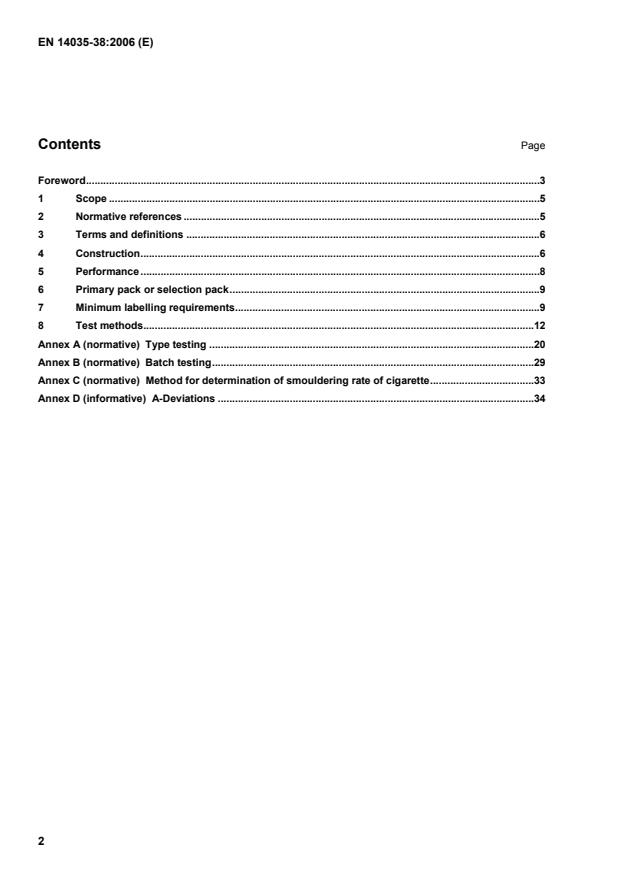
Type testing.20 Annex B (normative)
Batch testing.29 Annex C (normative)
Method for determination of smouldering rate of cigarette.33 Annex D (informative)
A-Deviations.34
Specifications (IEC 61672-1:2002) EN 61672-2, Electroacoustics — Sound level meters — Part 2: Pattern evaluation tests (IEC 61672-2:2003) EN ISO 845, Cellular plastics and rubbers — Determination of apparent (bulk) density (ISO 845:1988) EN ISO 868, Plastics and ebonite — Determination of indentation hardness by means of a durometer (Shore hardness) (ISO 868:2003) EN ISO 2439, Flexible cellular polymeric materials — Determination of hardness (indentation technique) (ISO 2439:1997, including Technical Corrigendum 1:1998) ISO 2859-1, Sampling procedures for inspection by attributes — Part 1: Sampling schemes indexed by acceptance quality limit (AQL) for lot-by-lot inspection ISO 3599, Vernier callipers reading to 0,1 and 0,05 mm 3 Terms and definitions For the purposes of this European Standard, the terms and definitions given in EN 14035-1:2003 apply. 4 Construction 4.1 Means of ignition The means of ignition shall be identified by a protruding fuse. Conformity to this requirement shall be verified by visual examination. 4.2 Attachment of initial fuse The attachment of the protruding fuse to the shot tube shall be secure when tested in accordance with 8.1. 4.3 Protection of initial fuse 4.3.1 General The initial fuse shall be protected in one of the ways specified in 4.3.2, 4.3.3 or 4.3.4. 4.3.2 Initial fuse protected by fuse cover An orange fuse cover shall be in place over the initial fuse. Conformity to this requirement shall be verified by visual examination. 4.3.3 Initial fuse protected by primary pack or selection pack The shot tube shall be contained in a primary pack or selection pack conforming to Clause 6. Conformity to this requirement shall be verified by visual examination. 4.3.4 Protruding fuse designed to resist side ignition When tested in accordance with 8.6, the protruding fuse shall not ignite.
1) If applicable.
7.4 Name, address and telephone number of manufacturer or distributor or importer Labelling shall include: — name or trade mark, the address and the telephone number of the manufacturer; or — an abbreviation or a code allowing the identification of the manufacturer, and the name or trade mark, the address and the telephone number: — of his authorized distributor; or — if the manufacturer is not established in a CEN member country, of the importer in a CEN member country. The address shall comprise at least the town and the country. On the shot tube at least the abbreviations allowing the identification of — the manufacturer; or — the distributor or importer. An additional code or abbreviation for the manufacturer shall be marked. 7.5 Reference to this European Standard A shot tube shall be marked with ‘EN 14035-38'. A primary pack shall be marked with the words 'Contents conform to EN 14035-38'. 7.6 Printing 7.6.1 Labelling Labelling shall be clearly visible, easily legible, indelible and on a single-colour background. NOTE Printing errors which are not misleading should not be classified as faults. 7.6.2 Type size When measured in accordance with 8.7, the type sizes shall be such that the height of the capital letter “X” (in upper case) is at least 2,8 mm for the information specified in 7.2, 7.3 and 7.8 and at least 2,1 mm for the other information. 7.7 Marking of very small shot tubes 7.7.1 Reduced size If the shot tube does not provide enough space for the specified information using the types sizes specified in 7.6.2, for the information specified in 7.2 and 7.3 the type size shall be reduced to 2,1 mm. 7.7.2 Reduced information If the shot tube does not provide enough space to carry all the specified information even in reduced type size, at least the information specified in 7.4 shall be given on the shot tube, if at all possible.
Where y is the distance, in m, from the viewing point to the testing point (see Figure 2). The observer is positioned so that the bottom edge of the triangle on the front screen coincides with the top of the shot tube and the bottom edge of the tape on the back screen coincides with the bottom edge of the horizontal tape on the front screen.
Key 1 acrylic glass 2 black tape, 10 mm to 20 mm wide 3 solid base 4 stand Figure 1 – Viewing screen
Key 1 top of shot tube 2 sighting device 3 position of observer Figure 2 – Use of a viewing screen to monitor a height of 20 m 8.3.2.5 Measuring device, capable of measuring a height of 1,0 m to the nearest 10 mm. 8.3.3 Procedure 8.3.3.1 Measure and record the wind speed (see 8.3.1.3). 8.3.3.2 If carrying out a type test of shot tubes, set up the microphone of the sound level meter (8.3.2.3) in the test area (8.3.1.1 or 8.3.1.2), at a height of 1,0 m above the ground, determined by the measuring device (8.3.2.5), and at a horizontal distance from the testing point of 8,0 m for category 2 shot tubes or 15,0 m for category 3 shot tubes. Direct the microphone horizontally towards the testing point and, if necessary, connect it to the sound level meter. 8.3.3.3 Position the shot tube, in accordance with the instructions on the label, in the centre of the test area. Remove the orange fuse cover, if any, and straighten the initial fuse, if necessary. Apply the ignition source (8.3.2.2) and, at the same instant, start the timing device (8.3.2.1). Observe the intermediate time at the moment the initial fuse ignites. If the initial fuse fails to ignite within 10 s, record the fact and do not proceed with further testing of that shot tube. Otherwise, stop the timing device when the shot tube starts to produce its principal effects. Record whether the initial fuse ignited within 10 s and whether the ignition of the initial fuse was visible. 8.3.3.4 Record the duration of the initial fuse burning. Observe and record whether the pyrotechnic unit is ejected and whether it functions. After the shot tube has ceased to function start the timing device (8.3.2.1) immediately and record whether any flames caused by the functioning of the shot tube are extinguished within 60,0 s after the shot tube has ceased to function.
6,0 m, for a category 2 shot tube, or 15,0 m, for a category 3 shot tube, from the testing point. Observe and record whether the shot tube remains upright whilst functioning. 8.3.3.5 Record the maximum A-weighted impulse sound pressure level, as measured by the sound level meter (8.3.2.3). 8.3.3.6 After the shot tube has ceased to function examine the firework case and record whether it has any additional holes or splits. 8.4 Determination of internal diameter (type test) 8.4.1 Apparatus Vernier callipers, reading to 0,1 mm, complying with ISO 3599. 8.4.2 Procedure Using the callipers (8.4.1), measure the inside diameter of the shot tube to the nearest 1 mm. Record the diameter. 8.5 Determination of net explosive content (type test) 8.5.1 Apparatus Laboratory balance
...