


prEN 4165-001
(Main)Aerospace series - Connectors, electrical, rectangular, modular - Operating temperature 175 °C continuous - Part 001: Technical specification
Aerospace series - Connectors, electrical, rectangular, modular - Operating temperature 175 °C continuous - Part 001: Technical specification
This document specifies the general characteristics, the conditions for qualification, acceptance and quality assurance, as well as the test programs and groups for rectangular connectors with one or multiple removable modules, intended for use in a temperature range from −55 °C to 175 °C continuous.
This family of connectors is particularly suitable for aeronautic use in zones of severe environmental conditions on board aircraft, applying EN 2282.
The maximum in-service temperature can be limited by maximum temperature of contacts.
Luft- und Raumfahrt - Elektrischer Rechtecksteckverbinder in modularer Bauweise - Betriebstemperatur 175 °C konstant - Teil 001: Technische Lieferbedingungen
Dieses Dokument legt die allgemeingültigen Eigenschaften, die Qualifikations-, Abnahme- und Qualitätssicherungsbedingungen sowie die Prüfprogramme und gruppen für Rechtecksteckverbinder mit einem oder mehreren demontierbaren Modul(en) fest, die für den Einsatz in einem Temperaturbereich von −55 °C bis 175 °C konstant bestimmt sind.
Diese Steckverbinderfamilie ist besonders geeignet zur Verwendung in der Luftfahrt in Bereichen mit schwierigen Umweltbedingungen an Bord von Luftfahrzeugen entsprechend EN 2282.
Die höchste Betriebstemperatur kann durch die Höchsttemperatur von Kontakten begrenzt sein.
Série aérospatiale - Connecteurs électriques rectangulaires modulaires - Température d'utilisation 175 °C continu - Partie 001 : Spécification technique
La présente norme spécifie les caractéristiques générales, les conditions de qualification, de réception et d'assurance qualité, ainsi que les programmes et les groupes d'essais, pour les connecteurs rectangulaires à un ou plusieurs modules amovibles, destinés à être utilisés dans une plage de températures comprises entre −55 °C et 175 °C continu.
Cette famille de connecteurs est particulièrement adaptée aux utilisations aéronautiques dans les zones soumises à des conditions d’environnement extrêmes à bord des aéronefs, en se conformant à l'EN 2282.
La température maximale en service peut être limitée par la température maximale des contacts.
Aeronavtika - Konektorji, električni, pravokotni, modularni - Stalna delovna temperatura 175 °C - 001. del: Tehnična specifikacija
General Information
- Status
- Not Published
- Publication Date
- 07-Mar-2027
- Technical Committee
- ASD-STAN - Aerospace
- Current Stage
- 4060 - Closure of enquiry - Enquiry
- Start Date
- 04-Dec-2025
- Completion Date
- 04-Dec-2025
Relations
- Effective Date
- 20-Feb-2023
- Effective Date
- 20-Feb-2023
Overview
The prEN 4165-001:2023 standard, published by CEN and developed by the Aerospace and Defence Industries Association of Europe (ASD-STAN), specifies the technical requirements for aerospace-grade electrical connectors. These connectors are rectangular, modular, and designed for continuous operation within a wide temperature range of −55 °C to 175 °C. The standard governs essential aspects such as general characteristics, qualification conditions, acceptance criteria, quality assurance procedures, and test programs. It is tailored specifically for connectors intended for use in severe environmental conditions on board aircraft, ensuring high performance and reliability in aerospace applications.
Key Topics
Connector Type and Design
The standard focuses on modular rectangular connectors that can accommodate one or multiple removable modules. It details different coupling mechanisms including centre coupling, rack and panel plug, and push-pull latching, which are critical for secure and reliable connections in aerospace systems.Operating Temperature Range
prEN 4165-001 defines continuous operating temperatures from −55 °C up to 175 °C, making these connectors suitable for demanding aeronautical environments where extreme thermal resilience is needed.Materials and Surface Treatments
Guidelines cover material selections and treatments to ensure durability, corrosion resistance, and electrical conductivity, essential under harsh environmental stresses.Qualification and Testing
Comprehensive testing procedures are defined in accordance with EN 2591 series for mechanical, environmental, and electrical performance validation. This includes visual examinations, continuity checks, and environmental stress simulations such as cold, low pressure, and damp heat tests.Quality Assurance and Acceptance
The standard specifies rigorous quality assurance methods and acceptance criteria to guarantee connector performance throughout their lifecycle. It includes provisions for sampling, maintenance of qualification, and periodic retesting.Design and Interface Specifications
Detailed dimensions, interface details of contacts and modules, coding/keying mechanisms, and mating sequences are standardized to ensure compatibility and interchangeability of components.
Applications
The prEN 4165-001 standard is primarily aimed at the aerospace industry, focusing on electrical connectors used in aircraft systems exposed to severe environmental conditions. Key applications include:
- Avionics and electrical system connections within aircraft cabins and flight control zones
- High-temperature zones subject to continuous thermal stress
- Critical aerospace systems requiring modular, reparable, and replaceable connector solutions
- Environments conforming to EN 2282 standards for aeronautic use, ensuring reliability in vibration, humidity, and temperature extremes
The modular and secure coupling mechanisms improve maintainability and reduce downtime in aerospace maintenance operations. These connectors are essential for ensuring safety, signal integrity, and system robustness in modern aircraft electrical architectures.
Related Standards
- EN 2282 – Defines the environmental conditions and test profiles applicable for aeronautic electrical connectors, providing the environmental context for prEN 4165-001.
- EN 2591 series – Test methods for aerospace electrical and optical connectors, referenced extensively for qualification and acceptance testing protocols.
- ASD-STAN Specifications – Other aerospace connector standards from ASD-STAN, covering mechanical and electrical interface requirements across various aerospace applications.
By aligning with these related standards, prEN 4165-001 ensures compatibility, reliability, and high-quality manufacturing for electrical connectors used in demanding aerospace environments.
Keywords: aerospace electrical connectors, modular connectors, rectangular connectors, operating temperature 175 °C, aerospace standards, connector qualification, environmental testing, aircraft electrical systems, prEN 4165-001, ASD-STAN connectors.

Get Certified
Connect with accredited certification bodies for this standard

DEKRA North America
DEKRA certification services in North America.

Eagle Registrations Inc.
American certification body for aerospace and defense.

Element Materials Technology
Materials testing and product certification.
Sponsored listings
Frequently Asked Questions
prEN 4165-001 is a draft published by the European Committee for Standardization (CEN). Its full title is "Aerospace series - Connectors, electrical, rectangular, modular - Operating temperature 175 °C continuous - Part 001: Technical specification". This standard covers: This document specifies the general characteristics, the conditions for qualification, acceptance and quality assurance, as well as the test programs and groups for rectangular connectors with one or multiple removable modules, intended for use in a temperature range from −55 °C to 175 °C continuous. This family of connectors is particularly suitable for aeronautic use in zones of severe environmental conditions on board aircraft, applying EN 2282. The maximum in-service temperature can be limited by maximum temperature of contacts.
This document specifies the general characteristics, the conditions for qualification, acceptance and quality assurance, as well as the test programs and groups for rectangular connectors with one or multiple removable modules, intended for use in a temperature range from −55 °C to 175 °C continuous. This family of connectors is particularly suitable for aeronautic use in zones of severe environmental conditions on board aircraft, applying EN 2282. The maximum in-service temperature can be limited by maximum temperature of contacts.
prEN 4165-001 is classified under the following ICS (International Classification for Standards) categories: 49.060 - Aerospace electric equipment and systems. The ICS classification helps identify the subject area and facilitates finding related standards.
prEN 4165-001 has the following relationships with other standards: It is inter standard links to EN 4165-001:2015/AC:2017, EN 4165-001:2015. Understanding these relationships helps ensure you are using the most current and applicable version of the standard.
prEN 4165-001 is available in PDF format for immediate download after purchase. The document can be added to your cart and obtained through the secure checkout process. Digital delivery ensures instant access to the complete standard document.
Standards Content (Sample)
SLOVENSKI STANDARD
01-julij-2023
Aeronavtika - Konektorji, električni, pravokotni, modularni - Stalna delovna
temperatura 175 °C - 001. del: Tehnična specifikacija
Aerospace series - Connectors, electrical, rectangular, modular - Operating temperature
175°C continuous - Part 001: Technical specification
Luft- und Raumfahrt - Elektrischer Rechtecksteckverbinder in modularer Bauweise -
Betriebstemperatur 175 °C - Teil 001: Technische Lieferbedingungen
Série aérospatiale - Connecteurs électriques rectangulaires modulaires - Température
d'utilisation 175 °C continu - Partie 001: Spécification technique
Ta slovenski standard je istoveten z: prEN 4165-001
ICS:
31.220.10 Vtiči in vtičnice, konektorji Plug-and-socket devices.
Connectors
49.060 Letalska in vesoljska Aerospace electric
električna oprema in sistemi equipment and systems
2003-01.Slovenski inštitut za standardizacijo. Razmnoževanje celote ali delov tega standarda ni dovoljeno.
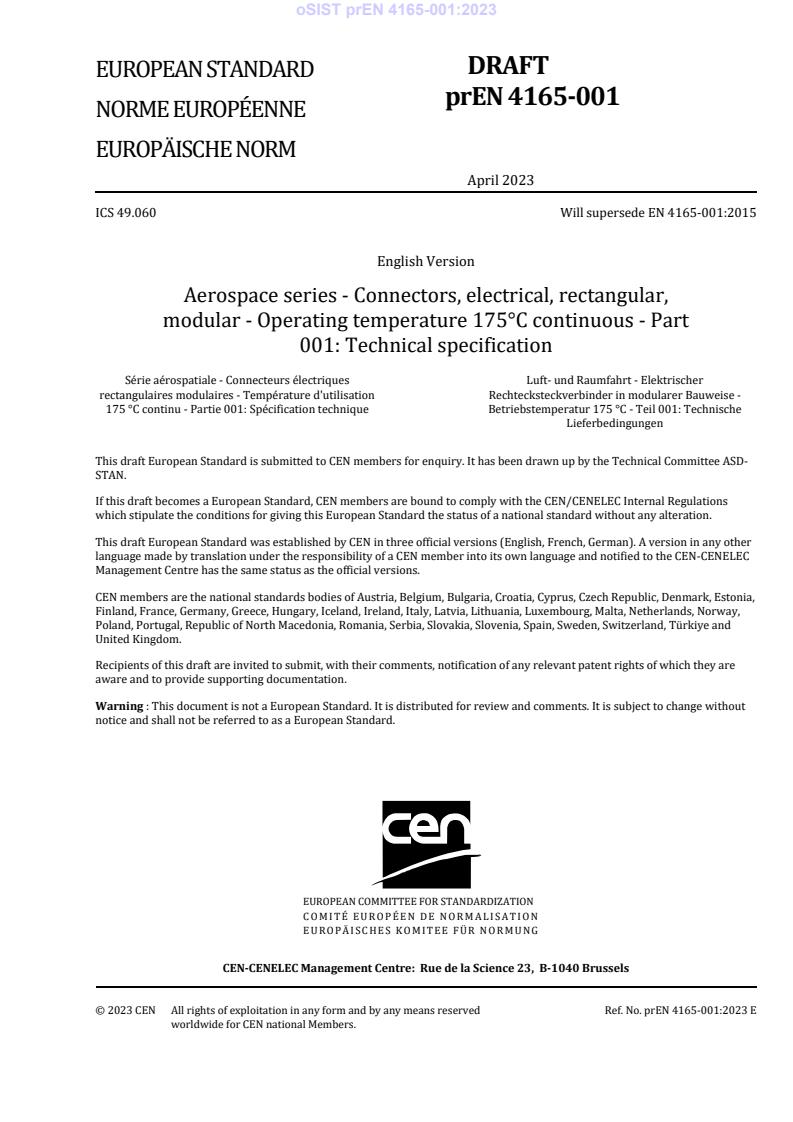
DRAFT
EUROPEAN STANDARD
NORME EUROPÉENNE
EUROPÄISCHE NORM
April 2023
ICS 49.060 Will supersede EN 4165-001:2015
English Version
Aerospace series - Connectors, electrical, rectangular,
modular - Operating temperature 175°C continuous - Part
001: Technical specification
Série aérospatiale - Connecteurs électriques Luft- und Raumfahrt - Elektrischer
rectangulaires modulaires - Température d'utilisation Rechtecksteckverbinder in modularer Bauweise -
175 °C continu - Partie 001: Spécification technique Betriebstemperatur 175 °C - Teil 001: Technische
Lieferbedingungen
This draft European Standard is submitted to CEN members for enquiry. It has been drawn up by the Technical Committee ASD-
STAN.
If this draft becomes a European Standard, CEN members are bound to comply with the CEN/CENELEC Internal Regulations
which stipulate the conditions for giving this European Standard the status of a national standard without any alteration.
This draft European Standard was established by CEN in three official versions (English, French, German). A version in any other
language made by translation under the responsibility of a CEN member into its own language and notified to the CEN-CENELEC
Management Centre has the same status as the official versions.
CEN members are the national standards bodies of Austria, Belgium, Bulgaria, Croatia, Cyprus, Czech Republic, Denmark, Estonia,
Finland, France, Germany, Greece, Hungary, Iceland, Ireland, Italy, Latvia, Lithuania, Luxembourg, Malta, Netherlands, Norway,
Poland, Portugal, Republic of North Macedonia, Romania, Serbia, Slovakia, Slovenia, Spain, Sweden, Switzerland, Türkiye and
United Kingdom.
Recipients of this draft are invited to submit, with their comments, notification of any relevant patent rights of which they are
aware and to provide supporting documentation.
Warning : This document is not a European Standard. It is distributed for review and comments. It is subject to change without
notice and shall not be referred to as a European Standard.
EUROPEAN COMMITTEE FOR STANDARDIZATION
COMITÉ EUROPÉEN DE NORMALISATION
EUROPÄISCHES KOMITEE FÜR NORMUNG
CEN-CENELEC Management Centre: Rue de la Science 23, B-1040 Brussels
© 2023 CEN All rights of exploitation in any form and by any means reserved Ref. No. prEN 4165-001:2023 E
worldwide for CEN national Members.
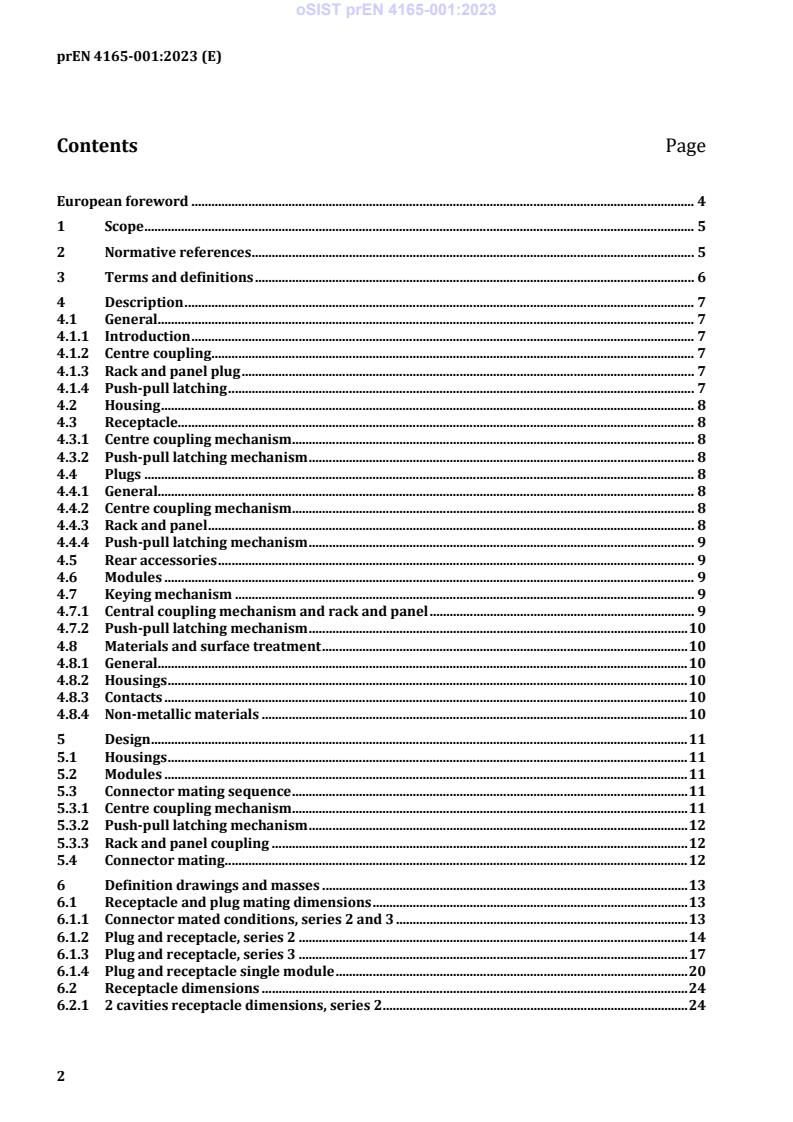
Contents Page
European foreword . 4
1 Scope . 5
2 Normative references . 5
3 Terms and definitions . 6
4 Description . 7
4.1 General. 7
4.1.1 Introduction . 7
4.1.2 Centre coupling . 7
4.1.3 Rack and panel plug . 7
4.1.4 Push-pull latching . 7
4.2 Housing . 8
4.3 Receptacle. 8
4.3.1 Centre coupling mechanism . 8
4.3.2 Push-pull latching mechanism . 8
4.4 Plugs . 8
4.4.1 General. 8
4.4.2 Centre coupling mechanism . 8
4.4.3 Rack and panel . 8
4.4.4 Push-pull latching mechanism . 9
4.5 Rear accessories . 9
4.6 Modules . 9
4.7 Keying mechanism . 9
4.7.1 Central coupling mechanism and rack and panel . 9
4.7.2 Push-pull latching mechanism . 10
4.8 Materials and surface treatment . 10
4.8.1 General. 10
4.8.2 Housings . 10
4.8.3 Contacts . 10
4.8.4 Non-metallic materials . 10
5 Design . 11
5.1 Housings . 11
5.2 Modules . 11
5.3 Connector mating sequence . 11
5.3.1 Centre coupling mechanism . 11
5.3.2 Push-pull latching mechanism . 12
5.3.3 Rack and panel coupling . 12
5.4 Connector mating . 12
6 Definition drawings and masses . 13
6.1 Receptacle and plug mating dimensions . 13
6.1.1 Connector mated conditions, series 2 and 3 . 13
6.1.2 Plug and receptacle, series 2 . 14
6.1.3 Plug and receptacle, series 3 . 17
6.1.4 Plug and receptacle single module . 20
6.2 Receptacle dimensions . 24
6.2.1 2 cavities receptacle dimensions, series 2 . 24
6.2.2 4 cavities receptacle dimensions, series 2 . 25
6.2.3 2 cavities receptacle dimensions, series 3 . 26
6.2.4 4 cavities receptacle dimensions, series 3 . 27
6.3 Receptacle coding pin cavity dimensions, series 2 and series 3 . 28
6.4 Receptacle module cavities dimensions, series 2 and series 3 . 29
6.5 Receptacle single module cavities dimensions, series 2 . 30
6.6 2 cavities plug dimensions, series 2 . 31
6.7 4 cavities plug dimensions, series 2 . 31
6.8 2 cavities plug dimensions, series 3 . 33
6.9 4 cavities plug dimensions, series 3 . 33
6.10 Plug coding key cavity dimensions, series 2 and series 3 . 35
6.11 Plug module cavity dimensions, series 2 and series 3 . 35
6.12 Plug single module cavity dimensions, series 2 . 37
6.13 Receptacle and plug module cavity coding dimensions, series 2 and series 3. 39
7 Details on contact and module interface . 41
7.1 Male module and contact interfacial sealing dimensions . 41
7.2 Female module and contact interface dimensions . 41
7.3 Male module and contact interfacial sealing dimensions, size 23 . 42
7.4 Female module and contact interfacial sealing dimensions, size 23 . 42
8 Contact arrangements . 43
9 Tests according to EN 2591-100 . 54
10 Tooling testing . 69
10.1 Gauges to test the holding force of the grounding spring system of the housing . 69
10.1.1 Gauges for 4 cavities housing series 2 and 3 . 69
10.1.2 Gauges for 2 cavities housing series 2 and 3 . 70
10.2 Gauges to test the stability of male contacts in module . 71
10.3 Gauges to test EN 2591-419 for 23R modules . 72
11 Quality assurance . 73
12 Qualification . 73
12.1 Sampling and definition of specimens . 73
12.1.1 Sampling for qualification of metallic housings and modules . 73
12.1.2 Sampling for qualification of composite housings and modules . 74
12.1.3 Sampling for qualification of push-pull latching mechanism housing and modules . 74
12.1.4 Sampling for qualification of a new module arrangement . 75
12.2 Preparation of specimens . 75
12.3 Programme of qualification tests . 76
13 Maintenance of qualification . 80
13.1 Tests . 80
13.2 Sampling distribution . 80
13.3 Acceptance . 81
14 Quality control . 82
15 Designation and marking . 82
16 Delivery conditions . 82
17 Packaging . 82
18 Storage . 82
Bibliography . 83
European foreword
This document (prEN 4165-001:2023) has been prepared by the Aerospace and Defence Industries
Association of Europe — Standardization (ASD-STAN).
After enquiries and votes carried out in accordance with the rules of this Association, this document has
received the approval of the National Associations and the Official Services of the member countries of
ASD-STAN, prior to its presentation to CEN.
This document is currently submitted to the CEN Enquiry.
This document will supersede EN 4165-001:2015.
1 Scope
This document specifies the general characteristics, the conditions for qualification, acceptance and
quality assurance, as well as the test programs and groups for rectangular connectors with one or
multiple removable modules, intended for use in a temperature range from −55 °C to 175 °C continuous.
This family of connectors is particularly suitable for aeronautic use in zones of severe environmental
conditions on board aircraft, applying EN 2282.
The maximum in-service temperature can be limited by maximum temperature of contacts.
2 Normative references
The following documents are referred to in the text in such a way that some or all of their content
constitutes requirements of this document. For dated references, only the edition cited applies. For
undated references, the latest edition of the referenced document (including any amendments) applies.
EN 2591-100, Aerospace series - Elements of electrical and optical connection - Test methods - Part 100:
General
EN 2591-101, Aerospace series - Elements of electrical and optical connection - Test methods - Part 101:
Visual examination
EN 2591-205, Aerospace series - Elements of electrical and optical connection - Test methods - Part 205:
Housing (shell) electrical continuity
EN 2591-303, Aerospace series - Elements of electrical and optical connection - Test methods - Part 303:
Cold/low pressure and damp heat
EN 2591-306, Aerospace series - Elements of electrical and optical connection - Test methods - Part 306:
Mould growth
EN 2591-314, Aerospace series - Elements of electrical and optical connection - Test methods - Part 314:
Immersion at low air pressure
EN 2591-315, Aerospace series - Elements of electrical and optical connection - Test methods - Part 315:
Fluid resistance
EN 2591-324, Aerospace series - Elements of electrical and optical connection - Test methods - Part 324:
Interfacial sealing
EN 2591-402, Aerospace series - Elements of electrical and optical connection - Test methods - Part 402:
Shock
EN 2591-403, Aerospace series - Elements of electrical and optical connection - Test methods - Part 403:
Sinusoidal and random vibration
EN 2591-419, Aerospace series - Elements of electrical and optical connection - Test methods - Part 419:
Stability of male contacts in insert
EN 3155-002, Aerospace series - Electrical contacts used in elements of connection - Part 002: List and
utilization of contacts
EN 3155-070, Aerospace series - Electrical contacts used in elements of connection - Part 070: Contacts,
electrical, male, type A, crimp, class S - Product standard
EN 3155-071, Aerospace series - Electrical contacts used in elements of connection - Part 071: Contacts,
electrical, female, type A, crimp, class S - Product standard
EN 3155-082, Aerospace series - Electrical contacts used in elements of connection - Part 082: Contacts,
electrical, female, type A, crimp, class S - Product standard
EN 3197, Aerospace series - Design and installation of aircraft electrical and optical interconnection systems
EN 3909, Aerospace series - Test fluids and test methods for electrical and optical components and sub-
assemblies
EN 4165-002, Aerospace series - Connectors, electrical, rectangular, modular - Operating temperature 175
°C continuous - Part 002: Specification of performance and contact arrangements
EN 4165-003, Aerospace series - Connectors, electrical, rectangular, modular - Operating temperature 175
°C continuous - Part 003: Modules series 2 and series 3 - Product standard
EN 4165-020, Aerospace series - Connectors, electrical, rectangular, modular - Operating temperature 175
°C continuous - Part 020: Coupling system keyway for receptacle - Product standard
EN 4165-021, Aerospace series - Connectors, electrical, rectangular, modular - Operating temperature 175
°C continuous - Part 021: Coupling system keyway for plug - Product standard
EN 4165-024, Aerospace series - Connectors, electrical, rectangular, modular - Operating temperature 175
°C continuous - Part 024: Single module plug - Product standard
EN 4165-025, Aerospace series - Connectors, electrical, rectangular, modular - Operating temperature 175
°C continuous - Part 025: Single module receptacle - Product standard
EN 9133, Aerospace series - Quality Management Systems - Qualification Procedure for Aerospace Standard
Products
ISO 263, ISO inch screw threads — General plan and selection for screws, bolts and nuts — Diameter range
0,06 to 6 in
3 Terms and definitions
For the purposes of this document, the terms and definitions given in EN 2591-100 apply.
ISO and IEC maintain terminology databases for use in standardization at the following addresses:
— ISO Online browsing platform: available at https://www.iso.org/obp/
— IEC Electropedia: available at https://www.electropedia.org/
4 Description
4.1 General
4.1.1 Introduction
Different variants of materials, housings, modules and contact arrangements are provided according to
the Class depending on the service conditions.
These connectors have rectangular housings, with removable modules and contacts. They can be fitted
with cable outlets. Male or female modules can be inserted or intermixed in plug or receptacle housings.
These connectors use different types of contacts (signal, power, coaxial, quadrax, optical, …) defined in
EN 3155-002.
These connectors can also be fitted with optical modules EN 4701 and EN 4830 with associated optical
contacts.
This specification covers three variations in housing and coupling mechanisms to mate and unmate:
— centre coupling screw;
— rack and panel;
— push-pull latching.
4.1.2 Centre coupling
The connectors are mated and unmated by a centre coupling screw, which provides when the connectors
are fully mated a shell to shell bottoming between plug and receptacle.
The plug contains a coupling screw and the receptacle a coupling nut.
This family of connectors provides two housing sizes (2 or 4 modules) and two series (series 2 and scoop
proof series 3).
The connectors are polarized by centre keying mechanism; polarization shall be obtained before the male
contacts enter the module of the female contacts and before the coupling system is engaged. Keying
mechanism shall provide 36 position keying capabilities.
4.1.3 Rack and panel plug
The rack and panel plugs contain a clipped centre coding socket clipped with internal keyways.
Polarization is ensured by the different positions which the secondary keyway may take and different
positions which the centre coding socket may take clipped in the housing.
The centre coupling screw is replaced by a centre guide pin. The floating fixation with coupling spring
ensures the alignment and the metal to metal bottoming between plug and receptacle.
4.1.4 Push-pull latching
The connectors are mated and unmated by a push-pull latching mechanism (for more detail, see 4.3.2 for
receptacle and 4.4.4 for plug).
This family of connectors provides single housing size (1 module series 2).
The connectors are polarized by integral key and keyways mechanism associated with dedicated colour
identification.
Polarization shall be obtained before the male contacts enter the module of the female contacts and
before the coupling system is engaged.
4.2 Housing
All parts except module are considered “housing”.
All “housings” models, except class C, shall meet electrical performances described in Table 39.
4.3 Receptacle
4.3.1 Centre coupling mechanism
The receptacle may be attached by:
— Rectangular flange with two mounting holes;
— Two end flanges with transversal holes (panel mounting) and lateral holes (stackable mounting).
The receptacle contains a coupling nut which ensures also the polarization function (coding pin) by
external keys. The main key fixed and is wider than the other. Polarization is ensured by the different
positions which the secondary key may take and different positions which the coding pin may be fixed in
the housing.
The module cavities are identified on the housing of the receptacle by letter A, B, C, D for size 4 (four
modules) and letter A, B for size 2 (two modules). The cavities are polarized by two keyways location.
4.3.2 Push-pull latching mechanism
The receptacle can be attached by rectangular flange.
The receptacle shell design incorporates specific design feature that provides a mechanical and electrical
interface to the plug. The electrical ground path established by the mounting design feature incorporated
in the receptacle shell maintains a stable, low resistance electrical ground path for the life of the
installation. This electrical ground path that is provided by the mechanical mounting feature shall require
no preparations during the initial assembly processes or maintenance once in service.
4.4 Plugs
4.4.1 General
The plugs contain a clipped centre coding socket clipped with internal keyway options. Polarization is
ensured by the different positions which the secondary keyway may take and different positions which
the centre coding socket may take clipped in the housing.
4.4.2 Centre coupling mechanism
The coupling screw permanently fitted on the plug enables the connectors to be coupled and uncoupled.
The internal thread of the coupling ring may be treated with a suitable lubricant compatible with the
performance required in this standard.
The module cavities are identified on the housing of the plug by letter A, B, C, D for size 4 (four modules)
and letter A, B for size 2 (two modules). The cavities are polarized with two keyway locations.
4.4.3 Rack and panel
The plug contains a clipped centre coding socket clipped with internal keyway options. Polarization is
ensured by the different positions which the secondary keyway may take and different positions which
the centre coding socket may take clipped in the housing.
The centre coupling screw is replaced by a centre guide pin. The floating fixations with coupling spring
ensure the alignment and the metal to metal bottoming between plug and receptacle.
4.4.4 Push-pull latching mechanism
The plug shell is mated to the receptacle shell by sliding the plug into the receptacle where the two shells
engage. The latch mechanism then engages the specific features located on the receptacle forcing the two
connectors shells together creating a mechanically rigid assembly. The receptacle shell shall contain
design features that interface to the plug shell providing not only a mechanically rigid assembly but a
360 degree enclosure essential to the EMI shielding performance. The coupling mechanism and
connector shell design shall incorporate a means of providing a visual reference that the plug is fully
mated to the receptacle. No tools shall be required to activate and release the latch mechanism to either
mate or unmate the plug to the receptacle. The coupling mechanism shall withstand 500 mating and
unmating cycles. This mechanism shall be self-lockable.
4.5 Rear accessories
The rear accessories used with this family are specified in product standards (see EN 4165-002).
4.6 Modules
The module shall be single-bloc type design complete with contact retention systems and appropriate
seals.
The female modules use female contacts and male modules use male contacts. These Modules use crimp
or solder contacts of sizes 23, 22, 20, 16, 12 and 8. They are rear release and held in the housing by
two retention tines. They are removable from the rear with a specific tool.
The modules have two keys which engage in the keyways of the housing. Polarization is ensured by the
different positions which the secondary keys may take. The module polarization is identified by letter A,
B, C, D, E, F or N (universal).
A blank module is installed in a cavity where no contacts are required. This module is a male module with
a universal polarization (N) installable in all coding cavities (A, B, C, D, E, F) and in all housing types (plug
or receptacle).
Modules shall be interchangeable in cavities of housing with different configurations.
Modules are available in four configurations:
— Without peripheral sealing and with standard fuel resistance : type 1;
— With peripheral sealing and with standard fuel resistance : type 2;
— Without peripheral sealing and with reinforced fuel resistance : type 3;
— With peripheral sealing and with reinforced fuel resistance : type 4.
4.7 Keying mechanism
4.7.1 Central coupling mechanism and rack and panel
4.7.1.1 Coding pin (receptacle)
Keying mechanism shall provide 36 position keying capabilities. These 36 positions are given with
6 different coding pins, identified by colour code. The main key is wider than the other, polarization is
ensured by the different positions which the secondary key may take. Universal coding pin is compatible
with all polarization codes. Coding pin shall be interchangeable between different housing models. They
are fitted in the housing with a specific tool and the modification of coding position shall be made at the
front face of the connector with specific tool.
4.7.1.2 Clipped coding socket (plug)
Keying mechanism shall provide 36 position keying capabilities. These 36 positions are given with
6 different coding sockets, identified by colour code. The main keyway is wider than the other;
polarization is ensured by the different positions which the secondary keyway may take. Universal coding
socket is compatible with all polarization codes. Coding socket shall be interchangeable between different
housing models. They are front clipped in the housing without specific tool and the modification of coding
position shall be either made by the front face of the connector with a new coding pin (a removed coding
socket is not reusable).
4.7.2 Push-pull latching mechanism
Polarization of the connector shells provides a means of preventing mismating connectors in close
proximity to one another. Shell polarization of the connector should be accomplished by means of integral
keys and keyways. It shall be impossible to mate a plug to a receptacle shell when these polarization keys
are polarized differently. Polarization engagement shall occur after initial shell engagement and before
the pin makes contact with the socket contact. The connector shells should use the code defined by this
specification.
Colour and coding are defined in product standard EN 4165-024 and EN 4165-025.
4.8 Materials and surface treatment
4.8.1 General
When dissimilar metals are in close contact, adequate protection against corrosion shall be used for the
electromotive force of the cell not to exceed 0,25 V.
4.8.2 Housings
The material of the housing for the connectors shall as follows (see EN 4165-002 for more details):
— Aluminium alloy with plating;
— Composite with plating;
— Composite without plating.
4.8.3 Contacts
Removable contacts (see EN 3155-002).
4.8.4 Non-metallic materials
The materials used for module, seals and grommets shall have mechanical characteristics compliant with
the required use.
5 Design
5.1 Housings
The connector housings shall be a one piece construction. They shall accommodate the rear accessories
and other fittings defined in this specification (see EN 4165-002). The rectangular flange receptacle can
furthermore be fitted with a conductive gasket ensuring electrical continuity between the connector
housing and panel.
For centre coupling mechanism, the threads shall conform to ISO 263, and the coupling mechanism shall
be designed so that the male and female contacts engage when it is rotated clockwise the right and
disengage when it is rotated anticlockwise to the left. The centre coupling screw shall be a hexagonal
socket head screw and compatible with the coupling torque values defined in the product standard.
For push-pull latching mechanism, the locking mechanism shall be designed so that coupling is done by
pushing the plug onto the receptacle. The mechanism has also a sliding perpendicular to the axis of
engagement of the plug onto the receptacle.
Unlocking is done by pressure on the mechanism and perpendicular to the axis of engagement of the plug
onto the receptacle.
The accessories shall be fixed by screw or clip on the rear of connectors.
5.2 Modules
The module carrying the male and female contacts shall be in hard material and have a cross section and
radii such that no cracks, flaking or breaks can occur in normal operation.
The module for contacts shall be removable; it shall be mechanically held in the housing by two retention
tines peripheral sealing can be provided between the housing and modules.
The front face of the modules shall be such that sealing is ensured when the connectors are coupled. The
interfacial seal of the module shall be permanently fastened on the hard module.
The grommet shall permit sealing for all cable diameters indicated in EN 4165-002 and shall not be
removable.
Module insertion shall be from the rear without tools and removal of the module shall be from the rear
with the tools specified in the product standards. Module design shall prevent wrong mating.
The mechanical contacts retention system shall be integrated in the hard part of module. The design of
module shall permit individual installation of the contacts without removal grommet. Fitting and removal
of the contacts shall be from the rear with the tools specified in the product standards.
When mated, the minimum engagement of contact shall be 1,27 mm.
5.3 Connector mating sequence
5.3.1 Centre coupling mechanism
The mating sequence shall be:
— Face to face positioning;
— Keyways polarization guide;
— Central thread coupling ;
— Grounding screening system;
— Electrical contact;
— Sealed interface compression;
— Metal/metal or composite shell to shell bottoming.
5.3.2 Push-pull latching mechanism
The connector mating sequence shall be as follow:
— Face to face positioning;
— Keyways polarization guiding;
— Grounding screening;
— Electrical contact;
— Sealed interface compression;
— Locking.
5.3.3 Rack and panel coupling
The connector mating sequence shall be as follow:
— Face to face positioning;
— Central guiding pin ;
— Keyways polarization guiding
— Grounding screening;
— Electrical contact;
— Sealed interface compression.
5.4 Connector mating
Housing design shall prevent incorrect mating of the plug onto receptacle.
6 Definition drawings and masses
The general dimensions and the masses are given in the product standards.
6.1 Receptacle and plug mating dimensions
6.1.1 Connector mated conditions, series 2 and 3
Dimensions are in millimetres, see Figure 1, Figure 2 and Table 1.
Key
1 Receptacle assembly
2 Standard plug assembly
3 Mechanical bottoming plate
Figure 1 — Standard plug mated with receptacle
a) Standard rack and panel plug b) Reversed rack and panel plug
Key
1 Receptacle assembly 3 Mechanical bottoming plate
2 Standard rack and panel plug assembly 4 Reserved rack and panel plug assembly
Figure 2 — Rack and panel plugs mated with receptacle
Table 1 — Mated dimensions
A B C D E F
38,5 33,4 40,0 34,9 19,3 14,2
Series 2
37,8 32,9 36,0 30,9 17,9 13,0
47,1 42,0 40,0 34,9 19,65 14,55
Series 3
46,4 41,5 36,0 30,9 18,25 13,35
6.1.2 Plug and receptacle, series 2
Module and contact position
Dimensions are in millimetres, see Figure 3, Figure 4 and Table 2.
Key
1 Mechanical bottom of receptacle a For sizes 22 – 20 – 16 – 12 modules
2 Female module assembly (size 8) b For size 8 module
3 Female module assembly (sizes 22 – 20 – 16 – 12) c See Figure 8.
4 See EN 4165-020. d See Figure 6 and Figure 7.
5 Male module assembly (all sizes)
6 Mechanical bottom of plug
Figure 3 — Module and contact position inside plug and receptacle, series 2
Key
1 Mechanical bottom of receptacle 5 Mechanical bottom of plug
2 Female module assembly size 23 6 See Figure 8.
3 According to EN 4165-020. 7 See Figure 6 and Figure 7.
4 Male module assembly size 23
Figure 4 — Module and contact position inside plug and receptacle, series 2, size 23
Table 2 — Contact position
A B C D
6,66 6,38 3,00 3,27
Sizes 22 – 20 – 16 – 12
6,20 5,93 2,54 2,82
6,79 6,51 2,87 3,27
Size 8
6,33 5,93 2,41 2,69
6.1.3 Plug and receptacle, series 3
Module and contact position
Dimensions are in millimetres, see Figure 5 to Figure 8, Table 3 and Table 4.
Key
1 Mechanical bottom of receptacle a For sizes 22 – 20 – 16 – 12 modules
2 Female module assembly (all sizes) b For size 8 module
3 According to EN 4165-020 c See Figure 8.
4 Male module assembly (all sizes) d See Figure 6 and Figure 7.
5 Mechanical bottom of plug
Figure 5 — Module and contact position inside plug and receptacle, series 3
Table 3 — Contact position
A B C D
6,66 14,94 11,56 3,27
Sizes 22 – 20 – 16 – 12
6,20 14,49 11,10 2,82
6,79 15,07 11,43 3,27
Size 8
6,33 14,49 10,97 2,69
Table 4 — Coding pin position
E
12,62
Coupling with clicker-nut plug
12,38
21,18
Coupling with rack and panel plug
series 3
20,94
Key
1 According to EN 4165-021.
2 Active thread 12,6 min.
Figure 6 — Coupling screw position inside plugs series 2 and series 3
Figure 7 — Guiding pin position inside rack and panel plugs series 2 and series 3
Key
1 Hexagonal groove 3,02 – 3,08/flat
Figure 8 — Head of coupling screw
6.1.4 Plug and receptacle single module
6.1.4.1 Receptacle
Dimensions are in millimetres, see Figure 9 and Figure 10.
Key
X Detail A
Figure 9 — Single module receptacle dimensions
Polarizing positions for N, A, Polarizing positions for D and Polarizing positions for F
B, C, E, G (internal keying) H (internal keying) (internal keying)
POL C1 C2 C3 C4 POL C1 C2 C3 C4
N 6,425 6,425 5,305 0,825 F 1,945 4,185 5,305 5,305
6,325 6,325 5,205 0,725 1,845 4,085 5,205 5,205
A 4,185 4,185 0,825 5,305
4,085 4,085 0,725 5,205
POL C1 C2 C3 C4
B 6,425 6,425 3,065 3,065
6,325 6,325 2,965 2,965 D 4,185 1,945 5,305 3,065
C 1,945 6,425 3,065 5,305 4,085 1,845 5,205 2,965
1,845 6,325 2,965 5,205 H 4,185 6,425 3,065 0,825
E 1,945 1,945 0,825 3,065 4,085 6,325 2,965 0,725
1,845 1,845 0,725 2,965
G 1,945 4,185 5,305 3,065
1,845 4,085 5,205 2,965
Key
X Detail A
Figure 10 — Single module receptacle coding dimensions
6.1.4.2 Plug
Dimensions are in millimetres, see Figure 11.
Key
a When latch is at connected position
Figure 11 — Single module plug dimensions
Alternative design:
6.2 Receptacle dimensions
6.2.1 2 cavities receptacle dimensions, series 2
See Figure 12.
Dimensions in millimetres
Key
1 Centre line
2 Groove only for classes F and W
3 Module cavities coding, see Figure 26
4 Coding pin cavity, see Figure 16
5 Mechanical bottom of receptacle
Figure 12 — 2 cavities receptacle dimensions, series 2
6.2.2 4 cavities receptacle dimensions, series 2
Dimensions are in millimetres, see Figure 13.
Key
1 Centre line
2 Groove only for classes F and W
3 Module cavities coding, see Figure 26
4 Coding pin cavity, see Figure 16
5 Mechanical bottom of receptacle
Figure 13 — 4 cavities receptacle dimensions, series 2
6.2.3 2 cavities receptacle dimensions, series 3
Dimensions are in millimetres, see Figure 14.
Key
1 Centre line
2 Groove only for classes F and W
3 Module cavities coding, see Figure 26
4 Coding pin cavity, see Figure 16
5 Mechanical bottom of receptacle
Figure 14 — 2 cavities receptacle dimensions, series 3
6.2.4 4 cavities receptacle dimensions, series 3
Dimensions are in millimetres, see Figure 15.
Key
1 Centre line
2 Groove only for classes F and W
3 Module cavities coding, see Figure 26
4 Coding pin cavity, see Figure 16
5 Mechanical bottom of receptacle
Figure 15 — 4 cavities receptacle dimensions, series 3
6.3 Receptacle coding pin cavity dimensions, series 2 and series 3
Dimensions are in millimetres, see Figur
...
Questions, Comments and Discussion
Ask us and Technical Secretary will try to provide an answer. You can facilitate discussion about the standard in here.
Loading comments...