

EN 3475-408:2025
(Main)Aerospace series - Cables, electrical, aircraft use - Test methods - Part 408: Fire resistance
General Information
- Abstract
This document specifies a method of testing the fire resistance of "fire-proof" electrical cables.
- Status
- Published
- Publication Date
- 23-Dec-2025
- Technical Committee
- ASD-STAN - Aerospace
- Drafting Committee
- ASD-STAN/D 2/S 2 - Cables & Stripping Tools
- Current Stage
- 6060 - Definitive text made available (DAV) - Publishing
- Start Date
- 24-Dec-2025
- Completion Date
- 24-Dec-2025

Overview
EN 3475-408:2025 is a critical European standard developed by CEN under the Aerospace and Defence Industries Association of Europe (ASD-STAN). This standard outlines the test methods for assessing the fire resistance of electrical cables specifically designed for aircraft use. As an update to the previous EN 3475-408:2005, this 2025 revision introduces enhanced technical requirements, including liquid burner specifications and test setup configurations to ensure the highest safety standards in aerospace applications.
The document details procedures to evaluate the fire resistance capabilities of "fire-proof" electrical cables used in the aerospace sector, addressing both single-core and multi-core cables. Proper adherence to this standard is essential for manufacturers and testing laboratories aiming to certify aerospace electrical cables against stringent fire safety norms.
Key Topics
Scope and Application
Focused on specifying methods for fire resistance testing of electrical cables used in aircraft, ensuring safe operation under extreme fire exposure.Test Specimen Preparation
Selection of six specimens at a minimum length of 0.75 meters, with procedures for immersion in test fluids relevant to aerospace environments (e.g., kerosene, phosphate-based hydraulic fluid, synthetic oil, isopropyl alcohol, ethylene glycol).Burner Types and Calibration
Two burner methods are specified:- Method A: Utilizes liquid combustible (kerosene) with defined flame characteristics at 1100 °C ± 80 °C and a heat flux density of 116 kW/m² ± 10 kW/m².
- Method B: Uses gas combustible with similar flame temperature and heat flux requirements.
Burner calibration is rigorously defined for temperature measurement using thermocouples and heat flux measurement using copper tube calorimeters to ensure test consistency.
Test Fixture and Setup
The standard requires a test fixture capable of holding specimens securely with specified vibration parameters (frequency ~30 Hz, 4 g acceleration) to simulate operational conditions. Fixture orientation differs by burner type (vertical for gas, horizontal for liquid).Measurement and Monitoring
For single-core cables, current leakage detection is mandatory via nickel-plated copper strand wrapping. This ensures integrity assessment during fire exposure.Burner Distance and Exposure Conditions
Critical dimensions between burner nozzle and specimen as per ISO 2685 standards guarantee that the fire resistance testing accurately replicates aircraft fire scenarios.
Applications
EN 3475-408:2025 is essential for manufacturers, test laboratories, and regulatory authorities involved in the aerospace sector. The standard enables:
Certification of Aircraft Electrical Cables
Ensuring cables meet fire resistance performance expected in the harsh flight environment, thereby enhancing flight safety.Quality Assurance in Aerospace Cable Production
Providing a benchmark test methodology to validate cable designs and materials against fire hazards.Regulatory Compliance and Safety Assurance
Supporting compliance with global aerospace regulations that mandate stringent fire safety measures for all electrical wiring systems aboard aircraft.Research and Development
Guiding R&D teams in designing cables with superior fire-resistant materials and construction techniques by providing standardized testing criteria.
Related Standards
EN 3909 – Aerospace series Test fluids and test methods for electrical and optical components and sub-assemblies, referenced for the preparation of test fluids in EN 3475-408.
ISO 2685:1998 – Aircraft environmental test procedures for resistance to fire in designated fire zones; provides the fundamental burner specifications and calibration methods referenced by EN 3475-408.
AECMA Prestandard (Historical Reference) – The aerospace cable testing guidelines preceding the EN 3475-408 standard.
Conclusion
EN 3475-408:2025 defines a comprehensive and technically robust methodology for testing the fire resistance of aerospace-grade electrical cables. Implementation of this standard plays a vital role in ensuring that electrical wiring systems in aircraft can withstand fire incidents, thereby protecting passengers, aircrew, and equipment. For manufacturers and testing facilities, adherence to EN 3475-408:2025 is indispensable for achieving certification, maintaining quality, and meeting international aerospace safety regulations.
Keywords: aerospace electrical cables, fire resistance test, aircraft cable fire safety, EN 3475-408:2025, cable burn test, ISO 2685, EN 3909, aircraft electrical wiring standards, aerospace cable certification, fire-proof cables
Relations
- Effective Date
- 28-Jan-2023
- Effective Date
- 25-Aug-2026
- Effective Date
- 28-Jan-2026
- Effective Date
- 28-Jan-2026
- Effective Date
- 28-Jan-2026
- Effective Date
- 28-Jan-2026
- Effective Date
- 28-Jan-2026
- Effective Date
- 28-Jan-2026
- Effective Date
- 28-Jan-2026
- Effective Date
- 28-Jan-2026
- Effective Date
- 28-Jan-2026
- Effective Date
- 28-Jan-2026
- Effective Date
- 28-Jan-2026
- Effective Date
- 28-Jan-2026
- Effective Date
- 28-Jan-2026
Get Certified
Connect with accredited certification bodies for this standard

BUREAU VERITAS Certification Germany
Bureau Veritas certification in Germany.

Element Materials Technology
Materials testing and product certification.

AQMS Ltd.
AQMS provides ISO certification to SMEs across the UK.
Sponsored listings
Frequently Asked Questions
EN 3475-408:2025 is a standard published by the European Committee for Standardization (CEN). Its full title is "Aerospace series - Cables, electrical, aircraft use - Test methods - Part 408: Fire resistance". This standard covers: This document specifies a method of testing the fire resistance of "fire-proof" electrical cables.
This document specifies a method of testing the fire resistance of "fire-proof" electrical cables.
EN 3475-408:2025 is classified under the following ICS (International Classification for Standards) categories: 49.060 - Aerospace electric equipment and systems. The ICS classification helps identify the subject area and facilitates finding related standards.
EN 3475-408:2025 has the following relationships with other standards: It is inter standard links to EN 3475-408:2005, ISO 2685:1998, EN 378-1:2000/A1:2003, EN 3909:2016, EN 3375-009:2023, EN 4612-004:2019, EN 3375-011:2022, EN 4612-003:2019, EN 4604-005:2015, EN 4604-010:2018, EN 4612-005:2011, EN 2266-003:2005, EN 4612-012:2011, EN 3375-012:2013, EN 4611-006:2018. Understanding these relationships helps ensure you are using the most current and applicable version of the standard.
EN 3475-408:2025 is available in PDF format for immediate download after purchase. The document can be added to your cart and obtained through the secure checkout process. Digital delivery ensures instant access to the complete standard document.
Standards Content (Sample)
SLOVENSKI STANDARD
01-februar-2026
Aeronavtika - Električni kabli za uporabo v zračnih plovilih - Preskusne metode -
408. del: Požarna odpornost
Aerospace series - Cables, electrical, aircraft use - Test methods - Part 408: Fire
resistance
Luft- und Raumfahrt - Elektrische Leitungen für Luftfahrtverwendung - Prüfverfahren -
Teil 408: Feuerbeständigkeit
Série aérospatiale - Câbles électriques à usage aéronautique - Méthodes d’essais -
Partie 408: Résistance au feu
Ta slovenski standard je istoveten z: EN 3475-408:2025
ICS:
29.060.20 Kabli Cables
49.060 Letalska in vesoljska Aerospace electric
električna oprema in sistemi equipment and systems
2003-01.Slovenski inštitut za standardizacijo. Razmnoževanje celote ali delov tega standarda ni dovoljeno.
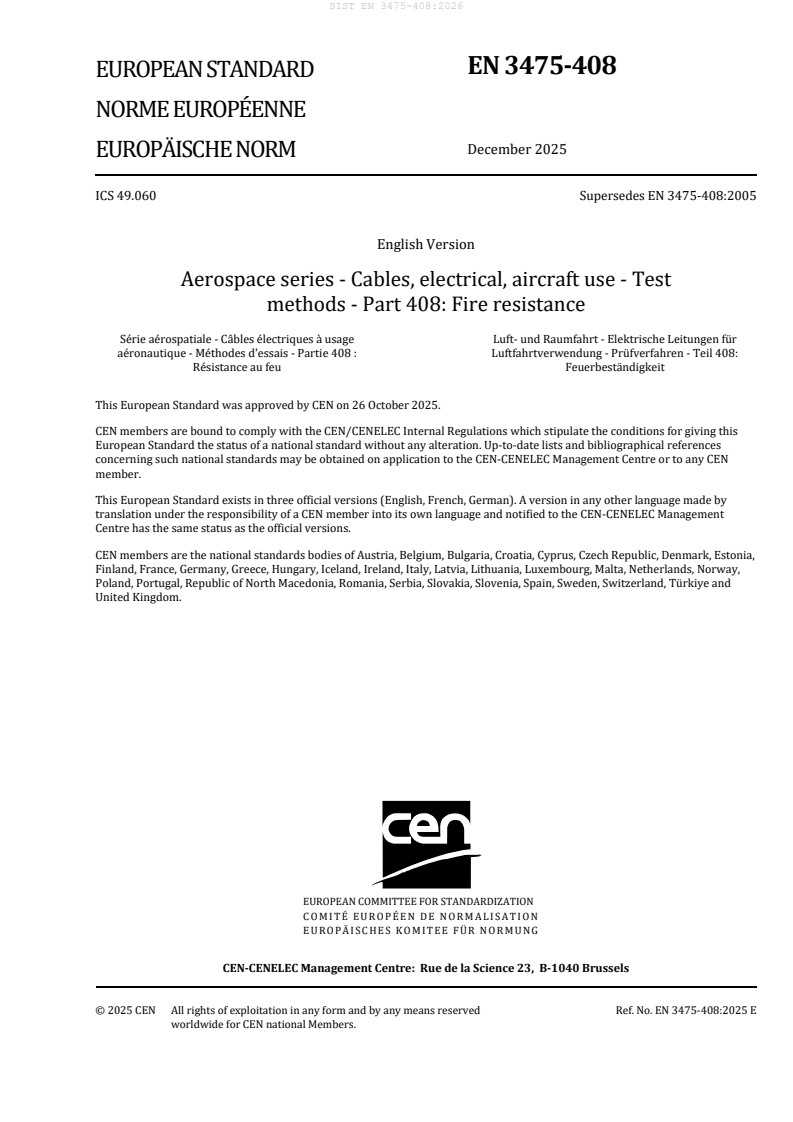
EN 3475-408
EUROPEAN STANDARD
NORME EUROPÉENNE
December 2025
EUROPÄISCHE NORM
ICS 49.060 Supersedes EN 3475-408:2005
English Version
Aerospace series - Cables, electrical, aircraft use - Test
methods - Part 408: Fire resistance
Série aérospatiale - Câbles électriques à usage Luft- und Raumfahrt - Elektrische Leitungen für
aéronautique - Méthodes d'essais - Partie 408 : Luftfahrtverwendung - Prüfverfahren - Teil 408:
Résistance au feu Feuerbeständigkeit
This European Standard was approved by CEN on 26 October 2025.
CEN members are bound to comply with the CEN/CENELEC Internal Regulations which stipulate the conditions for giving this
European Standard the status of a national standard without any alteration. Up-to-date lists and bibliographical references
concerning such national standards may be obtained on application to the CEN-CENELEC Management Centre or to any CEN
member.
This European Standard exists in three official versions (English, French, German). A version in any other language made by
translation under the responsibility of a CEN member into its own language and notified to the CEN-CENELEC Management
Centre has the same status as the official versions.
CEN members are the national standards bodies of Austria, Belgium, Bulgaria, Croatia, Cyprus, Czech Republic, Denmark, Estonia,
Finland, France, Germany, Greece, Hungary, Iceland, Ireland, Italy, Latvia, Lithuania, Luxembourg, Malta, Netherlands, Norway,
Poland, Portugal, Republic of North Macedonia, Romania, Serbia, Slovakia, Slovenia, Spain, Sweden, Switzerland, Türkiye and
United Kingdom.
EUROPEAN COMMITTEE FOR STANDARDIZATION
COMITÉ EUROPÉEN DE NORMALISATION
EUROPÄISCHES KOMITEE FÜR NORMUNG
CEN-CENELEC Management Centre: Rue de la Science 23, B-1040 Brussels
© 2025 CEN All rights of exploitation in any form and by any means reserved Ref. No. EN 3475-408:2025 E
worldwide for CEN national Members.
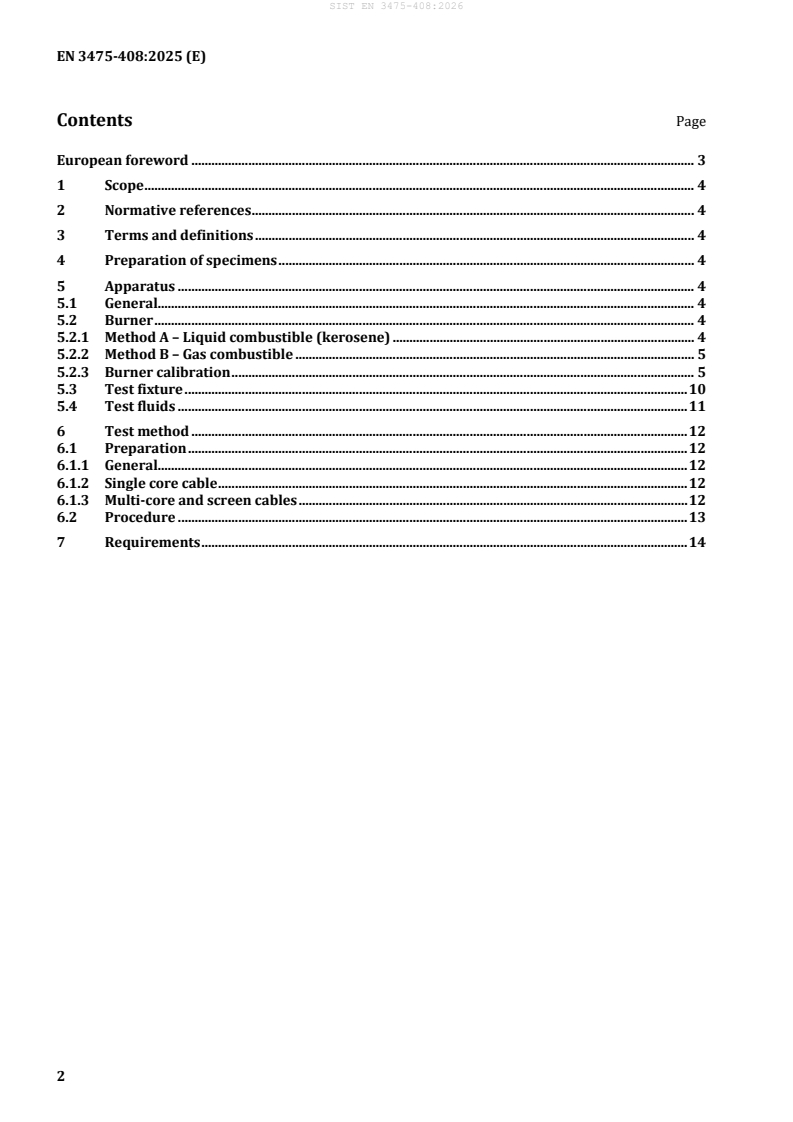
Contents Page
European foreword . 3
1 Scope . 4
2 Normative references . 4
3 Terms and definitions . 4
4 Preparation of specimens . 4
5 Apparatus . 4
5.1 General. 4
5.2 Burner . 4
5.2.1 Method A – Liquid combustible (kerosene) . 4
5.2.2 Method B – Gas combustible . 5
5.2.3 Burner calibration . 5
5.3 Test fixture . 10
5.4 Test fluids . 11
6 Test method . 12
6.1 Preparation . 12
6.1.1 General. 12
6.1.2 Single core cable . 12
6.1.3 Multi-core and screen cables . 12
6.2 Procedure . 13
7 Requirements . 14
European foreword
This document (EN 3475-408:2025) has been prepared by ASD-STAN.
After enquiries and votes carried out in accordance with the rules of this Association, this document has
received the approval of the National Associations and the Official Services of the member countries of
ASD-STAN, prior to its presentation to CEN.
This document shall be given the status of a national standard, either by publication of an identical text
or by endorsement, at the latest by June 2026, and conflicting national standards shall be withdrawn at
the latest by June 2026.
Attention is drawn to the possibility that some of the elements of this document may be the subject of
patent rights. CEN shall not be held responsible for identifying any or all such patent rights.
This document supersedes EN 3475-408:2005.
EN 3475-408:2005:
— editorial improvements, update of Clause 2 and introduction of liquid burner requirements with test
setup configuration.
According to the CEN-CENELEC Internal Regulations, the national standards organizations of the
following countries are bound to implement this document: Austria, Belgium, Bulgaria, Croatia, Cyprus,
Czech Republic, Denmark, Estonia, Finland, France, Germany, Greece, Hungary, Iceland, Ireland, Italy,
Latvia, Lithuania, Luxembourg, Malta, Netherlands, Norway, Poland, Portugal, Republic of North
Macedonia, Romania, Serbia, Slovakia, Slovenia, Spain, Sweden, Switzerland, Türkiye and the
United Kingdom.
1 Scope
This document specifies a method of testing the fire resistance of “fire-proof” electrical cables.
2 Normative references
The following documents are referred to in the text in such a way that some or all of their content
constitutes requirements of this document. For dated references, only the edition cited applies. For
undated references, the latest edition of the referenced document (including any amendments) applies.
EN 2234, Aerospace series — Cable, electrical, fire resistant — Technical specification
EN 3909, Aerospace series — Test fluids and test methods for electrical and optical components and sub-
assemblies
EN 4608-001, Aerospace series — Cable, electrical, fire resistant — Single and twisted multicore assembly,
screened (braided) and jacketed — Operating temperatures between −65 °C and 260 °C — Part 001:
Technical specification
ISO 2685:1998, Aircraft — Environmental test procedure for airborne equipment — Resistance to fire in
designated fire zones
3 Terms and definitions
No terms and definitions are listed in this document.
ISO and IEC maintain terminology databases for use in standardization at the following addresses:
— ISO Online browsing platform: available at https://www.iso.org/obp/
— IEC Electropedia: available at https://www.electropedia.org/
4 Preparation of specimens
Six test specimens, 0,75 m minimum length, shall be selected at random from a quantity of cable.
5 Apparatus
5.1 General
The following shall be required for this test: a burner, a burner calibration, a test fixture, and test fluids.
5.2 Burner
5.2.1 Method A – Liquid combustible (kerosene)
The burner shall be as specified in ISO 2685:1998, Clause A.2, or any other burner or assembly of burners
satisfying the following conditions:
— liquid combustible type of kerosene shall be in accordance with EN 3909;
— the burner outlet shall be equipped with an extension of 318 mm, 152 mm high and 280 mm width;
— cable length exposed to the flame: 280 mm;
— flame characteristics according to ISO 2685:1998:
— temperature: 1 100 °C ± 80 °C;
— heat flux density received by the calorimeter specified in ISO 2685:1998, Annex B:
2 2
116 kW/m ± 10 kW/m .
5.2.2 Method B – Gas combustible
The burner shall be as specified in ISO 2685:1998, Clause A.1, or any other burner or assembly of burners
satisfying the following conditions:
— cable length exposed to the flame: 152 mm;
— diameter or width of the flame at the base of the burner(s) ≥ 2 D (D: diameter of the cable under test);
— flame characteristics according to ISO 2685:1998:
— temperature: 1 100 °C ± 80 °C;
— heat flux density received by the calorimeter specified in ISO 2685:1998, Annex B:
2 2
116 kW/m ± 10 kW/m .
5.2.3 Burner calibration
5.2.3.1 Temperature
5.2.3.1.1 Temperature measurement
The calibration in temperature of the burner consists of adjusting the mixing ratio of air and combustible,
until the flame is delivering a standard flame. A flame is characterized by its temperature and its heat
flux. As the quantitative value is directly dependent on the instrumentation, it is necessary to respect a
common tool to ensure uniformity between tests.
Before calibrating the burner, allow the apparatus to run for at least 5 min for stabilizing the
heating conditions.
During and after calibration, the burner shall not be extinguished until the end of the fire test.
The surface calibrated is only valid as long as the burner settings was not changed or turned off.
The temperature of each thermocouple shall be recorded at least every 5 s intervals during
minimum 3 min.
5.2.3.1.2 Temperature measuring equipment
It is important that the temperature measuring equipment (including the thermocouple and the
acquisition tools) ensures an accuracy and compatible reactivity with the values sought.
The temperature-measuring tool is composed of thermal
...