

EN ISO 27427:2019
(Main)Anaesthetic and respiratory equipment - Nebulizing systems and components (ISO 27427:2013)
- Abstract
ISO 27427:2013 specifies requirements for the safety and performance testing of general purpose nebulizing systems intended for continuous or breath-actuated delivery of liquids, in aerosol form, to humans through the respiratory system.
ISO 27427:2013 includes gas-powered nebulizers which can be powered by, e.g., compressors, pipeline systems, cylinders, etc., and electrically powered nebulizers [e.g., spinning disc, ultrasonic, vibrating mesh (active and passive), and capillary devices] or manually powered nebulizers.
- Status
- Withdrawn
- Publication Date
- 17-Sep-2019
- Withdrawal Date
- 06-Oct-2026
- Technical Committee
- CEN/TC 215 - Respiratory and anaesthetic equipment
- Drafting Committee
- CEN/TC 215/WG 4 - Tracheal tubes and other equipment
- Current Stage
- 9960 - Withdrawal effective - Withdrawal
- Start Date
- 26-Jul-2023
- Completion Date
- 07-Oct-2026


Relations
- Effective Date
- 26-Dec-2018
- Effective Date
- 19-Jan-2023
- Effective Date
- 25-Aug-2026
- Effective Date
- 25-Aug-2026
- Effective Date
- 25-Aug-2026
- Effective Date
- 25-Aug-2026
- Effective Date
- 25-Aug-2026
- Effective Date
- 25-Aug-2026
- Effective Date
- 25-Aug-2026
- Effective Date
- 25-Aug-2026
- Effective Date
- 25-Aug-2026
- Effective Date
- 25-Aug-2026
- Effective Date
- 25-Aug-2026
- Effective Date
- 09-Feb-2026
- Effective Date
- 09-Feb-2026
Get Certified
Connect with accredited certification bodies for this standard

BSI Group
BSI (British Standards Institution) is the business standards company that helps organizations make excellence a habit.

TÜV Rheinland
TÜV Rheinland is a leading international provider of technical services.

TÜV SÜD
TÜV SÜD is a trusted partner of choice for safety, security and sustainability solutions.
Sponsored listings
Frequently Asked Questions
EN ISO 27427:2019 is a standard published by the European Committee for Standardization (CEN). Its full title is "Anaesthetic and respiratory equipment - Nebulizing systems and components (ISO 27427:2013)". This standard covers: ISO 27427:2013 specifies requirements for the safety and performance testing of general purpose nebulizing systems intended for continuous or breath-actuated delivery of liquids, in aerosol form, to humans through the respiratory system. ISO 27427:2013 includes gas-powered nebulizers which can be powered by, e.g., compressors, pipeline systems, cylinders, etc., and electrically powered nebulizers [e.g., spinning disc, ultrasonic, vibrating mesh (active and passive), and capillary devices] or manually powered nebulizers.
ISO 27427:2013 specifies requirements for the safety and performance testing of general purpose nebulizing systems intended for continuous or breath-actuated delivery of liquids, in aerosol form, to humans through the respiratory system. ISO 27427:2013 includes gas-powered nebulizers which can be powered by, e.g., compressors, pipeline systems, cylinders, etc., and electrically powered nebulizers [e.g., spinning disc, ultrasonic, vibrating mesh (active and passive), and capillary devices] or manually powered nebulizers.
EN ISO 27427:2019 is classified under the following ICS (International Classification for Standards) categories: 11.040.10 - Anaesthetic, respiratory and reanimation equipment. The ICS classification helps identify the subject area and facilitates finding related standards.
EN ISO 27427:2019 has the following relationships with other standards: It is inter standard links to EN 13544-1:2007+A1:2009, EN ISO 27427:2023, ISO 10524-1:2018, ISO 9170-1:2017, ISO 14971:2007, IEC 60601-1-6:2010, IEC 60601-1-8:2006, ISO 11137-1:2006, ISO 10524-3:2019, ISO 10993-1:2018, ISO 7396-1:2016, IEC 60601-1:2005, IEC 60601-1-2:2007, ISO 23328-1:2003, ISO 11135-1:2007. Understanding these relationships helps ensure you are using the most current and applicable version of the standard.
EN ISO 27427:2019 is available in PDF format for immediate download after purchase. The document can be added to your cart and obtained through the secure checkout process. Digital delivery ensures instant access to the complete standard document.
Standards Content (Sample)
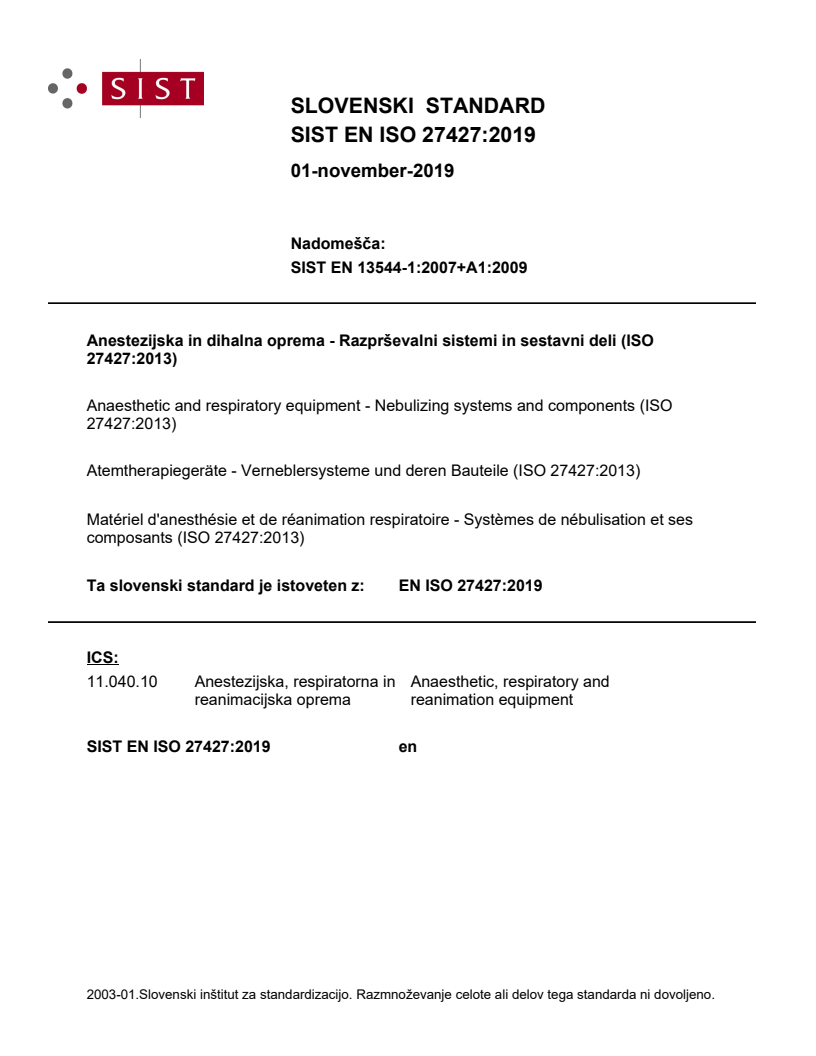
SLOVENSKI STANDARD
01-november-2019
Nadomešča:
SIST EN 13544-1:2007+A1:2009
Anestezijska in dihalna oprema - Razprševalni sistemi in sestavni deli (ISO
27427:2013)
Anaesthetic and respiratory equipment - Nebulizing systems and components (ISO
27427:2013)
Atemtherapiegeräte - Verneblersysteme und deren Bauteile (ISO 27427:2013)
Matériel d'anesthésie et de réanimation respiratoire - Systèmes de nébulisation et ses
composants (ISO 27427:2013)
Ta slovenski standard je istoveten z: EN ISO 27427:2019
ICS:
11.040.10 Anestezijska, respiratorna in Anaesthetic, respiratory and
reanimacijska oprema reanimation equipment
2003-01.Slovenski inštitut za standardizacijo. Razmnoževanje celote ali delov tega standarda ni dovoljeno.
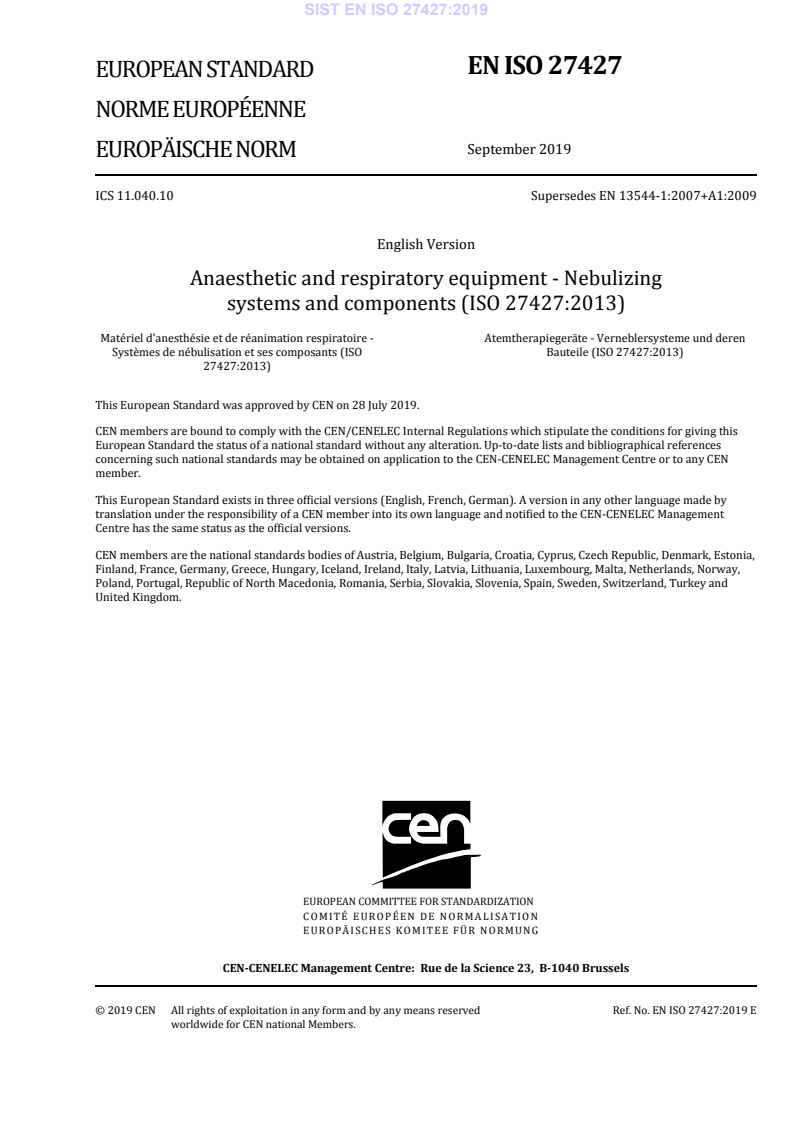
EN ISO 27427
EUROPEAN STANDARD
NORME EUROPÉENNE
September 2019
EUROPÄISCHE NORM
ICS 11.040.10 Supersedes EN 13544-1:2007+A1:2009
English Version
Anaesthetic and respiratory equipment - Nebulizing
systems and components (ISO 27427:2013)
Matériel d'anesthésie et de réanimation respiratoire - Atemtherapiegeräte - Verneblersysteme und deren
Systèmes de nébulisation et ses composants (ISO Bauteile (ISO 27427:2013)
27427:2013)
This European Standard was approved by CEN on 28 July 2019.
CEN members are bound to comply with the CEN/CENELEC Internal Regulations which stipulate the conditions for giving this
European Standard the status of a national standard without any alteration. Up-to-date lists and bibliographical references
concerning such national standards may be obtained on application to the CEN-CENELEC Management Centre or to any CEN
member.
This European Standard exists in three official versions (English, French, German). A version in any other language made by
translation under the responsibility of a CEN member into its own language and notified to the CEN-CENELEC Management
Centre has the same status as the official versions.
CEN members are the national standards bodies of Austria, Belgium, Bulgaria, Croatia, Cyprus, Czech Republic, Denmark, Estonia,
Finland, France, Germany, Greece, Hungary, Iceland, Ireland, Italy, Latvia, Lithuania, Luxembourg, Malta, Netherlands, Norway,
Poland, Portugal, Republic of North Macedonia, Romania, Serbia, Slovakia, Slovenia, Spain, Sweden, Switzerland, Turkey and
United Kingdom.
EUROPEAN COMMITTEE FOR STANDARDIZATION
COMITÉ EUROPÉEN DE NORMALISATION
EUROPÄISCHES KOMITEE FÜR NORMUNG
CEN-CENELEC Management Centre: Rue de la Science 23, B-1040 Brussels
© 2019 CEN All rights of exploitation in any form and by any means reserved Ref. No. EN ISO 27427:2019 E
worldwide for CEN national Members.
Contents Page
European foreword . 3
European foreword
The text of ISO 27427:2013 has been prepared by Technical Committee ISO/TC 121 "Anaesthetic and
respiratory equipment” of the International Organization for Standardization (ISO) and has been taken
over as EN ISO 27427:2019 by Technical Committee CEN/TC 215 “Respiratory and anaesthetic
equipment” the secretariat of which is held by BSI.
This European Standard shall be given the status of a national standard, either by publication of an
identical text or by endorsement, at the latest by March 2020, and conflicting national standards shall
be withdrawn at the latest by March 2020.
Attention is drawn to the possibility that some of the elements of this document may be the subject of
patent rights. CEN shall not be held responsible for identifying any or all such patent rights.
This document supersedes EN 13544-1:2007+A1:2009.
According to the CEN-CENELEC Internal Regulations, the national standards organizations of the
following countries are bound to implement this European Standard: Austria, Belgium, Bulgaria,
Croatia, Cyprus, Czech Republic, Denmark, Estonia, Finland, France, Germany, Greece, Hungary, Iceland,
Ireland, Italy, Latvia, Lithuania, Luxembourg, Malta, Netherlands, Norway, Poland, Portugal, Republic of
North Macedonia, Romania, Serbia, Slovakia, Slovenia, Spain, Sweden, Switzerland, Turkey and the
United Kingdom.
Endorsement notice
The text of ISO 27427:2013 has been approved by CEN as EN ISO 27427:2019 without any modification.
INTERNATIONAL ISO
STANDARD 27427
Third edition
2013-12-15
Anaesthetic and respiratory
equipment — Nebulizing systems and
components
Matériel d’anesthésie et de réanimation respiratoire — Systèmes de
nébulisation et ses composants
Reference number
ISO 27427:2013(E)
©
ISO 2013
ISO 27427:2013(E)
© ISO 2013
All rights reserved. Unless otherwise specified, no part of this publication may be reproduced or utilized otherwise in any form
or by any means, electronic or mechanical, including photocopying, or posting on the internet or an intranet, without prior
written permission. Permission can be requested from either ISO at the address below or ISO’s member body in the country of
the requester.
ISO copyright office
Case postale 56 • CH-1211 Geneva 20
Tel. + 41 22 749 01 11
Fax + 41 22 749 09 47
E-mail copyright@iso.org
Web www.iso.org
Published in Switzerland
ii © ISO 2013 – All rights reserved
ISO 27427:2013(E)
Contents Page
Foreword .iv
Introduction .v
1 Scope . 1
2 Normative references . 1
3 Terms and definitions . 2
4 General requirements and requirements for test . 4
4.1 Risk management . 4
4.2 Test methods and alternatives . 5
4.3 Electrical safety . 5
4.4 Mechanical safety. 5
4.5 Pneumatic safety . 6
4.6 Protection against inadvertent adjustments . 6
4.7 Usability . 6
5 Marking . 6
5.1 Symbols . 6
5.2 Marking on the device . 6
5.3 Labelling on the packaging or individual pack . 7
5.4 Instructions for use, inserts, and accompanying documents . 8
6 Construction requirements .11
6.1 Materials .11
6.2 Connectors .11
6.3 Rotary controls .13
7 Cleaning, sterilization, and disinfection .14
8 Biocompatibility .14
Annex A (informative) Rationale .15
Annex B (normative) Diameters of respirable fraction particles .19
Annex C (normative) Test methods for aerosol output and aerosol output rate .20
Annex D (normative) Test methods for particle sizing .23
Annex E (informative) Hazard identification for risk assessment .32
Annex F (informative) Classification of general purpose nebulizers .38
Annex G (informative) Environmental aspects .40
Annex AA (informative) Conformance to essential principles .42
Bibliography .46
ISO 27427:2013(E)
Foreword
ISO (the International Organization for Standardization) is a worldwide federation of national standards
bodies (ISO member bodies). The work of preparing International Standards is normally carried out
through ISO technical committees. Each member body interested in a subject for which a technical
committee has been established has the right to be represented on that committee. International
organizations, governmental and non-governmental, in liaison with ISO, also take part in the work.
ISO collaborates closely with the International Electrotechnical Commission (IEC) on all matters of
electrotechnical standardization.
The procedures used to develop this document and those intended for its further maintenance are
described in the ISO/IEC Directives, Part 1. In particular the different approval criteria needed for the
different types of ISO documents should be noted. This document was drafted in accordance with the
editorial rules of the ISO/IEC Directives, Part 2 (see www.iso.org/directives).
Attention is drawn to the possibility that some of the elements of this document may be the subject of
patent rights. ISO shall not be held responsible for identifying any or all such patent rights. Details of
any patent rights identified during the development of the document will be in the Introduction and/or
on the ISO list of patent declarations received (see www.iso.org/patents).
Any trade name used in this document is information given for the convenience of users and does not
constitute an endorsement.
For an explanation on the meaning of ISO specific terms and expressions related to conformity
assessment, as well as information about ISO’s adherence to the WTO principles in the Technical Barriers
to Trade (TBT) see the following URL: Foreword - Supplementary information
The committee responsible for this document is ISO/TC 121, Anaesthetic and respiratory equipment,
Subcommittee SC 2, Airways and related equipment.
This third edition cancels and replaces the second edition (ISO 27427:2010), of which it constitutes a
major revision.
iv © ISO 2013 – All rights reserved
ISO 27427:2013(E)
Introduction
Nebulizers are widely used to deliver drugs and vaccines in an aerosol form to humans through the
respiratory system. Nebulizers are also used for diagnostic purposes using radioisotopes for lung
challenge tests. These drugs can be in the form of a solution, suspension or emulsion. Aerosol inhalation
is the preferred route of administration for some drugs. Some drugs are intended for treatment of
systemic diseases and other drugs are intended to treat respiratory diseases. To achieve the intended
treatment, aerosol particles have to be deposited in specific parts of the respiratory tract. Different
size particles tend to deposit in different parts of the respiratory system; therefore, the performance
profile and the intended use of the nebulizer have to be defined by the manufacturer and specified in
the accompanying documentation.
[29]
This International Standard is based on Reference. This International Standard was developed to
cover “general purpose” nebulizers and is based on adult test parameters which are likely to be different
than stated when testing for paediatric or infant patient populations. It was specifically written to
ensure that the results of the various tests declared by the manufacturer are meaningful to the users
and buyers of nebulizers.
The objectives of this International Standard are to ensure
— suitability of the nebulizers for the intended use as disclosed by the manufacturer,
— safety, particularly for electrically powered nebulizers,
— compatibility between the materials of the components and the dispensed liquid, and
— biocompatibility of the materials of the components that come into contact with the human body.
Important changes were made to the original EN standard in recognition of the advances in test devices
such as lasers and low-flow impactors that allow manufacturers to use different test methods, provided
these alternate methods are validated against the methods specified in this International Standard.
Terms defined in this International Standard are set in bold type.
Throughout this International Standard, text for which rationale is provided in Annex A is indicated by
an asterisk (*).
INTERNATIONAL STANDARD ISO 27427:2013(E)
Anaesthetic and respiratory equipment — Nebulizing
systems and components
1 Scope
*This International Standard specifies requirements for the safety and performance testing of general
purpose nebulizing systems intended for continuous or breath-actuated delivery of liquids, in aerosol
form, to humans through the respiratory system.
This International Standard includes gas-powered nebulizers which can be powered by, e.g.,
compressors, pipeline systems, cylinders, etc., and electrically powered nebulizers [e.g., spinning
disc, ultrasonic, vibrating mesh (active and passive), and capillary devices] or manually powered
nebulizers.
This International Standard does not specify the minimum performance of nebulizing systems.
*This International Standard does not apply to devices intended for nasal deposition.
This International Standard does not apply to devices intended solely to provide humidification or
hydration by providing water in aerosol form.
[3]
NOTE ISO 8185 covers this.
*This International Standard does not apply to drug-specific nebulizers or their components (e.g.,
metered dose inhalers, metered liquid inhalers, dry powder inhalers).
2 Normative references
The following documents, in whole or in part, are normatively referenced in this document and are
indispensable for its application. For dated references, only the edition cited applies. For undated
references, the latest edition of the referenced document (including any amendments) applies.
ISO 5356-1, Anaesthetic and respiratory equipment — Conical connectors — Part 1: Cones and sockets
ISO 5356-2, Anaesthetic and respiratory equipment — Conical connectors — Part 2: Screw-threaded weight-
bearing connectors
ISO 5367, Anaesthetic and respiratory equipment — Breathing sets and connectors
ISO 7396-1, Medical gas pipeline systems — Part 1: Pipeline systems for compressed medical gases and
vacuum
ISO 9170-1, Terminal units for medical gas pipeline systems — Part 1: Terminal units for use with compressed
medical gases and vacuum
ISO 10524-1, Pressure regulators for use with medical gases — Part 1: Pressure regulators and pressure
regulators with flow-metering devices
ISO 10524-3, Pressure regulators for use with medical gases — Part 3: Pressure regulators integrated with
cylinder valves
ISO 10993-1, Biological evaluation of medical devices — Part 1: Evaluation and testing within a risk
management process
ISO 11135-1, Sterilization of health care products — Ethylene oxide — Part 1: Requirements for development,
validation and routine control of a sterilization process for medical devices
ISO 27427:2013(E)
ISO 11137-1, Sterilization of health care products — Radiation — Part 1: Requirements for development,
validation and routine control of a sterilization process for medical devices
ISO 11137-2, Sterilization of health care products — Radiation — Part 2: Establishing the sterilization dose
ISO 11137-3, Sterilization of health care products — Radiation — Part 3: Guidance on dosimetric aspects
ISO 11607-1, Packaging for terminally sterilized medical devices — Part 1: Requirements for materials,
sterile barrier systems and packaging systems
ISO 14971, Medical devices — Application of risk management to medical devices
ISO 15001, Anaesthetic and respiratory equipment — Compatibility with oxygen
ISO 15223-1, Medical devices — Symbols to be used with medical device labels, labelling and information to
be supplied — Part 1: General requirements
ISO 17665-1, Sterilization of health care products — Moist heat — Part 1: Requirements for the development,
validation and routine control of a sterilization process for medical devices
ISO 23328-1, Breathing system filters for anaesthetic and respiratory use — Part 1: Salt test method to
assess filtration performance
ISO 80369-1, Small-bore connectors for liquids and gases in healthcare applications — Part 1: General
requirements
IEC 60601-1:2005, Medical electrical equipment — Part 1: General requirements for basic safety and
essential performance
IEC 60601-1-2:2006+A1:2012, Medical electrical equipment — Part 1-2: General requirements for basic
safety and essential performance — Collateral standard: Electromagnetic compatibility — Requirements
and tests
IEC 60601-1-6, Medical electrical equipment — Part 1-6: General requirements for basic safety and essential
performance — Collateral standard: Usability
IEC 60601-1-8, Medical electrical equipment – Part 1-8: General requirements for basic safety and essential
performance – Collateral Standard: General requirements, tests and guidance for alarm systems in medical
electrical equipment and medical electrical systems
IEC 62366, Medical devices — Application of usability engineering to medical devices
EN 556-1, Sterilization of medical devices — Requirements for medical devices to be designated “STERILE” —
Part 1: Requirements for terminally sterilized medical devices
EN 13544-2, Respiratory therapy equipment — Part 2: Tubing and connectors
EN 15908, Anaesthetic and respiratory equipment. Non-interchangeable screw-threaded (NIST) low-
pressure connectors for medical gases
ENV 737-6, Medical gas pipeline systems — Part 6: Dimensions and allocation of probes for terminal units
for compressed medical gases and vacuum
CGA V-5-2005, Diameter Index Safety System — Noninterchangeable Low Pressure Connections for Medical
Gas Applications
3 Terms and definitions
For the purposes of this document, the following terms and definitions apply.
2 © ISO 2013 – All rights reserved
ISO 27427:2013(E)
3.1
aerosol
suspension of particles in gas
Note 1 to entry: Particles can be liquid or solid.
Note 2 to entry: The gas can be the driving gas or ambient air.
3.2
aerosol outlet port
outlet of the nebulizing system through which the aerosol is emitted
3.3
*aerosol output
mass or volume of aerosol emitted by the nebulizing system at the aerosol outlet port for the given
fill volume
3.4
*aerosol output rate
mass or volume of aerosol emitted by the nebulizing system per unit of time
3.5
breath-actuated nebulizer
nebulizer triggered by a respiratory parameter
Note 1 to entry: Examples of this classification are found in Annex F.
3.6
continuous nebulizer
nebulizer in which aerosol is delivered continuously over multiple inhalation/exhalation breathing
cycles or over long periods
3.7
electrically powered nebulizer
nebulizer that operates by means of electrical power
Note 1 to entry: Electrically powered nebulizers include ultrasonic, vibrating mesh and capillary-type devices.
3.8
gas-powered nebulizer
nebulizer in which the aerosol is generated by compressed gas
3.9
liquid container
part of the nebulizer that contains the liquid for nebulization
3.10
manually powered nebulizer
nebulizer that operates by means of human power
3.11
mass median aerodynamic diameter
MMAD
particle size at which 50 % of the mass of the active component are contained in droplets of smaller or
equal aerodynamic diameter
3.12
maximum fill volume
maximum volume of liquid, expressed in millilitres, in the liquid container when the nebulizer is filled
to its maximum filling level
ISO 27427:2013(E)
3.13
nebulizer
device that converts a liquid to an aerosol
Note 1 to entry: A nebulizer is also known as an aerosol generator.
3.14
nebulizing system
device, including the nebulizer and all other components, up to and including the aerosol outlet port,
required to make the aerosol available for inhalation
Note 1 to entry: Airway devices (e.g., masks, tracheal and tracheostomy tubes, supralaryngeal airways) and
breathing systems are not part of the nebulizing system.
3.15
*percentage of fill volume emitted
aerosol output expressed as a percentage of the fill volume recommended by the manufacturer that is
emitted by the nebulizer
3.16
*residual volume
estimated volume of liquid remaining in the nebulizing system when the nebulizer stops generating
an aerosol
3.17
*respirable fraction
fraction of aerosol droplets below 5 μm in diameter expressed as a percentage of the total aerosol
distribution
Note 1 to entry: The respirable fraction can be converted to a percentage (%) by multiplying by 100.
3.18
*test solution
aqueous solution used for the type-tests to characterize aerosol output, aerosol output rate, and
particle sizing
Note 1 to entry: See 4.2.1.2, 5.4.2 j) and k), Annex C, and Annex D.
3.19
test substance
active ingredient contained in the test solution
3.20
validation
confirmation through the provision of objective evidence that the requirements for a specific intended
use or application have been fulfilled
Note 1 to entry: The term “validated” is used to designate the corresponding status.
Note 2 to entry: The use conditions for validation can be real or simulated.
4 General requirements and requirements for test
4.1 Risk management
4.1.1 General
Nebulizing systems and nebulizers shall, when transported, stored, installed, operated in normal use,
and maintained according to the instructions of the manufacturer, present no risks that are not reduced
4 © ISO 2013 – All rights reserved
ISO 27427:2013(E)
to an acceptable level using the risk management procedures in accordance with ISO 14971 and which
are connected with their intended application, in normal and in single fault condition.
NOTE A situation in which a fault is not detected is considered a normal condition. Fault conditions/hazardous
situations might remain undetected over a period of time and, as a consequence, might lead to an unacceptable
risk. In that case, a subsequent detected fault condition needs to be considered as a single fault condition. Specific
risk control measures need to be determined within the risk management process to deal with such situations.
4.1.2 Clinical evaluation
If applicable, a clinical evaluation shall be performed and the results documented in the technical
documentation of the device.
Compliance is checked by inspecting the technical documentation of the device.
4.2 Test methods and alternatives
4.2.1 Test methods for aerosol output, aerosol output rate, and particle sizing
The type-test methods for aerosol output, aerosol output rate, and particle sizing in air are specified
in Annexes C and D.
4.2.1.1 *All type-test methods shall be performed on at least three representative devices of the same
type.
4.2.1.2 *The type-test methods shall use a test solution of albuterol 0,1 % (M/V) concentration in 0,9 %
sodium chloride solution or 2,5 % (M/V) sodium fluoride in distilled water with the provision that its use
is declared in the accompanying documents. See 5.4.2 j).
4.2.2 *Alternative test methods
The manufacturer can use type-test methods for aerosol output, aerosol output rate, and particle
sizing different from those specified in Annexes C and D.
Alternative test methods shall be validated against the test methods in Annexes C and D to demonstrate
equivalency.
Demonstration of equivalency shall be included in the technical documentation of the manufacturer.
Evidence shall be provided (e.g. to regulatory authorities) upon request.
4.2.3 Calibration and setup
To establish confidence in the test method, it is recommended that mass balance procedures be
incorporated during initial determinations. It is also recommended that occasional checks for system
leaks and overall efficiency of analysis be performed.
4.3 Electrical safety
A nebulizing system that utilizes electrical power shall meet the requirements given in IEC 60601-1, in
addition to the requirements given in this International Standard.
Compliance is checked by applying the tests given in IEC 60601-1.
4.4 Mechanical safety
Nebulizing systems shall comply with Clause 9 of IEC 60601-1:2005.
Compliance is checked by inspection.
ISO 27427:2013(E)
4.5 Pneumatic safety
If it is declared by the manufacturer that a nebulizing system is intended to be connected directly to
a pipeline system complying with ISO 7396-1 or a pressure regulator complying with ISO 10524-1 or
ISO 10524-3, the nebulizing system shall meet the requirements of this International Standard for
a pneumatic power supply having a range of 280 kPa (2,8 bar) to 600 kPa (6 bar) and shall cause no
hazardous situation under single fault conditions of the medical gas supply, [i.e. up to 1 MPa (10 bar)
inlet pressure].
4.6 Protection against inadvertent adjustments
Means of protection against inadvertent adjustment of controls which can create a hazardous output
shall be provided.
EXAMPLE Acceptable mechanical control techniques include locks, shielding, friction loading, detents,
pressure-sensitive finger pads, capacitive finger-switched microprocessor-oriented “soft” controls, and a specific
sequence of key or switch operations.
Compliance is checked by visual inspection following the instructions for use.
4.7 Usability
4.7.1 The manufacturer shall address, in a usability engineering process, the risk resulting from poor
usability according to IEC 60601-1-6 and IEC 62366.
4.7.2 The ON/OFF switch and/or control devices shall be positioned in such a way as to be safely
operated without hesitation or loss of time and without ambiguity.
4.7.3 Control devices (if fitted) shall be so arranged that their layout, travel, and resistance to operation
are compatible with the action to be performed, taking account of ergonomic principles.
Compliance is checked by inspecting the usability engineering file.
5 Marking
5.1 Symbols
ISO 15223-1 and 6.4 of IEC 60601-1:2005 apply.
Compliance is checked by inspection.
5.2 Marking on the device
Nebulizers, nebulizing systems, and components shall contain durable and legible marking on the
device to include the following.
5.2.1 Marking of the nebulizer and components
The following shall be marked on the nebulizer and components:
a) an arrow showing the direction of gas flow on all operator-detachable flow direction-sensitive
components, breathing attachments or parts (e.g. facemask or mouthpiece one-way valve, etc.),
unless manufactured to prevent incorrect assembly;
b) the inlet and outlet, if gas-specific;
c) the maximum fill volume level on the liquid container of the nebulizer.
6 © ISO 2013 – All rights reserved
ISO 27427:2013(E)
5.2.2 Marking of the controls and instruments
If applicable, controls and instruments shall be legibly marked as
a) the gas supply pressures, in kilopascals (kPa),
b) the pressures in breathing systems, in hectopascals (hPa),
c) the flows, in litres per minute (l/min),
d) if supplied, the air entrainment/oxygen dilution valves, in percent oxygen (% O ), and
e) the power and/or control devices marked with the relevant symbols.
Compliance is checked by inspection. All displayed qualitative or quantitative information, values,
functions, and/or markings shall be discernible or identifiable to an OPERATOR with 6-6 (20/20) vision
(corrected, if necessary) from a distance of 1 m at a light level of 215 lx, when viewing the information,
markings, etc., perpendicular to and including 15° above, below, left, and right of the normal line of sight
of the OPERATOR. See IEC 60601-1, 7.1.2 and 7.1.3.
5.3 Labelling on the packaging or individual pack
The following shall be labelled on the packaging or individual pack:
a) the name or trademark and address of the manufacturer;
b) the device identification and content information;
c) the batch code, preceded by the word “LOT”, or serial number;
d) the word “STERILE”, if appropriate (It is recommended that the method of sterilization be given.);
e) if applicable, an indication that the device is for single use;
NOTE The manufacturer’s attention is drawn to the regulatory provision, requiring that the indication
of single use be consistent across the European Community.
f) the device packaging and/or labelling to differentiate between the same or similar products, both
sterile and non-sterile, placed on the market by the same manufacturer;
g) the expiry date, expressed as the year and month, if the device is sensitive to storage or shelf life;
h) any special storage and/or handling conditions;
i) any warning and/or precaution (e.g. compatibility with the use of oxygen mixtures and compatibility
between oxygen and administered drugs);
j) for packages containing parts made of antistatic or conductive material, the word “ANTISTATIC” or
“CONDUCTIVE”;
k) if natural rubber latex is incorporated in parts of the medical devices that come directly or indirectly
into contact with the patient, the device shall be labelled accordingly;
l) if phthalates are incorporated in parts of the medical devices that come directly or indirectly into
contact with the patient, the device shall be labelled accordingly;
m) for nebulizing systems intended to be connected to an electrical power source, the nominal power
expressed in Watts (W) or kilowatts (kW), as appropriate;
n) for nebulizing systems intended to be connected to the supply mains, the rated supply voltage(s)
or rated voltage range(s) to which they can be connected, expressed in Volts (V).
Compliance is checked by inspection.
ISO 27427:2013(E)
5.4 Instructions for use, inserts, and accompanying documents
Nebulizers, nebulizing systems, and components shall be accompanied by instructions for use, inserts,
or accompanying documents that include:
5.4.1 General information
a) the date of issue or the date of latest revision of the instructions, inserts, or accompanying documents;
b) the name or trademark and address of the manufacturer;
c) for devices imported into the European Union, the name and address of the person responsible and
of the authorized representative of the manufacturer established within the European Community;
d) the purpose and the intended use of the device and parts thereof, as determined by the manufacturer,
including the power and/or control devices;
EXAMPLE Intended use categories include, but are not limited to:
— patient populations,
— environment of use,
— single-use disposable,
— single-patient reuse, and
— multi-patient reuse.
e) if applicable, the interdependence of controls;
f) a statement that the nebulizing system is or is not suitable for use in a anaesthetic breathing
system or a ventilator breathing system, see References [26] and [27];
g) *if applicable, the maximum temperature above ambient reached in the nebulizing chamber under
all operating conditions;
h) the types of liquid (e.g. solution, suspension, and/or emulsion) the device is designed to nebulize;
i) the maximum fill volume level, as marked on the liquid container of the nebulizer;
j) if appropriate, the recommended fill volume for use;
k) if handheld, an indication of the spatial orientation (e.g. vertical, horizontal, inverted) at which the
nebulizer functions as intended;
l) a statement that using a solution, suspension, or emulsion different from that recommended by the
manufacturer, in particular, a suspension and/or high-viscosity solution, can alter the particle size
distribution curve, the mass median aerodynamic diameter (MMAD), aerosol output, and/or
aerosol output rate, which can then be different from those disclosed by the manufacturer;
m) a statement that nebulizing systems intended to be connected to a power source (electrical or
pneumatic) shall be disconnected from the power source after use;
n) the mass of the most usual configuration, in kilograms (kg).
5.4.2 Performance disclosures
a) a statement to the effect that the following disclosures for nebulizer performance are based upon
testing that utilizes adult ventilatory patterns and are likely to be different from those stated for
paediatric or infant populations;
8 © ISO 2013 – All rights reserved
ISO 27427:2013(E)
b) the distribution of particles, in terms of percent of sampled mass, within each of the following size
ranges: % >5 µm, % 2 µm to 5 µm, and % <2 µm when tested in accordance with Annex D;
c) the mass median aerodynamic diameter (MMAD) and the geometric standard deviation (GSD)
only if the distribution is unimodal and log-normal, as derived from the particle size distribution
curve, when tested in accordance with Annex D;
d) the respirable fraction performance of the nebulizer, when tested in accordance with Annex D;
e) the aerosol output and aerosol output rate at the fill volume recommended by the manufacturer or
2 ml if a recommended fill volume is not provided, expressed as the mass of test substance collected
and the mass of test substance collected per minute, when tested in accordance with Annex C;
f) for gas-powered nebulizers, the aerosol output and aerosol output rate at the minimum, nominal,
and maximum driving gas flows with the corresponding pressures, when tested in accordance with
Annex C;
g) the percentage of fill volume emitted per minute (e.g. 20 % of fill volume per minute) as the
aerosol output in one minute divided by the fill volume recommended by the manufacturer or 2 ml
if no fill volume is recommended, when tested in accordance with Annex C;
h) for gas-powered nebulizers, the percentage of fill volume emitted and percentage of fill
volume emitted per minute at the minimum, nominal, and maximum driving gas flows with the
corresponding pressures, when tested in accordance with Annex C;
i) the residual volume (in millilitres), when tested in accordance with Annex C;
NOTE Aerosol output fraction can then be calculated as the aerosol output divided by the mass
(weight) of the liquid placed in the nebulizer.
j) the test solution used to carry out the nebulizer performance type-tests in Annexes C and D;
k) *if alternative test methods or test solutions have been used to demonstrate nebulizer
performance, a demonstration of equivalency shall be included in the technical documentation of
the manufacturer and shall be made available upon request;
l) for a breath-actuated nebulizer, the method of operation and relevant sensitivity;
m) *the maximum A-weighted sound pressure level, as derived from the test method in 9.6.2.1 of
IEC 60601-1:2005;
n) for nebulizers intended for use with ventilators, a statement to the effect that the measured aerosol
output and aerosol output rate are not intended to be used as basis to determine the correct
dosage and that the aerosol output can differ when the nebulizer is used in combination with a
ventilator.
5.4.3 Driving gas supply information
a) the recommended driving gas(es);
b) the minimum and maximum recommended driving gas pressures and flows;
c) the pressure and flow characteristics of any gas power outlet under the worst-case conditions
stated by the manufacturer;
d) if applicable, a warning that oxygen or oxygen mixtures (O > 23 %) should not be used as driving
[36]
gas;
e) if applicable, a statement of the composition and dryness specification for all gases to be supplied to
the nebulizer;
f) the service lifetime of the reusable parts.
ISO 27427:2013(E)
5.4.4 Materials compatibility information
a) the information about any precautions to be taken if there is a specific unusual risk associated with
the compatibility between the materials of the components and the dispensed liquids;
b) if applicable, a statement that the materials used in the components could not be compatible with
solutions/suspensions/emulsions that have not been evaluated;
c) a statement that identifies the residual risk if phthalates are incorporated in parts of the medical
devices coming directly or indirectly into contact with the patient and if the device is used in the
treatment of children or pregnant or nursing women;
d) for single-use devices, the risks associated with the reuse or reprocessing of single-use devices.
NOTE For devices imported into the European Union, the manufacturer’s attention is drawn to the regulatory
provision, requiring that the indication of single use be consistent across the European Community.
5.4.5 Cleaning, disinfection, and sterilization information
a) for nebulizing systems intended for single-patient reuse, recommended methods of cleaning and,
if indicated, disinfection prior to reuse;
b) for nebulizing systems intended for multi-patient reuse, recommended methods of cleaning and
either disinfection or sterilization prior to reuse;
c) the number of cycles of cleaning, disinfection, and/or sterilizations the nebulizing system will
withstand;
d) for nebulizing systems intended to be connected to a power source (electrical or pneumatic),
cleaning, disinfection, and sterilization shall be carried out with the power source disconnected;
e) for nebulizing systems not intended for reuse, the risks associated with cleaning and disinfection
and/or sterilization prior to reuse.
5.4.6 Dismantling and reassembling information
a) if applicable, procedures for disconnecting the nebulizing system from the power source (electrical
or pneumatic), dismantling, and reassembly;
b) recommended functional test(s) to be carried out after reassembly and before use;
c) for nebulizing systems intended to be connected to a power source (electrical or pneumatic),
dismantling and reassembling shall be carried out with the power source disconnected.
5.4.7 Monitoring, alarm, and protection devices
a) the instructions for use shall contain the information required by IEC 60601-1-8, 5.2.1;
b) the instructions for use shall contain details and characteristics of non-return valves and pressure-
relief valves, if fitted.
5.4.8 Electromagnetic compatibility information
If applicable, the instructions for use shall include a warning statement to the effect that the functioning
of this nebulizer can be affected by electromagnetic interference exceeding the levels specified in
IEC 60601-1-2.
5.4.9 Device disposal information
The instructions for use shall include information about any precautions to be taken if there is a specific
unusual risk associated with the disposal of a device.
10 © ISO 2013 – All rights reserved
ISO 27427:2013(E)
5.4.10 Parts not integral to the nebulizing system disclosure
a) a list of the parts that are not integral parts of the system and are necessary for correct use;
b) a statement that these parts shall comply with the relevant requirements of this International
Standard.
Compliance is checked by inspection.
6 Construction requirements
6.1 Materials
6.1.1 Materials for construction shall be compatible with the manufacturer’s recommended gas(es) or
gas mixture(s) and, if applicable, in compliance with ISO 15001.
Compliance is checked by inspection and by examination of the risk controls described in a risk
assessment and associated verification and validation studies.
While intended to be used with drugs and cleaning agents, materials should be chosen to minimize risks
due to toxicity.
6.1.2 Nebulizer components that come into contact wit
...