

prEN 15496
(Main)Cycles - Requirements and test methods for cycle locks
- Abstract
This document specifies performance requirements and describes test methods for strength, security, function and corrosion resistance of locks for cycles. It also covers certain aspects regarding the safety of the rider of the cycle on which the lock is mounted. This document covers permanently-mounted cycle locks and removable locks.
- Status
- Not Published
- Publication Date
- 01-May-2024
- Technical Committee
- CEN/TC 333 - Cycles
- Drafting Committee
- CEN/TC 333 - Cycles
- Current Stage
- 4098 - Decision to abandon - Enquiry
- Start Date
- 22-Nov-2024
- Completion Date
- 07-Oct-2026

Overview
The European standard prEN 15496:2022 specifies essential requirements and test methods for cycle locks, targeting strength, security, functionality, and corrosion resistance. Developed by the Technical Committee CEN/TC 333 "Cycles," this standard addresses both permanently-mounted and removable locks used to secure bicycles. The document aims to enhance the security level of unattended bicycles while ensuring rider safety and lock durability under practical conditions. Replacing the older EN 15496:2008, this updated standard integrates the latest testing procedures to address evolving lock-picking techniques and mechanical attacks.
Key Topics
Performance Requirements
The standard defines strict criteria for the mechanical and functional performance of cycle locks, focusing on operational unlocking torque, key strength, locking mechanism resistance, and corrosion endurance.Test Methods
Procedures cover a broad range of tests including:- Tensile, torsional, and impact strength tests for lock housings, shackles, and chain components
- Cutting and pulling resistance tests against common attack methods
- Drill resistance testing for locking mechanisms
- Picking resistance evaluations utilizing simulated lock-picking tools
- Corrosion resistance testing through accelerated salt spray exposure
Lock Types Defined
- Permanently-mounted cycle locks (e.g., frame locks) that become integral to the bike
- Removable locks such as padlocks, chain locks, cable locks, and U-shackle locks which can be detached without tools other than a key
Safety Considerations
The standard includes safety requirements to minimize hazards to riders caused by lock design or mounting.Marking and Durability
Requirements for clear, durable markings on locks and keys for identification and traceability purposes, along with durability testing of markings.
Applications
Manufacturers
Designers and producers of cycle locks use this standard to ensure their products meet recognized European security and durability benchmarks, enhancing market acceptance and consumer confidence.Quality Control
Testing laboratories and certification bodies apply the prescribed test methods to evaluate lock models and verify compliance, facilitating standard conformity and performance claims.Retail and Consumers
Retailers benefit from offering locks that adhere to prEN 15496, as the standard helps customers make informed decisions based on proven security levels. Cyclists gain assurance of lock robustness and resistance against common theft tactics.Urban Mobility and Bike-Sharing
Entities managing public bike-sharing schemes or urban cycling infrastructure employ locks complying with this standard to reduce theft rates and maintenance costs.
Related Standards
- EN 1670:2007 – Building hardware corrosion resistance requirements and test methods
- EN 10277:2018 – Technical delivery conditions for bright steel products used in lock components
- EN ISO 9227:2017 – Salt spray tests for evaluating corrosion resistance in artificial atmospheres
- EN ISO 9994:2019 – Safety specifications for lighters, referenced for safety aspects of locking mechanisms
These complementary standards support the robustness, reliability, and safety requirements set out in prEN 15496, addressing material quality, environmental resistance, and operational safety.
By adhering to prEN 15496:2022, stakeholders can ensure cycle locks provide practical and effective security solutions while maintaining longevity and rider safety, fostering confidence in cycle security products throughout Europe and beyond.
Relations
- Effective Date
- 19-Jan-2023
Get Certified
Connect with accredited certification bodies for this standard

TÜV Rheinland
TÜV Rheinland is a leading international provider of technical services.

TÜV SÜD
TÜV SÜD is a trusted partner of choice for safety, security and sustainability solutions.

DEKRA Certification Inc.
DEKRA US certification services.
Sponsored listings
Frequently Asked Questions
prEN 15496 is a draft published by the European Committee for Standardization (CEN). Its full title is "Cycles - Requirements and test methods for cycle locks". This standard covers: This document specifies performance requirements and describes test methods for strength, security, function and corrosion resistance of locks for cycles. It also covers certain aspects regarding the safety of the rider of the cycle on which the lock is mounted. This document covers permanently-mounted cycle locks and removable locks.
This document specifies performance requirements and describes test methods for strength, security, function and corrosion resistance of locks for cycles. It also covers certain aspects regarding the safety of the rider of the cycle on which the lock is mounted. This document covers permanently-mounted cycle locks and removable locks.
prEN 15496 is classified under the following ICS (International Classification for Standards) categories: 43.150 - Cycles. The ICS classification helps identify the subject area and facilitates finding related standards.
prEN 15496 has the following relationships with other standards: It is inter standard links to EN 15496:2008. Understanding these relationships helps ensure you are using the most current and applicable version of the standard.
prEN 15496 is available in PDF format for immediate download after purchase. The document can be added to your cart and obtained through the secure checkout process. Digital delivery ensures instant access to the complete standard document.
Standards Content (Sample)
SLOVENSKI STANDARD
01-september-2022
Kolesa - Zahteve in preskusne metode za ključavnice
Cycles - Requirements and test methods for cycle locks
Fahrräder - Anforderungen und Prüfverfahren für Fahrradschlösser
Cycles - Exigences et méthodes d'essai pour les antivols pour cycles
Ta slovenski standard je istoveten z: prEN 15496
ICS:
43.150 Kolesa Cycles
2003-01.Slovenski inštitut za standardizacijo. Razmnoževanje celote ali delov tega standarda ni dovoljeno.
DRAFT
EUROPEAN STANDARD
NORME EUROPÉENNE
EUROPÄISCHE NORM
July 2022
ICS 43.150 Will supersede EN 15496:2008
English Version
Cycles - Requirements and test methods for cycle locks
Cycles - Exigences et méthodes d'essai pour les antivols Fahrräder - Anforderungen und Prüfverfahren für
pour cycles Fahrradschlösser
This draft European Standard is submitted to CEN members for enquiry. It has been drawn up by the Technical Committee
CEN/TC 333.
If this draft becomes a European Standard, CEN members are bound to comply with the CEN/CENELEC Internal Regulations
which stipulate the conditions for giving this European Standard the status of a national standard without any alteration.
This draft European Standard was established by CEN in three official versions (English, French, German). A version in any other
language made by translation under the responsibility of a CEN member into its own language and notified to the CEN-CENELEC
Management Centre has the same status as the official versions.
CEN members are the national standards bodies of Austria, Belgium, Bulgaria, Croatia, Cyprus, Czech Republic, Denmark, Estonia,
Finland, France, Germany, Greece, Hungary, Iceland, Ireland, Italy, Latvia, Lithuania, Luxembourg, Malta, Netherlands, Norway,
Poland, Portugal, Republic of North Macedonia, Romania, Serbia, Slovakia, Slovenia, Spain, Sweden, Switzerland, Turkey and
United Kingdom.
Recipients of this draft are invited to submit, with their comments, notification of any relevant patent rights of which they are
aware and to provide supporting documentation.
Warning : This document is not a European Standard. It is distributed for review and comments. It is subject to change without
notice and shall not be referred to as a European Standard.
EUROPEAN COMMITTEE FOR STANDARDIZATION
COMITÉ EUROPÉEN DE NORMALISATION
EUROPÄISCHES KOMITEE FÜR NORMUNG
CEN-CENELEC Management Centre: Rue de la Science 23, B-1040 Brussels
© 2022 CEN All rights of exploitation in any form and by any means reserved Ref. No. prEN 15496:2022 E
worldwide for CEN national Members.
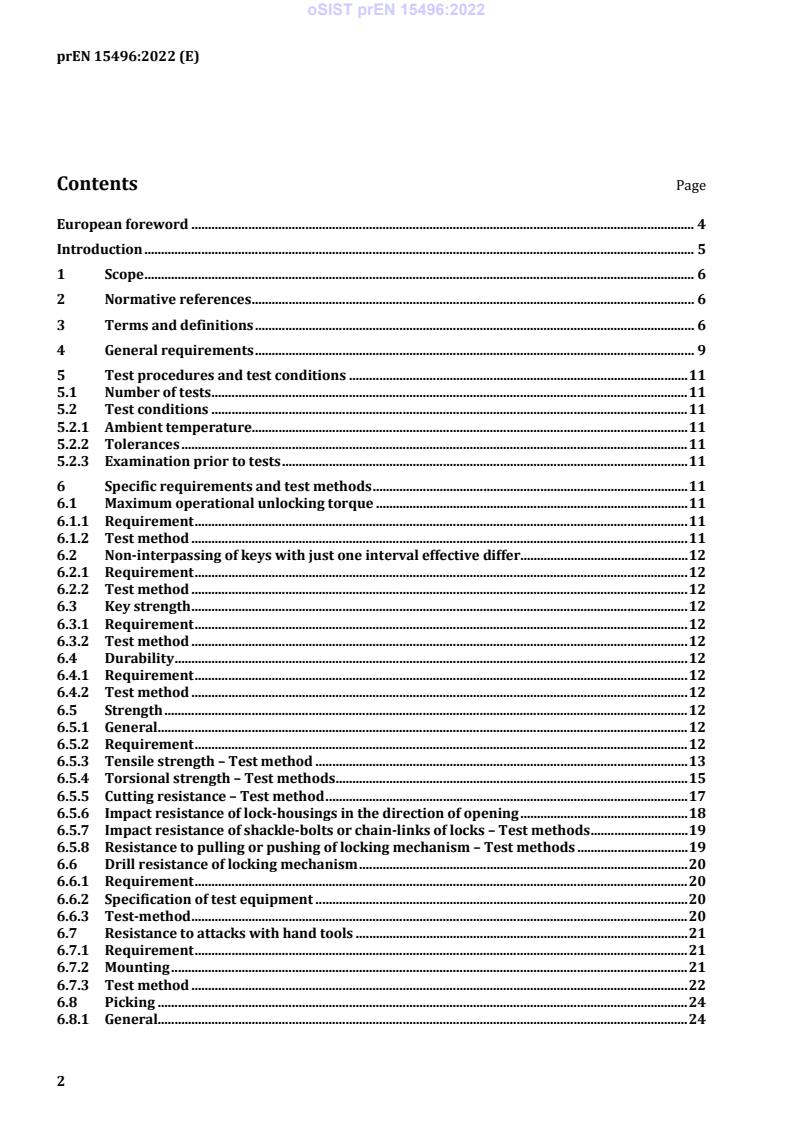
Contents Page
European foreword . 4
Introduction . 5
1 Scope . 6
2 Normative references . 6
3 Terms and definitions . 6
4 General requirements . 9
5 Test procedures and test conditions . 11
5.1 Number of tests . 11
5.2 Test conditions . 11
5.2.1 Ambient temperature. 11
5.2.2 Tolerances . 11
5.2.3 Examination prior to tests . 11
6 Specific requirements and test methods . 11
6.1 Maximum operational unlocking torque . 11
6.1.1 Requirement . 11
6.1.2 Test method . 11
6.2 Non-interpassing of keys with just one interval effective differ . 12
6.2.1 Requirement . 12
6.2.2 Test method . 12
6.3 Key strength . 12
6.3.1 Requirement . 12
6.3.2 Test method . 12
6.4 Durability . 12
6.4.1 Requirement . 12
6.4.2 Test method . 12
6.5 Strength . 12
6.5.1 General. 12
6.5.2 Requirement . 12
6.5.3 Tensile strength – Test method . 13
6.5.4 Torsional strength – Test methods . 15
6.5.5 Cutting resistance – Test method . 17
6.5.6 Impact resistance of lock-housings in the direction of opening . 18
6.5.7 Impact resistance of shackle-bolts or chain-links of locks – Test methods . 19
6.5.8 Resistance to pulling or pushing of locking mechanism – Test methods . 19
6.6 Drill resistance of locking mechanism . 20
6.6.1 Requirement . 20
6.6.2 Specification of test equipment . 20
6.6.3 Test-method . 20
6.7 Resistance to attacks with hand tools . 21
6.7.1 Requirement . 21
6.7.2 Mounting . 21
6.7.3 Test method . 22
6.8 Picking . 24
6.8.1 General. 24
6.8.2 Requirement . 25
6.8.3 Test specimens . 25
6.8.4 Test equipment. 25
6.8.5 Test procedure . 25
6.8.6 Evaluation of test results . 26
6.8.7 Additional testing . 26
6.9 Corrosion resistance . 26
6.9.1 Requirement . 26
6.9.2 Test method . 26
7 Marking . 27
7.1 Requirement . 27
7.1.1 Cycle lock . 27
7.1.2 Keys . 27
7.2 Durability test . 27
7.2.1 Requirement . 27
7.2.2 Test method . 27
Annex A (informative) Calculation of m* . 28
Annex B (normative) Dimensions of test stand . 29
Annex C (informative) Photographs of tools specified in Table 2 and Table 3 . 30
Annex D (informative) Photographs of picking tools . 33
European foreword
This document (prEN 15496:2022) has been prepared by Technical Committee CEN/TC 333 “Cycles”,
the secretariat of which is held by UNI.
This document is currently submitted to the CEN Enquiry.
This document will supersede EN 15496:2008.
In comparison with the previous edition, the following technical modifications have been made:
— Normative references in Clause 2 have been updated.
Introduction
This document has been developed in response to demand throughout Europe aimed to ensure that
locking systems manufactured in compliance with this standard will offer unattended bicycles a high,
practical level of security. The tests have been designed and evaluated in practical tests by experts in
the lock industry and consideration has been given to the latest techniques employed by professional
cycle-thieves whose methods are constantly changing.
The scope has been limited to security and durability requirements and, to some extent, the safety of
the rider.
1 Scope
This document specifies performance requirements and describes test methods for strength, security,
function and corrosion resistance of locks for cycles. It also covers certain aspects regarding the safety
of the rider of the cycle on which the lock is mounted. This document covers permanently-mounted
cycle locks and removable locks.
2 Normative references
The following documents are referred to in the text in such a way that some or all of their content
constitutes requirements of this document. For dated references, only the edition cited applies. For
undated references, the latest edition of the referenced document (including any amendments) applies.
EN 1670:2007, Building hardware — Corrosion resistance — Requirements and test methods
EN 10277:2018, Bright steel products — Technical delivery conditions
EN ISO 9227:2017, Corrosion tests in artificial atmospheres — Salt spray tests (ISO 9227:2017)
EN ISO 9994:2019, Lighters — Safety specification (ISO 9994:2018)
3 Terms and definitions
For the purposes of this document, the following terms and definitions apply.
ISO and IEC maintain terminological databases for use in standardization at the following addresses:
— ISO Online browsing platform: available at https://www.iso.org/obp
— IEC Electropedia: available at https://www.electropedia.org/
3.1
cable lock
cable made of steel wire, in a single or spiral loop, with one end permanently attached to the lock
housing
3.2
chain and lock combination
chain with a detachable lock
3.3
chain lock
chain combined with a padlock or U-shackle lock
3.4
combination lock
lock that can be operated without a key and unlocked by moving parts of the lock in a certain pattern
(combination of movements)
3.5
cycle
any vehicle that has at least two wheels and is propelled solely or mainly by the muscular energy of the
person on that vehicle, in particular by means of pedals
3.6
cycle lock
device which, when locked, is intended to mechanically prevent the use of a bicycle
3.7
depth of incision
depth of transverse notches on the length of a key
3.8
detainer
part of the key mechanism of a locking mechanism which should first be moved by the key into a pre-
determined position before the key can be used for unlocking or locking
3.9
diamond-type frame
traditional type of cycle-frame consisting of a head-tube, a top-tube, a seat-tube, and a down-tube
3.10
key
device, supplied by the manufacturer, for locking and unlocking a lock and that is capable of being used
only through direct physical contact with the lock
3.11
key-operated lock
lock that is operated with a key
3.12
keyway
aperture extending along the whole or part of the length of the plug into which the key is inserted
3.13
key mechanism
part of the mechanism that recognises a correct key
Note 1 to entry: A key mechanism is also used as a synonym to “identification number” (regarding electronic
locks) and “combination code” (for combination locks).
3.14
lock housing
part of the lock containing the key mechanism and blocking mechanism
3.15
locking mechanism
part of the mechanism that is operated by the key mechanism to lock/unlock the lock
3.16
padlock
independent locking device comprising a housing, a key mechanism, a locking mechanism, and a
shackle
3.17
plug
part of the key-mechanism that can be moved when the proper key is used
3.18
permanently-mounted cycle lock
cycle lock that forms one unit (excluding accessories and keys), which is mounted on a cycle and that
can be considered as a permanent part of that cycle
Note 1 to entry: A permanently-mounted lock can also be equipped with accessories such as chains or cables
which can be locked with the same locking unit as that of the permanently-mounted lock.
Note 2 to entry: One of the most common types of lock of this type is the so-called frame lock.
3.19
practical effective differ
difference between key mechanisms of similar design, achieved only by the movable detainers, which
allow each key mechanism to be operated only by its own key
Note 1 to entry: The number of practical effective differs is equal to the number of theoretical differs after
deduction of the differs suppressed by the manufacturer due to technical constraints and deduction of the differs
suppressed by requirements in this document (see Clause 4).
3.20
removable cycle lock
cycle lock that consists of one or more than one unit and that can be used for locking a cycle but that
cannot be considered as a permanent part of that cycle since it is detachable without the use of any
tools other than a key
Note 1 to entry: Removable locks are often used for the connection of a cycle to other cycles or to fixed objects
such as a ground-anchor.
3.21
shackle
part of the lock which passes through and secures the lock fitting
3.22
u-shackle lock
lock housing with a partially or totally detachable shackle in which the legs of the shackle may or may
not be parallel to each other
4 General requirements
NOTE In Table 1, a summary of the requirements and test parameters, specified in this document, is
presented.
Table 1 — Summary of requirements and test parameters
Test parameter Requirement Test Requirement Unit
clause clause value
General requirements 4 -
Maximum operational unlocking torque 6.1.1 6.1.2 1 Nm
Non-interpassing of keys with just one interval 6.2.1 6.2.2 1,5 Nm
effective differ
Key strength 6.3.1 6.3.2 2 Nm
Durability 6.4.1 6.4.2 5000 n
Strength 6.5.2
Tensile strength
U-shackle locks: Tensile strength in the direction of 6.5.2 6.5.3.2.1 30 kN
opening
U-shackle locks: Tensile strength transverse or 6.5.2 6.5.3.2.2 10 kN
inclined to the direction of opening
Other locks 6.5.2 6.5.3.3 10 kN
Torsional strength
U-shackle locks 6.5.2 6.5.4.2 500 Nm
Chains for chain locks 6.5.2 6.5.4.3 500 Nm
Chain and lock combinations 6.5.2 6.5.4.4 500 Nm
Other locks 6.5.2 6.5.4.5 500 Nm
Cutting resistance 6.5.2 6.5.5.2 55 kN
Impact resistance of lock-housings in the 6.5.2 6.5.6 3050 g 5 strokes
direction of opening 1,0 m
–20 °C
Impact resistance of shackle-bolts or chain-links 6.5.2 6.5.7 3050 g 5 strokes
of locks – Test methods 1,0 m
–20 °C
Resistance to pulling or pushing of locking 6.5.2 6.5.8 5 kN
mechanism
Drill resistance of locking mechanism 6.6.1 6.6.3 2 min
Resistance to attacks with hand tools 6.7.1 6.7.3 180 seconds
Picking 6.8.2 6.8.5 228 m*
Corrosion resistance 6.9.1 6.9.2
Marking 7.1 7.2
4.1 A cycle lock shall be so designed that when it is mounted according to the manufacturer’s
instructions and locked, it shall fulfil all of the following requirements:
a) cycle cannot be either ridden or pushed along in a normal way and the rotation of at least one
wheel is prevented, and
b) it is not possible to remove the lock by detaching a part of the cycle that is easy to detach and attach
(e.g. a wheel or a seat-post), and
c) it is not possible to remove or unlock it by deforming a part of the cycle (e.g. the front fork or the
seat-stays) unless such deformation prevents the future normal use of the cycle.
4.2 For safety reasons, it shall not be possible for a permanently-mounted cycle lock or for a
removable cycle lock, when mounted according to the manufacturer’s instructions, to interfere with the
normal and safe use of the cycle.
4.3 For the requirements in subclauses 4.3.1 to 4.3.5 deviations from the requirements are permitted
if the same level of security can be achieved with other solutions. The assessment of any other such
solutions shall be presented in the test report.
4.3.1 The key mechanism shall have at least five active detainers.
4.3.2 The key shall be provided with at least three different depths of incision.
4.3.3 Only 60 % of the number of blocking elements shall be permitted to have the same incision.
When the 60 % value does not result in a whole number, the immediately lower whole number shall
apply
4.3.4 Not more than two equal, adjacent blocking elements shall be permitted.
4.3.5 The lock shall have a minimum number of practical effective differs (n), thus:
a) for key- operated locks: 2 500 with a minimum of 1 000 per keyway
b) for combination locks: 9 000
c) for key-operated electronic locks: 50 000
d) for electronic locks operated by a remote device: 100 000. After each operation, the receiver shall
require a new code, generated in a random pattern, in order to operate again.
4.4 Combination locks and electronic locks shall be so designed that it is not possible to determine
the correct code by visually inspecting external scratches or marks after 500 times of opening and
closing the lock.
4.5 Cycle locks shall be so designed that it is not possible to determine the correct code by visual
inspection through the key-hole or other openings.
4.6 All locks except combination locks shall be delivered with at least two, but not more than four,
keys or remote devices.
4.7 A permanently-mounted key-operated cycle lock shall be so designed that the locking is positive,
i.e. the key shall not be removable from the lock until the blocking element of the shackle is in the
blocked and locked position.
4.8 Electronic locks shall have a function that makes the lock capable of preventing opening by
random or systematic generation and transmission of codes. An example of such a function is a time-
delay function that blocks reception of further codes for a certain time after each reception of an
incorrect code.
5 Test procedures and test conditions
5.1 Number of tests
Each test specified in 6.1 to 6.6, 6.7.3 and 6.9.2 shall be carried out on a new lock unless otherwise
specified or unless it is without doubt that one test has no influence on the next test.
5.2 Test conditions
5.2.1 Ambient temperature
All tests shall be carried out at an ambient temperature of +20 °C ± 5 °C.
5.2.2 Tolerances
Unless otherwise stated, the following tolerances apply:
Force ±2 %
Torque ±2 %
Mass/weight ±2 %
Dimension ±2 %
Time ±5 s
Temperature ±3 °C
5.2.3 Examination prior to tests
Prior to all tests the test personnel shall have the opportunity to examine the design of an assembled
lock, an unassembled lock, technical drawings and specifications.
6 Specific requirements and test methods
6.1 Maximum operational unlocking torque
6.1.1 Requirement
When tested by the method described in 6.1.2 the lock shall be unlocked at a torque not exceeding
1 Nm ± 0,1 Nm.
6.1.2 Test method
Insert the correct key fully in the lock when it is in the locked position and gradually apply a torque to
the key, turning it in the direction of unlocking. Record the maximum torque value needed in order to
unlock the lock.
6.2 Non-interpassing of keys with just one interval effective differ
6.2.1 Requirement
When tested by the method described in 6.2.2 it shall not be possible to operate the lock with the two
keys differing from the correct key by one interval in the first detainer (the detainer closest to the head
of the key).
6.2.2 Test method
Insert the next closest key fully in the lock when it is in the locked position and gradually apply a torque
to the key, turning it in the direction of unlocking. Increase the torque until a torque of 1,5 Nm ± 0,1 Nm
is applied.
6.3 Key strength
6.3.1 Requirement
When tested in accordance with 6.3.2, the key shall not break under the applied maximum torque of
2 Nm. After the test, the key shall be able to be removed from the lock and re-used to operate the same
lock.
6.3.2 Test method
Insert the correct key fully in the lock, blocked from rotation, and apply a torque of at least 2 Nm.
6.4 Durability
6.4.1 Requirement
When tested by the method described in 6.4.2 the lock shall retain its normal function.
6.4.2 Test method
Open and close the lock 5 000 times with the correct key or combination. Withdraw and insert any key
after each locking.
6.5 Strength
6.5.1 General
If a lock is of a type that should be subjected to a certain type of test, but is designed in such a way that it
is impossible to apply the particular test, the lock shall be exempted from that test. Such an exemption
shall be stated in the test report.
Strength tests shall, unless otherwise stated, be performed only with directions and positions of forces
that can be used in practice during the theft of a cycle. Of these directions and positions, those which the
test engineer considers most likely to open the lock shall be used.
6.5.2 Requirement
When tested by the methods described in 6.5.3, 6.5.4, 6.5.5, 6.5.6, and 6.5.7 the lock shall not break.
When tested by the method described in 6.5.8, the essential part of the locking mechanism shall not
completely detach from the lock.
6.5.3 Tensile strength – Test method
6.5.3.1 General
Permanently mounted cycle locks with a maximum inner dimension less than 150 mm shall not be
subjected to the tests in 6.5.3.2.
6.5.3.2 U-shackle locks
6.5.3.2.1 Tensile strength in the direction of opening
Secure the body of the lock in a mounting device and ensure that the mounting device does not affect
the test result.
Gradually apply a force F, as shown in Figure 1, to the lock in the opening direction until the lock breaks
or until a force of 30 kN is achieved and retained for 1 min, whichever occurs first.
For application of the force, use devices, as shown in Figure 1, with a diame
...