

EN 17860-1:2024
(Main)Carrier cycles - Part 1: Terms and definitions
- Abstract
This standard specifies terms and definitions related to safety and performance requirements for the design, assembly, and testing of carrier cycles.
- Status
- Published
- Publication Date
- 03-Sep-2024
- Technical Committee
- CEN/TC 333 - Cycles
- Drafting Committee
- CEN/TC 333/WG 9 - Cargo bikes
- Current Stage
- 6060 - Definitive text made available (DAV) - Publishing
- Start Date
- 04-Sep-2024
- Due Date
- 05-Sep-2023
- Completion Date
- 04-Sep-2024
- Directive
- 2001/95/EC - General product safety

Overview
EN 17860-1:2024 is the CEN vocabulary for carrier cycles (commonly called cargo bikes or delivery bicycles). This Part 1 standard defines the terms and definitions used throughout the EN 17860 series and is intended to ensure consistent interpretation of safety and performance requirements for the design, assembly, and testing of carrier cycles. Approved by CEN in July 2024, it supports harmonised assessment of mechanical and electrical aspects for cycles that are excluded from EU type-approval (Regulation (EU) No. 168/2013).
Key Topics
The document provides standardized terminology across technical subjects relevant to carrier cycles, including:
- Cycle types and classifications: definitions for bicycle, cycle, carrier cycle, EPAC (electrically power assisted cycle), single-track, multi-track and tilting-wheel configurations.
- General terms: payload, unladen weight, maximum permissible total weight (gross vehicle weight), bolted joints, composite materials, visible crack, wheelbase and track.
- Driving environment: definition of public road and implications for cycle use.
- Brakes and stopping: brake system, brake lever, braking distance, parking brake, disc- and rim-brake.
- Head assembly and steering: conventional vs indirect steering, fork steerer, shimmy.
- Frame, fork, wheels and rims: dummy fork, suspension frame/fork, composite wheels, primary/secondary retention systems.
- Pedal and drive systems: crank assembly, drive belt, pulley, quick-release pedal.
- Saddle and seat-post: maximum saddle height, seat-post definitions.
- Electrical terms: continuous rated power, corrected crank power, hub generator (definitions relevant for EPACs).
- Passenger transport and trailers: vocabulary for passenger carriage and trailers used with carrier cycles.
Applications
EN 17860-1:2024 is a foundational reference for anyone involved in the lifecycle of carrier cycles:
- Manufacturers and designers - to produce unambiguous design specifications and technical documentation.
- Test laboratories and conformity assessors - to ensure consistent use of terminology when developing and performing mechanical and electrical tests.
- Regulators and standards bodies - to align national standards and regulations with CEN vocabulary.
- Fleet operators, logistics providers and procurement teams - to write clear procurement specs and safety checklists.
- Engineering teams and technical writers - to create user manuals, safety instructions and maintenance procedures using standardized terms.
Using the standardized vocabulary reduces misinterpretation in design, testing and certification, aiding product safety, market access and cross-border trade.
Related Standards
EN 17860-1 is Part 1 of the carrier cycles series. Related parts include:
- EN 17860-2: Lightweight single-track carrier cycles - mechanical/functional aspects
- EN 17860-3: Lightweight multi-track carrier cycles - mechanical/functional aspects
- prEN 17860-4 / -5 / -6 / -7: working drafts covering heavyweight multi-track cycles, electrical aspects, passenger transport and trailers
Keywords: EN 17860-1:2024, carrier cycles, cargo bikes, terms and definitions, CEN, safety and performance, design, assembly, testing, EPAC.
Relations
- Effective Date
- 01-Jul-2026
- Effective Date
- 28-Jan-2026
- Effective Date
- 28-Jan-2026
- Effective Date
- 28-Jan-2026
- Effective Date
- 28-Jan-2026
- Effective Date
- 28-Jan-2026
- Effective Date
- 28-Jan-2026
Get Certified
Connect with accredited certification bodies for this standard

TÜV Rheinland
TÜV Rheinland is a leading international provider of technical services.

TÜV SÜD
TÜV SÜD is a trusted partner of choice for safety, security and sustainability solutions.

DEKRA Certification Inc.
DEKRA US certification services.
Sponsored listings
Frequently Asked Questions
EN 17860-1:2024 is a standard published by the European Committee for Standardization (CEN). Its full title is "Carrier cycles - Part 1: Terms and definitions". This standard covers: This standard specifies terms and definitions related to safety and performance requirements for the design, assembly, and testing of carrier cycles.
This standard specifies terms and definitions related to safety and performance requirements for the design, assembly, and testing of carrier cycles.
EN 17860-1:2024 is classified under the following ICS (International Classification for Standards) categories: 43.150 - Cycles. The ICS classification helps identify the subject area and facilitates finding related standards.
EN 17860-1:2024 has the following relationships with other standards: It is inter standard links to EN 17860-2:2024+A1:2026, EN 17860-7:2024, EN 17860-2:2024, EN 17860-5:2024, EN 17860-3:2024, EN 17860-4:2025, EN 17860-6:2025. Understanding these relationships helps ensure you are using the most current and applicable version of the standard.
EN 17860-1:2024 is associated with the following European legislation: EU Directives/Regulations: 2001/95/EC. When a standard is cited in the Official Journal of the European Union, products manufactured in conformity with it benefit from a presumption of conformity with the essential requirements of the corresponding EU directive or regulation.
EN 17860-1:2024 is available in PDF format for immediate download after purchase. The document can be added to your cart and obtained through the secure checkout process. Digital delivery ensures instant access to the complete standard document.
Standards Content (Sample)
SLOVENSKI STANDARD
01-november-2024
Tovorna kolesa - 1. del: Izrazi in definicije
Carrier cycles - Part 1: Terms and definitions
Lastenfahrräder - Teil 1: Begriffe und Definitionen
Cycles utilitaires - Partie 1 : Termes et définitions
Ta slovenski standard je istoveten z: EN 17860-1:2024
ICS:
43.150 Kolesa Cycles
2003-01.Slovenski inštitut za standardizacijo. Razmnoževanje celote ali delov tega standarda ni dovoljeno.
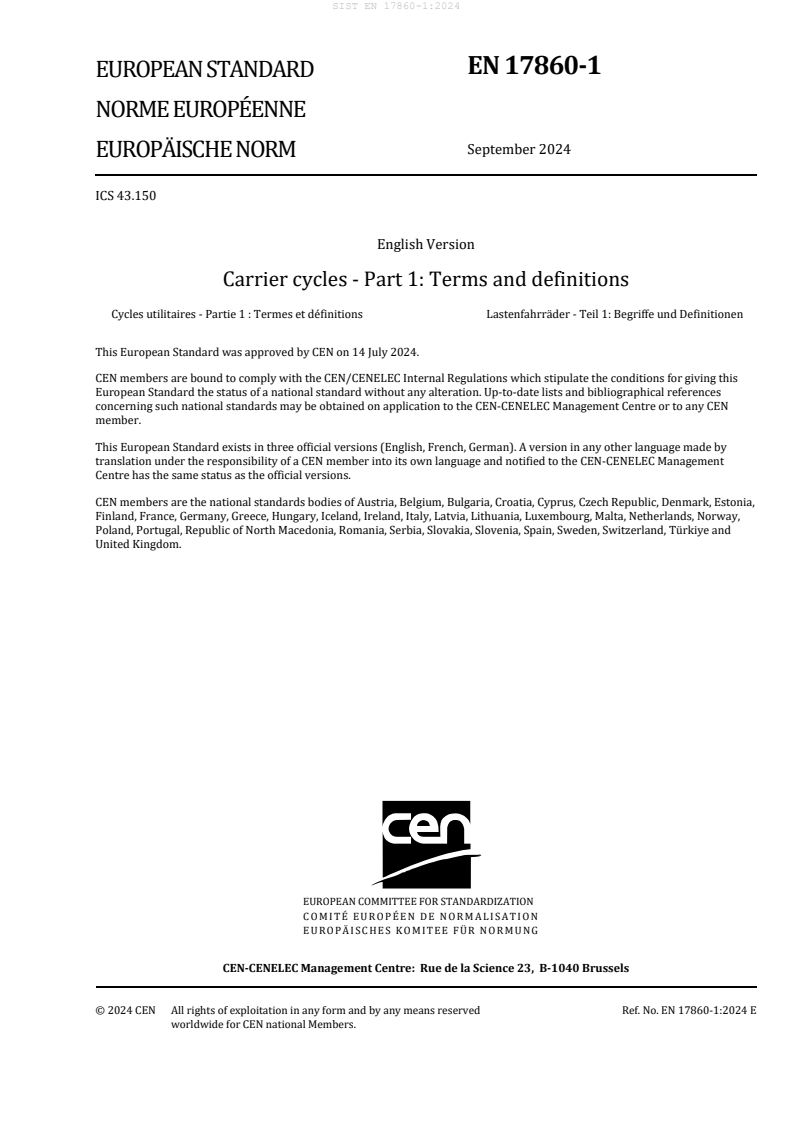
EN 17860-1
EUROPEAN STANDARD
NORME EUROPÉENNE
September 2024
EUROPÄISCHE NORM
ICS 43.150
English Version
Carrier cycles - Part 1: Terms and definitions
Cycles utilitaires - Partie 1 : Termes et définitions Lastenfahrräder - Teil 1: Begriffe und Definitionen
This European Standard was approved by CEN on 14 July 2024.
CEN members are bound to comply with the CEN/CENELEC Internal Regulations which stipulate the conditions for giving this
European Standard the status of a national standard without any alteration. Up-to-date lists and bibliographical references
concerning such national standards may be obtained on application to the CEN-CENELEC Management Centre or to any CEN
member.
This European Standard exists in three official versions (English, French, German). A version in any other language made by
translation under the responsibility of a CEN member into its own language and notified to the CEN-CENELEC Management
Centre has the same status as the official versions.
CEN members are the national standards bodies of Austria, Belgium, Bulgaria, Croatia, Cyprus, Czech Republic, Denmark, Estonia,
Finland, France, Germany, Greece, Hungary, Iceland, Ireland, Italy, Latvia, Lithuania, Luxembourg, Malta, Netherlands, Norway,
Poland, Portugal, Republic of North Macedonia, Romania, Serbia, Slovakia, Slovenia, Spain, Sweden, Switzerland, Türkiye and
United Kingdom.
EUROPEAN COMMITTEE FOR STANDARDIZATION
COMITÉ EUROPÉEN DE NORMALISATION
EUROPÄISCHES KOMITEE FÜR NORMUNG
CEN-CENELEC Management Centre: Rue de la Science 23, B-1040 Brussels
© 2024 CEN All rights of exploitation in any form and by any means reserved Ref. No. EN 17860-1:2024 E
worldwide for CEN national Members.
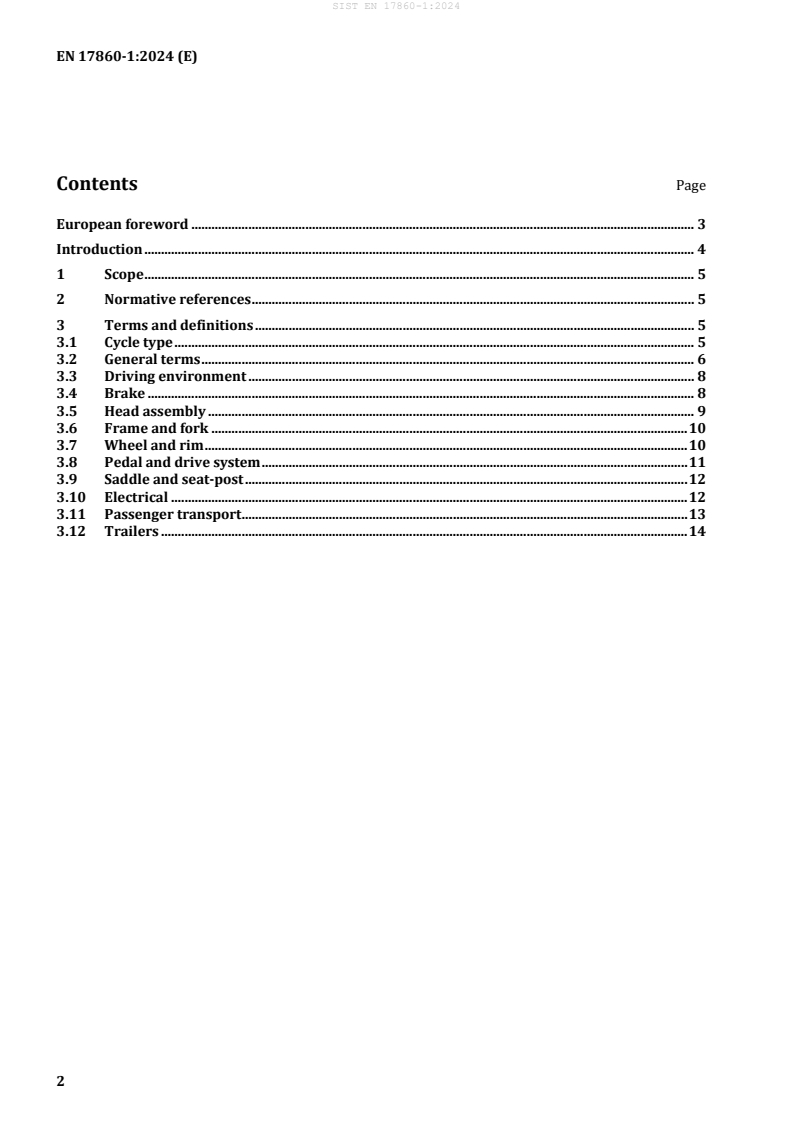
Contents Page
European foreword . 3
Introduction . 4
1 Scope . 5
2 Normative references . 5
3 Terms and definitions . 5
3.1 Cycle type . 5
3.2 General terms . 6
3.3 Driving environment . 8
3.4 Brake . 8
3.5 Head assembly . 9
3.6 Frame and fork . 10
3.7 Wheel and rim . 10
3.8 Pedal and drive system . 11
3.9 Saddle and seat-post . 12
3.10 Electrical . 12
3.11 Passenger transport . 13
3.12 Trailers . 14
European foreword
This document (EN 17860-1:2024) has been prepared by Technical Committee CEN/TC 333 “Cycles”, the
secretariat of which is held by UNI.
This European Standard shall be given the status of a national standard, either by publication of an
identical text or by endorsement, at the latest by March 2025, and conflicting national standards shall be
withdrawn at the latest by March 2025.
Attention is drawn to the possibility that some of the elements of this document may be the subject of
patent rights. CEN shall not be held responsible for identifying any or all such patent rights.
This document is part of standard series consisting of the following parts, users are invited to check which
parts are applicable to their situation
— EN 17860-1:2023, Cycles — Carrier Cycles — Part 1: Vocabulary
— EN 17860-2:2023, Cycles — Carrier Cycles — Part 2: Lightweight single track carrier cycles –
mechanical and functional aspects
— EN 17860-3:2023, Cycles — Carrier Cycles — Part 3: Lightweight multi track carrier cycles –
mechanical and functional aspects
— prEN 17860-4, Cycles — Carrier Cycles — Heavyweight multi track carrier cycles – mechanical and
functional aspects
— prEN 17860-5:2023, Cycles — Carrier Cycles — Electrical aspects
— prEN 17860-6, Cycles — Carrier Cycles — Passenger transport
— prEN 17860-7:2023, Cycles — Carrier Cycles — Trailers
Any feedback and questions on this document should be directed to the users’ national standards body.
A complete listing of these bodies can be found on the CEN website.
According to the CEN-CENELEC Internal Regulations, the national standards organisations of the
following countries are bound to implement this European Standard: Austria, Belgium, Bulgaria, Croatia,
Cyprus, Czech Republic, Denmark, Estonia, Finland, France, Germany, Greece, Hungary, Iceland, Ireland,
Italy, Latvia, Lithuania, Luxembourg, Malta, Netherlands, Norway, Poland, Portugal, Republic of North
Macedonia, Romania, Serbia, Slovakia, Slovenia, Spain, Sweden, Switzerland, Türkiye and the United
Kingdom.
Introduction
This document gives terms and definitions related to requirements and test methods for carrier cycles.
This document has been developed in response to demand throughout Europe. Its aim is to provide a
standard for the assessment of mechanical and electrical aspects for carrier cycles of a type which are
excluded from type approval by Regulation (EU) No. 168/2013.
1 Scope
This document specifies terms and definitions related to safety and performance requirements for the
design, assembly, and testing of carrier cycles.
2 Normative references
There are no normative references in this document.
3 Terms and definitions
For the purposes of this document, the following terms and definitions apply.
ISO and IEC maintain terminological databases for use in standardization at the following addresses:
• ISO Online browsing platform: available at https://www.iso.org/obp
• IEC Electropedia: available at https://www.electropedia.org/
3.1 Cycle type
3.1.1
bicycle
two-wheeled vehicle that is propelled solely or mainly by the muscular energy of the person on that
vehicle, in particular by means of pedals
[SOURCE: EN 15194:2017, 3.2]
3.1.2
cycle
vehicle that has at least two wheels and is propelled solely or mainly by the muscular energy of the person
on that vehicle, in particular by means of pedals
[SOURCE: EN 15194:2017, 3.1]
3.1.3
carrier cycle
cycle specifically for transporting goods and/or passengers
Note 1 to entry: Carrier cycles are commonly referred to as cargo bikes or delivery (bi)cycles.
3.1.4
electrically power assisted cycle
EPAC
cycle, equipped with pedals and an auxiliary electric motor, which cannot be propelled exclusively by
means of this auxiliary electric motor, except in the start-up assistance mode
[SOURCE: EN 15194:2017, 3.3]
3.1.5
single track
with wheels in line
3.1.6
multi track
with wheels not in line
3.1.7
tilting wheel
wheel of which the axle can rotate around the longitudinal axis of the frame
Note1 to entry: Typically found on three wheeled cycles at the front axle, the wheels tilt in the direction of a turn to
balance some or all of the roll moment caused by centripetal acceleration.
3.2 General terms
3.2.1
bolted joint
components joined together with threaded fastener
[SOURCE: EN 15194:2017, 3.71]
3.2.2
composite material
component that is entirely or partially made of a non-metallic matrix materials which is reinforced by
metallic or non-metallic materials such as short or long fibres, fabric, or particles
[SOURCE: EN 15194:2017, 3.18]
3.2.3
footrest
facility for supporting the feet of the transported passenger
[SOURCE: DIN 79010, 3.12]
3.2.4
fracture
unintentional separation into two or more parts
[SOURCE: EN 15194:2017, 3.35]
3.2.5
luggage carrier
device, including containers such as baskets, that is mounted and permanently attached above and/or
adjacent to the rear wheel(s) (in the case of a rear luggage carrier) or front wheel(s) (in the case of a front
luggage carrier) of a cycle and that is exclusively designed for carrying luggage or children in child-seats
[SOURCE: EN ISO 11243:2016, 3.2]
3.2.6
quick-release device
lever actuated mechanism that connects, retains, or secures a wheel or any other component
[SOURCE: EN 15194:2017, 3.54]
3.2.7
payload
total load
sum of the weight of the cyclist and the weight of the loaded goods/passengers
Note 1 to entry: Table 1 gives an overview of the relation between weight related definitions.
[SOURCE: DIN 79010, 3.6]
3.2.8
maximum permissible total weight
gross vehicle weight
weight of the fully assembled carrier cycle plus cyclist, luggage and unbraked trailer as defined by the
manufacturer
Note 1 to entry: Table 1 gives an overview of the relation between weight related definitions.
3.2.9
unladen weight
weight of the carrier cycle with standard equipment (according to the manufacturer's description) for
normal operation, including the battery
Note 1 to entry: Table 1 gives an overview of the relation between weight related definitions.
Table 1 — Relation between weight related definitions
Weight of Weight of
Weight of
Weight of the goods the
Definition the carrier
the cyclist and/or unbraked
cycle
passengers trailer
Payload/total load Included Included
Unladen weight Included
Maximum permissible total weight / Included Included Included Included
Gross vehicle weight
3.2.10
visible crack
crack which results from a test where that crack is visible to the naked eye
[SOURCE: EN 15194:2017, 3.66]
3.2.11
wheelbase
distance between the contact
...