

EN 1760-3:2004+A1:2009
(Main + Amendment)Safety of machinery - Pressure sensitive protective devices - Part 3: General principles for the design and testing of pressure sensitive bumpers, plates, wires and similar devices
- Abstract
This document deals with requirements for pressure sensitive protective devices which are not specified in EN 1760-1 and EN 1760-2. The majority of these devices are produced for specific applications and are not available as off-the-shelf items.
The purpose of this document relates primarily to safety and reliability rather than suitability. For the relationship between safety and reliability, see EN 954-1:1996, Annex D.
This document specifies requirements for pressure sensitive protective devices with and without an external reset facility.
This document does not specify the dimensions of pressure sensitive protective devices in relation to any particular application. Specific requirements for particular applications may be set out in relevant type C standards.
The document does not cover stopping devices used only for the regular operation, including emergency stopping, of machinery. It also does not apply to use in locations accessible to elderly or disabled persons or children, where special additional requirements may be necessary.
Basic requirements are given for pressure sensitive protective devices not covered in EN 1760-1 and EN 1760-2.
Specific requirements are given for the following devices:
- pressure sensitive bumpers;
- pressure sensitive plates;
- pressure sensitive wires (trip wires).
NOTE Some requirements are made with respect to electromagnetic compatibility (EMC). These are intended to meet the requirements of the Council Directive 98/37/EC ("Machinery Directive") [1] only and not those of Council Directive 89/336/EC ("EMC Directive") [2].
- Status
- Withdrawn
- Publication Date
- 24-Mar-2009
- Withdrawal Date
- 23-Jul-2013
- Technical Committee
- CEN/TC 114 - Safety of machinery
- Drafting Committee
- CEN/TC 114/WG 8 - Pressure-sensitive mats and similar devices
- Current Stage
- 9960 - Withdrawal effective - Withdrawal
- Start Date
- 24-Jul-2013
- Completion Date
- 24-Jul-2013
- Directive
- 2006/42/EC - Directive 2006/42/EC of the European Parliament and of the Council of 17 May 2006 on machinery, and amending Directive 95/16/EC (recast)OJ Ref: C, C 214 OJ Date: 08-Sep-2009

Relations
- Effective Date
- 19-Jan-2023
- Effective Date
- 14-Nov-2012
- Effective Date
- 31-Jul-2013
- Effective Date
- 09-Feb-2026
- Effective Date
- 09-Feb-2026
- Effective Date
- 09-Feb-2026
- Effective Date
- 09-Feb-2026
- Effective Date
- 09-Feb-2026
- Effective Date
- 09-Feb-2026
- Effective Date
- 09-Feb-2026
- Refers
EN IEC 60068-2-14:2023 - Environmental testing - Part 2-14: Tests - Test N: Change of temperature - Effective Date
- 09-Feb-2026
- Effective Date
- 09-Feb-2026
- Effective Date
- 09-Feb-2026
- Effective Date
- 09-Feb-2026
- Effective Date
- 09-Feb-2026
Get Certified
Connect with accredited certification bodies for this standard

CIS Institut d.o.o.
Personal Protective Equipment (PPE) certification body. Notified Body NB-2890 for EU Regulation 2016/425 PPE.

Kiwa BDA Testing
Building and construction product certification.
Kmetijski inštitut Slovenije
Agricultural Institute of Slovenia. Soil testing, plant health, agricultural product analysis.
Sponsored listings
Frequently Asked Questions
EN 1760-3:2004+A1:2009 is a standard published by the European Committee for Standardization (CEN). Its full title is "Safety of machinery - Pressure sensitive protective devices - Part 3: General principles for the design and testing of pressure sensitive bumpers, plates, wires and similar devices". This standard covers: This document deals with requirements for pressure sensitive protective devices which are not specified in EN 1760-1 and EN 1760-2. The majority of these devices are produced for specific applications and are not available as off-the-shelf items. The purpose of this document relates primarily to safety and reliability rather than suitability. For the relationship between safety and reliability, see EN 954-1:1996, Annex D. This document specifies requirements for pressure sensitive protective devices with and without an external reset facility. This document does not specify the dimensions of pressure sensitive protective devices in relation to any particular application. Specific requirements for particular applications may be set out in relevant type C standards. The document does not cover stopping devices used only for the regular operation, including emergency stopping, of machinery. It also does not apply to use in locations accessible to elderly or disabled persons or children, where special additional requirements may be necessary. Basic requirements are given for pressure sensitive protective devices not covered in EN 1760-1 and EN 1760-2. Specific requirements are given for the following devices: - pressure sensitive bumpers; - pressure sensitive plates; - pressure sensitive wires (trip wires). NOTE Some requirements are made with respect to electromagnetic compatibility (EMC). These are intended to meet the requirements of the Council Directive 98/37/EC ("Machinery Directive") [1] only and not those of Council Directive 89/336/EC ("EMC Directive") [2].
This document deals with requirements for pressure sensitive protective devices which are not specified in EN 1760-1 and EN 1760-2. The majority of these devices are produced for specific applications and are not available as off-the-shelf items. The purpose of this document relates primarily to safety and reliability rather than suitability. For the relationship between safety and reliability, see EN 954-1:1996, Annex D. This document specifies requirements for pressure sensitive protective devices with and without an external reset facility. This document does not specify the dimensions of pressure sensitive protective devices in relation to any particular application. Specific requirements for particular applications may be set out in relevant type C standards. The document does not cover stopping devices used only for the regular operation, including emergency stopping, of machinery. It also does not apply to use in locations accessible to elderly or disabled persons or children, where special additional requirements may be necessary. Basic requirements are given for pressure sensitive protective devices not covered in EN 1760-1 and EN 1760-2. Specific requirements are given for the following devices: - pressure sensitive bumpers; - pressure sensitive plates; - pressure sensitive wires (trip wires). NOTE Some requirements are made with respect to electromagnetic compatibility (EMC). These are intended to meet the requirements of the Council Directive 98/37/EC ("Machinery Directive") [1] only and not those of Council Directive 89/336/EC ("EMC Directive") [2].
EN 1760-3:2004+A1:2009 is classified under the following ICS (International Classification for Standards) categories: 13.110 - Safety of machinery. The ICS classification helps identify the subject area and facilitates finding related standards.
EN 1760-3:2004+A1:2009 has the following relationships with other standards: It is inter standard links to EN 1760-3:2004, EN 1760-3:2004/AC:2006, EN ISO 13856-3:2013, ISO 8986-1:1993, EN 60068-2-27:2009, EN IEC 61000-6-2:2019, EN 60529:1991, EN 61000-4-4:2012, EN IEC 60947-5-1:2025, EN IEC 61000-4-6:2023, EN IEC 60068-2-14:2023, EN IEC 61000-4-2:2025, EN 60068-2-6:2008, EN 61000-4-5:2014, EN IEC 60068-2-78:2025. Understanding these relationships helps ensure you are using the most current and applicable version of the standard.
EN 1760-3:2004+A1:2009 is associated with the following European legislation: EU Directives/Regulations: 2006/42/EC, 98/37/EC; Standardization Mandates: M/079, M/396. When a standard is cited in the Official Journal of the European Union, products manufactured in conformity with it benefit from a presumption of conformity with the essential requirements of the corresponding EU directive or regulation.
EN 1760-3:2004+A1:2009 is available in PDF format for immediate download after purchase. The document can be added to your cart and obtained through the secure checkout process. Digital delivery ensures instant access to the complete standard document.
Standards Content (Sample)
2003-01.Slovenski inštitut za standardizacijo. Razmnoževanje celote ali delov tega standarda ni dovoljeno.Sicherheit von Maschinen - Druckempfindliche Schutzeinrichtungen - Teil 3: Allgemeine Leitsätze für die Gestaltung und Prüfung von Schaltpuffern, Schaltflächen, Schaltleinen und ähnlichen EinrichtungenSécurité des machines - Dispositifs de protection sensibles à la pression - Partie 3: Principes généraux de conception d'essai des pare-chocs, plaques, câbles et dispositifs analogues sensibles à la pressionSafety of machinery - Pressure sensitive protective devices - Part 3: General principles for the design and testing of pressure sensitive bumpers, plates, wires and similar devices13.110Varnost strojevSafety of machineryICS:Ta slovenski standard je istoveten z:EN 1760-3:2004+A1:2009SIST EN 1760-3:2004+A1:2009en,fr01-maj-2009SIST EN 1760-3:2004+A1:2009SLOVENSKI
STANDARD
EUROPEAN STANDARD NORME EUROPÉENNE EUROPÄISCHE NORM
EN 1760-3:2004+A1
March 2009 ICS 13.110 Supersedes EN 1760-3:2004English Version
Safety of machinery - Pressure sensitive protective devices - Part 3: General principles for the design and testing of pressure sensitive bumpers, plates, wires and similar devices
Sécurité des machines - Dispositifs de protection sensibles à la pression - Partie 3: Principes généraux de conception d'essai des pare-chocs, plaques, câbles et dispositifs analogues sensibles à la pression
Sicherheit von Maschinen - Druckempfindliche Schutzeinrichtungen - Teil 3: Allgemeine Leitsätze für die Gestaltung und Prüfung von Schaltpuffern, Schaltflächen, Schaltleinen und ähnlichen Einrichtungen This European Standard was approved by CEN on 21 May 2004 and includes Corrigendum 1 issued by CEN on 25 January 2006 and Amendment 1 approved by CEN on 15 February 2009.
CEN members are bound to comply with the CEN/CENELEC Internal Regulations which stipulate the conditions for giving this European Standard the status of a national standard without any alteration. Up-to-date lists and bibliographical references concerning such national standards may be obtained on application to the CEN Management Centre or to any CEN member.
This European Standard exists in three official versions (English, French, German). A version in any other language made by translation under the responsibility of a CEN member into its own language and notified to the CEN Management Centre has the same status as the official versions.
CEN members are the national standards bodies of Austria, Belgium, Bulgaria, Cyprus, Czech Republic, Denmark, Estonia, Finland, France, Germany, Greece, Hungary, Iceland, Ireland, Italy, Latvia, Lithuania, Luxembourg, Malta, Netherlands, Norway, Poland, Portugal, Romania, Slovakia, Slovenia, Spain, Sweden, Switzerland and United Kingdom.
EUROPEAN COMMITTEE FOR STANDARDIZATION
COMITÉ EUROPÉEN DE NORMALISATION EUROPÄISCHES KOMITEE FÜR NORMUNG
Management Centre:
Avenue Marnix 17,
B-1000 Brussels © 2009 CEN All rights of exploitation in any form and by any means reserved worldwide for CEN national Members. Ref. No. EN 1760-3:2004+A1:2009: ESIST EN 1760-3:2004+A1:2009
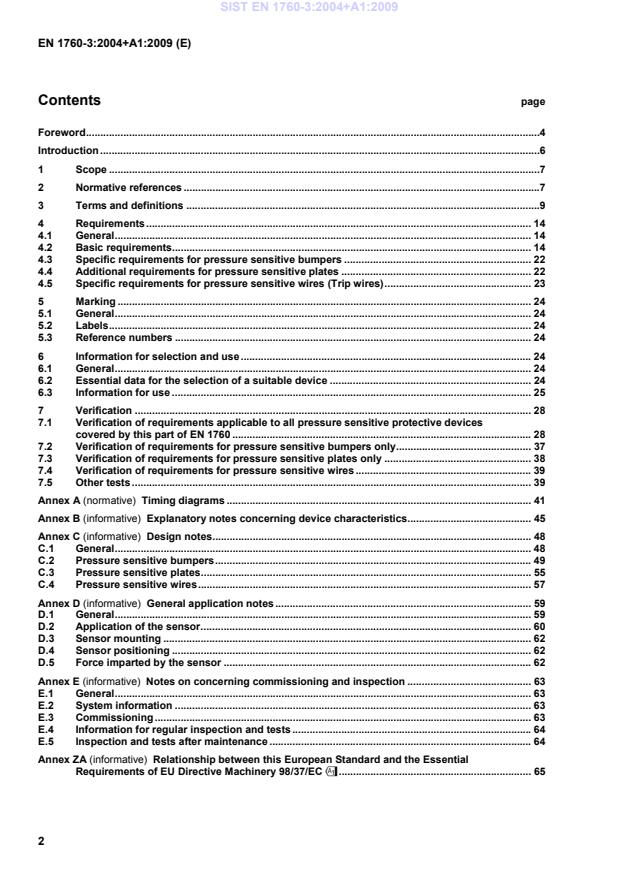
Timing diagrams . 41Annex B (informative)
Explanatory notes concerning device characteristics. 45Annex C (informative)
Design notes . 48C.1General . 48C.2Pressure sensitive bumpers . 49C.3Pressure sensitive plates . 55C.4Pressure sensitive wires . 57Annex D (informative)
General application notes . 59D.1General . 59D.2Application of the sensor . 60D.3Sensor mounting . 62D.4Sensor positioning . 62D.5Force imparted by the sensor . 62Annex E (informative)
Notes on concerning commissioning and inspection . 63E.1General . 63E.2System information . 63E.3Commissioning . 63E.4Information for regular inspection and tests . 64E.5Inspection and tests after maintenance . 64Annex ZA (informative)
Relationship between this European Standard and the Essential Requirements of EU Directive Machinery 98/37/EC" . 65SIST EN 1760-3:2004+A1:2009
!Relationship between this European Standard and the Essential Requirements of EU Directive 2006/42/EC" . 66Bibliography . 67SIST EN 1760-3:2004+A1:2009
!EN ISO 14121-1"). The best solution may combine several of these different means. It is recommended that the machinery / vehicle supplier and the user examine together carefully the existing constraints before making their decision on the choice of safeguarding means. This European Standard does not specify the dimensions and the configuration of the effective sensing surface of pressure sensitive protective devices in relation to any particular application. However, there is a requirement for the manufacturer of any safety device to provide sufficient information to enable the user (i.e. the machinery manufacturer and / or the user of the machinery) to specify an adequate arrangement.
(IEC 61000-4-4:1995) EN 61000-4-5, Electromagnetic compatibility (EMC) - Part 4: Testing and measurement techniques - Section 5: Surge immunity test (IEC 61000-4-5:1995) EN 61000-4-6, Electromagnetic compatibility (EMC) - Part 4: Testing and measurement techniques - Section 6: Immunity to conducted disturbances, induced by radio-frequency fields
(IEC 61000-4-6:1996) EN 61000-6-2, Electromagnetic compatibility (EMC) - Part 6-2: Generic standards - Immunity for industrial environments (IEC 61000-6-2:1999) EN ISO 12100-1:2003, Safety of machinery - Basic concepts, general principles for design – Part 1: Basic terminology, methodology (ISO 12100-1:2003) EN ISO 12100-2:2003, Safety of machinery - Basic concepts, general principles for design - Part 2: Technical principles (ISO 12100-2:2003) EN ISO 13849-2, Safety of machinery - Safety-related parts of control systems - Part 2: Validation (ISO 13849-2:2003) EN 60068-2-78, Environmental testing - Part 2-78: Tests; Test Cab: Damp heat, steady state
(IEC 60068-2-78:2001) EN 60664-1:2003, Insulation coordination for equipment within low-voltage systems — Part 1: Principles, requirements and tests (IEC 60664-1:1992) SIST EN 1760-3:2004+A1:2009
3.1.2 pressure sensitive plate pressure sensitive protective device with a sensor which has the following characteristics: the effective sensing surface is normally, but not necessarily, flat; the width of the effective sensing surface is usually greater than 80 mm; the effective sensing surface moves as a whole 3.1.3 pressure sensitive wire pressure sensitive protective device with a sensor which has the following characteristics: a wire, cord, rope, or cable held in tension; a change in the tension is detected to give an output signal 3.2 sensor that part of the pressure sensitive protective device which generates a signal in response to sufficient pressure applied to part of its surface 3.3 control unit that part of the pressure sensitive protective device which responds to the condition of the sensor and generates output signals to the machine control system SIST EN 1760-3:2004+A1:2009
Key 1 pressure sensitive protective device 2 sensor(s) 3 control unit (may be located within the machine control system or be part of the machine control system e.g. as a logic block) 4 output signal switching device 5 part of the machine control system for pressure sensitive protective device output signal processing 6 actuating force 7 sensor output signal 8 ON state / OFF state signal 9 manual reset signal (where appropriate alternative to A) 10 reset signal from machine control system (where appropriate) 11 monitoring signals (optional) A manual reset signal to the machine control system (where appropriate alternative to 9) B machine control system(s) Figure 1 — Pressure sensitive protective device applied to a machine SIST EN 1760-3:2004+A1:2009
Key 1 stated limit force 2 lowest actuating force a force (N) b travel (mm) c actuating travel d over travel at 250 N e working travel at 250 N f over travel at 400 N g working travel at 400 N h total travel A actuating point and actuating force at maximum operating speed B force travel points B1 and B2 occur at a force of 250 N or 400 N at an operating speed of less than or equal to 10 mm/s C The force-travel point occurs at e.g. 600 N at an operating speed of less than or equal to 10 mm/s NOTE Test piece 1 according to Table 1 is used to apply the forces. Figure 2 — An example of a force-travel diagram SIST EN 1760-3:2004+A1:2009
Test piece 2 Actuating force: 400 N Body part: Shoulder
Test piece 3 Actuating force: 50 N Body part: Finger (Knuckle)
Test piece 4 Actuating force: 50 N Body part: Finger (Tip)
Test piece 5 Actuating force: 250 N Body part: Arm or leg
Test piece 6 Actuating force: 400 N Body part: Whole body
NOTE 1 is the test direction. SIST EN 1760-3:2004+A1:2009
for systems without reset the actuating force is removed (refer to Figure A.3). SIST EN 1760-3:2004+A1:2009
one octave per min If the manufacturer states that the pressure sensitive protective device is suitable for a wider vibration range then it shall meet this requirement over the stated vibration range. 4.2.8 Power supply variation NOTE See 7.1.1 and 7.1.12 for verification. 4.2.8.1 General The pressure sensitive protective device shall continue in normal operation as defined in 4.2.7 when subjected to power supply variations given in 4.2.8.2 and 4.2.8.3 4.2.8.2 Electrical power supply variation NOTE See 7.1.1 and 7.1.12.2 for verification. The pressure sensitive protective device shall meet the electrical power supply variation requirements of EN 60204-1:1997, 4.3. 4.2.8.3 Non-electrical power supply variations NOTE See 7.1.1 and 7.1.12.3 for verification. The pressure sensitive protective device shall continue in normal operation as defined in 4.2.7 when subjected to non-electrical power supply variations as stated by the manufacturer and in accordance with the relevant requirements of EN 982 for hydraulic systems and EN 983 for pneumatic systems. Where overpressure protective devices for this power supply are not incorporated, overpressure variations outside the stated range shall not reduce the safety performance of the device. SIST EN 1760-3:2004+A1:2009
...