


EN 13218:2002
(Main)Machine tools - Safety - Stationary grinding machines
Machine tools - Safety - Stationary grinding machines
This Standard specifies safety the technical safety requirements and /or protective measures to be adopted by persons undertaking the design, construction and supply (including installation and dismantling, arrangements for transport and maintenance) of stationary grinding machines as defined in 3.1 and 3.2 and intended to be used for the grinding of workpieces of cold metal.
This Standard deals with the significant hazards listed in 4.
This standard does not apply to honing, polishing and belt grinding machines.
This standard applies to machines which are manufactured after the date of issue of this standard .
Werkzeugmaschinen - Sicherheit - Ortsfeste Schleifmaschinen
Diese Norm legt Sicherheitsanforderungen und Schutzmaßnahmen fest, die von Personen zu beachten sind, die mit der Konstruktion, dem Bau und der Lieferung (einschließlich Installation und Demontage, mit Vorkehrungen für Transport und Instandhaltung) von ortsfesten Schleifmaschinen nach 3.1 und 3.2 zur Kaltbearbeitung metallischer Werkstoffe befasst sind.
Diese Norm deckt die signifikanten Gefährdungen ab, die in Abschnitt 4 aufgeführt sind.
Diese Norm gilt nicht für Hon-, Polier- und Bandschleifmaschinen.
Diese Norm gilt für Maschinen, die nach dem Ausgabedatum dieser Norm hergestellt wurden.
Machines-outils - Sécurité - Machines à meuler fixes
La présente norme spécifie les prescriptions de sécurité pour la conception, la construction et la fourniture (y compris le montage et démontage, ainsi que les dispositions pour le transport et la maintenance) des machines à meuler fixes définies en 3.1 et 3.2 et destinées au meulage de pièces métalliques à froid.
La présente norme traite des phénomènes dangereux significatifs dont la liste figure en 4.
La présente norme ne s'applique pas aux machines à rôder, à polir ni aux machines à meuler à bande.
La présente norme s'applique aux machines fabriquées après la date de publication de la présente norme
Obdelovalni stroji - Varnost – Stacionarni brusni stroji
Ta standard določa tehnične zahteve za varnost in/ali zaščitne ukrepe, ki jih morajo sprejeti osebe pri načrtovanju, izgradnji in dobavi (vključno z postavitvijo in razstavitvijo, ureditvijo transporta in vzdrževanjem) stacionarnih brusnih strojev, kot je določeno v točkah 3.1 in 3.2 ter namenjenim za uporabo pri brušenju obdelovanca iz hladne kovine. Ta standard obravnava velike nevarnostmi, kot so navedeno v točki 4. Ta standard ne velja za honanje, loščenje in tračne brusilnike. Ta standard velja za opremo, ki je bila izdelana po datumu izdaje tega standarda.
General Information
- Status
- Withdrawn
- Publication Date
- 18-Jun-2002
- Withdrawal Date
- 29-Jul-2008
- Technical Committee
- CEN/TC 143 - Machine tools - Safety
- Current Stage
- 9960 - Withdrawal effective - Withdrawal
- Start Date
- 30-Jul-2008
- Completion Date
- 30-Jul-2008
- Directive
- 98/37/EC - Machinery
Relations
- Effective Date
- 22-Dec-2008
- Effective Date
- 28-Jan-2026
- Effective Date
- 28-Jan-2026

Get Certified
Connect with accredited certification bodies for this standard

National Aerospace and Defense Contractors Accreditation Program (NADCAP)
Global cooperative program for special process quality in aerospace.
CARES (UK Certification Authority for Reinforcing Steels)
UK certification for reinforcing steels and construction.
DVS-ZERT GmbH
German welding certification society.
Sponsored listings
Frequently Asked Questions
EN 13218:2002 is a standard published by the European Committee for Standardization (CEN). Its full title is "Machine tools - Safety - Stationary grinding machines". This standard covers: This Standard specifies safety the technical safety requirements and /or protective measures to be adopted by persons undertaking the design, construction and supply (including installation and dismantling, arrangements for transport and maintenance) of stationary grinding machines as defined in 3.1 and 3.2 and intended to be used for the grinding of workpieces of cold metal. This Standard deals with the significant hazards listed in 4. This standard does not apply to honing, polishing and belt grinding machines. This standard applies to machines which are manufactured after the date of issue of this standard .
This Standard specifies safety the technical safety requirements and /or protective measures to be adopted by persons undertaking the design, construction and supply (including installation and dismantling, arrangements for transport and maintenance) of stationary grinding machines as defined in 3.1 and 3.2 and intended to be used for the grinding of workpieces of cold metal. This Standard deals with the significant hazards listed in 4. This standard does not apply to honing, polishing and belt grinding machines. This standard applies to machines which are manufactured after the date of issue of this standard .
EN 13218:2002 is classified under the following ICS (International Classification for Standards) categories: 25.080.50 - Grinding and polishing machines. The ICS classification helps identify the subject area and facilitates finding related standards.
EN 13218:2002 has the following relationships with other standards: It is inter standard links to EN 13218:2002+A1:2008, EN 12418:2000+A1:2009, EN 13862:2001+A1:2009. Understanding these relationships helps ensure you are using the most current and applicable version of the standard.
EN 13218:2002 is associated with the following European legislation: EU Directives/Regulations: 98/37/EC; Standardization Mandates: M/BC/CEN/88/13. When a standard is cited in the Official Journal of the European Union, products manufactured in conformity with it benefit from a presumption of conformity with the essential requirements of the corresponding EU directive or regulation.
EN 13218:2002 is available in PDF format for immediate download after purchase. The document can be added to your cart and obtained through the secure checkout process. Digital delivery ensures instant access to the complete standard document.
Standards Content (Sample)
SLOVENSKI STANDARD
01-november-2003
Obdelovalni stroji - Varnost – Stacionarni brusni stroji
Machine tools - Safety - Stationary grinding machines
Werkzeugmaschinen - Sicherheit - Ortsfeste Schleifmaschinen
Machines-outils - Sécurité - Machines a meuler fixes
Ta slovenski standard je istoveten z: EN 13218:2002
ICS:
25.080.50 Brusilni in polirni stroji Grinding and polishing
machines
2003-01.Slovenski inštitut za standardizacijo. Razmnoževanje celote ali delov tega standarda ni dovoljeno.
EUROPEAN STANDARD
EN 13218
NORME EUROPÉENNE
EUROPÄISCHE NORM
June 2002
ICS 25.080.50
English version
Machine tools - Safety - Stationary grinding machines
Machines-outils - Sécurité - Machines à meuler fixes Werkzeugmaschinen - Sicherheit - Ortsfeste
Schleifmaschinen
This European Standard was approved by CEN on 26 August 2001.
CEN members are bound to comply with the CEN/CENELEC Internal Regulations which stipulate the conditions for giving this European
Standard the status of a national standard without any alteration. Up-to-date lists and bibliographical references concerning such national
standards may be obtained on application to the Management Centre or to any CEN member.
This European Standard exists in three official versions (English, French, German). A version in any other language made by translation
under the responsibility of a CEN member into its own language and notified to the Management Centre has the same status as the official
versions.
CEN members are the national standards bodies of Austria, Belgium, Czech Republic, Denmark, Finland, France, Germany, Greece,
Iceland, Ireland, Italy, Luxembourg, Malta, Netherlands, Norway, Portugal, Spain, Sweden, Switzerland and United Kingdom.
EUROPEAN COMMITTEE FOR STANDARDIZATION
COMITÉ EUROPÉEN DE NORMALISATION
EUROPÄISCHES KOMITEE FÜR NORMUNG
Management Centre: rue de Stassart, 36 B-1050 Brussels
© 2002 CEN All rights of exploitation in any form and by any means reserved Ref. No. EN 13218:2002 E
worldwide for CEN national Members.
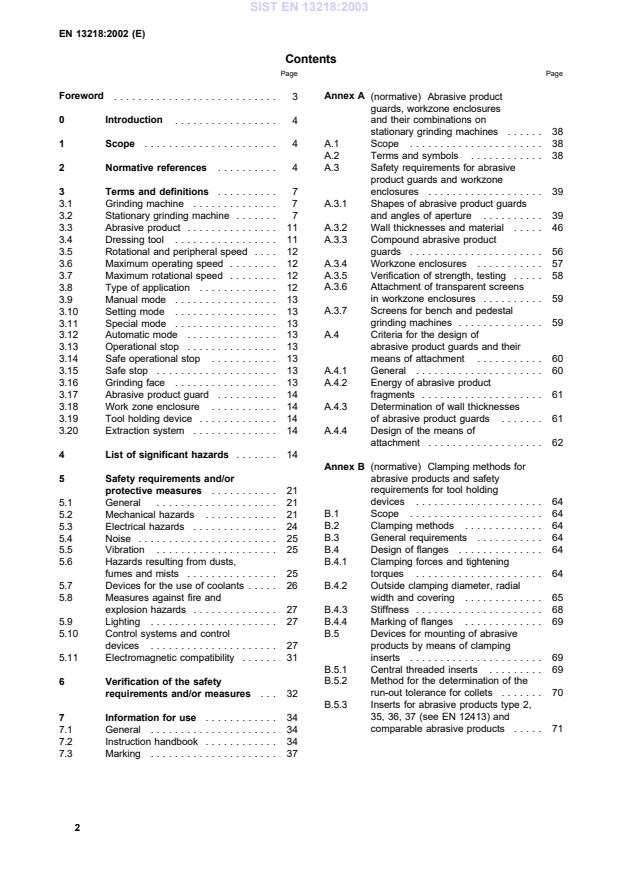
Contents
Page Page
Foreword . 3 Annex A (normative) Abrasive product
guards, workzone enclosures
0 Introduction . 4 and their combinations on
stationary grinding machines . 38
1 Scope . 4 A.1 Scope . 38
A.2 Terms and symbols . 38
2 Normative references . 4 A.3 Safety requirements for abrasive
product guards and workzone
3 Terms and definitions . 7 enclosures . 39
3.1 Grinding machine . 7 A.3.1 Shapes of abrasive product guards
3.2 Stationary grinding machine . 7 and angles of aperture . 39
3.3 Abrasive product . 11 A.3.2 Wall thicknesses and material . 46
3.4 Dressing tool . 11 A.3.3 Compound abrasive product
3.5 Rotational and peripheral speed . 12 guards . 56
A.3.4 Workzone enclosures . 57
3.6 Maximum operating speed . 12
3.7 Maximum rotational speed . 12 A.3.5 Verification of strength, testing . 58
A.3.6 Attachment of transparent screens
3.8 Type of application . 12
3.9 Manual mode . 13 in workzone enclosures . 59
A.3.7 Screens for bench and pedestal
3.10 Setting mode . 13
3.11 Special mode . 13 grinding machines . 59
3.12 Automatic mode . 13 A.4 Criteria for the design of
3.13 Operational stop . 13 abrasive product guards and their
3.14 Safe operational stop . 13 means of attachment . 60
3.15 Safe stop . 13 A.4.1 General . 60
3.16 Grinding face . 13 A.4.2 Energy of abrasive product
3.17 Abrasive product guard . 14 fragments . 61
3.18 Work zone enclosure . 14 A.4.3 Determination of wall thicknesses
3.19 Tool holding device . 14 of abrasive product guards . 61
3.20 Extraction system . 14 A.4.4 Design of the means of
attachment . 62
4 List of significant hazards . 14
Annex B (normative) Clamping methods for
5 Safety requirements and/or abrasive products and safety
requirements for tool holding
protective measures . 21
5.1 General . 21 devices . 64
B.1 Scope . 64
5.2 Mechanical hazards . 21
5.3 Electrical hazards . 24 B.2 Clamping methods . 64
5.4 Noise . 25 B.3 General requirements . 64
5.5 Vibration . 25 B.4 Design of flanges . 64
5.6 Hazards resulting from dusts, B.4.1 Clamping forces and tightening
fumes and mists . 25 torques . 64
5.7 Devices for the use of coolants . 26 B.4.2 Outside clamping diameter, radial
width and covering . 65
5.8 Measures against fire and
explosion hazards . 27 B.4.3 Stiffness . 68
B.4.4 Marking of flanges . 69
5.9 Lighting . 27
5.10 Control systems and control B.5 Devices for mounting of abrasive
products by means of clamping
devices . 27
5.11 Electromagnetic compatibility . 31 inserts . 69
B.5.1 Central threaded inserts . 69
6 Verification of the safety B.5.2 Method for the determination of the
requirements and/or measures run-out tolerance for collets . 70
... 32
B.5.3 Inserts for abrasive products type 2,
7 Information for use . 34 35, 36, 37 (see EN 12413) and
comparable abrasive products . 71
7.1 General . 34
7.2 Instruction handbook . 34
7.3 Marking . 37
Page Pa g e
Annex C (informative) Calculation of the
Annex F (normative) Requirements for
clamping force and the tightening grinding machines for the
torque for the mounting of abrasive machining of materials generating
products by means of flanges . 76 flammable and explosive dusts . 85
F.1 Devices for wet grinding . 85
C.1 Symbols . 76
C.2 Operating forces . 77 F.2 Devices for dry grinding with
wet precipitation by means of
C.3 Necessary clamping force . 79
C.4 Tightening torque of the instantaneous moistening . 85
F.3 Devices for dry grinding with
screws . 81
C.5 Surface pressure . 81 precipitation by means of a
wet-type cyclone . 86
Annex D (informative) Noise reduction . 83 F.4 Additional requirements, dry
grinding . 87
D.1 Measures for the reduction of
noise emission . 83
Annex G (informative) Relevant and special clauses
Annex E (informative) Noise emission for different types of stationary grinding
machine . 85
determination, declaration
and verification . 84
Annex ZA (informative) Relationship of this
E.1 Measuring procedure . 84
European Standard with other
E.2 Operating conditions . 84
EC Directives . 88
E.3 Declaration and verification of
noise emission values . 84
Bibliogr aphy . 89
Foreword
This document (EN 13218:2002) has been prepared by Technical Committee CEN/TC 143 "Machine tools - Safety",
the secretariat of which is held by SNV.
This European Standard shall be given the status of a national standard, either by publication of an identical text or
by endorsement, at the latest by December 2002, and conflicting national standards shall be withdrawn at the latest
by December 2002.
This document has been prepared under a mandate given to CEN by the European Commission and the European
Free Trade Association, and supports essential requirements of EU Directive(s).
For relationship with EU Directive(s), see informative annex ZA, which is an integral part of this document.
According to the CEN/CENELEC Internal Regulations, the national standards organizations of the following countries
are bound to implement this European Standard: Austria, Belgium, Czech Republic, Denmark, Finland, France,
Germany, Greece, Iceland, Ireland, Italy, Luxembourg, Malta, Netherlands, Norway, Portugal, Spain, Sweden,
Switzerland and the United Kingdom.
0 Introduction
This European standard has been prepared to be a harmonised standard to provide one means of conforming with
the essential safety requirements of the Machinery Directive and associated EFTA regulations. This standard is a
type C standard as stated in EN 292-1:1991.
The machinery concerned and the extent to which hazards, hazardous situations and events are covered are
indicated in the scope of this standard.
1 Scope
This standard specifies the technical safety requirements and/or protective measures to be adopted by persons
undertaking the design, construction and supply (including installation and dismantling, arrangements for transport
and maintenance) of stationary grinding machines as defined in 3.1 and 3.2 and intended to be used for the grinding
of workpieces of cold metal.
This standard deals with the significant hazards as listed in 4.
This standard does not apply to honing, polishing and belt grinding machines.
This standard applies to machines which are manufactured after the date of issue of this standard.
2 Normative references
This European Standard incorporates, by dated or undated reference, provisions from other publications. These
normative references are cited at the appropriate places in the text and the publications are listed hereafter. For
dated references, subsequent amendments to or revisions of any of these publications apply to this European
Standard only when incorporated in it by amendment or revision. For undated references, the latest edition of the
publication referred to applies (including amendments).
CR 1030-1
Hand-arm vibration – Guidelines for vibration hazards reduction – Part 1: Engineering methods by design of
machinery
EN 287-1
Approval testing of welders – Fusion welding – Part 1: Steels
EN 287-2
Approval testing of welders – Fusion welding – Part 2: Aluminium and aluminium alloys
EN 288-1
Specification and qualification of welding procedures for metallic materials – Part 1: General rules for fusion
welding
EN 292-1:1991
Safety of machinery – Basic concepts, general principles for design – Part 1: Basic terminology, methodology
EN 292-2:1991
Safety of machinery – Basic concepts, general principles for design – Part 2: Technical principles and specifica-
tions
EN 292-2:1991/A1:1995
Safety of machinery – Basic concepts, general principles for design – Part 2: Technical principles and specifica-
tions; Amendment A1
EN 294
Safety of machinery – Safety distances to prevent danger zones being reached by the upper limbs
EN 349
Safety of machinery – Minimum gaps to avoid crushing of parts of the human body
EN 418
Safety of machinery – Emergency stop equipment, functional aspects – Principles for design
EN 547-1
Safety of machinery - Human body measurements - Part 1: Principles for determining the dimensions required
for openings for whole body access into machinery
EN 547-2
Safety of machinery - Human body measurements - Part 2: Principles for determining the dimensions required
for access openings
EN 614-1
Safety of machinery - Ergonomic design principles - Part 1: Terminology and general principles
EN 626-1
Safety of machinery - Reduction of risks to health from hazardous substances emitted by machinery - Part 1:
Principles and specifications for machinery manufacturers
EN 729-1
Quality requirements for welding – Fusion welding of metallic materials – Part 1: Guidelines for selection and use
EN 953
Safety of machinery – Guards – General requirements for the design and construction of fixed and movable
guards
EN 954-1
Safety of machinery – Safety-related parts of control systems – Part 1: General principles for design
EN 982
Safety of machinery – Safety requirements for fluid power systems and their components – Hydraulics
EN 983
Safety of machinery – Safety requirements for fluid power systems and their components – Pneumatics
EN 1033
Hand arm vibration – Laboratory measurement of vibration at the grip surface of hand guided machinery –
General
EN 1037
Safety of machinery – Prevention of unexpected start-up
EN 1050:1996
Safety of machinery – Principles for risk assessment
EN 1070
Safety of machinery – Terminology
EN 1088:1995
Safety of machinery – Interlocking devices associated with guards – Principles for design and selection
EN 1127-1:1997
Explosive atmospheres – Explosion prevention and protection – Part 1: Basic concepts and methodology
EN 1837
Safety of machinery - Integral lighting of machines
EN 10025
Hot rolled products of non-alloy structured steels - Technical delivery conditions
EN 10130:1991 + A1
Cold-rolled low carbon steel flat products for cold forming – Technical delivery conditions
EN 12096
Mechanical vibration – Declaration and verification of vibration emission values
EN 12413
Safety requirements for bonded abrasive products
EN 13236
Safety requirements for superabrasives
EN 13478
Safety of machinery – Fire prevention and protection
EN 22553
Welded, brazed and soldered joints – Symbolic representation on drawings (ISO 2553:1992)
EN 25817:1992
Arc-welded joints in steel – Guidance on quality levels for imperfections (ISO 5817:1992)
ENV 26385
Ergonomic principles for the design of work systems (ISO 6385:1981)
EN 50081-2
Electromagnetic compatibility – Generic emission standard – Part 2: Industrial environment
EN 50082-2
Electromagnetic compatibility – Generic immunity standard – Part 2: Industrial environment
EN 60204-1:1997
Safety of machinery – Electrical equipment of machines – Part 1: General requirements (IEC 60204-1:1997)
EN 61310-2
Safety of machinery – Indication, marking and actuation – Part 2: Requirements for marking (IEC 61310-2:1995)
EN ISO 3744
Acoustics – Determination of sound power levels of noise sources using sound pressure – Engineering method
in an essentially free field over a reflecting plane (ISO 3744:1994)
EN ISO 3746
Acoustics – Determination of sound power levels of noise sources using sound pressure – Survey method using
an enveloping measurement surface over a reflecting plane (ISO 3746:1995)
EN ISO 4871
Acoustics – Declaration and verification of noise emission values of machinery and equipment (ISO 4871:1996)
EN ISO 11201
Acoustics – Noise emitted by machinery and equipment – Measurements of emission sound pressure levels at
a work station and at other specified positions – Engineering method in an essentially free field over a reflecting
plane (ISO 11201:1995)
EN ISO 11202
Acoustics – Noise emitted by machinery and equipment – Measurements of emission sound pressure levels at
a work station and at other specified positions – Survey method in situ (ISO 11202:1995)
EN ISO 11204
Acoustics – Noise emitted by machinery and equipment – Measurements of emission sound pressure levels at
a work station and at other specified positions – Method requiring environmental corrections (ISO 11204:1995)
EN ISO 11688-1
Acoustics – Recommended practice for the design of low-noise machinery and equipment – Part 1: Planning
(ISO/TR 11688-1:1995)
ISO 230-5
Test code for machine tools – Part 5: Determination of the noise emission
ISO 666
Machine tools – Mounting of plain grinding wheels by means of hub flanges
ISO 1052
Steels for general engineering purposes
ISO 1083
Spheroidal graphite cast iron – Classification
ISO 3522
Cast aluminium alloys – Chemical composition and mechanical properties
ISO 3574
Cold-reduced carbon steel sheet of commercial and drawing qualities
ISO 4997
Cold-reduced steel sheet of structural quality
ISO 6316
Hot-rolled steel strip of structural quality
ISO 6361-2
Wrought aluminium and aluminium alloy sheets, strips and plates – Part 2: Mechanical properties
3 Terms and definitions
For the purposes of this European Standard, the terms and definitions given in EN 1070 and the following terms and
definitions apply.
Additional terms and definitions specifically needed for this standard are added below.
3.1
grinding machine
machine tool intended to machine workpieces by means of abrasive products
3.2
stationary grinding machine
grinding machine fixed in position during operation and capable of a combination of one or more types of operations,
examples see Table 1
Table 1: Stationary grinding machines
No. Machine Designation Grinding method
de: Außenrundschleif- External cylindrical grind-
maschine ing
en: The grinding of the external
External cylindrical surface of a rotating
1.1
grinding machine workpiece.
fr: Rectifieuse cylindrique The workpiece and the
extérieure grinding wheel are
mechanically guided.
de: Centreless grinding
Spitzenlose Außen-
rundschleifmaschine The grinding of the external
surface of a rotating
en: workpiece.
Centreless external
1.2 cylindrical grinding The workpiece is rotated
machine mechanically guided with
reference to the grinding
fr: Rectifieuse cylindrique wheel by means of a
sans centre control-wheel and rests on a
straight-edge placed
between the two wheels.
de: Internal grinding
Innenrundschleif-
maschine The grinding of the internal
surface of a rotating work-
en: piece.
1.3
Internal cylindrical
grinding machine The workpiece and the
grinding wheel are
fr: Rectifieuse cylindrique mechanically guided.
intérieure
de: Surface grinding-
Planschleifmaschine, peripheral grinding
Rechtecktisch, waage-
rechte Spindel The grinding of plane
surfaces of a workpiece.
en: The workpiece is secured to
Surface grinding a reciprocating table. The
1.4
machine, reciprocating workpiece and the grinding
table, horizontal spindle wheel are mechanically
guided.
fr: Rectifieuse plane à table
a déplacement
rectiligne – broche
horizontale
(continued)
Table 1 (continued)
No. Machine Designation Grinding method
de: Surface grinding –
Planschleifmaschine, peripheral grinding
Rundtisch, waagerechte
Spindel The grinding of plane
surfaces of a workpiece.
en: The workpiece is secured to
1.5 Surface grinding a rotary table. The
machine, rotary table workpiece and the grinding
horizontal spindle wheel are mechanically
guided.
fr: Rectifieuse plane à table
rotative – broche hori-
zontale
de: Surface grinding – face
Planschleifmaschine, grinding
Rechtecktisch, senk-
rechte Spindel The grinding of plane
surfaces of a workpiece.
en: The workpiece is secured to
Surface grinding a reciprocating table. The
1.6
machine, reciprocating workpiece and the grinding
table, vertical spindle wheel are mechanically
guided.
fr: Rectifieuse plane à table
a déplacement rectiligne
– broche verticale
de: Surface grinding – face
Planschleifmaschine, grinding
Rundtisch, senkrechte
Spindel The grinding of plane
surfaces of a workpiece.
en: The workpiece is secured to
Surface grinding a rotary table. The
1.7
machine, rotary table workpiece and the grinding
vertical spindle wheel are mechanically
guided.
fr: Rectifieuse plane à table
a déplacement rota-
tive – broche verticale
de: Surface grinding – face
Doppelspindel-Plan- grinding
schleifmaschine, waage-
rechte oder senkrechte The grinding of a workpiece
Spindeln by passing it between two
disc or cylinder wheels or
1.8
en: segments. The workpiece
Surface grinding and the grinding wheels are
machine, double spindle mechanically guided.
horizontal or vertical
fr: Rectifieuse plane à deux
(continued)
Table 1 (continued)
No. Machine Designation Grinding method
de: Peripheral and face grind-
Werkzeugschleif- ing
maschine
The grinding or regrinding of
en: cutting faces and edges of
1.9
Tool grinding machine tools (workpiece). The
workpieces and the grinding
fr: Affûteuse wheels are mechanically
guided.
de: Cutting-off
Trennschleifmaschine
The grinding of workpieces
en: for slotting or cutting-off.
Cutting-off machine The workpiece is firmly fixed
and the cutting-off wheel is
fr: Tronçonneuse mechanically guided.
1.10
de: Cutting-off
Trennschleifmaschine
The grinding of workpieces
en: for cutting-off. The
Cutting-off machine workpiece is firmly clamped,
1.11
the cutting-off wheel is
fr: Tronçonneuse guided by hand.
de: Cutting-off
Trennschleifmaschine
The grinding of workpieces
en: for slotting or cutting-off.
Cutting-off machine The workpiece is guided by
hand. The cutting-off wheel
fr: Tronçonneuse is mechanically guided.
1.12
(continued)
Table 1 (concluded)
No. Machine Designation Grinding method
de: Peripheral grinding
Tisch- oder Ständer-
schleifmaschine The grinding of a surface of
a workpiece using the wheel
en: periphery.
1.13
Bench or pedestal
grinding machine
fr: Touret pour établi ou sur
de: Face grinding
Ständerschleifmaschine
The grinding of a surface of
en: a workpiece using the wheel
Pedestal grinding face. The workpiece is
1.14
machine guided by hand.
fr: Lapidaire
de: Peripheral
Pendelschleifmaschine grinding/cutting-off
en: The grinding or cutting of a
Swing frame grinding workpiece using the wheel
1.15 machine periphery. The workpiece is
firmly clamped or stabilized
fr: Meulage et tronçonnage by its own weight. The
avec machine suspendue grinding machine is
suspended and guided by
hand.
de: Surface grinding
Hochdruckschleif-
maschine High pressure grinding
where the workpiece is
en: secured to a table. The
1.16
High pressure grinding workpiece and the grinding
machine wheel are mechanically
guided.
fr: Machine pour meulage à
3.3
abrasive product
cutting tools of varied shapes with geometrically unspecified cutting edges. They are made from abrasive grains and
bond. There is a distinction between bonded abrasive products and superabrasives, see EN 12413 and EN 13236
3.4
dressing tool
fixed or rotary tool for the generation or reproduction of the grinding capacity (sharpening) and/or the geometry
(truing) of abrasive products
3.5
rotational and peripheral speed
peripheral speed of a grinding wheel is calculated by the formula:
The speed of rotation of a grinding wheel is calculated by the formula:
where
n is the speed of rotation in rotations per minute ;
v is the peripheral speed in metres per second;
D is the outside diameter of the abrasive product in millimetres
3.6
maximum operating speed
maximum permissible peripheral speed of a rotating abrasive product
3.7
maximum rotational speed
maximum rotational speed of a grinding wheel spindle under all operating conditions. Rotational speed of a new
abrasive product at maximum operating speed
3.8
type of application
see Table 2
Table 2: Type of application
Grinding method Type of application Abrasive product Workpiece
Fixed Guided mechanically
Mechanically guided grinding Guided mechanically Fixed
Grinding Guided mechanically Guided mechanically
Guided by hand Fixed
Manually guided grinding
Fixed Guided by hand
Fixed Guided mechanically
Mechanically guided
Guided mechanically Fixed
cutting-off
Cutting-off Guided mechanically Guided mechanically
Guided by hand Fixed
Manually guided
cutting-off
Fixed Guided by hand
The type of feed describes the way in which workpiece and abrasive product are moved to each other. There is a
distinction between
a) mechanical feed, see Table 1, e. g. No. 1.1
and
b) manual feed, see Table 1, e. g. No. 1.13.
There is also the possibility of mechanical and manual feed combinations on a single grinding machine, see Table 1,
e. g. No. 1.12.
3.9
manual mode
operation mode for the machining under manual control. All process steps for the machining are controlled or started
by an operator without support by an NC-machining program
3.10
setting mode
operation mode at which the operator executes the setting for the subsequent machining process
NOTE: The setting mode includes e. g. alignment of the tool and determination of the workpiece position by
touching with the rotating abrasive product.
3.11
special mode
operation mode at which the possibility for manual intervention into the machining process as well as for a limited
automatic mode (fixed sequence of separate consecutive steps) started by the operator, is given
3.12
automatic mode
Operation mode where only the start-up of a machining process is initiated by the operator, all subsequent process
steps being automatically carried out
3.13
operational stop
Stop of the machine movements in the production process. Control functions between control system and machine
drives are maintained (torque, speed of rotation, position)
3.14
safe operational stop
operation stop with additional control system measures preventing dangerous machine movements due to control
system faults
3.15
safe stop
removal of the energy supply to the machine actuator, preventing dangerous machine movements due to control
system faults
3.16
grinding face
that part of an abrasive product which is used to grind the workpiece (examples, see Figures 1 to 3)
Figure 1 Figure 2
Peripheral grinding Face grinding
Figure 3
Side grinding
3.17
abrasive product guard
guard which encloses the abrasive product exposing only the part necessary for grinding and which is designed and
constructed in such a way that it retains fragments in the guarded area in the event of breakage of the abrasive
product
3.18
work zone enclosure
guard enclosing the working area and retaining any parts which may be ejected during processing
3.19
tool holding device
device intended to secure the abrasive product to the grinding wheel spindle
3.20
extraction system
system for removal of the dusts, fumes and mists released during the grinding process
4 List of significant hazards
Significant hazards associated with the machine have been identified in accordance with the procedures described
in EN 292-1:1991, clause 5 and in EN 1050 (see Table 3).
4.1 The list of hazards contained in Table 3 is the result of a hazard identification and risk assessment carried out
as described in EN 1050, for the wide range of stationary grinding machines covered by the scope of this standard.
The safety requirements and/or protective measures and information for use contained in clauses 5 and 7 are based
on the risk assessment and deal with the identified hazards by either eliminating them or reducing the effects of the
risks they generate.
4.2 The risk assessment assumes foreseeable access from all directions, as well as unexpected start-up. Risks to
both the operators and other persons who can have access to the hazard zones are identified, taking into account
hazards which can occur under various conditions (e. g. commissioning, set-up, production, maintenance, repair,
decommissioning) during the life of the machine. The assessment includes an analysis of the effect of failure in the
control system.
4.3 In addition, the user of this standard (e. g. the designer, manufacturer, supplier) shall validate that the risk
assessment is complete for the machine under consideration with particular attention to:
– the intended use of the machine including maintenance, setting and cleaning and its reasonably foreseeable
misuse;
– the identification of the significant hazards associated with the machine.
Table 3: List of significant hazards
Hazards in Annex A of
Relevant
Relevant clauses in EN 292
Relevant
EN 1050
Exposed Hazardous situations Danger clauses in
Type B
persons (Examples) zone this
Annex
standard
No Designation Part 1 Part 2 standard
A
1 Mechanical hazards 4.2
due to:
1.1 Crushing/ Operator Manual or automatic Work 4.2.1 3.2 EN 294 5.2.4
1.2 Shearing workpiece clamping, manual zone 4.2.2 4.1.1 EN 349 5.2.7
or automatic toolchanging EN 953 5.2.10
EN 1088
1.4 Entanglement Operator Manual operations close to Work 4.2.1 EN 953 5.2.4
the grinding wheel or the zone 4.2.2 EN 1088 5.2.5
spindle of the machine
1.5 Drawing-in or trapping Operator Manual operations between Work 4.2.1 3.11 EN 953 5.2.4
the grinding wheel and parts zone 4.1.1 EN 1088 5.2.5
of the machine, particularly 6.1.2 5.2.7
1.3,
the work rest, or between
1.4
the grinding wheel and the
workpiece
1.6 Impact Operator Operation in the area of Work 4.2.1 EN 294 5.2.4
travelling axes and in the zone EN 953 5.2.10
area of automatic loading EN 1088
devices
1.8 Friction or abrasion Operator Unintentional contact with Work 4.2.1 3.3.b EN 953 5.2.1
the rotating abrasive product zone 3.11 EN 1088 5.2.5
during loading, unloading Annex A
and/or measuring
(continued)
Table 3 (continued)
Hazards in Annex A of Relevant clauses in
Relevant
Relevant
EN 1050 EN 292
Exposed Hazardous situations Danger clauses
Type B
persons (Examples) zone in this
standard
standard
No Designation Part 1 Part 2 Annex A
2 Electrical hazards
due to:
2.1 Contact of persons Operator, Work on electrical Electrical 4.3 3.9 1.5.1 EN 60204-1 5.3.1
with live parts (direct maintenance equipment, cabinet, 6.2.2 1.6.3
contact) personnel contact with live parts, terminal
connections during boxes,
commissioning, maintenance, control
trouble-shooting panel
2.2 Contact of persons Operator, Work on electrical Whole 4.3 3.9 1.5.1 EN 60204-1:1997 5.3.2
with parts which have maintenance equipment, machine
become live under faulty personnel contact with live parts, or faulty
conditions (indirect connections during parts
contact) commissioning, maintenance,
trouble-shooting
4 Hazards generated by
noise resulting in
4.1 Hearing loss (deafness); Operator and Power generation and Area 4.5 3.2 1.5.8 EN ISO 11688-1 5.4
other physiological other persons transmission elements, grind- around 4 EN ISO 4871 5.3
disorders (e. g. loss of having access to ing processes, audible the EN ISO 3744 clause 7
balance, loss of awareness) the area around resonance of workpieces machine EN ISO 3746 Annex D
the machine EN ISO 11201 Annex E
EN ISO 11202
EN ISO 11204
ISO 230-5
(continued)
Table 3 (continued)
Hazards in Annex A of Relevant clauses in
Relevant
Relevant
EN 1050 EN 292
Exposed Hazardous situations Danger clauses
Type B
persons (Examples) zone in this
standard
standard
No Designation Part 1 Part 2 Annex A
5 Hazards generated by
vibrations
5.1 Use of manually guided Operator Transmission of vibrations Handles 4.6 3.2 1.5.9 CR 1030-1 5.5
tools resulting in nervous from the grinding process to for the EN 1033 clause 7
and vascular disorders the operator in the case of guiding EN 12096
machines for manually of
guided grinding tools
7 Hazards generated by
materials and substances
(and their constituent
elements) processed or
used by the machinery
7.1 Contact with or inhalation of Operator and Inhalation of or contact with Work 4.8 3.3b 1.1.3 EN 626-1 5.7.2
harmful fluids, mists, fumes persons having dust or vapour released by zone, 3.4 1.5.13
and dusts access to the the grinding wheel, particles area 1.6.5
area around the of workpieces or by coolants around
machine applied the
machine
7.2 Fire or explosion Persons having Fire or explosion from dusts Area 4.8 3.4 1.5.6 EN 1127-1 5.8
access to the or chips generated during around 1.5.7 prEN clause 7
area around the grinding of e. g. aluminium, the 13478:1999 Annex F
machine magnesium or by the use of machine
flammable fluids
(continued)
Table 3 (continued)
Hazards in Annex A of Relevant clauses in
Relevant
Relevant
EN 1050 EN 292
Exposed Hazardous situations Danger clauses
Type B
persons (Examples) zone in this
standard
standard
No Designation Part 1 Part 2 Annex A
7.3 Biological and Operator, Contact with hydraulic or Work 4.8 1.1.3 5.7.3
microbiological (viral or maintenance cutting fluid as liquid or mist zone, 1.6.5 clause 7
bacterial) hazards personnel containing detritus and coolant 2.1
bacteria during loading/ supply
unloading, process control, system
and maintenance
8 Hazards generated by
neglecting ergonomic
principles in machinery
design, as e. g. hazards
from:
8.1 Unhealthy postures or Operator Handling of workpieces, Work 4.9 3.6.1 1.1.2d, e ENV 26385 5.2.9
excessive efforts abrasive products and zone, 6.2.1 1.1.5 EN 547-1 clause 7
machine parts area 6.2.3 1.6.2 EN 547-2
around 6.2.4 1.6.4 EN 614-1
the 6.2.6
machine
8.4 Inadequate local lighting Operator Judgement and accuracy of Work 3.6.5 1.1.4 EN 1837 5.9
manual actions impaired zone
during setting, handling and
positioning of workpieces
(continued)
Table 3 (continued)
Hazards in Annex A of Relevant clauses in
Relevant
Relevant
EN 1050 EN 292
Exposed Hazardous situations Danger clauses
Type B
persons (Examples) zone in this
standard
standard
No Designation Part 1 Part 2 Annex A
10 Hazards caused by
unexpected start-up,
unexpected overrun/
overspeed (or any
similar malfunction) from:
10.1 Failure/disorder of the Operator, Undetected failures in the Work 3.7 1.2.7 EN 60204-1 5.3
control system maintenance control system leading to zone 6.2.2 1.6.3 EN 954-1 5.10
personnel malfunctions, unexpected EN 982
movements, overrun EN 983
10.2 Restoration of energy Operator, Unexpected movements of Work 3.7.2 1.2.6 EN 60204-1:1997 5.10.2
supply maintenance the machine zone EN 1037
after an interruption personnel
10.3 External influences on the Operator, Unpredictable behaviour of Work 3.7.11 1.2.1 EN 50082-2 5.11
electrical equipment maintenance electronic controls due to zone 1.5.11 EN 50081-2
personnel electromagnetic interference 4.1.2.8
13 Hazards due to failure of Operator Malfunctions of the control Work 3.7 1.2.6 EN 60204-1:1997 5.2.8
power supply:
with consequent zone 3.7.2 5.3
misapplication of stored 5.10
energy or power, e. g. power
workholding fails, motor
overspeed
(continued)
Table 3 (concluded)
Hazards in Annex A of
Relevant clauses in EN 292
Relevant
EN 1050
Relevant
Exposed Hazardous situations Danger clauses in
Type B
persons (Examples) zone this
standard
Annex
standard
No Designation Part 1 Part 2
A
14 Hazards due to failure of Operator Unexpected movements and Work 3.7 1.2.1 EN 954-1 5.10
the control circuit: speed variations, loss of zone 6.2.2 1.2.3
clamping energy 1.2.4
1.2.5
1.2.7
1.6.3
17 Hazards due to falling or
Operator and Ejections of Work 4.2.2 3.3 1.3.2 EN 953
5.2.1
ejected objects or fluids: other persons zone, 3.8 1.3.3 EN 1088
5.2.2
having access – parts of the abrasive area
5.2.3
to product around
5.2.8
the area around the
5.2.9
the machine – workpieces or other machine
Annex A
machine parts
Annex B
Annex C
– dust or coolant
18 Loss of stability Operator and Unrestrained machine or Work 4.2.2 6.2.5 1.3.1 5.2.9
other persons machine parts, falls or zone, clause 7
having access overturns area
to around
the area around the
the machine machine
5 Safety requirements and/or protective measures
5.1 General
Grinding machines shall comply with the safety requirements and/or protective measures of this clause. Annex G
gives an overview of the relevant and special clauses for different types of stationary grinding machines. In addition,
grinding machines shall be designed according to the principles of EN 292 for hazards relevant but not significant
which are not dealt with by this standard.
5.2 Mechanical hazards
5.2.1 Guards to prevent ejection in the event of abrasive product breakage
5.2.1.1 Abrasive product guards
Grinding machines shall be equipped with abrasive product guards able to contain the fragments effectively in the
event of an abrasive product breakage. The wall thicknesses of these guards shall be specified in relation to the type
of material used and the maximum operating speed and the mass of the abrasive products.
The guard shall enclose the abrasive product to the greatest extent practicable, see A.3.1 to A.3.3.
Where parts of the abrasive product guard are connected to each other by welding or other means, the connection
shall be strong enough to ensure that parts will not separate when subjected to the impact of fragments.
Requirements for abrasive product guards, see A.3.1 to A.3.3.
The abrasive product guards shall be attached to the grinding machines so that they will not loosen or move in an
uncontrolled way in the case of an abrasive product breakage.
For requirements for the attachment of the abrasive product guards, see A.4.
An abrasive product guard is not required.
– for internal grinding machines (No 1.3, Table 1), where abrasive products are used with D £ 80 mm and a
peripheral speed up to 50 m/s.
– on grinding machines where abrasive products are used with D £ 1 000 mm and a maximum operating speed
of v £ 16 m/s.
s
In circumstances/situations where an abrasive product guard cannot be provided, a guard enclosing the workzone
or other measures leading to the required protection shall be provided. The guard enclosing the workzone shall
comply with the requirements of A.3.4.2.2 in relation to the wall thickness and material.
Where rotating dressing tools generate the same hazards as rotating abrasive products, relevant protective
measures for these tools shall also be provided.
5.2.1.2 Additional guards
Grinding machines on which abrasive products with maximum operating speeds v > 50 m/s are operated shall be
s
equipped with an additional guard, retaining the fragments ejected from the aperture of the abrasive product guard
in the machining area (totally enclosed working area).
The additional guarding provision may include:
– a guard in accordance with A.3.4
– an abrasive product guard, additionally equipped with an internal guard which closes the aperture of the
abrasive product guard in the event of an abrasive product breakage (see A.3.1.4)
Additional guarding is not required:
– for manually guided swing frame grinding machines and swing frame cutting-off machines with a maximum
operating speed v £ 80 m/s, see Table 1, No 1.15
s
– for manually and mechanically guided cutting-off machines with a maximum operating speed v < 100 m/s and
s
a diameter of the cutting-off wheel D £ 406 mm, see Table 1 No 1.11 and 1.12.
Abrasive product guards and additional guards shall be rated for the abrasive product with the largest dimensions
applicable on the machine at intended use and the maximum rotational speed of the wheel spindle, unless means
are provided to detect the diameter and prevent the selection of inappropriate wheel spindle speeds.
5.2.2 Guards to prevent ejection of parts
Grinding machines where besides hazards caused by abrasive product fragments hazards caused by the ejection
of workpieces, parts of the workpieces, machine parts, dust or cooling lubricants are likely shall be provided with
fixed and/or movable guards retaining these parts and substances in the work zone. The guards shall be designed,
constructed and located taking into consideration the expected stress. They shall comply with the general require-
ments of EN 953.
The guards to prevent ejection of parts can also serve to contain abrasive product fragments in accordance with
5.2.1 and/or to prevent access to the work zone in accordance with 5.2.4 when they are suitably designed,
constructed and located.
5.2.3 Protective screens for bench and pedestal grinding machines
Bench- and pedestal grinding machines shall be provided with a transparent screen for the protection of the face and
especially the eyes of the operator against small grinding particles and grinding sparks.
The screens shall have sufficient resistance to impact and abrasion so that they do not break or crack in the case
of impact load during handling of workpieces and that the surface abrasion caused by ejected abrasive grit and
grinding sparks is minimised. Polycarbonate is an example for a suitable screen material.
The screen shall be adjustable and of sufficient size so that the operator in normal working positions can only view
the grinding operation through the screen. The screen shall not impede guiding and holding of the workpieces.
The minimum dimensions of screens are given in A.3.7.
5.2.4 Guards to prevent access to the work zone
For grinding machines where risks caused by the access to the work zone are likely, e.g. by crushing, shearing,
entanglement of impact, fixed and/or movable guards preventing such access shall be provided. The guards shall
comply with the general requirements for design and construction in accordance with EN 953 and EN 294. For
interlocks see 5.10.6.
The guards to prevent access to the work zone can also serve to contain abrasive product fragments in accordance
with 5.2.1 and/or to prevent the ejection of parts in accordance with 5.2.2 when they are suitably designed,
constructed and located.
Guards to prevent access to the work zone are not required for grinding machines with the following types of
application:
– manually guided grinding
– manually guided cutting-off
– mechanically guided grinding with manual feed.
5.2.5 Means of preventing unintended contact with the abrasive product
Grinding machines shall be provided with means of preventing unintended contact with the abrasive product. The
complete abrasive product should be guarded except that part necessarily exposed for the work.
This requirement is met by the abrasive product guard in accordance with 5.2.1.1.
During manual interventions such as loading, unloading or measuring, additional precautions shall be provided.
These may include:
– stopping the rotation of the abrasive product,
or
– providing an automatic safeguard
or
– positioning the abrasive product so that it cannot be reached by the operator (respect of safety distances).
Cutting-off machines for mechanically guided cutting-off shall be provided with measures to ensure that the cutting-
off wheel moves automatically back to its initial position after use. It shall remain in that position and be automatically
guarded against contact until the cutting-off wheel has stopped.
5.2.6 Tool holding devices
Tool holding devices shall be designed so that the abrasive product cannot become loose during operation including
acceleration and braking.
Clamping methods for abrasive products and safety requirements for tool holding devices, see annexes B and C.
5.2.7 Workpiece rests, workpiece guides and clamping devices
Grinding machines shall be provided with clamping devices, holding or guiding the workpieces to prevent them from
inadvertent movement.
Grinding machines in accordance with Table 1 No 1.13 and 1.14 shall be provided with workpiece rests capable of
accommodating safely the forces generated. The workpiece rest shall be adjustable with respect to the wear of the
wheel so that the distance between the abrasive product and the workpiece rest will not exceed 2 mm. It shall be
of at least the same width as the abrasive product for which the grinding machine was designed, shall be of
substantial construction and securely attached to the grinding machine.
Grinding machines with power operated clamping devices shall be provided so that in the case of clamping energy
loss
...
Questions, Comments and Discussion
Ask us and Technical Secretary will try to provide an answer. You can facilitate discussion about the standard in here.
Loading comments...