

EN 13139:2002
(Main)Aggregates for mortar
General Information
- Abstract
This European Standard specifies the properties of aggregates and filler aggregates obtained by processing natural, manufactured or recycled materials and mixtures of these aggregates for use in mortar, e.g.,
a) masonry mortar,
b) floor/screed mortar,
c) surfacing of internal walls (plastering mortar),
d) rendering of external walls,
e) special bedding materials,
f) repair mortar,
g) grouts,
for buildings, roads and civil engineering works.
This standard does not cover filler aggregates to be used as a constituent in cement or as other than inert filler aggregates for mortars or aggregates to be used in the surface layer of industrial floors.
It provides for the evaluation of conformity of the products to this European Standard.
NOTE 1 The requirements in this European Standard are based upon experience with aggregate types with an established pattern of use. Care should be taken when considering the use of aggregates from sources with no such pattern of use, e.g., recycled aggregates and aggregates arising from certain industrial by-products. Such aggregates, which should comply with all the requirements of this European Standard, could have other characteristics not included in Mandate M 125 that do not apply to the generality of aggregates types with an established pattern of use and when required, provisions valid at the place of use can be used to assess their suitability.
NOTE 2 Properties for lightweight aggregates are specified in prEN 13055-1.
- Status
- Published
- Publication Date
- 07-May-2002
- Withdrawal Date
- 31-May-2004
- Technical Committee
- CEN/TC 154 - Aggregates
- Drafting Committee
- CEN/TC 154/SC 1 - Aggregates for mortars
- Current Stage
- 9092 - Decision on results of review/2YR ENQ - revise - Review Enquiry
- Start Date
- 05-Oct-2007
- Completion Date
- 05-Oct-2007
- Directive
- 305/2011 - Regulation (eu) No 305/2011 of the European Parliament and of the Council of 9 march 2011 laying down harmonised conditions for the marketing of construction products and repealing council directive 89/106/eecOJ Ref: C, C 259 OJ Date: 08-Aug-2014
89/106/EEC - Construction productsOJ Ref: C, C 139, C 212, C 319 OJ Date: 06-Sep-2002
- Ref Project
SIST EN 13139:2002 - Aggregates for mortar



Overview
EN 13139:2002 - Aggregates for mortar (CEN) defines the properties, testing and conformity assessment of aggregates and filler aggregates obtained from natural, manufactured or recycled sources for use in mortar. It covers typical mortar uses such as masonry mortar, floor/screed mortar, plastering/rendering, bedding materials, repair mortars and grouts for buildings, roads and civil engineering works. The standard excludes aggregates used as a cement constituent or aggregates for industrial floor surfacing; lightweight aggregates are covered separately (EN 13055‑1).
Key topics and technical requirements
EN 13139 specifies requirements and test methods in these main areas:
- Scope and definitions - clear terms for aggregate types (natural, manufactured, recycled), sizes and fractions (coarse, fine, fines, filler).
- Sampling - representative sampling procedures (reference: EN 932‑1).
- Geometrical requirements - aggregate sizing (d/D designations), grading limits, oversize/undersize tolerances and producer-declared typical grading with defined tolerances and reduced-tolerance options.
- Fines and fillers - definition of fines (passing 0.063 mm), categories for maximum fines content and guidance on harmful fines assessment (sand equivalent EN 933‑8, methylene blue EN 933‑9, filler grading EN 933‑10).
- Particle shape and shell content - where relevant (EN 933‑3, EN 933‑7).
- Physical properties - particle density, water absorption (EN 1097‑6), resistance to weathering and freeze/thaw (EN 1367 series).
- Chemical requirements - chemical analysis and limits to avoid harmful reactions in mortars (EN 1744‑1).
- Conformity and factory production control - procedures for assessing and documenting conformity (annexes including factory production control).
Practical applications and users
EN 13139 is intended for:
- Aggregate producers and suppliers - to define product descriptions, declare typical grading and implement factory production control.
- Mortar and cement-based product manufacturers - to select appropriate aggregates that meet grading, fines and chemical criteria.
- Specifiers, engineers and contractors - to include standardized aggregate requirements in specifications and tenders.
- Quality control laboratories and certifiers - to carry out the referenced tests and verify conformity with the standard.
Using EN 13139 helps ensure consistent mortar performance (workability, bond, durability) and reduces risks from unsuitable fines or reactive constituents - especially important when using recycled aggregates or industrial by‑products.
Related standards and test methods
Key related CEN/ISO references: EN 933‑1/3/7/8/9/10 (geometrical tests), EN 932‑1/5 (sampling and equipment), EN 1097‑6 (density/absorption), EN 1367‑1/2 (weathering), EN 1744‑1 (chemical), EN 13055‑1, prEN 12620, prEN 13043, prEN 13242.
Keywords: EN 13139, aggregates for mortar, mortar grading, fines content, filler aggregates, CEN standard, mortar specification, aggregate testing.
Relations
- Effective Date
- 25-Aug-2026
- Effective Date
- 28-Jan-2026
- Effective Date
- 28-Jan-2026
- Effective Date
- 28-Jan-2026
- Effective Date
- 28-Jan-2026
- Effective Date
- 28-Jan-2026
- Effective Date
- 28-Jan-2026
- Effective Date
- 28-Jan-2026
- Effective Date
- 28-Jan-2026
- Effective Date
- 28-Jan-2026
- Effective Date
- 28-Jan-2026
- Effective Date
- 28-Jan-2026
- Effective Date
- 28-Jan-2026
- Effective Date
- 28-Jan-2026
- Effective Date
- 28-Jan-2026
Get Certified
Connect with accredited certification bodies for this standard

DIBt (Deutsches Institut für Bautechnik)
German Institute for Building Technology.
DIN CERTCO
DIN Group product certification.

Aboma Certification B.V.
Specialized in construction, metal, and transport sectors.
Sponsored listings
Frequently Asked Questions
EN 13139:2002 is a standard published by the European Committee for Standardization (CEN). Its full title is "Aggregates for mortar". This standard covers: This European Standard specifies the properties of aggregates and filler aggregates obtained by processing natural, manufactured or recycled materials and mixtures of these aggregates for use in mortar, e.g., a) masonry mortar, b) floor/screed mortar, c) surfacing of internal walls (plastering mortar), d) rendering of external walls, e) special bedding materials, f) repair mortar, g) grouts, for buildings, roads and civil engineering works. This standard does not cover filler aggregates to be used as a constituent in cement or as other than inert filler aggregates for mortars or aggregates to be used in the surface layer of industrial floors. It provides for the evaluation of conformity of the products to this European Standard. NOTE 1 The requirements in this European Standard are based upon experience with aggregate types with an established pattern of use. Care should be taken when considering the use of aggregates from sources with no such pattern of use, e.g., recycled aggregates and aggregates arising from certain industrial by-products. Such aggregates, which should comply with all the requirements of this European Standard, could have other characteristics not included in Mandate M 125 that do not apply to the generality of aggregates types with an established pattern of use and when required, provisions valid at the place of use can be used to assess their suitability. NOTE 2 Properties for lightweight aggregates are specified in prEN 13055-1.
This European Standard specifies the properties of aggregates and filler aggregates obtained by processing natural, manufactured or recycled materials and mixtures of these aggregates for use in mortar, e.g., a) masonry mortar, b) floor/screed mortar, c) surfacing of internal walls (plastering mortar), d) rendering of external walls, e) special bedding materials, f) repair mortar, g) grouts, for buildings, roads and civil engineering works. This standard does not cover filler aggregates to be used as a constituent in cement or as other than inert filler aggregates for mortars or aggregates to be used in the surface layer of industrial floors. It provides for the evaluation of conformity of the products to this European Standard. NOTE 1 The requirements in this European Standard are based upon experience with aggregate types with an established pattern of use. Care should be taken when considering the use of aggregates from sources with no such pattern of use, e.g., recycled aggregates and aggregates arising from certain industrial by-products. Such aggregates, which should comply with all the requirements of this European Standard, could have other characteristics not included in Mandate M 125 that do not apply to the generality of aggregates types with an established pattern of use and when required, provisions valid at the place of use can be used to assess their suitability. NOTE 2 Properties for lightweight aggregates are specified in prEN 13055-1.
EN 13139:2002 is classified under the following ICS (International Classification for Standards) categories: 91.100.15 - Mineral materials and products. The ICS classification helps identify the subject area and facilitates finding related standards.
EN 13139:2002 has the following relationships with other standards: It is inter standard links to ISO 565:1990, EN 933-10:2009, EN 1367-2:2009, EN 933-9:2022, EN 12503-2:2001, EN 933-1:2012, EN 933-7:1998, EN 1097-6:2022, EN 933-8:2012+A1:2015, EN 1367-1:2007, EN 1744-1:1998, EN 932-5:2012, EN 932-1:1996, EN 933-3:2012, EN 13914-2:2016. Understanding these relationships helps ensure you are using the most current and applicable version of the standard.
EN 13139:2002 is associated with the following European legislation: EU Directives/Regulations: 305/2011, 89/106/EEC; Standardization Mandates: M/125. When a standard is cited in the Official Journal of the European Union, products manufactured in conformity with it benefit from a presumption of conformity with the essential requirements of the corresponding EU directive or regulation.
EN 13139:2002 is available in PDF format for immediate download after purchase. The document can be added to your cart and obtained through the secure checkout process. Digital delivery ensures instant access to the complete standard document.
Standards Content (Sample)
2003-01.Slovenski inštitut za standardizacijo. Razmnoževanje celote ali delov tega standarda ni dovoljeno.Aggregates for mortarAgregati za malteGranulats pour mortiersGesteinskörnungen für Mörtel91.100.15Mineralni materiali in izdelkiMineral materials and productsICS:SIST EN 13139:2002enTa slovenski standard je istoveten z:EN 13139:200201-september-2002SIST EN 13139:2002SLOVENSKI
STANDARD
EUROPEAN STANDARDNORME EUROPÉENNEEUROPÄISCHE NORMEN 13139May 2002ICS 91.100.15English versionAggregates for mortarGranulats pour mortiersGesteinskörnungen für MörtelThis European Standard was approved by CEN on 25 March 2002.CEN members are bound to comply with the CEN/CENELEC Internal Regulations which stipulate the conditions for giving this EuropeanStandard the status of a national standard without any alteration. Up-to-date lists and bibliographical references concerning such nationalstandards may be obtained on application to the Management Centre or to any CEN member.This European Standard exists in three official versions (English, French, German). A version in any other language made by translationunder the responsibility of a CEN member into its own language and notified to the Management Centre has the same status as the officialversions.CEN members are the national standards bodies of Austria, Belgium, Czech Republic, Denmark, Finland, France, Germany, Greece,Iceland, Ireland, Italy, Luxembourg, Malta, Netherlands, Norway, Portugal, Spain, Sweden, Switzerland and United Kingdom.EUROPEAN COMMITTEE FOR STANDARDIZATIONCOMITÉ EUROPÉEN DE NORMALISATIONEUROPÄISCHES KOMITEE FÜR NORMUNGManagement Centre: rue de Stassart, 36
B-1050 Brussels© 2002 CENAll rights of exploitation in any form and by any means reservedworldwide for CEN national Members.Ref. No. EN 13139:2002 E
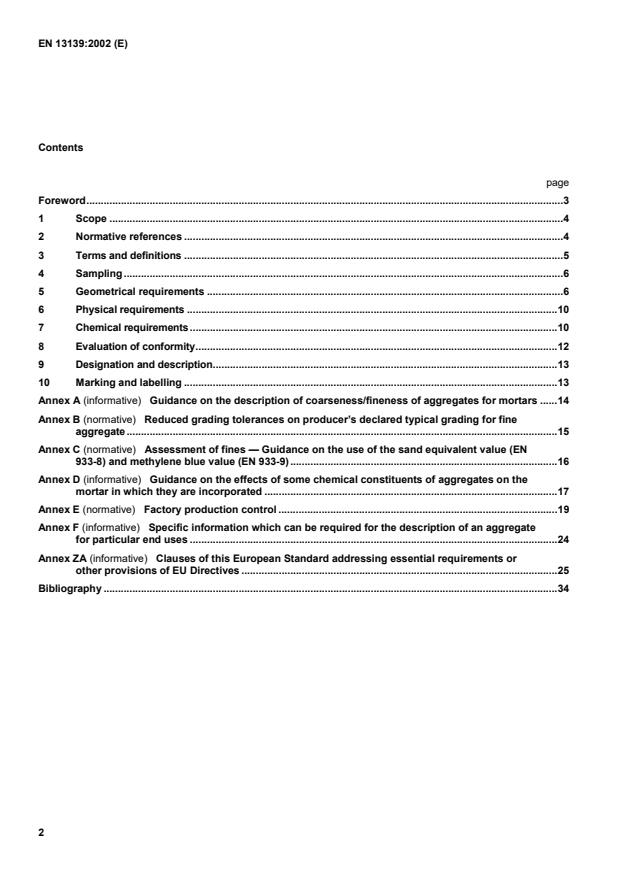
Guidance on the description of coarseness/fineness of aggregates for mortars.14Annex B (normative)
Reduced grading tolerances on producer’s declared typical grading for fineaggregate.15Annex C (normative)
Assessment of fines — Guidance on the use of the sand equivalent value (EN933-8) and methylene blue value (EN 933-9).16Annex D (informative)
Guidance on the effects of some chemical constituents of aggregates on themortar in which they are incorporated.17Annex E (normative)
Factory production control.19Annex F (informative)
Specific information which can be required for the description of an aggregatefor particular end uses.24Annex ZA (informative)
Clauses of this European Standard addressing essential requirements orother provisions of EU Directives.25Bibliography.34
Care should be taken when considering the use of aggregates from sources with no such pattern of use, e.g.,recycled aggregates and aggregates arising from certain industrial by-products.
Such aggregates, which should comply with allthe requirements of this European Standard, could have other characteristics not included in Mandate M 125 that do not applyto the generality of aggregate types with an established pattern of use and when required, provisions valid at the place of usecan be used to assess their suitability.NOTE 2Properties for lightweight aggregates are specified in prEN 13055-1.2 Normative referencesThis European Standard incorporates by dated or undated reference, provisions from other publications.
Thesenormative references are cited at the appropriate places in the text and the publications are listed hereafter.
Fordated references, subsequent amendments to or revisions of any of these publications apply to this EuropeanStandard only when incorporated in it by amendment or revision.
For undated references, the latest edition of thepublication referred to applies (including amendments).EN 932-1, Tests for general properties of aggregates — Part 1: Methods for sampling.EN 932-5, Tests for general properties of aggregates — Part 5: Common equipment and calibration.EN 933-1, Tests for geometrical properties of aggregates — Part 1: Determination of particle size distribution —Sieving method.EN 933-3, Tests for geometrical properties of aggregates — Part 3: Determination of particle shape
— Flakinessindex.EN 933-7, Tests for geometrical properties of aggregates — Part 7: Determination of shell content — Percentage of shells in coarse aggregates.EN 933-8, Tests for geometrical properties of aggregates — Part 8: Assessment of fines – Sand equivalent test.EN 933-9, Tests for geometrical properties of aggregates — Part 9: Assessment of fines – Methylene-blue test.EN 933-10, Tests for geometrical properties of aggregates — Part 10: Assessment of fines — Grading of fillers (air jetsieving).
When required, the tests specified in clause 5 shall becarried out to determine appropriate geometrical properties.5.2 Aggregate sizes5.2.1All aggregates shall be described in terms of aggregate sizes using the designations d/D except foraggregates added as fillers which shall be described as filler aggregate.5.2.2Aggregate size shall be described by the pair of sieve sizes in millimetres with d as the lower limitdesignation and D as the upper limit designation sieve between which most of the particle size distribution lies, (e.g.0/4 mm,0/2 mm, 2/4 mm, etc.).
The following aggregate sizes are preferred:0/1 mm, 0/2 mm, 0/4 mm, 0/8 mm, 2/4 mm, 2/8 mm5.3 GradingThe grading of aggregates, determined in accordance with EN 933-1, shall conform to the following requirements asappropriate to their aggregate size (d/D).5.3.1 Oversize and undersize limitsAggregates sizes specified in 5.2.3 shall conform to the oversize and undersize limits given in Table 1, except whereotherwise specified for special uses.Table 1 — Oversize and undersize limitsLimits in percentage passing by massOversizeUndersizeAggregatesizesmm2 D a1,4 D bD cd0,5 d b0/10/20/410010010095 to 10095 to 10095 to 100 85 to 99 85 to 99 85 to 99------0/810098 to 10090 to 99--2/42/810010095 to 10098 to 10085 to 9985 to 990 to 200 to 200 to 50 to 5aWhere essential for special purposes the sieve on which 100 % passes may be specified at avalue less than 2 D. For thin layer mortar (0/1) 100 % shall pass D.bWhere the sieves calculated as 0,5 d and 1,4 D are not exact numbers in theISO 565:1990/R20 series the next nearest sieve size shall be adopted.cIf the percentage passing D is > 99 % by mass, the producer shall document and declare thetypical grading including the sieves identified in Table 2.5.3.2 Typical grading and tolerancesThe following requirements shall be applied to control the variability of the fine aggregate.When required the producer shall document and declare the typical grading for each fine aggregate size produced.When assessing production within a system of continuous factory production control at least 90 % of the most recent20 results of grading shall fall within the appropriate tolerances specified in Table 2 about the declared grading.NOTE 1Recommendations for the description of the coarseness of the aggregates are given in annex A.NOTE 2The majority of fine aggregates in regular satisfactory use for most applications conform to general use gradingrequirements.
It is not intended that special use gradings should apply except where essential for particular applications.
requirements of Table 1 and Table 4.bFor special purposes the producer and purchaser can agree reduced grading tolerances (see 5.3.4 and
annex B).5.3.3 Filler aggregateThe grading of filler aggregate determined in accordance with EN 933-10 shall conform to the limits specified inTable 3.When required the producer shall document and declare the typical grading for each filler aggregate size produced.When assessing production within a system of continuous factory production control at least 90 % of the most recent20 results of grading shall fall within the appropriate tolerances specified in Table 2.Table 3 — Grading requirements for filler aggregatePercentage passing by massSieve sizemmOverall range for individualresultsMaximum producers' declaredgrading range for 90 % of results20,1250,06310085 to 10070 to 100-10105.3.4 Special use aggregatesWhen specified for special uses and cases where the variability of grading is reduced, the grading tolerances shall beapplied in accordance with annex B.5.4 Particle shape and shell content5.4.1 Particle shapeThe particle shape of fine aggregates smaller than 4 mm is not normally relevant in the behaviour of mortars.
No European test method is available for thedetermination of shell content in fine aggregates5.5 Fines5.5.1 Fines contentThe fines content, determined in accordance with EN 933-1, shall not exceed the limits specified in Table 4 for theselected category.
The limits for fines content of filler aggregates shall comply with the requirements specified inTable 3.Table 4 — Limits for fines contentMaximum percentage passing 0,063 mm sieve by massAggregate sizemmCategory 1Category 2Category 3Category 4Category 50/1 a0/20/4; 2/4 b0/8; 2/8 b33335555888830303011>30 a---aValue to be declared by the producer.bAggregate sizes 2/4 and 2/8
are used only in mortar in combination with sizes 0/1; 0/2; 0/4 and
0/8.
Combinations of aggregate sizes shall conform to the limits for the fines content for the
appropriate combined aggregate size.NOTE 1Depending on the end use the appropriate category should be selected.NOTE 2Examples of end uses for different categories are:—Category 1:
Floor screeds, sprayed, repair mortars, grouts (all aggregates).—Category 2:
Rendering and plastering mortars (all aggregates).—Category 3:
Masonry mortars (all aggregates except crushed rock).—Category 4:
Masonry mortars (crushed rock).5.5.2 Fines qualityWhen the fines content in the fine aggregate exceeds 3 % by mass and there is documented evidence of satisfactoryuse further testing may not be necessary.
When it is required, aggregates and filler aggregates shall be assessed forharmful fines in accordance with annex C.NOTEIt is not possible currently, pending further research, to establish universal requirements for harmful fines for allmaterials.
Further guidance on the assessment of harmful fines is included in annex C.
When required, the tests specified in clause 6 shall becarried out to determine appropriate physical properties.6.2 Particle density and water absorption6.2.1 Particle densityThe particle density shall be determined in accordance with EN 1097-6 and the results declared stating the clausenumber of the test method and the equations used.6.2.2 Water absorptionThe water absorption shall be determined in accordance with EN 1097-6 and the results declared stating the clausenumber of the test method and the equations used.6.2.3Resistance to freezing and thawingWhen required the resistance to freezing and thawing of aggregate fractions coarser than 4 mm shall be determinedin accordance with either EN 1367-1 or derived from the 10 mm to 14 mm aggregate fraction from the same sourcein accordance with EN 1367-2, and the results declared.When the resistance to freezing and thawing of aggregates of 4 mm or less and filler aggregates is required in theend use situation, it shall be derived from a freeze-thaw test on the mortar in accordance with the provisions valid atthe place of use and the results declared.7 Chemical requirements7.1 GeneralThe necessity for testing and declaring all properties specified in this clause shall be limited according to theparticular application at end use or origin of the aggregate and filler aggregate.
When required, the tests specifiedin clause 7 shall be carried out to determine appropriate chemical properties.Aggregates and filler aggregates shall not contain materials in proportions that are harmful to the durability or surfaceproperties of the mortar in which they are incorporated.NOTE 1The chemical requirements specified in 7.2, 7.3, 7.4 and 7.5 apply only to aggregates and filler aggregates for use inmortars in which the binder contains cements within the scope of EN 197-1.NOTE 2Guidance on the effects of chemical constituents in aggregates and filler aggregates, including alkali-silica reactivity,related to the durability, appearance and surface properties of the mortar in which they are incorporated is given in annex D.NOTE 3When the value of a property is required but not defined by specified limits the value should be declared by theproducer as an XXDeclared category, e.g., in Table 5 for air-cooled blast furnace slag a value of say 1,2 % corresponds toAS1,2(Declared value).NOTE 4When a property is not required, a “No requirement” category can be used.NOTE 5Guidance on selection of approriate categories for specific applications can be found in national provisions in theplace of use of the aggregate and filler aggregate.
Requirements for the maximum permissible chloride content in masonry mortars are specified ine.g., EN 998-2 and depending upon the end use of the mortar and for other mortars in EN 206-1.
Further guidance is given inannex D.7.3 Sulfur containing compounds7.3.1 Acid-soluble sulfateThe acid-soluble sulfate content of the aggregates and filler aggregates for mortar determined in accordance withEN 1744-1:1998, clause 12, shall be declared in accordance with the relevant category specified in Table 5.Table 5 — Categories for maximum values of acid-soluble sulfate contentAggregateAcid soluble sulfatecontentPercentage loss by massCategoryAS 0,2 0,8> 0,8AS0,2AS0,8
ASDeclaredAggregates other than air-cooled blast furnace slagNo requirementASNR 1,0> 1,0AS1,0
ASDeclaredAir-cooled blast furnace slagNo requirementASNR7.3.2 Total sulfurThe total sulfur content of the aggregate and filler aggregates, determined in accordance with EN 1744-1:1998,clause 11, shall not exceed:a)1 % S by mass for natural aggregates;b)2 % S by mass for air-cooled blast furnace slag.Special precautions are necessary if pyrrhotite, (an unstable form of iron sulfide FeS), is present in the aggregate.If this mineral is known to be present, a maximum total sulfur content of 0,1 % as S shall apply.7.4 Constituents which alter the rate of setting and hardening of mortarAggregates and filler aggregates that contain organic or other substances in proportions that alter the rate ofsetting and hardening of mortar shall be assessed for the effect on stiffening time and compressive strength inaccordance with EN 1744-1:1998, 15.3.The proportions of such materials shall be such that they do not:a)increase the stiffening time of mortar test specimens by more than 120 min;b)decrease the compressive strength of mortar test specimens by more than 20 % at 28 days.
If the results indicate the presence of humic acid, the presence of fulvo acids shall be determined inaccordance with EN 1744-1:1998, 15.2.
If the supernatant liquid in these tests is lighter than the standard coloursthe aggregates shall be considered to be free from organic matter.NOTE 1Some inorganic compounds which discolour the supernatant liquid in the sodium hydroxide test do not adverselyaffect the setting and hardening of mortar.NOTE 2Sugars do not affect the colour of the supernatant liquid in the sodium hydroxide test or the fulvo acid test.
If it issuspected that sugars or sugar type materials are present, the aggregate should be tested using the mortar specimen test (seeEN 1744-1:1998, 15.3). The stiffening time and compressive strength requirements shown above should apply.When required the presence of lightweight organic contaminators shall be tested in accordance with EN 1744-1:1998,14.2 and the results declared.7.5 Additional requirements for manufactured aggregates7.5.1 Water soluble matterWhen determined in accordance with EN 1744-1:1998, clause 16, water soluble matter shall not exceed 1 % bymass.7.5.2 Loss on ignitionWhen required, the loss on ignition determined in accordance with EN 1744-1:1998, clause 17, shall not exceed thelimits specified in Table 6.Table 6 — Limits for loss on ignitionLoss on ignition (by mass)Air cooled blast furnace slag%Pulverized fly ash (pfa)%35 aa
See EN 450:1995, 4.2.2.
A loss on ignition of 7 % may be
tolerated at the place of use depending upon the environmental class to
which the structure is exposed.7.6 Durability7.6.1 Alkali-silica reactivityWhen required the alkali-silica reactivity of aggregates and filler aggregates shall be assessed in accordance withthe provisions valid in the place of use and the results declared.NOTEGuidance on the effects of alkali-silica reactivity, is given in annex D.8 Evaluation of conformity8.1 GeneralThe producer shall undertake initial type tests (see 8.2) and factory production control (see 8.3) to ensure that theproduct conforms to this European Standard and to declared values as appropriate.
the properties of the aggregates.The results of the initial tests shall be documented as the starting point of the factory production control for thatmaterial.
This shall particularly include the identification of any components likely to emit radiation above normalbackground levels, any components likely to release polyaromatic carbons or other dangerous substances. If thecontent of any of these components exceeds the limits in force according to the provisions valid in the place of useof the aggregate, the results of the initial tests shall be declared.8.3 Factory production controlThe producer shall have in place a system of factory production control that complies with the requirements ofannex E.The records held by the producer shall indicate what quality control procedures are in operation during theproduction of the aggregate.NOTEThe form of control applied to any aggregate depends upon its intended use and the regulations relating to that use.9 Designation and description9.1
Aggregates for mortar and filler aggregates shall be designated as follows:a) source (name of pit or quarry or, in case of doubt, also depot);b) type of aggregate (a simple indication of the petrographic type, geological origin or a trade name);c) the number of this European Standard;d) aggregate size;e) any additional information needed to identify the particular aggregate.NOTEThe purchaser should inform the producer (or supplier) at the time of order of any special requirements associatedwith a particular end use and of his requirements for extra information.9.2
A full description of the aggregate would consist of the properties and information listed in annex F.10 Marking and labellingEach delivery of aggregates for mortar shall be accompanied by a numbered delivery ticket, issued by or on behalfof the producer, stating:a) source (name of pit or quarry or in case of doubt, also depot);b) the production area and/or location;c) the date of despatch;d) the designation in accordance with clause 9;e) if required, the particle density and maximum chloride content;f) CE marking if relevant.NOTE 1It can be a requirement of the supply agreement to have additional information Included on the delivery ticket.NOTE 2For CE marking and labelling see ZA.3.
Either table, but not both, may be used for such descriptions.In Tables A.1 and A.2, coarse graded aggregates are denoted by the letter C, medium graded by M and fine gradedby F.Additionally when Table A.1 is selected, a "P" for percentage passing the 0,500 mm sieve is added after C, M or F(e.g. for medium grading sands MP).Similarly when Table A.2 is selected, an "F" for fineness modulus is added after C, M or F (e.g. for fine grading sandsFF).Table A.1 — Coarseness or fineness based on the percentage passing the 0,500 mm sievePercentage passing by massCPMPFP5 to 4530 to 7055 to 100Table A.2 — Coarseness or fineness based on the fineness modulusFineness modulusCFMFFF3,6 to 2,42,8 to 1,52,1 to 0,6Fineness modulus (FM) is used to check constancy.
Where additionally required, the FM of a delivery should bewithin the limits of the declared FM ± 0,25 or other specified limit.NOTE 1Fineness modulus (FM) is calculated as the sum of cumulative percentages by mass retained on the followingsieves (mm) expressed as a percentage, i.e.100125025050124FM)},(),(),()()(){(>+>+>+>+>+>S=NOTE 2The result of the fineness modulus calculation is strongly influenced by the fines content.
Crushed rock aggregatecould be classified as a fine aggregate although the aggregate without the fines is to be considered as a typical coarseaggregate.
See 5.3.4.
The limits and/or categories should be established from experience of existingrequirements of materials in local satisfactory use according to the provisions valid in the place of use of the aggregate.NOTE 2The requirements for the sand equivalent and methylene blue tests on 0/2 fraction should normally be expressedwith a probability of 90%.NOTE 3When equivalence of performance with known satisfactory aggregates is established or there is evidence ofsatisfactory use with no experience of problems the fines in the aggregate may also be considered as non-harmful.
In addition, to minimizethe risk of corrosion of metals embedded in mortar (wall ties, etc.) it is usual to limit the amount of chloride in mortarcontributed from all constituents.The chloride ion content requirements of EN 998-2 are usually achieved when the water-soluble chloride ion contentof the aggregate does not exceed 0,15 % for plain mortar and 0,06 % for mortars with embedded metals.
Thesevalues are intended for the guidance of aggregate producers.D.2 SulfatesSulfates in aggregates can give rise to the expansive disruption of mortar. Such salts can also lead to the productionof unsightly deposits on exposed surfaces of mortar.
Under certain circumstances, other sulfur compounds canoxidize in the mortar to produce sulfates.
These can also give rise to the expansive disruption of the mortar.D.3 Staining and pop-outsSome constituents of aggregates can cause staining and discoloration or swelling and pop-outs of the mortar in whichthey are incorporated.
Iron pyrite and lignite are two examples of such harmful constituents.D.4 Damage to exposed surfacesImpurities that can cause damage to exposed surfaces include particles of wood, coal, clay bound products, reactivewaste materials and harmful residues from former loads in the means of transport.D.5 Other harmful constituentsWhere appearance is an essential feature of the mortar, aggregates should not contain materials in proportions thatcause damage to exposed mortar surfaces. Since very small percentages by mass of contaminators in aggregatescan have a considerable effect on exposed mortar surfaces, attention should be given to the suitability of a source fora particular end use.Other constituents can adversely affect the rate of hydration of cement, altering the rate of setting and hardening ofmortar.
Humus and sugar-type materials are two examples of substances that affect the rate of setting and hardeningof mortar.
Certain clay minerals also adversely affect the rate of development of strength and the strength anddurability of mortar in which they are incorporated.D.6 Alkali–silica aggregate reactionCertain aggregates can react with alkalis present in the pore fluids of mortar.
Under adverse conditions and in thepresence of moisture this can lead to expansion and subsequent cracking or disruption of the mortar.
The most
Records ofsuch reviews shall be maintained.E.3 Control proceduresThe producer shall establish and maintain a factory production control manual setting out the procedures by whichthe requirements for factory production control are satisfied.E.3.1 Document and data controlDocument and data control shall include those documents and data that are relevant to the requirements of thisstandard covering purchasing, processing, inspection of materials and the factory production control systemdocuments.A procedure concerning the management of documents and data shall be documented in the production controlmanual covering procedures and responsibilities for approval, issue, distribution and administration of internal andexternal documentation and data; and the preparation, issue and recording of changes to documentation.
Theproducer shall retain overall responsibility for any parts of the operation sub-contracted.E.3.3 Knowledge of the raw materialThere shall be documentation detailing the nature of the raw material, its source and where appropriate, one ormore maps showing the location and extraction plan.It is the producer's responsibility to ensure that if any dangerous substances are identified their content does notexceed the limits in force according to the provisions valid in the place of use of the aggregate.NOTEMost of the dangerous substances defined in Council Directive 76/769/EEC are not usually present in most sourcesof aggregates of mineral origin.
However, the Note in ZA.1 is drawn to the attention of the aggregates producer.E.4 Management of productionThe factory production control system shall fulfil the following requirements.a) There shall be procedures to identify and control the materials.NOTEThese can include procedures for maintaining and adjusting processing equipment, inspection or testing materialsampled during processing, modifying the process during bad weather, etc.b) There shall be procedures to identify and control any hazardous materials identified in E.3.3 to ensure that theydo not exceed the limits in force according to the provisions valid in the place of use of the aggregate.c) There shall be procedures to ensure that material is put into stock in a controlled manner and the storagelocations and their contents are identified.d) There shall be procedures to ensure that material taken from stock has not deteriorated in such a way that itsconformity is compromised.e) The product shall be identifiable up to the point of sale as regards source and type.E.5 Inspection and testE.5.1 GeneralThe producer shall make available all the necessary facilities, equipment and trained personnel to carry out therequired inspections and tests.E.5.2 EquipmentThe producer shall be responsible for the control, calibration and maintenance of inspection, measuring and testequipment.Accuracy and frequency of calibration shall be in accordance with EN 932-5.Equipment shall be used in accordance with documented procedures.Equipment shall be uniquely identified.Calibration records shall be retained.
The frequency ofsampling and the tests when required shall be carried out for the relevant characteristics as specified in Table E.1.NOTE 1Test frequencies are generally related to periods of production. A period of production is defined as a full week,month or year of production working days.NOTE 2The requirements for factory production control can introduce visual inspection. Any deviations indicated by theseinspections may lead to increased test frequencies.NOTE 3When the measured value is close to a specified limit the frequency may need to be increased.NOTE 4Under special conditions the test frequencies may be decreased below those given in Table E.1.
These conditionscould be:a) highly automated production equipment;b) long-term experience with consistency of special properties;c) sources of high conformity;d) running a Quality Management System with exceptional measures for surveillance and monitoring of the productionprocess.The producer shall prepare a schedule of test frequencies taking into account the minimum requirements ofTable E.1.Reasons for decreasing the test frequencies shall be stated in the factory production control document.E.6 RecordsThe results of factory production control shall be recorded including sampling locations, dates and times andproduct tested with any other relevant information, e.g., weather conditions.NOTE 1Some characteristics can be shared by several products, in which case the producer, based on his experience, canfind it possible to apply the results of one test to more than one product.
This is particularly the case when a product is thecombination of two or more different sizes.
The particle size distribution or the cleanliness should be checked in case theintrinsic characteristics may have changed.Where the product inspected or tested does not satisfy the requirement laid down in the specification, or if there isan indication that it shall not do so, a note shall be made in the records of the steps taken to deal with the situation(e.g. carrying out of a new test and/or measures to correct the production process).The records required by all the clauses of this annex shall be included.The records shall be kept for at least the statutory period.NOTE 2"Statutory period” is the period of time records are required to be kept in accordance with Regulations applying atthe place of production.E.7 Control of non-conforming productFollowing an inspection or test that indicates that a product does not conform, the affected material shall be:a) reprocessed; orb) diverted to another application for which it is suitable; orc) rejected and marked as non-conforming.
...