

EN 13779:2007
(Main)Ventilation for non-residential buildings - Performance requirements for ventilation and room-conditioning systems
- Abstract
This European Standard applies to the design and implementation of ventilation and room conditioning systems for non-residential buildings subject to human occupancy, excluding applications like industrial processes. It focuses on the definitions of the various parameters that are relevant for such systems.
The guidance for design given in this standard and its annexes are mainly applicable to mechanical supply and exhaust ventilation systems, and the mechanical part of hybrid ventilation systems.
Applications for residential ventilation are not dealt with in this standard. Performance of ventilation systems in residential buildings are dealt with in CEN/TR 14788.
The classification uses different categories. For some values, examples are given and, for requirements, typical ranges with default values are presented. The default values given in this standard are not normative as such, and should be used where no other values are specified. Classification should always be appropriate to the type of building and its intended use, and the basis of the classification should be explained if the examples given in the standard are not to be used.
NOTE Different standards may express the categories for the same parameters in a different way, and also the category symbols may be different.
- Status
- Withdrawn
- Publication Date
- 24-Apr-2007
- Withdrawal Date
- 06-Oct-2026
- Technical Committee
- CEN/TC 156 - Ventilation for buildings
- Drafting Committee
- CEN/TC 156 - Ventilation for buildings
- Current Stage
- 9960 - Withdrawal effective - Withdrawal
- Start Date
- 09-Aug-2017
- Completion Date
- 07-Oct-2026

Relations
- Effective Date
- 22-Dec-2008
- Effective Date
- 05-Feb-2014
- Effective Date
- 28-Jan-2026
- Effective Date
- 28-Jan-2026
- Effective Date
- 28-Jan-2026
- Effective Date
- 28-Jan-2026
- Effective Date
- 28-Jan-2026
- Effective Date
- 28-Jan-2026
- Effective Date
- 28-Jan-2026
- Effective Date
- 28-Jan-2026
- Effective Date
- 28-Jan-2026
- Effective Date
- 28-Jan-2026
- Effective Date
- 28-Jan-2026
- Effective Date
- 28-Jan-2026
- Effective Date
- 28-Jan-2026
Get Certified
Connect with accredited certification bodies for this standard

DIBt (Deutsches Institut für Bautechnik)
German Institute for Building Technology.
DIN CERTCO
DIN Group product certification.

Aboma Certification B.V.
Specialized in construction, metal, and transport sectors.
Sponsored listings
Frequently Asked Questions
EN 13779:2007 is a standard published by the European Committee for Standardization (CEN). Its full title is "Ventilation for non-residential buildings - Performance requirements for ventilation and room-conditioning systems". This standard covers: This European Standard applies to the design and implementation of ventilation and room conditioning systems for non-residential buildings subject to human occupancy, excluding applications like industrial processes. It focuses on the definitions of the various parameters that are relevant for such systems. The guidance for design given in this standard and its annexes are mainly applicable to mechanical supply and exhaust ventilation systems, and the mechanical part of hybrid ventilation systems. Applications for residential ventilation are not dealt with in this standard. Performance of ventilation systems in residential buildings are dealt with in CEN/TR 14788. The classification uses different categories. For some values, examples are given and, for requirements, typical ranges with default values are presented. The default values given in this standard are not normative as such, and should be used where no other values are specified. Classification should always be appropriate to the type of building and its intended use, and the basis of the classification should be explained if the examples given in the standard are not to be used. NOTE Different standards may express the categories for the same parameters in a different way, and also the category symbols may be different.
This European Standard applies to the design and implementation of ventilation and room conditioning systems for non-residential buildings subject to human occupancy, excluding applications like industrial processes. It focuses on the definitions of the various parameters that are relevant for such systems. The guidance for design given in this standard and its annexes are mainly applicable to mechanical supply and exhaust ventilation systems, and the mechanical part of hybrid ventilation systems. Applications for residential ventilation are not dealt with in this standard. Performance of ventilation systems in residential buildings are dealt with in CEN/TR 14788. The classification uses different categories. For some values, examples are given and, for requirements, typical ranges with default values are presented. The default values given in this standard are not normative as such, and should be used where no other values are specified. Classification should always be appropriate to the type of building and its intended use, and the basis of the classification should be explained if the examples given in the standard are not to be used. NOTE Different standards may express the categories for the same parameters in a different way, and also the category symbols may be different.
EN 13779:2007 is classified under the following ICS (International Classification for Standards) categories: 91.140.30 - Ventilation and air-conditioning systems. The ICS classification helps identify the subject area and facilitates finding related standards.
EN 13779:2007 has the following relationships with other standards: It is inter standard links to EN 13779:2004, EN 16798-3:2017, EN 16798-5-1:2017, EN 15251:2007, EN 16798-5-2:2017, EN 12792:2003, EN 16798-7:2017, EN 12097:2006, EN 308:2022, EN 16798-17:2017, EN ISO 52120-1:2022, EN 12599:2000, EN 13053:2006, EN ISO 7730:2025, EN ISO 6647-2:2007. Understanding these relationships helps ensure you are using the most current and applicable version of the standard.
EN 13779:2007 is associated with the following European legislation: Standardization Mandates: M/343. When a standard is cited in the Official Journal of the European Union, products manufactured in conformity with it benefit from a presumption of conformity with the essential requirements of the corresponding EU directive or regulation.
EN 13779:2007 is available in PDF format for immediate download after purchase. The document can be added to your cart and obtained through the secure checkout process. Digital delivery ensures instant access to the complete standard document.
Standards Content (Sample)
2003-01.Slovenski inštitut za standardizacijo. Razmnoževanje celote ali delov tega standarda ni dovoljeno.Ventilation for non-residential buildings - Performance requirements for ventilation and room-conditioning systemsUDþHYDOQHVentilation dans les bâtiments non résidentiels - Exigences de performances pour les systemes de ventilation et de climatisationLüftung von Nichtwohngebäuden - Allgemeine Grundlagen und Anforderungen für Lüftungs- und KlimaanlagenTa slovenski standard je istoveten z:EN 13779:2007SIST EN 13779:2007en91.140.30VLVWHPLVentilation and air-conditioningICS:SIST EN 13779:20051DGRPHãþDSLOVENSKI
STANDARDSIST EN 13779:200701-julij-2007
EUROPEAN STANDARDNORME EUROPÉENNEEUROPÄISCHE NORMEN 13779April 2007ICS 91.140.30Supersedes EN 13779:2004
English VersionVentilation for non-residential buildings - Performancerequirements for ventilation and room-conditioning systemsVentilation dans les bâtiments non résidentiels - Exigencesde performances pour les systèmes de ventilation et declimatisationLüftung von Nichtwohngebäuden - Allgemeine Grundlagenund Anforderungen für Lüftungs- und KlimaanlagenThis European Standard was approved by CEN on 26 March 2007.CEN members are bound to comply with the CEN/CENELEC Internal Regulations which stipulate the conditions for giving this EuropeanStandard the status of a national standard without any alteration. Up-to-date lists and bibliographical references concerning such nationalstandards may be obtained on application to the CEN Management Centre or to any CEN member.This European Standard exists in three official versions (English, French, German). A version in any other language made by translationunder the responsibility of a CEN member into its own language and notified to the CEN Management Centre has the same status as theofficial versions.CEN members are the national standards bodies of Austria, Belgium, Bulgaria, Cyprus, Czech Republic, Denmark, Estonia, Finland,France, Germany, Greece, Hungary, Iceland, Ireland, Italy, Latvia, Lithuania, Luxembourg, Malta, Netherlands, Norway, Poland, Portugal,Romania, Slovakia, Slovenia, Spain, Sweden, Switzerland and United Kingdom.EUROPEAN COMMITTEE FOR STANDARDIZATIONCOMITÉ EUROPÉEN DE NORMALISATIONEUROPÄISCHES KOMITEE FÜR NORMUNGManagement Centre: rue de Stassart, 36
B-1050 Brussels© 2007 CENAll rights of exploitation in any form and by any means reservedworldwide for CEN national Members.Ref. No. EN 13779:2007: E
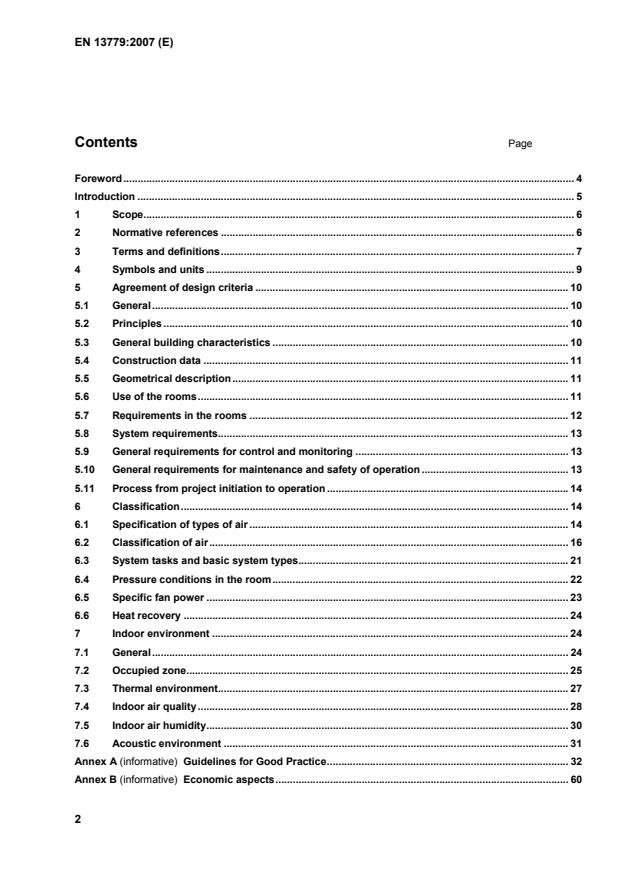
Guidelines for Good Practice.32 Annex B (informative)
Economic aspects.60
Checklist for the design and use of systems with low energy consumption.61 Annex D (informative)
Calculation and application of Specific Fan Power Calculating and checking the SFP, SFPE, and SFPV.64 Annex E (informative)
Efficiency of ventilation and air diffusion.71 Bibliography.72
Existing national regulations with or without reference to national standards, may restrict for the time being the implementation of the European Standards mentioned in this report. According to the CEN/CENELEC Internal Regulations, the national standards organizations of the following countries are bound to implement this European Standard: Austria, Belgium, Bulgaria, Cyprus, Czech Republic, Denmark, Estonia, Finland, France, Germany, Greece, Hungary, Iceland, Ireland, Italy, Latvia, Lithuania, Luxembourg, Malta, Netherlands, Norway, Poland, Portugal, Romania, Slovakia, Slovenia, Spain, Sweden, Switzerland and United Kingdom.
building type : purpose ; residential non-residential calculation /ventilation rates calculation/ ventilation energy
EN 15242
EN 15241 design; system performance CEN/TR 14788a EN 13779rev criteria for the indoor environment
EN 15251 a A new Work Item (WI 00156105) has been established to revise and upgrade into a European Standard.
Natural ventilation systems are not covered by this standard.
The guidance for design given in this standard and its annexes are mainly applicable to mechanical supply and exhaust ventilation systems, and the mechanical part of hybrid ventilation systems. Applications for residential ventilation are not dealt with in this standard. Performance of ventilation systems in residential buildings are dealt with in CEN/TR 14788.
The classification uses different categories. For some values, examples are given and, for requirements, typical ranges with default values are presented. The default values given in this standard are not normative as such, and should be used where no other values are specified. Classification should always be appropriate to the type of building and its intended use, and the basis of the classification should be explained if the examples given in the standard are not to be used.
NOTE Different standards may express the categories for the same parameters in a different way, and also the category symbols may be different.
2 Normative references The following referenced documents are indispensable for the application of this document. For dated references, only the edition cited applies. For undated references, the latest edition of the referenced document (including any amendments) applies. EN 308, Heat exchangers — Test procedures for establishing performance of air to air and flue gases heat recovery devices EN 12097, Ventilation for Buildings — Ductwork — Requirements for ductwork components to facilitate maintenance of ductwork systems EN 12599:2000, Ventilation for buildings — Test procedures and measuring methods for handing over installed ventilation and air conditioning systems EN 12792:2003, Ventilation for buildings — Symbols, terminology and graphical symbols EN 13053:2006, Ventilation for buildings — Air handling units — Rating and performance for units, components and sections prEN 15232, Energy performance of buildings — Impact of Building Automation, Controls and Building Management
EN 15239, Ventilation for buildings —
Energy performance of buildings —
Guidelines for inspection of ventilation systems EN 15240, Ventilation for buildings —
Energy performance of buildings — Guidelines for inspection of air-conditioning systems EN 15241, Ventilation for buildings — Calculation methods for energy losses due to ventilation and infiltration in commercial buildings EN 15242, Ventilation for buildings — Calculation methods for the determination of air flow rates in buildings including infiltration
room conditioning system system able to keep comfort conditions in a room within a defined range NOTE Air conditioning systems as well as surface based systems are included 3.2
types of air types of air are defined in 6.1 3.3
occupied zone usually the term “occupied zone” is used only for areas designed for human occupancy and is defined as a volume of air that is confined by specified horizontal and vertical planes
NOTE 1 The vertical planes are usually parallel with the walls of the room. Usually there is also a limit placed on the height of the occupied zone. Thus, the occupied zone in a room is that space in which the occupants are normally located and where the requirements for the indoor environment shall be satisfied. Definitions are given in 7.2. NOTE 2 definition of the occupied zone is dependent on the geometry and the use of the room and should be specified case by case 3.4
ventilation effectiveness relation between the pollution concentrations in the supply air, the extract air and the indoor air in the breathing zone (within the occupied zone). It is defined as
SUPIDASUPETAvcccc−−=ε (1) where: εv
is the ventilation effectiveness
cETA
is the pollution concentration in the extract air in mg.m-3
cIDA
is the pollution concentration in the indoor air (breathing zone within the occupied zone) in mg.m-3
cSUP
is the pollution concentration in the supply air in mg.m-3 NOTE 1 The ventilation effectiveness depends on the air distribution and the kind and location of the air pollution sources in the space. It may therefore have different values for different pollutants. If there is complete mixing of air and pollutants, the ventilation effectiveness is one.
specific fan power for the building or the whole system (SFP) is the combined amount of electric power consumed by all the fans in the air distribution system divided by the total airflow rate through the building under design load conditions, in W.m-3.s. Specific power of each fan is defined as totvSFPηpqPP∆== (2) where: PSFP
is the specific fan power in W.m-3.s
P
is the input power of the motor for the fan in W
qv
is the design airflow through the fan in m3.s-1
∆p is the total pressure difference across the fan in Pa
ηtot is the overall efficiency of the fan
NOTE 1 The coefficient is valid for the design airflow with clean filter conditions, all components dry and any bypasses closed. It is related to an air density of 1,2 kg.m-3. It should be taken into account that the design performance is not usually the rated maximum performance of the ventilation components, but typically between 40 and 60 % of the maximum performance. NOTE 2 Further guidance for the applications, calculation and validation of the specific fan power is presented in Annex D. 3.6
demand controlled ventilation ventilation system where the ventilation rate is controlled by air quality, moisture, occupancy or some other indicator for the need of ventilation 3.7
ventilation system combination of appliances designed to supply interior spaces with outdoor air and to extract polluted indoor air
NOTE The system can consist of mechanical components (e.g. combination of air handling unit, ducts and terminal units). Ventilation system can also refer to natural ventilation systems making use of temperature differences and wind with facade grills in combination with mechanical exhaust (e.g. in corridors, toilets etc.). Both mechanical and natural ventilation can be combined with operable windows. A combination of mechanical and non-mechanical components is possible (hybrid systems).
θo (theta) K (°C) Density ρ (rho) kg.m-3 Heat or cooling load Φ (phi) W (kW) Area A m2 Costs C € a Concentration c mg.m-3 Specific heat capacity at constant pressure cp J.kg-1.K-1 Diameter d m Energy consumption (measured) E J (MJ, GJ) Energy demand (calculated) E J (MJ, GJ) Specific leakage f l.s-1.m-2 Present value factor fpv - Height h m Initial Investment I € b Thermal insulation of clothing Icl clo Length L m Metabolic rate (activity) M met Life span n years nL50-value nL50 h-1 Fan power P W Specific fan power PSFP W.m-3.s Present value PV €
a
5.1 General
The design criteria specify the information needed to design the system. These criteria also constitute the basis for the measurements that will be carried out during the hand-over process. They provide the common language between all the parties including the client, designer, contractor and the operation and maintenance personnel. Information necessary to design the system is organised on the basis of various documents outlined in 5.2 to 5.10. If the method used for dimensioning the system requires more details, they shall be provided. Calculation procedure for the energy requirements of the ventilation system is presented in EN 15241. 5.2 Principles Although in this standard the terms “client”, “designer” or “contractor” are used to describe the function, the responsibilities are dependent on the contract. Their use does not presuppose any definition of responsibility for the information. Nevertheless, if one party does not provide the information, the other shall ask for it or make and record the necessary assumptions. All key design decisions shall be agreed and documented. The description of the characteristics of the environment and the structure of the building shall be obtained for design. The desired results required at the time of hand-over and during normal operation shall be specified and documented. The description of the building with construction data, use and requirements is an evolving process with an increasing degree of detail and accuracy with the evolution of the project. Therefore the use of all specifications shall always be stated clearly. The details about the information needed are also dependent on the calculation method that is employed. The introduction of a system of abbreviations for constructions, room use and requirements to be used throughout the design phase is recommended. 5.3 General building characteristics 5.3.1 Location, outdoor conditions, neighbourhood Information about the location of the relevant building, the significant neighbourhood characteristics such as adjacent buildings, shading, reflections, emissions, roads, airfields, sea coast, special requirements and all other information that will influence the building design shall be specified in design. The reference for noise and wind exposure of facades should be given, if available. The category of outdoor air shall be defined in accordance with Table 4.
The occupancy profile during typical days, annual periods of non-occupancy (e.g. schools etc.), and on general operational use (e.g. weekend, night etc.) shall be specified. 5.4 Construction data All building parts shall be specified in a list with their relevant construction data. 5.5 Geometrical description The geometrical description including information about the orientation of the elements exposed to the outdoors shall be presented, and this can be done in the form of drawings and/or tables. The specification of the net volume and floor area, room by room, is recommended.
5.6 Use of the rooms 5.6.1 General The information about the use of each room, or group of rooms with similar use shall be given, preferably in a table. The necessary information according to A.1 of EN 12599:2000 shall also be included.
5.6.2 Human occupancy The design condition in respect of the number of people that can be in the room for a longer period (see Table 12) shall be specified. This number constitutes a basic condition of use because the ventilation rate shall be designed for this level of occupancy. In addition the activity and clothing has to be defined.
The occupancy level shall be given as schedule, for example by specifying hourly values on typical days. 5.6.3 Other internal heat gains Internal heat gains (persons, lighting and equipment) shall be specified for the various rooms or group of rooms. The gains shall be defined as follows: sensible gains, convective or radiative latent gains. They shall be defined as schedules similar to occupation.
5.7.6 Noise level With no regulations or specific requirements the reference values in A.16 are valid as maximum allowable sound pressure level from the system in the room.
5.7.7 Lighting The lighting shall be designed for the actual requirements in the rooms. The installed electrical power for the lighting should not be too high for reasons of energy conservation, as the energy is not only required for lighting but also for cooling in summertime. Typical values for lighting levels and lighting power requirements are given in A.17.3.
The relevant system requirements shall be specified. The system requirements shall also conform to existing national regulations and guidelines, including those for structural fire safety and the regulations related to acoustics. The system requirements typically include: -location of air intake and discharge openings, see 6.2.3
-air filtering -heat recovery -re-use of extract air -thermal insulation of the system -airtightness of the system -pressure conditions within the system and the building, taking into account the building and system airtightness -power consumption -space requirements for components and systems -aspects to installation, operation and maintenance
NOTE Annex A gives further information and default values. 5.9 General requirements for control and monitoring The method for the control and monitoring of all the systems shall be specified. In some applications it makes sense to distinguish between the first year(s) of operation and the time after. The monitoring of the energy consumption shall allow a periodic check of the energy consumption of important individual systems and of the whole building. Therefore a measuring concept shall be identified at an early stage of the project and the necessary measuring devices installed. Changes of uses and requirements should be followed by adaptations of the system. 5.10 General requirements for maintenance and safety of operation The system shall be designed to allow efficient service and maintenance to ensure effective operation.
NOTE 1 Further guidance is given in A.14. The system shall be so designed that, with proper operation and maintenance, it will remain in ope-rating condition for a reasonable period of time. The system shall be designed so as to facilitate cleaning, maintenance and service operation (see EN 12097). The equipment shall be furnished with appropriate protection and safety devices for maintenance and repair work, and for emergency stopping. NOTE 2 National authorities may give more detailed requirements or instructions for safety in operation and maintenance.
NOTE 1 More details are given in Annex C in the form of checklists. a) Project initiation. b) Definition of design conditions and requirements. c) Check with authorities, relevant regulations. d) Design. e) Installation. f) Check of the installation. g) Start of operation, check of functions, balancing, testing with written records. h) Declaration of finished installation, addressed to the client. i) Common completeness check, functional tests, functional measurements and special measure-ments according to EN 12599. j) Hand over the system including the delivery of all relevant documents with instructions how to operate and maintain the system, to the client. k) Operation and maintenance. l) Regular inspections (see EN 15240 and EN 15239). m) Monitoring the energy consumption by bookkeeping or another way of recording. NOTE 2 Every ventilation, air-conditioning or room-conditioning system requires an adequate operation and maintenance procedure in order to satisfy the guaranteed conditions in the room, to ensure energy-efficient operation in all situations, to avoid emissions from the ventilation system to the room, to provide generally a good air quality in the rooms and to protect the system from damage and premature failure. It is recommended to prepare a duty-booklet for operation, service and maintenance, to contain a description of the control, service and maintenance measures including the time intervals and responsibilities (see also EN 15240 and EN 15239). 6 Classification
6.1 Specification of types of air The types of air in a building and in a ventilation or air-conditioning system are specified in Table 2 and illustrated in Figure 1. The abbreviations and colours given in Table 2 shall be used to mark the type of air in drawings of ventilation or air-conditioning systems. The abbreviations can also be helpful for the labelling of system parts.
Table 2 — Specification of types of air No. (in Figure 1) Type of air AbbreviationColour Definition 1 Outdoor air
ODA
Green Air entering the system or opening from outdoors before any air treatment 2 Supply air
SUP
Blue Airflow entering the treated room, or air entering the system after any treatment
3 Indoor air
IDA
Grey Air in the treated room or zone 4 Transferred air
TRA
Grey Indoor air which passes from the treated room to another treated room
5 Extract air
ETA
Yellow The airflow leaving the treated room
6 Recirculation air
RCA
Orange Extract air that is returned to the air treatment system and reused as supply air 7 Exhaust air
EHA
Brown Airflow discharged to the atmosphere. 8 Secondary air
SEC
Orange Airflow taken from a room and returned to the same room after any treatment
9 Leakage
LEA
Grey Unintended airflow through leakage paths in the system 10 Infiltration
INF
Green Leakage of air into building through leakage paths in elements of structure separating it from the outdoor air 11 Exfiltration
EXF
Grey Leakage of air out of building through leakage paths in elements of structure separating it from the outdoor air 12 Mixed air
MIA
Streams with separate colours Air which contains two or more streams of air 1.1 Single room outdoor air SRO Green Air entering the single room air handling unit or opening from outdoors before any air treatment 2.1 Single room supply air SRS Blue Airflow entering the treated room
5.1 Single room extract air SET Yellow The airflow leaving the treated room into a single room air handling unit 7.1 Single room exhaust air SEH Brown Airflow discharged to the atmosphere from a single room air handling unit.
Figure 1 — Illustration of types of air using numbers given in Table 2 6.2 Classification of air 6.2.1 General The following classifications may be used to describe the quality of the different types of air defined in 6.1. Some applications of these classifications are given in Annex A.
6.2.2 Extract air and exhaust air The classifications of extract air and exhaust air for the application in this standard are given in Table 3. In case the extract air contains different categories of extract air from different rooms, the stream with the highest category-number determines as a default the category of the total air stream.
Table 3 — Classification of extract air (ETA) and exhaust air (EHA) Category Description
Extract air with low pollution level ETA 1 EHA 1 Air from rooms where the main emission sources are the building materials and structures, and air from occupied rooms, where the main emission sources are human metabolism and building materials and structures. Rooms where smoking is allowed are excluded.
Extract air with moderate pollution level ETA 2 EHA 2 Air from occupied rooms, which contains more impurities than category 1 from the same sources and/or also from human activities. Rooms which shall otherwise fall in category ETA 1 but where smoking is allowed.
Extract air with high pollution level ETA 3 EHA 3 Air from rooms where emitted moisture, processes, chemicals etc. substantially reduce the quality of the air.
Extract air with very high pollution level ETA 4 EHA 4 Air which contains odours and impurities in significantly higher concentrations than those allowed for indoor air in occupied zones.
6.2.3 Outdoor air In the process of system design, consideration needs to be given to the quality of the outdoor air around the building or proposed location of the building. In the design, there are two main options for mitigating the effects of poor outdoor air on the indoor environment: locate air intakes where the outdoor air is least polluted (if the outdoor air pollution is not uniform around the building)
apply some form of air cleaning NOTE 1 See A.2 and A.3 for further information about these options.
Different air filtering techniques are available, their suitability depends on whether the outdoor air is polluted with gases, particles or both (and the size of the particles of concern). There are no universally accepted definitions of acceptable levels of outdoor air quality and those that do exist are not intended primarily to support the design of ventilation systems. Design decisions will therefore depend on: what local regulations are in force; choices to adopt regulations and guidelines;
Table 4 — Classification of outdoor air (ODA) Category DescriptionODA 1 Pure air which may be only temporarily dusty (e.g. pollen) ODA 2 Outdoor air with high concentrations of particulate matter and/or gaseous pollutants ODA 3 Outdoor air with very high concentrations of gaseous pollutants and/or particulate tt Application of such a classification will depend on defining the criteria. As a starting point, the following approach is suggested.
ODA 1 applies where the WHO (1999) guidelines and any National air quality standards or regulations for outdoor air are fulfilled.
ODA 2 applies where pollutant concentrations exceed the WHO guidelines or any National air quality standards or regulations for outdoor air by a factor of up to 1,5.
ODA 3 applies where pollutant concentrations exceed the WHO guidelines or any National air quality standards or regulations for outdoor air by a factor greater than 1,5.
Since there are not guidelines of regulations for all pollutants, and those that do exist are not uniform between nations, informed interpretation is required on the part of the designer. The potential impact of mixtures of pollutants, not just individual pollutants, should be considered.
Typical gaseous pollutants to be considered in the evaluation of the outdoor air for the design of ventilation and room-conditioning systems are carbon monoxide, carbon dioxide, sulphur dioxide, oxides of nitrogen and volatile organic compounds (VOCs). The indoor impact of such outdoor pollutants will depend on how reactive they are. Carbon monoxide, for example, is relatively stable and subject to little adsorption by indoor surfaces. In contrast, ozone in the outdoor air is usually not relevant for the design of the system as ozone is highly reactive and its concentration decreases very rapidly in the ventilation system and in the room. Other gaseous pollutants are mostly intermediate between these extremes. Particulate matter refers to the total amount of solid or liquid particles in the air, from the visible dust to submicron particles. Most outdoor air guidelines refer to PM10 (particulate matter with an aerodynamic diameter up to 10 µm) but there is growing acceptance that, for the purpose of health protection, greater emphasis should be placed on smaller particles. Where biological particles need to be considered, PM10 guidelines are not relevant and the more important consideration is the immunological or infectious hazard represented by the particles.
NOTE 2 Further information about outdoor air quality and how to determine the ODA class are given in A.3.
6.2.4 Supply air The quality of the supply air for buildings subject to human occupancy shall be such that, taking into account the expected emissions from indoor sources (human metabolism, activities and processes, building materials, furniture ) and from the ventilation system itself, proper indoor air quality will be achieved
The outdoor air rates shall be specified in design of the system. If supply air also contains recirculation air, this shall be noted in design documentation, too. In order to avoid misunderstandings, it is recommended to define the quality of the supply air also by specifying the concentration limits that will apply to named pollutants (e.g. CO2, VOC) in the indoor air. Therefore a declaration of the expected emissions from indoor sources is also needed and, wherever possible, this should be related to concentration limits and emission standards.
NOTE 2 Extract air can be mixed to the supply air on purpose by recirculation or unintentionally by leakage. Special attention should be paid to the situation in heat recovery devices or sections, see A.4. 6.2.5 Indoor air
6.2.5.1 General The basic classification of indoor air is given in Table 5. This classification applies to the indoor air in the occupied zone. Table 5 — Basic classification of indoor air quality (IDA) Category DescriptionIDA 1 High indoor air quality IDA 2 Medium indoor air quality IDA 3 Moderate indoor air quality IDA 4 Low indoor air quality
The values for indoor air classes can be given in national regulations. Values presented in EN 15251 may be used as default values. The exact definition of categories depends on the nature of the pollutant sources that are to be taken into account, and on the effects of these pollutants. For example, pollutant sources may be: localised in space or distributed through a building; continuous or intermittent emitters; emitters of particles (inorganic, viable or other organic) or gases/vapours (organic or inorganic). The effects can be considered in terms of perception of air quality or of health effects. These effects may depend on the persons exposed, e.g. whether they are healthy adults, children or hospital patients. Hence, a complete definition of indoor air quality categories is outside the scope of this standard. However, the intention of the categories can be illustrated by reference to the situation in which: people (i.e. human metabolism) are the only source of air pollution that needs to be taken into account; only the perception of non-adapted persons is considered. For practical applications the four categories of indoor air quality shall be quantified by one of the methods given in 6.2.5.2 to 6.2.5.4. The choice of the method is free but shall be adapted to the use of the room and the requirements. The different methods lead for the same category of indoor air quality, but not necessarily to the same quantity of supply air. In special cases other methods may be used to quantify the indoor air quality (IAQ).
Where emissions from materials can be estimated on a “per m2” basis, a total required ventilation rate can be calculated by combining the requirement per person and the requirements per m2. Where pollutants will be present but not immediately perceived, additional allowance should be made. Alternatively, the air cleaning required to achieve acceptable concentrations (or percentage removal) can be specified. This would be common, for example, in relation to hospitals. The methods would depend on the premises, the pollutants present and the national codes that apply. All categories and figures are informative. Normative values and ways to calculate the total ventilation rate taking into account the different pollution sources can be given on national level. Annex A presents default values. NOTE 2 For spaces for human occupancy, the ventilation option for periods of non-occupancy shall be specified according to national regulations so that the intended quality of indoor air is achieved at the start of occupancy. The main options for ventilation outside occupancy are:
-basic ventilation rate throughout the non-occupancy period, e.g. using extract from hygiene rooms -earlier start of ventilation before occupancy -run the ventilation system for short periods during the period of non-occupancy A minimum value of 0,1 to 0,2 l/s,m2 is recommended if national requirements are not available. NOTE 3 Further guidance for expressing the quality of indoor air, and how to specify the indoor environment in building design, is given in ISO/DIS 16814 6.2.5.2 Indirect classification by the rate of outdoor air per person This method is a well-based practical method for all situations where the rooms serve for typical human occupancy. The outdoor air rates shall be specified according to national regulations and guidelines. The specified values shall be fulfilled in the occupied zone.
NOTE Values presented in Table A.10 may be used as default values. 6.2.5.3 Indirect classification by the air flow rate per floor area This method can in some cases be used to design a system for rooms which are not for human occupancy and which do not have a clearly defined use (for example storage rooms).
NOTE Default values for these cases are given in Table A.11. 6.2.5.4 Classification by CO2-level Indoor air quality can be categorised by CO2 co
...