

EN 13779:2004
(Main)Ventilation for non-residential buildings - Performance requirements for ventilation and room-conditioning systems
- Abstract
This document applies to the design of ventilation and room conditioning systems for non-residential build-ings subject to human occupancy. It focuses on the definitions of the various parameters that are relevant for such systems. Naturally ventilated buildings are outside the scope of this document.
The classification uses different categories. For some values, examples are given and, for requirements, typical ranges with default values are presented. The default values given in this document shall be used where no other values are specified. Classification should always be appropriate to the type of building and its intended use, and the basis of the classification should be explained if the examples given in the standard are not to be used. National regulations must always be followed, even when they are out of the range given in this document.
- Status
- Withdrawn
- Publication Date
- 31-Aug-2004
- Withdrawal Date
- 24-Apr-2007
- Technical Committee
- CEN/TC 156 - Ventilation for buildings
- Drafting Committee
- CEN/TC 156/WG 7 - System performance
- Current Stage
- 9960 - Withdrawal effective - Withdrawal
- Start Date
- 25-Apr-2007
- Completion Date
- 25-Apr-2007

Relations
- Effective Date
- 22-Dec-2008
Get Certified
Connect with accredited certification bodies for this standard

DIBt (Deutsches Institut für Bautechnik)
German Institute for Building Technology.
DIN CERTCO
DIN Group product certification.

Aboma Certification B.V.
Specialized in construction, metal, and transport sectors.
Sponsored listings
Frequently Asked Questions
EN 13779:2004 is a standard published by the European Committee for Standardization (CEN). Its full title is "Ventilation for non-residential buildings - Performance requirements for ventilation and room-conditioning systems". This standard covers: This document applies to the design of ventilation and room conditioning systems for non-residential build-ings subject to human occupancy. It focuses on the definitions of the various parameters that are relevant for such systems. Naturally ventilated buildings are outside the scope of this document. The classification uses different categories. For some values, examples are given and, for requirements, typical ranges with default values are presented. The default values given in this document shall be used where no other values are specified. Classification should always be appropriate to the type of building and its intended use, and the basis of the classification should be explained if the examples given in the standard are not to be used. National regulations must always be followed, even when they are out of the range given in this document.
This document applies to the design of ventilation and room conditioning systems for non-residential build-ings subject to human occupancy. It focuses on the definitions of the various parameters that are relevant for such systems. Naturally ventilated buildings are outside the scope of this document. The classification uses different categories. For some values, examples are given and, for requirements, typical ranges with default values are presented. The default values given in this document shall be used where no other values are specified. Classification should always be appropriate to the type of building and its intended use, and the basis of the classification should be explained if the examples given in the standard are not to be used. National regulations must always be followed, even when they are out of the range given in this document.
EN 13779:2004 is classified under the following ICS (International Classification for Standards) categories: 91.140.30 - Ventilation and air-conditioning systems. The ICS classification helps identify the subject area and facilitates finding related standards.
EN 13779:2004 has the following relationships with other standards: It is inter standard links to EN 13779:2007. Understanding these relationships helps ensure you are using the most current and applicable version of the standard.
EN 13779:2004 is associated with the following European legislation: EU Directives/Regulations: 305/2011, 89/106/EEC. When a standard is cited in the Official Journal of the European Union, products manufactured in conformity with it benefit from a presumption of conformity with the essential requirements of the corresponding EU directive or regulation.
EN 13779:2004 is available in PDF format for immediate download after purchase. The document can be added to your cart and obtained through the secure checkout process. Digital delivery ensures instant access to the complete standard document.
Standards Content (Sample)
2003-01.Slovenski inštitut za standardizacijo. Razmnoževanje celote ali delov tega standarda ni dovoljeno.Ventilation for non-residential buildings - Performance requirements for ventilation and room-conditioning systemsUDþHYDOQHVentilation des bâtiments non résidentiels - Exigences de performances des systemes de ventilation et de conditionnement d'airLüftung von Nichtwohngebäuden - Allgemeine Grundlagen und Anforderungen an Lüftungs- und KlimaanlagenTa slovenski standard je istoveten z:EN 13779:2004SIST EN 13779:2005en91.140.30VLVWHPLVentilation and air-conditioningICS:SLOVENSKI
STANDARDSIST EN 13779:200501-januar-2005
EUROPEAN STANDARDNORME EUROPÉENNEEUROPÄISCHE NORMEN 13779September 2004ICS 91.140.30 English versionVentilation for non-residential buildings - Performancerequirements for ventilation and room-conditioning systemsVentilation dans les bâtiments non résidentiels -spécifications des performances pour les systèmes deventilation et de climatisationLüftung von Nichtwohngebäuden - Allgemeine Grundlagenund Anforderungen an Lüftungs- und KlimaanlagenThis European Standard was approved by CEN on 16 January 2004.CEN members are bound to comply with the CEN/CENELEC Internal Regulations which stipulate the conditions for giving this EuropeanStandard the status of a national standard without any alteration. Up-to-date lists and bibliographical references concerning such nationalstandards may be obtained on application to the Central Secretariat or to any CEN member.This European Standard exists in three official versions (English, French, German). A version in any other language made by translationunder the responsibility of a CEN member into its own language and notified to the Central Secretariat has the same status as the officialversions.CEN members are the national standards bodies of Austria, Belgium, Cyprus, Czech Republic, Denmark, Estonia, Finland, France,Germany, Greece, Hungary, Iceland, Ireland, Italy, Latvia, Lithuania, Luxembourg, Malta, Netherlands, Norway, Poland, Portugal, Slovakia,Slovenia, Spain, Sweden, Switzerland and United Kingdom.EUROPEAN COMMITTEE FOR STANDARDIZATIONCOMITÉ EUROPÉEN DE NORMALISATIONEUROPÄISCHES KOMITEE FÜR NORMUNGManagement Centre: rue de Stassart, 36
B-1050 Brussels© 2004 CENAll rights of exploitation in any form and by any means reservedworldwide for CEN national Members.Ref. No. EN 13779:2004: E
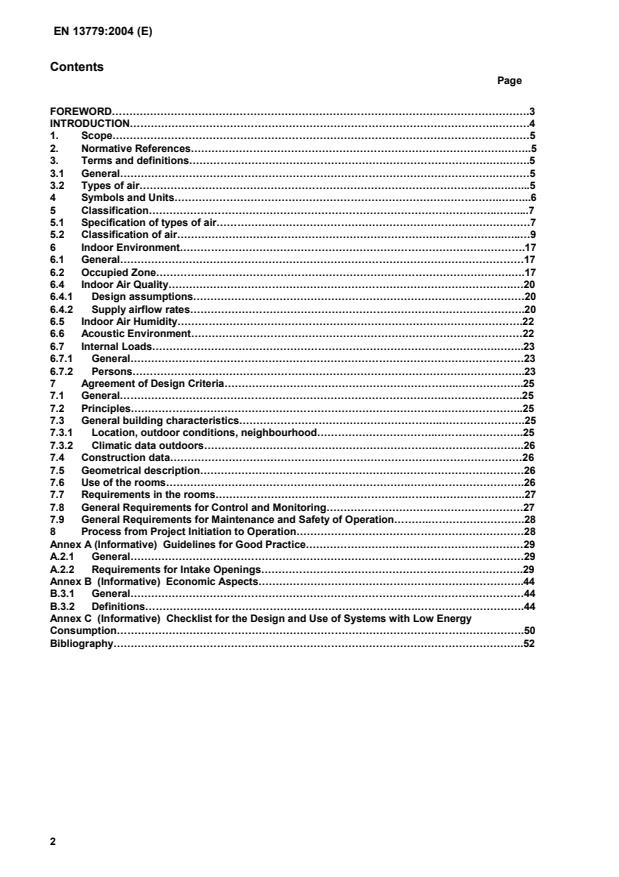
Page
FOREWORD………………………………………………………………………………………………………….3 INTRODUCTION…………………………………………………………………………………………….……….4 1. Scope………………………………………………………………………………………………….………5 2. Normative References……………………………………………………………………………….…….5 3. Terms and definitions…………………………………………………………………………….….…….5 3.1 General……………………………………………………………………………………………….….……5 3.2 Types of air……………………………………………………………………………………….….….….5 4 Symbols and Units………………………………………………………………………………….….….6 5 Classification……………………………………………………………………………………….…….7 5.1 Specification of types of air……………………………………………………………………….………7 5.2 Classification of air………………………………………………………………………………….….…9 6 Indoor Environment……………………………………………………………………………………….17 6.1 General………………………………………………………………………………………………………17 6.2 Occupied Zone………………………………………………………………………………………….….17 6.4 Indoor Air Quality……………………………………………………………………………………….…20 6.4.1 Design assumptions……………………………………………………………………………………20 6.4.2
Supply airflow rates…………………………………………………………………………………….20 6.5 Indoor Air Humidity……………………………………………………………………………………….22 6.6 Acoustic Environment……………………………………………………………………………………22 6.7 Internal Loads……………………………………………………………………………………….…….23 6.7.1 General……………………………………………………………………………………………………23 6.7.2 Persons…………………………………………………………………………………….…………….23 7 Agreement of Design Criteria………………………………………………………….……………….25 7.1 General………………………………………………………………………………….………………….25 7.2 Principles……………………………………………………………………………….………………….25 7.3 General building characteristics………………………………………………….…………………….25 7.3.1 Location, outdoor conditions, neighbourhood…………………………….…………………….25 7.3.2 Climatic data outdoors………………………………………………………….…………………….26 7.4 Construction data…………………………………………………………………………………………26 7.5 Geometrical description………………………………………………….………………………………26 7.6
Use of the rooms…………………………………………………………….…………………………….26 7.7 Requirements in the rooms……………………………………………….…………………………….27 7.8 General Requirements for Control and Monitoring…………………………………………………27 7.9 General Requirements for Maintenance and Safety of Operation……….……………………….28 8 Process from Project Initiation to Operation…………………………………………………………28 Annex A (Informative)
Guidelines for Good Practice………………………………………………………29 A.2.1 General……………………………………………………………………………………………………29 A.2.2 Requirements for Intake Openings………………………………………………………………….29 Annex B
(Informative)
Economic Aspects………………………………………………………………….44 B.3.1 General……………………………………………………………………………………………………44 B.3.2 Definitions…………………………………………………………………….………………………….44 Annex C
(Informative)
Checklist for the Design and Use of Systems with Low Energy Consumption……………………………………………………………………………………………………….50 Bibliography……………………………………………………………………………………………………….52
is the ventilation effectiveness
cEHA
is the pollution concentration in the exhaust air
cIDA is the pollution concentration in the indoor air (breathing zone within in the occupied zone)
cSUP
is the pollution concentration in the supply air The ventilation effectiveness depends on the air distribution and the kind and location of the air pollution sources in the space. It may therefore have different values for different pollutants. If there is complete mixing of air and pollutants, the ventilation effectiveness is one. Further information on ventilation effectiveness is given in CR 1752. NOTE: Another term frequently used for the same concept is “contaminant removal effectiveness”. 3.5 Specific fan power The specific power of each fan is defined as totvSFPpη∆==qPP (2) where PSFP
is the specific fan power in W.m-3.s
P
is the input power of the motor for the fan in W
qv
is the nominal airflow through the fan in m3.s-1
∆p is the total pressure difference across the fan
ηtot is the total efficiency of fan, motor and drive in the built-in situation. The coefficient is valid for the nominal airflow with clean filter conditions any bypasses closed. It is related to an air density of 1,2 kg.m-3. 4 Symbols and Units For the purposes of this document, the symbols and units given in Table 1 shall apply. The units in brack-ets are also in use.
Symbols and units Quantity Symbol Unit Pressure difference ∆p pa Temperature difference ∆θ K Ventilation effectiveness εv - Celsius temperature θ (theta) °C Air temperature in the room θa (theta) °C Mean radiant temperature θr (theta) °C Operative temperature
θo (theta) °C Density ρ (rho) kg.m-3 Heat or cooling load Φ (phi) W (kW) Area A m2 Costs C € * Concentration c mg.m-3 Specific heat capacity at constant pressure cp J.kg-1.K-1 Diameter d m Energy consumption (measured) E J (MJ, GJ) Energy demand (calculated) E J (MJ, GJ) Specific leakage f l.s-1.m-2 Present value factor fpv - Height h m Initial Investment I € * Thermal insulation of clothing Icl clo Length L m Metabolic rate (activity) M met Life span n years nL50-value nL50 h-1 Power P W Specific fan power PSFP W.m-3.s Present value PV € * Pressure p Pa Mass flow rate qm kg.s-1 Volume flow rate qv m3.s-1 (l.s-1, m3.h-1) Interest rate r - Time t s (h) Volume V m3 Air velocity v m.s-1 * Or National currency 5 Classification
5.1 Specification of types of air The types of air in a building and in a ventilation or air-conditioning system are specified in Table 2 and il-lustrated in Figure 1. The abbreviations and colours given in Table 2 shall be used to mark the type of air in drawings of ventilation or air-conditioning systems. The abbreviations can also be helpful for the label-ling of system parts. Where there is a free choice of the language, the use of English is recommended. The colour code of the supply air is chosen according to the system-controlled functions in accordance with Table 15.
Specification of types of air No. (in Figure 1) Type of air AbbreviationColour Definition 1 Outdoor air Aussenluft Air neuf ODA AUL ANF Green Air entering the system or opening from outdoors before any air treatment 2 Supply air Zuluft Air fourni SUP ZUL FOU See Table 13 Airflow entering the treated room, or air entering the system after any treatment 3 Indoor air Raumluft Air intérieur IDA RAL INT Grey Air in the treated room or zone 4 Transferred airÜberströmluft Air transféré TRA ÜSL TRA Grey Indoor air which passes from the treated room to another treated room
5 Extract air Abluft Air repris ETA ABL REP Yellow The airflow leaving the treated room
6 Recirculation airUmluft Air recyclé RCA UML REC Orange Extract air that is returned to the air treatment system
7 Exhaust air Fortluft Air rejeté EHA FOL RJT Brown Airflow discharged to the atmosphere. 8 Secondary air Sekundärluft Air brassé SEC SEK BRA Orange Airflow taken from a room and returned to the same room after any treatment (example: fan coil unit) 9 Leakage Leckluft Fuites LEA LEC FUI Grey Unintended airflow through leakage paths in the system 10 Infiltration Infiltration Infiltration INF INF INF Green Leakage of air into building through leakage paths in elements of structure separating it from the outdoor air
11 Exfiltration Exfiltration Exfiltration EXF EXF EXF Grey Leakage of air out of building through leakage paths in elements of structure separating it from the outdoor air
12 Mixed air Mischluft Air mélangé MIA MIL MEL Streams withseparate colours Air which contains two or more streams of air
Classification of extract air (ETA) Category Description Examples of where air in each category would be found (informative)
Extract air with low pollution level ETA 1 Air from rooms where the main emission sources are the building materials and struc-tures, and air from occupied rooms, where the main emission sources are human me-tabolism and building materials and struc-tures. Rooms where smoking is allowed are excluded. Offices, including integrated small storage rooms, spaces for public service, classrooms, stairways, corridors, meeting rooms, com-mercial spaces with no additional emission sources.
Extract air with moderate pollution level ETA 2 Air from occupied rooms, which contains more impurities than category 1 from the same sources and/or also from human ac-tivities. Rooms which shall otherwise fall in category ETA 1 but where smoking is al-lowed. Lunchrooms, kitchens for preparing hot drinks, stores, storage spaces in office build-ings, hotel rooms, dressing rooms.
Extract air with high pollution level ETA 3 Air from rooms where emitted moisture, processes, chemicals etc. substantially re-duce the quality of the air. Toilets and wash rooms, saunas, kitchens, some chemistry laboratories, copying plants, rooms specially designed for smokers.
Extract air with very high pollution level ETA 4 Air which contains odours and impurities det-rimental to health in significantly higher con-centrations than those allowed for indoor air in occupied zones. Exhaust hoods in professional use, grills and local kitchen exhausts, garages and drive tunnels, car parks, rooms for handling paints and solvents, rooms for unwashed laundry, rooms for foodstuff waste, central vacuum cleaning systems, heavily used smoking rooms and certain chemistry laboratories.
Table 4
Classification of exhaust air (EHA) Category Description Examples (informative) EHA 1 Exhaust air with low pollution level
Equivalent to ETA 1 see ETA 1 EHA 2 Exhaust air with moderate pollution level
Equivalent to ETA 2 see ETA 2 EHA 3 Exhaust air with high pollution level
Equivalent to ETA 3 see ETA 3 EHA 4 Exhaust air with very high pollution level
Equivalent to ETA 4 see ETA 4 5.2.3 Outdoor Air In the process of system design, consideration needs to be given to the quality of the outdoor air around the building or proposed location of the building. In the design, there are two main options for mitigating the effects of poor outdoor air on the indoor environment: • siting air intakes where the outdoor air is least polluted (if the outdoor air pollution is not uniform around the building) – see Annex A.2; • employing some form of air cleaning - see A.3.
With respect to the application in this document the outdoor air is classified as in Table 5. Table 5
Classification of outdoor air (ODA) Category Description ODA 1 Pure air which may be only temporarily dusty (e.g. pollen) ODA 2 Outdoor air with high concentrations of particulate matter ODA 3 Outdoor air with high concentrations of gaseous pollutants ODA 4 Outdoor air with high concentrations of gaseous pollutants and particulate matter ODA 5 Outdoor air with very high concentrations of gaseous pollutants or particulate matter The classification is made according to the most critical gaseous pollutant and particulate matter (includ-ing all kinds of solid particles and salty mist). Air is called “pure”, when the WHO (1999) guidelines and any National air quality standards or regulations for the relevant substances in the outside air are fulfilled. Concentrations are called “high”, when they exceed the above mentioned requirements by a factor of up to 1.5. Concentrations are called “very high”, when they exceed the requirements by a factor higher than 1.5. Since there are not guidelines of regulations for all pollutants, and those that do exist are not uniform be-tween nations, informed interpretation is required on the part of the designer. The potential impact of mix-tures of pollutants, not just individual pollutants, should be considered.
Typical gaseous pollutants to be considered in the evaluation of the outdoor air for the design of ventilation and room-conditioning systems are carbon monoxide, carbon dioxide, sulphur dioxide, oxides of nitrogen and volatile organic compounds (VOCs – e.g. benzene, solvents and polyaromatic hydrocarbons). The in-door impact of such outdoor pollutants will depend on how reactive they are. Carbon monoxide, for exam-ple, is relatively stable and subject to little adsorption by indoor surfaces. In contrast, ozone in the outdoor air is usually not relevant for the design of the system as ozone is highly reactive and its concentration de-creases very rapidly in the ventilation system and in the room. Other gaseous pollutants are mostly inter-mediate between these extremes. Particulate matter refers to the total amount of solid or liquid particles in the air, from the visible dust to submicron particles. Most outdoor air guidelines refer to PM10 (particulate matter with an aerodynamic di-ameter up to 10 µm) but there is growing acceptance that, for the purpose of health protection, greater emphasis should be placed on smaller particles. Where biological particles need to be considered, PM10 guidelines are not relevant and the more important consideration is the immunological or infectious hazard represented by the particles.
As a general guide, examples of levels of outdoor air quality are given in Table 6.
Table 6
Examples of pollutant concentrations in outdoor air Concentration Description of location CO2 ppm CO mg m-3 NO2 µg m-3 SO2 µg m-3 Total PM mg m-3 PM10 µg m-3 Rural area; no significant sources 350 < 1 5 to 35 < 5 < 0.1 < 20 Smaller town 375 1 to 3 15 to 40 5 to 15 0,1 – 0,3 10 to 30 Polluted city centre 400 2 to 6 30 to 80 10 to 50 0,2 – 1,0 20 to 50 NOTE: The given values for the air pollutants are annual concentrations and should not be used for the design of systems. Maximum concentrations are higher. For further information, use local measurements and national guidelines.
Classification of supply air (SUP) Category Description SUP 1 Supply air which contains only outdoor air SUP 2 Supply air which contains outdoor air and recirculation air NOTE: Recirculation air can be mixed to the supply air on purpose or by leakage. Special attention has to be paid to the situation in heat exchangers. The quality of the supply air for buildings subject to human occupancy shall be such that, taking into ac-count the expected emissions from indoor sources (human metabolism, activities and processes, building materials, furniture) and from the ventilation system itself, the proper indoor air quality will be achieved.
In order to avoid misunderstandings, it is recommended to define the quality of the supply air not only by using the classification given in Table 7, but also by specifying the concentration limits that will apply to named pollutants in the indoor air. Therefore a declaration of the expected emissions from indoor sources is also needed and, wherever possible, this should be related to concentration limits and emission stan-dards. 5.2.5 Indoor Air 5.2.5.1 General The basic classification of indoor air is given in Table 8. This classification applies to the indoor air in the occupied zone. Table 8
Basic classification of indoor air quality (IDA) Category Description IDA 1 High indoor air quality IDA 2 Medium indoor air quality IDA 3 Moderate indoor air quality IDA 4 Low indoor air quality The exact definition of categories such as these will depend on the nature of the pollutant sources that are to be taken into account, and on the effects of these pollutants. For example, pollutant sources may be: • localised in space or distributed through a building; • continuous or intermittent emitters; • emitters of particles (inorganic, viable or other organic) or gases/vapours (organic or inorganic). The effects can be considered in terms of perception of air quality (by adapted or unadapted persons) or of health effects such as mucous membrane irritation, toxic effects, infection, allergic reactions or carcino-genesis. These effects may depend on the persons exposed, e.g. whether they are healthy adults, chil-dren or hospital patients. Hence, a complete definition of indoor air quality categories is difficult and outside the scope of this docu-ment. However, for practical applications the four categories of indoor air quality shall be quantified by one of the methods given in 5.2.5.2 to 5.2.5.6. The choice of the method is free but shall be adapted to the use of the room and the requirements. The different methods lead for the same category of indoor air quality not necessarily to the same quantity of supply air. In special cases other methods than described below may be used to quantify the IAQ. 5.2.5.2 Classification by CO2-level Current research and practice would suggest that IAQ could be categorised by CO2 concentration, as shown in Table 9. CO2 is a good indicator for the emission of human bioeffluents. Classification by the CO2-level is well established for occupied rooms, where smoking is not allowed and pollution is caused
CO2-level in rooms CO2-level above level of outdoor air in ppm Categorie Typical range Default value IDA 1 ≤ 400
350 IDA 2 400 – 600
500 IDA 3 600 – 1,000
800 IDA 4 > 1,000 1,200 The CO2-based categories would be nominally equivalent to outdoor airflow rates as shown in Table 11. 5.2.5.3 Classification by the perceived air quality in decipols This method of classification is described in CR 1752. It is applicable to occupied rooms with no risk of non-perceivable hazardous air pollutants such as CO, Radon etc. Typical specifications are as follows: Table 10 Perceived air quality in the occupied zone Perceived air quality in decipols Categorie Typical range Default value IDA 1 ≤ 1,0 0,8 IDA 2 1,0 – 1,4 1,2 IDA 3 1,4 – 2,5 2,0 IDA 4 > 2,5 3,0 The method is not yet fully accepted and difficult to use in practice. Therefore it should only be used in ap-plications where all the necessary information about the emission rates is available. An estimation is given in CR 1752. 5.2.5.4 Indirect Classification by the rate of outdoor air per person This method is a well-based practical method for all situations where the rooms serve for typical human occupancy. The rates of outdoor air (supplied by the ventilation system) per person in case of normal work in an office or at home with a metabolic rate of about 1,2 met are given in Table 11. These values are of-ten used to design the system. The values must be fulfilled in the occupied zone. The rates given for non-smoking areas take into consideration the human metabolism as well as typical emissions in low-polluting buildings. In cases with high activity levels (met >1,2), the outdoor rates should be increased by a factor of met/1,2.
Rates of outdoor air per person Rate of outdoor air per person Non-smoking area Smoking area Category Unit Typical range Default value Typical range Default value IDA 1
m3.h-1.person-1 l.s-1.person-1 > 54 > 15 72 20 > 108 >
30 144 40 IDA 2
m3.h-1.person-1 l.s-1.person-1 36 - 54 10 – 15 45
12,5 72 - 108 20 -
30 90 25 IDA 3
m3.h-1.person-1 l.s-1.person-1 22 - 36
6 – 10 29
8 43 - 72 12 - 20 58 16 IDA 4
m3.h-1.person-1 l.s-1.person-1 < 22 <
6 18
5 < 43 < 12 36 10 The selection of non- or low-polluting materials for the building is strongly recommended, including fur-nishing, carpets and the ventilation or air-conditioning system itself, rather than increasing the rate of out-door air in order to dilute these avoidable emissions.
The rates given for smoking areas are valid for areas where smoking is allowed. It is recommended to de-fine smoking and non-smoking areas and to adapt the system to the situation.
5.2.5.5 Indirect Classification by the air flow rate per floor area This method can in some cases be used to design a system for rooms which are not for human occu-pancy and which do not have a clearly defined use (for example storage rooms). The rates of air flow rates per unit floor area are given in Table 12. These are based on a running time of 50 % and room heights up to 3 m. With shorter running time and for higher rooms the air flow rate should be higher. Table 12 Rates of outdoor or transferred air per unit floor area (net area) for rooms not designed for human occupancy Unit Rate of outdoor or transferred air per unit floor area Category
Typical range Default value IDA 1 m3.h-1.m-2 l.s-1.m-2 * * * * IDA 2 m3.h-1.m-2 l.s-1.m-2 > 2,5 > 0,7 3 0,83 IDA 3 m3.h-1.m-2 l.s-1.m-2 1,3 – 2,5 0,35 – 0,7 2 0,55 IDA 4 m3.h-1.m-2 l.s-1.m-2 < 1,3 < 0,35 1 0,28 * For IDA 1 this method is not sufficient
5.2.5.6 Classification by concentration levels for specific pollutants This method of classification is suitable for situations with significant emissions of specific pollutants. If there is sufficient information about all the indoor emissions, then ventilation rate requirements can be cal-culated as shown in 6.4.2.3. Where the emission rates are not known, the required air quality can also be indirectly specified by the ventilation rate based on experience. 5.3 System Tasks and Basic System Types Ventilation, air-conditioning and room-conditioning systems are intended to control the indoor air quality and the thermal and humidity conditions in the room to a specification that is agreed in advance. The specification of the indoor environment also has consequences for the price of the installation, the space
given in Table 13. Table 13 Possible types of control of the indoor air quality (IDA-C) Category Description IDA – C 1 No control
The system runs constantly. IDA – C 2 Manual control The system runs according to a manually controlled switch. IDA – C 3 Time control The system runs according to a given time schedule. IDA – C4 Occupancy control The system runs dependent on the presence (light switch, infrared sensors etc.) IDA – C5 Presence control (number of people) The system runs dependent on the number of people in the space. IDA – C 6 Direct control The system is controlled by sensors measuring indoor air parameters or adapted cri-teria (e.g. CO2, mixed gas or VOC sensors). The used parameters shall be adapted to the kind of activity in the space. Whichever control system is used (including manual control), better performance can generally be achieved by using some form of proactive control. This might mean, for example, tracking the build-up of pollutants and increasing the ventilation rate by a modest amount before a limiting concentration is ex-ceeded, rather than having a large increase in ventilation after the limiting concentration has been ex-ceeded. The thermal environment in a room can be controlled by the ventilation system alone or in combination with other means such as cooled/heated ceilings, floors etc. Based on this, the two basic system types given in Table 14 are used. Table 14 Basic system types according to the means of controlling the thermal environment in a room Description Name of the system type Controlled by the ventilation system alone All air system Controlled by the ventilation system in combination with other means (e.g. heating appliances, chilled ceilings, radiators). Mixed system
Possible treatments of the air to change the hygrothermal environment are: heating, cooling, humidifica-tion and dehumidification. For the purpose of classification, a function is valid only where the system is able to control this function in such a way that the given boundary conditions in the room can be met. This means, for instance, that uncontrolled dehumidification in a cooling unit is not counted as dehumidification in the above-mentioned way. The definitions of the basic system types according to the ability to control the temperature and moisture content in the room are given in Table 15.
Violet Key
- Not influenced by the system x Controlled by the system and guaranteed in the room (x) Effected by the system but not guaranteed in the room Category THM-C5 shall be claimed only when controlled dehumidification is needed. 5.4 Pressure Conditions in the Room In order to control the flow direction and the distribution of emissions between areas of the building and/or with the outside, pressure conditions are created by means of different supply and extract airflows. Possi-ble categories for pressure conditions are as given in Table 16. Table 16 Pressure conditions in the room Category Description (situation with no wind and no stack effect) PC 1 PC 2 PC 3 PC 4 PC 5
Underpressure (≤ -6 Pa)
Slight underpressure (-2 to -6 Pa)
Balanced (-2 to +2 Pa ) = default situation
Slight overpressure (2 to 6 Pa)
Overpressure (> 6 Pa) The choice of pressure level depends on the specific application. In some cases more than one level of under- or overpressure is required to control the airflow between all areas of the building. When the re-quired pressure levels are to be achieved with a wind, the building envelope shall be airtight according to A.9. Usually the proposed directions of flow in undisturbed conditions are specified and not the defined pressure levels. In cold climates overpressure in the building can cause damages to the construction.
When nothing is declared, category PC 3 shall be adopted. 5.5 Specific fan power The classification of the specific fan power (for each fan) is as given in Table 17 (classification per fan). When nothing is declared, the default values in Table A.3 shall be applied.
Category PSFP in W.m-3.s SFP 1 SFP 2 SFP 3 SFP 4 SFP 5 < 500 500 – 750 750 – 1,250 1,250 – 2,000 > 2,000 6 Indoor Environment 6.1 General
Ventilation, air-conditioning or room-conditioning systems influence the following parameters:
• thermal environment • indoor air quality • indoor air humidity • acoustic environment. However, it is important to realise that the comfort and the performance of persons in a room is also de-pendent on other influences such as: • type of work and configuration of working place • lighting and colours • size of room, furniture • view to the outside • working conditions and working relationships • individual factors. The design assumptions for the indoor environment are based on agreements between the client and the designer. Typical design assumptions are given in 6.3 to 6.7 and further guidance on air quality is given in 5.2. The agreed requirements for the thermal environment, indoor air quality, indoor air humidity and the acoustic environment shall be met in the occupied zone as defined in 6.2. A system shall be designed for the specific needs of the project.
6.2 Occupied Zone The requirements for the indoor environment shall be satisfied in the occupied zone. This means that all measurements dealing with comfort criteria shall be related to this zone. The total area of a room can be used to evaluate the requirements, but the comfort criteria are not guaranteed beyond the occupied zone. Typical dimensions for the occupied zone are given in Table 18 and indicated in Figure 2. Table 18 Dimensions for the occupied zone Distance from the inner surface of Typical range (m) Default value (m) Floors (lower boundary) A Floors (upper boundary) B External windows and doors C HVAC appliances D External walls E Internal walls F Doors, transit zones etc. G 000 to 0,20
1,30 to 2,00
0,50 to 1,50
0,50 to 1,50
0,15 to 0,75
0,15 to 0,75
Special agreement 0,05
1,80
1,00
1,00
0,50
0,50
-
Vertical section
Plan view Figure 2 Description of the occupied zone Where external walls with windows or doors are considered, the element with the largest distance is taken as valid for the whole surface. It should be recognised that in rooms with low ceilings (room height below 2,5 m) it could be difficult to meet the requirements to an upper boundary of 2,0 m. Special agreements should also be considered for the following types of zone, in which it could be difficult to meet the requirements to the thermal environment, especially with respect to draught and temperature:
a) transit zones b) zones close to doors that are often used or open
c) zones close to supply air terminals d) zones close to units with high heat production or airflow rate. Except when indicated or agreed otherwise, zones a) and b) are not considered part of the occupied zone, but zones c) and d) are considered part of the occupied zone. If the use of a room is not based on the room dimensions but on other factors, the occupied zone can be defined according to the arrangement of working areas and equipment therein or by the location of the breathing zone, as agreed between designer and client. 6.3 Thermal Environment 6.3.1 General The following statements are based on EN ISO 7730 and are valid for typical applications such as office buildings etc. 6.3.2 Design assumptions The most important design assumptions with respect to the thermal environment are the clothing and the activity of the occupants. Typical values for office buildings or similar working places for sedentary activi-ties are shown in Table 19.
Table 19 Design assumptions for clothing and activity in office buildings Parameter Typical range (clo) Default value for design Clothing
Summer: 0,5 to 0,7
Winter: 0,8 to 1,0
Summer: 0,5 clo
Winter: 1,0 clo Activity (see Table 25) 1,0 to 1,4 met 1,2 met The heat exchange of the human body by radiation is dependent on the temperature of the surrounding surfaces, and the heat exchange by convection is dependent on the air temperature and air velocity.
Basic information on these aspects is given in EN ISO 7730, EN ISO 8990 and prEN ISO 9920. 6.3.3 Air temperature and operative temperature In most of the applications in the scope of this document there are low velocities (< 0,2 m.s-1) and small differences between the air temperature and the mean radiant temperature in the room (< 4°C). Therefore in this document the operative temperature at a given location in the room is defined as 2raoθθθ+=
(3) where
θ0 is the operative temperature at the considered location in the room
θa is the air temperature in the room
θr is the mean radiant temperature of all surfaces (walls, floor, ceiling, windows, radiators etc.) with respect to the considered location in the room. Further information about the operative temperature is given in EN ISO 7726 and EN ISO 7730. Considering the default values for office buildings according to Table 19, the optimal operative tempera-ture is 24,5°C for summer conditions and 21,5°C for winter conditions. Wherever possible, the designer should use design values for the actual building under consideration and not rely on default values or ta-bles of typical values. The designer should also take into account that temperature requirements will de-pend on the adaptation of the users, for example by choice of clothing clo values and looseness of fit. This varies markedly with the usual outdoor climate, and therefore regional knowledge of conditions that result in thermal comfort may be applied. Local regulations take priority. However, except where agreed other-wise, the design of the system shall be based on the values given in Table 20.
Table 20 Design values for the operative temperature in office buildings Situation Typical range (°C) Default value for design (°C) Wintertime with heating θ0 = 19 to 24 θ0 = 21 1) Summertime with cooling θ0 = 23 to 26 θ0 = 26 2) 1) At design conditions for wintertime. Minimum temperature during the day. 2) At design conditions for summertime. Maximum temperature during the day. Except where agreed otherwise, the specified operative temperature shall apply to a location in the centre of the room at a height of 0,6 m above the floor.
On the basis of agreed design values, the designer and client may agree a proportion of time that the de-sign values may be exceeded (e.g. hours per day or days per year). 6.3.4 Air velocities and draught rate The acceptable mean air velocity is dependent on the draught rate (percentage of people dissatisfied due to draught) the air temperature and the turbulence intensity. This correlation is described in EN ISO 7730 and CR 1752 as follows: )14,337,0()05,0()34(62,0+××−−=TUvvDRaθ (4) where
DR is the draught rate in %
θa is the local air temperature in °C (19°C– 27°C)
v is the local mean air velocity in m s-1
TU is the local turbulence intensity in % (30% to 60% with mixing flow air distribution) With no specific agreement, based on the above mentioned principles, the design room air temperatures according to 6.3.3, a draught rate of 10% to 20% and assuming a turbulence intensity of 40% (mixed air ventilation), the values given in Table 21 can be used.
With individual control of airflow or in restricted times with intensive ventilation, higher values are allowed. The agreed values shall be fulfilled in all situations with normal operation. This requires that the system with its terminal devices be designed accordingly. 6.4 Indoor Air Quality 6.4.1 Design assumptions The most important design assumptions with respect to the indoor air quality are information about the human occupancy, whether smoking is allowed or not, and emissions from sources other than human me-tabolism and smoking. It should also be taken into account that air quality is likely to be perceived more negatively as temperature and humidity increase. Typical values for human occupancy are given in Table 22. The design shall be based whenever possible on the real data for the project. However, if no values are declared, the default values given in Table 22 shall be applied. If no information in respect of smoking is declared, it shall be assumed that, in all kinds of use given in Table 22, smoking is not allowed. When smoking is allowed, it is strongly recommended to clearly distinguish between smoking and non-smoking areas. Table 22 Design assumptions for floor area per person Floor area per person in m2.person-1 *) Kind of use Typical range Default value Landscaped office room Small office room Meeting room Department store Classroom Hospital ward Hotel bedroom Restaurant 7 8 2 3 2 5 5 1,2 totototototototo 20 12 5 8 5 15 20 5 12 10 3,0 4,0 2,5 10 10 1,5 *) Net floor-area per room Emissions from sources other than human metabolism and smoking shall be specified as clearly as pos-sible. If nothing is declared, it has to be clarified with the client, that no further emissions must be taken into consideration. 6.4.2
Supply airflow rates 6.4.2.1 General The ventilation rate (outdoor and supply airflow rate) shall be determined using the following criteria: • human occupancy with or without smoking • other known emissions
• heating or cooling load that shall be dissipated by ventilation. In order to prevent uncontrolled loss of supply air, the duc
...