

EN 15251:2007
(Main)Indoor environmental input parameters for design and assessment of energy performance of buildings addressing indoor air quality, thermal environment, lighting and acoustics
- Abstract
- This European Standard specifies the indoor environmental parameters which have an impact on the energy performance of buildings.
- The standard specifies how to establish indoor environmental input parameters for building system design and energy performance calculations.
- The standard specifies methods for long term evaluation of the indoor environment obtained as a result of calculations or measurements.
- The standard specifies criteria for measurements which can be used if required to measure compliance by inspection.
- The standard identifies parameters to be used by monitoring and displaying the indoor environment in existing buildings.
- This standard is applicable mainly in non-industrial buildings where the criteria for indoor environment are set by human occupancy and where the production or process does not have a major impact on indoor environment. The standard is thus applicable to the following building types: single family houses, apartment buildings, offices, educational buildings, hospitals, hotels and restaurants, sports facilities, wholesale and retail trade service buildings.
- The standard specifies how different categories of criteria for the indoor environment can be used. But does not require certain criteria to be used. This is up to national regulations or individual project specifications.
- The recommended criteria in this standard can also be used in national calculation methods, which may be different to the methods referred to here.
- The standard does not prescribe design methods, but give input parameters to the design of buildings, heating, cooling, ventilation and lighting systems.
The standard does not include criteria for local discomfort factors like draught, radiant temperature asymmetry, vertical air temperature differences and floor surface temperatures.
- Status
- Withdrawn
- Publication Date
- 15-May-2007
- Withdrawal Date
- 13-Oct-2026
- Technical Committee
- CEN/TC 156 - Ventilation for buildings
- Drafting Committee
- CEN/TC 156 - Ventilation for buildings
- Current Stage
- 9960 - Withdrawal effective - Withdrawal
- Start Date
- 01-May-2019
- Completion Date
- 14-Oct-2026

Relations
- Effective Date
- 08-May-2019
- Effective Date
- 14-Oct-2026
- Effective Date
- 25-Aug-2026
- Effective Date
- 28-Jan-2026
- Effective Date
- 28-Jan-2026
- Effective Date
- 28-Jan-2026
- Effective Date
- 28-Jan-2026
- Effective Date
- 28-Jan-2026
- Effective Date
- 28-Jan-2026
- Effective Date
- 28-Jan-2026
- Effective Date
- 28-Jan-2026
- Effective Date
- 28-Jan-2026
- Effective Date
- 28-Jan-2026
- Effective Date
- 28-Jan-2026
- Refers
EN ISO 13731:2001 - Ergonomics of the thermal environment - Vocabulary and symbols (ISO 13731:2001) - Effective Date
- 28-Jan-2026
Get Certified
Connect with accredited certification bodies for this standard

DIBt (Deutsches Institut für Bautechnik)
German Institute for Building Technology.
DIN CERTCO
DIN Group product certification.

Aboma Certification B.V.
Specialized in construction, metal, and transport sectors.
Sponsored listings
Frequently Asked Questions
EN 15251:2007 is a standard published by the European Committee for Standardization (CEN). Its full title is "Indoor environmental input parameters for design and assessment of energy performance of buildings addressing indoor air quality, thermal environment, lighting and acoustics". This standard covers: - This European Standard specifies the indoor environmental parameters which have an impact on the energy performance of buildings. - The standard specifies how to establish indoor environmental input parameters for building system design and energy performance calculations. - The standard specifies methods for long term evaluation of the indoor environment obtained as a result of calculations or measurements. - The standard specifies criteria for measurements which can be used if required to measure compliance by inspection. - The standard identifies parameters to be used by monitoring and displaying the indoor environment in existing buildings. - This standard is applicable mainly in non-industrial buildings where the criteria for indoor environment are set by human occupancy and where the production or process does not have a major impact on indoor environment. The standard is thus applicable to the following building types: single family houses, apartment buildings, offices, educational buildings, hospitals, hotels and restaurants, sports facilities, wholesale and retail trade service buildings. - The standard specifies how different categories of criteria for the indoor environment can be used. But does not require certain criteria to be used. This is up to national regulations or individual project specifications. - The recommended criteria in this standard can also be used in national calculation methods, which may be different to the methods referred to here. - The standard does not prescribe design methods, but give input parameters to the design of buildings, heating, cooling, ventilation and lighting systems. The standard does not include criteria for local discomfort factors like draught, radiant temperature asymmetry, vertical air temperature differences and floor surface temperatures.
- This European Standard specifies the indoor environmental parameters which have an impact on the energy performance of buildings. - The standard specifies how to establish indoor environmental input parameters for building system design and energy performance calculations. - The standard specifies methods for long term evaluation of the indoor environment obtained as a result of calculations or measurements. - The standard specifies criteria for measurements which can be used if required to measure compliance by inspection. - The standard identifies parameters to be used by monitoring and displaying the indoor environment in existing buildings. - This standard is applicable mainly in non-industrial buildings where the criteria for indoor environment are set by human occupancy and where the production or process does not have a major impact on indoor environment. The standard is thus applicable to the following building types: single family houses, apartment buildings, offices, educational buildings, hospitals, hotels and restaurants, sports facilities, wholesale and retail trade service buildings. - The standard specifies how different categories of criteria for the indoor environment can be used. But does not require certain criteria to be used. This is up to national regulations or individual project specifications. - The recommended criteria in this standard can also be used in national calculation methods, which may be different to the methods referred to here. - The standard does not prescribe design methods, but give input parameters to the design of buildings, heating, cooling, ventilation and lighting systems. The standard does not include criteria for local discomfort factors like draught, radiant temperature asymmetry, vertical air temperature differences and floor surface temperatures.
EN 15251:2007 is classified under the following ICS (International Classification for Standards) categories: 91.140.01 - Installations in buildings in general. The ICS classification helps identify the subject area and facilitates finding related standards.
EN 15251:2007 has the following relationships with other standards: It is inter standard links to EN 16798-1:2019, EN 12599:2026, ISO/TS 14415:2005, EN 12831-1:2017, EN 15193-1:2017+A1:2021, EN 16798-5-1:2017, EN ISO 8996:2021, EN ISO 7726:2025, EN 16798-5-2:2017, EN 12792:2003, EN 16798-7:2017, EN 12464-1:2002, EN ISO 52017-1:2017, EN ISO 7730:2025, EN ISO 13731:2001. Understanding these relationships helps ensure you are using the most current and applicable version of the standard.
EN 15251:2007 is associated with the following European legislation: Standardization Mandates: M/343. When a standard is cited in the Official Journal of the European Union, products manufactured in conformity with it benefit from a presumption of conformity with the essential requirements of the corresponding EU directive or regulation.
EN 15251:2007 is available in PDF format for immediate download after purchase. The document can be added to your cart and obtained through the secure checkout process. Digital delivery ensures instant access to the complete standard document.
Standards Content (Sample)
2003-01.Slovenski inštitut za standardizacijo. Razmnoževanje celote ali delov tega standarda ni dovoljeno.Eingangsparameter für das Raumklima zur Auslegung und Bewertung der Energieeffizienz von Gebäuden - Raumluftqualität, Temperatur, Licht und AkustikCriteres pour l'environnement intérieur et évaluation des performances énergétiques des bâtiments couvrant la qualité d'air intérieur, la thermique, l'éclairage et l'acoustiqueIndoor environmental input parameters for design and assessment of energy performance of buildings addressing indoor air quality, thermal environment, lighting and acoustics91.040.01Stavbe na splošnoBuildings in generalICS:Ta slovenski standard je istoveten z:EN 15251:2007SIST EN 15251:2007en01-november-2007SIST EN 15251:2007SLOVENSKI
STANDARD
EUROPEAN STANDARDNORME EUROPÉENNEEUROPÄISCHE NORMEN 15251May 2007ICS 91.140.01 English VersionIndoor environmental input parameters for design andassessment of energy performance of buildings addressingindoor air quality, thermal environment, lighting and acousticsCritères pour l'environnement intérieur et évaluation desperformances énergétiques des bâtiments couvrant laqualité d'air intérieur, la thermique, l'éclairage etl'acoustiqueEingangsparameter für das Raumklima zur Auslegung undBewertung der Energieeffizienz von Gebäuden -Raumluftqualität, Temperatur, Licht und AkustikThis European Standard was approved by CEN on 26 March 2007.CEN members are bound to comply with the CEN/CENELEC Internal Regulations which stipulate the conditions for giving this EuropeanStandard the status of a national standard without any alteration. Up-to-date lists and bibliographical references concerning such nationalstandards may be obtained on application to the CEN Management Centre or to any CEN member.This European Standard exists in three official versions (English, French, German). A version in any other language made by translationunder the responsibility of a CEN member into its own language and notified to the CEN Management Centre has the same status as theofficial versions.CEN members are the national standards bodies of Austria, Belgium, Bulgaria, Cyprus, Czech Republic, Denmark, Estonia, Finland,France, Germany, Greece, Hungary, Iceland, Ireland, Italy, Latvia, Lithuania, Luxembourg, Malta, Netherlands, Norway, Poland, Portugal,Romania, Slovakia, Slovenia, Spain, Sweden, Switzerland and United Kingdom.EUROPEAN COMMITTEE FOR STANDARDIZATIONCOMITÉ EUROPÉEN DE NORMALISATIONEUROPÄISCHES KOMITEE FÜR NORMUNGManagement Centre: rue de Stassart, 36
B-1050 Brussels© 2007 CENAll rights of exploitation in any form and by any means reservedworldwide for CEN national Members.Ref. No. EN 15251:2007: ESIST EN 15251:2007
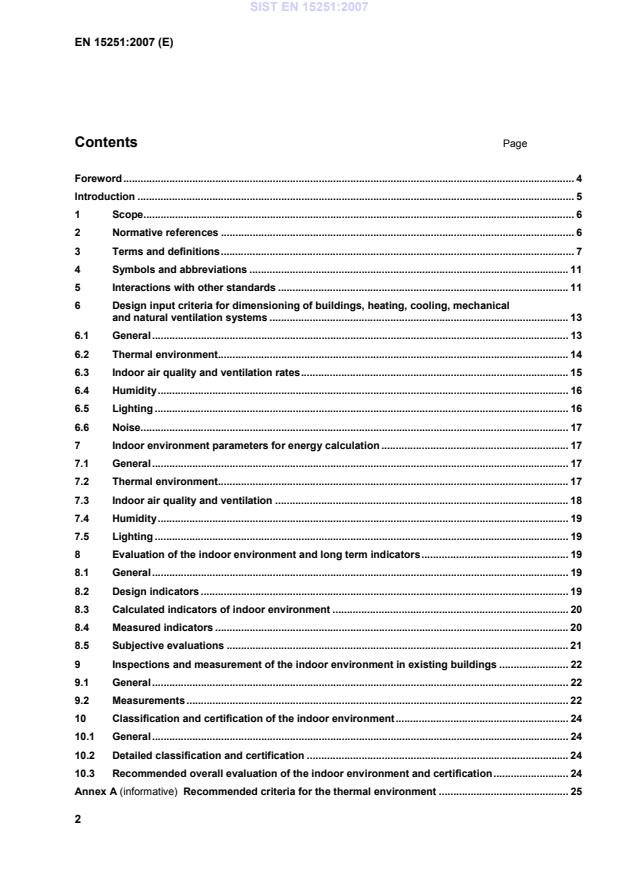
Recommended criteria for the thermal environment.25 SIST EN 15251:2007
Basis for the criteria for indoor air quality and ventilation rates.32 B.1 Recommended design ventilation rates in non-residential buildings.32 B.1.1 General.32 B.1.2 Method based on person and building component.32 B.1.3 Method based on ventilation rate per person or per m2 floor area.35 B.1.4 Recommended values of CO2 for energy calculation.36 B.2 Recommended design ventilation rates in residential buildings.36 B.3 Recommended criteria for dimensioning of humidification and de-humidification.38 B.4 Recommended ventilation during un-occupied hours.39 Annex C (informative)
Example on how to define low and very low polluting buildings.40 Annex D (informative)
Recommended criteria for lighting.41 Annex E (informative)
Indoor system noise criteria of some spaces and buildings.42 Annex F (informative)
Long term evaluation of the general thermal comfort conditions.43 Annex G (informative)
Recommended criteria for acceptable deviations.46 G.1 Building Category.46 G.2 Length of deviation.46 Annex H (informative)
Methodologies for subjective evaluations.47 Annex I (informative)
Examples of classification and certification of the indoor environment.48 I.1 The design criteria used.48 I.2 Whole year computer simulations of the indoor environment and energy performance.49 I.3 Long term measurement of selected parameters for the indoor environment.49 I.4 Subjective responses from occupants.49 Bibliography.51
Existing national regulations with or without reference to national standards, may restrict for the time being the implementation of the European Standards mentioned in this report. According to the CEN/CENELEC Internal Regulations, the national standards organizations of the following countries are bound to implement this European Standard: Austria, Belgium, Bulgaria, Cyprus, Czech Republic, Denmark, Estonia, Finland, France, Germany, Greece, Hungary, Iceland, Ireland, Italy, Latvia, Lithuania, Luxembourg, Malta, Netherlands, Norway, Poland, Portugal, Romania, Slovakia, Slovenia, Spain, Sweden, Switzerland and United Kingdom. SIST EN 15251:2007
• The standard specifies how to establish indoor environmental input parameters for building system design and energy performance calculations.
• The standard specifies methods for long term evaluation of the indoor environment obtained as a result of calculations or measurements.
• The standard specifies criteria for measurements which can be used if required to measure compliance by inspection. • The standard identifies parameters to be used by monitoring and displaying the indoor environment in existing buildings. • This standard is applicable mainly in non-industrial buildings where the criteria for indoor environment are set by human occupancy and where the production or process does not have a major impact on indoor environment. The standard is thus applicable to the following building types: single family houses, apartment buildings, offices, educational buildings, hospitals, hotels and restaurants, sports facilities, wholesale and retail trade service buildings.
• The standard specifies how different categories of criteria for the indoor environment can be used. But does not require certain criteria to be used. This is up to national regulations or individual project specifications. • The recommended criteria in this standard can also be used in national calculation methods, which may be different to the methods referred to here. • The standard does not prescribe design methods, but give input parameters to the design of buildings, heating, cooling, ventilation and lighting systems. • The standard does not include criteria for local discomfort factors like draught, radiant temperature asymmetry, vertical air temperature differences and floor surface temperatures. 2 Normative references The following referenced documents are indispensable for the application of this document. For dated references, only the edition cited applies. For undated references, the latest edition of the referenced document (including any amendments) applies. EN 12464-1 2002 Light and lighting — Lighting of work places — Part 1: Indoor work places EN 12599
Ventilation for buildings — Test procedures and measuring methods for handing over installed ventilation and air conditioning systems EN 12792 2003 Ventilation for buildings — Symbols, terminology and graphical symbols EN 12831
Heating systems in buildings — Method for calculation of the design heat load SIST EN 15251:2007
Energy performance of buildings — Energy requirements for lighting EN 15241
Ventilation for buildings — Calculation methods for energy losses due to ventilation and infiltration in commercial buildings EN 15242
Ventilation for buildings — Calculation methods for the determination of air flow rates in buildings including infiltration prEN 15255
Thermal performance of buildings — Sensible room cooling load calculation — General criteria and validation procedures prEN 15265
Thermal performance of buildings — Calculation of energy needs for space heating and cooling using dynamic methods — General criteria and validation procedures EN ISO 7726
Ergonomics of the thermal environment — Instruments for measuring physical quantities (ISO 7726:1998) EN ISO 7730
Ergonomics of the thermal environment — Analytical determination and interpretation of thermal comfort using calculation of the PMV and PPD indices and local thermal comfort criteria (ISO 7730:2005) EN ISO 8996
Ergonomics of the thermal environment — Determination of metabolic rate (ISO 8996:2004) EN ISO 9920
Ergonomics of the thermal environment — Estimation of the thermal insulation and evaporative resistance of a clothing ensemble (ISO 9920:1995) EN ISO 13731 2001 Ergonomics of the thermal environment — Vocabulary and symbols (ISO 13731:2001) EN ISO 13790
Thermal performance of buildings — Calculation of energy use for space heating (ISO 13790:2004) ISO/TS 14415
Ergonomics of the thermal environment — Application of International Standards to people with special requirements CIE 69
Methods of characterizing illuminance meters and luminance meters; performance, characteristics and specifications 3 Terms and definitions
For the purposes of this document, the terms and definitions given in EN 12792:2003, EN ISO 13731:2001, EN 12464-1:2002 and the following apply. 3.1
adaptation
physiological, psychological or behavioural adjustment of building occupants to the interior thermal environment in order to avoid discomfort NOTE In naturally ventilated buildings these are often in response to changes in indoor environment induced by outside weather conditions. SIST EN 15251:2007
active cooling
see mechanical cooling 3.3
buildings, very low-polluting buildings where an extraordinary effort has been done to select low-emitting materials and activities with emission of pollutants are prohibited and no previous emitting sources (like tobacco smoke) was present NOTE Criteria are listed in Annex G. 3.4
buildings, low-polluting buildings where an effort has been done to select low-emitting materials and activities with emission of pollutants are limited or prohibited NOTE Criteria are listed in Annex G 3.5
buildings, not low-polluting old or new buildings where no effort has been done to select low-emitting materials and activities with emission of pollutants not prohibited NOTE Previous emissions (like tobacco smoke) may have taken place. 3.6 buildings without mechanical cooling
buildings that do not have any mechanical cooling and rely on other techniques to reduce high indoor temperature during the warm season like moderately-sized windows, adequate sun shielding, use of building mass, natural ventilation, night time ventilation etc. for preventing overheating
3.7
cooling season
part of the year during which (at least parts of the day and part of the building, usually summer) cooling appliances are needed to keep the indoor temperatures at specified levels NOTE The length of the cooling season differs substantially from country to country and from region to region). 3.8
daylight factor (D) ratio of the illuminance at a point on a given indoor plane due to the light received directly or indirectly from the sky of assumed or known illuminance distribution, to the illuminance on a horizontal plane due to an unobstructed hemisphere of this sky. The contribution of direct sunlight to both illuminances is excluded
[EN 12665:2002] NOTE usually expressed as a percentage 3.9
demand controlled ventilation
ventilation system where the ventilation rate is controlled by air quality, moisture, occupancy or some other indicator for the need of ventilation SIST EN 15251:2007
3.11 external temperature, running mean exponentially weighted running mean of the daily mean external air temperature ,ed is such a series, and is calculated from the formula: ,rm = (1- α).{ ,ed -1 + α. ,ed -2 + α2 ,ed -3….}
(1)
This equation can be simplified to
,rm = (1- α),ed -1 + α. ,rm-1
(2)
Where
,rm = Running mean temperature for today ,rm-1 = Running mean temperature for previous day ,ed-1 is the daily mean external temperature for the previous day ,ed -2 is the daily mean external temperature for the day before and so on.
α is a constant between 0 and 1. Recommended to use 0,8
The following approximate equation can be used where records of daily mean external temperature are not available: ,rm = (,ed -1 + 0,8 ,ed -2 + 0,6 ,ed -3 + 0,5 ,ed -4 + 0,4 ,ed -5 + 0,3 ,ed -6 + 0,2 ,ed -7)/3,8
(3)
3.12
heating season
parts of the year during which (at least parts of the day and part of the building, usually winter) heating appliances are needed to keep the indoor temperatures at specified levels
NOTE The length of the heating season differs substantially from country to country and from region to region). 3.13
mechanical cooling
cooling of the indoor environment by mechanical means used to provide cooling of supply air, fan coil units, cooled surfaces, etc.
NOTE The definition is related to people’s expectation regarding the internal temperature in warm seasons. Opening of windows during day and night time is not regarded as mechanical cooling. Any mechanical assisted ventilation (fans) is regarded as mechanical cooling. 3.14 optimal operative temperature operative temperature where a maximum number of the occupants can be expected to feel the indoor temperature acceptable
NOTE For mechanical cooled building it corresponds to PMV = 0. SIST EN 15251:2007
occupied hours occupied hours of the building are those when the majority of the building is in its intended use
3.16
room conditioning system system able to keep a comfort conditions in a room within a defined range NOTE Air conditioning as well radiant, surface heating and cooling systems are included.
3.17
ventilation rate
magnitude of outdoor air flow to a room or building either through the ventilation system or infiltration through building envelope
3.18 ventilation system
combination of appliances designed to supply interior spaces with outdoor air and to extract polluted indoor air NOTE The system can consist of mechanical components (e.g. combination of air handling unit, ducts and terminal units). Ventilation system can also refer to natural ventilation systems making use of temperature differences and wind with facade grills in combination with exhaust (e.g. in corridors, toilets etc.). Both mechanical and natural ventilation can be combined with operable windows. A combination of mechanical and non-mechanical components is possible (hybrid systems).
qp= ventilation rate for persons, l/(s,person)
n = number of persons, - A= floor area, m2 Lp,A= A-weighed sound pressure level, dB(A) Lp,eq,A=equivalent A-weighed sound pressure level, dB(A) D = Daylight factor Êm = Maintained (average) illuminance
E = Illuminance (at a point or surface)
Ra = Colour rendering index
5 Interactions with other standards The present standard both gives input to other standards and is using outputs from other standards. The diagram shows an overview of the interaction with other standards related to the EPBD.
Figure 1 — Diagram showing the interaction with other standards related to the EPBD
The present standard will interact in the following way with other standards A It will provide indoor environmental criteria for the design of building and HVAC systems. The thermal criteria (design indoor temperature in winter, design indoor temperature in summer) are used as input for heating (EN 12831) and cooling load (prEN 15243) calculations and sizing of the equipment. Ventilation rates are used for sizing ventilation systems (Clause 6), and lighting levels for design of lighting system including the use of day lighting.
The design values for sizing the building services are needed to fulfil the requirements in the article 4 of EPBD referring to possible negative effect of indoor environment and to give advice in respect
improvement of the energy efficiency of existing buildings (article 6) as well as of the heating (article 8) and cooling (article 9) of building.
B It will provide values for the indoor environment (temperature, ventilation, lighting) as input to the calculation of the energy demand (building energy demand), when the space is occupied, (EN ISO 13790, prEN 15255, prEN 15265) (Clause 7). It will also provide standardised input values which are needed for energy calculations as required calculations specified in article 3 of EPBD.
C Output from measured environmental parameters in existing buildings (prEN 15203, temperature, indoor air quality, ventilation rates) will enable the evaluation of overall annual performance (Clause 8). SIST EN 15251:2007
Table 1 — Description of the applicability of the categories used
NOTE
In other standards like EN 13779 and EN ISO 7730 categories are also used; but may be named different ( A, B, C or 1, 2, 3 etc.) 6 Design input criteria for dimensioning of buildings, heating, cooling, mechanical and natural ventilation systems 6.1 General For design of buildings and dimensioning of room conditioning systems the thermal comfort criteria (minimum room temperature in winter, maximum room temperature in summer) shall be used as input for heating load (EN 12831) and cooling load (prEN 15255) calculations. This will guarantee that a minimum-maximum room temperature can be obtained at design outdoor conditions and design internal loads. Ventilation rates that are used for sizing the equipment shall be specified in design (EN 15241, EN 15242). This clause presents input values for the sizing and dimensioning of the systems as well as for design of buildings without mechanical cooling.
Category
Explanation I High level of expectation and is recommended for spaces occupied by very sensitive and fragile persons with special requirements like handicapped, sick, very young children and elderly persons II Normal level of expectation and should be used for new buildings and renovations III An acceptable, moderate level of expectation and may be used for existing buildings IV Values outside the criteria for the above categories. This category should only be accepted for a limited part of the year SIST EN 15251:2007
6.2.1 Mechanically heated and/or cooled buildings Design values for the indoor temperature for heating load and cooling load calculations shall be specified at national level.
For establishing design criteria the following procedure is recommended.
Criteria for the thermal environment shall be based on the thermal comfort indices PMV-PPD (predicted mean vote - predicted percentage of dissatisfied) with assumed typical levels of activity and thermal insulation for clothing (winter and summer) as described in detail in EN ISO 7730. Based on the selected criteria (comfort category) a corresponding temperature interval is established. The values for dimensioning of cooling systems are the upper values of the comfort range and values for dimensioning of the heating system are the lower comfort values of the range. Some examples of recommended design indoor operative temperatures, derived according to this principle, for heating and cooling are presented in Table A.2.
The design values for sizing the building services are needed to fulfil the requirements in the article 4 of EPBD referring to possible negative effects of the indoor environment and to give advice about
improvement of the energy efficiency of existing buildings (article 6) as well as of the heating (article 8) and cooling (article 9) of building. The design criteria in this clause are both for design of buildings (window, sun shielding, building mass, etc) and HVAC systems. Instead of using temperature as the design criterion the PMV-PPD index can be used directly. In this way the effect of increased air velocity will be taken into account. Selection of the category is building specific, and the needs of special occupant groups such as elderly people (low metabolic rate and impaired control of body temperature) shall be considered (ISO/TS 14415). For this group of people category I is recommended. For buildings and spaces were the mechanical cooling capacity is not adequate to meet the required temperature categories the design documents shall state, using one of the methods in Annex F, how often the conditions are outside the required range. 6.2.2 Buildings without mechanical cooling For the dimensioning of the heating system the same criteria as for mechanically ventilated, cooled and heated buildings shall be used (6.2.1). The criteria for the thermal environment in buildings without mechanical cooling may be specified using the same method as in 6.2.1 or differently from those with mechanical cooling during the warm season due to the different expectations of the building occupants and their adaptation to warmer conditions. The level of adaptation and expectation is strongly related to outdoor climatic conditions. In summer most naturally ventilated buildings are free-running so there is no mechanical cooling system to dimension and the criteria for the categories are based on indoor temperature. Summer temperatures are mainly used to design for the provision of passive thermal controls (e.g. solar shading, thermal capacity of building, design, orientation and opening of windows, etc) to avoid over heating of the building.
6.3.1 Non-residential buildings For design of ventilation systems and calculation of heating and cooling loads the required ventilation rate shall be specified in the design documents based on national requirements or using one of the recommended methods in this standard (see B.1).
It is possible to design for different categories of indoor air quality, which will influence the required ventilation rates. The different categories of air quality can be expressed in different ways (combination of ventilation for people and building components, ventilation per m2 floor area, ventilation per person or according to required CO2 level) as shown in Annex B. The design documents shall document, which method has been used. The ventilation rates for air quality are independent of season. They depend on occupancy, activities indoors (i.e. smoking, cooking, cleaning, washing…), processes (like copiers in offices, chemicals in school buildings, etc…) and emissions from building materials as well as furniture.
In the design and operation the main sources of pollutants should be identified and eliminated or decreased by any feasible means. The remaining pollution is then dealt by local exhausts, and ventilation.
6.3.2 Residential buildings Indoor air quality in residential buildings depends of many parameters and sources like number of persons (time of occupation), emissions from activities (smoking, humidity, intensive cooking), emissions from furnishing, flooring materials and cleaning products, hobbies etc. Humidity is of particular concern in residential ventilation as most of adverse health effects and building disorder (condensation, moulds,) is related to humidity. Several of these sources cannot be influenced or controlled by the designer. Required design ventilation rates shall be specified as an air change per hour for each room, and/or outside air supply and/or required exhaust rates (bathroom, toilets, and kitchens) or given as an overall required air-change rate. Most national regulations and codes give precise indications on detailed airflows per room and shall be followed. The required rates shall be used for designing mechanical-, natural- and exhaust ventilation systems.
This standard gives, in B.2, default values to use in case no national regulation is available.
The default ventilation rates in B.2 are based on average use of a residence. In operation some residences may need more ventilation and some may manage with lower ventilation rates. National regulations as well as international standards help the designer to determine assumptions made on standard residential sources and the correct airflow to achieve.
of pollens from outdoors • Removal of odours and gaseous contaminants (gas phase air cleaning).
Design guidelines on air cleaning and filtration are given in EN 13779 and ISO/DIS 16814. 6.4 Humidity The humidification of indoor air is usually not needed. Humidity has only a small effect on thermal sensation and perceived air quality in the rooms of sedentary occupancy, however, long term high humidity indoors will cause microbial growth, and very low humidity, ( <15-20%) causes dryness and irritation of eyes and air ways. Requirements for humidity influence the design of dehumidifying (cooling load) and humidifying systems and will influence energy consumption. The criteria depend partly on the requirements for thermal comfort and indoor air quality and partly on the physical requirements of the building (condensation, mould etc.) For special buildings (museums, historical buildings, churches) additional humidity requirements shall be taken into account. Humidification or dehumidification of room air is usually not required but if used excess humidification and dehumidification avoided.
Recommended design values of indoor humidity for occupied spaces for dimensioning of dehumidification and humidification systems are given in B.3.
6.5 Lighting
6.5.1 Non residential buildings To enable people to perform visual tasks efficiently and accurately, adequate light (without side effects like glare and blinding) shall be provided. The required task illuminance is defined and detailed in EN 12464-1 and for some tasks is presented in Table D.1. For sports lighting EN 12193 can be used. NOTE 1 Light in residential buildings and emergency lighting is beyond the scope of this document. The design illuminance levels can be secured by means of daylight, artificial light or a combination of both. For reasons of health, comfort and energy in most cases the use of daylight (maybe with some additional lighting) is preferred over the use of artificial light. Of course this depends on many factors like standard occupancy hours, autonomy (portion of occupancy time during which there is enough daylight), location of the building (latitude), amount of daylight hours during summer and winter, etcetera.
To make sure that at least a reasonable amount of occupancy time (daylight) can be used, it is recommended to set demands on the daylight penetration in the spaces meant for human occupancy. EN 15193 provides details of occupancy periods and daylight availability and estimations. When it comes to illuminance a distinction in categories seems less appropriate than e.g. for temperature and fresh air supply.
NOTE 2 Windows which are too small may be a problem (not enough daylight, impaired well being etc). Windows that are unprotected and are too big can also be a problem too in terms of overheating.
For design of ventilation the required sound levels shall be specified in the design documents based on national requirements. If this is not the case the recommended values listed in this standard (see Annex E) may be applied if appropriate. The noise from the HVAC systems of the building may disturb the occupants and prevent the intended use of the space or building. The noise in a space can be evaluated using A-weighted equivalent sound pressure level.
Table E.1 is only based on noise from service equipment and not outside noise. Often national requirements exist for noise from service equipment inside or outside assuming windows are closed.
These criteria apply to the sources from the building as well as the noise level from outdoor service equipment. The criteria should be used to limit the sound pressure level from the mechanical equipment and to set sound insulation requirements for the noise from outdoors and adjacent rooms.
The values can in some countries be exceeded in the case when the occupant can control the operation of the equipment or the windows. For example a room air conditioner may generate a higher sound pressure level if its operation is controlled by the occupant, but even in this case the rise of the sound pressure level over the values in Annex E should be limited to between 5 and 10 dB (A). National requirements may differ. Ventilation should not rely on opening of windows in the areas with high outdoor noise where it is not possible to reach the target level when airing or if the building is located in an area with a high outdoor noise level compared to the level the designer wishes to achieve in the indoor zone. National regulations often set requirements for ventilation conditions (including airing) and shall be followed.
7 Indoor environment parameters for energy calculation 7.1 General Standardised input values for the energy calculations are needed for calculations specified in article 3 and in the annex of EPBD. To perform a yearly energy calculation (EN ISO 13790) criteria for the indoor environment shall be specified and documented.
7.2 Thermal environment 7.2.1 General As the energy calculations may be performed on seasonal, monthly of hourly basis (dynamic simulation) the indoor environment is specified accordingly. Indoor temperature criteria for heating and for cooling shall be specified.
7.2.2 Seasonal calculations For seasonal and monthly calculations of energy consumption for heating and cooling respectively the same values of indoor temperature as for design (sizing) the heating and cooling systems shall be used (6.2) for each category of indoor environment. Assumptions regarding clothing level (EN ISO 9920) and activity level (EN ISO 8996) shall be listed. 7.2.3 Hourly calculations (dynamic simulation) In dynamic simulation the energy consumption is calculated on an hourly basis. Recommended values for the acceptable range of the indoor temperature for heating and cooling are presented in A.3. The midpoint of the temperature range should be used as a target value but the indoor SIST EN 15251:2007
Assumptions regarding clothing level (EN ISO 9920) and activity level (EN ISO 899
...