


EN 12952-16:2022
(Main)Water-tube boilers and auxiliary installations - Part 16: Requirements for grate and fluidized-bed firing systems for solid fuels for the boiler
Water-tube boilers and auxiliary installations - Part 16: Requirements for grate and fluidized-bed firing systems for solid fuels for the boiler
1.1 Firing systems
This document applies to atmospheric fluidized-bed and grate firing systems of steam boilers and hot water generators. These systems commence at the fuel bunkers and end at the ash extraction plant. For combination of various firing systems, the individual requirements of each system apply, especially those included in EN 12952-8:2022 and EN 12952-9:2022.
If several fuels are burnt simultaneously or if a fuel quality varies considerably (e.g. moisture content), additional safety measures can be necessary, especially with respect to limitation of the fuel flow into the firing system and ensuring proper air supply to the individual fuels.
Pressurized firing systems can require enhanced safety measures, which are not given in this European Standard.
1.2 Fuels
This document covers the use of solid fuels. Pulverized fuel fired in an entrained air flow (burner) system is covered by EN 12952-9:2022.
Solid fuels covered are:
• all coal qualities, e.g. lignite or brown coal, sub-bituminous or hard brown coal, bituminous coal or hard coal, pitch coal, anthracite, coke, coal culm, coal sludge;
• other fossil solid fuels (e.g. peat, oil shale);
• biomass solid fuels (e.g. wood, wood wastes [bark], pellets, energy plants [miscanthus], harvest wastes [straw] and briquettes);
• municipal waste solid fuels (e.g. garbage, sewage sludge, refuse derived fuels [RDF]);
• industrial waste solid fuels (e.g. petrol coke, soot, tyres, paper wastes, coated wood chips, spent wood, animal product wastes).
Fuel blends from two or more groups, or fuels of unconventional or unknown quality can require special safety measures which can be proved either by practical experience gained from comparable fuels, or by suitable tests, e.g. in accordance with EN 14034-2:2006+A1:2011. Such measures specified and documented by the manufacturer.
Fuels on which the design is documented in the operating instructions (see 11.2). This includes the fuel data for 100 % input of the basic fuel and the data for any supplementary fuels together with their maximum thermal input percentage.
1.3 Operation
The requirements for operational equipment in Clause 4, Clause 5, Clause 6, Clause 7, Clause 8, Clause 9, Clause 10 and Clause 11 apply to steam boilers and hot water generators with permanent supervision by properly trained personnel familiar with the special conditions of the firing systems and the type of fuel.
Wasserrohrkessel und Anlagenkomponenten - Teil 16: Anforderungen an Rost- und Wirbelschichtfeuerungsanlagen für feste Brennstoffe für den Kessel
1.1 Feuerungsanlagen
Dieses Dokument gilt für atmosphärische Wirbelschicht- und Rostfeuerungsanlagen von Dampfkesseln und Heißwassererzeugern. Diese beginnen bei den Brennstoffbunkern und enden bei der Entaschungsanlage. Bei Kombination verschiedener Feuerungsanlagen gelten auch deren spezielle Anforderungen, insbesondere die, die in EN 12952 8:2022 und EN 12952 9:2022 enthalten sind.
Werden mehrere Brennstoffe gleichzeitig verbrannt oder variiert eine Brennstoffqualität stark (z. B. Feuchtegehalt), können zusätzliche Sicherheitsmaßnahmen erforderlich sein, insbesondere hinsichtlich der Begrenzung des Brennstoffstroms in die Feuerungsanlage und der Sicherstellung einer ordnungsgemäßen Luftzufuhr zu den einzelnen Brennstoffen.
Druckfeuerungsanlagen können erhöhte Sicherheitsmaßnahmen erfordern, die in dieser Europäischen Norm nicht festgelegt sind.
1.2 Brennstoffe
Dieses Dokument behandelt den Einsatz von festen Brennstoffen. Kohlenstaub, der in einem Flug-strom (Brenner-)system verfeuert wird, ist in EN 12952 9:2022 behandelt.
Erfasste feste Brennstoffe sind:
— alle Kohlenarten, z. B. Lignit oder Braunkohle, hoch- oder niederflüchtige Steinkohle, Pechkohle, Anthrazit, Koks, Koksgrus, Kohlenschlamm;
— andere fossile feste Brennstoffe (z. B. Torf, Ölschiefer);
— feste Biomasse-Brennstoffe (z. B. Holz, Holzabfälle (Rinde), Pellets, Zuchtpflanzen (Miscanth), Ernteabfälle (Stroh) und Briketts);
— feste städtische Abfallbrennstoffe (z. B. Müll, Klärschlamm, aus Müll gewonnene Brennstoffe (BRAM));
— feste Industrie-Abfallbrennstoffe (z. B. Petrolkoks, Ruß, Reifen, Papierabfälle, Späne von beschichtetem Holz, genutztes Holz, Schlachthofabfälle).
Brennstoffmischungen von einer oder mehreren Gruppen oder Brennstoffe ungewöhnlicher oder unbekannter Art können besondere Sicherheitsmaßnahmen erfordern, deren Eignung entweder durch praktische Erfahrungen, gewonnen mit vergleichbaren Brennstoffen, oder durch geeignete Versuche, z. B. entsprechend EN 14034 2:2006+A1:2011, bestätigt werden kann. Derartige Maßnahmen sind durch den Hersteller festzulegen und zu dokumentieren.
Brennstoffe, auf denen die Auslegung basiert, sind in den Betriebsanleitungen (siehe 11.2) festzulegen. Dies umfasst die Brennstoffdaten für 100 % Zufuhr des Grundbrennstoffes und alle Daten für Zusatzbrennstoffe zusammen mit ihrem maximalen thermischen Zufuhranteil.
1.3 Betrieb
Die Anforderungen an die betriebliche Ausrüstung in Abschnitt 4, Abschnitt 5, Abschnitt 6, Abschnitt 7, Abschnitt 8, Abschnitt 9, Abschnitt 10 und Abschnitt 11 gelten für Dampf- und Heißwassererzeuger mit ständiger Beaufsichtigung durch entsprechend ausgebildete Personen, die mit den besonderen Bedingungen der Feuerungsanlage und der Brennstoffart vertraut sind.
Chaudières à tubes d’eau et installations auxiliaires - Partie 16: Exigences pour les équipements de chauffe à lit fluidisé pour combustibles solides
1.1 Équipements de chauffe
Le présent document s'applique aux équipements de chauffe à lit fluidisé et à grille des chaudières à vapeur et des générateurs d’eau surchauffée. Ces équipements commencent aux trémies à combustible et se terminent à l'installation d'extraction des cendres. Pour ce qui concerne la combinaison de différents équipements de chauffe, les exigences spécifiques de chaque équipement s’appliquent, notamment celles spécifiées dans l’EN 12952 8:2022 et l’EN 12952 9:2022.
Lorsque plusieurs combustibles sont brûlés simultanément ou lorsqu'une qualité de combustible varie de manière significative (par exemple la teneur en humidité), des mesures de sécurité supplémentaires peuvent se révéler nécessaires, notamment pour ce qui concerne la réduction du débit de combustible approvisionnant l'équipement de chauffe et la bonne alimentation en air pour les différents combustibles.
Des équipements de chauffe sous pression peuvent nécessiter des mesures de sécurité accrues qui ne sont pas spécifiées dans la présente Norme européenne.
1.2 Combustibles
Le présent document couvre l'utilisation de combustibles solides. L’EN 12952 9:2022 couvre le combustible pulvérisé brûlé dans un système d’écoulement d’air entraîné (brûleur).
Les combustibles solides couverts sont :
• toutes les qualités de charbon, par exemple le lignite ou le charbon brun, le charbon brun subbitumineux ou dur, le charbon bitumineux ou la houille, le charbon de brai, l'anthracite, le coke, la poussière de charbon, les résidus de charbon ;
• d'autres combustibles solides (par exemple la tourbe, le schiste bitumineux) ;
• les combustibles solides biomasses (par exemple le bois, les déchets de bois [l'écorce], les boulettes, les plantes énergétiques [miscanthus], les résidus de moisson [paille] et briquettes) ;
• les combustibles solides de déchets urbains (par exemple des ordures, des boues d'eaux d'égouts, des combustibles dérivés des déchets [RDF]) ;
• des combustibles solides de déchets industriels (par exemple du coke de pétrole, de la suie, des pneus, des déchets de papier, des copeaux de bois revêtus, du bois usagé, des déchets de produits animaux).
Des mélanges de combustibles provenant de deux groupes ou plus, ou des combustibles d'une qualité inhabituelle ou inconnue peuvent nécessiter des mesures de sécurité particulières. Ce besoin peut être révélé par l'expérience pratique acquise avec des combustibles comparables, ou par des essais appropriés, par exemple conformément à l’EN 14034 2:2006+A1:2011. De telles mesures doivent être spécifiées et consignées par le fabricant.
Les combustibles autorisés à la conception sont consignés dans les instructions d'exploitation (voir 11.2). Ceci concerne les données de combustible pour un approvisionnement de 100 % de combustible de base, et les données de tous combustibles supplémentaires selon leur pourcentage d'apport thermique maximal.
1.3 Mode opératoire
Les exigences relatives aux équipements d'exploitation des Article 4, Article 5, Article 6, Article 7, Article 8, Article 9, Article 10 et Article 11 s'appliquent aux chaudières à vapeur et aux générateurs d'eau surchauffée, sous surveillance permanente assurée par un personnel correctement formé et familiarisé aux particularités des équipements de chauffe et du type de combustible.
Vodocevni kotli in pomožne napeljave - 16. del: Zahteve za kurilne sisteme na trdna goriva z zgorevalno rešetko ali z lebdečo plastjo
General Information
- Status
- Published
- Publication Date
- 18-Oct-2022
- Technical Committee
- CEN/TC 269 - Shell and water tube boilers
- Drafting Committee
- CEN/TC 269/WG 1 - Water-tube boilers
- Current Stage
- 6060 - Definitive text made available (DAV) - Publishing
- Start Date
- 19-Oct-2022
- Due Date
- 26-Aug-2021
- Completion Date
- 19-Oct-2022
- Directive
- 97/23/EC - Pressure equipment
Relations
- Effective Date
- 26-Oct-2022
- Effective Date
- 28-Jan-2026
- Refers
EN 12952-18:2012 - Water-tube boilers and auxiliary installations - Part 18: Operating instructions - Effective Date
- 28-Jan-2026
- Effective Date
- 28-Jan-2026
Overview
EN 12952-16:2022 is the CEN standard for grate and atmospheric fluidized-bed firing systems for solid fuels used with water-tube boilers and hot water generators. It covers the firing system from fuel bunkers through preparation, combustion (grate or fluidized-bed), combustion air and flue gas handling, to the ash extraction plant. The standard applies to a wide range of solid fuels (coal types, peat, biomass, municipal and industrial waste) and defines safety, design and operational requirements for permanently supervised installations.
Key topics and requirements
- Scope and fuels: Defines covered fuel types and notes that pulverized fuel in entrained-air burners is covered by EN 12952-9. It highlights the need for special measures when burning mixed or variable-quality fuels.
- Fuel storage and conveying (Clause 4): Requirements for bunkers, bins and conveying plant that form the start of the firing system.
- Fuel treatment (Clause 5): Provisions for size reduction and drying where applicable.
- Fuel feeding (Clause 6): Safe fuel transport into the furnace (feeders, chutes, lances, through-grate feeding).
- Explosion prevention (Clause 7): Measures and an overview table for prevention in different operational areas.
- Combustion air & flue gas (Clause 8): Air supply design, combustion air/fuel ratio considerations and flue gas discharge requirements.
- Firing system design, monitoring & safety (Clause 9): Requirements for combustion process monitoring devices, control systems, electrical equipment and operational safety (purging, lighting-up, start-up, shutdown).
- Ash handling (Clause 10): Requirements for extraction and safe removal of ash.
- Operating manual & operation (Clause 11 & Annex A): Documentation and training requirements; systems are intended for use under permanent supervision by trained personnel.
- Special cases: Pressurized firing systems may need enhanced measures not covered by this standard. For unconventional fuels, testing (e.g., EN 14034-2) or manufacturer-documented measures are recommended.
Practical applications and users
EN 12952-16 is intended for:
- Boiler manufacturers and system integrators designing grate firing and fluidized-bed combustion (FBC) systems.
- Plant engineers, boiler operators and safety managers responsible for fuel handling, combustion control and ash extraction.
- Project engineers specifying firing systems for biomass, coal, waste-to-energy and co-firing plants.
- Inspection bodies and compliance teams verifying conformity with CEN standards and EU requirements (see Annex ZA).
Practical uses include ensuring safe fuel supply, preventing explosions, optimizing combustion air systems, and documenting operating instructions and safety procedures.
Related standards
- EN 12952-8:2022 (liquid & gaseous firing systems)
- EN 12952-9:2022 (pulverized solid fuels)
- EN 12952-18:2012 (operating instructions)
- EN 14034-2:2006+A1:2011 (tests for unconventional fuel behavior)
Keywords: EN 12952-16, grate firing systems, fluidized-bed firing systems, solid fuels, water-tube boilers, firing systems safety, fuel handling, combustion air, ash handling.



Get Certified
Connect with accredited certification bodies for this standard

DNV
DNV is an independent assurance and risk management provider.

Lloyd's Register
Lloyd's Register is a global professional services organisation specialising in engineering and technology.
DNV Energy Systems
Energy and renewable energy certification.
Sponsored listings
Frequently Asked Questions
EN 12952-16:2022 is a standard published by the European Committee for Standardization (CEN). Its full title is "Water-tube boilers and auxiliary installations - Part 16: Requirements for grate and fluidized-bed firing systems for solid fuels for the boiler". This standard covers: 1.1 Firing systems This document applies to atmospheric fluidized-bed and grate firing systems of steam boilers and hot water generators. These systems commence at the fuel bunkers and end at the ash extraction plant. For combination of various firing systems, the individual requirements of each system apply, especially those included in EN 12952-8:2022 and EN 12952-9:2022. If several fuels are burnt simultaneously or if a fuel quality varies considerably (e.g. moisture content), additional safety measures can be necessary, especially with respect to limitation of the fuel flow into the firing system and ensuring proper air supply to the individual fuels. Pressurized firing systems can require enhanced safety measures, which are not given in this European Standard. 1.2 Fuels This document covers the use of solid fuels. Pulverized fuel fired in an entrained air flow (burner) system is covered by EN 12952-9:2022. Solid fuels covered are: • all coal qualities, e.g. lignite or brown coal, sub-bituminous or hard brown coal, bituminous coal or hard coal, pitch coal, anthracite, coke, coal culm, coal sludge; • other fossil solid fuels (e.g. peat, oil shale); • biomass solid fuels (e.g. wood, wood wastes [bark], pellets, energy plants [miscanthus], harvest wastes [straw] and briquettes); • municipal waste solid fuels (e.g. garbage, sewage sludge, refuse derived fuels [RDF]); • industrial waste solid fuels (e.g. petrol coke, soot, tyres, paper wastes, coated wood chips, spent wood, animal product wastes). Fuel blends from two or more groups, or fuels of unconventional or unknown quality can require special safety measures which can be proved either by practical experience gained from comparable fuels, or by suitable tests, e.g. in accordance with EN 14034-2:2006+A1:2011. Such measures specified and documented by the manufacturer. Fuels on which the design is documented in the operating instructions (see 11.2). This includes the fuel data for 100 % input of the basic fuel and the data for any supplementary fuels together with their maximum thermal input percentage. 1.3 Operation The requirements for operational equipment in Clause 4, Clause 5, Clause 6, Clause 7, Clause 8, Clause 9, Clause 10 and Clause 11 apply to steam boilers and hot water generators with permanent supervision by properly trained personnel familiar with the special conditions of the firing systems and the type of fuel.
1.1 Firing systems This document applies to atmospheric fluidized-bed and grate firing systems of steam boilers and hot water generators. These systems commence at the fuel bunkers and end at the ash extraction plant. For combination of various firing systems, the individual requirements of each system apply, especially those included in EN 12952-8:2022 and EN 12952-9:2022. If several fuels are burnt simultaneously or if a fuel quality varies considerably (e.g. moisture content), additional safety measures can be necessary, especially with respect to limitation of the fuel flow into the firing system and ensuring proper air supply to the individual fuels. Pressurized firing systems can require enhanced safety measures, which are not given in this European Standard. 1.2 Fuels This document covers the use of solid fuels. Pulverized fuel fired in an entrained air flow (burner) system is covered by EN 12952-9:2022. Solid fuels covered are: • all coal qualities, e.g. lignite or brown coal, sub-bituminous or hard brown coal, bituminous coal or hard coal, pitch coal, anthracite, coke, coal culm, coal sludge; • other fossil solid fuels (e.g. peat, oil shale); • biomass solid fuels (e.g. wood, wood wastes [bark], pellets, energy plants [miscanthus], harvest wastes [straw] and briquettes); • municipal waste solid fuels (e.g. garbage, sewage sludge, refuse derived fuels [RDF]); • industrial waste solid fuels (e.g. petrol coke, soot, tyres, paper wastes, coated wood chips, spent wood, animal product wastes). Fuel blends from two or more groups, or fuels of unconventional or unknown quality can require special safety measures which can be proved either by practical experience gained from comparable fuels, or by suitable tests, e.g. in accordance with EN 14034-2:2006+A1:2011. Such measures specified and documented by the manufacturer. Fuels on which the design is documented in the operating instructions (see 11.2). This includes the fuel data for 100 % input of the basic fuel and the data for any supplementary fuels together with their maximum thermal input percentage. 1.3 Operation The requirements for operational equipment in Clause 4, Clause 5, Clause 6, Clause 7, Clause 8, Clause 9, Clause 10 and Clause 11 apply to steam boilers and hot water generators with permanent supervision by properly trained personnel familiar with the special conditions of the firing systems and the type of fuel.
EN 12952-16:2022 is classified under the following ICS (International Classification for Standards) categories: 27.040 - Gas and steam turbines. Steam engines. The ICS classification helps identify the subject area and facilitates finding related standards.
EN 12952-16:2022 has the following relationships with other standards: It is inter standard links to EN 12952-16:2002, EN 12952-8:2022, EN 12952-18:2012, EN 12952-9:2022. Understanding these relationships helps ensure you are using the most current and applicable version of the standard.
EN 12952-16:2022 is associated with the following European legislation: EU Directives/Regulations: 2014/68/EU, 97/23/EC; Standardization Mandates: M/071, M/601. When a standard is cited in the Official Journal of the European Union, products manufactured in conformity with it benefit from a presumption of conformity with the essential requirements of the corresponding EU directive or regulation.
EN 12952-16:2022 is available in PDF format for immediate download after purchase. The document can be added to your cart and obtained through the secure checkout process. Digital delivery ensures instant access to the complete standard document.
Standards Content (Sample)
SLOVENSKI STANDARD
01-december-2022
Nadomešča:
SIST EN 12952-16:2003
Vodocevni kotli in pomožne napeljave - 16. del: Zahteve za kurilne sisteme na
trdna goriva z zgorevalno rešetko ali z lebdečo plastjo
Water-tube boilers and auxiliary installations - Part 16: Requirements for grate and
fluidized-bed firing systems for solid fuels for the boiler
Wasserrohrkessel und Anlagenkomponenten - Teil 16: Anforderungen an Rost- und
Wirbelschichtfeuerungsanlagen für feste Brennstoffe für den Kessel
Chaudières à tubes d’eau et installations auxiliaires - Partie 16: Exigences pour les
équipements de chauffe à lit fluidisé pour combustibles solides
Ta slovenski standard je istoveten z: EN 12952-16:2022
ICS:
27.060.30 Grelniki vode in prenosniki Boilers and heat exchangers
toplote
2003-01.Slovenski inštitut za standardizacijo. Razmnoževanje celote ali delov tega standarda ni dovoljeno.
EN 12952-16
EUROPEAN STANDARD
NORME EUROPÉENNE
October 2022
EUROPÄISCHE NORM
ICS 27.040 Supersedes EN 12952-16:2002
English Version
Water-tube boilers and auxiliary installations - Part 16:
Requirements for grate and fluidized-bed firing systems
for solid fuels for the boiler
Chaudières à tubes d'eau et installations auxiliaires - Wasserrohrkessel und Anlagenkomponenten - Teil 16:
Partie 16: Exigences pour les équipements de chauffe à Anforderungen an Rost- und
lit fluidisé pour combustibles solides Wirbelschichtfeuerungsanlagen für feste Brennstoffe
für den Kessel
This European Standard was approved by CEN on 15 August 2022.
CEN members are bound to comply with the CEN/CENELEC Internal Regulations which stipulate the conditions for giving this
European Standard the status of a national standard without any alteration. Up-to-date lists and bibliographical references
concerning such national standards may be obtained on application to the CEN-CENELEC Management Centre or to any CEN
member.
This European Standard exists in three official versions (English, French, German). A version in any other language made by
translation under the responsibility of a CEN member into its own language and notified to the CEN-CENELEC Management
Centre has the same status as the official versions.
CEN members are the national standards bodies of Austria, Belgium, Bulgaria, Croatia, Cyprus, Czech Republic, Denmark, Estonia,
Finland, France, Germany, Greece, Hungary, Iceland, Ireland, Italy, Latvia, Lithuania, Luxembourg, Malta, Netherlands, Norway,
Poland, Portugal, Republic of North Macedonia, Romania, Serbia, Slovakia, Slovenia, Spain, Sweden, Switzerland, Türkiye and
United Kingdom.
EUROPEAN COMMITTEE FOR STANDARDIZATION
COMITÉ EUROPÉEN DE NORMALISATION
EUROPÄISCHES KOMITEE FÜR NORMUNG
CEN-CENELEC Management Centre: Rue de la Science 23, B-1040 Brussels
© 2022 CEN All rights of exploitation in any form and by any means reserved Ref. No. EN 12952-16:2022 E
worldwide for CEN national Members.
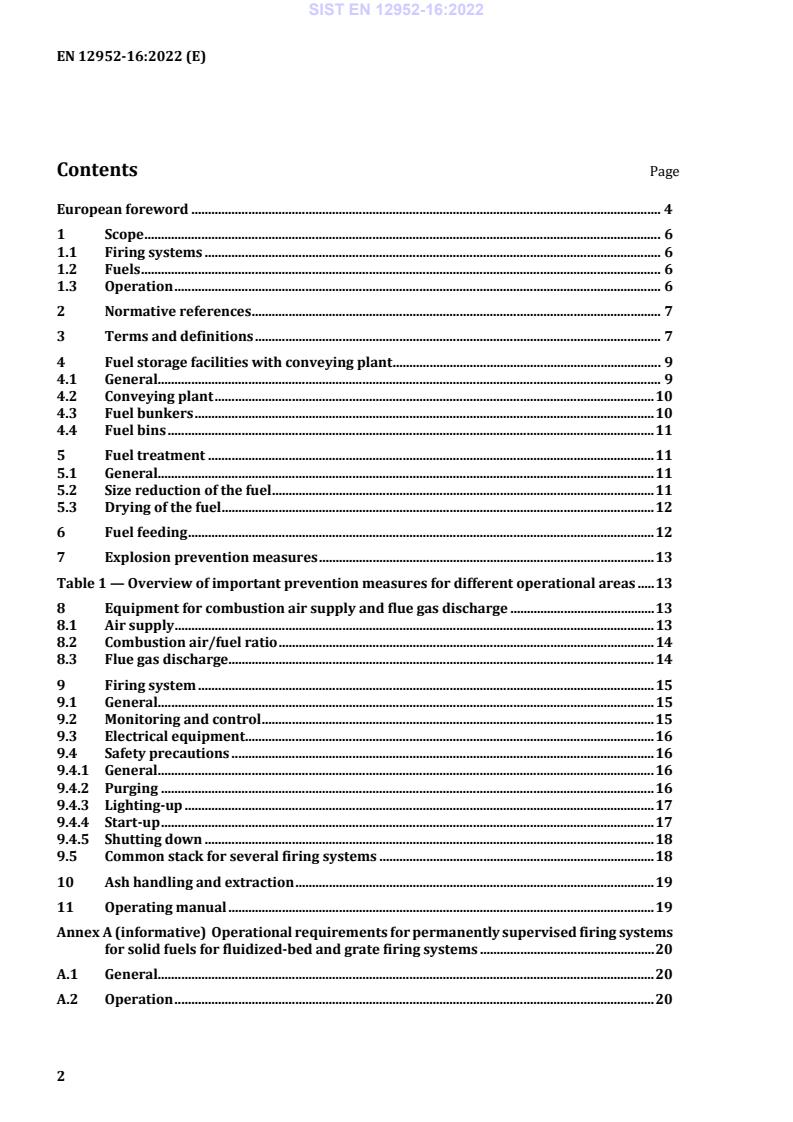
Contents Page
European foreword . 4
1 Scope . 6
1.1 Firing systems . 6
1.2 Fuels . 6
1.3 Operation . 6
2 Normative references . 7
3 Terms and definitions . 7
4 Fuel storage facilities with conveying plant . 9
4.1 General. 9
4.2 Conveying plant . 10
4.3 Fuel bunkers . 10
4.4 Fuel bins . 11
5 Fuel treatment . 11
5.1 General. 11
5.2 Size reduction of the fuel . 11
5.3 Drying of the fuel . 12
6 Fuel feeding . 12
7 Explosion prevention measures . 13
Table 1 — Overview of important prevention measures for different operational areas . 13
8 Equipment for combustion air supply and flue gas discharge . 13
8.1 Air supply . 13
8.2 Combustion air/fuel ratio . 14
8.3 Flue gas discharge . 14
9 Firing system . 15
9.1 General. 15
9.2 Monitoring and control . 15
9.3 Electrical equipment. 16
9.4 Safety precautions . 16
9.4.1 General. 16
9.4.2 Purging . 16
9.4.3 Lighting-up . 17
9.4.4 Start-up . 17
9.4.5 Shutting down . 18
9.5 Common stack for several firing systems . 18
10 Ash handling and extraction . 19
11 Operating manual . 19
Annex A (informative) Operational requirements for permanently supervised firing systems
for solid fuels for fluidized-bed and grate firing systems . 20
A.1 General. 20
A.2 Operation . 20
A.3 Operation and maintenance . 20
A.3.1 General . 20
A.3.2 Operating instructions . 20
Annex B (informative) Significant technical changes between this European Standard and
the previous edition . 21
Annex ZA (informative) Relationship between this European Standard and the essential
requirements of EU Directive 2014/68/EU aimed to be covered . 22
Table ZA.1 — Correspondence between this European Standard and Directive 2014/68/EU
................................................................................................................................................................... 22
Bibliography . 23
European foreword
This document (EN 12952-16:2022) has been prepared by Technical Committee CEN/TC 269 “Shell and
water-tube boilers”, the secretariat of which is held by DIN.
This European Standard shall be given the status of a national standard, either by publication of
an identical text or by endorsement, at the latest by April 2023, and conflicting national standards shall
be withdrawn at the latest by April 2023.
Attention is drawn to the possibility that some of the elements of this document may be the subject of
patent rights. CEN shall not be held responsible for identifying any or all such patent rights.
This document supersedes EN 12952-16:2002.
The technical modifications in comparison with the previous edition are listed in Annex B.
The EN 12952 series concerning water-tube boilers and auxiliary installations consists of the following
parts:
• Part 1: General;
• Part 2: Materials for pressure parts of boilers and accessories;
• Part 3: Design and calculation for pressure parts;
• Part 4: In service boiler life expectancy calculations;
• Part 5: Workmanship and construction of pressure parts of the boiler;
• Part 6: Inspection during construction, documentation and marking of pressure parts of the boiler;
• Part 7: Requirements for equipment for the boiler;
• Part 8: Requirements for firing systems for liquid and gaseous fuels for the boiler;
• Part 9: Requirements for firing systems for pulverized solid fuels for the boiler;
• Part 10: Requirements for safeguards against excessive pressure;
• Part 11: Requirements for limiting devices of the boiler and accessories;
• Part 12: Requirements for boiler feedwater and boiler water quality;
• Part 13: Requirements for flue gas cleaning systems;
• Part 14: Requirements for flue gas DENOX systems using liquefied pressurized ammonia and ammonia
water solution;
• Part 15: Acceptance tests;
• Part 16: Requirements for grate and fluidized-bed firing systems for solid fuels for the boiler;
• CR 12952 Part 17: Guideline for the involvement of an inspection body independent of the
manufacturer;
• Part 18: Operating instructions.
Although these parts can be obtained separately, it should be recognized that the parts are inter-
dependent. As such, the design and manufacture of water-tube boilers requires the application of more
than one part in order for the requirements of the document to be satisfactorily fulfilled.
This document has been prepared under a Standardization Request given to CEN by the European
Commission and the European Free Trade Association, and supports essential requirements of EU
Directive(s) / Regulation(s).
For relationship with EU Directive(s) / Regulation(s), see informative Annex ZA, which is an integral part
of this document.
Any feedback and questions on this document should be directed to the users’ national standards body.
A complete listing of these bodies can be found on the CEN website.
According to the CEN-CENELEC Internal Regulations, the national standards organisations of the
following countries are bound to implement this European Standard: Austria, Belgium, Bulgaria, Croatia,
Cyprus, Czech Republic, Denmark, Estonia, Finland, France, Germany, Greece, Hungary, Iceland, Ireland,
Italy, Latvia, Lithuania, Luxembourg, Malta, Netherlands, Norway, Poland, Portugal, Republic of North
Macedonia, Romania, Serbia, Slovakia, Slovenia, Spain, Sweden, Switzerland, Türkiye and the United
Kingdom.
1 Scope
1.1 Firing systems
This document applies to atmospheric fluidized-bed and grate firing systems of steam boilers and hot
water generators. These systems commence at the fuel bunkers and end at the ash extraction plant. For
combination of various firing systems, the individual requirements of each system apply, especially those
included in EN 12952-8:2022 and EN 12952-9:2022.
If several fuels are burnt simultaneously or if a fuel quality varies considerably (e.g. moisture content),
additional safety measures can be necessary, especially with respect to limitation of the fuel flow into the
firing system and ensuring proper air supply to the individual fuels.
Pressurized firing systems can require enhanced safety measures, which are not given in this European
Standard.
1.2 Fuels
This document covers the use of solid fuels. Pulverized fuel fired in an entrained air flow (burner) system
is covered by EN 12952-9:2022.
Solid fuels covered are:
• all coal qualities, e.g. lignite or brown coal, sub-bituminous or hard brown coal, bituminous coal or
hard coal, pitch coal, anthracite, coke, coal culm, coal sludge;
• other fossil solid fuels (e.g. peat, oil shale);
• biomass solid fuels (e.g. wood, wood wastes [bark], pellets, energy plants [miscanthus], harvest
wastes [straw] and briquettes);
• municipal waste solid fuels (e.g. garbage, sewage sludge, refuse derived fuels [RDF]);
• industrial waste solid fuels (e.g. petrol coke, soot, tyres, paper wastes, coated wood chips, spent
wood, animal product wastes).
Fuel blends from two or more groups, or fuels of unconventional or unknown quality can require special
safety measures which can be proved either by practical experience gained from comparable fuels, or by
suitable tests, e.g. in accordance with EN 14034-2:2006+A1:2011. Such measures specified and
documented by the manufacturer.
Fuels on which the design is documented in the operating instructions (see 11.2). This includes the fuel
data for 100 % input of the basic fuel and the data for any supplementary fuels together with their
maximum thermal input percentage.
1.3 Operation
The requirements for operational equipment in Clause 4, Clause 5, Clause 6, Clause 7, Clause 8, Clause 9,
Clause 10 and Clause 11 apply to steam boilers and hot water generators with permanent supervision by
properly trained personnel familiar with the special conditions of the firing systems and the type of fuel.
2 Normative references
The following documents are referred to in the text in such a way that some or all of their content
constitutes requirements of this document. For dated references, only the edition cited applies. For
undated references, the latest edition of the referenced document (including any amendments) applies.
EN 12952-8:2022, Water-tube boilers and auxiliary installations — Part 8: Requirements for firing systems
for liquid and gaseous fuels for the boiler
EN 12952-9:2022, Water-tube boilers and auxiliary installations — Part 9: Requirements for firing systems
for pulverized solid fuel for the boiler
EN 12952-18:2012, Water-tube boilers and auxiliary installations - Part 18: Operating instructionsyy
3 Terms and definitions
For the purposes of this document, the following terms and definitions apply.
ISO and IEC maintain terminological databases for use in standardization at the following addresses:
• IEC Electropedia: available at https://www.electropedia.org/
• ISO Online browsing platform: available at https://www.iso.org/obp
3.1
annunciator
device to sense a non-standard or abnormal condition and initiate a visual and/or audible signal
3.2
back-up firing system
separate firing system to maintain safe ignition and stable combustion
3.3
basic fire
in the case of grate firing systems the layer of glowing fuel, fire bed, or flame of the fed fuel
Note 1 to entry: The basic fire ensures safe ignition.
3.4
carrier gas
transport medium for pneumatic conveying
3.5
combustion air
total air supplied to the firing system for combustion
3.6
combustion process monitoring device
device which detects the presence of the fire, or the conditions required for a stable combustion process
3.7
firing system heat input
heat input into the combustion chamber
Note 1 to entry: This normally is calculated as the mass flow of the fuel multiplied by its net calorific value.
3.8
firing system
total equipment required for the combustion of fuels
Note 1 to entry: Included are the installation for the storage in the boiler house, preparation and supply of fuels, the
combustion air supply, the grate or fluidized bed, the flue gas discharge, and all related control and monitoring
devices
3.9
fluidized-bed combustion firing system (FBC)
fuel is burnt in its fluidized state together with an inert component
3.10
fuel bin
silo
dust-tight and air-tight container for storage of fuels
3.11
fuel bunker
container for the storage of solid fuel
3.12
fuel feeding system
device to transport fuel into the combustion chamber
Note 1 to entry: This can be effected e.g. by feeders through ports in the furnace walls, by means of chutes or lances,
through the bottom grate or fluidizing gas distributor, or indirectly into the ash recirculation or combustion air
supply.
3.13
fuel handling plant
installation for conveying, mixing and distributing solid fuels to the individual fuel bunkers or fuel bins
3.14
grate firing system
fuel is burnt in a layer supported by a system e.g. firebars, which can have a cooling system
3.15
indicator
measuring instrument which indicates a variable value (e.g. pressure, temperature, flow, level)
Note 1 to entry: It can be equipped with an annunciator.
3.16
lighting-up equipment
facility to achieve safe ignition of the feed fuel
3.17
limiter
transducer, which, on reaching a fixed limit value (e.g. pressure, temperature, flow, level) is used to
interrupt and lock-out the energy supply. It requires manual unlocking before restart
3.18
lockout
interruption of the energy supply
Note 1 to entry: Manual unlocking is required before restart.
3.19
minimum fluidized-bed temperature
lowest temperature of the fluidized material at which it can be safely burnt
3.20
minimum heat input of the firing system
minimum heat input at which the firing system can be safely operated
3.21
monitor
transducer which on reaching of a fixed limit value and initiates an alarm and/or a cut-out. The output
signal only reverses if the causing value has changed at a defined range
3.22
purging of the flue gas passes
flow including air through the combustion chamber, flue gas passes, treatment systems and associated
ducts which effectively removes any gaseous combustibles
3.23
cold start-up condition
plant started when the temperature of ceramic lining and bed material is at ambient value
3.24
safety time
time period during which the effectiveness of the safety device may be inhibited without a hazardous
condition occurring
4 Fuel storage facilities with conveying plant
4.1 General
4.1.1 All facilities shall be designed so as to withstand mechanical and thermal stresses. Fuel shall not
be heated to an unacceptable level. Sites where fuel can accumulate shall be avoided.
4.1.2 Conveyance, temporary storage, and extraction of fuel shall be arranged such that blockage is
avoided.
4.1.3 Fuels liable to volatise or pyrolysis in the absence of external heating require measures to prevent
fire, explosion and injuries to personnel.
WARNING — Wet sludges can have an inherent explosion risk due to the release of volatiles (e.g.
methane) when stored. Dried sludges have a fire and dust explosion risk comparable to that of pulverized
fuels. Sludge storage in bins is preferable to bunker storage (see 4.4.1).
4.1.4 The storage of fuels supplied in small grain sized particles or fibres which can be stirred up and
become airborne shall only be permitted in bins (silos).
4.1.5 If different types of fuels are used, dangerous operating conditions due to blending shall be
excluded, e.g. by the use of separate bunkers or bins and separate feeding systems.
4.1.6 If there is a risk of blockage of conveying systems or firing systems by coarse fuel lumps, foreign
matter, and tramp metal, it shall be removed, preferably before entering the bunker.
4.2 Conveying plant
4.2.1 Several continuous conveyors arranged in series to form one conveying line shall be interlocked
such that the normal operation of any conveyor is possible only if the downstream conveyors are in
operation and the storage facility is ready to accept the fuel.
4.2.2 Automatic facilities for open mechanical conveyance and distribution of fuel shall only start after
visual and/or audible warning signals have been given.
Precautions shall be taken for the protection of personnel against injury from moving components.
Sufficient time shall be provided between a warning signal and starting of the plant.
4.2.3 If the type and format of the fuel requires bins (silos) for temporary storage in accordance with
4.1.3 or 4.1.4, subsequent conveyance shall be performed in a closed system, which shall be air-tight if
operated under internal pressure
4.2.4 For pneumatic conveyance of fuel in closed pipes, deposition shall be prevented by sufficient
velocity of the carrier gas depending on the type and format of the fuel.
4.2.5 All piping system components of a pneumatic conveying system shall be capable of being purged
of fuel.
4.2.6 Feeding of fuel into the pneumatic conveying line shall be interlocked in such a way that feeding
is possible only if sufficient carrier gas is supplied. Suitable monitoring devices, e.g. monitors for flow or
pressure of the carrier gas shall be provided.
4.2.7 If the carrier gas is exhausted to the atmosphere via a dust separator, the outlet shall be protected
against contact with ignition sources, or sparks.
4.2.8 If multiple lines are installed, devices shall be provided to isolate idle conveying lines from the
downstream storage facility or the furnace.
4.2.9 If fuels are conveyed hydraulically by pumps, 4.2.3 to 4.2.5 shall apply.
4.3 Fuel bunkers
4.3.1 With exception of bunkers emptied by cranes, fuel bunkers shall be built to achieve uniform
discharge by the selection of proper shape and design, in order to ensure a continuous uniform fuel flow
and to avoid segregation.
4.3.2 To avoid ingress of hot air/gas into the bunker, a minimum fuel level shall be maintained and
monitored in the bunker, or other suitable measures shall be taken.
4.3.3 The inner surface of the fuel bunker roof shall be designed to prevent the accumulation of dust
and gas in dead pockets.
4.3.4 Bunker charging openings shall be guarded to prevent personnel from falling in.
4.3.5 Fuel bunkers shall be equipped with fire fighting or fire prevention equipment. Coal bunkers may
be emptied by use of emergency chutes.
4.4 Fuel bins
4.4.1 Some fuels according to their type and format shall be stored in dust-tight bins (silos). The
requirements for pulverized fuel bins defined in EN 12952-9:2022, 5.4 and 6.2.2 shall apply.
4.4.2 The permissible maximum storage temperature shall be specified for each single fuel and fuel
blends and shall be monitored during the storage, if there is a risk of self ignition.
4.4.3 If emanation of combustible gas from the fuel cannot be prevented, bins shall be equipped with
suitable gas monitoring and safe venting devices, or an explosion-proof bin or inert gas protection shall
be provided.
4.4.4 Fuels described in 4.1.4 shall be stored in bins equipped with a stationary non-freezing fire
extinguishing system to enable fire to be fought without opening access doors. The extinguishing
compound shall be evenly sprayed across the entire cross sectional area of the bin. Spray nozzles shall be
protected against blockage by the ingress of dust. Where stationary spray-type extinguishing systems are
operated automatically, manual initiation shal
...
Questions, Comments and Discussion
Ask us and Technical Secretary will try to provide an answer. You can facilitate discussion about the standard in here.
Loading comments...