

EN 30-1-4:2002
(Main)Domestic cooking appliances burning gas - Part 1-4: Safety - Appliances having one or more burners with an automatic burner control system
- Abstract
This standard specifies the construction and performance characteristics as well as the requirements and methods of test for the safety and marking of domestic cooking appliances, capable of using the combustible gases defined in EN 30-1-1:1998 and EN 30-1-1/A1:1999, that have one or more burners with an automatic burner control system, referred to in the text as "appliances".
This standard includes specific requirements and methods of test that are applicable to burners having an automatic burner control system, whether or not the appliance is equipped with a fan for the supply of combustion air to, and/or the evacuation of the products of combustion from, the burner concerned. These specific requirements and methods of test are only applicable when the burner has a automatic burner control system and do not apply to burners having automatic ignition that fall within the scope of EN 30-1-1:1998 and EN 30-1-1/A1:1999.
This Standard is intended to be used in conjunction with EN 30-1-1:1998 and EN 30-1-1/A1:1999 and, where appropriate, other parts of EN 30-1 covering appliances having:
¾ forced-convection ovens and/or grills;
¾ a glass ceramic hotplate.
It does not cover all of the safety requirements and methods of test that are specific to forced convection ovens and/or grills and glass ceramic hotplates.
Unless specifically excluded hereafter, this standard applies to these appliances or their component parts, whether or not the component parts are independent or incorporated into a single appliance, even if the other heating components of the appliance use electrical energy (e.g. combined gas-electric cookers).
This standard includes requirements covering the electrical safety of equipment incorporated in the appliance that is associated with the use of gas. It does not include requirements covering the electrical safety of electrically-heated component parts of their associated equipment ).
- Status
- Withdrawn
- Publication Date
- 27-Aug-2002
- Withdrawal Date
- 08-May-2012
- Technical Committee
- CEN/TC 49 - Gas cooking appliances
- Drafting Committee
- CEN/TC 49/WG 1 - Revision of EN 30
- Current Stage
- 9960 - Withdrawal effective - Withdrawal
- Start Date
- 09-May-2012
- Completion Date
- 09-May-2012
- Directive
- 2009/142/EC - Appliances burning gaseous fuelsOJ Ref: C, C 349 OJ Date: 22-Dec-2010
90/396/EEC - Appliances burning gaseous fuelsOJ Ref: C 142, C 88 OJ Date: 08-Apr-2004

Relations
- Effective Date
- 22-Dec-2008
- Effective Date
- 28-Jan-2026
- Effective Date
- 28-Jan-2026
- Effective Date
- 08-Jun-2022
Frequently Asked Questions
EN 30-1-4:2002 is a standard published by the European Committee for Standardization (CEN). Its full title is "Domestic cooking appliances burning gas - Part 1-4: Safety - Appliances having one or more burners with an automatic burner control system". This standard covers: This standard specifies the construction and performance characteristics as well as the requirements and methods of test for the safety and marking of domestic cooking appliances, capable of using the combustible gases defined in EN 30-1-1:1998 and EN 30-1-1/A1:1999, that have one or more burners with an automatic burner control system, referred to in the text as "appliances". This standard includes specific requirements and methods of test that are applicable to burners having an automatic burner control system, whether or not the appliance is equipped with a fan for the supply of combustion air to, and/or the evacuation of the products of combustion from, the burner concerned. These specific requirements and methods of test are only applicable when the burner has a automatic burner control system and do not apply to burners having automatic ignition that fall within the scope of EN 30-1-1:1998 and EN 30-1-1/A1:1999. This Standard is intended to be used in conjunction with EN 30-1-1:1998 and EN 30-1-1/A1:1999 and, where appropriate, other parts of EN 30-1 covering appliances having: ¾ forced-convection ovens and/or grills; ¾ a glass ceramic hotplate. It does not cover all of the safety requirements and methods of test that are specific to forced convection ovens and/or grills and glass ceramic hotplates. Unless specifically excluded hereafter, this standard applies to these appliances or their component parts, whether or not the component parts are independent or incorporated into a single appliance, even if the other heating components of the appliance use electrical energy (e.g. combined gas-electric cookers). This standard includes requirements covering the electrical safety of equipment incorporated in the appliance that is associated with the use of gas. It does not include requirements covering the electrical safety of electrically-heated component parts of their associated equipment ).
This standard specifies the construction and performance characteristics as well as the requirements and methods of test for the safety and marking of domestic cooking appliances, capable of using the combustible gases defined in EN 30-1-1:1998 and EN 30-1-1/A1:1999, that have one or more burners with an automatic burner control system, referred to in the text as "appliances". This standard includes specific requirements and methods of test that are applicable to burners having an automatic burner control system, whether or not the appliance is equipped with a fan for the supply of combustion air to, and/or the evacuation of the products of combustion from, the burner concerned. These specific requirements and methods of test are only applicable when the burner has a automatic burner control system and do not apply to burners having automatic ignition that fall within the scope of EN 30-1-1:1998 and EN 30-1-1/A1:1999. This Standard is intended to be used in conjunction with EN 30-1-1:1998 and EN 30-1-1/A1:1999 and, where appropriate, other parts of EN 30-1 covering appliances having: ¾ forced-convection ovens and/or grills; ¾ a glass ceramic hotplate. It does not cover all of the safety requirements and methods of test that are specific to forced convection ovens and/or grills and glass ceramic hotplates. Unless specifically excluded hereafter, this standard applies to these appliances or their component parts, whether or not the component parts are independent or incorporated into a single appliance, even if the other heating components of the appliance use electrical energy (e.g. combined gas-electric cookers). This standard includes requirements covering the electrical safety of equipment incorporated in the appliance that is associated with the use of gas. It does not include requirements covering the electrical safety of electrically-heated component parts of their associated equipment ).
EN 30-1-4:2002 is classified under the following ICS (International Classification for Standards) categories: 97.040.20 - Cooking ranges, working tables, ovens and similar appliances. The ICS classification helps identify the subject area and facilitates finding related standards.
EN 30-1-4:2002 has the following relationships with other standards: It is inter standard links to EN 30-1-4:2012, EN 15181:2008, EN 30-1-3:2003+A1:2006, EN 30-1-4:2002/A1:2006. Understanding these relationships helps ensure you are using the most current and applicable version of the standard.
EN 30-1-4:2002 is associated with the following European legislation: EU Directives/Regulations: 2009/142/EC, 90/396/EEC; Standardization Mandates: M/BC/CEN/89/6. When a standard is cited in the Official Journal of the European Union, products manufactured in conformity with it benefit from a presumption of conformity with the essential requirements of the corresponding EU directive or regulation.
EN 30-1-4:2002 is available in PDF format for immediate download after purchase. The document can be added to your cart and obtained through the secure checkout process. Digital delivery ensures instant access to the complete standard document.
Standards Content (Sample)
2003-01.Slovenski inštitut za standardizacijo. Razmnoževanje celote ali delov tega standarda ni dovoljeno.Domestic cooking appliances burning gas - Part 1-4: Safety - Appliances having one or more burners with an automatic burner control systemAppareils de cuisson domestiques utilisant les combustibles gazeux - Partie 1-4 : Sécurité - Appareils comportant un ou plusieurs bruleurs avec systeme automatique de commande pour bruleursHaushalt-Kochgeräte für gasförmige Brennstoffe - Teil 1-4: Sicherheit - Geräte mit einem oder mehreren Brenner(n) mit FeuerungsautomatTa slovenski standard je istoveten z:EN 30-1-4:2002SIST EN 30-1-4:2004en,fr,de97.040.20ICS:SLOVENSKI
STANDARDSIST EN 30-1-4:200401-januar-2004
EUROPEAN STANDARDNORME EUROPÉENNEEUROPÄISCHE NORMEN 30-1-4August 2002ICS 97.040.20English versionDomestic cooking appliances burning gas - Part 1-4: Safety -Appliances having one or more burners with an automaticburner control systemAppareils de cuisson domestiques utilisant lescombustibles gazeux - Partie 1-4: Sécurité - Appareilscomportant un ou plusieurs brûleurs avec systèmeautomatique de commande pour brûleursHaushalt-Kochgeräte für gasförmige Brennstoffe - Teil 1-4:Sicherheit - Geräte mit einem oder mehreren Brenner(n)mit FeuerungsautomatThis European Standard was approved by CEN on 14 March 2002.CEN members are bound to comply with the CEN/CENELEC Internal Regulations which stipulate the conditions for giving this EuropeanStandard the status of a national standard without any alteration. Up-to-date lists and bibliographical references concerning such nationalstandards may be obtained on application to the Management Centre or to any CEN member.This European Standard exists in three official versions (English, French, German). A version in any other language made by translationunder the responsibility of a CEN member into its own language and notified to the Management Centre has the same status as the officialversions.CEN members are the national standards bodies of Austria, Belgium, Czech Republic, Denmark, Finland, France, Germany, Greece,Iceland, Ireland, Italy, Luxembourg, Malta, Netherlands, Norway, Portugal, Spain, Sweden, Switzerland and United Kingdom.EUROPEAN COMMITTEE FOR STANDARDIZATIONCOMITÉ EUROPÉEN DE NORMALISATIONEUROPÄISCHES KOMITEE FÜR NORMUNGManagement Centre: rue de Stassart, 36
B-1050 Brussels© 2002 CENAll rights of exploitation in any form and by any means reservedworldwide for CEN national Members.Ref. No. EN 30-1-4:2002 E
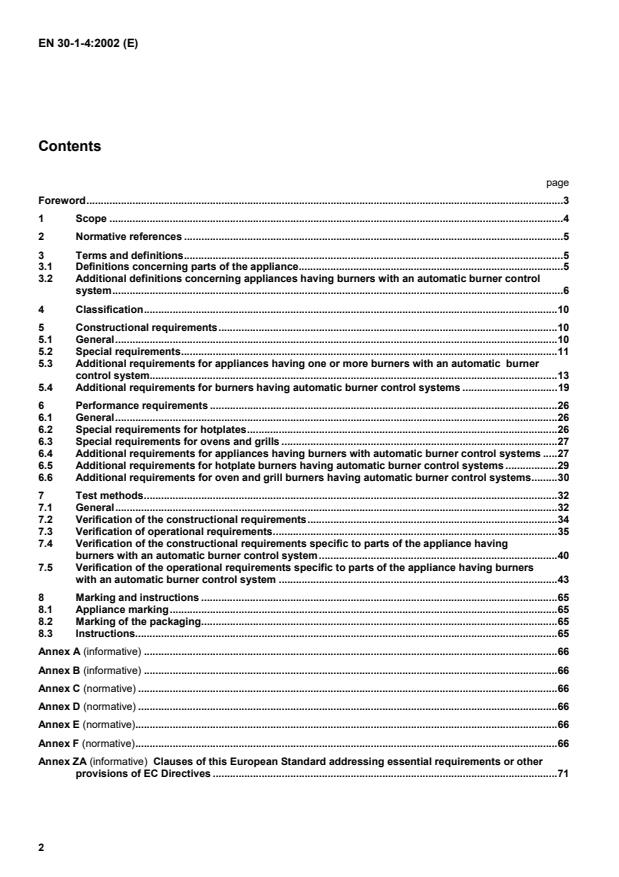
burnercontrol system.135.4Additional requirements for burners having automatic burner control systems.196Performance requirements.266.1General.266.2Special requirements for hotplates.266.3Special requirements for ovens and grills.276.4Additional requirements for appliances having burners with automatic burner control systems.276.5Additional requirements for hotplate burners having automatic burner control systems.296.6Additional requirements for oven and grill burners having automatic burner control systems.307Test methods.327.1General.327.2Verification of the constructional requirements.347.3Verification of operational requirements.357.4Verification of the constructional requirements specific to parts of the appliance havingburners with an automatic burner control system.407.5Verification of the operational requirements specific to parts of the appliance having burnerswith an automatic burner control system.438Marking and instructions.658.1Appliance marking.658.2Marking of the packaging.658.3Instructions.65Annex A (informative).66Annex B (informative).66Annex C (normative).66Annex D (normative).66Annex E (normative).66Annex F (normative).66Annex ZA (informative)
Clauses of this European Standard addressing essential requirements or otherprovisions of EC Directives.71
Inparticular, this Standard identifies the requirements and methods of test specific to these appliances, which are inaddition to, or replace, those given in EN 30-1-1:1998 and EN 30-1-1/A1:1999.This present part is intended to be used together with any other part of EN 30-1-x related to “Safety”, whenever theappliances covered by this other part includes a burner with an automatic burner control system.Requirements relating to ‘Rational use of energy’ are given in other appropriate parts of this standard, EN 30-2-x.Matters relating to quality assurance systems, production testing and certificates of conformity, including those forauxiliary devices, are not dealt with in this standard.Requirements concerning the emission of NOx are not mentioned in this European standard, taking account of theusage of the appliances and their low output, their contribution to environment pollution is negligible.NOTEFor countries requesting special categories (specified in EN 437:1993), the absence of specific informationconcerning A.3.3 and A.3.4 implies that the general requirements (see 5.2.4 and 5.1.1) also apply for particular categories.Other European Standards covering domestic cooking appliances burning gas are as follows:¾ EN 30-1-1: Domestic cooking appliances burning gas fuel – Part 1-1 : Safety – General,¾ EN 30-1-2: Domestic cooking appliances burning gas – Part 1-2 : Safety – Appliances having forced-convection ovens and /or grills,¾ prEN 30-1-3: Domestic cooking appliances burning gas – Part 1-3: Safety – Appliances having a glass ceramichotplate,¾ EN 30-2-1: Domestic cooking appliances burning gas – Part 2-1: Rational use of energy – General,¾ EN 30-2-2: Domestic cooking appliances burning gas – Part 2-2: Rational use of energy – Appliances havingforced-convection ovens and /or grills.Annexes A and B are informative.Annexes C, D, E and F are normative.
1)Refer to the electrical safety rules.
The burner is so enclosed that flames may not be visible duringnormal operation.3.1.2tapThe definition of 3.4.2.12 of EN 30-1-1:1998 and EN 30-1-1/A1:1999 “tap” is replaced by the following text:manually operated burner controla device to isolate the gas supply to a burner and possibly to adjust its thermal function during use.A manually operated burner control may be:¾ direct-acting: in which case the device is mechanical in operation (e.g. a tap or cock) and the gas flow iscontrolled directly by manipulation of a control handle as defined in 3.4.3.1 of EN 30-1-1:1998 andEN 30-1-1/A1:1999;¾ indirect: in which case the opening and closing of the gas supply to the burner is achieved indirectly by meansof one or more automatic shut off valves.
This control may incorporate means of adjusting the thermal functionof the burner.
For example:¾ by adjusting the gas flow (e.g. high-low thermostat);¾ by on-off cycling (e.g. on-off thermostat, gas energy regulator).3.2 Additional definitions concerning appliances having burners with an automatic burnercontrol system3.2.1 Definitions concerning the appliance and its components3.2.1.1combustion circuitassembly comprising the air supply circuit, the combustion chamber and the products of combustion circuit up tothe outlet of the appliance.3.2.1.2fully pre-mixed gas and air burnerburner in which the gas and a quantity of air, corresponding to at least that theoretically required to achievecomplete combustion, are mixed upstream of the burner ports.3.2.2 Definitions concerning adjusting, control and safety devices3.2.2.1total air adjustera device enabling the total air flow required for the burner or, where appropriate, the burners to be set topredetermined value according to the supply conditions. The operation of changing the setting of this device istermed the “adjustment of the total air”.3.2.2.2touch controlan indirect manually operated burner control actuated by contact or the close proximity of a finger, with little or nomovement of the contact surface.3.2.2.3touch control padone of the contact surfaces of a touch control by which it is actuated.
It comprisesat least a multi-burner programming unit and all the elements of the flame detector devices for the burnerscontrolled. The various functions of this automatic burner control system may be in one or more housings.3.2.2.8multi-burner programming unita programming unit that reacts to signals from control and safety devices, gives control commands, controls thestart-up sequences of the burners, supervises their operation and causes controlled shut-down, and if necessarysafety shut-down and lock-out of the burner or burners. The programming unit follows predetermined sequences ofactions and always operates in conjunction with a flame detector device for each of the burners controlled.According to predetermined sequences it may enable the burner to start up independently, or in combination withother burners, even when one or more burners are already in operation. It supervises their operation independentlyand causes controlled shut-down, safety shut-down and, if appropriate, lock-out of one or all of the burners underits control.3.2.2.9programmethe sequence of control operations determined by the programming unit involving switching on, starting up,supervising and switching off the burner3.2.2.10flame detector devicea device by which the presence of a flame is detected and signalled.It can consist of a flame sensor, an amplifier and a relay for signal transmission. These parts, with the possibleexception of the actual flame sensor, may be assembled in a single housing for use in conjunction with aprogramming unit.3.2.2.11flame signalthe signal given by the flame detector device, normally when the flame sensor senses a flame.3.2.2.12flame simulationa condition that occurs when the flame signal indicates the presence of a flame when in reality no flame is present.
and which is constructed so that its setting cannot bealtered by the user.3.2.2.16self-resetting thermal cut-outthermal cut-out which as appropriate initiates automatic recycling of the burner or automatic restoration of the fullheat input of the burner after the relevant part of the appliance has cooled down sufficiently3.2.2.17non-self-resetting thermal cut-outthermal cut-out which requires a manual operation, or the replacement of a part, in order as appropriate to restartthe burner or to restore its full heat input.3.2.3 Definitions concerning the operation of the appliance3.2.3.1start gas ratethe mean volume rate or mass rate during the safety time where this gas rate is limited by design for the purposesof ignition.3.2.3.2start gas flamea flame that can only be established at the start gas rate of the burner.3.2.3.3main flamea flame established, or capable of being established, at the full-on gas rate of the burner for the purposes ofignition.3.2.3.4running condition of the systemeither:the condition of the automatic single burner control system in which the burner is in normal operation under thesupervision of the single burner programming unit and its flame detector device,or:the conditions of the automatic multi-burner control system in which one or more burners are in normal operationunder the supervision of the multi-burner programming unit and their individual flame detector devices.3.2.3.5ignition energy restorationthe process by which, after disappearance of the flame signal in the running condition or ,where appropriate, in theevent of failure to ignite, the ignition device is energized again without the gas supply having been totallyinterrupted.
This process ends with the restoration of the running condition or, if there is no flame signal at the endof the safety time:either:
burner.4 ClassificationThe classification given in clause 4 of EN 30-1-1:1998 and EN 30-1-1/A1:1999 applies with the followingmodifications:4.2.2.3Appliances designed for use with gases of the third familyThe text of 4.2.2.3 “Appliances designed for use with gases of the third family” of EN 30-1-1:1998 andEN 30-1-1/A1:1999 is replaced with the following:Appliances designed for use with gases of the third family onlyCategory I3B/P: Appliances capable of using gases of the third family (propane and butane) at the fixed supplypressure.Category I3+: Appliances capable of using gases of the third family (propane and butane) and operating with apressure couple without intervention on the appliance other than an adjustment of the primary air, or total air, forconversion from butane to propane and vice versa. The device for regulating the gas pressure of the appliance, ifany, is not operational within the range of the two normal pressures of the pressure couple.Category I3P: Appliances using only gases from group P of the third family (propane) at the fixed supply pressure.5 Constructional requirements5.1 GeneralUnless specifically modified as described hereafter, the appliance shall comply with the requirements of 5.1 ofEN 30-1-1:1998 and EN 30-1-1/A1:1999 which are applicable to them, any verifications in the form of tests beingcarried out in accordance with clause 7 of this standard, and not in accordance with the corresponding clause ofEN 30-1-1:1998 and EN 30-1-1/A1:1999.The appliance shall also comply with the additional requirements given in 5.3 of this standard.
Requirements for indirect manually operated burner controls handles and for touchcontrols are given in 5.3.2 of this standard.5.2.4 Injectors and adjusters5.2.3 of EN 30-1-1:1998 and EN 30-1-1/A1:1999 is applicable with the following modification:All requirements concerning air rate adjusters and primary air adjusters shall also apply to total air adjusters.5.2.5 Oven thermostats5.2.4 of EN 30-1-1:1998 and EN 30-1-1/A1:1999 is applicable where the oven burner is not equipped with anautomatic burner control system.
Requirements for oven burners having an automatic burner control system aregiven in 5.3.3 of this standard.5.2.6 Ignition systems5.2.5 of EN 30-1-1:1998 and EN 30-1-1/A1:1999 is replaced with the following:All the components of the ignition device shall be designed to avoid damage or accidental displacement in normaluse. The relative positions of the ignition device and the burner shall be sufficiently well defined to ensuresatisfactory operation of the assembly.When the ignition devices include a permanent pilot, the gas rate of this pilot shall not exceed 0,06 kW for eachburner controlled.
hotplates2) .5.2.8.2.2 of EN 30-1-1:1998 and EN 30-1-1/A1:1999 is replaced by the following :Covered burners and griddlesNon-enclosed covered burners and griddles may be permanent or temporary. When a non-enclosed coveredburner or griddle is temporary, the plate shall be removable and shall be supplied with the appliance.Correct replacement of the removable plate or griddle on the burner for which it is intended shall be easy andobvious. The removable plate or griddle shall be stable when in its correct position.Griddles shall be designed such that any greases produced in cooking cannot spill onto the burner or onto parts notintended for this purpose.5.2.10 Accumulation of unburnt gas in the appliance5.2.12 of EN 30-1-1:1998 and EN 30-1-1/A1:1999 is applicable to parts of the appliance having burners notequipped with automatic burner control systems.
Requirements for parts of the appliance having burners equippedwith automatic burner control systems are given in 5.3.8 of this standard.5.3 Additional requirements for appliances having one or more burners with an automaticburner control system5.3.1 Indirect manually operated burner controls5.3.1.1 GeneralThese controls shall only be used with burners having an automatic burner control system.5.3.1.2 Controls operated by rotation or with a sliding action5.3.1.2.1 GeneralFor a given appliance, all the controls controlling the same type of burners shall be of the same type, i.e.:¾ with the reduced rate, if this exists:either:at the end of the travel or between the closed and full on positions for controls having a single closing direction;or: for rotating controls with two closing directions, positioned such that the same turning direction is used whenturning from the full-on positions to the reduced rate positions;¾ with all controls having two closing directions or with all having the same single closing direction.NOTEThis requirement does apply to combined oven and grill controls.
2)Additional requirements for glass ceramic hotplates are given in prEN 30-1-3:2002.
In addition, the “off” position shall be provided with means complyingwith the requirements of 5.3.1.2.3.If the oven and grill have separate controls, an interlock device shall be incorporated that prevents simultaneousoperation of the oven and grill.5.3.1.3 Touch controlsThe touch controls for a particular burner shall be provided with sufficient touch pads to control the operation of theburner.
These shall be so designed and arranged that the operation of the burner is easy and obvious.The touch controls shall be designed in such a way that at least one of the touch pads only requires a singlemanual action to cause the closure of the gas supply to the burner. The closure of the gas supply shall occur in notmore than 1 s after this manual action.The touch controls shall be so designed that it requires at least two distinct manual actions to initiate the ignitionsequence for the burner.NOTETwo touches of the same touch pad are not considered as two distinct actions.If the thermal function of the burner can be varied, the touch controls shall be so designed that it is easy to increaseor decrease the thermal function.When an oven and grill are situated in the same compartment and the oven or grill burner is not intended to beoperated at the same time as the other burner, or electric heating element, in the compartment, their touch controlsshall be so designed that simultaneous operation is not possible.When an appliance incorporates a hotplate having touch controls, the hotplate shall be so constructed thatinadvertent operation of the touch controls for any hotplate burner is unlikely as a result of spillage of liquids,including that caused by a vessel boiling over, or from a damp cloth being placed on the control panel. Thisrequirement is verified in accordance with the method of test described in 7.4.4.
There shall not be anyrisk of confusion with the control for another energy.Control handles shall be so arranged relative to one another, and with respect to control handles for any otherenergy, that the movement of one handle does not cause inadvertent movement of an adjacent handle.Control handles shall be so designed that they can neither be fitted in the wrong position nor move by themselves.Control handles shall not be interchangeable if this leads to a risk of confusion between the energy controlled, theclosing direction, the operating positions and the “off” position.5.3.2.1.2 MarkingThe requirements of 5.2.2.2 of EN 30-1-1:1998 and EN 30-1-1/A1:1999 are applicable.5.3.2.2 Touch control pads5.3.2.2.1 DesignThe purpose of touch control pads shall be clearly identifiable with respect to the burners they control. There shallnot be any risk of confusion with the control for another energy, nor with other direct and indirect manually operatedburner controls.Touch control pads shall be so arranged relative to one another, with respect to the touch control pads of anotherburner, and with respect to those for any other energy, that the manual operation of one touch pad does not causeinadvertent operation of an adjacent touch pad.Touch control pads shall not be interchangeable if this leads to a risk of confusion between the energy controlled,the closing direction, the correct operating status and the "off" condition.5.3.2.2.2 MarkingThe touch control pad enabling rapid extinction of the burner in accordance with the requirements of 5.3.1.3, shallbe identified by a symbol, or equivalent indication, such that it cannot be confused with any other touch control padfor the burner.Marking and/or other forms of indication (e.g. indicator lights) shall ensure that it is evident whether the burner is inoperation or not.If the thermal function of the burner can be varied, indicators shall be used in such a way as to ensure that thecurrent operating status of the burner, and the means of increasing or decreasing the thermal function, are obvious.5.3.3 Verification of the state of operationThe operation of the burner(s) shall be able to be verified at any time by the user, either by means of visualobservation of the flames, or by other indirect means.In the case of mirrors, or viewing ports, etc., they shall be capable of retaining their optical properties.When an indirect means of signalling is used (e.g. indicator light), the signalling of the existence of a flame shall notbe able to be confused with the signalling of any fault, except for a fault in the functioning of the flame detectoritself, which shall manifest itself by an indication of loss of flame.
...