

EN 15823:2010
(Main)Packaging - Braille on packaging for medicinal products
- Abstract
This European Standard specifies requirements and provides guidance for the application of Braille to the labelling of medicinal products.
NOTE 1 The labelling of medicinal products placed on the market and incorporating Braille in accordance with this European Standard meets the requirements of European Directive 2001/83/EC, Article 56, (a) as amended by Directive 2004/27/EC [1].
NOTE 2 The principles in this European Standard can be applied in other sectors, as appropriate.
- Status
- Withdrawn
- Publication Date
- 22-Jun-2010
- Withdrawal Date
- 06-Oct-2026
- Technical Committee
- CEN/TC 261 - Packaging
- Drafting Committee
- CEN/TC 261/SC 5/WG 12 - Marking
- Current Stage
- 9960 - Withdrawal effective - Withdrawal
- Start Date
- 16-Jul-2014
- Completion Date
- 07-Oct-2026

Relations
- Replaced By
EN ISO 17351:2014 - Packaging - Braille on packaging for medicinal products (ISO 17351:2013) - Effective Date
- 23-Jul-2014
Get Certified
Connect with accredited certification bodies for this standard

BSI Group
BSI (British Standards Institution) is the business standards company that helps organizations make excellence a habit.

TÜV Rheinland
TÜV Rheinland is a leading international provider of technical services.

TÜV SÜD
TÜV SÜD is a trusted partner of choice for safety, security and sustainability solutions.
Sponsored listings
Frequently Asked Questions
EN 15823:2010 is a standard published by the European Committee for Standardization (CEN). Its full title is "Packaging - Braille on packaging for medicinal products". This standard covers: This European Standard specifies requirements and provides guidance for the application of Braille to the labelling of medicinal products. NOTE 1 The labelling of medicinal products placed on the market and incorporating Braille in accordance with this European Standard meets the requirements of European Directive 2001/83/EC, Article 56, (a) as amended by Directive 2004/27/EC [1]. NOTE 2 The principles in this European Standard can be applied in other sectors, as appropriate.
This European Standard specifies requirements and provides guidance for the application of Braille to the labelling of medicinal products. NOTE 1 The labelling of medicinal products placed on the market and incorporating Braille in accordance with this European Standard meets the requirements of European Directive 2001/83/EC, Article 56, (a) as amended by Directive 2004/27/EC [1]. NOTE 2 The principles in this European Standard can be applied in other sectors, as appropriate.
EN 15823:2010 is classified under the following ICS (International Classification for Standards) categories: 11.120.99 - Other standards related to pharmaceutics; 11.180.30 - Aids for blind or partially sighted people. The ICS classification helps identify the subject area and facilitates finding related standards.
EN 15823:2010 has the following relationships with other standards: It is inter standard links to EN ISO 17351:2014. Understanding these relationships helps ensure you are using the most current and applicable version of the standard.
EN 15823:2010 is available in PDF format for immediate download after purchase. The document can be added to your cart and obtained through the secure checkout process. Digital delivery ensures instant access to the complete standard document.
Standards Content (Sample)
2003-01.Slovenski inštitut za standardizacijo. Razmnoževanje celote ali delov tega standarda ni dovoljeno.Embalaža - Braillova pisava na embalaži za zdravilaVerpackung - Blindenschrift auf Arzneimittel-VerpackungenEmballage - Csur les emballages destinés aux médicamentsPackaging - Braille on packaging for medicinal products55.020Pakiranje in distribucija blaga na splošnoPackaging and distribution of goods in general11.180.30EUDQMHAids and adaptations for readingICS:Ta slovenski standard je istoveten z:EN 15823:2010SIST EN 15823:2010en,fr,de01-november-2010SIST EN 15823:2010SLOVENSKI
STANDARD
EUROPEAN STANDARD NORME EUROPÉENNE EUROPÄISCHE NORM
EN 15823
June 2010 ICS 11.120.99; 11.180.30 English Version
Packaging - Braille on packaging for medicinal products
Emballage - Braille sur les emballages destinés aux médicaments
Verpackung - Blindenschrift auf ArzneimittelverpackungenThis European Standard was approved by CEN on 26 May 2010.
CEN members are bound to comply with the CEN/CENELEC Internal Regulations which stipulate the conditions for giving this European Standard the status of a national standard without any alteration. Up-to-date lists and bibliographical references concerning such national standards may be obtained on application to the CEN Management Centre or to any CEN member.
This European Standard exists in three official versions (English, French, German). A version in any other language made by translation under the responsibility of a CEN member into its own language and notified to the CEN Management Centre has the same status as the official versions.
CEN members are the national standards bodies of Austria, Belgium, Bulgaria, Croatia, Cyprus, Czech Republic, Denmark, Estonia, Finland, France, Germany, Greece, Hungary, Iceland, Ireland, Italy, Latvia, Lithuania, Luxembourg, Malta, Netherlands, Norway, Poland, Portugal, Romania, Slovakia, Slovenia, Spain, Sweden, Switzerland and United Kingdom.
EUROPEAN COMMITTEE FOR STANDARDIZATION
COMITÉ EUROPÉEN DE NORMALISATION EUROPÄISCHES KOMITEE FÜR NORMUNG
Management Centre:
Avenue Marnix 17,
B-1000 Brussels © 2010 CEN All rights of exploitation in any form and by any means reserved worldwide for CEN national Members. Ref. No. EN 15823:2010: ESIST EN 15823:2010
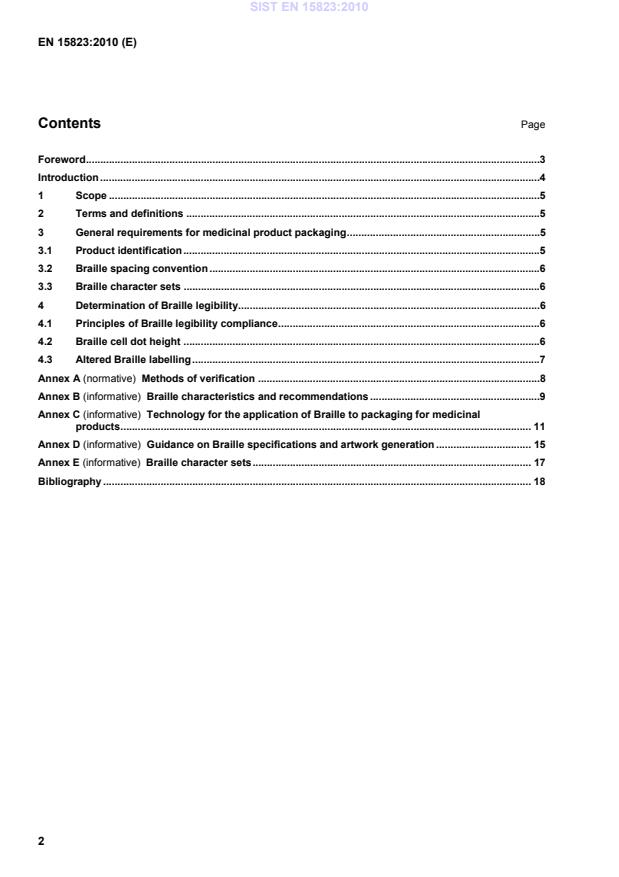
Methods of verification .8Annex B (informative)
Braille characteristics and recommendations .9Annex C (informative)
Technology for the application of Braille to packaging for medicinal products . 11Annex D (informative)
Guidance on Braille specifications and artwork generation . 15Annex E (informative)
Braille character sets . 17Bibliography . 18 SIST EN 15823:2010
NOTE 1 The labelling of medicinal products placed on the market and incorporating Braille in accordance with this European Standard meets the requirements of European Directive 2001/83/EC, Article 56, (a) as amended by Directive 2004/27/EC [1]. NOTE 2 The principles in this European Standard can be applied in other sectors, as appropriate. 2 Terms and definitions For the purposes of this document, the following terms and definitions apply. 2.1 Braille tactile reading and writing system composed of Braille cells 2.2 Braille cell series of up to six raised dots set out in a domino-type cell 2.3
burst-through cracking, breaking, pin-holing of the coating or material surface, visible to the naked eye, caused by the process of embossing Braille 2.4 labelling information on the immediate or outer packaging 2.5 Marburg Medium spacing convention defined system of dimensions within and between the Braille cells NOTE The Marburg Medium spacing convention for Braille [4] is recommended in the European Commission Guidance [3] for use for medicinal product labelling. 2.6 marketing authorization holder
MAH natural or legal person or entity responsible for placing the medicinal product on the market 3 General requirements for medicinal product packaging 3.1 Product identification 3.1.1 Information in Braille The approved Braille text on the labelling shall include the information as required in the country in which the product is to be supplied. NOTE 1 Guidance on the information to be labelled in Braille is given in the European Commission Guidance [3]. SIST EN 15823:2010
Methods of verification A.1 Braille cell dot height measurement The number of samples and the method of measurement shall be agreed between the customer and supplier. The Braille cell dot height shall be measured along the Braille text in at least three places.
The Braille cell dot height can be measured using a calibrated, spring-loaded (spring-force not less than 0,5 N) micrometer with an anvil that covers at least three Braille dots in a cell, see [5]. Measurement of the Braille cell dot height shall use cells containing at least three dots. Alternative methods may be used provided that they are of at least equivalent precision and accuracy.
Measurements can be performed with two decimal places and results shall be reported to two decimal places. NOTE It is recommended that random checks are carried out across all stations, see C.5.2. Checks should also be made to ensure the readability of underlying printed text.
A.2 Product identification by Braille legibility testing It is not necessary to undertake legibility testing for each batch provided that the Braille specification applied has been adequately validated.
If the Braille cell dot height requirement (
...