

prEN 14236
(Main)Ultrasonic domestic gas meters
- Abstract
This document specifies requirements and tests for the construction, performance and safety of class 1,0 and class 1,5 battery powered ultrasonic gas meters (hereinafter referred to as meters), having co-axial single pipe, or two pipe connections, used to measure volumes of distributed fuel gases of the 2nd and/or 3rd family gases as given in EN 437:2021, at maximum working pressures not exceeding 0,5 bar )) and maximum actual flow rates of up to 40 m3/h over a minimum ambient temperature range of −10 °C to +40 °C, and minimum gas temperature span of 40 K. This document applies to meters where the measuring element and the register(s) are enclosed in the same case.
This document applies to meters with and without built-in temperature conversion, that are installed in locations with vibration and shocks of low significance and in
- closed locations (indoor or outdoor with protection as specified by the manufacturer) with condensing or with non-condensing humidity;
or, if specified by the manufacturer;
- open locations (outdoor without any covering) both with condensing humidity or with non-condensing humidity;
and in locations with electromagnetic disturbances likely to be found in residential, commercial and light industrial use.
Unless otherwise stated, all pressures given in this document are gauge pressures.
Clauses 1 to 14 are for design and type testing only.
Requirements for electronic indexes, batteries, valves incorporated in the meter and other additional functionalities are given in EN 16314:2013
Unless otherwise stated in a particular test, the tests are carried out on meters that include additional functionality devices intended by the manufacturer.
When more than one meter type is submitted for testing, then each meter type needs to be tested against this document.
- Status
- Not Published
- Publication Date
- 23-Apr-2026
- Technical Committee
- CEN/TC 237 - Gas meters
- Drafting Committee
- CEN/TC 237/WG 9 - Ultrasonic gas meters
- Current Stage
- 4060 - Closure of enquiry - Enquiry
- Start Date
- 23-Apr-2026
- Due Date
- 01-Jul-2024
- Completion Date
- 23-Apr-2026

Overview
prEN 14236:2026 specifies the requirements and testing methods for battery-powered ultrasonic domestic gas meters. Developed by CEN/TC 237, this standard defines the construction, performance, and safety criteria for class 1.0 and class 1.5 meters used for measuring fuel gas volumes from the 2nd and/or 3rd family gases, as outlined in EN 437:2021. prEN 14236 applies to gas meters designed for both indoor and outdoor installation (with conditions), with maximum working pressures up to 0.5 bar and flow rates up to 40 m³/h. It also covers meters featuring coaxial, single pipe, or two-pipe connections, with or without integrated temperature conversion.
This standard is relevant for meter manufacturers, utility providers, and installers seeking compliant, precise, and safe domestic gas metering solutions for residential, commercial, and light industrial applications.
Key Topics
- Scope: Applies to battery-powered ultrasonic gas meters for measuring volumes of distributed fuel gases (natural gas, propane, butane, etc.) under specific temperature and pressure conditions.
- Types of Gas: Covers meters for 2nd family gases (mainly natural gases) and 3rd family gases (mainly LPGs) per EN 437:2021.
- Performance Classes: Specifies requirements for class 1.0 and class 1.5 meters, ensuring accuracy and reliability.
- Installation Environments: Suitable for use in closed (indoor/outdoor protected) and, if specified, open (outdoor unprotected) locations, including those with condensing or non-condensing humidity and expected electromagnetic disturbances.
- Temperature and Pressure Range:
- Ambient temperature: −10°C to +40°C minimum
- Gas temperature span: minimum 40 K
- Storage temperature: −20°C to +60°C or wider
- Maximum working pressure: ≤ 0.5 bar
- Construction and Safety:
- Robust case enclosing the measuring and registering elements
- Resistance to vibration, shocks, and environmental influences
- Marking and durability of the meter labels
- Testing and Compliance: Outlines type testing for design validation. The standard does not cover installation and operational procedures, but focuses on product requirements.
- Functionalities:
- With/without built-in temperature conversion
- Communications ports, memory and display requirements
- Immunity to electromagnetic and ultrasonic disturbances
Applications
Ultrasonic domestic gas meters built to prEN 14236 are critical for the following applications:
- Residential Gas Metering: Measuring household gas usage accurately, supporting fair billing and consumption monitoring.
- Commercial and Light Industrial Metering: Ensuring precision and safety for gas supplies in small businesses and industrial facilities.
- Utility Operations: Enhancing grid management and data collection through optional integrated communications and temperature conversion capabilities.
- Smart Metering Initiatives: Supporting implementation of smart grids with advanced diagnostics, data logging, and interface options outlined in EN 16314:2013.
prEN 14236 ensures meters are suitable for installation in environments with typical disturbances, such as urban or suburban homes, and commercial premises where vibrations, shocks, or electromagnetic interference may be present.
Related Standards
When implementing or specifying ultrasonic gas meters per prEN 14236, consider the following related standards:
- EN 437:2021 - Test gases, pressures, and appliance categories for gas supply systems
- EN 16314:2013 - Additional functionalities for gas meters (such as electronic indexes, communication modules, and valves)
- EN 60529 - Degrees of protection by enclosures (IP codes)
- EN IEC 61000 series - Electromagnetic compatibility (EMC) testing
- EN 549:2019 - Rubber materials for gas equipment seals and diaphragms
prEN 14236 will supersede EN 14236:2018 and aligns with current European regulatory frameworks to ensure safety, performance, and interoperability for fuel gas metering in domestic environments.
Keywords: ultrasonic gas meter, domestic gas metering, prEN 14236, CEN, fuel gas measurement, smart metering, gas safety standards, performance testing, EMC compliance, utility gas meters
Relations
- Effective Date
- 17-May-2023
Get Certified
Connect with accredited certification bodies for this standard

DIBt (Deutsches Institut für Bautechnik)
German Institute for Building Technology.
DIN CERTCO
DIN Group product certification.

Aboma Certification B.V.
Specialized in construction, metal, and transport sectors.
Sponsored listings
Frequently Asked Questions
prEN 14236 is a draft published by the European Committee for Standardization (CEN). Its full title is "Ultrasonic domestic gas meters". This standard covers: This document specifies requirements and tests for the construction, performance and safety of class 1,0 and class 1,5 battery powered ultrasonic gas meters (hereinafter referred to as meters), having co-axial single pipe, or two pipe connections, used to measure volumes of distributed fuel gases of the 2nd and/or 3rd family gases as given in EN 437:2021, at maximum working pressures not exceeding 0,5 bar )) and maximum actual flow rates of up to 40 m3/h over a minimum ambient temperature range of −10 °C to +40 °C, and minimum gas temperature span of 40 K. This document applies to meters where the measuring element and the register(s) are enclosed in the same case. This document applies to meters with and without built-in temperature conversion, that are installed in locations with vibration and shocks of low significance and in - closed locations (indoor or outdoor with protection as specified by the manufacturer) with condensing or with non-condensing humidity; or, if specified by the manufacturer; - open locations (outdoor without any covering) both with condensing humidity or with non-condensing humidity; and in locations with electromagnetic disturbances likely to be found in residential, commercial and light industrial use. Unless otherwise stated, all pressures given in this document are gauge pressures. Clauses 1 to 14 are for design and type testing only. Requirements for electronic indexes, batteries, valves incorporated in the meter and other additional functionalities are given in EN 16314:2013 Unless otherwise stated in a particular test, the tests are carried out on meters that include additional functionality devices intended by the manufacturer. When more than one meter type is submitted for testing, then each meter type needs to be tested against this document.
This document specifies requirements and tests for the construction, performance and safety of class 1,0 and class 1,5 battery powered ultrasonic gas meters (hereinafter referred to as meters), having co-axial single pipe, or two pipe connections, used to measure volumes of distributed fuel gases of the 2nd and/or 3rd family gases as given in EN 437:2021, at maximum working pressures not exceeding 0,5 bar )) and maximum actual flow rates of up to 40 m3/h over a minimum ambient temperature range of −10 °C to +40 °C, and minimum gas temperature span of 40 K. This document applies to meters where the measuring element and the register(s) are enclosed in the same case. This document applies to meters with and without built-in temperature conversion, that are installed in locations with vibration and shocks of low significance and in - closed locations (indoor or outdoor with protection as specified by the manufacturer) with condensing or with non-condensing humidity; or, if specified by the manufacturer; - open locations (outdoor without any covering) both with condensing humidity or with non-condensing humidity; and in locations with electromagnetic disturbances likely to be found in residential, commercial and light industrial use. Unless otherwise stated, all pressures given in this document are gauge pressures. Clauses 1 to 14 are for design and type testing only. Requirements for electronic indexes, batteries, valves incorporated in the meter and other additional functionalities are given in EN 16314:2013 Unless otherwise stated in a particular test, the tests are carried out on meters that include additional functionality devices intended by the manufacturer. When more than one meter type is submitted for testing, then each meter type needs to be tested against this document.
prEN 14236 is classified under the following ICS (International Classification for Standards) categories: 91.140.40 - Gas supply systems. The ICS classification helps identify the subject area and facilitates finding related standards.
prEN 14236 has the following relationships with other standards: It is inter standard links to EN 14236:2018. Understanding these relationships helps ensure you are using the most current and applicable version of the standard.
prEN 14236 is associated with the following European legislation: EU Directives/Regulations: 2014/32/EU; Standardization Mandates: M/541, M/626. When a standard is cited in the Official Journal of the European Union, products manufactured in conformity with it benefit from a presumption of conformity with the essential requirements of the corresponding EU directive or regulation.
prEN 14236 is available in PDF format for immediate download after purchase. The document can be added to your cart and obtained through the secure checkout process. Digital delivery ensures instant access to the complete standard document.
Standards Content (Sample)
SLOVENSKI STANDARD
01-marec-2026
Ultrazvočni plinomeri za gospodinjstva
Ultrasonic domestic gas meters
Ultraschall-Haushaltsgaszähler
Compteurs de gaz domestiques à ultrasons
Ta slovenski standard je istoveten z: prEN 14236
ICS:
91.140.40 Sistemi za oskrbo s plinom Gas supply systems
2003-01.Slovenski inštitut za standardizacijo. Razmnoževanje celote ali delov tega standarda ni dovoljeno.
DRAFT
EUROPEAN STANDARD
NORME EUROPÉENNE
EUROPÄISCHE NORM
January 2026
ICS 91.140.40 Will supersede EN 14236:2018
English Version
Ultrasonic domestic gas meters
Compteurs de gaz domestiques à ultrasons Ultraschall-Haushaltsgaszähler
This draft European Standard is submitted to CEN members for enquiry. It has been drawn up by the Technical Committee
CEN/TC 237.
If this draft becomes a European Standard, CEN members are bound to comply with the CEN/CENELEC Internal Regulations
which stipulate the conditions for giving this European Standard the status of a national standard without any alteration.
This draft European Standard was established by CEN in three official versions (English, French, German). A version in any other
language made by translation under the responsibility of a CEN member into its own language and notified to the CEN-CENELEC
Management Centre has the same status as the official versions.
CEN members are the national standards bodies of Austria, Belgium, Bulgaria, Croatia, Cyprus, Czech Republic, Denmark, Estonia,
Finland, France, Germany, Greece, Hungary, Iceland, Ireland, Italy, Latvia, Lithuania, Luxembourg, Malta, Netherlands, Norway,
Poland, Portugal, Republic of North Macedonia, Romania, Serbia, Slovakia, Slovenia, Spain, Sweden, Switzerland, Türkiye and
United Kingdom.
Recipients of this draft are invited to submit, with their comments, notification of any relevant patent rights of which they are
aware and to provide supporting documentation.
Warning : This document is not a European Standard. It is distributed for review and comments. It is subject to change without
notice and shall not be referred to as a European Standard.
EUROPEAN COMMITTEE FOR STANDARDIZATION
COMITÉ EUROPÉEN DE NORMALISATION
EUROPÄISCHES KOMITEE FÜR NORMUNG
CEN-CENELEC Management Centre: Rue de la Science 23, B-1040 Brussels
© 2026 CEN All rights of exploitation in any form and by any means reserved Ref. No. prEN 14236:2026 E
worldwide for CEN national Members.
prEN 14236:2026 (E)
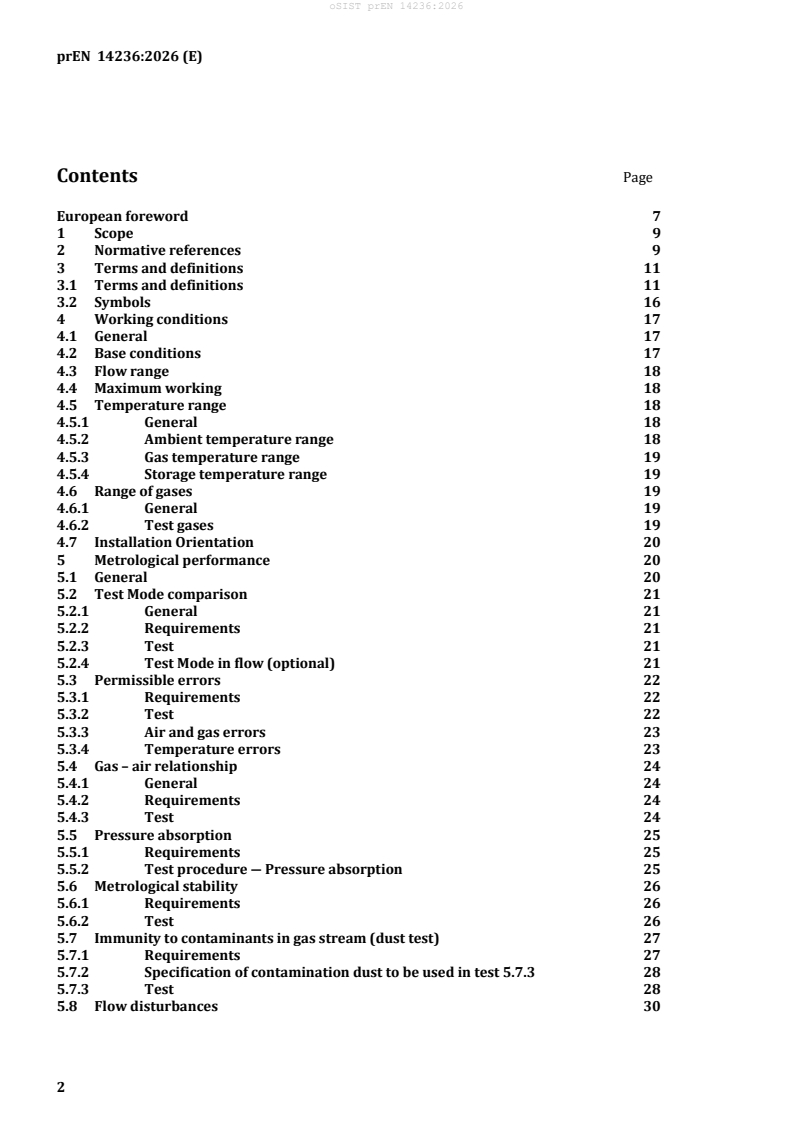
Contents Page
European foreword 7
1 Scope 9
2 Normative references 9
3 Terms and definitions 11
3.1 Terms and definitions 11
3.2 Symbols 16
4 Working conditions 17
4.1 General 17
4.2 Base conditions 17
4.3 Flow range 18
4.4 Maximum working 18
4.5 Temperature range 18
4.5.1 General 18
4.5.2 Ambient temperature range 18
4.5.3 Gas temperature range 19
4.5.4 Storage temperature range 19
4.6 Range of gases 19
4.6.1 General 19
4.6.2 Test gases 19
4.7 Installation Orientation 20
5 Metrological performance 20
5.1 General 20
5.2 Test Mode comparison 21
5.2.1 General 21
5.2.2 Requirements 21
5.2.3 Test 21
5.2.4 Test Mode in flow (optional) 21
5.3 Permissible errors 22
5.3.1 Requirements 22
5.3.2 Test 22
5.3.3 Air and gas errors 23
5.3.4 Temperature errors 23
5.4 Gas – air relationship 24
5.4.1 General 24
5.4.2 Requirements 24
5.4.3 Test 24
5.5 Pressure absorption 25
5.5.1 Requirements 25
5.5.2 Test procedure ― Pressure absorption 25
5.6 Metrological stability 26
5.6.1 Requirements 26
5.6.2 Test 26
5.7 Immunity to contaminants in gas stream (dust test) 27
5.7.1 Requirements 27
5.7.2 Specification of contamination dust to be used in test 5.7.3 28
5.7.3 Test 28
5.8 Flow disturbances 30
5.8.1 Requirements 30
5.8.2 Test 30
5.9 Zero flow 34
5.9.1 Requirements 34
5.9.2 Test 34
5.10 Reverse flow 35
5.10.1 Requirements 35
5.10.2 Test 35
5.11 Low flow registration 35
5.11.1 Requirements 35
5.11.2 Test 35
5.12 High flow registration 35
5.12.1 Requirement 35
5.12.2 Test 35
5.13 Pulsed (unsteady) flow 35
5.13.1 General 35
5.13.2 Requirements 36
5.13.3 Test 36
5.14 Temperature sensitivity 36
5.14.1 Requirements 36
5.14.2 Test 36
6 Construction and materials 37
6.1 Mechanical Interference 37
6.1.1 Requirements 37
6.1.2 Test 37
6.2 Unauthorized interference 37
6.2.1 Requirements 37
6.2.2 Test 37
6.3 Robustness of meter case 38
6.3.1 Meter case 38
6.3.2 Protection against penetration of dust and water 38
6.3.3 External leak tightness 38
6.3.4 Resistance to internal pressure 38
6.3.5 Heat resistance 39
6.3.6 Resistance to Impact 39
6.3.7 Resistance to mishandling 42
6.4 Connections 42
6.4.1 Orientation 42
6.4.2 Nominal connection diameters for single and two pipe meters 42
6.4.3 Strength 44
6.5 Resistance to vibration 46
6.5.1 Requirement 46
6.5.2 Apparatus 46
6.5.3 Test 47
6.6 Corrosion protection 47
6.6.1 General 47
6.6.2 External corrosion 48
6.6.3 Internal corrosion 49
6.7 Flame retardance of external surfaces 50
6.7.1 Requirements 50
6.7.2 Test 50
6.8 Requirements for rubber components in the gas path 50
6.8.1 Requirements 50
6.8.2 Test 50
6.9 Resistance to storage temperature range 50
6.9.1 Requirement 50
6.9.2 Test 50
6.10 Resistance to the effects of toluene/iso-octane vapour 51
6.10.1 Requirements 51
6.10.2 Test 51
6.11 Resistance to water vapour 53
6.11.1 Requirements 53
6.11.2 Test 53
6.12 Ageing 54
6.12.1 Requirements 54
6.12.2 Test 55
7 Optional features 55
7.1 Pressure measuring point 55
7.1.1 Requirements 55
7.1.2 Test 55
7.2 Electrical insulating feet (optional) 56
7.2.1 Requirements 56
7.2.2 Test 56
7.3 Resistance to high ambient temperature 56
7.3.1 Requirements 56
7.3.2 Test 57
7.3.3 Typical Test Apparatus 57
7.4 Meter fitted with a thermal cut-off valve 58
7.4.1 Requirements 58
7.4.2 Test 58
7.5 Meters with temperature conversion 58
7.6 Additional Functionalities (if fitted) 58
7.6.1 Requirement 58
7.6.2 Test 59
7.7 Use in hazardous zones 59
7.7.1 Requirement 59
7.7.2 Test 59
8 Index 59
8.1 Recording and storage 59
8.1.1 Requirement 59
8.1.2 Test 59
8.2 Display 59
8.2.1 Requirement 59
8.2.2 Test 60
8.3 Display functionality 60
8.3.1 Requirements 60
8.3.2 Test 60
8.4 Non-volatile memory 61
8.4.1 Requirements 61
8.4.2 Test 61
9 Marking 62
9.1 All meters 62
9.2 Two-pipe meters 62
9.2.1 Requirements 62
9.2.2 Test 63
9.3 Durability and legibility of marking 63
9.3.1 Requirement 63
9.3.2 Closed location Test 63
9.3.3 Open location Tests 63
9.4 Indelibility of marking 64
9.4.1 Requirements 64
9.4.2 Test 64
9.5 Accompanying information 64
10 Software 64
10.1 Requirements 64
10.2 Test 65
11 Communications 65
11.1 General 65
11.1.1 Requirements 65
11.1.2 Test 65
11.2 Metrological influence of radio communication function 65
11.2.1 Requirements 65
11.2.2 Test 65
11.3 Test-mode 66
11.3.1 Requirement 66
11.3.2 Test 66
11.4 Data optical port(optional) 66
11.5 Galvanic port (optional) 66
11.6 Diagnostics 66
11.6.1 Requirements 66
11.6.2 Test 67
11.6.3 Display Flags 67
12 Battery 68
12.1 General 68
12.2 Additional Requirements 68
12.2.1 Voltage interruptions 68
12.2.2 Minimal operating voltage 68
12.2.3 Battery life 68
13 Immunity to electromagnetic disturbances 68
13.1 General 68
13.2 Electrostatic discharge 69
13.2.1 Requirements 69
13.2.2 Test 69
13.3 Radio frequency electromagnetic field 69
13.3.1 Requirements 69
13.3.2 Test 69
13.4 Electromagnetic induction (power frequency) 70
13.4.1 Requirements (zero flow) 70
13.4.2 Test 70
13.4.3 Requirements (under flow conditions) 71
13.4.4 Test 71
13.5 Electromagnetic induction (pulsed field) 71
13.5.1 Requirements (zero flow) 71
13.5.2 Test 71
13.5.3 Requirements (under flow conditions) 71
13.5.4 Test 71
13.6 Radio interference suppression 72
13.6.1 Requirements 72
13.6.2 Test 72
14 Ultrasonic (acoustic) noise interference 72
14.1 Requirements 72
14.2 Test 72
14.2.1 Test sequence 72
14.2.2 White noise test 72
14.2.3 Scanning frequency test 73
15 Meters supplied for testing 73
Annex A (informative) Production requirements for meters 76
A.1 General 76
A.2 Technical requirements 76
A.2.1 General 76
A.2.2 Verification of conformity at the temperature of the test laboratory 76
A.2.3 Meters with a built-in gas temperature conversion 77
A.3 Declaration of conformity 77
A.4 Provision of information 78
A.5 Certificates of conformity 78
Annex B (informative) Meters with gas temperature conversion devices 80
B.1 Scope 80
B.2 Metrological performance 80
B.2.1 Errors of indication 80
B.3 Error of indication where the gas and ambient temperatures are not equal 82
B.3.1 Requirements 82
B.3.2 Marking 83
B.3.3 Temperature sensitivity 84
B.3.4 Temperature converted volume 84
Annex C (informative) Test Gases 85
C.1 General 85
C.2 Test gas properties 85
Annex ZA (informative) Relationship between this European Standard and the Essential
Requirements of EU Directive 2014/32/EU Measuring Instruments Directive aimed to be
covered 87
Bibliography 92
European foreword
This document (prEN 14236:2026) has been prepared by Technical Committee CEN/TC 237 “Gas
meters” the secretariat of which is held by BSI.
This document is currently submitted to the CEN Enquiry.
This document will supersede EN 14236:2018.
This document has been prepared under a standardization request addressed to CEN by the European
Commission. The Standing Committee of the EFTA States subsequently approves these requests for its
Member States.
For the relationship with EU Legislation, see informative Annex ZA, which is an integral part of this
document.
2018 are the following:
— 1 - additional text
— 2 - updated and additional normative references included
— 3–1 - some definitions removed and some added
— 3.2 - subclauses removed and some new symbols added
— 4.1, 4.2, and 4.3 - new clauses and original clauses renumbered
— 5.1 and 5.2
— 5.3.3 and 5.3.4 - new subclauses
— 5.8 - replaced by new 5.8
— New 6.2
— 6.2 - now Clause 6.3, and 6.2.1 and 6.2.2 renumbered 6.3.1 and 6.3.2
— 6.2.3 - now 6.3.4, text changed
— 6.2.4 - now 6.3.3, text changed
— 6.2.5 - now 6.3.5
— 6.2.6 - now 6.4
— 6.2.7 - now 6.5, format and content changed from the original 6.2.7
— 6.2.8 - now 6.3.6, format and content changed from the original 6.2.8
— 6.2.9 - now 6.3.7, content of new 6.3.7.2 changed from original 6.2.9.2
— 6.3 - now Clause 6.6, formal and content changed from the original 6.3
— 6.4 to 6.8 - deleted
— 6.9 - now 6.7
New 6.8
—
— 6.10 - now 6.9
— 6.11 - now 6.10
— 6.12 - now 6.11, new 6.11.2 content changed from the original 6.12.2
— 6.13 - now 6.12, new 6.12.1 content changed from the original 6.13.1
— New 7.2
— 7.2 to 7.2.2.2 inclusive- renumbered 7.3 to 7.3.2.2 inclusive
— 7.2.3 - now 7.4
— New 7.5
— 7.4 - now 7.6, new title
— 7.5 - now 7.7, content changed from original 7.5
— 8.2 - Content changed
— 8.3 - Title changed and content
— 8.5 - deleted
— 9.3 - format changed
— New 9.4
— 9.4 - now 9.5, content changed from original 9.4
— 10.1 - content changed
— 11 - format and content changed
— 12 - some content changed
— 13 - some content change
— Annex A - now Annex C
— Annex B - now Annex A, content changed
— Annex C - now Annex B
1 Scope
This document specifies requirements and tests for the construction, performance and safety of class 1,0
and class 1,5 battery powered ultrasonic gas meters (hereinafter referred to as meters), having co-axial
single pipe, or two pipe connections, used to measure volumes of distributed fuel gases of the 2nd and/or
1)
3rd family gases as given in EN 437:2021, at maximum working pressures not exceeding 0,5 bar ) and
/h over a minimum ambient temperature range of −10 °C to
maximum actual flow rates of up to 40 m
+40 °C, and minimum gas temperature span of 40 K. This document applies to meters where the
measuring element and the register(s) are enclosed in the same case.
This document applies to meters with and without built-in temperature conversion, that are installed in
locations with vibration and shocks of low significance and in
— closed locations (indoor or outdoor with protection as specified by the manufacturer) with
condensing or with non-condensing humidity;
or, if specified by the manufacturer;
— open locations (outdoor without any covering) both with condensing humidity or with non-
condensing humidity;
and in locations with electromagnetic disturbances likely to be found in residential, commercial and light
industrial use.
Unless otherwise stated, all pressures given in this document are gauge pressures.
Clauses 1 to 14 are for design and type testing only.
Requirements for electronic indexes, batteries, valves incorporated in the meter and other additional
functionalities are given in EN 16314:2013
Unless otherwise stated in a particular test, the tests are carried out on meters that include additional
functionality devices intended by the manufacturer.
When more than one meter type is submitted for testing, then each meter type needs to be tested against
this document.
2 Normative references
The following documents are referred to in the text in such a way that some or all of their content
constitutes requirements of this document. For dated references, only the edition cited applies. For
undated references, the latest edition of the referenced document (including any amendments) applies.
EN 437:2021, Test gases - Test pressures - Appliance categories
EN 549:2019+A2:2024, Specification for rubber materials for seals and diaphragms for gas appliances and
gas equipment
EN 16314:2013, Gas meters - Additional functionalities
EN 55032:2015, Electromagnetic compatibility of multimedia equipment - Emission Requirements
1)
1 bar =1 000 mbar = 105 Pa.
As impacted by EN 55032:2015/A1:2020, EN 55032:2015/A11:2020 and EN 55032:2015/AC:2016-07.
EN IEC 60079-0:2018, Explosive atmospheres - Part 0: Equipment - General requirements (IEC 60079
0:2017)
EN 60079-7:2015, Explosive atmospheres - Part 7: Equipment protection by increased safety "e"
EN IEC 60079-11:2024, Explosive atmospheres - Part 11: Equipment protection by intrinsic safety "i"
(IEC 60079-11:2023)
EN IEC 60079-15:2019, Explosive atmospheres — Part 15: Equipment protection by type of protection “n”
(IEC 60079-15:2017)
EN 60529:1991, Degrees of protection provided by enclosures (IP Code) (IEC 60529:1989)
EN 60695-11-5:2017, Fire hazard testing - Part 11-5: Test flames - Needle-flame test method - Apparatus,
confirmatory test arrangement and guidance (IEC 60695-11-5:2016)
EN 60695-11-10:2013, Fire hazard testing - Part 11-10: Test flames - 50 W horizontal and vertical flame
test methods (IEC 60695-11-10:2013)
EN IEC 60730-1:2024, Automatic electrical controls for household and similar use - Part 1: General
requirements (IEC 60730-1:2022)
EN IEC 61000-4-2:2025, Electromagnetic compatibility (EMC) - Part 4-2: Testing and measurement
techniques - Electrostatic discharge immunity test (IEC 61000-4-2:2025)
EN IEC 61000-4-3:2020, Electromagnetic compatibility (EMC) — Part 4-3: Testing and measurement
techniques — Radiated, radiofrequency, electromagnetic field immunity test (IEC 61000-4-3:2020)
EN 61000-4-8:2010, Electromagnetic compatibility (EMC) - Part 4-8: Testing and measurement techniques
- Power frequency magnetic field immunity test (IEC 61000-4-8:2009)
EN 61000-4-9:2016, Electromagnetic compatibility (EMC) - Part 4-9: Testing and measurement techniques
- Impulse magnetic field immunity test (IEC 61000-4-9:2016)
EN IEC 61000-6-1:2019, Electromagnetic compatibility (EMC) — Part 6-1: Generic standards — Immunity
for residential, commercial and light-industrial environments (IEC 61000-6-1:2016)
EN IEC 61000-6-2:2019, Electromagnetic compatibility (EMC) — Part 6-2: Generic standards — Immunity
for industrial environments (IEC 61000-6-2:2016)
EN 62056-21:2002, Electricity metering - Data exchange for meter reading, tariff and load control - Part
21: Direct local data exchange (IEC 62056-21:2002)
As impacted by EN IEC 60079-0:2018/AC:2020:02 and EN IEC 60079-0:2018/A11:2024.
As impacted by EN IEC 60079 7:2015/A1:2018 and EN 60079 7:2015/A11:2024.
As impacted by EN IEC 60079-15:2019/A11:2025.
As impacted by EN 60529:1991/corrigendum May 1993, EN 60529:1991/A1:2000, EN 60529:1991/A2:2013, EN
60529:1991/A2:2013/AC:2019-02 and EN 60529:1991/AC:2016-12.
As impacted by EN 60695 11-10:2013/AC:2014.
EN ISO 1518-1:2023, Paints and varnishes — Determination of scratch resistance (ISO 1518-1: 2023)
EN ISO 2409:2020, Paints and varnishes - Cross-cut test (ISO 2409:2020)
EN ISO 2812-1:2017, Paints and varnishes - Determination of resistance to liquids - Part 1: Immersion in
liquids other than water (ISO 2812-1:2017)
EN ISO 4628-2:2016, Paints and varnishes - Evaluation of degradation of coatings - Designation of quantity
and size of defects, and of intensity of uniform changes in appearance - Part 2: Assessment of degree of
blistering (ISO 4628-2:2016)
EN ISO 4628-3:2024, Paints and varnishes — Evaluation of degradation of coatings — Designation of
quantity and size of defects, and of intensity of uniform changes in appearance — Part 3: Assessment of
degree of rusting (ISO 4628-3:2024)
EN ISO 4892-3:2024, Plastics - Methods of exposure to laboratory light sources - Part 3: Fluorescent UV
lamps (ISO 4892-3:2024)
EN ISO 6270-1:2018, Paints and varnishes - Determination of resistance to humidity - Part 1: Condensation
(single-sided exposure) (ISO 6270-1:2017)
EN ISO 6272-1:2011, Paints and varnishes - Rapid-deformation (impact resistance) tests - Part 1: Falling-
weight test, large-area indenter (ISO 6272-1:2011)
EN ISO 6272-2:2011, Paints and varnishes - Rapid-deformation (impact resistance) tests - Part 2: Falling-
weight test, small-area indenter (ISO 6272-2:2011)
EN ISO 9227:2022, Corrosion tests in artificial atmospheres - Salt spray tests (ISO 9227:2022)
EN ISO/CIE 11664-4:2019, Colorimetry — Part 4: CIE1976 L*a*b* Colour space (ISO11664-4)
ISO 834-1:2025, Fire-resistance tests — Elements of building construction — Part 1: General requirements
ASTM D1003-13:2021, Standard Test Method for Haze and Luminous Transmittance of Transparent
Plastics
3 Terms and definitions
For the purposes of this document, the following terms, definitions, and symbols apply.
ISO and IEC maintain terminology databases for use in standardization at the following addresses:
— IEC Electropedia: available at https://www.electropedia.org/
— ISO Online browsing platform: available at https://www.iso.org/obp/ui/#home
3.1 Terms and definitions
3.1.1
actual flow rate
flow rate at the gas pressure and gas temperature conditions prevailing in the gas distribution line in
which the meter is fitted, at the meter inlet
3.1.2
additional functionality
functions over and above that within the meter, which can be integral to the meter, or included within a
connected device
3.1.3
air
air of density approximately 1,2 kg/m
3.1.4
base conditions
fixed conditions to which a volume of gas is converted (e.g. base gas temperature 273,15 K plus 15 K at
base gas pressure of 1 013,25 mbar)
3.1.5
contaminants
gas borne dust, vapour and other substances that could affect the operation of the meter
3.1.6
class 1,0 meter
≤ Q < Q , and
meter which has an error of indication between −2 % and +2 % for flow rates Q, where Qmin t
an error of indication between −1 % and +1 % for flow rates Q, where Q ≤ Q ≤ Q , where Q to Q >
t max max min
20 and Q to Q > 5 and Q to Q is 1,2
max t r max
3.1.7
class 1,5 meter
meter which has an error of indication between −2 % and +2 % for flow rates Q, where Q ≤ Q < Q , and
min t
an error of indication between −1 % and +1 % for flow rates Q, where Q ≤ Q ≤ Q , where Q to Q >
t max max min
150 and Q to Q > 10 and Q to Q is 1,2
max t r max
3.1.8
communication port
air of density approximately 1,2 kg/m
3.1.9
display
device which shows information from the meter (e.g. liquid crystal that displays registers, volume or
flags)
3.1.10
distributed gas
locally available gas
3.1.11
error of indication
∈
value which shows the relationship in percentage terms of the difference between the volume indicated
by the meter and the volume which has actually flowed through the meter, to the latter volume:
Vi− Vc
∈⋅ 100
Vc
where
is the indicated volume in cubic metres (m )
V
i
is the volume in cubic metres (m ) that has actually flowed through the meter
V
c
3.1.12
distriburbance
influence quantity having a value within the limits specified but outside the specified rated operating
conditions of the measuring instrument
3.1.13
durability
ability of an instrument to maintain its performance characteristics over a specified period of use
3.1.14
event
condition requiring action or to log an action
3.1.15
external leak tightness
leak tightness of the gas carrying components of the meter into the atmosphere
3.1.16
flag
single alphabetic character on the index giving a visual signal of significant events and/or change(s) in
the operation of the meter
3.1.17
galvanic connection/interface
hard wired serial connection or pulse output from the meter
3.1.18
gas meter
instrument designed to measure, memorize and display the volume of fuel gas that has passed through it
3.1.19
gauge pressure
absolute pressure minus atmospheric pressure
3.1.20
index
current reading of the total volume (mass) passed through the meter
3.1.21
index window
area of transparent material through which the index can be read
3.1.22
maximum error shift
maximum mean error shift at any of the tested flow rates
3.1.23
maximum flow rate
highest flow rate at which the meter provides indications that satisfy the requirements regarding
maximum permissible error (MPE)
3.1.24
maximum working pressure
upper limit of the working pressure for which the meter has been designed, as declared by the
manufacturer and marked on the index or the casework
3.1.25
mean error
arithmetic mean of consecutive errors of indication at a flow rate
3.1.26
measuring element
part of the meter which produces an electrical signal proportional to the gas flow rate
3.1.27
memory
element which stores digital information
3.1.28
meter case
pressure containing structure of the meter
3.1.29
meter class
class to which a meter belongs, according to the metrological requirements of this document, i.e. class 1,5
or class 1,0
3.1.30
meter cover
rigid enclosure on the front of the meter made either wholly of transparent material, or of opaque
material provided with index window(s)
3.1.31
MPE
maximum permissible error for a class
3.1.32
minimum flow rate
lowest flowrate at which the meter provides indications that satisfy the requirements regarding MPE
3.1.33
normal conditions of use
conditions referring to the meter operating:
— at a pressure up to the maximum working pressure (with or without a flow of gas);
— within the range of flow rates;
— within the ambient temperature range;
— within the gas temperature range;
— with the distributed gas
3.1.34
operating mode
method (sample frequency and timing) of obtaining volume flow measurements
3.1.35
working pressure range
limits of working pressure, as declared by the manufacturer, for which the meter will continue to operate
within its metrological characteristics
3.1.36
operating temperature range
range of gas and ambient temperatures for which the meter satisfies the metrological requirements of
this standard
3.1.37
optical port
serial data port using an infra-red transmitter and receiver
3.1.38
overload flow rate
the highest flow rate at which the meter operates for a short period of time without deteriorating
3.1.39
pressure absorption
difference between the pressure measured at the inlet and outlet connections of the meter whilst the
meter is operating
3.1.40
pressure measuring point
permanent fitting on the meter outlet enabling a direct measurement of the outlet pressure to be obtained
3.1.41
range of mean errors
difference between the minimum and maximum mean errors over a specified flow range
3.1.42
reference conditions
conditions of use prescribed for testing the performance of a measuring instrument or for inter
comparison of results of results measurements
3.1.43
regression line
straight line, generated using a statistical method, to give a graphical representation of a set of results
3.1.44
register
electronic device comprising both memory and display, which stores and displays information
3.1.45
segment
individual part of a display which is able to show a portion of a character
3.1.46
starting flow rate
lowest flow rate at which the meter is able to indicate a volume of gas passed
3.1.47
storage temperature range
range of temperatures at which the meter can be stored without being adversely affected
3.1.48
temperature conversion device
device which converts the measured volume to a corresponding volume at base gas temperature
3.1.49
test house
organisation used to perform prescribed tests on meters, in accordance with this standard
3.1.50
thermal cut-off valve
heat sensitive valve used to cut off the flow of gas to the meter if the ambient temperature rises above a
predetermined level for a specified time
3.1.51
transitional flow rate
flow rate occurring between the maximum and minimum flow rates at which the flow rate range is
divided into two zones, the upper zone and the lower zone, each zone having a characteristic MPE
3.1.52
ultrasonic gas meter
meter that uses ultrasound and that is designed to measure, memorize and display the volume of gas that
has passed through it
3.1.53
ultrasonic transducer
device used to generate and detect the ultrasound signals within the meter
3.1.54
working pressure
difference between the pressure of the gas at the inlet of the meter and the atmospheric pressure
3.2 Symbols
D outside diameter of the pipe in millimetres (mm)
−2
g
acceleration due to gravity, in metres per square second ( m ⋅ s )
MPE maximum permissible error, in percent (%)
p base pressure to which the indicated volume is referred
b
p maximum working pressure
max
Q maximum flow rate, specified in cubic metres per hour (m /h) for which the meter has
max
been designed
Q minimum flow rate, specified in cubic metres per hour (m /h) for which the meter has
min
been designed
Q overload flow rate, the highest flow rate at which the meter operates for a short period of
r
time without deteriorating
Q overload flow rate, the highest flow rate at which the meter operates for a short period of
r
time without deteriorating
Q lowest flow rate at which the meter is capable of registering the passage of gas, as
start
declared by the manufacturer
Q transitional flow rate, occurring between the maximum and minimum flow rates at which
t
the flow rate range is divided into two zones, the ‘upper zone’ and the ‘lower zone’
NOTE Each zone has a characteristic maximum permissible error
t base gas temperature
b
t base gas temperature for meters declared suitable for differential temperature and
b,I
intermittent operation
t ambient temperature of the meter
m
t declared minimum operating temperature of the meter
min
t declared maximum operating temperature of the meter
max
t gas temperature range of the meter
g
t specified centre temperature for a temperature converted meter
sp
4 Working conditions
4.1 General
If no specific requirements are given, the test equipment shall be traceable to a national or international
reference standard and the uncertainty shall be equal or better than:
— for type evaluation 1/5 of the maximum permissible error; and
— for verification 1/3 of the maximum permissible error.
4.2 Base conditions
Base conditions of temperature (tb) and pressure (pb) shall be specified and marked on the data plate of
the meter.
In particular, the following formula applies for the conversion of test volumes to the base conditions of
the meter under test:
tC + 273,15
( ) p bar
b ( )
a
V =V⋅ ⋅ where pp = + P
tb,P a a amb gauge
b
p bar
( )
tC + 273,15
a
( )
a
where
p is the absolute inlet pressure of the meter under test, i.e. the sum of two pressure contributes
a
defined as follows:
p : barometric pressure during test;
amb
p : inlet gauge pressure of meter under test;
gauge
t is the steady temperature of the test volume;
a
V is the volume at actual condition.
a
4.3 Flow range
The values of maximum flow rates and those corresponding values shall be those given in Table 1.
Table 1 — Flow range
Qr
Upper limits of Q
t
Q Upper limits of Q m /h)
max min
m /h)
m /h)
2,5 0,016 0,25 3,0
4 0,025 0,4 4,8
6 0,040 0,6 7,2
10 0,060 1,0 12,0
16 0,1 1,6 19,2
25 0,16 2,5 30,0
40 0,25 4,0 48,0
The definitions of the meter classifications applicable in this European Standard are given in Table 2.
Table 2 — Flow rate ranges by meter classification
Class Q /Q Q /Q Q /Q
max min max t r min
2,5 0,016 0,25 3,0
4 0,025 0,4 4,8
4.4 Maximum working
The maximum working pressure of the meter shall be declared. It shall not exceed 0,5 bar, and this
pressure shall be marked on the index or casework of the meter.
4.5 Temperature range
4.5.1 General
Unless otherwise stated, all temperatures given in this document shall be measured to within ± 1 °C.
4.5.2 Ambient temperature range
All meters shall be capable of meeting the requirements for a minimum ambient temperature range of
−10 °C to +40 °C, this shall be verified by conforming with the requirements given in Clause 5 and
Clause 6.
The manufacturer can declare a wider design temperature range but shall use the minimum and
maximum temperature limits as specified in Table 3 and Table 4.
Table 3 — Upper temperature limit
Upper temperature limit of t
m
30°C 40°C 55°C 70°C
Table 4 — Lower temperature limit
Lower temperature limit of t
m
5°C −10°C −25°C −40°C
4.5.3 Gas temperature range
All meters shall be designed for a gas temperature range equal to, or within the ambient temperature
range, with a minimum gas temperature span of 40°C. Upper and lower limit of gas temperature shall be
chosen in accordance with Table 3 and Table 4. This shall be verified by conforming with the
requirements of 5.3.1 and 5.9.
4.5.4 Storage temperature range
All meters shall be designed for a storage temperature of ≤ −20 °C to ≥ +60 °C and in any case shall have
a range equal to or wider than the declared ambient temperature range. This shall be verified by
conforming with the requirements of 6.9.
4.6 Range of gases
4.6.1 General
The range of gases for which the meter has been designed, in terms of gas families, for at least one group
shall be specified in accordance with EN 437:2021.
Additionally, the meter shall be designed to work on air fulfilling the air-gas relationship requirements
specified in 5.4.
4.6.2 Test gases
The range of gases for which the meter is suitable shall be specified from Table 5.
Table 5 — Gas groups (from EN 437)
Second Groups H L E
family
Third Groups P/B P B
family
Additional Air
Meters suitable for:
— second family gases shall be tested with air and ≥99,5 % CH4;
— third family gases shall be tested with air and ≥99,5 % Propane and/or ≥99,5 % Butane, as
appropriate.
By agreement with the Test house any other test gas can be included. The additional gases shall be
marked on the meter as defined in 9.1.
NOTE For further information on test gases see Annex B.
4.7 Installation Orientation
Where meters can be installed in orientations other than with the connection ports vertical, meters shall
be tested in those other orientations, for durability and as agreed with the Test house.
5 Metrological performance
5.1 General
Where the manufacturer declares that the meter can be used in two directions (forward and reverse flow)
then all the tests shall be performed in both directions.
The flow rate shall be determined using sample times that are not readily predictable within discrete
time intervals.
These time intervals (τ) shall not exceed 2 s, unless the manufacturer can demonstrate that a proposed
longer time interval will not cause the metrological characteristics of the meter to be affected by unsteady
flow conditions.
Irrespective of whether the discrete time intervals are longer than 2 s, the requirements specified in
5.13.2 shall still be applied
Provision shall be made for synchronizing the start and finish of test periods (with test equipment),
according to the manufacturer’s specification e.g. via a galvanic connection or optical port.
Any failure in synchronising test equipment with the meter under test may introduce an error
contribution, calculated as follows in 2.
τ
MAX
ε%,τ t= 2⋅⋅ 100
( )
t
where
τ is the maximum sampling time of the meter under test in seconds;
t is the test time in seconds.
Where τ is not specified by manufacturer, τ = 2s shall be used in the calculation.
The meter shall have a mode, providing volume resolution of at least 0,1 dm .
The meter shall have a fast-sampling mode with sampling time not exceeding 0,5 s.
All modes other than the normal mode shall only be available for a maximum of 24h before reverting to
normal operating mode, unless explicitly declared by the manufacturer.
The meter, including any additional functionality devices intended by the manufacturer, shall have the
error adjusted as close to zero as the adjustments allow, without systematically favouring any party.
After the meter has been subjected to other influences, given in the individual clauses of this standard,
the average of the errors of indication of the meter shall either:
— not vary from the average of the initial errors of indication by more than that allowed by those
clauses or;
— be within the error limits specified within those clauses.
5.2 Test Mode comparison
5.2.1 General
When the meter has one or more fast sampling modes in addition to the normal operating mode, then
provided that the requirements in 5.2.2 are met, all subsequent tests in this European Standard shall be
carried out in the test-mode. If the requirement is not satisfied, then all subsequent tests shall be
performed in the normal operating mode.
Where specific modes of measurement for managing flow outside the controlled range are present in the
normal operating mode, these can be disabled in test mode, unless otherwise specified.
Provision shall be made to ensure that any test gas is properly detected by the meter under test. In
particular, where the meter has a gas detection system that occurs at a fixed time interval, the gas
detection procedure shall also be performed whenever the test-mode is activated.
5.2.2 Requirements
The accuracy of the measurements shall not be influenced by different sampling modes.
The difference of the mean errors of the normal operating mode and the test-mode shall not exceed the
following limits:
— 0,6% for any flow rate Q ≤ Q < Q ;
min t
— 0,3% for any flow rate between Q ≤ Q ≤Q .
t max
In both modes, the mean error shall be within the maximum permissible errors as specified in Table 6.
If this requirement is not satisfied, subsequent tests shall be undertaken in the normal operating mode.
5.2.3 Test
Test the meter in the standard mode and in the test-mode in air, in accordance with 5.3.2, Table 6.
Calculate the difference in mean error at each flow rate and ensure requirement in 5.2.2 is met.
5.2.4 Test Mode in flow (optional)
5.2.4.1 General
Where the meter provides instantaneous flow rate readings, these can be used as an alternative to volume
for calculating the error of measurement at steady flow profiles, unless otherwise specified in this
standard.
5.2.4.2 Requirements
Select the test mode and carry out the test in accordance with 5.2.4.3 at a given steady test flow rate. The
difference of the mean errors of the normal operating mode and the test-mode shall not exceed the
following limits:
— 0,6% for any flow rate Q ≤ Q < Q ;
min t
— 0,3% for any flow rate between Q ≤ Q ≤ Q .
t max
5.2.4.3 Test
Test the meter in the normal operating mode and in the test-mode in flow in accordance with Table 7,
test a).
Calculate the difference in mean error at each flow rate, using either of the following equations, and
ensure that error is within the limits specified in 5.2.4.2.
V −−V Q Q
bc b c
E= ⋅ 100,ε= ⋅ 100
xx
VQ
cc
where
E is the mean error in volume;
x
ε is the mean error in flow;
x
V is the volume read by the meter, at base conditions;
b
V is the volume read by the reference instrument, converted to meter under test base
c
conditions;
Q is the flow rate read by the meter, at base conditions;
b
Q is the flow rate read by the reference instrument, converted to meter under test base
c
conditions. Qc can be either measured directly or inferred by ratio Q = V / t where t is the test
c c x x
duration at any given steady test flowrate.
5.3 Permissible errors
5.3.1 Requirements
The meter shall be adjusted such that it does not exploit the MPE and is correctly calibrated when the
adjustment is as close to zero as possible, by using method a) or b).
It shall be declared which of the following two methods has been adopted:
1) Weighted Mean Error (WME) between -0,6 % and 0,6 %; or
2) when the errors between Q and Q all have the same sign, they do not exceed 1,3 %.
t max
When tested in accordance with 5.3.2, the mean error E for both air and test-gases shall be within the
x
maximum permissible errors specified in Table 6. This shall apply at minimum and maximum declared
temperature including any additional test temperature comprised between t and t .
min max
Table 6 — Maximum permissible errors, class 1,5 and class 1,0
Maximum permissible errors
Flow rate
m /h
Class 1,5 Class 1,0
Q ≤ Q ≤ Q ±3 % ±2 %
min t
Qt ≤ Q ≤ Q ±1,5 % ±1 %
max
5.3.2 Test
5.3.2.1 General
Thermally stabilize the meter to be tested to the temperature of the test laboratory.
Pass a volume of air at 20 °C measured by a reference standard, through the meter and note the volume
indicated by the meter. The minimum volume of air to be passed through the meter is specified by the
manufacturer and agreed with the Test house.
Carry out the tests specified in 5.3.3 and 5.3.4, in air, in any order, then record ‘n’ repeated errors at each
of the flow rates and calculate their mean value.
5.3.2.2 Method a)
If method 5.3.1a) is chosen, calculate the WME using the mean values at different flow rates.
n
kE
∑ ii
Qi
il=
WME with k for Q ≤ 0.7Q
ii max
n
Qmax
k
Qi
∑ i
1.4 - for Q ≤ 0.7Q
max max
il=
Qmax
where
K is the weighting factor at the flow rate Q ;
i
i
E is the mean error in flow rate Q .
i
i
5.3.2.3 Method b)
If method b) is chosen (see 5.3.1), determine whether any errors between Q and Q all have the same
t max
sign and the value do not exceed 1,3 %.
5.3.3 Air and gas errors
Test the meter using air and the test gases specified by the manufacturer in accordance with Table 7, Test
a).
5.3.4 Temperature errors
Test the meter on air at t and t in accordance with Table 7, Test b).
min max
Table 7 — Error tests on air and gases
Test Test Flow rates Number of Minimum number of
consecutive consecutive tests in
a
tests in air (n) gas (n)
a) Q ; 3 Q ; 5 Q ; 10 Q ; 0,1 Q ; 6 2
min min min min max
0,2 Q ; 0,4 Q ; 0,7 Q ; Q
max max max max
b) 0,1 Q ; Q . 3 2
max max
c) Q ; 0,1 Q ; 0,4 Q ; Q . 3 2
min max max max
d) Q ; 0,1 Q ; Q . 3 2
min max max
e) 0,05 Q 3 X
max
f) Q 3 X
max
a
Refer to 5.4.1 below.
==
5.4 Gas – air relationship
5.4.1 General
Where meters fulfil the requirements in 5.4.2, all of the following tests shall be carried out on air only.
5.4.2 Requirements
The difference between the mean errors (i.e. the error of indication of the meter) on the test gases and
that on air, at each flow rates, shall be within the limits specified in Table 8.
If the requirements given in Table 8 are not fulfilled, then all subsequent tests shall be carried out using
both air and test gases unless otherwise specified. See Figure 1.
Table 8 — Mean error difference between gas and air
Flow rate Maximum mean error
difference
m /h Class 1,5 Class 1,0
Q ≤ Q < Q ±3 % ±2 %
min t
Q ≤ Q ≤ Q ±1,5 % ±1 %
t max
5.4.3 Test
Apply the requirements of 5.4.2 to the results from testing the meter in air and gas in accordance with
Table 7, Test a).
Key
X flow rate
Y error %
class 1,5
maximum mean error difference
error curve on air
error curve on gas
Figure 1 — Maximum mean error differences between air and gas for class 1,5
5.5 Pressure absorption
5.5.1 Requirements
−3
The pressure absorption of a meter with a flow of air with a density of 1,2 kg.m , at a flow rate equal to
Qmax, shall not exceed the values given in Table 9.
Table 9 — Pressure Absorption
Q Maximum permissible values for pressure
max
3 −1 absorption
m .h
Initial (mbar) Endurance (mbar)
2,5 ≤ Q ≤ 16 inclusive 2 2,2
max
25 ≤ Q ≤ 40 inclusive 3 3,3
max
5.5.2 Test procedure ― Pressure absorption
Supply the meter under test with a flow of air of density 1,2 kg/m , at a flow rate equal to Q and
max
measure the differential pressure across the meter with a suitable measuring instrument, accurate to 0,1
mbar.
The distance between the pressure test points and the meter connections shall not exceed three times
the nominal internal connection diameter of the meter connection points for two pipe meters and shall
not exceed three times the nominal internal diameter of the minimum typically installed supply pipe to
coaxial, single pipe meters.
Alternatively, a measurement method may
...