

EN 16603-50-51:2014
(Main)Space engineering - SpaceWire protocol identification
- Abstract
There is a number of communication protocols that can be used in conjunction with the SpaceWire Standard (ECSS-E-ST-50-12), to provide a comprehensive set of services for onboard user applications. These protocols are covered by the ECSS-E-ST-50-5x series.
To distinguish between the various protocols a protocol identifier is used. This Standard specifies this protocol identifier.
This standard may be tailored for the specific characteristic and constrains of a space project in conformance with ECSS-S-ST-00.
- Status
- Published
- Publication Date
- 09-Sep-2014
- Withdrawal Date
- 30-Mar-2015
- Technical Committee
- CEN/CLC/TC 5 - Space
- Drafting Committee
- CEN/CLC/TC 5 - Space
- Current Stage
- 9060 - Closure of 2 Year Review Enquiry - Review Enquiry
- Start Date
- 03-Mar-2020
- Completion Date
- 03-Mar-2020

Overview
EN 16603-50-51:2014 - "Space engineering - SpaceWire protocol identification" (CEN) defines the protocol identification scheme used to distinguish multiple communication protocols operating over a SpaceWire network. The standard specifies how a Protocol Identifier and an optional Extended Protocol Identifier are carried in SpaceWire packets, allocation and reserved values, addressing behavior at targets, and handling of unknown protocols. It is intended for tailoring per ECSS-S-ST-00 for project-specific constraints.
Key topics and technical requirements
Packet addressing
- A packet arriving at a target shall start with a single-byte logical address (the SpaceWire network may strip path addresses en route).
- Default logical address is 254 (0xFE); targets may choose to ignore this value or accept multiple logical addresses.
Protocol Identifier (PID)
- A single byte immediately following the logical address identifies the protocol.
- Value 0x00 is reserved to indicate an Extended Protocol Identifier.
- Value 0xFF (255) is reserved and shall not be used.
Extended Protocol Identifier (EPID)
- When used, the PID byte is 0x00 and the next two bytes form a 16-bit EPID, enabling up to 65,535 protocol identifiers.
- EPID values 0x0000–0x00FF are reserved and must not be used.
- If a target does not support EPID, packets with PID 0x00 must be discarded.
Unknown protocol handling
- Packets with unsupported PID or EPID shall be discarded; targets may keep counts of discarded packets for diagnostics.
Allocation ranges
- PID 1–239 (0x01–0xEF) are allocated by the SpaceWire working group (examples: RMAP = 1, CCSDS Packet Transfer Protocol = 2, GOES‑R = 238, legacy serial = 239).
- PID 240–254 (0xF0–0xFE) are project‑assignable (risk of conflicts if not coordinated).
- No EPIDs are currently allocated in the standard; consult the SpaceWire website for updates.
Applications and who uses it
- Applicable for spacecraft avionics, on‑board data handling, payload interfaces and satellite network design.
- Primary users:
- SpaceWire system architects and network engineers
- Onboard communications protocol designers (RMAP, CCSDS implementations)
- Satellite integrators, mission systems engineers and standards/compliance teams
- Firmware developers for routers, nodes and instruments that implement SpaceWire
Related standards
- ECSS‑E‑ST‑50‑12 (SpaceWire - Links, nodes, routers and networks)
- ECSS‑E‑ST‑50‑52 (Remote Memory Access Protocol - RMAP)
- ECSS‑E‑ST‑50‑53 (CCSDS Packet Transfer Protocol)
- ECSS‑S‑ST‑00 (tailoring guidance)
Keywords: EN 16603-50-51:2014, SpaceWire, protocol identification, Protocol Identifier, Extended Protocol Identifier, RMAP, CCSDS Packet Transfer Protocol, Space engineering.
Relations
- Effective Date
- 28-Jan-2026
- Effective Date
- 28-Jan-2026
Get Certified
Connect with accredited certification bodies for this standard

BUREAU VERITAS Certification Germany
Bureau Veritas certification in Germany.

Element Materials Technology
Materials testing and product certification.

AQMS Ltd.
AQMS provides ISO certification to SMEs across the UK.
Sponsored listings
Frequently Asked Questions
EN 16603-50-51:2014 is a standard published by the European Committee for Standardization (CEN). Its full title is "Space engineering - SpaceWire protocol identification". This standard covers: There is a number of communication protocols that can be used in conjunction with the SpaceWire Standard (ECSS-E-ST-50-12), to provide a comprehensive set of services for onboard user applications. These protocols are covered by the ECSS-E-ST-50-5x series. To distinguish between the various protocols a protocol identifier is used. This Standard specifies this protocol identifier. This standard may be tailored for the specific characteristic and constrains of a space project in conformance with ECSS-S-ST-00.
There is a number of communication protocols that can be used in conjunction with the SpaceWire Standard (ECSS-E-ST-50-12), to provide a comprehensive set of services for onboard user applications. These protocols are covered by the ECSS-E-ST-50-5x series. To distinguish between the various protocols a protocol identifier is used. This Standard specifies this protocol identifier. This standard may be tailored for the specific characteristic and constrains of a space project in conformance with ECSS-S-ST-00.
EN 16603-50-51:2014 is classified under the following ICS (International Classification for Standards) categories: 49.140 - Space systems and operations. The ICS classification helps identify the subject area and facilitates finding related standards.
EN 16603-50-51:2014 has the following relationships with other standards: It is inter standard links to EN ISO 14814:2006, EN ISO 17262:2012. Understanding these relationships helps ensure you are using the most current and applicable version of the standard.
EN 16603-50-51:2014 is associated with the following European legislation: Standardization Mandates: M/496. When a standard is cited in the Official Journal of the European Union, products manufactured in conformity with it benefit from a presumption of conformity with the essential requirements of the corresponding EU directive or regulation.
EN 16603-50-51:2014 is available in PDF format for immediate download after purchase. The document can be added to your cart and obtained through the secure checkout process. Digital delivery ensures instant access to the complete standard document.
Standards Content (Sample)
2003-01.Slovenski inštitut za standardizacijo. Razmnoževanje celote ali delov tega standarda ni dovoljeno.Vesoljska tehnika - SpaceWire - Identifikacijski protokolRaumfahrttechnik - SpaceWire - Protokoll zur IdentifikationIngénierie spatiale - SpaceWire - identifieur de protocoleSpace engineering - SpaceWire - protocol identification49.140Vesoljski sistemi in operacijeSpace systems and operationsICS:Ta slovenski standard je istoveten z:EN 16603-50-51:2014SIST EN 16603-50-51:2014en,fr,de01-november-2014SIST EN 16603-50-51:2014SLOVENSKI
STANDARD
EUROPEAN STANDARD NORME EUROPÉENNE EUROPÄISCHE NORM
EN 16603-50-51
September 2014 ICS 49.140
English version
Space engineering - SpaceWire protocol identification
Ingénierie spatiale - SpaceWire identifieur de protocole
Raumfahrttechnik - SpaceWire Protokoll zur IdentifikationThis European Standard was approved by CEN on 1 March 2014.
CEN and CENELEC members are bound to comply with the CEN/CENELEC Internal Regulations which stipulate the conditions for giving this European Standard the status of a national standard without any alteration. Up-to-date lists and bibliographical references concerning such national standards may be obtained on application to the CEN-CENELEC Management Centre or to any CEN and CENELEC member.
This European Standard exists in three official versions (English, French, German). A version in any other language made by translation under the responsibility of a CEN and CENELEC member into its own language and notified to the CEN-CENELEC Management Centre has the same status as the official versions.
CEN and CENELEC members are the national standards bodies and national electrotechnical committees of Austria, Belgium, Bulgaria, Croatia, Cyprus, Czech Republic, Denmark, Estonia, Finland, Former Yugoslav Republic of Macedonia, France, Germany, Greece, Hungary, Iceland, Ireland, Italy, Latvia, Lithuania, Luxembourg, Malta, Netherlands, Norway, Poland, Portugal, Romania, Slovakia, Slovenia, Spain, Sweden, Switzerland, Turkey and United Kingdom.
CEN-CENELEC Management Centre: Avenue Marnix 17, B-1000 Brussels © 2014 CEN/CENELEC All rights of exploitation in any form and by any means reserved worldwide for CEN national Members and for CENELEC Members. Ref. No. EN 16603-50-51:2014 E SIST EN 16603-50-51:2014
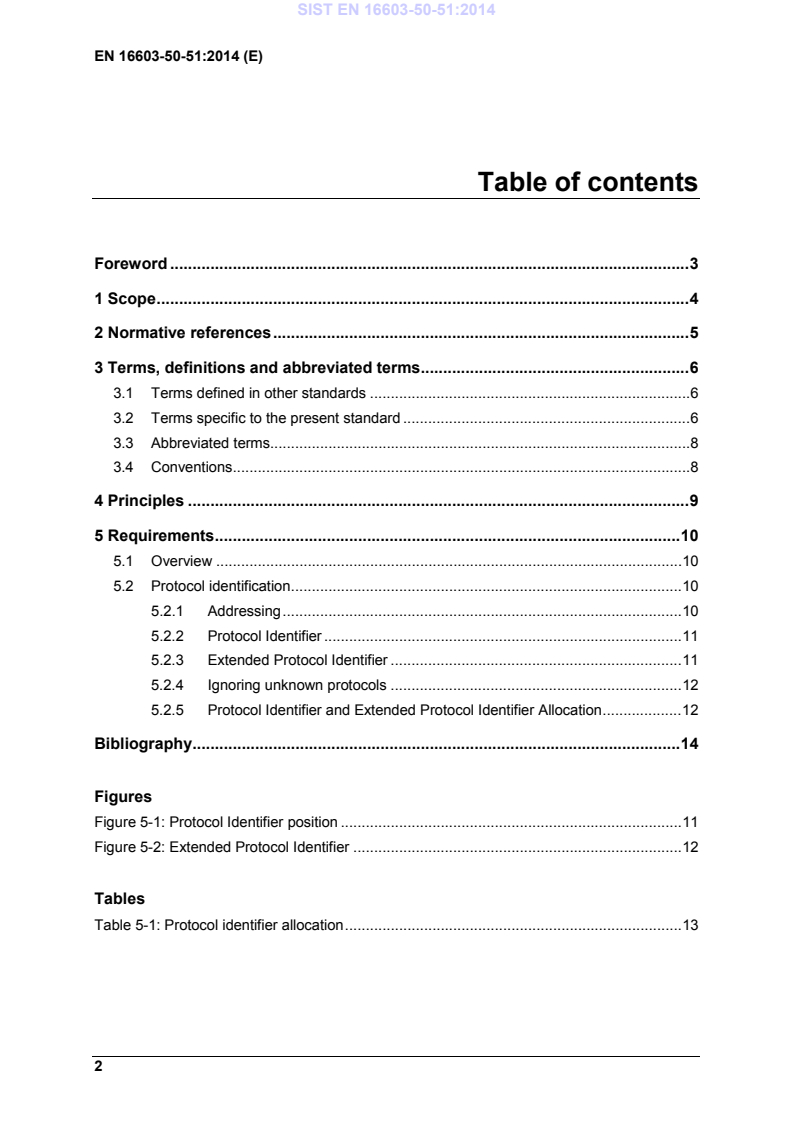
Figures Figure 5-1: Protocol Identifier position . 11 Figure 5-2: Extended Protocol Identifier . 12
Tables Table 5-1: Protocol identifier allocation . 13
To distinguish between the various protocols a protocol identifier is used. This Standard specifies this protocol identifier. This standard may be tailored for the specific characteristic and constrains of a space project in conformance with ECSS-S-ST-00. SIST EN 16603-50-51:2014
EN reference Reference in text Title EN 16601-00-01 ECSS-S-ST-00-01 ECSS system - Glossary of terms EN 16603-50-12 ECSS-E-ST-50-12 Space engineering - SpaceWire - Links, nodes, routers and networks EN 16603-50-52 ECSS-E-ST-50-52 Space engineering - SpaceWire - Remote memory access protocol EN 16603-50-53 ECSS-E-ST-50-53 Space engineering - SpaceWire - CCSDS packet transfer protocol
CCSDS 133.0-B-1 Space Packet Protocol, Blue Book
SMCS-ASTD-PS-001 Issue 1.1, 24 July 2009 STUP SpaceWire Protocol - Protocol Specification, EADS Astrium ASE4
417-R-RTP-0050 Version 2.1, 16 January 2008 Geostationary Operational Environmental Satellites (GOES), GOES-R Series, GOES-R Reliable Data Delivery Protocol (GRDDP), NASA Goddard Spaceflight Centre
For example, write data to memory. 3.2.3 command packet packet that contains a command 3.2.4 confirmation primitive passed from a service provider to a service user to indicate the success or otherwise of a previous service request 3.2.5 data character SpaceWire symbol containing 8-bits of user information 3.2.6 Error End of Packet marker (EEP) control character indicating that the Packet was terminated prematurely 3.2.7 End of Packet marker (EOP) control character indicating the end of a packet 3.2.8 extender protocol identifier two data characters following a protocol identifier which has value 0x00 that identify a particular protocol being used for communication SIST EN 16603-50-51:2014
...