

EN 2633:2015
(Main)Aerospace series - Aluminium alloy AL-P2024 - AlCu4Mg1 - T3511 - Extruded bars and sections - 1,2 mm ≤ De ≤ 160 mm with peripheral coarse grain control
General Information
- Abstract
This standard specifies the requirements relating to:
Aluminium alloy AL-P2024
AlCu4Mg1
T3511
Extruded bar and section
1,2 mm ≤ De ≤ 160 mm
with peripheral coarse grain control
for aerospace applications.
- Status
- Published
- Publication Date
- 17-Nov-2015
- Withdrawal Date
- 30-May-2016
- Technical Committee
- ASD-STAN - Aerospace
- Drafting Committee
- ASD-STAN/D 4 - Metallic
- Current Stage
- 6060 - Definitive text made available (DAV) - Publishing
- Start Date
- 18-Nov-2015
- Completion Date
- 18-Nov-2015

Overview
EN 2633:2015 is a European standard that specifies the technical requirements for aerospace-grade aluminium alloy AL-P2024 (AlCu4Mg1) in the T3511 temper. The standard covers extruded bars and sections with an external diameter (De) between 1.2 mm and 160 mm. It emphasizes peripheral coarse grain control to enhance material performance for aerospace applications. Developed by CEN and prepared under the Aerospace and Defence Industries Association of Europe (ASD-STAN), this standard ensures consistency, quality, and reliability in aluminium alloy products widely used in aerospace structures.
Key Topics
- Material Specification: Aluminium alloy AL-P2024 known as AlCu4Mg1, provided in the T3511 heat treatment condition.
- Product Form: Extruded bars and sections with sizes ranging from 1.2 mm to 160 mm in diameter.
- Peripheral Coarse Grain Control: Requirements to control the grain structure on the material periphery to improve mechanical properties and fatigue resistance, critical for aerospace safety.
- Mechanical Properties: Minimum proof stress (Rp0.2) from 325 to 350 MPa, tensile strength (Rm) between 440 and 480 MPa, and minimum elongation criteria tailored for different diameter ranges.
- Heat Treatment and Delivery Conditions: Detail on the heat treatment process involving solution heat treatment, water quenching, and controlled stretching. The standard defines the T3511 temper specific for aerospace quality.
- Inspection and Testing: Includes ultrasonic inspection, dimensional checks, marking, and defect control according to related EN standards such as EN 4050-4 and EN 4400-3.
- Chemical Composition Limits: Strict compositional limits for elements like copper, magnesium, manganese, and others to ensure material consistency and performance.
- Fatigue Performance: Guidelines and data on fatigue life for different stress levels and cycle counts, vital for aerospace structural components.
Applications
EN 2633:2015 aluminium alloy AL-P2024 extruded bars and sections are primarily used in aerospace applications where high strength-to-weight ratio, durability, and fatigue resistance are essential. Common applications include:
- Aircraft structural components such as frames, ribs, and fittings.
- Aerospace machined parts requiring precise mechanical properties.
- Components exposed to cyclic stresses and requiring reliability over extended service periods.
- High-performance extrusions where grain control impacts durability and corrosion resistance.
This standard supports aerospace manufacturers and suppliers by providing a comprehensive specification for aluminium alloy materials that meet stringent quality and performance requirements.
Related Standards
- EN 4400-3: Technical specification for aluminium and aluminium alloy wrought products - bars and sections, detailing delivery, inspection, and testing practices.
- EN 4050-4: Test method for metallic materials - ultrasonic inspection, providing acceptance criteria for internal and surface defects in aerospace bars and forgings.
- EN 4258: General organization of aerospace metallic material standardization, explaining the framework for drafting standards like EN 2633.
- EN 4500-2: Rules for drafting aluminium and magnesium alloy material standards, ensuring consistent presentation and content structure.
- ASD-STAN Standards: European aerospace standards developed by the Aerospace and Defence Industries Association of Europe, including harmonized technical requirements across member countries.
By aligning with these standards, EN 2633:2015 integrates quality control, manufacturing processes, and testing methodologies specific to aerospace aluminium alloys, facilitating global acceptance and interoperability across aerospace supply chains.
Keywords: EN 2633:2015, aerospace aluminium alloy standards, AL-P2024, AlCu4Mg1, T3511 temper, extruded aluminium bars, peripheral coarse grain control, aerospace materials, aluminium alloy mechanical properties, aerospace extrusions, aerospace-grade aluminium, EN 4400-3, EN 4050-4, aerospace quality control, fatigue-resistant aluminium alloys.
Relations
- Effective Date
- 25-Nov-2015
- Effective Date
- 28-Jan-2026
- Effective Date
- 28-Jan-2026
- Effective Date
- 28-Jan-2026
- Effective Date
- 28-Jan-2026
Get Certified
Connect with accredited certification bodies for this standard

BUREAU VERITAS Certification Germany
Bureau Veritas certification in Germany.

Element Materials Technology
Materials testing and product certification.

AQMS Ltd.
AQMS provides ISO certification to SMEs across the UK.
Sponsored listings
Frequently Asked Questions
EN 2633:2015 is a standard published by the European Committee for Standardization (CEN). Its full title is "Aerospace series - Aluminium alloy AL-P2024 - AlCu4Mg1 - T3511 - Extruded bars and sections - 1,2 mm ≤ De ≤ 160 mm with peripheral coarse grain control". This standard covers: This standard specifies the requirements relating to: Aluminium alloy AL-P2024 AlCu4Mg1 T3511 Extruded bar and section 1,2 mm ≤ De ≤ 160 mm with peripheral coarse grain control for aerospace applications.
This standard specifies the requirements relating to: Aluminium alloy AL-P2024 AlCu4Mg1 T3511 Extruded bar and section 1,2 mm ≤ De ≤ 160 mm with peripheral coarse grain control for aerospace applications.
EN 2633:2015 is classified under the following ICS (International Classification for Standards) categories: 49.025.20 - Aluminium. The ICS classification helps identify the subject area and facilitates finding related standards.
EN 2633:2015 has the following relationships with other standards: It is inter standard links to EN 2633:1993, EN 4400-3:2019, EN 4050-4:2012, EN 4258:2024, EN 4400-2:2019. Understanding these relationships helps ensure you are using the most current and applicable version of the standard.
EN 2633:2015 is available in PDF format for immediate download after purchase. The document can be added to your cart and obtained through the secure checkout process. Digital delivery ensures instant access to the complete standard document.
Standards Content (Sample)
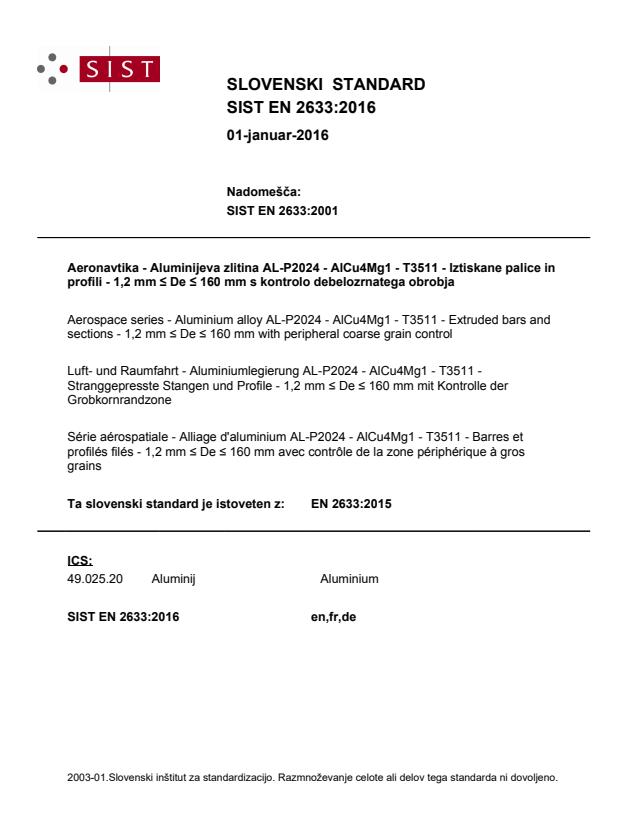
2003-01.Slovenski inštitut za standardizacijo. Razmnoževanje celote ali delov tega standarda ni dovoljeno.*URENRUQUDQG]RQHJUDLQVURO49.025.20AluminijAluminiumICS:Ta slovenski standard je istoveten z:EN 2633:2015SIST EN 2633:2016en,fr,de01-januar-2016SIST EN 2633:2016SLOVENSKI
STANDARDSIST EN 2633:20011DGRPHãþD
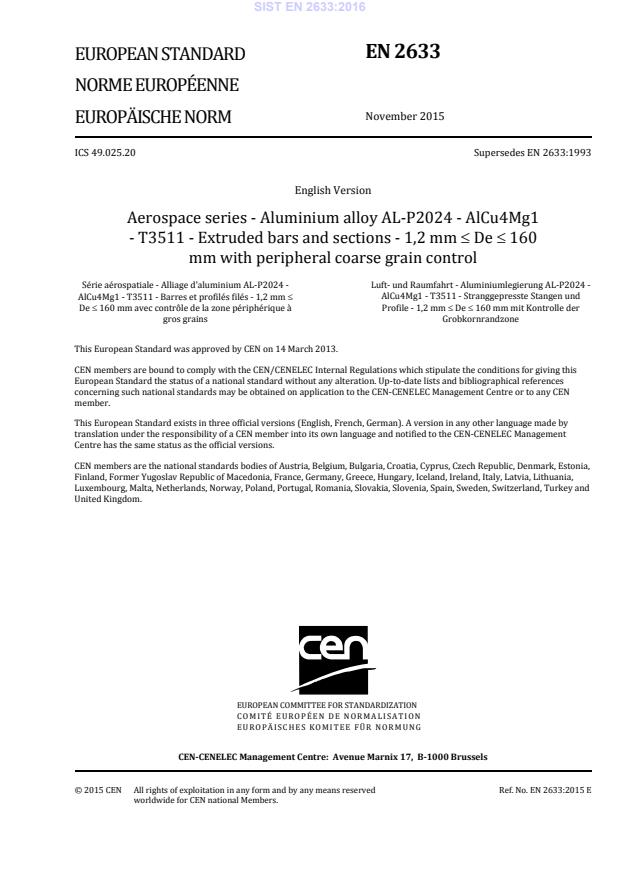
EUROPEAN STANDARD NORME EUROPÉENNE EUROPÄISCHE NORM
EN 2633
November
t r s w ICS
v {ä r t wä t r Supersedes EN
t x u uã s { { uEnglish Version
Aerospace series æ Aluminium alloy ALæP t r t v æ AlCu vMg s æ T u w s s æ Extruded bars and sections æ
sá t mm De
s x r mm with peripheral coarse grain control Série aérospatiale æ Alliage d 5aluminium ALæP t r t v æ AlCu vMg s æ T u w s s æ Barres et profilés filés æ
sá t mm De
s x r mm avec contrôle de la zone périphérique à gros grains
Luftæ und Raumfahrt æ Aluminiumlegierung ALæP t r t v æAlCu vMg s æ T u w s s æ Stranggepresste Stangen und Profile æ
sá t mm De
s x r mm mit Kontrolle der Grobkornrandzone This European Standard was approved by CEN on
s v March
t r s uä
egulations which stipulate the conditions for giving this European Standard the status of a national standard without any alterationä Upætoædate lists and bibliographical references concerning such national standards may be obtained on application to the CENæCENELEC Management Centre or to any CEN memberä
translation under the responsibility of a CEN member into its own language and notified to the CENæCENELEC Management Centre has the same status as the official versionsä
CEN members are the national standards bodies of Austriaá Belgiumá Bulgariaá Croatiaá Cyprusá Czech Republicá Denmarká Estoniaá Finlandá Former Yugoslav Republic of Macedoniaá Franceá Germanyá Greeceá Hungaryá Icelandá Irelandá Italyá Latviaá Lithuaniaá Luxembourgá Maltaá Netherlandsá Norwayá Polandá Portugalá Romaniaá Slovakiaá Sloveniaá Spainá Swedená Switzerlandá Turkey andUnited Kingdomä
EUROPEAN COMMITTEE FOR STANDARDIZATION COMITÉ EUROPÉEN DE NORMALISATION EUROPÄISCHES KOMITEE FÜR NORMUNG
CEN-CENELEC Management Centre:
Avenue Marnix 17,
B-1000 Brussels
t r s w CEN All rights of exploitation in any form and by any means reserved worldwide for CEN national Membersä Refä Noä EN
t x u uã t r s w ESIST EN 2633:2016
...