

EN 1196:2011
(Main)Domestic and non-domestic gas-fired air heaters - Supplementary requirements for condensing air heaters
General Information
- Abstract
This European Standard specifies the additional requirements and test methods for gas-fired air heaters
which are designed so that water vapour condenses from combustion products. On this subject, it extends
the European Standards EN 778 and EN 1319 for domestic air heaters, and EN 1020 for non-domestic air
heaters.
This European Standard applies to gas-fired air heaters with or without a fan in the combustion circuit in
one of the following constructional types:
- an integral air heater with at least one condensing heat exchanger;
- a non-condensing air heater with an integrated additional condensing heat exchanger;
- a non-condensing air heater, with an integrated additional condensing heat exchanger for the recovery
of heat from combustion products and from ventilation air if appropriate.
This European Standard covers type-testing only.
- Status
- Withdrawn
- Publication Date
- 16-Aug-2011
- Withdrawal Date
- 29-Sep-2026
- Technical Committee
- CEN/TC 180 - Non-domestic gas-fired overhead radiant heaters
- Current Stage
- 9960 - Withdrawal effective - Withdrawal
- Start Date
- 16-Oct-2019
- Completion Date
- 30-Sep-2026


Relations
- Effective Date
- 20-Aug-2011
- Effective Date
- 23-Oct-2019
Get Certified
Connect with accredited certification bodies for this standard

DIBt (Deutsches Institut für Bautechnik)
German Institute for Building Technology.
DIN CERTCO
DIN Group product certification.

Aboma Certification B.V.
Specialized in construction, metal, and transport sectors.
Sponsored listings
Frequently Asked Questions
EN 1196:2011 is a standard published by the European Committee for Standardization (CEN). Its full title is "Domestic and non-domestic gas-fired air heaters - Supplementary requirements for condensing air heaters". This standard covers: This European Standard specifies the additional requirements and test methods for gas-fired air heaters which are designed so that water vapour condenses from combustion products. On this subject, it extends the European Standards EN 778 and EN 1319 for domestic air heaters, and EN 1020 for non-domestic air heaters. This European Standard applies to gas-fired air heaters with or without a fan in the combustion circuit in one of the following constructional types: - an integral air heater with at least one condensing heat exchanger; - a non-condensing air heater with an integrated additional condensing heat exchanger; - a non-condensing air heater, with an integrated additional condensing heat exchanger for the recovery of heat from combustion products and from ventilation air if appropriate. This European Standard covers type-testing only.
This European Standard specifies the additional requirements and test methods for gas-fired air heaters which are designed so that water vapour condenses from combustion products. On this subject, it extends the European Standards EN 778 and EN 1319 for domestic air heaters, and EN 1020 for non-domestic air heaters. This European Standard applies to gas-fired air heaters with or without a fan in the combustion circuit in one of the following constructional types: - an integral air heater with at least one condensing heat exchanger; - a non-condensing air heater with an integrated additional condensing heat exchanger; - a non-condensing air heater, with an integrated additional condensing heat exchanger for the recovery of heat from combustion products and from ventilation air if appropriate. This European Standard covers type-testing only.
EN 1196:2011 is classified under the following ICS (International Classification for Standards) categories: 91.140.10 - Central heating systems; 97.100.20 - Gas heaters. The ICS classification helps identify the subject area and facilitates finding related standards.
EN 1196:2011 has the following relationships with other standards: It is inter standard links to EN 1196:1998, EN 17082:2019. Understanding these relationships helps ensure you are using the most current and applicable version of the standard.
EN 1196:2011 is associated with the following European legislation: EU Directives/Regulations: 2009/142/EC, 90/396/EEC; Standardization Mandates: M/BC/CEN/89/6. When a standard is cited in the Official Journal of the European Union, products manufactured in conformity with it benefit from a presumption of conformity with the essential requirements of the corresponding EU directive or regulation.
EN 1196:2011 is available in PDF format for immediate download after purchase. The document can be added to your cart and obtained through the secure checkout process. Digital delivery ensures instant access to the complete standard document.
Standards Content (Sample)
2003-01.Slovenski inštitut za standardizacijo. Razmnoževanje celote ali delov tega standarda ni dovoljeno.Plinski grelniki zraka - Dodatne zahteve za kondenzacijske grelnikeGasbefeuerte Warmlufterzeuger für den häuslichen und den nicht-häuslichen Gebrauch - Zusätzliche Anforderungen an kondensierende WarmlufterzeugerGénérateurs d'air chaud à usages domestique et non domestique utilisant les combustibles gazeux - Exigences complémentaires pour les générateurs d'air chaud à condensationDomestic and non-domestic gas-fired air heaters - Supplementary requirements for condensing air heaters97.100.20Plinski grelnikiGas heatersICS:Ta slovenski standard je istoveten z:EN 1196:2011SIST EN 1196:2012en,fr,de01-januar-2012SIST EN 1196:2012SLOVENSKI
STANDARDSIST EN 1196:19991DGRPHãþD
EUROPEAN STANDARD NORME EUROPÉENNE EUROPÄISCHE NORM
EN 1196
August 2011 ICS 97.100.20 Supersedes EN 1196:1998English Version
Domestic and non-domestic gas-fired air heaters - Supplementary requirements for condensing air heaters
Générateurs d'air chaud à usages domestique et non domestique utilisant les combustibles gazeux - Exigences complémentaires pour les générateurs d'air chaud à condensation
Gasbefeuerte Warmluftterzeuger für den häuslichen und den nicht-häuslichen Gebrauch - Zusätzliche Anforderungen an kondensierende Warmlufterzeuger This European Standard was approved by CEN on 14 July 2011.
CEN members are bound to comply with the CEN/CENELEC Internal Regulations which stipulate the conditions for giving this European Standard the status of a national standard without any alteration. Up-to-date lists and bibliographical references concerning such national standards may be obtained on application to the CEN-CENELEC Management Centre or to any CEN member.
This European Standard exists in three official versions (English, French, German). A version in any other language made by translation under the responsibility of a CEN member into its own language and notified to the CEN-CENELEC Management Centre has the same status as the official versions.
CEN members are the national standards bodies of Austria, Belgium, Bulgaria, Croatia, Cyprus, Czech Republic, Denmark, Estonia, Finland, France, Germany, Greece, Hungary, Iceland, Ireland, Italy, Latvia, Lithuania, Luxembourg, Malta, Netherlands, Norway, Poland, Portugal, Romania, Slovakia, Slovenia, Spain, Sweden, Switzerland and United Kingdom.
EUROPEAN COMMITTEE FOR STANDARDIZATION
COMITÉ EUROPÉEN DE NORMALISATION EUROPÄISCHES KOMITEE FÜR NORMUNG
Management Centre:
Avenue Marnix 17,
B-1000 Brussels © 2011 CEN All rights of exploitation in any form and by any means reserved worldwide for CEN national Members. Ref. No. EN 1196:2011: ESIST EN 1196:2012
Contents
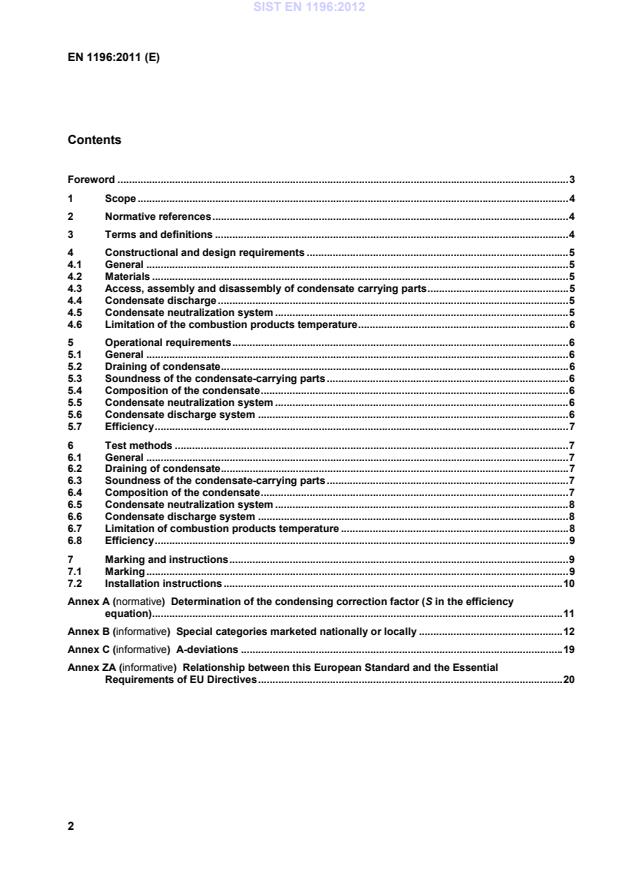
Foreword . 31Scope . 42Normative references . 43Terms and definitions . 44Constructional and design requirements . 54.1General . 54.2Materials . 54.3Access, assembly and disassembly of condensate carrying parts . 54.4Condensate discharge . 54.5Condensate neutralization system . 54.6Limitation of the combustion products temperature . 65Operational requirements . 65.1General . 65.2Draining of condensate . 65.3Soundness of the condensate-carrying parts . 65.4Composition of the condensate . 65.5Condensate neutralization system . 65.6Condensate discharge system . 65.7Efficiency . 76Test methods . 76.1General . 76.2Draining of condensate . 76.3Soundness of the condensate-carrying parts . 76.4Composition of the condensate . 76.5Condensate neutralization system . 86.6Condensate discharge system . 86.7Limitation of combustion products temperature . 86.8Efficiency . 97Marking and instructions . 97.1Marking . 97.2Installation instructions . 10Annex A (normative)
Determination of the condensing correction factor (S in the efficiency equation) . 11Annex B (informative)
Special categories marketed nationally or locally . 12Annex C (informative)
A-deviations . 19Annex ZA (informative)
Relationship between this European Standard and the Essential Requirements of EU Directives . 20 SIST EN 1196:2012
Drains within the appliance shall have an internal diameter of at least 13 mm.
The main drain for connection to the external drain shall have an internal diameter of at least 18 mm. Condensate drains shall be so designed and arranged that combustion products do not escape via the drains. If the appliance is equipped with a sealed combustion chamber, the condensate formed both in the appliance and in the flue system shall be discharged through one or more condensate drains.
The drains for the flue system may be the same as the drains for the appliance. Condensate formed in the flue system shall drain to a purposely-designed drain. Drains for removal of condensate shall be provided with a means, e.g. a water trap or siphon, to prevent leakage of combustion products or combustion air. If the air heater's condensate outlet is blocked or if a pump for the discharge of condensate fails to operate, the construction shall be such that no hazardous situation can arise when the appliance is operating. 4.5 Condensate neutralization system If the air heater is fitted with a condensate neutralization system, this system shall be designed in such a way that the reagents can be exchanged without dismantling any part of the appliance. SIST EN 1196:2012
5.6.2 Behaviour in the event of blockage or pump failure Blockage of the condensate drain(s) or switching off the pump for the discharge of the condensate shall not lead to concentrations of CO in the combustion products higher than 0,1 %, and spillage of condensate shall not occur before safety shut-down or lock-out occurs. SIST EN 1196:2012
The collected condensate is analyzed for the concentrations of the constituents specified by the manufacturer. It is checked whether the requirement of 5.4 is met. SIST EN 1196:2012
This may be the condensate collected according to 6.4. The pH value of this condensate is measured and it is checked that the requirement of 5.5 is met. 6.6 Condensate discharge system 6.6.1 Capacity The sizing of the condensate draining system or the capacity of a pump is checked by the introduction of the following equivalent rates of water into the draining system: for natural gas: 2 l/h water per m3/h of natural gas; for propane: 3 l/h water per m3/h of propane; for butane: 4 l/h water per m3/h of butane. The minimum volume of water used for this test is 2 l.
If the condensate drain is a combined drain for the combustion circuit and the flue, then the volumes stated above are increased by a factor of 2. NOTE The volumes above take into account the possibility of the penetration of rain or snow into the flue system as designed by some manufacturers. It is checked if the requirement of 5.6.1 is met. 6.6.2 Behaviour in the event of blockage or pump failure The appliance is operated continuously in a condensing mode at nominal heat input. With the condensate drain blocked or with a pump for the discharge of condensate put out of operation, it is checked if the requirement of 5.6.2 is met. In order to accelerate the test, water may be added to the condensation circuit. 6.6.3 Soundness of the combustion circuit The appliance is installed with the maximum flue length specified by the manufacturer, and operated with the maximum pressure in the combustion chamber. It is checked that the requirement of 5.6.3 is met. 6.7 Limitation of combustion products temperature The appliance is installed as given in 6.1 and according to the manufacturer's instructions and operated at nominal heat input. The appliance is supplied with one of the corresponding reference gases for the appliance category. After reaching thermal equilibrium, the appliance overheat cut-off device or air temperature limiter is rendered inoperative and the air delivery fan is put out of action.
The temperature of the combustion products is measured until the appliance is switched off by the device for limiting the combustion products temperature. It is checked that the requirement of 5.7 is met. SIST EN 1196:2012
The air heater is supplied with one of the corresponding reference gases for the appliance category. The efficiency (on net calorific value), i, expressed as a percentage, of the appliance is determined at each heat input specified by the manufacturer, using the indirect method based on the following equation: 100)(21−++−=iiiHSqqHη
(1) where Hi
is the net calorific value in megajoules per cubic metre (MJ/m3) at 15 °C, 1 013,25 mbar, dry; S is the condensing correction (MJ/m3 gas); this factor S is determined according to the procedure given in Annex A; q1 is the heat of the dry products of combustion divided by the heat input based on the net calorific value in per cent (%); q2 is the heat of the water vapour contained in the products of combustion divided by the heat input based on the net calorific value in per cent (%). 6.8.2 Efficiency at nominal heat input The appliance is operated at nominal heat input. The flow rate of the air to be heated is controlled so as to be equal to the minimum stated by the manufacturer. Under these conditions it is checked if the requirement of 5.7 is met. 6.8.3 Efficiency at minimum heat input The appliance is operated at minimum heat input.
The flow rate of the air to be heated is controlled so as to be equal to the minimum stated by the manufacturer. Under these conditions it is checked if the requirement of 5.7 is met. 7 Marking and instructions 7.1 Marking In addition to the marking as required in the associated appliance standard, i.e. EN 778, EN 1020 or EN 1319, the following applies: on the appliance and also the packaging it shall be clearly stated that it is a condensing appliance and that local regulations may apply with respect to the discharge of condensate as effluent; type C6 appliances shall carry a firmly attached label indicating limitations of materials suitable for use with the appliance including the maximum operating temperature that the flue shall be capable of withstanding during use. The label shall draw the attention to the installation instructions on this subject, and shall be located near the flue gas outlet. SIST EN 1196:2012
...