

EN 1836:2005+A1:2007
(Main + Amendment)Personal eye-equipment - Sunglasses and sunglare filters for general use and filters for direct observation of the sun
- Abstract
This European Standard specifies physical properties (mechanical, optical etc.) for sunglasses and sunglare filters of nominal plano power which are not prescription lenses, intended for protection against solar radiation for general use, for social and domestic purposes, including road use and driving. This European Standard specifies also requirements for filters for the direct observation of the sun (e.g. during eclipses). Guidance for selection and use of these filters is given in Annex E. For sunglasses and sunglare filters for industrial use, EN 166 and EN 172 apply.
This European Standard does not apply to eyewear for protection against radiation from artificial light sources, such as those used in solaria. EN 170 applies for these filters.
This European Standard does not apply to ski goggles, for which EN 174 applies, or other types of eye protection used for leisure activities.
This European Standard does not apply to sunglasses and filters that have been medically prescribed for attenuating solar radiation.
- Status
- Withdrawn
- Publication Date
- 11-Sep-2007
- Withdrawal Date
- 06-Aug-2013
- Technical Committee
- CEN/TC 85 - Eye-protective equipment
- Drafting Committee
- CEN/TC 85 - Eye-protective equipment
- Current Stage
- 9960 - Withdrawal effective - Withdrawal
- Start Date
- 07-Aug-2013
- Completion Date
- 07-Aug-2013
- Directive
- 89/686/EEC - Personal protective equipment (PPE)OJ Ref: C, C 205 OJ Date: 09-Jul-2011

Relations
- Effective Date
- 18-Jan-2023
- Effective Date
- 22-Dec-2008
- Effective Date
- 25-Sep-2013
- Effective Date
- 09-Feb-2026
- Effective Date
- 28-Jan-2026
- Effective Date
- 28-Jan-2026
- Effective Date
- 28-Jan-2026
- Effective Date
- 28-Jan-2026
- Effective Date
- 28-Jan-2026
- Effective Date
- 28-Jan-2026
- Effective Date
- 28-Jan-2026
- Effective Date
- 28-Jan-2026
- Effective Date
- 28-Jan-2026
- Effective Date
- 28-Jan-2026
Get Certified
Connect with accredited certification bodies for this standard

CIS Institut d.o.o.
Personal Protective Equipment (PPE) certification body. Notified Body NB-2890 for EU Regulation 2016/425 PPE.

Kiwa BDA Testing
Building and construction product certification.
Kmetijski inštitut Slovenije
Agricultural Institute of Slovenia. Soil testing, plant health, agricultural product analysis.
Sponsored listings
Frequently Asked Questions
EN 1836:2005+A1:2007 is a standard published by the European Committee for Standardization (CEN). Its full title is "Personal eye-equipment - Sunglasses and sunglare filters for general use and filters for direct observation of the sun". This standard covers: This European Standard specifies physical properties (mechanical, optical etc.) for sunglasses and sunglare filters of nominal plano power which are not prescription lenses, intended for protection against solar radiation for general use, for social and domestic purposes, including road use and driving. This European Standard specifies also requirements for filters for the direct observation of the sun (e.g. during eclipses). Guidance for selection and use of these filters is given in Annex E. For sunglasses and sunglare filters for industrial use, EN 166 and EN 172 apply. This European Standard does not apply to eyewear for protection against radiation from artificial light sources, such as those used in solaria. EN 170 applies for these filters. This European Standard does not apply to ski goggles, for which EN 174 applies, or other types of eye protection used for leisure activities. This European Standard does not apply to sunglasses and filters that have been medically prescribed for attenuating solar radiation.
This European Standard specifies physical properties (mechanical, optical etc.) for sunglasses and sunglare filters of nominal plano power which are not prescription lenses, intended for protection against solar radiation for general use, for social and domestic purposes, including road use and driving. This European Standard specifies also requirements for filters for the direct observation of the sun (e.g. during eclipses). Guidance for selection and use of these filters is given in Annex E. For sunglasses and sunglare filters for industrial use, EN 166 and EN 172 apply. This European Standard does not apply to eyewear for protection against radiation from artificial light sources, such as those used in solaria. EN 170 applies for these filters. This European Standard does not apply to ski goggles, for which EN 174 applies, or other types of eye protection used for leisure activities. This European Standard does not apply to sunglasses and filters that have been medically prescribed for attenuating solar radiation.
EN 1836:2005+A1:2007 is classified under the following ICS (International Classification for Standards) categories: 13.340.20 - Head protective equipment. The ICS classification helps identify the subject area and facilitates finding related standards.
EN 1836:2005+A1:2007 has the following relationships with other standards: It is inter standard links to EN 1836:2005, EN 1836:2005/AC:2006, EN ISO 12312-1:2013, ISO/CIE 10527:1991, EN 16128:2025, EN 167:2001, EN 165:2005, EN 12472:2020, EN 168:2001, EN ISO 10692-1:2001, EN 166:2001, EN 1938:2010, EN ISO 3715-2:2002, CEN/TS 17946:2023. Understanding these relationships helps ensure you are using the most current and applicable version of the standard.
EN 1836:2005+A1:2007 is associated with the following European legislation: EU Directives/Regulations: 89/686/EEC; Standardization Mandates: M/031. When a standard is cited in the Official Journal of the European Union, products manufactured in conformity with it benefit from a presumption of conformity with the essential requirements of the corresponding EU directive or regulation.
EN 1836:2005+A1:2007 is available in PDF format for immediate download after purchase. The document can be added to your cart and obtained through the secure checkout process. Digital delivery ensures instant access to the complete standard document.
Standards Content (Sample)
2003-01.Slovenski inštitut za standardizacijo. Razmnoževanje celote ali delov tega standarda ni dovoljeno.Personal eye-equipment - Sunglasses and sunglare filters for general use and filters for direct observation of the sunEquipement de protection individuelle de l'oeil - Lunettes solaires et filtres de protection contre les rayonnements solaires pour usage général et filtres pour observation directe du soleilPersönlicher Augenschutz - Sonnenbrillen und Sonnenschutzfilter für den allgemeinen Gebrauch und Filter für die direkte Beobachtung der SonneTa slovenski standard je istoveten z:EN 1836:2005+A1:2007SIST EN 1836:2005+A1:2007en,fr,de13.340.20Varovalna oprema za glavoHead protective equipmentICS:SLOVENSKI
STANDARDSIST EN 1836:2005+A1:200701-november-2007
EUROPEAN STANDARD NORME EUROPÉENNE EUROPÄISCHE NORM
EN 1836:2005+A1
September 2007 ICS 13.340.20 Supersedes EN 1836:2005 English Version
Personal eye-equipment - Sunglasses and sunglare filters for general use and filters for direct observation of the sun
Equipement de protection individuelle de l'oeil - Lunettes solaires et filtres de protection contre les rayonnements solaires pour usage général et filtres pour observation directe du soleil
Persönlicher Augenschutz - Sonnenbrillen und Sonnenschutzfilter für den allgemeinen Gebrauch und Filter für die direkte Beobachtung der Sonne This European Standard was approved by CEN on 28 July 2005 and includes Amendment 1 approved by CEN on 3 August 2007 and the Corrigendum issued in 2006.
CEN members are bound to comply with the CEN/CENELEC Internal Regulations which stipulate the conditions for giving this European Standard the status of a national standard without any alteration. Up-to-date lists and bibliographical references concerning such national standards may be obtained on application to the CEN Management Centre or to any CEN member.
This European Standard exists in three official versions (English, French, German). A version in any other language made by translation under the responsibility of a CEN member into its own language and notified to the CEN Management Centre has the same status as the official versions.
CEN members are the national standards bodies of Austria, Belgium, Bulgaria, Cyprus, Czech Republic, Denmark, Estonia, Finland, France, Germany, Greece, Hungary, Iceland, Ireland, Italy, Latvia, Lithuania, Luxembourg, Malta, Netherlands, Norway, Poland, Portugal, Romania, Slovakia, Slovenia, Spain, Sweden, Switzerland and United Kingdom.
EUROPEAN COMMITTEE FOR STANDARDIZATION
COMITÉ EUROPÉEN DE NORMALISATION EUROPÄISCHES KOMITEE FÜR NORMUNG
Management Centre: rue de Stassart, 36
B-1050 Brussels © 2007 CEN All rights of exploitation in any form and by any means reserved worldwide for CEN national Members. Ref. No. EN 1836:2005+A1:2007: E
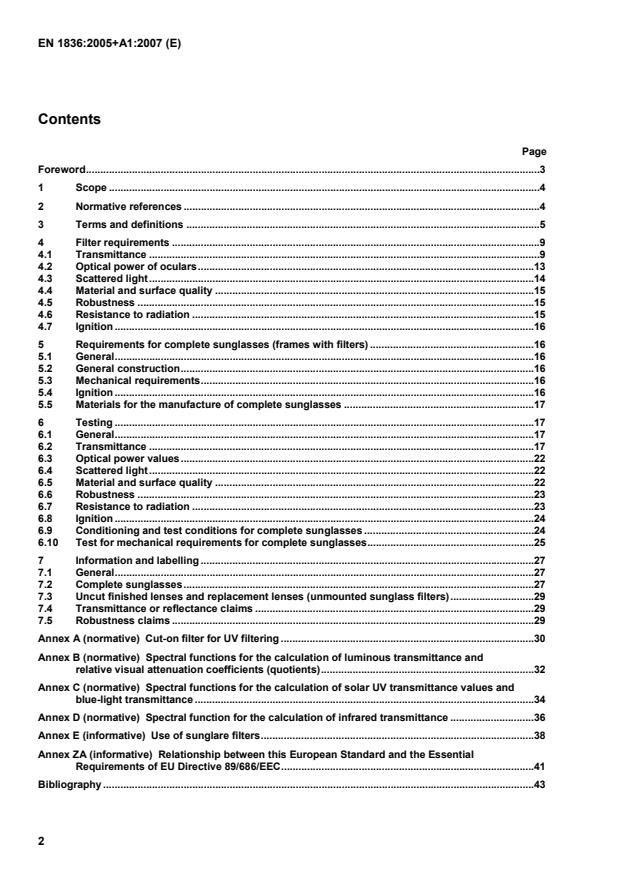
Cut-on filter for UV filtering.30 Annex B (normative)
Spectral functions for the calculation of luminous transmittance and relative visual attenuation coefficients (quotients).32 Annex C (normative)
Spectral functions for the calculation of solar UV transmittance values and blue-light transmittance.34 Annex D (normative)
Spectral function for the calculation of infrared transmittance.36 Annex E (informative)
Use of sunglare filters.38 Annex ZA (informative)
Relationship between this European Standard and the Essential Requirements of EU Directive 89/686/EEC.41 Bibliography.43
ττττ+−=P where τ pmax is the maximum values of luminous transmittance as determined with linearly polarised radiation; τ pmin is the minimum values of luminous transmittance as determined with linearly polarised radiation. 3.3 luminous transmittance of photochromic sunglare filters five different values of the luminous transmittance of photochromic sunglare filters are defined by this European Standard: τ 0 luminous transmittance in the faded state as reached at 23 °C after specified conditioning; τ 1 luminous transmittance in the darkened state as reached at 23 °C after specified irradiation simulating mean outdoor conditions; τ w luminous transmittance in the darkened state as reached at 5 °C after specified irradiation simulating outdoor conditions at low temperatures; τ s luminous transmittance in the darkened state as reached at 35 °C after specified irradiation simulating outdoor conditions at high temperatures; τ a luminous transmittance in the darkened state as reached at 23 °C after specified irradiation simulating reduced light conditions.
relative visual attenuation coefficient (quotient) for signal light recognition quotient Q is defined as: Q = vsignττ where τv is the luminous transmittance of the sunglare filter for CIE standard illuminant D 65. See ISO/CIE 10526; τsign is the luminous transmittance of the sunglare filter for the spectral power distribution of the traffic signal light.
˜()()()()()()∫∫⋅⋅⋅⋅⋅⋅⋅=nm 780 nm 380 sSVSVλλλλτλλλλτλττλλdd)(Anm780nm380AsFsign ™
where SAλ (λ) is the spectral distribution of radiation of CIE standard illuminant A (or 3200 K light source for blue signal light). See: ISO/CIE 10526; SD65λ (λ) is the spectral distribution of radiation of CIE standard illuminant D 65. See: ISO/CIE 10526:1991; V(λ) is the spectral luminous efficiency for daylight vision. See: ISO/CIE 10527; τS(λ) is the spectral transmittance of the traffic signal lens; τF(λ) is the spectral transmittance of the sunglare filter.
The spectral values of the products of the spectral distributions (SAλ (λ), SD65λ (λ)) of the illuminants, the spectral luminous efficiency V(λ) of the eye and the spectral transmittance τS (λ) of the traffic signal lenses are given in Annex B. 3.9 solar blue-light transmittance ττττsb mean of the spectral transmittance between 380 nm and 500 nm weighted with the solar radiation Esλ(λ) at sea level for air mass 2 and the blue-light hazard function B(λ). The complete weighting function is the product of both: )()()(λλλλλBEWBs×= The values of these functions are given in Annex C and may be interpolated where necessary. The definition of τsb is the following: ()()()()()()()()∫∫∫∫⋅⋅⋅⋅⋅⋅⋅⋅500nm380nm500nm380nm500nm380nm500nm380nmλλλλλτλλλλλλλττλλλλdd=dd=FssFsbWBWBBEBE
()()()()()()()()∫∫∫∫⋅⋅⋅=⋅⋅⋅⋅⋅=nm380nm315nm380nm315nm380nm315nm380nm315ddddλλλλλτλλλλλλλττλλλλWWSESEFssFSUVA
()()()()()()()()∫∫∫∫⋅⋅⋅=⋅⋅⋅⋅⋅=nm315nm280nm315nm280nm315nm280nm315nm280ddddλλλλλτλλλλλλλττλλλλWWSESEFssFSUVB 4 Filter requirements 4.1 Transmittance 4.1.1 General For the determination of the transmittance values see 6.2. 4.1.2 Transmittance and filter categories Sunglare filters for general use shall be attributed to five filter categories, where category 0 applies only to photochromic filters in the faded state, to gradient filters with a luminous transmittance > 80 % at the reference point, and to filters that have a luminous transmittance > 80 %, but where a specific protection against any part of the solar spectrum is claimed. The range of the luminous transmittance of these five categories is given by the values in Table 1. An overlap of the transmittance values shall be not more than ± 2 % (absolute) between the categories 0, 1, 2 and 3 except for gradient lenses, where the double value is permitted for the above specified categories. If the supplier declares a luminous transmittance value, the limit deviation for this value shall be ± 3 % absolute for the transmittance values falling in categories 0 to 3 and ± 30 % relative to the stated value for the transmittance values falling in category 4. When describing the transmittance properties of photochromic filters, two categories for transmittance values are generally used. These two values correspond to the faded state and to the darkened state of the filter. In the case of gradient filters the transmittance value at the reference point shall be used to characterise the luminous transmittance and the category of the filter. Table 1 specifies also the UV requirements for sunglare filters for general use. Sunglare filters for which enhanced infrared absorption is claimed, shall meet the requirements of the last column of Table 1.
Ultraviolet spectral range Visible spectral rangeEnhanced infrared absorptiona
Maximum value of spectral transmittance
τF(λ) Maximum value of solarUVA transmittanceτSUVA Range of luminous transmittance
τv Maximum value of solar infrared transmittance
τSIR
280 nm to 315 nm over 315 nm to 350 nm 315 nm to 380 nm from over % to
%
80,0 100
τv τv 43,0 80,0 τv 2 0,1 × τv
18,0 43,0
0,5 × τv 0,5 × τv 8,00 18,0
3,00 8,00
a Only applicable to sunglare filters recommended by the manufacturer as a protection against infrared radiation.
4.1.3 General transmittance requirements 4.1.3.1 Uniformity of luminous transmittance Apart from a marginal zone 5 mm wide, the relative difference in the luminous transmittance value between any two points of the filter within a circle 40 mm in diameter around the reference point, or to the edge of the filter less the marginal zone 5 mm wide, whichever is greater, shall not be greater than 10 % (relative to the higher value), except for category 4 where it shall not be greater than 20 %. The boxed centre takes the place of the reference point if this is not known. In the case of gradient filters, this requirement applies in a section perpendicular to the gradient. In the case of mounted gradient filters, this requirement applies in a section parallel to the connection line of the two reference points. For mounted filters the relative difference between the luminous transmittance value of the filters at the visual centre for the right and left eye shall not exceed 20 % (relative to the lighter filter). Changes of luminous transmittance that are caused by thickness variations due to the design of the lens are permitted. 4.1.3.2 Requirements for road use and driving 4.1.3.2.1 General Filters suitable for road use and driving shall be of categories 0, 1, 2 or 3 and shall additionally meet the following two requirements.
Table 2 — Transmittance requirements for filters for the direct observation of the sun Requirements Ultraviolet spectral range Visible spectral range
Infrared spectral range 280 nm to 315 nm
315 nm to 380 nm
Range of luminous transmittance τ v Filter category Maximum value of spectral transmittance τ
τ F(λ ) Maximum value of solar UVA transmittance ττ SUVA
from under
% to
%
Maximum value of solar infrared transmittance τ SIR
% E12 0,003 2 0,001 2 E13 0,001 2 0,000 44 E14 0,000 44 0,000 16 E15 0,000 16 0,000 061 E16 τ v τ v 0,000 0610,000 023 3
In addition to the filter requirements of Table 2, only the following paragraphs of this European Standard apply to filters for the direct observation of the sun: 4.1.3.1, 4.2, 4.3, 4.4, 4.6 and 4.7. Frames shall comply with the requirements of 5.3 and 5.4. NOTE The frame should hold the filters securely in front of the eyes. 4.1.5 Claimed transmittance and reflectance properties 4.1.5.1 General In the case where specific transmittance or reflectance values are claimed, these claims shall be in accordance with 4.1.5.2, 4.1.5.3, and 4.1.5.4. 4.1.5.2 Blue-light-absorption/transmittance 4.1.5.2.1 Blue-light-absorption In the case where it is claimed that a filter has x % blue-light-absorption, the solar-blue-light-transmittance τsb of the filter shall not exceed (100,5 - x) %. 4.1.5.2.2 Blue-light-transmittance In the case where it is claimed that a filter has less than x % blue-light-transmittance, the solar blue-light-transmittance τsb of the filter shall not exceed (x + 0,5) %. For the calculation of the blue-light-transmittance the values of Annex C shall be used.
cm/m, prism dioptres b 1 ± 0,09 0,09 0,12 2 ± 0,12 0,12 0,25 a In ophthalmology and optometry the numerical equal unit dioptre is used for the unit of the refractive power
m-1. b In ophthalmology and optometry the numerical equal unit prism dioptre is used for the unit of the prismatic power cm/m.
4.2.2 Oculars mounted in spectacles and unmounted filters covering both eyes The maximum optical power values shall be as given in Table 4. The values in columns 2 and 3 shall be adhered to for each position of the measuring field midpoint within a 10 mm radius circle around the visual centres. The values in columns 4, 5 and 6 shall be adhered to at the visual centres. Testing is carried out in accordance with 6.3. Table 4 — Optical power values of nominally afocal filters mounted in spectacles Optical class Spherical power Mean value of the optical power values in the two principal meridians Astigmatic power Absolute difference of the optical power values in the two principal meridians Difference in prismatic power
horizontal vertical
(D1 + D2) / 2
m-1, dioptres ID1 - D2I
m-1, dioptres Base out
cm/m, prism dioptresBase in
cm/m, prism dioptres
cm/m, prism dioptres 1 ± 0,09 0,09 0,75 0,25 0,25 2 ± 0,12 0,12 1,00 0,25 0,25
4.3 Scattered light When tested as described in Clause 4 of EN 167:2001 at the reference point, the reduced luminous coefficient of the filters in the new state, i.e. at the time of placing on the market, shall not exceed the value of: 0,65 (cd/m²) / lx.
% 100 17,8 ± 5 17,8 0,44 ± 10 0,44 0,023 ± 15
6.2.1 Transmittance and reflectance 6.2.1.1 Luminous transmittance The spectral distribution of standard illuminant D 65 and the standard spectral values of the colorimetric 2° standard observer CIE 1931 according to ISO/CIE 10526:1991 shall be used to determine the luminous transmittance. The product of the spectral distribution of standard illuminant D 65 and the standard spectral values of the colorimetric 2° standard observer CIE 1931 according to ISO/CIE 10526:1991 shall be as given in Annex B. Linear interpolation of these values for steps smaller than 10 nm is permissible. 6.2.1.2 Infrared transmittance The infrared transmittance τSIR shall be calculated from the spectral transmittance values using the solar spectral irradiance as given in Annex D.
Table 7 — Irradiance for testing the darkened state of photochromic lenses Wavelength range nm Irradiance W/m2 Tolerance W/m² 300-340 < 2,5 - 340-380 5,6 ± 1,5 380-420 12 ± 3 420-460 20 ± 3 460-500 26,0 ± 2,6
The luminous transmittance values of photochromic filters defined in 4.1.4.1 and for the special conditions of use in Annex E.5 are determined for the conditions given in Table 8. Where testing at 15 000 lx is specified, the irradiance values and the permissible tolerances of these values are those given in Table 7, but multiplied by a factor 0,3. The surface temperature of the filter shall be maintained within ± 1 °C of the required temperature (see Table 8). NOTE Darkening may be carried out in a water bath. However, since immersion of the specimen in water reduces the reflectivity of the surface thereby increasing the measured transmittance relative to the transmittance values that would be measured in air, the transmittance values determined using water immersion need correction to yield the equivalent air values. Calibration of the equipment may be checked using a test sample with a refractive index deviating by not more than ± 0,01 from the refractive index of the sample. Table 8 — Measurement conditions for the different luminous transmittance values Luminous transmittance value (see Clause 3) Surface temperature of the test specimen °C Illumination at the surface of the sample lux τ0 (23 ± )1 0 (faded state) τ1 (23 ± 1) 50 000 ± 5 000 τw (5 ± 1) 50 000 ± 5 000 τs (35 ± 1) 50 000 ± 5 000 τa (23 ± 1) 15 000 ± 1 500 NOTE These measurement conditions are also recommended for additional data, such as time constant for example.
The requirements of 4.1.2 and 4.1.3 shall be met in the faded state and after irradiation for 15 min. 6.2.3.1.3 Method to approximate the spectral distribution of solar radiation for air mass m = 2 using 1 lamp Use an ozone free high pressure xenon arc lamp, a heat absorbing filter and a cut-on filter as specified in Figure 1.
Key a) wavelength in nm b) spectral transmittance Figure 1 — Spectral transmittance of the combination of the heat absorbing filter and the cut-on filter for the measurement of photochromic glasses This transmittance curve can be achieved using, for example, a heat absorbing filter Schott KG 22) with a thickness of 3 mm or a Pittsburg 2043, 2 mm thick and a clear white crown glass, e. g. B 270 with a thickness of 5 mm. 6.2.3.1.4 Method to approximate the spectral distribution of solar radiation for air mass m = 2 using 2 lamps In order to approximate as closely as possible the spectral distribution of solar radiation for air mass m = 2, use 2 ozone free high pressure xenon arc lamps. The radiation of the 2 lamps is superimposed by the means of semitransparent mirror. If different filtering is used in front of the 2 lamps, the solar spectrum can be approximated more closely than with one lamp. The principle could be expanded by the use of more than 2 lamps in order to even better approximate the solar spectrum in the relevant spectral ranges.
1) ORIEL Air mass 2 is an example of a suitable product available commercially. This information is given for the convenience of users of this European Standard and does not constitute an endorsement by CEN of this product. 2) Schott KG 2, Pittsburg 2043, B 270 are examples of suitable products available commercially. This information is given for the convenience of users of this European Standard and does not constitute an endorsement by CEN of these products.
...