

EN 16325:2013
(Main)Guarantees of Origin related to energy - Guarantees of Origin for Electricity
- Abstract
This European Standard specifies requirements for Guarantees of Origin of electricity from all energy sources. This standard will establish the relevant terminology and definitions, requirements for registration, issuing, transferring and cancellation in line with the RES, Cogeneration and IEM Directives. This standard will also cover measuring methods and auditing procedures.
These Guarantees of Origin may be traded and/or used for Disclosure/Labelling.
The content of this standard can, for example, be applied, after necessary modifications, to heating, cooling, and gas (including biogas). These modifications are not part of this standard.
This European Standard will not establish any sustainability criteria, this work is done elsewhere.
This standard is suitable for certification purposes.
- Status
- Withdrawn
- Publication Date
- 19-Feb-2013
- Withdrawal Date
- 06-Oct-2026
- Technical Committee
- CEN/CLC/JWG 2 - Guarantees of origin and Energy certificates
- Drafting Committee
- CEN/CLC/JWG 2 - Guarantees of origin and Energy certificates
- Current Stage
- 9960 - Withdrawal effective - Withdrawal
- Start Date
- 28-Oct-2015
- Completion Date
- 07-Oct-2026

Relations
- Effective Date
- 18-Jan-2023
- Amended By
EN 16325:2013/FprA1 - Guarantees of Origin related to energy - Guarantees of Origin for Electricity - Effective Date
- 06-Feb-2013
Get Certified
Connect with accredited certification bodies for this standard

DNV
DNV is an independent assurance and risk management provider.

BSI Group
BSI (British Standards Institution) is the business standards company that helps organizations make excellence a habit.

Bureau Veritas
Bureau Veritas is a world leader in laboratory testing, inspection and certification services.
Sponsored listings
Frequently Asked Questions
EN 16325:2013 is a standard published by the European Committee for Standardization (CEN). Its full title is "Guarantees of Origin related to energy - Guarantees of Origin for Electricity". This standard covers: This European Standard specifies requirements for Guarantees of Origin of electricity from all energy sources. This standard will establish the relevant terminology and definitions, requirements for registration, issuing, transferring and cancellation in line with the RES, Cogeneration and IEM Directives. This standard will also cover measuring methods and auditing procedures. These Guarantees of Origin may be traded and/or used for Disclosure/Labelling. The content of this standard can, for example, be applied, after necessary modifications, to heating, cooling, and gas (including biogas). These modifications are not part of this standard. This European Standard will not establish any sustainability criteria, this work is done elsewhere. This standard is suitable for certification purposes.
This European Standard specifies requirements for Guarantees of Origin of electricity from all energy sources. This standard will establish the relevant terminology and definitions, requirements for registration, issuing, transferring and cancellation in line with the RES, Cogeneration and IEM Directives. This standard will also cover measuring methods and auditing procedures. These Guarantees of Origin may be traded and/or used for Disclosure/Labelling. The content of this standard can, for example, be applied, after necessary modifications, to heating, cooling, and gas (including biogas). These modifications are not part of this standard. This European Standard will not establish any sustainability criteria, this work is done elsewhere. This standard is suitable for certification purposes.
EN 16325:2013 is classified under the following ICS (International Classification for Standards) categories: 27.010 - Energy and heat transfer engineering in general. The ICS classification helps identify the subject area and facilitates finding related standards.
EN 16325:2013 has the following relationships with other standards: It is inter standard links to EN 16325:2013+A1:2015, EN 16325:2013/FprA1. Understanding these relationships helps ensure you are using the most current and applicable version of the standard.
EN 16325:2013 is available in PDF format for immediate download after purchase. The document can be added to your cart and obtained through the secure checkout process. Digital delivery ensures instant access to the complete standard document.
Standards Content (Sample)
2003-01.Slovenski inštitut za standardizacijo. Razmnoževanje celote ali delov tega standarda ni dovoljeno.Herkunftsnachweise bezüglich Energie - Herkunftsnachweise für ElektrizitätGaranties d'origine liées à l'énergie - Garanties d'Origine de l'électricitéGuarantees of Origin related to energy - Guarantees of Origin for Electricity27.010Prenos energije in toplote na splošnoEnergy and heat transfer engineering in generalICS:Ta slovenski standard je istoveten z:EN 16325:2013SIST EN 16325:2014en,fr,de01-januar-2014SIST EN 16325:2014SLOVENSKI
STANDARD
EUROPEAN STANDARD NORME EUROPÉENNE EUROPÄISCHE NORM
EN 16325
February 2013 ICS 27.010
English version
Guarantees of Origin related to energy - Guarantees of Origin for Electricity
Garanties d'origine liées à l'énergie - Garanties d'Origine de l'électricité
Herkunftsnachweise bezüglich Energie - Herkunftsnachweise für Elektrizität This European Standard was approved by CEN on 28 December 2012.
CEN and CENELEC members are bound to comply with the CEN/CENELEC Internal Regulations which stipulate the conditions for giving this European Standard the status of a national standard without any alteration. Up-to-date lists and bibliographical references concerning such national standards may be obtained on application to the CEN-CENELEC Management Centre or to any CEN and CENELEC member.
This European Standard exists in three official versions (English, French, German). A version in any other language made by translation under the responsibility of a CEN and CENELEC member into its own language and notified to the CEN-CENELEC Management Centre has the same status as the official versions.
CEN and CENELEC members are the national standards bodies and national electrotechnical committees of Austria, Belgium, Bulgaria, Croatia, Cyprus, Czech Republic, Denmark, Estonia, Finland, Former Yugoslav Republic of Macedonia, France, Germany, Greece, Hungary, Iceland, Ireland, Italy, Latvia, Lithuania, Luxembourg, Malta, Netherlands, Norway, Poland, Portugal, Romania, Slovakia, Slovenia, Spain, Sweden, Switzerland, Turkey and United Kingdom.
CEN-CENELEC Management Centre: Avenue Marnix 17, B-1000 Brussels © 2013 CEN/CENELEC All rights of exploitation in any form and by any means reserved worldwide for CEN national Members and for CENELEC Members. Ref. No. EN 16325:2013 E
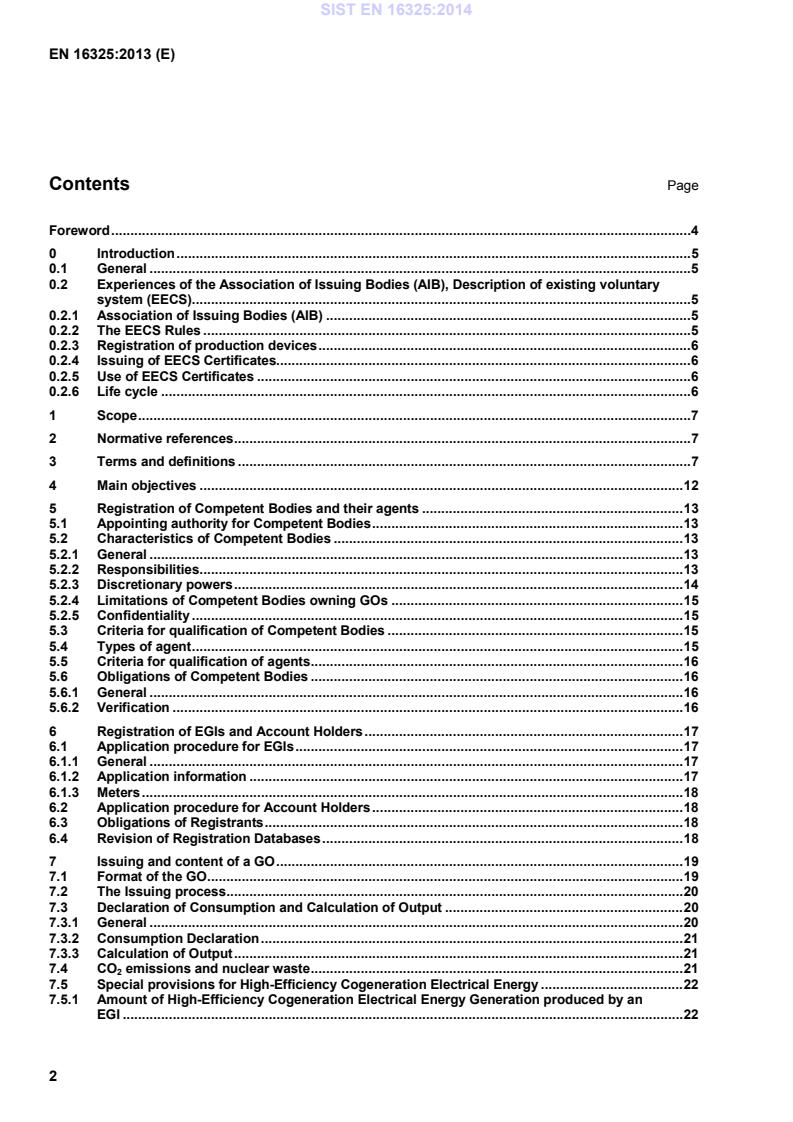
Fuel (or heat source) codes . 32 Annex B (normative)
Technology codes . 36 Annex C (normative)
Coding structures . 38 C.1 Introduction . 38 C.2 Coding of Registration Databases . 38 C.3 Coding of certificates . 38 C.4 Coding of Electricity Generation Installations . 39 C.5 Coding of Account Holder Account IDs . 40 C.6 Coding of Technologies . 41 Annex D (normative)
Geographical coordinates. 42 Annex E (normative)
Cogeneration GO codes Uses of Heat . 44 Annex F (normative)
Relevant perimeter. 45 F.1 Hydraulic continuity principle . 45 F.1.1 General . 45 F.1.2 Extended hydraulic continuity principle . 45 F.2 Smoothing of Electricity generation . 46 F.3 Electricity storage and conversion . 46 F.4 Alternative measures for a hydraulic plant . 46 F.4.1 Certain flow. 46 F.4.2 Non-energy-based hydraulic systems . 47 Bibliography . 48
The AIB has as its purpose the development, use and promotion of a standardised system based on structures and procedures in order to ensure the reliable operation of international certificate schemes which satisfy the criteria of objectivity, non-discrimination, transparency and costs effectiveness in order to facilitate the international exchange of certificates. 0.2.2 The EECS Rules The European Energy Certificate System (EECS) is a commercially funded, integrated European framework for issuing, holding, transferring and otherwise processing electronic records (EECS Certificates) certifying, in relation to specific quantities of output from power plants, attributes of its source and/or the method and quality of its production. The number of certificates issued to a power plant during a period will be directly proportional to the electricity produced by it during that period. These certificates guarantee the source of that electricity. EECS is governed by rules (the EECS Rules) which are intended to secure, in a manner that is consistent with European Community law and relevant national laws, that systems operating within the EECS framework are reliable, secure and inter-operable. The implementation, under the EECS Rules, of harmonised standards for issuing and processing EECS Certificates enables the owners of EECS Certificates to transfer them to other account holders at both the domestic and international level. SIST EN 16325:2014
EECS Certificates may be eligible as Guarantees of Origin issued pursuant to European Community legislation as implemented by member states; or in connection with other legislative certification schemes or under other, entirely voluntary, arrangements. To become a member of an individual EECS Scheme, the relevant provisions applicable in that member’s domain should satisfy the requirements of the EECS Rules, including legislative and administrative arrangements for the issue of such certificates. Each member produces a domain protocol, which legislative provisions ensure that the EECS Rules are satisfied. Account holders are not bound by the EECS Rules, but by the legislation to their domain.
0.2.3 Registration of production devices EECS Certificates can only be issued to the owners of power plants that have successfully registered within a domain. To apply for registration under EECS, the owner of the power plant should provide information about themselves and the power plant, including the technology and energy sources, commissioning dates and capacities, details of any public support that has been received, details of the arrangements for measuring energy sources and produced electricity, including any production auxiliaries, pumping stations and on-site demand. Registration requires the power plant to comply with both the law and with EECS with members being permitted to conduct physical inspections where necessary. 0.2.4 Issuing of EECS Certificates Once a power plant has been registered, then it can receive EECS Certificates. The produced electricity, along with any fuels used, may only be measured by an approved body. The EECS Certificates may only be traded for electricity supplied to the grid, nett of electricity used by production Auxiliaries or for pumping water back to the header lake in pumped storage facilities. Certificates for electricity used by production auxiliaries and pumping are automatically cancelled upon issue. 0.2.5 Use of EECS Certificates Certification of the quality of electricity and the method of its production provides an efficient mechanism for accounting for: the quality and method of production, as supplied to consumers; progress towards targets for the use of certain technologies; and production and/or consumption for stimulating investment in certain categories of plant. Certification enables specific types of electricity to be given a value; which can be traded separate to the physical electricity. For this to work effectively, producers, traders, suppliers, consumers, NGOs and governments should be sure that the certificates provide reliable evidence of the qualities to which they relate. EECS ensures that users have confidence in the EECS certificates issued and processed by AIB members.
0.2.6 Life cycle The life cycle of an EECS Certificate encompasses: issuance, transfer and cancellation. EECS Certificates are issued on registries operated by AIB members for electricity by power plant registered in connection with national legislation or otherwise under EECS. They may be transferred from the producer’s account to that of a trader and so on; either within the country of origin or to other EECS registries across Europe. EECS certificate may be cancelled and removed from circulation when the value of the certificate is realised, and may be used to adjust the residual mix for that domain. EECS Certificate may be cancelled by consumers in recognition of the qualities they represent; to qualify for financial incentives from government; or to discharge contractual or legal obligations. EECS Certificates may also be withdrawn from circulation where they have been issued in error; or expired (automatically cancelled), if they remain transferrable after a set period.
correction by the Competent Body of any data of a GO in case that an error is introduced upon issuing of the GO or in the course of the processing of the GO 3.4 Auxiliaries item of the plant and/or apparatus not directly part of an electricity generation process but required for the functional operation of the EGI 3.5 Approved Measurement Body person or organisation that is responsible for collecting and determining (on behalf of the Registrant) measured values of the Import and Export Meters of an EGI, and which has been approved by a Competent Body to measure Electrical Energy 3.6 Cancel to use a GO for purposes of Disclosure and prevent it from being transferred to another account SIST EN 16325:2014
Electricity energy made available by the flow of electric charge through a conductor 3.18 Electricity Generation Installation
EGI separately measured device or group of devices that produces Output SIST EN 16325:2014
3.21 Export Meter one or more device(s) and supporting arrangements for determining (in whole or in part) the quantity of Electrical Energy flowing from an EGI to a distribution or transmission system or to satisfy onsite demand 3.22 GO Issuing Request request by the authorised representative of an EGI to a Competent Body for the Issue of GOs in respect of that EGI and a specific period of time 3.23 Gross Electrical Energy total Gross Electrical Energy production of an EGI; as evidenced by measured values collected and determined by an Approved Measurement Body with reference to its Import and Export Meters (adjusted by meter amendments and the outcome of any disputes) 3.24 Guarantee of Origin
GO certificate Issued under a National GO Scheme with the Purpose of Disclosure Note 1 to entry: Guarantees of origin should be used within the framework of Labelling to designate the provider mix and - if a provider sells to an end-consumer with undertaking a product differentiation with a different energy mix (product mix) – also for a designation of the product mix. 3.25 High-Efficiency Cogeneration Cogeneration which meets the criteria of Annexes II and III of the Cogeneration Directive 3.26 IEM Directive Internal Electricity Market Directive, being Directive 2009/72/EC (and its predecessor 2003/54/EC) of the European Parliament and of the Council 3.27 Import Meter one or more devices and supporting arrangements for determining (in whole or in part) the quantity of Electrical Energy flowing into an EGI from a distribution or transmission system or onsite production 3.28 Input amount of a specific type of energy or material goods consumed by an EGI in the production of Output 3.29 Issue process of creating (as a GO) a record in a Transferables Account in a Registration Database SIST EN 16325:2014
Such audit is achieved by reference to the records of, or made available by, the Registrant (or, if different, the owner or operator of the relevant EGI). Where appropriate, inspection of records may be supplemented by inspection of the relevant EGI. 3.40 Production Registrar person or organisation responsible for assessing applications to register EGIs for the purposes of the National GO Scheme SIST EN 16325:2014
Support extent to which financial Support (other than through the sale or Cancellation of GOs) has been received or is receiving for investment in qualifying EGIs or for their current production of Output 3.42 Registrant person in whose name an EGI is registered in a Registration Database 3.43 Registration Database
Registry database operated either by a Competent Body or by a third party on its behalf , comprising: a) Transferables and Cancellation Accounts and the GOs in those Accounts; b) details of EGIs and information provided to the Competent Body or a third party on its behalf in connection with the registration of those EGIs; and c) details of GOs which have been transferred out of that Registration Database 3.44 Registration Functions registration of EGIs and the issuing and registration of GOs in respect of their Output, and the maintenance of records regarding such processes 3.45 RES Directive Directive 2009/28/EC of the European Parliament and of the Council of 23 April 2009 on the promotion of the use of energy from renewable sources and amending and subsequently repealing Directives 2001/77/EC and 2003/30/EC 3.46 Transfer Request request to transfer one or more GOs which specifies:
a) the identity of the relevant GOs; b) the identity of the Transferables Account in which such GOs are held; c) the identity of the Transferee’s Transferables Account; and
d) the Registration Database on which such Transferables Account is held,
and which is made by the Account Holder of that Transferables Account or the operator of a trading exchange which the Account Holder has notified the relevant Competent Body is authorised to make such a request in relation to GOs held in its (relevant) Transferables Account 3.47 Transferables Account record on a Registration Database relating to a particular account holder incorporating:
a) GOs Issued to that Account Holder by the Competent Body operating that Registration Database; and b) GOs transferred to that Account Holder
which in either case have not subsequently:
4) been Withdrawn 3.48 Transferee Account Holder whose Transferables Account has been nominated in a Transfer Request 3.49 Transferor Account Holder who has requested the Competent Body in whose Registration Database a GO is held on its Transferables Account to transfer that GO to another Transferables Account 3.50 Type of Installation (of an EGI) type of Input consumed by an EGI and the type of technology used in the conversion of this Input into Output Note 1 to entry: See Normative Annexes A and B for clarification/more information. 3.51 Useful Heat heat produced in a Cogeneration process to satisfy an economically justifiable demand for heat or cooling, as intended by the Cogeneration Directive 3.52 Virtual Natural Flow flow which would have been due to gravity, had a hydraulic linkage existed 3.53 Withdrawal removal of a GO from a Transferables Account or the amendment of its status by the Competent Body on whose Registration Database a GO resides 4 Main objectives This European Standard provides guidance to Competent Bodies and their agents and stakeholders in National GO Schemes as to the manner in which they should discharge their responsibilities with respect to National GO Schemes. This European Standard shall support and promote a set of long-term objectives for the development of National GO Schemes, being: a) Uniqueness: 1) No more than one Certificate with a purpose of Disclosure shall be Issued and subsequently Cancelled in respect of the same unit of Output. b) Ownership of GOs: 1) The Account Holder of a Transferable Account shall be treated as the owner of the GOs in that Transferable Account.
c) Operational reliability and record keeping: SIST EN 16325:2014
e) Access and transparency: 1) Participation in National GO Schemes should be based on objective and publicly disclosed criteria.
2) Access to details of GO should be made available to National GO Scheme Participants. 3) Competent Bodies shall ensure that the purpose of a GO is clearly communicated to National GO Scheme Participants in order that they may better inform consumers. f) Communications: 1) The systems of Competent Bodies should use or accommodate appropriate international communication procedures and standards in order to facilitate effective, efficient and secure cross-border transfers. 5 Registration of Competent Bodies and their agents 5.1 Appointing authority for Competent Bodies The appointing authority for Competent Bodies within a Domain shall be the relevant Member State. 5.2 Characteristics of Competent Bodies 5.2.1 General
A Competent Body shall not be entitled to become or remain a Competent Body if it or any of its Affiliates participates in or distorts the competition in markets associated with GO. The Competent Body may participate in the market by buying or selling GOs when fulfilling public services or in connection with the performance of Registration Functions or associated functions such as metering, inspections, reviews, audits and data collection and aggregation. The competent body may act as authorised representative of an EGI for requesting the issuing of GOs when fulfilling public services. 5.2.2 Responsibilities
A Competent Body shall be responsible for: a) a specific geographic or geopolitical Domain which does not overlap with any other Domain;
b) issuing and administering GOs under one or more Directives;
2) GO, including their: i) issuance; ii) transfer from an Account on its Registration Database to another Account on the same Database or to an Account on the Registration Databases of another Competent Body; and
iii) Expiry, Withdrawal and Cancellation; h) cooperating with other Competent Bodies to ensure the accurate, reliable and secure transfer of GO between Accounts held on different Registries.
5.2.3 Discretionary powers A Competent Body shall at its own discretion conduct or commission: a) inspections of EGIs registered on its Registration Database and the associated Import Meter(s) and Export Meter(s) with a view to satisfying itself that: 1) the information recorded in relation thereto on the Registration Database is accurate;
2) the Registrant and, where applicable, the owner and/or operator of the EGI, is complying with all relevant obligations under the relevant National GO Scheme; and
3) such EGI meets the qualification criteria for the relevant National GO Schemes; b) ad hoc inspections of records associated with relevant Public Support in relation to EGIs registered on its Registration Database. SIST EN 16325:2014
Competent Bodies shall preserve the confidentiality of information provided to them in connection with their roles as Competent Body save to the extent that: a) they are implicitly or explicitly required to disclose such information under this European Standard; b) they are otherwise authorised to disclose such information by the person to whom a duty of confidentiality with respect to such information is owed; or c) they are required to disclose such information by law, including by any direction or request of a Competent Body which it is reasonable for the Competent Body to treat as having the force of law. 5.3 Criteria for qualification of Competent Bodies The appointment criteria in connection with a proposed Domain for a Competent Body are that: a) the Competent Body has been appointed for the purpose of issuing GO under the relevant National GO Scheme with respect to any EGI located in the proposed Domain; and b) in each such case (subject only to the consent of the owner and/or operator of the relevant EGI) the Competent Body is entitled: 1) to use and permit such data to be used for the
...