

EN 13055-1:2002
(Main)Lightweight aggregates - Part 1: Lightweight aggregates for concrete, mortar and grout
- Abstract
This European Standard specifies the properties of lightweight aggregates and lightweight filler aggregates obtained by processing natural, manufactured or recycled materials and mixtures of these aggregates for use in concrete, mortar and grout in buildings, roads and civil engineering works.
This European Standard covers lightweight aggregates of mineral origin having particle densities not exceeding
2 000 kg/m3 (2,00 Mg/m3) or loose bulk densities not exceeding 1 200 kg/m3 (1,20 Mg/m3) including:
a) natural aggregates;
b) aggregates manufactured from natural materials and/or from by-products of industrial processes;
c) by-products of industrial processes;
d) recycled aggregates.
It provides for the evaluation of conformity of the products to this European Standard.
The requirements specified in this standard may not be relevant to all types of lightweight aggregates. For particular applications the requirements and tolerances may be adapted for the end use.
NOTE The requirements in this European Standard are based upon experience with aggregate types with an established pattern of use. Care should be taken when considering the use of aggregates from sources with no such pattern of use, e.g., recycled aggregates and aggregates arising from certain industrial by-products. Such aggregates, which should comply with all the requirements of this European Standard, could have other characteristics not included in Mandate M 125 that do not apply to the generality of aggregate types with an established pattern of use and when required, provisions valid at the place of use can be used to assess their suitability.
- Status
- Withdrawn
- Publication Date
- 07-May-2002
- Withdrawal Date
- 29-Sep-2026
- Technical Committee
- CEN/TC 154 - Aggregates
- Drafting Committee
- CEN/TC 154/SC 5 - Lightweight aggregates
- Current Stage
- 9960 - Withdrawal effective - Withdrawal
- Start Date
- 18-May-2016
- Completion Date
- 30-Sep-2026
- Directive
- 305/2011 - Regulation (eu) No 305/2011 of the European Parliament and of the Council of 9 march 2011 laying down harmonised conditions for the marketing of construction products and repealing council directive 89/106/eecOJ Ref: C, C 259 OJ Date: 08-Aug-2014
89/106/EEC - Construction productsOJ Ref: C, C 139, C 212, C 319 OJ Date: 06-Sep-2002

Relations
- Replaced By
EN 13055:2016 - Lightweight aggregates - Effective Date
- 08-Jun-2022
- Effective Date
- 03-Jun-2026
- Effective Date
- 03-Jun-2026
- Effective Date
- 28-Jan-2026
- Effective Date
- 28-Jan-2026
- Effective Date
- 28-Jan-2026
- Effective Date
- 28-Jan-2026
- Effective Date
- 28-Jan-2026
- Effective Date
- 28-Jan-2026
- Effective Date
- 28-Jan-2026
- Effective Date
- 28-Jan-2026
- Effective Date
- 28-Jan-2026
- Effective Date
- 28-Jan-2026
- Effective Date
- 28-Jan-2026
- Effective Date
- 28-Jan-2026
Get Certified
Connect with accredited certification bodies for this standard

DIBt (Deutsches Institut für Bautechnik)
German Institute for Building Technology.
DIN CERTCO
DIN Group product certification.

Aboma Certification B.V.
Specialized in construction, metal, and transport sectors.
Sponsored listings
Frequently Asked Questions
EN 13055-1:2002 is a standard published by the European Committee for Standardization (CEN). Its full title is "Lightweight aggregates - Part 1: Lightweight aggregates for concrete, mortar and grout". This standard covers: This European Standard specifies the properties of lightweight aggregates and lightweight filler aggregates obtained by processing natural, manufactured or recycled materials and mixtures of these aggregates for use in concrete, mortar and grout in buildings, roads and civil engineering works. This European Standard covers lightweight aggregates of mineral origin having particle densities not exceeding 2 000 kg/m3 (2,00 Mg/m3) or loose bulk densities not exceeding 1 200 kg/m3 (1,20 Mg/m3) including: a) natural aggregates; b) aggregates manufactured from natural materials and/or from by-products of industrial processes; c) by-products of industrial processes; d) recycled aggregates. It provides for the evaluation of conformity of the products to this European Standard. The requirements specified in this standard may not be relevant to all types of lightweight aggregates. For particular applications the requirements and tolerances may be adapted for the end use. NOTE The requirements in this European Standard are based upon experience with aggregate types with an established pattern of use. Care should be taken when considering the use of aggregates from sources with no such pattern of use, e.g., recycled aggregates and aggregates arising from certain industrial by-products. Such aggregates, which should comply with all the requirements of this European Standard, could have other characteristics not included in Mandate M 125 that do not apply to the generality of aggregate types with an established pattern of use and when required, provisions valid at the place of use can be used to assess their suitability.
This European Standard specifies the properties of lightweight aggregates and lightweight filler aggregates obtained by processing natural, manufactured or recycled materials and mixtures of these aggregates for use in concrete, mortar and grout in buildings, roads and civil engineering works. This European Standard covers lightweight aggregates of mineral origin having particle densities not exceeding 2 000 kg/m3 (2,00 Mg/m3) or loose bulk densities not exceeding 1 200 kg/m3 (1,20 Mg/m3) including: a) natural aggregates; b) aggregates manufactured from natural materials and/or from by-products of industrial processes; c) by-products of industrial processes; d) recycled aggregates. It provides for the evaluation of conformity of the products to this European Standard. The requirements specified in this standard may not be relevant to all types of lightweight aggregates. For particular applications the requirements and tolerances may be adapted for the end use. NOTE The requirements in this European Standard are based upon experience with aggregate types with an established pattern of use. Care should be taken when considering the use of aggregates from sources with no such pattern of use, e.g., recycled aggregates and aggregates arising from certain industrial by-products. Such aggregates, which should comply with all the requirements of this European Standard, could have other characteristics not included in Mandate M 125 that do not apply to the generality of aggregate types with an established pattern of use and when required, provisions valid at the place of use can be used to assess their suitability.
EN 13055-1:2002 is classified under the following ICS (International Classification for Standards) categories: 91.100.15 - Mineral materials and products. The ICS classification helps identify the subject area and facilitates finding related standards.
EN 13055-1:2002 has the following relationships with other standards: It is inter standard links to EN 13055:2016, ISO 3310-1:2000, ISO 3310-2:1999, EN 933-1:2012, EN 933-2:2020, EN 1744-1:1998, EN 932-1:1996, EN 933-10:2009, EN 932-5:2012, EN 1097-6:2000, EN 15316-4-6:2007, EN 1097-3:1998, EN 933-5:2022, EN 1097-5:2008, EN 15316-4-5:2007. Understanding these relationships helps ensure you are using the most current and applicable version of the standard.
EN 13055-1:2002 is associated with the following European legislation: EU Directives/Regulations: 305/2011, 89/106/EEC; Standardization Mandates: M/125. When a standard is cited in the Official Journal of the European Union, products manufactured in conformity with it benefit from a presumption of conformity with the essential requirements of the corresponding EU directive or regulation.
EN 13055-1:2002 is available in PDF format for immediate download after purchase. The document can be added to your cart and obtained through the secure checkout process. Digital delivery ensures instant access to the complete standard document.
Standards Content (Sample)
2003-01.Slovenski inštitut za standardizacijo. Razmnoževanje celote ali delov tega standarda ni dovoljeno.Lightweight aggregates - Part 1: Lightweight aggregates for concrete, mortar and groutLahki agregati - 1. del: Lahki agregati za beton, malto in injekcijsko maltoGranulats légers - Partie 1: Granulats légers pour bétons et mortiers et coulisLeichte Gesteinskörnungen - Teil 1: Leichte Gesteinskörnungen für Beton, Mörtel und EinpressmörtelTa slovenski standard je istoveten z:EN 13055-1:2002SIST EN 13055-1:2002en91.100.15ICS:SLOVENSKI
STANDARDSIST EN 13055-1:200201-september-2002
EUROPEAN STANDARDNORME EUROPÉENNEEUROPÄISCHE NORMEN 13055-1May 2002ICS 91.100.15English versionLightweight aggregates - Part 1: Lightweight aggregates forconcrete, mortar and groutGranulats légers - Partie 1: Granulats légers pour bétons etmortiersLeichte Gesteinskörnungen - Teil 1: LeichteGesteinskörnungen für Beton und MörtelThis European Standard was approved by CEN on 21 March 2002.CEN members are bound to comply with the CEN/CENELEC Internal Regulations which stipulate the conditions for giving this EuropeanStandard the status of a national standard without any alteration. Up-to-date lists and bibliographical references concerning such nationalstandards may be obtained on application to the Management Centre or to any CEN member.This European Standard exists in three official versions (English, French, German). A version in any other language made by translationunder the responsibility of a CEN member into its own language and notified to the Management Centre has the same status as the officialversions.CEN members are the national standards bodies of Austria, Belgium, Czech Republic, Denmark, Finland, France, Germany, Greece,Iceland, Ireland, Italy, Luxembourg, Malta, Netherlands, Norway, Portugal, Spain, Sweden, Switzerland and United Kingdom.EUROPEAN COMMITTEE FOR STANDARDIZATIONCOMITÉ EUROPÉEN DE NORMALISATIONEUROPÄISCHES KOMITEE FÜR NORMUNGManagement Centre: rue de Stassart, 36
B-1050 Brussels© 2002 CENAll rights of exploitation in any form and by any means reservedworldwide for CEN national Members.Ref. No. EN 13055-1:2002 E
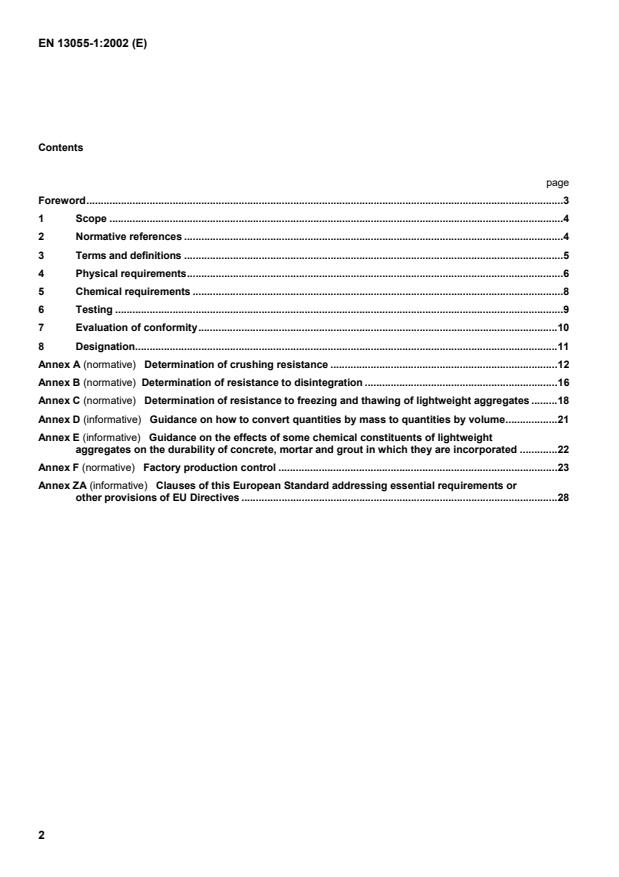
Determination of crushing resistance.12Annex B (normative)
Determination of resistance to disintegration.16Annex C (normative)
Determination of resistance to freezing and thawing of lightweight aggregates.18Annex D (informative)
Guidance on how to convert quantities by mass to quantities by volume.21Annex E (informative)
Guidance on the effects of some chemical constituents of lightweightaggregates on the durability of concrete, mortar and grout in which they are incorporated.22Annex F (normative)
Factory production control.23Annex ZA (informative)
Clauses of this European Standard addressing essential requirements orother provisions of EU Directives.28
— Grading of fillers(air jet sieving).EN 1097-3, Tests for mechanical and physical properties of aggregates — Part 3: Determination of loose bulkdensity and voids.EN 1097-5, Tests for mechanical and physical properties of aggregates — Part 5: Determination of the watercontent by drying in a ventilated oven.
retained on the upper sieve (oversize) andsome which pass the lower sieve (undersize).
Rounded sizes shown in parentheses can be used as simplifieddescriptions of aggregate sizes.4.3.2UndersizeThe quantity of the undersize shall not exceed 15 % by mass.4.3.3OversizeThe quantity of the oversize shall not exceed 10 % by mass. When required, the sieve which 100 % materialpasses shall be declared.4.4 GradingParticle size distribution shall be determined in accordance with EN 933-1 by dry sieving and the results declared.NOTECare should be taken with friable aggregates to prevent degradation.4.5 Particle shapeWhen required, particle shape shall be described and declared.NOTETest methods for normal weight aggregates are not applicable.4.6 FinesWhen required, the content of fines in lightweight aggregates shall be determined in accordance with EN 933-1 andthe results declared.NOTECare should be taken with friable aggregates to prevent degradation.
Loose
mc×=VVwhereVcis the comparison value;Vmis the value measured in accordance with EN 1744-1;1 500is the assumed nominal loose bulk density of normal weight aggregate.NOTE 1Further guidance is given in annex D.NOTE 2Guidance on the effect of chemical constituents in lightweight aggregates, including alkali-silica reactivity, related tothe durability, appearance and surface properties of the concrete, mortar and grout in which they are incorporated is given inannex E.5.2 ChlorideThe water-soluble chloride ion content of lightweight aggregates shall be provided and determined in accordancewith EN 1744-1:1998, clause 7, and declared.NOTEFurther guidance is given in annex E.5.3 Sulfur containing compounds5.3.1 Acid-soluble sulfateAcid-soluble sulfate content shall be determined in accordance with EN 1744-1:1998, clause 12, and declared.5.3.2 Total sulfurTotal sulfur content shall be determined in accordance with EN 1744-1:1998, clause 11, and declared.5.4 Loss on ignition (for ashes only)Loss on ignition shall be determined in accordance with EN 1744-1:1998, clause 17, and declared.5.5 Organic contaminatorsHarmful components in natural lightweight aggregates i.e., those which alter the rate of setting and hardening ofconcrete, mortar and grout shall be determined in accordance with EN 1744-1:1998, 15.3, and declared.NOTEFurther guidance is given in annex E.5.6 Alkali-silica reactivity of natural lightweight aggregatesWhen required, the alkali-silica reactivity of natural lightweight aggregates shall be assessed in accordance with theprovisions valid in the place of use and the results declared.NOTEGuidance on the effects of alkali-silica reactivity, is given in annex E.6 Testing6.1 SamplingSampling shall be carried out as specified in EN 932-1.NOTETo ensure a representative sample care should be taken to avoid segregation.
All apparatus, unless otherwise stated, shall conform to the general requirements of EN 932-5.A.2.2
Steel test cylinder and piston, as shown in Figure A.1 for procedure 1 and Figure A.2 for procedure 2.A.2.3
Hydraulic press, or similar device capable of providing sufficient pressure for the test and measuring thepressure to an accuracy of ± 5 %.A.2.4
Vibrating table, operating at approximately 3 000 oscillations per minute and amplitude 0,5 without load.A.2.5
Steel straightedge, of a suitable length.A.2.6
Scoop, of suitable size to fill the test cylinder.A.2.7
Thermostatically controlled ventilated drying oven, capable of maintaining a temperature of (110 ± 5) ºC.A.3 Preparation of test specimensSamples shall be taken in accordance with EN 932-1 and reduced in accordance with EN 932-2.Prepare three representative test specimens of suitable size and remove undersize and oversize.A.4 ProcedureA.4.1 Procedure 1Place the cylinder on the vibrating table and gently fill to overflowing by discharging the test lightweight aggregateusing a scoop, all around the cylinder, taking care to avoid segregation of the lightweight aggregate. Vibrate thecylinder for 3 s to 60 s and refill.Vibrate the cylinder for a further 3 s to 60 s and level the surface of the lightweight aggregate using thestraightedge.Position the top rail on the cylinder and place the piston gently on top of the compacted lightweight aggregate.Adjust the distance between the contact ring and the top rail to 20 mm and place the test assembly in the hydraulicpress.Increase the force on the piston to reach a compression of 20 mm in approximately 100 s, and record the force innewtons. Repeat the procedure with the remaining two test specimens.
N/mm2whereCais the crushing resistance, in newtons per square millimetre, determined inaccordance with procedure 1;Cbis the crushing resistance, in newtons per square millimetre, determined inaccordance with procedure 2;Lis the force exerted by the piston in newtons;Fis the compression force in newtons;Ais the area of the piston in square millimetres.Calculate the mean value of the three results.A.6 Test reportThe test report shall include the following information:a) reference to this European Standard;b) test carried out in accordance with procedure 1 or procedure 2;c) identification of the test specimen;d) identification of the test laboratory;e) date of test;f) mean crushing resistance (Ca or Cb);g) range of the three test results;h) period of vibration.
0,11 ±60112,8
0,1
0,13±130113
0,1±4514012117815010050118,5100,518100602020281810Key1Adjustable height ring2Piston3Upper cylinder4Lower cylinder5BaseFigure A.1 — Test apparatus for procedure 1
All apparatus, unless otherwise stated, shall conform to the general requirements of EN 932-5.B.2.2
Thermostatically controlled saturated steam autoclave, of suitable capacity capable of raising the testspecimens from 20 °C to (215 ± 5) °C in (60 ± 5) min and maintaining this temperature for (180 ± 10) min, at apressure of (2 ± 0,2) MPa. In addition, the autoclave shall be capable of allowing the test specimens to cool to(30 ± 10) °C in (90 ± 10) min.B.2.3
Test sieves, in accordance with ISO 3310-1 or ISO 3310-2.B.2.4
Balance, of adequate capacity and with an accuracy of ± 0,1 g.B.2.5
Thermostatically controlled ventilated drying oven, capable of maintaining a temperature of (110 ± 5) °C.B.2.6
Two metal containers, suitable for holding the lightweight aggregate in the autoclave.B.3 Preparation of test specimensSamples shall be taken in accordance with EN 932-1 and reduced in accordance with EN 932-2 and be largeenough to give two test specimens as specified in Table B.1.B.3.1
Dry the sample of lightweight aggregate in accordance with EN 1097-5.B.3.2
Dry sieve the two test specimens, removing the oversize and undersize using the appropriate upper andlower sieves specified in Table B.1.Table B.1 — Specimen size/sieve sizesLower and upper sieve sizesmmApproximate volumemlNext smaller sievemm4/88/1616/225001 0002 000248
Soak the two test specimens in distilled water at ambient temperature for (72 ± 1) h, weighing the aggregateto ensure that it is below the surface of the water.B.4.2
After soaking, strain the lightweight aggregate from the distilled water and allow the specimens to drain forabout 15 min.B.4.3
Place the drained specimens in the two metal containers and place these in the autoclave.B.4.4
Raise the autoclave to a pressure of (2 ± 0,2) MPa and a temperature of (215 ± 5) °C in (90 ± 5) min, andmaintain this pressure and temperature for (180 ± 5) min. Allow to cool to (30 ± 10) °C in (90 ± 5) min.B.4.5
Transfer the containers and contents to the oven and dry at (110 ± 5) °C in accordance withEN 1097-5 and allow to cool.B.4.6
Weigh each test specimen to the nearest 0,1 g (m1).B.4.7
Carefully screen each of the test specimens on the next smaller sieve indicated in Table B.1.B.4.8
Weigh the material passing through this sieve to 0,1 g for each test specimen (m2).B.5 Calculation and expression of resultsB.5.1
Calculate the percentage loss in mass M, for each of the two test specimens using the following equation:100´=12mmMwhereMis the percentage loss in mass;m1is the initial mass of the test specimen in grams;m2is the mass of the material in grams which passes the appropriate lower size sieveafter autoclaving.B.5.2 The result shall be expressed as the mean value obtained from two specimens.
All apparatus, unless otherwise stated, shall conform to the general requirements of EN 932-5.C.3.2
Ventilated drying oven, with forced circulation of adequate capacity. The oven shall be capable of beingmaintained at (110 ± 5) °C.C.3.3
Balance, capable to weigh test samples up to 400 g. with an accuracy of ± 0,02 g. and test samples above400 g. with an accuracy of 0,05 g.C.3.4
Low temperature cabinet, (upright or chest) with air circulation. The cabinet shall be capable of beingmaintained at (-17,5 ± 2,5) °C.C.3.5
Containers, made from corrosion resistant sheet steel with a base area of approximate 0,02 m2 and aheight of not less than 100 mm.C.3.6
Grid, of a suitable size and aperture to prevent the lightweight aggregates floating in the container specifiedin C.3.5.C.3.7
Test sieves, conforming to EN 933-2 shall be used.C.3.8
Water, distilled or demineralized.C.4 SamplingSampling shall be carried out in accordance with EN 932-1.C.5 Test specimensC.5.1 Test specimensThree individual test specimens shall be used. The test specimens shall be obtained in accordance with EN 932-2by sample reduction from production single size aggregates from which oversize and undersize aggregates havebeen removed.
If it is necessary to interrupt the test during the freezing cycle, the test specimens shall remain in the cabinet at(-17,5 ± 2,5) °C. A total interruption of up to 72 h is permitted.C.6.3 Sieving and dryingOn completion of the 20th cycle, pour the content of each container on to a sieve having an aperture size that ishalf the lower size sieve used to prepare the test specimen (e.g. in case of the 8 mm to 16 mm fraction, on to a testsieve of 4 mm aperture size). Wash and sieve the test specimen on the specified sieve by hand. Dry and weigh theresidue remaining on the sieve in accordance with C.5.3.C.7 Calculation and expression of resultsC.7.1
Calculate the undersize by combining the residues from the three test specimens, weigh and express themass obtained as a percentage of the mass of the combined test specimens.C.7.2
Calculate the result of the freeze-thaw test in accordance with the following equation:F = [(M1 - M2)/M1] ´ 100whereM1is the initial dry mass of the three test specimens before cycling, in grams;M2is the final dry mass of the three test specimens after cycling, which is retained on the specified sieve, ingrams;Fis the percentage loss in mass of the three test samples after freeze-thaw cycling.C.8 Test ReportThe test report shall refer to this European Standard and contain the following information:a) sampling method if known, and marking, type and origin of the laboratory samples;b) shape, size, grading and number of laboratory samples;c) visual observations of the aggregate retained on the specified sieve;NOTEAny unusual disintegration of the aggregate retained on the sieve should be reported.d) result of the freeze-thaw test, F expressed to the nearest 0,1% by mass;e) date of report and name of test laboratory.
Two screening tests for the presence of organic matter are in common use: the sodium hydroxide test andthe fulvo acid test. If the supernatant liquid in these tests is lighter than the standard colours when determined inaccordance with EN 1744-1:1998, 15.1 and/or 15.2, the aggregate can be considered to be free from organicmatter (see E.3.5).NOTESome inorganic compounds which discolour the supernatant liquid in the sodium hydroxide test do not adverselyaffect the setting and hardening of concrete/mortar.E.3.2
Aggregates that contain organic or other substances in proportions which alter the rate of setting andhardening of concrete/mortar should be quantitatively assessed for the presence of such materials. The effect onstiffening time and compressive strength should be determined in accordance with EN 1744-1:1998, 15.3.The proportions of such materials should be such that compliance with E.3.2 and E.3.4 is ensured.E.3.3
The increase of the stiffening time of concrete/mortar test specimens should not be more than 120 min.E.3.4
The decrease of the compressive strength of concrete/mortar test specimen should not be more than 20 %.E.3.5
Sugars do not affect the colour of the supernatant liquid in the sodium hydroxide test or the fulvo acid test. Ifit is suspected that sugars or sugar type materials are present, the aggregate should be tested using theconcrete/mortar specimen test specified in EN 1744-1:1998, 15.3. The stiffening time and compressive strengthrequirements given in E.3.3 and E.3.4 should apply.E.4 Alkali aggregate reactionCertain aggregates can react with alkalis present in the pore fluids of concrete, mortar and grout. Under adverseconditions and in the presence of moisture this can lead to expansion and subsequent cracking or disruption of theconcrete, mortar and grout. The most common form of reaction occurs between alkalis and certain form of silica(alkali-silica reaction). Another much less common form of reaction is alkali-carbonate reaction.E.4.1
In the absence of previous long-term experience of a lack of disruptive reactivity of a particular combinationof cement and aggregate, it may be necessary to take account of the following precautions:a) limit the total alkali content of the concrete/mortar mix;b) use a cement with a low effective alkali content;c) use a non-reactive aggregate combination;d) limit the degree of saturation of the concrete/mortar with water.E.4.2
The combination of aggregate and cement should be assessed using procedures described in regulationsvalid in the place of use only when compliance with one of the above procedures is not possible.
initiate action to prevent the occurrence of product non-conformity;b)
identify, record and deal with any product quality deviations.F.2.2 Management representative for factory production controlFor every aggregate producing plant the producer shall appoint a person with appropriate authority to ensure thatthe requirements given in this annex are implemented and maintained.F.2.3 Management reviewThe factory production control system adopted to satisfy the requirements of this annex shall be audited andreviewed at appropriate intervals by management to ensure its continuing suitability and effectiveness. Records ofsuch reviews shall be maintained.F.3 Control proceduresThe producer shall establish and maintain a factory production control manual setting out the procedures by whichthe requirements for factory production control are satisfied.F.3.1 Document and data controlDocument and data control shall include those documents and data that are relevant to the requirements of thisstandard covering purchasing, processing, inspection of materials and the factory production control systemdocuments.A procedure concerning the management of documents and data shall be documented in the production controlmanual covering procedures and responsibilities for approval, issue, distribution and administration of internal andexternal documentation and data; and the preparation, issue and recording of changes to documentation.F.3.2 Sub-contract servicesIf any part of the operation is sub-contracted by the producer a means of control shall be established. The producershall retain overall responsibility for any parts of the operation sub-contracted.
they do not exceed the limits in force according to the provisions valid in the place of use of the aggregate;c) there shall be procedures to ensure that material is put into stock in a controlled manner and the storage
locations and their contents are identified;d) there shall be procedures to ensure that material taken from stock has not deteriorated in such a way that
its conformity is compromised;e) the product shall be identifiable up to the point of sale as regards source and type.F.5 Inspection and testF.5.1 GeneralThe producer shall make available all the necessary facilities, equipment and trained personnel to carry out therequired inspections and tests.F.5.2 EquipmentThe producer shall be responsible for the control, calibration and maintenance of inspection, measuring and testequipment.Accuracy and frequency of calibration shall be in accordance with EN 932-5.Equipment shall be used in accordance with documented procedures.Equipment shall be uniquely identified.Calibration records shall be retained.F.5.3 Frequency and location of inspection, sampling and testsThe production control document shall describe the frequency and nature of inspections. The frequency ofsampling and the tests when required shall be carried out for the relevant characteristics as specified in Table F.1.
...