

EN 15610:2009
(Main)Railway applications - Noise emission - Rail roughness measurement related to rolling noise generation
- Abstract
1.1 This European Standard specifies a direct method for characterizing the surface roughness of the rail
associated with rolling noise ("acoustic roughness"), in the form of a one-third octave band spectrum.
This standard describes a method for:
a) selecting measuring positions;
b) data acquisition;
c) measurement data processing in order to estimate a set of one-third octave band roughness spectra;
d) presentation of this estimate for comparison with limits of acoustic roughness;
e) comparison with a given upper limit in terms of a one-third octave band wavelength spectrum.
1.2 It is applicable to the:
a) performance testing of reference track sections for the measurement, within a period of three months
before or after roughness characterization, of noise emitted by railway vehicles for acceptance testing
purposes;
b) acceptance of the rail surface condition only in the case where the result of the direct measurement of the
acoustic roughness is regarded as an established acceptance criterion.
1.3 It is not applicable to the:
a) measurement of rail roughness using an indirect method;
b) measurement of combined wheel-rail roughness;
c) analysis of the effect of wheel-rail interaction, such as a “contact filter”;
d) approval of rail reprofiling, including rail grinding operations, except for those where the acoustic
roughness (and not the level of corrugation) is an established approval criterion;
e) characterization of track geometry.
Testing and approval of measuring apparatus are not part of the scope of this standard.
- Status
- Withdrawn
- Publication Date
- 12-May-2009
- Withdrawal Date
- 13-Oct-2026
- Technical Committee
- CEN/TC 256 - Railway applications
- Drafting Committee
- CEN/TC 256/WG 3 - Noise emission
- Current Stage
- 9960 - Withdrawal effective - Withdrawal
- Start Date
- 01-May-2019
- Completion Date
- 14-Oct-2026

Relations
- Effective Date
- 18-Jun-2014
- Effective Date
- 09-Feb-2026
- Effective Date
- 09-Feb-2026
- Effective Date
- 09-Feb-2026
- Effective Date
- 28-Jan-2026
- Effective Date
- 28-Jan-2026
Get Certified
Connect with accredited certification bodies for this standard

BSMI (Bureau of Standards, Metrology and Inspection)
Taiwan's standards and inspection authority.
Zavod za gradbeništvo Slovenije (ZAG) - Inšpekcija
ZAG inspection body for construction products, structures, and materials.
Sponsored listings
Frequently Asked Questions
EN 15610:2009 is a standard published by the European Committee for Standardization (CEN). Its full title is "Railway applications - Noise emission - Rail roughness measurement related to rolling noise generation". This standard covers: 1.1 This European Standard specifies a direct method for characterizing the surface roughness of the rail associated with rolling noise ("acoustic roughness"), in the form of a one-third octave band spectrum. This standard describes a method for: a) selecting measuring positions; b) data acquisition; c) measurement data processing in order to estimate a set of one-third octave band roughness spectra; d) presentation of this estimate for comparison with limits of acoustic roughness; e) comparison with a given upper limit in terms of a one-third octave band wavelength spectrum. 1.2 It is applicable to the: a) performance testing of reference track sections for the measurement, within a period of three months before or after roughness characterization, of noise emitted by railway vehicles for acceptance testing purposes; b) acceptance of the rail surface condition only in the case where the result of the direct measurement of the acoustic roughness is regarded as an established acceptance criterion. 1.3 It is not applicable to the: a) measurement of rail roughness using an indirect method; b) measurement of combined wheel-rail roughness; c) analysis of the effect of wheel-rail interaction, such as a “contact filter”; d) approval of rail reprofiling, including rail grinding operations, except for those where the acoustic roughness (and not the level of corrugation) is an established approval criterion; e) characterization of track geometry. Testing and approval of measuring apparatus are not part of the scope of this standard.
1.1 This European Standard specifies a direct method for characterizing the surface roughness of the rail associated with rolling noise ("acoustic roughness"), in the form of a one-third octave band spectrum. This standard describes a method for: a) selecting measuring positions; b) data acquisition; c) measurement data processing in order to estimate a set of one-third octave band roughness spectra; d) presentation of this estimate for comparison with limits of acoustic roughness; e) comparison with a given upper limit in terms of a one-third octave band wavelength spectrum. 1.2 It is applicable to the: a) performance testing of reference track sections for the measurement, within a period of three months before or after roughness characterization, of noise emitted by railway vehicles for acceptance testing purposes; b) acceptance of the rail surface condition only in the case where the result of the direct measurement of the acoustic roughness is regarded as an established acceptance criterion. 1.3 It is not applicable to the: a) measurement of rail roughness using an indirect method; b) measurement of combined wheel-rail roughness; c) analysis of the effect of wheel-rail interaction, such as a “contact filter”; d) approval of rail reprofiling, including rail grinding operations, except for those where the acoustic roughness (and not the level of corrugation) is an established approval criterion; e) characterization of track geometry. Testing and approval of measuring apparatus are not part of the scope of this standard.
EN 15610:2009 is classified under the following ICS (International Classification for Standards) categories: 17.140.30 - Noise emitted by means of transport; 93.100 - Construction of railways. The ICS classification helps identify the subject area and facilitates finding related standards.
EN 15610:2009 has the following relationships with other standards: It is inter standard links to EN 15610:2019, EN 61260-1:2014, EN 61260-2:2016, EN 61260-3:2016, EN ISO 266:1997, CEN/TR 15874:2009. Understanding these relationships helps ensure you are using the most current and applicable version of the standard.
EN 15610:2009 is associated with the following European legislation: EU Directives/Regulations: 2001/16/EC, 2008/57/EC, 96/48/EC; Standardization Mandates: M/275, M/334. When a standard is cited in the Official Journal of the European Union, products manufactured in conformity with it benefit from a presumption of conformity with the essential requirements of the corresponding EU directive or regulation.
EN 15610:2009 is available in PDF format for immediate download after purchase. The document can be added to your cart and obtained through the secure checkout process. Digital delivery ensures instant access to the complete standard document.
Standards Content (Sample)
2003-01.Slovenski inštitut za standardizacijo. Razmnoževanje celote ali delov tega standarda ni dovoljeno.Bahnanwendungen - Geräuschemission - Messung der Schienenrauheit im Hinblick auf die Entstehung von RollgeräuschApplications ferroviaires - Bruit a l'émission - Mesurage de la rugosité des rails relative a la génération du bruit de roulementRailway applications - Noise emission - Rail roughness measuement related to rolling noise generation45.080Rails and railway components17.140.30Emisija hrupa transportnih sredstevNoise emitted by means of transportICS:Ta slovenski standard je istoveten z:EN 15610:2009SIST EN 15610:2009en01-september-2009SIST EN 15610:2009SLOVENSKI
STANDARD
EUROPEAN STANDARD NORME EUROPÉENNE EUROPÄISCHE NORM
EN 15610
May 2009 ICS 17.140.30; 93.100 English Version
Railway applications - Noise emission - Rail roughness measurement related to rolling noise generation
Applications ferroviaires - Bruit à l'émission - Mesurage de la rugosité des rails relative à la génération du bruit de roulement
Bahnanwendungen - Geräuschemission - Messung der Schienenrauheit im Hinblick auf die Entstehung von Rollgeräusch This European Standard was approved by CEN on 16 April 2009.
CEN members are bound to comply with the CEN/CENELEC Internal Regulations which stipulate the conditions for giving this European Standard the status of a national standard without any alteration. Up-to-date lists and bibliographical references concerning such national standards may be obtained on application to the CEN Management Centre or to any CEN member.
This European Standard exists in three official versions (English, French, German). A version in any other language made by translation under the responsibility of a CEN member into its own language and notified to the CEN Management Centre has the same status as the official versions.
CEN members are the national standards bodies of Austria, Belgium, Bulgaria, Cyprus, Czech Republic, Denmark, Estonia, Finland, France, Germany, Greece, Hungary, Iceland, Ireland, Italy, Latvia, Lithuania, Luxembourg, Malta, Netherlands, Norway, Poland, Portugal, Romania, Slovakia, Slovenia, Spain, Sweden, Switzerland and United Kingdom.
EUROPEAN COMMITTEE FOR STANDARDIZATION
COMITÉ EUROPÉEN DE NORMALISATION EUROPÄISCHES KOMITEE FÜR NORMUNG
Management Centre:
Avenue Marnix 17,
B-1000 Brussels © 2009 CEN All rights of exploitation in any form and by any means reserved worldwide for CEN national Members. Ref. No. EN 15610:2009: ESIST EN 15610:2009
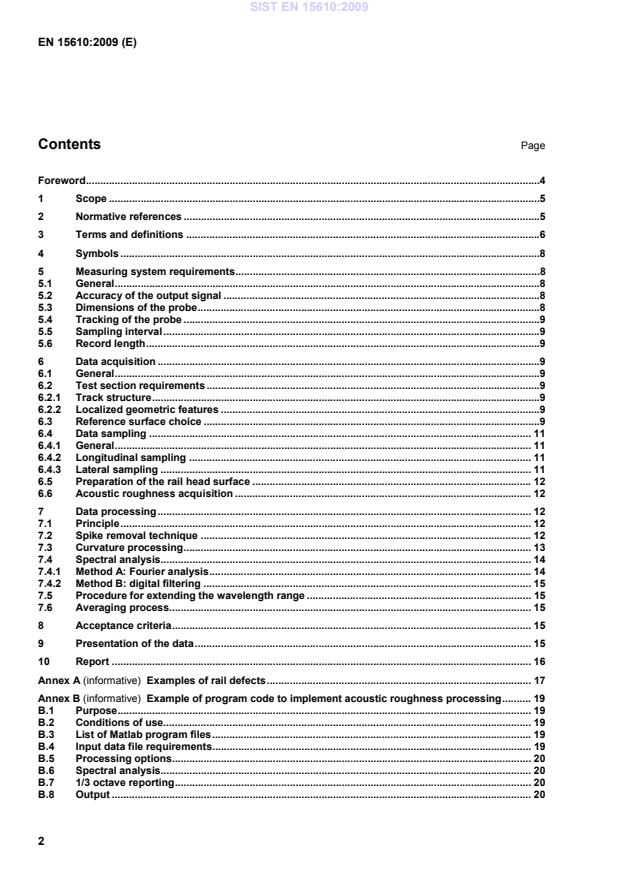
Examples of rail defects . 17 Annex B (informative)
Example of program code to implement acoustic roughness processing . 19 B.1 Purpose . 19 B.2 Conditions of use. 19 B.3 List of Matlab program files . 19 B.4 Input data file requirements . 19 B.5 Processing options. 20 B.6 Spectral analysis. 20 B.7 1/3 octave reporting . 20 B.8 Output . 20 SIST EN 15610:2009
Algorithm used to synthesize a one-third octave band spectrum from a corresponding narrow band spectrum . 31 Annex ZA (informative)
Relationship between this
European
Standard and the Essential Requirements
of EU Directive EU 2008/57/EC . 32 Bibliography . 34
1 Scope 1.1 This European Standard specifies a direct method for characterizing the surface roughness of the rail associated with rolling noise ("acoustic roughness"), in the form of a one-third octave band spectrum. This standard describes a method for: a) selecting measuring positions; b) data acquisition; c) measurement data processing in order to estimate a set of one-third octave band roughness spectra; d) presentation of this estimate for comparison with limits of acoustic roughness; e) comparison with a given upper limit in terms of a one-third octave band wavelength spectrum. 1.2 It is applicable to the: a) performance testing of reference track sections for the measurement, within a period of three months before or after roughness characterization, of noise emitted by railway vehicles for acceptance testing purposes; b) acceptance of the rail surface condition only in the case where the result of the direct measurement of the acoustic roughness is regarded as an established acceptance criterion. 1.3 It is not applicable to the: a) measurement of rail roughness using an indirect method; b) measurement of combined wheel-rail roughness; c) analysis of the effect of wheel-rail interaction, such as a “contact filter”; d) approval of rail reprofiling, including rail grinding operations, except for those where the acoustic roughness (and not the level of corrugation) is an established approval criterion; e) characterization of track geometry. Testing and approval of measuring apparatus are not part of the scope of this standard. 2 Normative references The following referenced documents are indispensable for the application of this document. For dated references, only the edition cited applies. For undated references, the latest edition of the referenced document (including any amendments) applies. EN 61260, Electroacoustics — Octave-band and fractional-octave-band filters (IEC 61260:1995) EN ISO 266, Acoustics — Preferred frequencies (ISO 266:1997) SIST EN 15610:2009
3.2 acoustic roughness spectrum )(~λr amplitude of the acoustic roughness expressed as a function of the wavelength λ
3.3 acoustic roughness level Lr level expressed in decibels, given by the following equation:
⋅=202rrlog10RMSrL
(1) where: Lr is the acoustic roughness level in dB,
rRMS is the root mean square roughness in µm,
r0 is the reference roughness; r0 = 1 µm. NOTE This definition applies to values measured either in the form of a wavelength spectrum, or for a specific wavelength band. 3.4 corrugation periodic wear pattern of the rail running surface 3.5 direct roughness measurement method refers to an acoustic roughness measurement method for which the transducer has to be applied directly to the rail surface so that the rail roughness is measured independently of the wheel running surface roughness and independently of any effect of wheel-rail interaction 3.6 indirect roughness measurement method refers to an acoustic roughness measurement method that measures a quantity that is the result of wheel-rail interaction, such as noise, rail or axle box vibration, whereby the original excitation by the combined wheel and rail roughness is inferred 3.7 test section specific section of track associated with a particular set of measurements
3.11 reference width wref
dimension of the reference surface across the rail Figure 1 shows an example of some of the defined terms:
Key c running band d reference surface e
partially conditioned surface
Figure 1 — Example showing defined parameters SIST EN 15610:2009
The following measuring system requirements apply. 5.2 Accuracy of the output signal The measuring system shall be capable of making valid measurements in the wavelength range and at the relevant acoustic roughness levels for the test site being characterized. However, where it is required simply to show that the estimated acoustic roughness does not exceed a given upper limit, the measuring system shall effect valid measurements for one-third octave band acoustic roughness levels equal to or greater than this limit. This case applies particularly for test section approval. 5.3 Dimensions of the probe If a contact probe is used, the probe tip shall be spherical and its radius shall not exceed 7 mm. In the case of a non-contacting sensor, its effective width shall be less than the sampling interval. SIST EN 15610:2009
The measuring system shall provide data with a sampling interval less than or equal to 1 mm. 5.6 Record length The system shall provide records of length ≥ 1 m. 6 Data acquisition 6.1 General The aim of the data acquisition procedure is to obtain digitized records of the acoustic roughness of the two rails in the test section measured at a sufficiently high sampling rate per unit of length of rail, and with a record length sufficient to derive from it the acoustic roughness spectrum. Record lengths of at least 1 m are required to estimate the acoustic roughness spectrum covering the wavelength range up to the 0,25 m one-third octave band. NOTE To attain wavelengths greater than 0,25 m, records longer than those specified in this subclause should be obtained. 6.2 Test section requirements
6.2.1 Track structure The track structure shall be constant along the test section, at least in terms of the following parameters: rail cross-section, rail inclination and rail supporting structure. In the case of a ballasted track, the rail supporting structure parameters are: the rail pad type, the rail fasteners, the sleeper type, the sleeper spacing and the ballast. NOTE If the track structure changes, separate test sections should be defined and the acoustic roughness of each should be assessed and presented. 6.2.2 Localized geometric features From the strict point of view of acoustic roughness data acquisition, there is no specific requirement for the test section. However, the rail along the test section may contain localized geometrical features (e.g.: rail defects, wheel burns, etc.), that should not be included in the assessment of the acoustic roughness related to the generation of rolling noise. NOTE The localized rail defects are not significant in the assessment of the acoustic roughness related to the rolling noise component. 6.3 Reference surface choice 6.3.1 General The acoustic roughness of the test section shall be assessed over a reference surface. The reference surface is specified, inside the running band, as follows: SIST EN 15610:2009
Where the acoustic rail roughness measurement is required for rolling stock type acceptance testing, any of the three following cases for that justification shall be used: a) Case 1: the running band on the rail head is clear visually and it is known that this running band is produced by the rolling stock to be measured.
Considering that the wheel-rail contact zone is approximately 10 mm wide, any partially conditioned area at the edges of the running band that are less than half this width shall not be considered to be part of the running band. b) Case 2: the wheel-rail contact zone can be measured for the specific train under test at the time of the acceptance test. NOTE 1 It is recommended that a line be drawn across the rail head with a permanent marker to identify the wheel-rail contact position satisfactorily. It is advisable to check the position at both ends of the test section.
Figure 2 shows a sample application of this method:
Key c effective running band of the trainset wheels d marker ink outside the rolling band Figure 2 — Example of using a permanent marker on the rail surface SIST EN 15610:2009
To obtain a reliable assessment of the roughness up to a given wavelength, a minimum record length is required. If the acoustic roughness is sampled in such a way that it forms less than 80 % of the overall length of the test section, the following criteria shall apply so that the samples are representative of the whole length of the test section: a) the samples shall be assessed over at least 5 measuring positions for each rail, each at least 1 m long, distributed over the test section; b) depending on the bandwidth range of interest, the samples shall total a length of at least: 1) 15 m for each rail, if the bandwidth range involved does not exceed the 0,25 m one-third octave band; 2) 7,2 m for each rail, if the bandwidth range involved does not exceed the 0,1 m one-third octave band. 6.4.3 Lateral sampling The acoustic roughness shall be assessed equally on each rail for a given width of rail head surface, irrespective of the actual range of wheel-rail contact positions for a given category of rolling stock and shall only be considered to be valid for the part of the rail head that is conditioned by running wear. Therefore, an important aspect of the acquisition process is to define the lateral position of the valid reference surface of the rail. The acoustic roughness shall be measured on the reference surface centre line. If the reference surface is wide enough, two supplementary, parallel, equidistant lines at either side of the centre line shall be measured. The distance between the centre line and the supplementary lines depends on the width of the valid rail reference surface: a) wref
≤ 20 mm: measurement of one line; SIST EN 15610:2009
Key c distance along the rail (metres) d roughness amplitude (micrometres) e spike f pit
g distance along the rail (metres) h roughness amplitude (micrometres)
i measured signal j signal processed with the spike removal algorithm
Figure 3 — Raw data for roughness (left) and spike removal (right)
The ratio between height h and width w of each spike shall be tested with the following criterion: h > w2/a, where h and w are expressed in metres and a = 3 m. If this condition is verified, the spike shall be removed by linear interpolation between x1 and x2. The spike removal procedure shall be repeated until no further spike is detected. 7.3 Curvature processing For each roughness data point xi from the r(x) roughness function, a circular curve Ci(x) of radius 0,375 m is defined passing through the data point r(xi), with its centre located at xi above the r(x) function (see Figure 4). The correction of the acoustic roughness at the roughness data point xi is taken as the maximum difference between the roughness function r(x) and this curve Ci(x), so that the resulting height r'(xi) of the roughness function r(x) is given by the following equation: r’(xi) = max(r(x) - Ci(x)) + r(xi).
Key c Ci(x) d r(x) e xi f r'(xi)- r(xi)
g roughness amplitude h distance along the rail i r(x) j r'(x)
Figure 4 — (not to scale) Curvature processing
Left: principle applied to position xi Right: effect of the curvature processing on a deep pit
7.4 Spectral analysis 7.4.1 General The one-third octave band acoustic roughness spectrum )(~λr shall be determined on the basis of the roughness data, after removal of the pits and spikes, r’(x), by using one of the two methods described below: 7.4.2 Method A: Fourier analysis For this, long data records can be divided into segments. In all cases, the length of the data used in a Fourier transform shall correspond to a length of at least 1 m. If a record is divided into successive segments, a 50 % overlap shall be applied. Each segment shall have a zero mean value and the linear trend removed. A Hanning window shall then be applied. The discrete Fourier transform (DFT) of each segment is used to produce results in terms of wave number. The magnitude squared of the Fourier transforms of each segment shall be averaged to make up a narrow band spectrum which shall be expressed as a function of the wavelength. The one-third octave band spectrum shall be synthesized on the basis of the narrow band spectrum. Each one-third octave band value shall be calculated as the energy sum of the narrow band values from the
...