


EN 16603-50:2014
(Main)Space engineering - Communications
Space engineering - Communications
This Standard specifies the requirements for the development of the endtoend data communications system for spacecraft.
Specifically, this standard specifies:
- The terminology to be used for space communication systems engineering.
- The activities to be performed as part of the space communication system engineering process, in accordance with the ECSS-E-ST-10 standard.
- Specific requirements on space communication systems in respect of functionality and performance.
The communications links covered by this Standard are the spacetoground and spacetospace links used during spacecraft operations, and the communications links to the spacecraft used during the assembly, integration and test, and operational phases.
Spacecraft endtoend communication systems comprise components in three distinct domains, namely the ground network, the space link, and the space network. This Standard covers the components of the space link and space network in detail. However, this Standard only covers those aspects of the ground network that are necessary for the provision of the endtoend communication services.
NOTE Other aspects of the ground network are covered in ECSS-E ST 70.
This Standard may be tailored for the specific characteristics and constraints of a space project in conformance with ECSS-S ST 00.
Raumfahrttechnik - Kommunikation
Ingénierie spatiale - Communications
Vesoljska tehnika - Komunikacije
Ta standard določa zahteve za razvoj celovitega podatkovnega komunikacijskega sistema za vesoljska plovila. Ta standard podrobno določa predvsem:
• terminologijo, uporabljeno za inženiring za vesoljske komunikacijske sisteme,
• dejavnosti, ki se izvajajo kot del inženirskega postopka za vesoljski komunikacijski sistem
v skladu s standardom ECSS-E-ST-10,
• posebne zahteve za vesoljske komunikacijske sisteme glede
funkcionalnosti in delovanja. Komunikacijske povezave, zajete v tem standardu, so povezave vesolje-zemlja in vesolje-vesolje, ki se uporabljajo med operacijami vesoljskih plovil, in komunikacijske povezave do vesoljskega plovila, ki se uporabljajo v času montaže, integracije, testiranja in delovanja. Celoviti komunikacijski sistemi za vesoljska plovila sestavljajo tri različna področja, in sicer zemeljsko omrežje, povezava z vesoljem in vesoljsko omrežje. Ta standard podrobno zajema komponente povezave z vesoljem in vesoljskega omrežja. Vendar pa ta standard zajema le tiste vidike
zemeljskega omrežja, ki so nujni za zagotavljanje celovitih komunikacijskih storitev. OPOMBA Drugi vidiki zemeljskega omrežja so zajeti v standardu ECSS-E-ST-70. Ta standard se lahko prilagodi posameznim lastnostim in omejitvam vesoljskega projekta v skladu s standardom ECSS-S-ST-00.
General Information
- Status
- Withdrawn
- Publication Date
- 09-Sep-2014
- Withdrawal Date
- 08-Feb-2026
- Technical Committee
- CEN/CLC/TC 5 - Space
- Drafting Committee
- CEN/CLC/TC 5 - Space
- Current Stage
- 9960 - Withdrawal effective - Withdrawal
- Start Date
- 06-Jul-2022
- Completion Date
- 11-Feb-2026
Relations
- Effective Date
- 28-Feb-2018



Get Certified
Connect with accredited certification bodies for this standard

DEKRA North America
DEKRA certification services in North America.

Eagle Registrations Inc.
American certification body for aerospace and defense.

Element Materials Technology
Materials testing and product certification.
Sponsored listings
Frequently Asked Questions
EN 16603-50:2014 is a standard published by the European Committee for Standardization (CEN). Its full title is "Space engineering - Communications". This standard covers: This Standard specifies the requirements for the development of the endtoend data communications system for spacecraft. Specifically, this standard specifies: - The terminology to be used for space communication systems engineering. - The activities to be performed as part of the space communication system engineering process, in accordance with the ECSS-E-ST-10 standard. - Specific requirements on space communication systems in respect of functionality and performance. The communications links covered by this Standard are the spacetoground and spacetospace links used during spacecraft operations, and the communications links to the spacecraft used during the assembly, integration and test, and operational phases. Spacecraft endtoend communication systems comprise components in three distinct domains, namely the ground network, the space link, and the space network. This Standard covers the components of the space link and space network in detail. However, this Standard only covers those aspects of the ground network that are necessary for the provision of the endtoend communication services. NOTE Other aspects of the ground network are covered in ECSS-E ST 70. This Standard may be tailored for the specific characteristics and constraints of a space project in conformance with ECSS-S ST 00.
This Standard specifies the requirements for the development of the endtoend data communications system for spacecraft. Specifically, this standard specifies: - The terminology to be used for space communication systems engineering. - The activities to be performed as part of the space communication system engineering process, in accordance with the ECSS-E-ST-10 standard. - Specific requirements on space communication systems in respect of functionality and performance. The communications links covered by this Standard are the spacetoground and spacetospace links used during spacecraft operations, and the communications links to the spacecraft used during the assembly, integration and test, and operational phases. Spacecraft endtoend communication systems comprise components in three distinct domains, namely the ground network, the space link, and the space network. This Standard covers the components of the space link and space network in detail. However, this Standard only covers those aspects of the ground network that are necessary for the provision of the endtoend communication services. NOTE Other aspects of the ground network are covered in ECSS-E ST 70. This Standard may be tailored for the specific characteristics and constraints of a space project in conformance with ECSS-S ST 00.
EN 16603-50:2014 is classified under the following ICS (International Classification for Standards) categories: 49.140 - Space systems and operations. The ICS classification helps identify the subject area and facilitates finding related standards.
EN 16603-50:2014 has the following relationships with other standards: It is inter standard links to EN 16603-50:2022. Understanding these relationships helps ensure you are using the most current and applicable version of the standard.
EN 16603-50:2014 is associated with the following European legislation: Standardization Mandates: M/496. When a standard is cited in the Official Journal of the European Union, products manufactured in conformity with it benefit from a presumption of conformity with the essential requirements of the corresponding EU directive or regulation.
EN 16603-50:2014 is available in PDF format for immediate download after purchase. The document can be added to your cart and obtained through the secure checkout process. Digital delivery ensures instant access to the complete standard document.
Standards Content (Sample)
SLOVENSKI STANDARD
01-november-2014
Vesoljska tehnika - Komunikacije
Space engineering - Communications
Raumfahrttechnik - Kommunikation
Ingénierie spatiale - Communications
Ta slovenski standard je istoveten z: EN 16603-50:2014
ICS:
49.140 Vesoljski sistemi in operacije Space systems and
operations
2003-01.Slovenski inštitut za standardizacijo. Razmnoževanje celote ali delov tega standarda ni dovoljeno.
EUROPEAN STANDARD
EN 16603-50
NORME EUROPÉENNE
EUROPÄISCHE NORM
September 2014
ICS 49.140
English version
Space engineering - Communications
Ingénierie spatiale - Communications Raumfahrttechnik - Kommunikation
This European Standard was approved by CEN on 1 March 2014.
CEN and CENELEC members are bound to comply with the CEN/CENELEC Internal Regulations which stipulate the conditions for giving
this European Standard the status of a national standard without any alteration. Up-to-date lists and bibliographical references concerning
such national standards may be obtained on application to the CEN-CENELEC Management Centre or to any CEN and CENELEC
member.
This European Standard exists in three official versions (English, French, German). A version in any other language made by translation
under the responsibility of a CEN and CENELEC member into its own language and notified to the CEN-CENELEC Management Centre
has the same status as the official versions.
CEN and CENELEC members are the national standards bodies and national electrotechnical committees of Austria, Belgium, Bulgaria,
Croatia, Cyprus, Czech Republic, Denmark, Estonia, Finland, Former Yugoslav Republic of Macedonia, France, Germany, Greece,
Hungary, Iceland, Ireland, Italy, Latvia, Lithuania, Luxembourg, Malta, Netherlands, Norway, Poland, Portugal, Romania, Slovakia,
Slovenia, Spain, Sweden, Switzerland, Turkey and United Kingdom.
CEN-CENELEC Management Centre:
Avenue Marnix 17, B-1000 Brussels
© 2014 CEN/CENELEC All rights of exploitation in any form and by any means reserved Ref. No. EN 16603-50:2014 E
worldwide for CEN national Members and for CENELEC
Members.
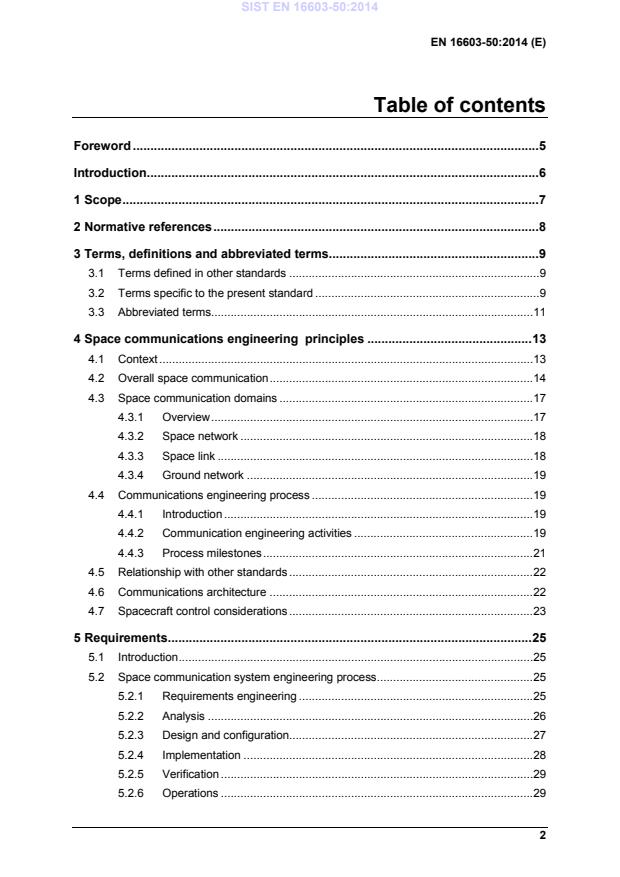
Table of contents
Foreword . 5
Introduction . 6
1 Scope . 7
2 Normative references . 8
3 Terms, definitions and abbreviated terms . 9
3.1 Terms defined in other standards . 9
3.2 Terms specific to the present standard . 9
3.3 Abbreviated terms. 11
4 Space communications engineering principles . 13
4.1 Context . 13
4.2 Overall space communication . 14
4.3 Space communication domains . 17
4.3.1 Overview . 17
4.3.2 Space network . 18
4.3.3 Space link . 18
4.3.4 Ground network . 19
4.4 Communications engineering process . 19
4.4.1 Introduction . 19
4.4.2 Communication engineering activities . 19
4.4.3 Process milestones . 21
4.5 Relationship with other standards . 22
4.6 Communications architecture . 22
4.7 Spacecraft control considerations . 23
5 Requirements . 25
5.1 Introduction . 25
5.2 Space communication system engineering process . 25
5.2.1 Requirements engineering . 25
5.2.2 Analysis . 26
5.2.3 Design and configuration. 27
5.2.4 Implementation . 28
5.2.5 Verification . 29
5.2.6 Operations . 29
5.3 Space communication system . 30
5.3.1 Bandwidth allocation . 30
5.3.2 Congestion . 30
5.3.3 Cessation of emission . 31
5.4 Telecommanding . 31
5.4.1 Commandability at all attitudes and rates . 31
5.4.2 Telecommand delivery service . 31
5.4.3 Erroneous telecommand rejection . 31
5.4.4 Essential command distribution . 31
5.4.5 Command authentication . 32
5.4.6 Command encryption . 32
5.4.7 Commanding-in-the-blind . 32
5.4.8 Telecommand acknowledgement . 32
5.5 Telemetry . 32
5.5.1 Telemetry at all attitudes and rates . 32
5.5.2 Essential telemetry acquisition . 32
5.5.3 Telemetry source identification . 33
5.5.4 Telemetry-in-the-blind . 33
5.5.5 Telemetry packet time stamping. 33
5.5.6 Simultaneous support of differing source rates . 33
5.6 Space link . 34
5.6.1 Introduction . 34
5.6.2 Directionality . 34
5.6.3 Short contact periods . 34
5.6.4 Interoperability . 35
5.6.5 Orbits . 35
5.6.6 Noise sources . 35
5.6.7 Mission phases . 35
5.6.8 Link setup times . 35
5.6.9 Mixed isochronous and asynchronous traffic . 35
5.6.10 Mixed housekeeping and payload data . 35
5.6.11 Space link performance . 36
5.6.12 Space link frequency . 37
5.6.13 Space link protocol . 38
5.6.14 Space link service . 39
5.7 Space network . 41
5.7.1 General . 41
5.7.2 Space network services . 42
5.8 Ground network . 43
5.8.1 Overview . 43
5.8.2 Data labelling . 43
5.8.3 Security . 43
5.8.4 Error rates . 43
5.8.5 Hot redundant operation of ground network nodes . 43
5.8.6 Ground network availability . 43
Annex A (normative) Communication system requirements document
(CSRD) - DRD . 44
Annex B (normative) Communication system baseline definition (CSBD) -
DRD . 48
Annex C (normative) Communication system analysis document (CSAD) -
DRD . 53
Annex D (normative) Communication system verification plan (CSVP) -
DRD . 56
Annex E (normative) Communication system architectural design
document (CSADD) - DRD . 59
Annex F (normative) Communication system detailed design document
(CSDDD) - DRD . 62
Annex G (normative) Communication system profile document (CSPD) -
DRD . 64
Annex H (normative) Communication system operations manual (CSOM) -
DRD . 66
Annex I (informative) Documentation summary . 69
Bibliography . 72
Figures
Figure 4-1: Example configuration of a space communication system . 14
Figure 4-2: CCSDS and Internet space link protocols . 17
Figure 4-3: Space communications reference architecture . 22
Tables
Table A- 1 ECSS-E-ST-50 DRD list . 70
Foreword
This document (EN 16603-50:2014) has been prepared by Technical Committee
CEN/CLC/TC 5 “Space”, the secretariat of which is held by DIN.
This standard (EN 16603-50:2014) originates from ECSS-E-ST-50C.
This European Standard shall be given the status of a national standard, either
by publication of an identical text or by endorsement, at the latest by March
2015, and conflicting national standards shall be withdrawn at the latest by
March 2015.
Attention is drawn to the possibility that some of the elements of this document
may be the subject of patent rights. CEN [and/or CENELEC] shall not be held
responsible for identifying any or all such patent rights.
This document has been prepared under a mandate given to CEN by the
European Commission and the European Free Trade Association.
This document has been developed to cover specifically space systems and has
therefore precedence over any EN covering the same scope but with a wider
domain of applicability (e.g. : aerospace).
According to the CEN-CENELEC Internal Regulations, the national standards
organizations of the following countries are bound to implement this European
Standard: Austria, Belgium, Bulgaria, Croatia, Cyprus, Czech Republic,
Denmark, Estonia, Finland, Former Yugoslav Republic of Macedonia, France,
Germany, Greece, Hungary, Iceland, Ireland, Italy, Latvia, Lithuania,
Luxembourg, Malta, Netherlands, Norway, Poland, Portugal, Romania,
Slovakia, Slovenia, Spain, Sweden, Switzerland, Turkey and the United
Kingdom.
Introduction
This standard specifies requirements for the development of the end-to-end
data communication system for spacecraft. Implementation aspects are defined
in both ECSS-E-ST-50 Level 3 standards and CCSDS standards.
The complete set of standards to define a complete communication link is
project dependent and cannot be specified here. ECSS-E-HB-50 provides some
guidance on this aspect, and gives some practical examples.
Scope
This Standard specifies the requirements for the development of the end-to-end
data communications system for spacecraft.
Specifically, this standard specifies:
• The terminology to be used for space communication systems
engineering.
• The activities to be performed as part of the space communication system
engineering process, in accordance with the ECSS-E-ST-10 standard.
• Specific requirements on space communication systems in respect of
functionality and performance.
The communications links covered by this Standard are the space-to-ground
and space-to-space links used during spacecraft operations, and the
communications links to the spacecraft used during the assembly, integration
and test, and operational phases.
Spacecraft end-to-end communication systems comprise components in three
distinct domains, namely the ground network, the space link, and the space
network. This Standard covers the components of the space link and space
network in detail. However, this Standard only covers those aspects of the
ground network that are necessary for the provision of the end-to-end
communication services.
NOTE Other aspects of the ground network are covered
in ECSS-E-ST-70.
This Standard may be tailored for the specific characteristics and constraints of
a space project in conformance with ECSS-S-ST-00.
Normative references
The following normative documents contain provisions which, through
reference in this text, constitute provisions of this ECSS Standard. For dated
references, subsequent amendments to, or revisions of any of these
publications, do not apply. However, parties to agreements based on this ECSS
Standard are encouraged to investigate the possibility of applying the most
recent editions of the normative documents indicated below. For undated
references the latest edition of the publication referred to applies.
EN reference Reference in text Title
EN 16601-00-01 ECSS-S-ST-00-01 ECSS system — Glossary of terms
Terms, definitions and abbreviated terms
3.1 Terms defined in other standards
For the purpose of this Standard, the terms and definitions from
ECSS-S-ST-00-01 apply, in particular for the following term:
function
3.2 Terms specific to the present standard
3.2.1 channel
combination of protocol and medium that provides a physical layer service
from end-to-end
NOTE This is the transfer of the unstructured bitstream
from point-to-point.
3.2.2 communication service
service that provides the capability of moving data between users.
NOTE At least two users are involved when a
communication service is used, one sending data
and the other(s) receiving data.
3.2.3 cross support
use by one party of part of another party’s data system resources to
complement its own system
3.2.4 entity
active element within a system
3.2.5 interface
description of the connection between real or abstract objects
3.2.6 isochronous service
service providing for the transfer of data with a defined maximum deviation
from a nominal delay from end to end
3.2.7 protocol
set of rules and formats (semantic and syntactic) that determine the
communication behaviour of layer entities in the performance of
communication functions
3.2.8 service
capability of a layer, and the layers beneath it (a service-provider), that is
provided to service-users at the boundary between the service-provider and the
service-users
NOTE The service defines the external behaviour of the
service-provider, independent of the mechanisms
used to provide that behaviour. Layers, layer
entities, and application-service-elements are
examples of components of a service-provider.
3.2.9 service data unit
amount of information whose identity is preserved when transferred between
peer entities in a given layer and which is not interpreted by the supporting
entities in that layer
3.2.10 service-provider
abstract representation of the totality of those entities which provide a service to
service-users
NOTE A service provider includes entities in the layer at
which the service is provided, and in the layers
beneath it.
3.2.11 service-user
entity in a single system that makes use of a service
NOTE The service-user makes use of the service through
a collection of service primitives defined for the
service.
3.2.12 simplex
communicating in one direction from data source to data sink
3.2.13 source
entity that sends service-data-units, using a service provider
3.2.14 sink
entity that receives service-data-units from a service provider
3.2.15 telecommand
communication link from ground to space by which a spacecraft is commanded
3.2.16 telemetry
housekeeping data and payload data
NOTE Housekeeping telemetry is usually transmitted at
low rate, but payload data can be transmitted at a
very high rate.
3.2.17 telemetry link
link from spacecraft to ground over which data generated on the spacecraft is
provided to ground
3.2.18 user
service-user
3.2.19 user application
application that makes use of data handling system services
NOTE An application can be a software entity or a
non-software entity which is controlling an
onboard system.
3.3 Abbreviated terms
For the purpose of this Standard, the abbreviated terms from ECSS-ST-00-01
and the following apply:
Abbreviation Meaning
AIT assembly, integration, and test
AR acceptance review
ARQ automatic repeat request
BER bit error rate
CCITT Consultative Committee for International Telegraph and
Telephone
CCSDS
Consultative Committee for Space Data Systems
CDMU central data management unit
CDR critical design review
CSAD communication system analysis document
CSADD communication system architectural design document
CSBD communication system baseline definition
CSDDD
communication system detailed design document
CSOM communication system operations manual
CSPD communication system profile document
CSRD communication system requirements document
CSVP
communication system verification plan
DRD document requirements definitions
EIRP
equivalent isotropically radiated power
EMC electromagnetic compatibility
ISO
International Organization for Standardization
ITU International Telecommunication Union
ITU-R
ITU – Radiocommunication
ITU-RR ITU – Radio Regulations
LEOP launch and early operations phase
MEC mission experiment centre
OSI open system interconnection
OCC operational control centre
PDR preliminary design review
PFD power flux density
QR qualification review
RF radio frequency
SDU service data unit
SRR system requirements review
TT&C telemetry, tracking and command
Space communications engineering
principles
4.1 Context
Space communications engineering is concerned with the provision of
end-to-end communication services to and from spacecraft. Communication
links are generally between the spacecraft and ground. However, this Standard
also addresses spacecraft-to-spacecraft links, e.g. in spacecraft constellations,
and can be applied to links between spacecraft and landed elements such as
orbiter-lander or orbiter-lander-rover configurations.
End-to-end communication is used both to control the operation of the
spacecraft, and to transfer data, such as payload data. However, the
requirements on the communications system for controlling the spacecraft
differ from those for payload data transfer. For control operations, the
communication system objective is to provide guaranteed delivery of
commands in the order of transmission. Commands can be repeated, but not
lost. By contrast, the requirement for payload data transfers is to transfer as
much data as possible. Some loss of data may be acceptable, and delivery order
is generally unimportant, provided the data can be reconstituted.
In addition to the end-to-end transfer of commands and data, some additional
services are provided across space communication links, such as time
correlation and ranging. Time correlation is used to accurately relate the local
time maintained at each end of the communication link in order to determine
the absolute time relationship between events. Ranging is used to determine the
distance to the spacecraft, e.g. between a ground station antenna and the
spacecraft, or between two spacecraft, and is used for orbit determination.
The goals of standardization for space communication systems are:
• to ensure efficient use of the RF spectrum allocated to the space
infrastructure in a non-interfering manner;
• to ensure that the RF links to and from the spacecraft can be used for
orbit determination and ranging;
• to ensure reliable and error free end-to-end communication between
ground stations and the spacecraft;
• to enable the use of the same ground segment infrastructure by different
spacecraft;
• to ensure that standard communication interfaces are provided to the
spacecraft payloads and experiments in order to simplify the spacecraft
development process;
• to enable cross support between agencies.
Cross support can be beneficial for many reasons, including:
• Technical: to attain additional network coverage or to conduct some
programmatic endeavour, such as very long baseline interferometry
measurements.
• Economic: to avoid the expense of duplicate implementation, especially
to meet some short term requirement.
• Emergency: to increase mission support over that normally planned.
• Research: to avoid the cost and time delay of repeating investigations or
re-flying an experiment and to obtain unique data acquired in the past
and held by another agency.
These arguments were apparent as long ago as the early 1970s. For this reason,
the Consultative Committee for Space Data Systems (CCSDS) was established
to standardize space link protocols. Where appropriate, this ECSS Standard
calls up CCSDS recommendations directly.
Space communication engineering involves many different disciplines. The
physical layers of wireless communications links are the preserve of RF or
optical specialists, and wired links are the speciality of analogue electronics
engineers. The electronic components that implement the communication
services are designed and implemented by analogue and digital electronics
engineers, and the design of the protocols used in the provision of services is
entrusted to protocol experts. In many cases, the higher level services and
protocols are implemented in software by specialized software engineers. Other
ECSS Standards which are applicable to this discipline are called up within this
Standard.
4.2 Overall space communication
Figure 4-1 shows an example of a configuration for a space communication
system.
NOTE This configuration includes a space-to-space link
between two flight elements.
Operations Mission
Spacecraft 2
Spacecraft 1 Ground control centre experiment
(e.g. Probe,
(e.g. Orbiter) station (OCC) centre (MEC)
Terrestrial Terrestrial
Lander)
Space link
Space link
link link
(Space-to
(Space-to
-ground)
-space)
Figure 4-1: Example configuration of a space communication system
The overall data communication requirement is to transfer data to and from any
element of the space system in accordance with the mission requirements.
The elements of a space communication system are described in the following
paragraphs. In a real space communication system, the number and type of
elements actually present can vary. For example, in complex missions, there can
be several spacecraft, and multiple ground stations. In other missions, a single
spacecraft can be controlled from a single operation control centre, without a
mission experiment centre.
The space communication system elements are:
• a spacecraft linked to the ground via a space link (space-to-ground). This
can also be linked to other spacecraft, landers, and probes via
space-to-space (proximity) links;
• other spacecraft, landers, and probes linked only with the main
spacecraft via proximity links;
• a ground station that forms the terrestrial end of the space-to-ground
space link, and is connected to the operational control centre via a
terrestrial link;
• an operational control centre (OCC), connected to the ground station via
a terrestrial link. The OCC is used to control the spacecraft;
• a dedicated mission experiment centre (MEC) connected to the
operations control centre. Mission payloads and experiments are
operated from the MEC.
Each element includes a data handling system, which provides three main
communication functions:
• managing data communication interfaces internal to the element (internal
links);
• managing data communication interfaces with external links (i.e. space
links and terrestrial links to other elements);
• performing data processing for the transfer between internal and external
links.
The data handling for transferring data from a sending element to a receiving
element of the space communication system via an external link consists of:
• For the down-link data stream:
At sender side
o Acquisition of data from subsystems.
o Processing and formatting of the data stream for
transmission to the ground via the external link as telemetry.
o Forwarding of the data stream via the external link.
At receiver side
o Acquisition of the data stream from the sender via the
external link.
o De-formatting and processing for delivery to receiver
internal elements (e.g. space system user for a link between
ground station and OCC) and for transfer to the next
element via an external link (e.g. transfer from ground
station to OCC).
o Delivery of data to receiver internal elements (e.g. space
system user).
• For the up-link data stream:
At sender side
o Acquisition of data from space system user.
o Processing and formatting of the data stream for
transmission to the spacecraft via the external link as
telecommand.
o Forwarding of the data stream via the external link.
At receiver side
o Acquisition of the data stream from the sender via the
external link.
o De-formatting and processing for delivery to receiver
internal elements (e.g. spacecraft subsystems for a link
between ground station and spacecraft) and for transfer to
the next element via an external link.
o Delivery of data to receiver internal elements (e.g.
commands to spacecraft subsystems).
The type of data to be transmitted can be telemetry, files, video, and digital
voice for the down-link, and telecommands, files, video, and digital voice for
the up-link.
For each type of data transmission, protocols defined by CCSDS or other
standardization bodies may be used. Figure 4-2 shows some of the CCSDS and
internet protocols that can be used over the space-to-ground space link. This
figure illustrates five of the seven ISO reference model layers defined in
ISO 7498 (the session and presentation are not shown).
Application CCSDS Time
Lossless Data Compression
Code Formats
Layer CCSDS 121.0-B
Application
CCSDS 301.0-B
Specific
Protocols
SCPS-FP FTP
CCSDS
CCSDS 717.0-B RFC-959
File Delivery
Protocol
(CFDP)
Transport
SCPS-TP TCP UDP
CCSDS 727.0-B
Layer
CCSDS 714.0-B RFC-793 RFC-768
SCPS Security Protocol
CCSDS 713.5-B
Network
Space Packet
SCPS-NP IP version 4 IP version 6
Layer
Protocol
CCSDS 713.0-B RFC-791 RFC-1883
CCSDS 133.0-B
Data Link
TM Space TC Space AOS Space
Data Link Data Link Data Link
Layer
Protocol Protocol Protocol
Protocol
CCSDS 132.0-B CCSDS 232.0-B CCSDS 732.0-B
Sub-layer
Proximity-1
Synchronization Packet TM Synch. and TC Synch. and Space Link
and Coding
Telemetry Channel Coding Channel Coding Protocol
Sub-layer
CCSDS 102.0-B CCSDS 101.0-B CCSDS 201.0-B
CCSDS 211.0-B
Physical
Layer
RF and Modulation Systems
CCSDS 401.0-B
Figure 4-2: CCSDS and Internet space link protocols
4.3 Space communication domains
4.3.1 Overview
A space communication system comprises three distinct domains that each
have markedly different characteristics. The three domains are
• the space network,
• the space link, and
• the ground network.
These domains are illustrated in Figure 4-3.
4.3.2 Space network
The space network comprises all of the nodes in the flight segment of a
spacecraft mission. These nodes can all be on a single spacecraft, or can be
distributed among several spacecraft, for example in a constellation. The space
network therefore includes both intra-spacecraft and inter-spacecraft links.
The type of network medium and topologies of the space network are highly
varied, often being based on proprietary protocols. The emphasis of this
Standard in this case is on the definition of appropriate user and transfer layer
services that maintain freedom of choice in the sub-network layers, while also
moving towards harmonization and better definition of the subnet layers.
Except in very rare circumstances, the space network cannot be maintained or
upgraded during a mission. Usually, the technology used to implement the
space network is conservative, and reflects the state-of-the-art years before
launch. This severely constrains the performance available when compared
with the ground network.
An increasing number of missions involve a space segment consisting of more
than one element, e.g. constellations of spacecraft, or planetary missions
consisting of an orbiter and lander, or orbiter-lander-rover. This Standard
regards all of these elements as comprising the space network. These missions
change the nature of the space network by including inherently unreliable
wireless links and introducing the potential for a variable network topology.
4.3.3 Space link
The space link is essentially a point-to-point wireless link between a ground
station and a spacecraft. This link is inherently unreliable, and the emphasis of
this Standard here is on the achievement of reliable data transfer services. Users
concerned only with the exchange of data, either onboard or on ground, do not
generally use the space link services directly, accessing these services instead
through their local ground or onboard subnets. However, users concerned with
the operation and control of the spacecraft can access space link services for a
number of reasons, including routine operations such as ranging, orbital
position determination, and emergency operations such as low level
commanding.
Equipment at the terrestrial end of the space link is essentially unconstrained in
terms of power, mass, and volume requirements. By contrast, equipment at the
onboard end of the space link is severely constrained in these respects. This
limits the bandwidth that can be achieved, especially in the return
(space-to-ground) direction.
The medium through which the space link signal propagates can interfere with
or distort the signal, and the very high relative velocity of some spacecraft
introduces severe Doppler effects. The movement of the spacecraft relative to its
ground station makes the signal propagation path characteristics highly
variable. The combination of these factors imposes on the space link to be
capable of operating reliably over a very wide range of conditions, and to
tolerate very high bit error rates (BER).
For bi-directional communications, the space link comprises at least two
physical channels, one for forward (ground-to-space) and one for return
(space-to-ground) communications. However, one constraint exists to achieve
at least limited communications for emergency control of the spacecraft, with
only a uni-directional link, i.e. with only the forward or return link operational.
This again imposes severe requirements on the space link protocols and
services.
4.3.4 Ground network
The ground network comprises ground-based equipment and terrestrial links
that implement the ground data handling system. The ground network is
largely described by ECSS-E-ST-70.
The ground network comprises the ground data processing equipment, usually
connected by a combination of local and wide area networks. Communication
between nodes is achieved using a variety of reliable terrestrial links with
well-defined protocols. The emphasis of this Standard in the ground network is
on the transfer and user layer services and protocols used to transfer spacecraft
data between nodes in the ground network and nodes in the space network.
This Standard is not concerned with ground based services and protocols used
to transfer data between communication end points on the ground, or with
services related to archiving and retrieval of spacecraft data.
An important aspect of the ground network is that it can be maintained and
upgraded to take advantage of technological developments occurring during
the lifetime of a mission. Furthermore, the performance of the ground network
can be enhanced by improving the terminal equipment and by increasing the
number or performance of the links in the subnet.
4.4 Communications engineering process
4.4.1 Introduction
Space communications engineering is carried out following the systems
engineering process model defined in ECSS-E-ST-10 and ECSS-E-HB-10. This
model includes the establishment of an appropriate engineering management
and configuration control infrastructure, and the identification of interfaces
with other engineering disciplines. The communication system engineering is
then carried out as a sequence of activities managed within this infrastructure.
4.4.2 Communication engineering activities
4.4.2.1 Overview
Spacecraft communications engineering comprises the following activities:
• communications engineering management,
• requirement engineering,
• analysis,
• design and configuration,
• implementation,
• verification, and
• operations.
4.4.2.2 Communications engineering management
Space communications engineering management systems and procedures are
put in place to administer the activities that are performed in the
implementation and operation of the space communication system.
Management includes the planning, scheduling, and supervision of the
activities to be performed, as well as configuration control and quality
assurance of all of the products of space communications engineering.
Communications engineering management is a continuous activity that extends
throughout the project.
4.4.2.3 Requirement engineering
The requirement engineering phase of space communication systems
engineering involves the capture of requirements specific to the space
communications system.
Communication requirements are derived from the spacecraft mission
requirements and by tailoring the requirements in this Standard.
The goals and activities to be performed during the requirement engineering
phase are described in ECSS-E-ST-10 and ECSS-E-HB-10.
4.4.2.4 Analysis
The analysis phase of the space communications engineering process is
concerned with the analysis of the requirements and the identification of
appropriate ways of implementing the communication system. The analysis
takes into account the performances to meet the mission objectives, mission
characteristics such as satellite orbit parameters, capabilities of available
technologies, and the availability of existing ground infrastructure.
The output from the analysis phase is a recommended means of implementing
the space communication system, with options if necessary, which is elaborated
during the design and configuration phase.
The analysis identifies the frequencies to be used for RF communications so that
an application can be made to the International Telecommunication Union –
Radiocommunication (ITU-R) for assignment of those frequencies.
The activities of the analysis phase are described in more detail in
ECSS-E-ST-10.
4.4.2.5 Design and configuration
Design involves the derivation of the architectural and detailed design of the
space communication system according to the preceding requirements and
analysis phases.
Configuration is the identification and naming of the component parts that
make up the space communication system in order that a proper engineering
management process can be applied to the development of those parts.
The design and configuration processes are described fully in ECSS-E-ST-10
and ECSS-M-ST-40.
4.4.2.6 Implementation
The implementation is the realization of the space communication system in
real hardware and software. This is essentially a manufacturing activity.
4.4.2.7 Verification
Verification is the process of proving that the space communication system
meets the requirements established for it. Verification is performed
incrementally, starting with the individual parts of the communication system,
and finishing with the complete, fully integrated system.
The verification process is described fully described in ECSS-E-ST-10-02.
4.4.2.8 Operations
Once the space communication system is implemented and verified, it enters its
operational phase. This continues throughout the operational lifetime of the
spacecraft. However, the start of the operational phase of the space
communication system is normally during the spacecraft integration and test
phase, since the communication system is often used during the spacecraft
testing.
4.4.3 Process milestones
A number of process milestones in the form of project reviews are associated
with the space communication engineering process. Each review comprises an
analysis of the outputs of preceding activities. Generally, successful completion
of a review means that the next activity of the space communication
engineering process can begin.
The milestone reviews for space communication engineering are:
• system requirements review, SRR;
• preliminary design review, PDR;
• critical design review, CDR;
• qualification review, QR;
• acceptance review, AR.
• Flight readiness review, FRR.
During the planning phase for a project, the need for additional reviews can be
identified, and then documented and incorporated into the project plan. Project
phasing and planning is covered by ECSS-M-ST-10.
4.5 Relationship with other standards
This Standard is primarily a process oriented standard, i.e. it is concerned with
the way in which the space communication system is achieved rather than the
functional and performance details of the space communication system
product. As such, this Standard is related to other ECSS and external standards.
Specifically ECSS-E-ST-70 is complementary to this Standard and describes the
engineering process to be used for the development of the ground system
elements of a space mission.
For the product oriented definitions of the communication system elements, e.g.
for the specification of functional and performance characteristics of the
services to be provided, this Standard refers to appropriate ECSS standards, or
other external standards such as ISO or CCSDS standards.
4.6 Communications architecture
In line with modern communication engineering practice, and to be consistent
with ISO, CCITT, and CCSDS standards, this Standard is based on a layered
architectural reference model, as shown in Figure 4-3. This model comprises
three layers:
• the user layer,
• the transfer layer, and
• the subnet layer.
The user layer in Figure 4
...
Questions, Comments and Discussion
Ask us and Technical Secretary will try to provide an answer. You can facilitate discussion about the standard in here.
Loading comments...