

EN 13501-1:2007+A1:2009
(Main + Amendment)Fire classification of construction products and building elements - Part 1: Classification using data from reaction to fire tests
- Abstract
This European Standard provides the reaction to fire classification procedure for all construction products, including products incorporated within building elements.
Products are considered in relation to their end use application.
This document applies to three categories, which are treated separately in this European Standard:
- construction products, excluding floorings and linear pipe thermal insulation products;
- floorings;
- linear pipe thermal insulation products.
NOTE The treatment of some families of products is still under review and can necessitate amendments to this European Standard (see European Commission Decision 2000/147/EC).
- Status
- Withdrawn
- Publication Date
- 01-Sep-2009
- Withdrawal Date
- 06-Oct-2026
- Technical Committee
- CEN/TC 127 - Fire safety in buildings
- Drafting Committee
- CEN/TC 127/WG 7 - Classification
- Current Stage
- 9960 - Withdrawal effective - Withdrawal
- Start Date
- 19-Dec-2018
- Completion Date
- 07-Oct-2026
Buy Documents


Relations
- Effective Date
- 19-Jan-2023
- Effective Date
- 24-Aug-2016
- Effective Date
- 04-Feb-2026
- Effective Date
- 28-Jan-2026
- Effective Date
- 28-Jan-2026
- Effective Date
- 28-Jan-2026
- Effective Date
- 28-Jan-2026
- Effective Date
- 28-Jan-2026
- Effective Date
- 28-Jan-2026
- Refers
EN ISO 1182:2020 - Reaction to fire tests for products - Non-combustibility test (ISO 1182:2020) - Effective Date
- 28-Jan-2026
- Effective Date
- 09-Feb-2026
- Effective Date
- 28-Jan-2026
- Effective Date
- 28-Jan-2026
- Effective Date
- 28-Jan-2026
- Effective Date
- 28-Jan-2026
Buy Documents
Get Certified
Connect with accredited certification bodies for this standard

CIS Institut d.o.o.
Personal Protective Equipment (PPE) certification body. Notified Body NB-2890 for EU Regulation 2016/425 PPE.

Kiwa BDA Testing
Building and construction product certification.
Kmetijski inštitut Slovenije
Agricultural Institute of Slovenia. Soil testing, plant health, agricultural product analysis.
Sponsored listings
Frequently Asked Questions
EN 13501-1:2007+A1:2009 is a standard published by the European Committee for Standardization (CEN). Its full title is "Fire classification of construction products and building elements - Part 1: Classification using data from reaction to fire tests". This standard covers: This European Standard provides the reaction to fire classification procedure for all construction products, including products incorporated within building elements. Products are considered in relation to their end use application. This document applies to three categories, which are treated separately in this European Standard: - construction products, excluding floorings and linear pipe thermal insulation products; - floorings; - linear pipe thermal insulation products. NOTE The treatment of some families of products is still under review and can necessitate amendments to this European Standard (see European Commission Decision 2000/147/EC).
This European Standard provides the reaction to fire classification procedure for all construction products, including products incorporated within building elements. Products are considered in relation to their end use application. This document applies to three categories, which are treated separately in this European Standard: - construction products, excluding floorings and linear pipe thermal insulation products; - floorings; - linear pipe thermal insulation products. NOTE The treatment of some families of products is still under review and can necessitate amendments to this European Standard (see European Commission Decision 2000/147/EC).
EN 13501-1:2007+A1:2009 is classified under the following ICS (International Classification for Standards) categories: 13.220.50 - Fire-resistance of building materials and elements. The ICS classification helps identify the subject area and facilitates finding related standards.
EN 13501-1:2007+A1:2009 has the following relationships with other standards: It is inter standard links to EN 13501-1:2007, EN 13501-1:2018, EN ISO 11925-2:2026, CEN/TS 15117:2005, EN ISO 9239-1:2025, EN 13823:2020+A1:2022, EN 15725:2023, EN ISO 1716:2018, EN ISO 11925-2:2020, EN ISO 1182:2020, EN 50341-2-19:2015, EN 13967:2012, EN 13915:2017, CEN/TS 16354:2013, EN 14308:2015. Understanding these relationships helps ensure you are using the most current and applicable version of the standard.
EN 13501-1:2007+A1:2009 is associated with the following European legislation: EU Directives/Regulations: 2008/68/EC; Standardization Mandates: M/117. When a standard is cited in the Official Journal of the European Union, products manufactured in conformity with it benefit from a presumption of conformity with the essential requirements of the corresponding EU directive or regulation.
EN 13501-1:2007+A1:2009 is available in PDF format for immediate download after purchase. The document can be added to your cart and obtained through the secure checkout process. Digital delivery ensures instant access to the complete standard document.
Standards Content (Sample)
2003-01.Slovenski inštitut za standardizacijo. Razmnoževanje celote ali delov tega standarda ni dovoljeno.Požarna klasifikacija gradbenih proizvodov in elementov stavb - 1. del: Klasifikacija po podatkih iz preskusov odziva na ogenjKlassifizierung von Bauprodukten und Bauarten zu ihrem Brandverhalten - Teil 1: Klassifizierung mit den Ergebnissen aus den Prüfungen zum Brandverhalten von BauproduktenClassement au feu des produits et éléments de construction - Partie 1: Classement à partir des données d’essais de réaction au feuFire classification of construction products and building elements - Part 1: Classification using data from reaction to fire tests13.220.50Požarna odpornost gradbenih materialov in elementovFire-resistance of building materials and elementsICS:Ta slovenski standard je istoveten z:EN 13501-1:2007+A1:2009SIST EN 13501-1:2007+A1:2009en,fr,de01-december-2009SIST EN 13501-1:2007+A1:2009SLOVENSKI
STANDARD
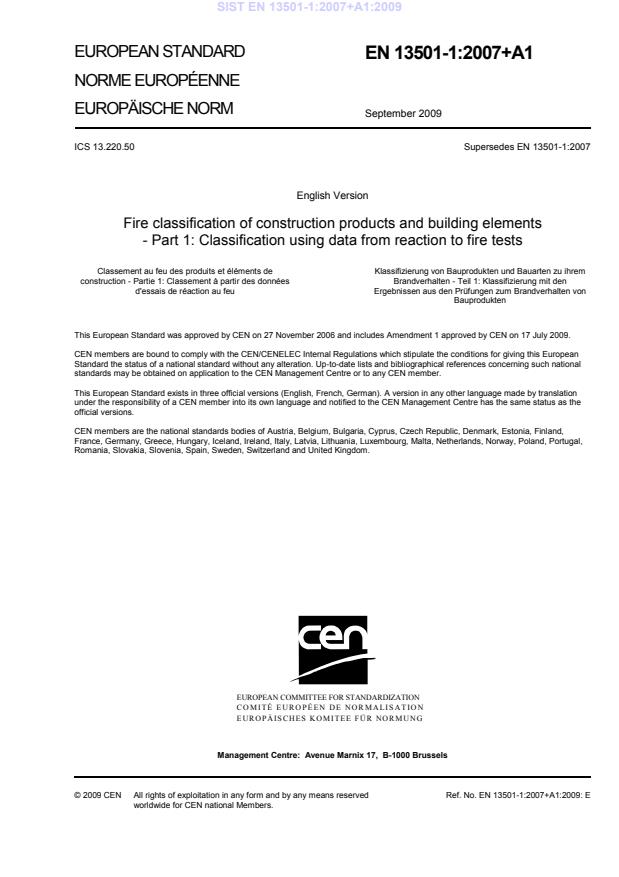
EUROPEAN STANDARD NORME EUROPÉENNE EUROPÄISCHE NORM
EN 13501-1:2007+A1
September 2009 ICS 13.220.50 Supersedes EN 13501-1:2007English Version
Fire classification of construction products and building elements - Part 1: Classification using data from reaction to fire tests
Classement au feu des produits et éléments de construction - Partie 1: Classement à partir des données d'essais de réaction au feu
Klassifizierung von Bauprodukten und Bauarten zu ihrem Brandverhalten - Teil 1: Klassifizierung mit den Ergebnissen aus den Prüfungen zum Brandverhalten von Bauprodukten This European Standard was approved by CEN on 27 November 2006 and includes Amendment 1 approved by CEN on 17 July 2009.
CEN members are bound to comply with the CEN/CENELEC Internal Regulations which stipulate the conditions for giving this European Standard the status of a national standard without any alteration. Up-to-date lists and bibliographical references concerning such national standards may be obtained on application to the CEN Management Centre or to any CEN member.
This European Standard exists in three official versions (English, French, German). A version in any other language made by translation under the responsibility of a CEN member into its own language and notified to the CEN Management Centre has the same status as the official versions.
CEN members are the national standards bodies of Austria, Belgium, Bulgaria, Cyprus, Czech Republic, Denmark, Estonia, Finland, France, Germany, Greece, Hungary, Iceland, Ireland, Italy, Latvia, Lithuania, Luxembourg, Malta, Netherlands, Norway, Poland, Portugal, Romania, Slovakia, Slovenia, Spain, Sweden, Switzerland and United Kingdom.
EUROPEAN COMMITTEE FOR STANDARDIZATION
COMITÉ EUROPÉEN DE NORMALISATION EUROPÄISCHES KOMITEE FÜR NORMUNG
Management Centre:
Avenue Marnix 17,
B-1000 Brussels © 2009 CEN All rights of exploitation in any form and by any means reserved worldwide for CEN national Members. Ref. No. EN 13501-1:2007+A1:2009: ESIST EN 13501-1:2007+A1:2009
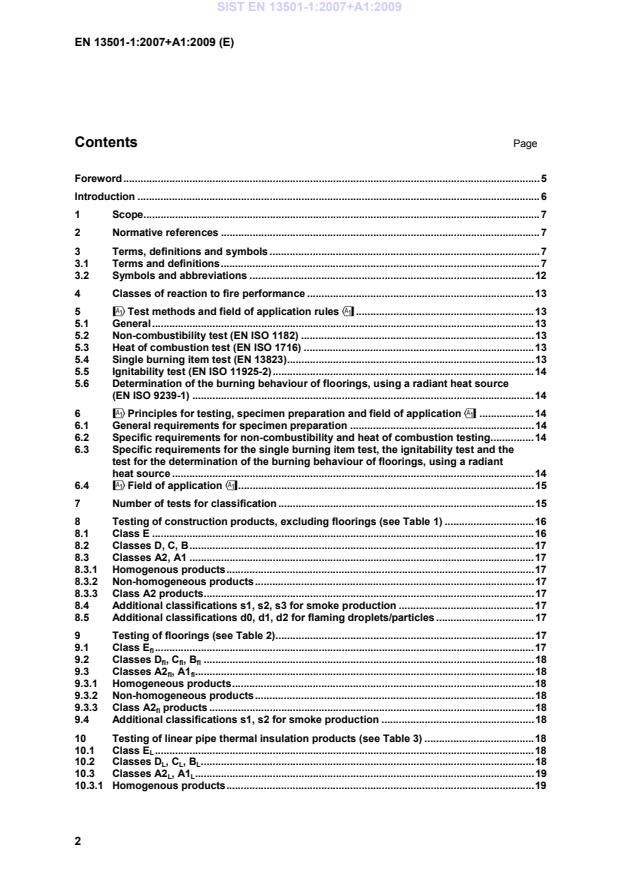
Background information for the application of the Commission Decision of 8 February 2000 implementing Council Directive 89/106/EEC as regards the classification of the reaction to fire performance of construction products . 41A.1General . 41A.2Assumptions . 41A.3Reference fire situations . 42A.4Relationship between classes and reference fire situations . 44Annex B (normative)
Reaction to fire classification report . 48Bibliography . 53 SIST EN 13501-1:2007+A1:2009
If the classification based on the tests and criteria given in Tables 1 and 2 is not appropriate, one or more reference scenarios (representative scale tests typifying agreed hazard scenarios) can be called upon within the context of a defined procedure. This procedure is intended to be the subject of a future European Standard or Commission Decision, on the basis of an agreement between the Commission and the Member States, in consultation with CEN/CENELEC and EOTA. !NOTE 2
Test reports constitute the basis for extended application reports as explained in prEN 15725." SIST EN 13501-1:2007+A1:2009
NOTE It is a product composed of one or more components, substantial and/or non-substantial. 3.1.5 substantial component material that constitutes a significant part of a non-homogeneous product. A layer with a mass/unit area
≥ 1,0 kg/m2 or a thickness ≥ 1,0 mm is considered to be a substantial component 3.1.6 non-substantial component material that does not constitute a significant part of a non-homogeneous product. A layer with a mass/unit area < 1,0 kg/m2 and a thickness < 1,0 mm is considered to be a non-substantial component NOTE Two or more non-substantial layers that are adjacent to each other (i.e. with no substantial component(s) in between the layers) are regarded as one non-substantial component when they collectively comply with the requirements for a layer being a non-substantial component. 3.1.7 internal non-substantial component non-substantial component that is covered on both sides by at least one substantial component 3.1.8 external non-substantial component non-substantial component that is not covered on one side by a substantial component 3.1.9 flooring upper layer(s) of a floor, comprising any surface finish with or without an attached backing and with any accompanying underlay, interlayer and adhesives 3.1.10 linear pipe thermal insulation product length of insulation product designed to fit around pipes, with a maximum outer insulation diameter of
300 mm and not intended for use with cylindrical ducts 3.1.11 substrate product which is used immediately beneath the product about which information is required. NOTE For flooring, it is the floor on which it is mounted or the material which represents this floor. SIST EN 13501-1:2007+A1:2009
NOTE It covers aspects such as its quantity, orientation, position in relation to other adjacent products, and its method of fixing. 3.1.14 fire performance response of an item when exposed to a specific fire (EN ISO 13943) 3.1.15 reaction to fire response of a product in contributing by its own decomposition to a fire to which it is exposed, under specified conditions 3.1.16 fire scenario detailed description of conditions, including environmental, of one or more stages from before ignition to after completion of combustion at a specific location or in a real scale simulation (EN ISO 13943) 3.1.17 reference scenario hazard situation used as a reference for a given test method or classification system 3.1.18 fire situation stage in the development of a fire, characterised by the nature, severity and size of the thermal attack on the products involved 3.1.19 combustion exothermic reaction of a substance with an oxidizer (EN ISO 13943) NOTE Combustion generally emits effluent accompanied by flames and/or visible light. 3.1.20 heat of combustion thermal energy produced by combustion of unit of mass of a given substance (EN ISO 13943) NOTE It is expressed in joules per kilogram. 3.1.21 gross heat of combustion (PCS) heat of combustion of a substance when the combustion is complete and any produced water is entirely condensed under specified conditions (EN ISO 13943) 3.1.22 net heat of combustion (PCI) heat of combustion of a substance when the combustion is complete and any produced water is in the vapour state under specified conditions (EN ISO 13943) NOTE The net heat of combustion may be calculated from the gross heat of combustion. SIST EN 13501-1:2007+A1:2009
NOTE Lateral flame spread is the furthest extent of travel of a sustained flame, as measured in the
EN 13823 test. 3.1.29 sustained flaming existence of flame on or over a surface for a minimum period of time (EN ISO 13943) NOTE The period of time required will vary across different standards, but it is usually of the order of 10 s. 3.1.30 fully developed fire state of total involvement of combustible materials in a fire (EN ISO 13943) 3.1.31 flashover transition to a state of total surface involvement in a fire of combustible materials within an enclosure
(EN ISO 13943) 3.1.32 flaming droplets/particles material separating from the specimen during the fire test and continuing to flame for a minimum period as described by the test method 3.1.33 critical heat flux at extinguishment (CHF) incident heat flux (kW/m2) at the surface of a specimen at the point where the flame ceases to advance and may subsequently go out.
NOTE The heat flux value reported is based on interpolations of measurements with a non-combustible calibration board. SIST EN 13501-1:2007+A1:2009
fire growth rate index used for classification purposes FIGRA0,2MJ fire growth rate index at THR threshold of 0,2 MJ FIGRA0,4MJ fire growth rate index at THR threshold of 0,4 MJ LFS lateral flame spread [m] PCS gross calorific potential [MJ/kg or MJ/m2] PCI net calorific potential [MJ/kg or MJ/m²] SMOGRA
smoke growth rate tf duration of sustained flaming [s] THR600s total heat release within 600 s [MJ] TSP600s total smoke production within 600 s [m²] m’
mean value of the set of results of a continuous parameter determined in accordance with the relevant test method using the minimum number of tests as specified in the test method m
mean value of the set of results of a continuous parameter determined in accordance with the procedure in 7.3 and used for classification SIST EN 13501-1:2007+A1:2009
Table 1. A classification can only be obtained by undertaking !the tests or the extended application process required" for that particular product. A classification obtained for one product type, e.g. floorings, cannot be interpreted or accepted in a different classification system. 5 !Test methods and field of application rules" 5.1 General The following test methods are specified in relation to the envisaged reaction to fire classification. The relevant classification parameters are given in Tables 1, 2 and 3. !Direct and extended application shall be carried out as described in CEN/TS 15117 and in
prEN 15725." 5.2 Non-combustibility test (EN ISO 1182) This test identifies products that will not, or not significantly, contribute to a fire, regardless of their end use. The test is relevant for the classes A1, A2, A1fl, A2fl, A1L and A2L. 5.3 Heat of combustion test (EN ISO 1716) This test determines the potential maximum total heat release of a product when completely burning, regardless of its end use. The test is relevant for the classes A1, A2, A1fl, A2fl, A1L and A2L. It allows the determination of both the gross heat of combustion (PCS) and the net heat of combustion (PCI). 5.4 Single burning item test (EN 13823) This test evaluates the potential contribution of a product to the development of a fire, under a fire situation simulating a single burning item in a room corner near to that product. The test is relevant for the classes A2, A2L, B, BL, C, CL, D and DL. Under the conditions specified in 8.3.2 the test is also relevant for the class A1. SIST EN 13501-1:2007+A1:2009
...
2003-01.Slovenski inštitut za standardizacijo. Razmnoževanje celote ali delov tega standarda ni dovoljeno.Požarna klasifikacija gradbenih proizvodov in elementov stavb - 1. del: Klasifikacija po podatkih iz preskusov odziva na ogenjKlassifizierung von Bauprodukten und Bauarten zu ihrem Brandverhalten - Teil 1: Klassifizierung mit den Ergebnissen aus den Prüfungen zum Brandverhalten von BauproduktenClassement au feu des produits et éléments de construction - Partie 1: Classement à partir des données d’essais de réaction au feuFire classification of construction products and building elements - Part 1: Classification using data from reaction to fire tests13.220.50Požarna odpornost gradbenih materialov in elementovFire-resistance of building materials and elementsICS:Ta slovenski standard je istoveten z:EN 13501-1:2007+A1:2009SIST EN 13501-1:2007+A1:2009en,fr,de01-december-2009SIST EN 13501-1:2007+A1:2009SLOVENSKI
STANDARD
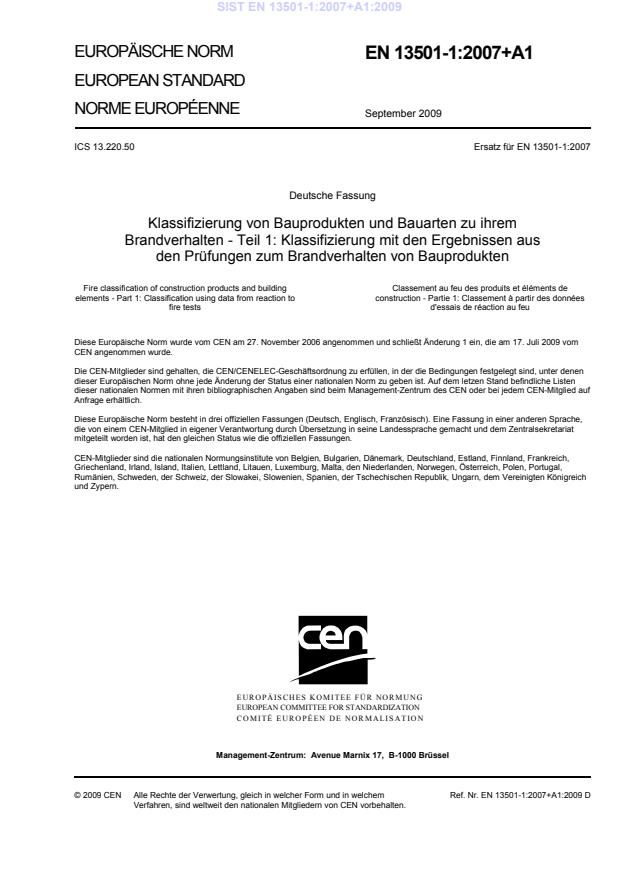
EUROPÄISCHE NORM EUROPEAN STANDARD NORME EUROPÉENNE
EN 13501-1:2007+A1
September 2009 ICS 13.220.50 Ersatz für EN 13501-1:2007Deutsche Fassung
Klassifizierung von Bauprodukten und Bauarten zu ihrem Brandverhalten - Teil 1: Klassifizierung mit den Ergebnissen aus den Prüfungen zum Brandverhalten von Bauprodukten
Fire classification of construction products and building elements - Part 1: Classification using data from reaction to fire tests
Classement au feu des produits et éléments de construction - Partie 1: Classement à partir des données d'essais de réaction au feu Diese Europäische Norm wurde vom CEN am 27. November 2006 angenommen und schließt Änderung 1 ein, die am 17. Juli 2009 vom CEN angenommen wurde.
Die CEN-Mitglieder sind gehalten, die CEN/CENELEC-Geschäftsordnung zu erfüllen, in der die Bedingungen festgelegt sind, unter denen dieser Europäischen Norm ohne jede Änderung der Status einer nationalen Norm zu geben ist. Auf dem letzen Stand befindliche Listen dieser nationalen Normen mit ihren bibliographischen Angaben sind beim Management-Zentrum des CEN oder bei jedem CEN-Mitglied auf Anfrage erhältlich.
Diese Europäische Norm besteht in drei offiziellen Fassungen (Deutsch, Englisch, Französisch). Eine Fassung in einer anderen Sprache, die von einem CEN-Mitglied in eigener Verantwortung durch Übersetzung in seine Landessprache gemacht und dem Zentralsekretariat mitgeteilt worden ist, hat den gleichen Status wie die offiziellen Fassungen.
CEN-Mitglieder sind die nationalen Normungsinstitute von Belgien, Bulgarien, Dänemark, Deutschland, Estland, Finnland, Frankreich, Griechenland, Irland, Island, Italien, Lettland, Litauen, Luxemburg, Malta, den Niederlanden, Norwegen, Österreich, Polen, Portugal, Rumänien, Schweden, der Schweiz, der Slowakei, Slowenien, Spanien, der Tschechischen Republik, Ungarn, dem Vereinigten Königreich und Zypern.
EUROPÄISCHES KOMITEE FÜR NORMUNG EUROPEAN COMMITTEE FOR STANDARDIZATION
COMITÉ EUROPÉEN DE NORMALISATION
Management-Zentrum:
Avenue Marnix 17,
B-1000 Brüssel © 2009 CEN Alle Rechte der Verwertung, gleich in welcher Form und in welchem Verfahren, sind weltweit den nationalen Mitgliedern von CEN vorbehalten.Ref. Nr. EN 13501-1:2007+A1:2009 DSIST EN 13501-1:2007+A1:2009
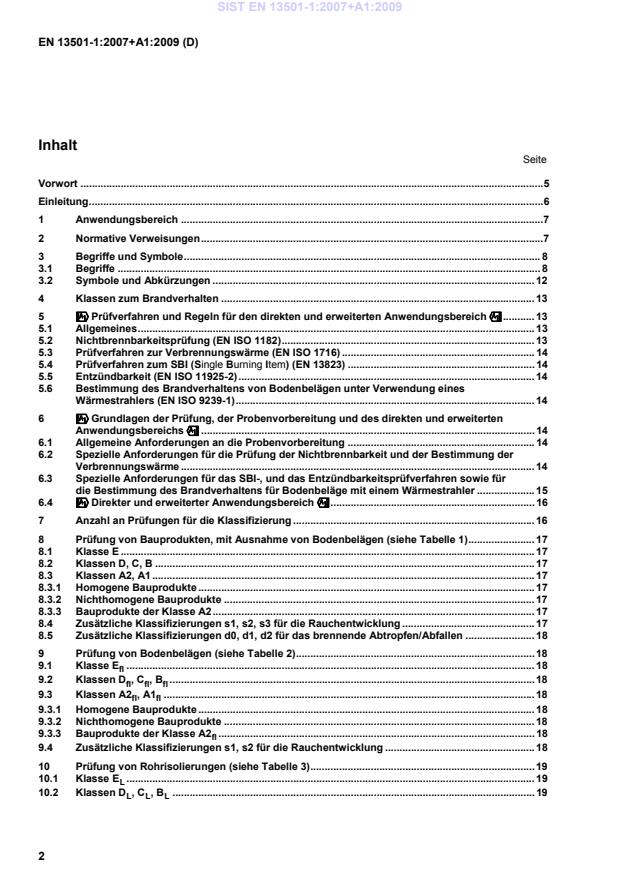
Hintergrundinformationen zur Anwendung der Entscheidung der Kommission vom 8. Februar 2000 zur Durchführung der Richtlinie 89/106/EWG des Rates im Hinblick auf die Klassifizierung des Brandverhaltens von Bauprodukten.41A.1 Allgemeines.41A.2 Annahmen.41A.3 Referenz-Brandsituation.42A.3.1 Referenz-Brandsituation für Bauprodukte einschließlich Rohrisolierungen mit Ausnahme von Bodenbelägen.42A.3.2 Referenz-Brandsituation für Bodenbeläge.43A.4 Beziehung zwischen den Klassen und den Referenz-Brandszenarien.44A.4.1 Allgemeines.44A.4.2 Für alle Bauprodukte mit Ausnahme von Bodenbelägen.44A.4.3 Für Bodenbeläge.45Anhang B (normativ)
Klassifizierungsbericht zum Brandverhalten.48Literaturhinweise.53
4 SIST EN 13501-1:2007+A1:2009
in der Nando-CPD Datenbank der EG Web-Seite aufgeführt (http://europa.eu.int/comm/enterprise/construction). Teile 2, 3 und 4 dieser Europäischen Norm befassen sich mit der Klassifizierung auf Grundlage von Feuer-widerstandsprüfungen. EN 13501-5 deckt die Klassifizierung auf Grundlage von Prüfungen für Dächer bei Beanspruchung durch Flugfeuer von außen ab. !ANMERKUNG 1" Wenn die Klassifizierung auf Grundlage der Prüfungen und Kriterien nach den Tabellen 1 und 2 nicht anwendbar ist, können ein oder mehrere Referenz-Szenarien (repräsentative maßstäbliche Versuche, die vereinbarte Risiko-Szenarien darstellen) im Zusammenhang mit einem definierten Verfahren herangezogen werden. Dieses Verfahren ist beabsichtigt, Gegenstand einer zukünftigen Europäischen Norm oder Entscheidung der Kommission auf Basis einer Vereinbarung zwischen der Kommission und den Mitgliedstaaten nach Rücksprache mit CEN/CENELEC und EOTA zu sein. !ANMERKUNG 2 Die Prüfberichte bilden die Grundlage für die Berichte zum erweiterten Anwendungsbereich, wie in prEN 15725 erläutert." 6 SIST EN 13501-1:2007+A1:2009
FIGRA = FIGRA0,2 MJ Für die Klassen C und D
FIGRA = FIGRA0,4 MJ Für die Klassen A2L, BL, und CL FIGRA = FIGRA0,2 MJ Für die Klassen DL
FIGRA = FIGRA0,4 MJ 3.1.38 FIGRA0,2 MJ Maximum des Quotienten aus der Wärmefreisetzungsrate der Probe und dem zugehörigen Zeitpunkt, wobei ein THR-Schwellenwert von 0,2 MJ benutzt wird ANMERKUNG FIGRA0,2 MJ ist in EN 13823 genauer festgelegt. 11 SIST EN 13501-1:2007+A1:2009
...